Microbial Genetics
Definitions
Genetics
◦ the study of heredity, genes and the mechanisms that they carry this
information
◦ Replication
◦ Expression
Genome
◦ Complete genetic information of the cell
Definitions
Chromosome
◦ The structures that are composed of DNA that carry the hereditary
information
Gene
◦ Segments of the chromosome that code for a specific product (usually a
protein)
Genomics
◦ Sequencing and molecular characterization of genomes
Definitions
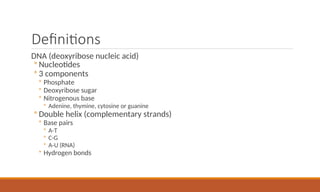
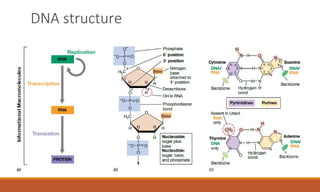
DNA (deoxyribose nucleic acid)
◦ Nucleotides
◦ 3 components
◦ Phosphate
◦ Deoxyribose sugar
◦ Nitrogenous base
◦ Adenine, thymine, cytosine or guanine
◦ Double helix (complementary strands)
◦ Base pairs
◦ A-T
◦ C-G
◦ A-U (RNA)
◦ Hydrogen bonds
DNA structure
DNA
Base sequence codes for protein
4 letter alphabet (A, T, G and C)
Genetic code
◦ Determines how nucleotide sequence is converted into amino acid
sequences
Complementary strand allow precise duplication
DNA to proteins
Gene on DNA
Converted to mRNA
mRNA on ribosome
tRNA brings amino acids to ribosome for protein synthesis
Definitions
Genotype
◦ Genetic information of the organism
◦ Information that codes for characteristics of the organism
Phenotype
◦ The expressed or physical characteristics of the organism
◦ The expression of the genotype
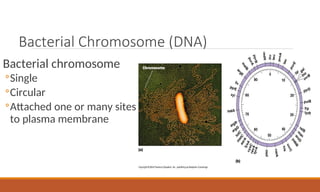
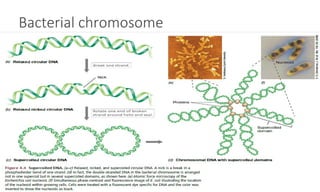
Bacterial Chromosome (DNA)
Bacterial chromosome
◦Single
◦Circular
◦Attached one or many sites
to plasma membrane
Bacterial chromosome
RNA Synthesis
Transcription
◦ Process of taking DNA code and converting to RNA code
Translation
◦ Converting RNA (mRNA) with tRNA to form amino acid sequences and
proteins
◦ Occurs at ribosome
Protein Synthesis
Three types of RNA
◦mRNA - messenger
◦tRNA - transfer
◦rRNA – ribosomal
DNA unzips at gene
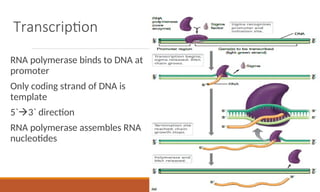
Transcription
RNA polymerase binds to DNA at
promoter
Only coding strand of DNA is
template
5`3` direction
RNA polymerase assembles RNA
nucleotides
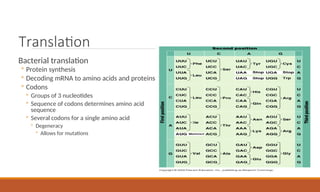
Translation
Bacterial translation
◦ Protein synthesis
◦ Decoding mRNA to amino acids and proteins
◦ Codons
◦ Groups of 3 nucleotides
◦ Sequence of codons determines amino acid
sequence
◦ Several codons for a single amino acid
◦ Degeneracy
◦ Allows for mutations
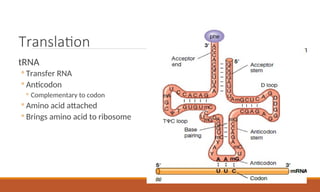
Translation
tRNA
◦ Transfer RNA
◦ Anticodon
◦ Complementary to codon
◦ Amino acid attached
◦ Brings amino acid to ribosome
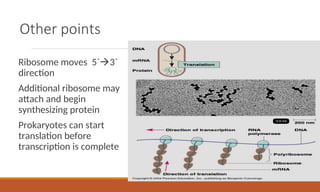
Other points
Ribosome moves 5`3`
direction
Additional ribosome may
attach and begin
synthesizing protein
Prokaryotes can start
translation before
transcription is complete
Genetic Transfer and Recombination
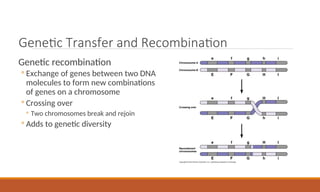
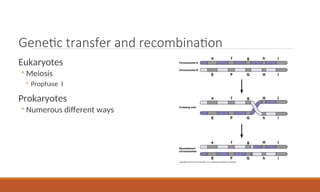
Genetic recombination
◦ Exchange of genes between two DNA
molecules to form new combinations
of genes on a chromosome
◦ Crossing over
◦ Two chromosomes break and rejoin
◦ Adds to genetic diversity
Genetic transfer and recombination
Eukaryotes
◦ Meiosis
◦ Prophase I
Prokaryotes
◦ Numerous different ways
Genetic Transfer and Recombination
Vertical gene transfer
◦Genetic information passed from an organism to its offspring
◦ Plants and animals
Horizontal gene transfer
◦Bacteria transfer genetic information form one organism to
another in the same generation
◦Genetic information passed laterally
Horizontal Gene Transfer
Horizontal gene transfer
◦Donor cell
◦Organism gives up its entire DNA
◦Part goes to recipient cell
◦Part is degraded by cellular enzymes
◦Recipient cell
◦Receives portion of donor cells DNA
◦Incorporates donor DNA into its own DNA
◦ Recombinant DNA
◦ Less than 1 % of population
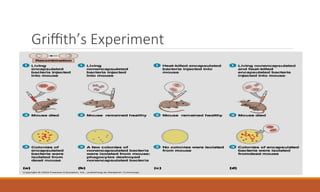
Transformation
Genes transferred from one bacterium to another in solution
◦ Naked DNA
◦ Discovered by Griffith
◦ Used Streptococcus pneumoniae
◦Two strains
◦ Virulent (pathologic) strain
◦ Had a polysaccharide capsule resists phagocytosis
◦ Avirulent (non- pathogenic) strain
◦ Lacked a capsule
Griffith’s Experiment
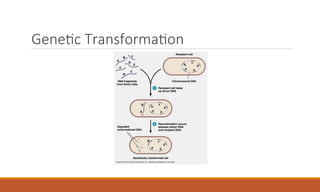
Transformation
Bacteria after cell death and lysis could release DNA into
environment
Recipient cell can take up DNA fragments and incorporate into
their own DNA
◦ Resulting in a hybrid (recombinant cell)
◦ Recombinant cell must be competent
◦ Able to alter cell wall to allow DNA (large molecule) to enter
◦ Bacillus, Haemophilus, Neisseria, Acinetobacter, and some Staph and Strep
Genetic Transformation
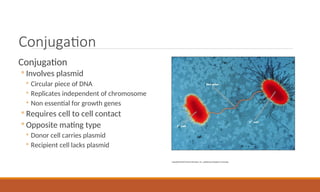
Conjugation
Conjugation
◦ Involves plasmid
◦ Circular piece of DNA
◦ Replicates independent of chromosome
◦ Non essential for growth genes
◦ Requires cell to cell contact
◦ Opposite mating type
◦ Donor cell carries plasmid
◦ Recipient cell lacks plasmid
Conjugation
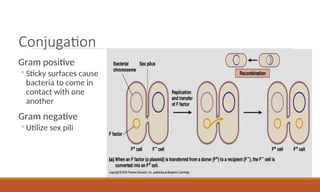
Gram positive
◦ Sticky surfaces cause
bacteria to come in
contact with one
another
Gram negative
◦ Utilize sex pili
Conjugation
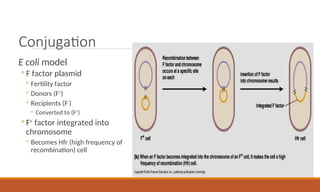
E coli model
◦ F factor plasmid
◦ Fertility factor
◦ Donors (F+
)
◦ Recipients (F-
)
◦ Converted to (F+
)
◦ F+
factor integrated into
chromosome
◦ Becomes Hfr (high frequency of
recombination) cell
Bacterial Conjugation
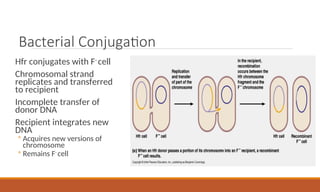
Hfr conjugates with F-
cell
Chromosomal strand
replicates and transferred
to recipient
Incomplete transfer of
donor DNA
Recipient integrates new
DNA
◦ Acquires new versions of
chromosome
◦ Remains F-
cell
Transduction in Bacteria
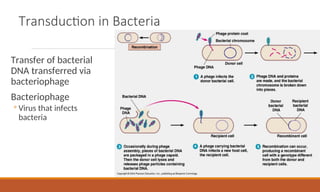
Transfer of bacterial
DNA transferred via
bacteriophage
Bacteriophage
◦ Virus that infects
bacteria
Transduction
Specialized transduction
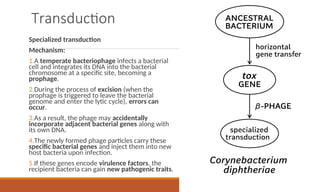
Mechanism:
1.A temperate bacteriophage infects a bacterial
cell and integrates its DNA into the bacterial
chromosome at a specific site, becoming a
prophage.
2.During the process of excision (when the
prophage is triggered to leave the bacterial
genome and enter the lytic cycle), errors can
occur.
3.As a result, the phage may accidentally
incorporate adjacent bacterial genes along with
its own DNA.
4.The newly formed phage particles carry these
specific bacterial genes and inject them into new
host bacteria upon infection.
5.If these genes encode virulence factors, the
recipient bacteria can gain new pathogenic traits.
Transduction
Specialized transduction
1.Corynebacterium diphtheriae
1. Transferred gene: Diphtheria toxin gene
2. Effect: Causes diphtheria—a serious disease that damages the throat and respiratory tract.
3. Note: Non-lysogenized strains of C. diphtheriae (without the prophage) are non-toxigenic and harmless.
2.Streptococcus pyogenes
1. Transferred gene: Erythrogenic toxin gene
2. Effect: Causes the characteristic red rash in scarlet fever.
3. Note: The presence of the prophage enhances the virulence of the bacterium.
3.Escherichia coli (especially EHEC strains like O157:H7)
1. Transferred gene: Shiga toxin gene
2. Effect: Causes hemorrhagic colitis and potentially fatal hemolytic uremic syndrome (HUS).
3. Note: This toxin is encoded by a lysogenic phage, and without the phage, the bacterium is significantly less
dangerous.
Plasmids
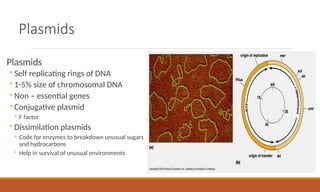
Plasmids
◦ Self replicating rings of DNA
◦ 1-5% size of chromosomal DNA
◦ Non – essential genes
◦ Conjugative plasmid
◦ F factor
◦ Dissimilation plasmids
◦ Code for enzymes to breakdown unusual sugars
and hydrocarbons
◦ Help in survival of unusual environments
Plasmids
Other plasmids
◦ Toxins (Anthrax, tetanus, Staph)
◦ Bacterial attachment
◦ Bacteriocins
◦ Toxic proteins that kill other bacteria
◦ Resistance factors (R factors)
◦ Resistance to antibiotics, heavy metals, cellular toxins
Plasmids
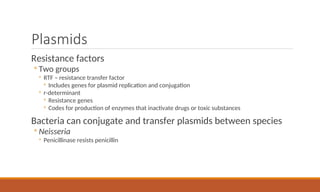
Resistance factors
◦ Two groups
◦ RTF – resistance transfer factor
◦ Includes genes for plasmid replication and conjugation
◦ r-determinant
◦ Resistance genes
◦ Codes for production of enzymes that inactivate drugs or toxic substances
Bacteria can conjugate and transfer plasmids between species
◦ Neisseria
◦ Penicillinase resists penicillin

L7. Microbial Genetics_intro_to_dentist.ppt

  • 1.
  • 2.
    Definitions Genetics ◦ the studyof heredity, genes and the mechanisms that they carry this information ◦ Replication ◦ Expression Genome ◦ Complete genetic information of the cell
  • 3.
    Definitions Chromosome ◦ The structuresthat are composed of DNA that carry the hereditary information Gene ◦ Segments of the chromosome that code for a specific product (usually a protein) Genomics ◦ Sequencing and molecular characterization of genomes
  • 4.
    Definitions DNA (deoxyribose nucleicacid) ◦ Nucleotides ◦ 3 components ◦ Phosphate ◦ Deoxyribose sugar ◦ Nitrogenous base ◦ Adenine, thymine, cytosine or guanine ◦ Double helix (complementary strands) ◦ Base pairs ◦ A-T ◦ C-G ◦ A-U (RNA) ◦ Hydrogen bonds
  • 5.
  • 6.
    DNA Base sequence codesfor protein 4 letter alphabet (A, T, G and C) Genetic code ◦ Determines how nucleotide sequence is converted into amino acid sequences Complementary strand allow precise duplication
  • 7.
    DNA to proteins Geneon DNA Converted to mRNA mRNA on ribosome tRNA brings amino acids to ribosome for protein synthesis
  • 8.
    Definitions Genotype ◦ Genetic informationof the organism ◦ Information that codes for characteristics of the organism Phenotype ◦ The expressed or physical characteristics of the organism ◦ The expression of the genotype
  • 9.
    Bacterial Chromosome (DNA) Bacterialchromosome ◦Single ◦Circular ◦Attached one or many sites to plasma membrane
  • 10.
  • 11.
    RNA Synthesis Transcription ◦ Processof taking DNA code and converting to RNA code Translation ◦ Converting RNA (mRNA) with tRNA to form amino acid sequences and proteins ◦ Occurs at ribosome
  • 12.
    Protein Synthesis Three typesof RNA ◦mRNA - messenger ◦tRNA - transfer ◦rRNA – ribosomal DNA unzips at gene
  • 13.
    Transcription RNA polymerase bindsto DNA at promoter Only coding strand of DNA is template 5`3` direction RNA polymerase assembles RNA nucleotides
  • 14.
    Translation Bacterial translation ◦ Proteinsynthesis ◦ Decoding mRNA to amino acids and proteins ◦ Codons ◦ Groups of 3 nucleotides ◦ Sequence of codons determines amino acid sequence ◦ Several codons for a single amino acid ◦ Degeneracy ◦ Allows for mutations
  • 15.
    Translation tRNA ◦ Transfer RNA ◦Anticodon ◦ Complementary to codon ◦ Amino acid attached ◦ Brings amino acid to ribosome
  • 16.
    Other points Ribosome moves5`3` direction Additional ribosome may attach and begin synthesizing protein Prokaryotes can start translation before transcription is complete
  • 17.
    Genetic Transfer andRecombination Genetic recombination ◦ Exchange of genes between two DNA molecules to form new combinations of genes on a chromosome ◦ Crossing over ◦ Two chromosomes break and rejoin ◦ Adds to genetic diversity
  • 18.
    Genetic transfer andrecombination Eukaryotes ◦ Meiosis ◦ Prophase I Prokaryotes ◦ Numerous different ways
  • 19.
    Genetic Transfer andRecombination Vertical gene transfer ◦Genetic information passed from an organism to its offspring ◦ Plants and animals Horizontal gene transfer ◦Bacteria transfer genetic information form one organism to another in the same generation ◦Genetic information passed laterally
  • 20.
    Horizontal Gene Transfer Horizontalgene transfer ◦Donor cell ◦Organism gives up its entire DNA ◦Part goes to recipient cell ◦Part is degraded by cellular enzymes ◦Recipient cell ◦Receives portion of donor cells DNA ◦Incorporates donor DNA into its own DNA ◦ Recombinant DNA ◦ Less than 1 % of population
  • 21.
    Transformation Genes transferred fromone bacterium to another in solution ◦ Naked DNA ◦ Discovered by Griffith ◦ Used Streptococcus pneumoniae ◦Two strains ◦ Virulent (pathologic) strain ◦ Had a polysaccharide capsule resists phagocytosis ◦ Avirulent (non- pathogenic) strain ◦ Lacked a capsule
  • 22.
  • 23.
    Transformation Bacteria after celldeath and lysis could release DNA into environment Recipient cell can take up DNA fragments and incorporate into their own DNA ◦ Resulting in a hybrid (recombinant cell) ◦ Recombinant cell must be competent ◦ Able to alter cell wall to allow DNA (large molecule) to enter ◦ Bacillus, Haemophilus, Neisseria, Acinetobacter, and some Staph and Strep
  • 24.
  • 25.
    Conjugation Conjugation ◦ Involves plasmid ◦Circular piece of DNA ◦ Replicates independent of chromosome ◦ Non essential for growth genes ◦ Requires cell to cell contact ◦ Opposite mating type ◦ Donor cell carries plasmid ◦ Recipient cell lacks plasmid
  • 26.
    Conjugation Gram positive ◦ Stickysurfaces cause bacteria to come in contact with one another Gram negative ◦ Utilize sex pili
  • 27.
    Conjugation E coli model ◦F factor plasmid ◦ Fertility factor ◦ Donors (F+ ) ◦ Recipients (F- ) ◦ Converted to (F+ ) ◦ F+ factor integrated into chromosome ◦ Becomes Hfr (high frequency of recombination) cell
  • 28.
    Bacterial Conjugation Hfr conjugateswith F- cell Chromosomal strand replicates and transferred to recipient Incomplete transfer of donor DNA Recipient integrates new DNA ◦ Acquires new versions of chromosome ◦ Remains F- cell
  • 29.
    Transduction in Bacteria Transferof bacterial DNA transferred via bacteriophage Bacteriophage ◦ Virus that infects bacteria
  • 30.
    Transduction Specialized transduction Mechanism: 1.A temperatebacteriophage infects a bacterial cell and integrates its DNA into the bacterial chromosome at a specific site, becoming a prophage. 2.During the process of excision (when the prophage is triggered to leave the bacterial genome and enter the lytic cycle), errors can occur. 3.As a result, the phage may accidentally incorporate adjacent bacterial genes along with its own DNA. 4.The newly formed phage particles carry these specific bacterial genes and inject them into new host bacteria upon infection. 5.If these genes encode virulence factors, the recipient bacteria can gain new pathogenic traits.
  • 31.
    Transduction Specialized transduction 1.Corynebacterium diphtheriae 1.Transferred gene: Diphtheria toxin gene 2. Effect: Causes diphtheria—a serious disease that damages the throat and respiratory tract. 3. Note: Non-lysogenized strains of C. diphtheriae (without the prophage) are non-toxigenic and harmless. 2.Streptococcus pyogenes 1. Transferred gene: Erythrogenic toxin gene 2. Effect: Causes the characteristic red rash in scarlet fever. 3. Note: The presence of the prophage enhances the virulence of the bacterium. 3.Escherichia coli (especially EHEC strains like O157:H7) 1. Transferred gene: Shiga toxin gene 2. Effect: Causes hemorrhagic colitis and potentially fatal hemolytic uremic syndrome (HUS). 3. Note: This toxin is encoded by a lysogenic phage, and without the phage, the bacterium is significantly less dangerous.
  • 32.
    Plasmids Plasmids ◦ Self replicatingrings of DNA ◦ 1-5% size of chromosomal DNA ◦ Non – essential genes ◦ Conjugative plasmid ◦ F factor ◦ Dissimilation plasmids ◦ Code for enzymes to breakdown unusual sugars and hydrocarbons ◦ Help in survival of unusual environments
  • 33.
    Plasmids Other plasmids ◦ Toxins(Anthrax, tetanus, Staph) ◦ Bacterial attachment ◦ Bacteriocins ◦ Toxic proteins that kill other bacteria ◦ Resistance factors (R factors) ◦ Resistance to antibiotics, heavy metals, cellular toxins
  • 34.
    Plasmids Resistance factors ◦ Twogroups ◦ RTF – resistance transfer factor ◦ Includes genes for plasmid replication and conjugation ◦ r-determinant ◦ Resistance genes ◦ Codes for production of enzymes that inactivate drugs or toxic substances Bacteria can conjugate and transfer plasmids between species ◦ Neisseria ◦ Penicillinase resists penicillin