Course Study material:
Unit IV
Lecture slide handouts:
Genetic Recombination
Course: CBZ
# Cell and Molecular Biology #
Raghvendra Dubey
Assistant Professor,
JNU, Jaipur
BSc. V-SEMESTER
REPRODUCTION IN BACTERIA: Bacteria reproduce
mainly by asexual reproduction and genetic
recombination
 Asexual reproduction involves the formation of identical
individuals from single parent.
 Sexual reproduction is by genetic recombination without the
formation of sex organs.
 Asexual reproduction: Bacteria reproduce asexually by binary
fission and endospores.
 Besides binary fission and endospore formation bacteria also
reproduces rarely by cysts, mesospores, conidiospores and
budding.
 Binary Fission – It is the simplest and most common method of
multiplication in bacteria. In favorable conditions bacteria
reproduces asexually by binary fission.
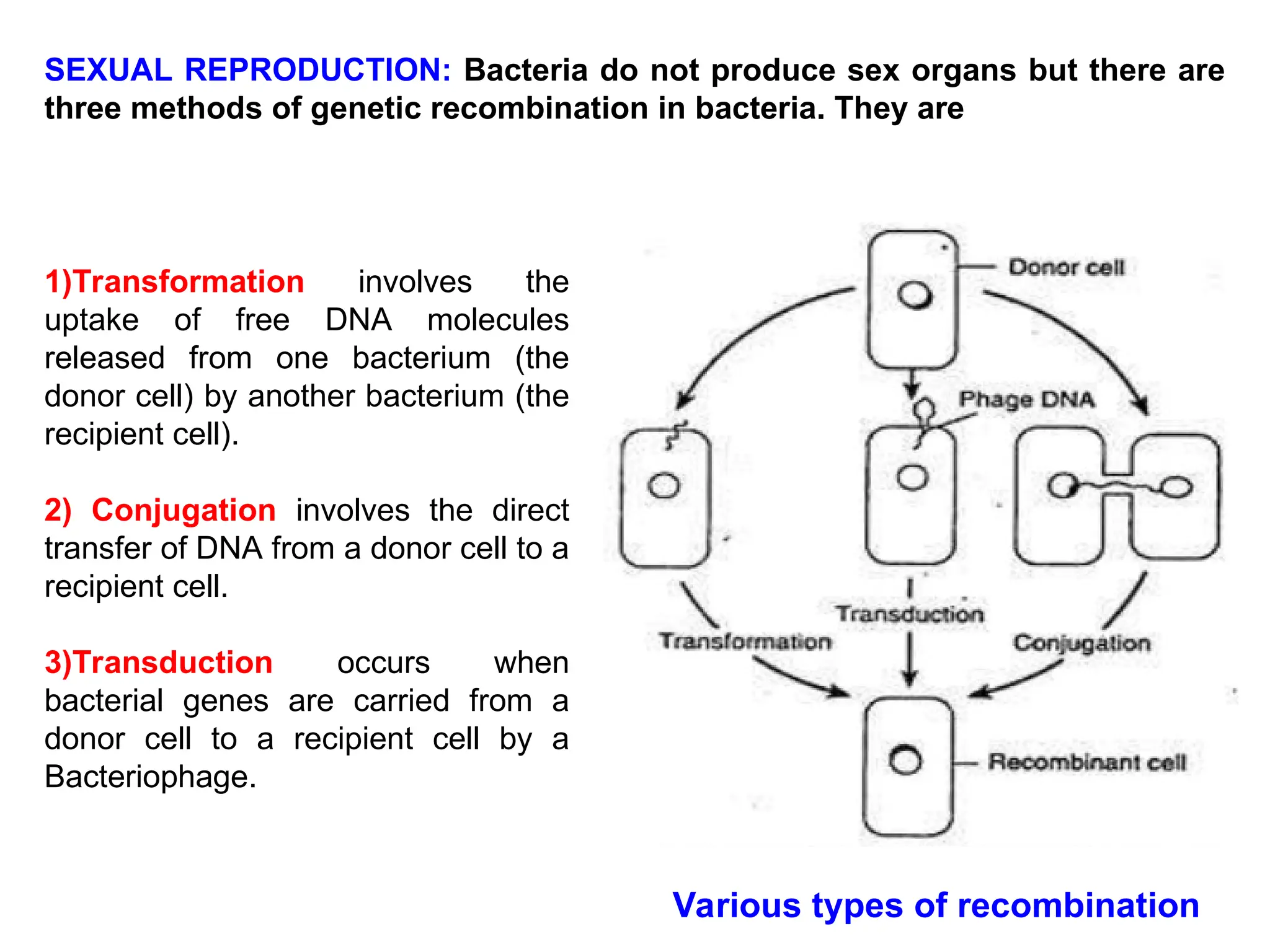
SEXUAL REPRODUCTION: Bacteria do not produce sex organs but there are
three methods of genetic recombination in bacteria. They are
Various types of recombination
1)Transformation involves the
uptake of free DNA molecules
released from one bacterium (the
donor cell) by another bacterium (the
recipient cell).
2) Conjugation involves the direct
transfer of DNA from a donor cell to a
recipient cell.
3)Transduction occurs when
bacterial genes are carried from a
donor cell to a recipient cell by a
Bacteriophage.
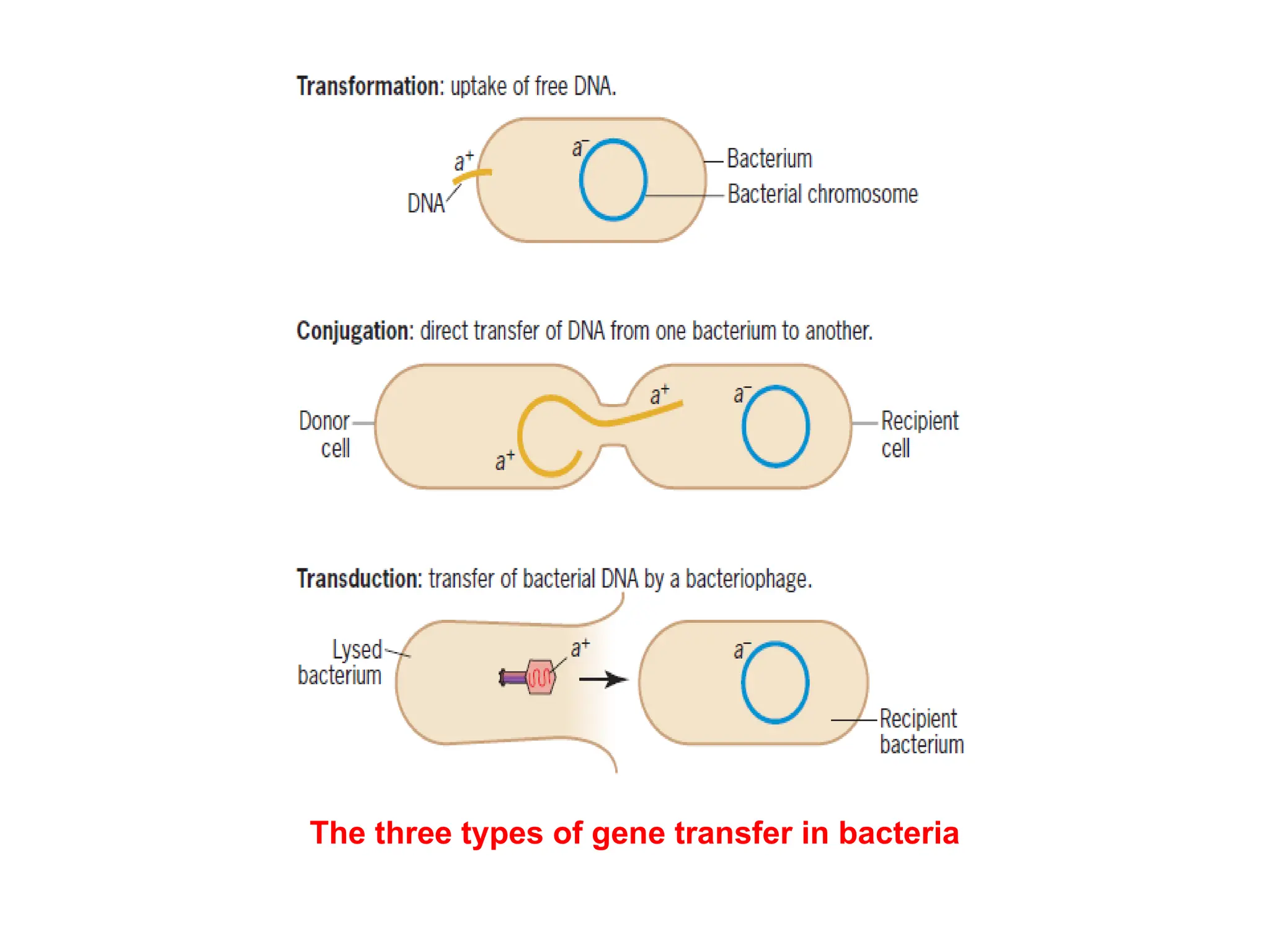
The three types of gene transfer in bacteria
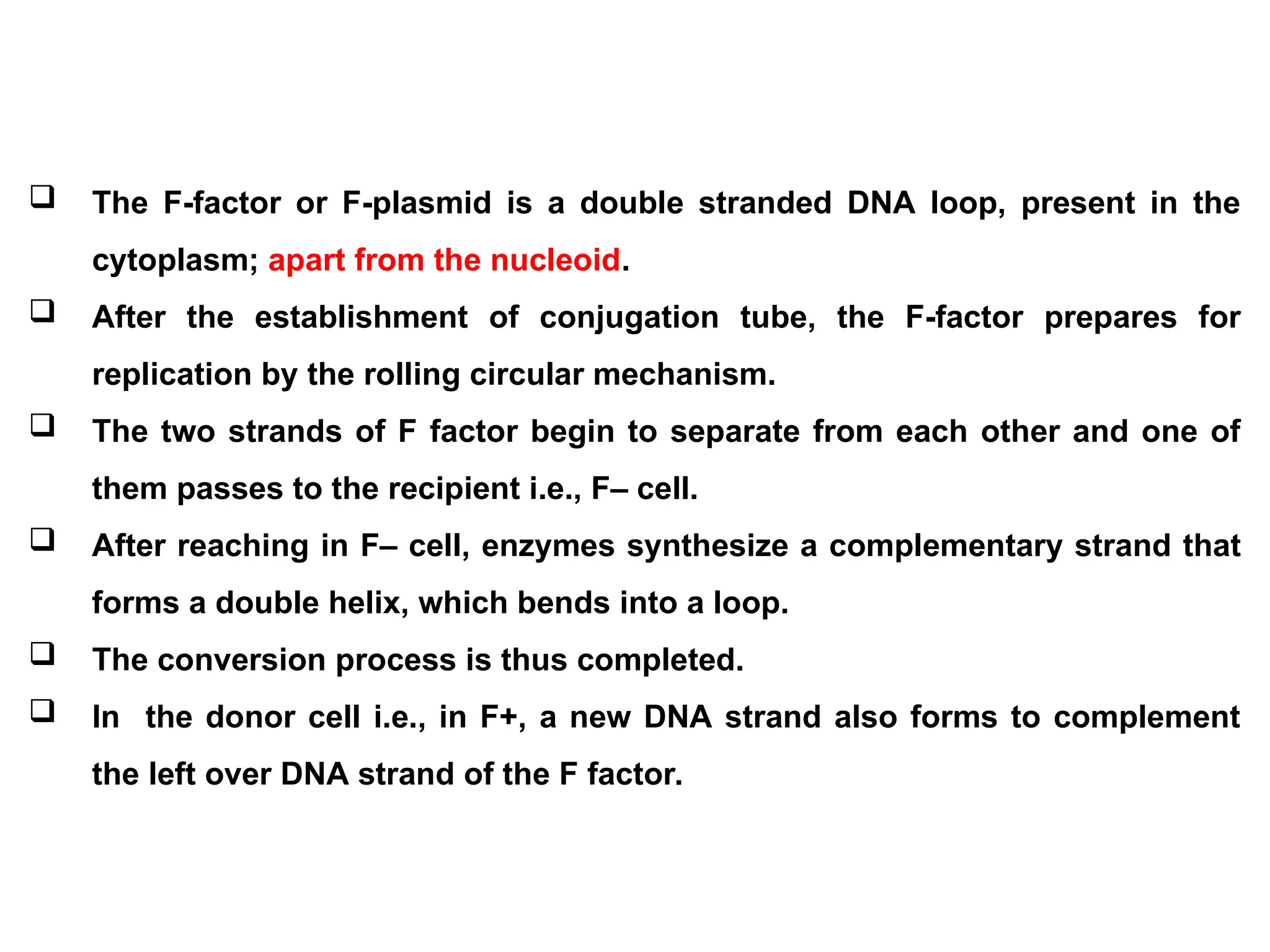
Conjugation: The initial evidence for bacterial conjugation, the transfer of genetic
information by direct cell to cell contact, came from an elegant experiment performed
by Joshua Lederberg and Edward L. Tatum in 1946. It was discovered in Escherichia
coli (E. coli).
The process was first postulated by Joshua Lederberg and Edward Tatum (1946) in
Escherichia coli.
They were awarded the Nobel Prize in 1958 for their work on bacterial genetics.
The bacteria cells that contain F (Fertility Factor) plasmid, F+
acts as donor cells or
male cells whereas the cells lacking F plasmid act as recipients (F-
) the F plasmid
encodes for sex pili and it is also named as fertility factor.
In the process of conjugation:
 Two cells of opposites strains F+
and F-
temporarily attach with each other
with the help of sex pilus.
 Conjugation tube is formed between them due to dissolution of the wall
layer.
There are two mating types of bacteria, one is. male type or F+ or donor cell,
which donates some DNA.
The other one is female type or F– or recipient cell, which receives DNA.
Later, after receiving DNA, the recipient cell may behave as donor cell i.e., F+
type.
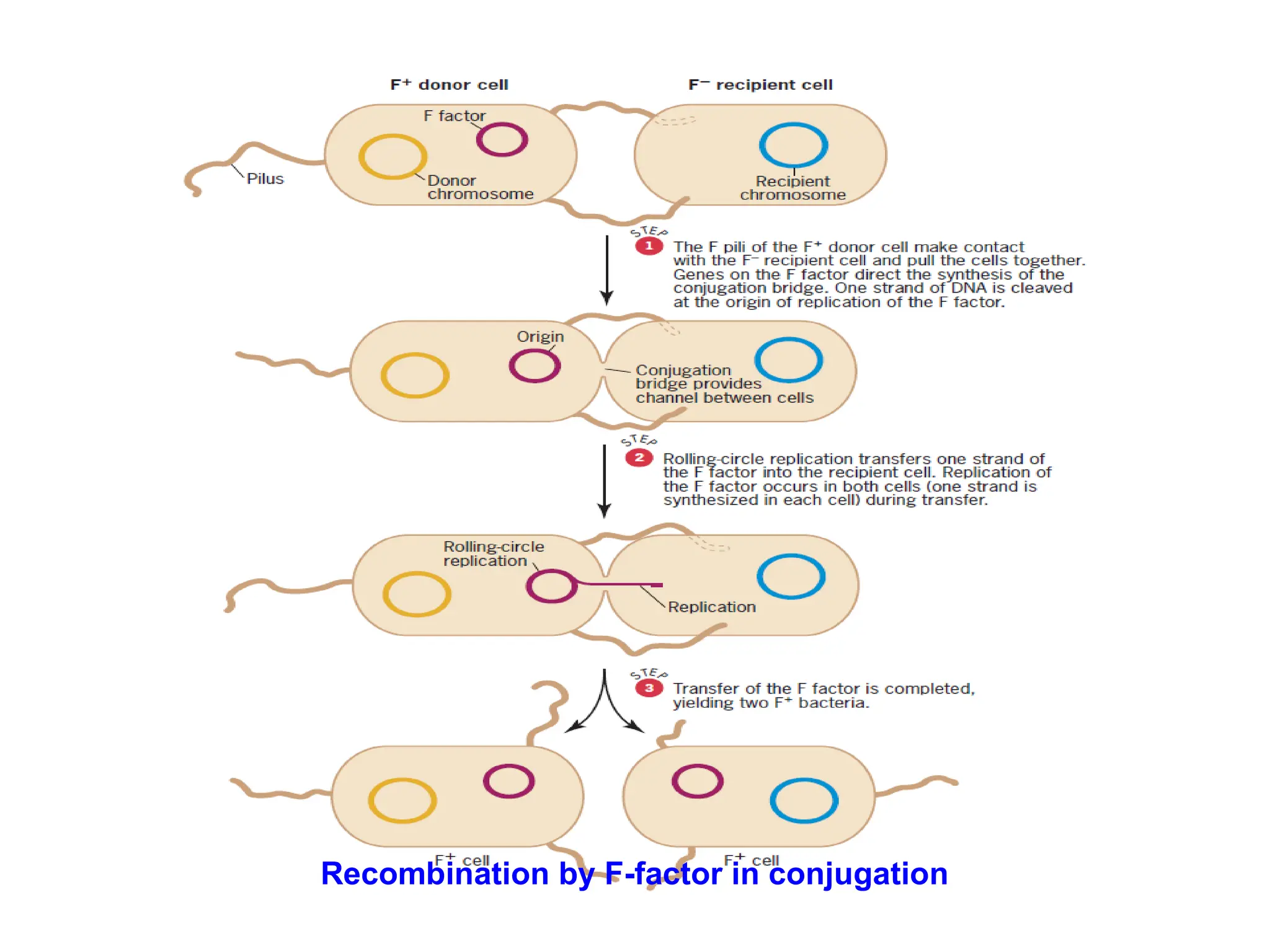
The F-factor is the fertility factor, sex-factor or F-plasmid present in the cell
of F+ i.e., donor cell or male type.
 The F-factor or F-plasmid is a double stranded DNA loop, present in the
cytoplasm; apart from the nucleoid.
 After the establishment of conjugation tube, the F-factor prepares for
replication by the rolling circular mechanism.
 The two strands of F factor begin to separate from each other and one of
them passes to the recipient i.e., F– cell.
 After reaching in F– cell, enzymes synthesize a complementary strand that
forms a double helix, which bends into a loop.
 The conversion process is thus completed.
 In the donor cell i.e., in F+, a new DNA strand also forms to complement
the left over DNA strand of the F factor.
Recombination by F-factor in conjugation
 There is another type of conjugation where passage of nucleoid
DNA takes place through conjugation tube, it was discovered in
strains of E. coli by William Hayes in 1950s. This strains of bacteria
are known as High frequency of recombination (Hfr) strain “the Hfr
factor is also called episome”.
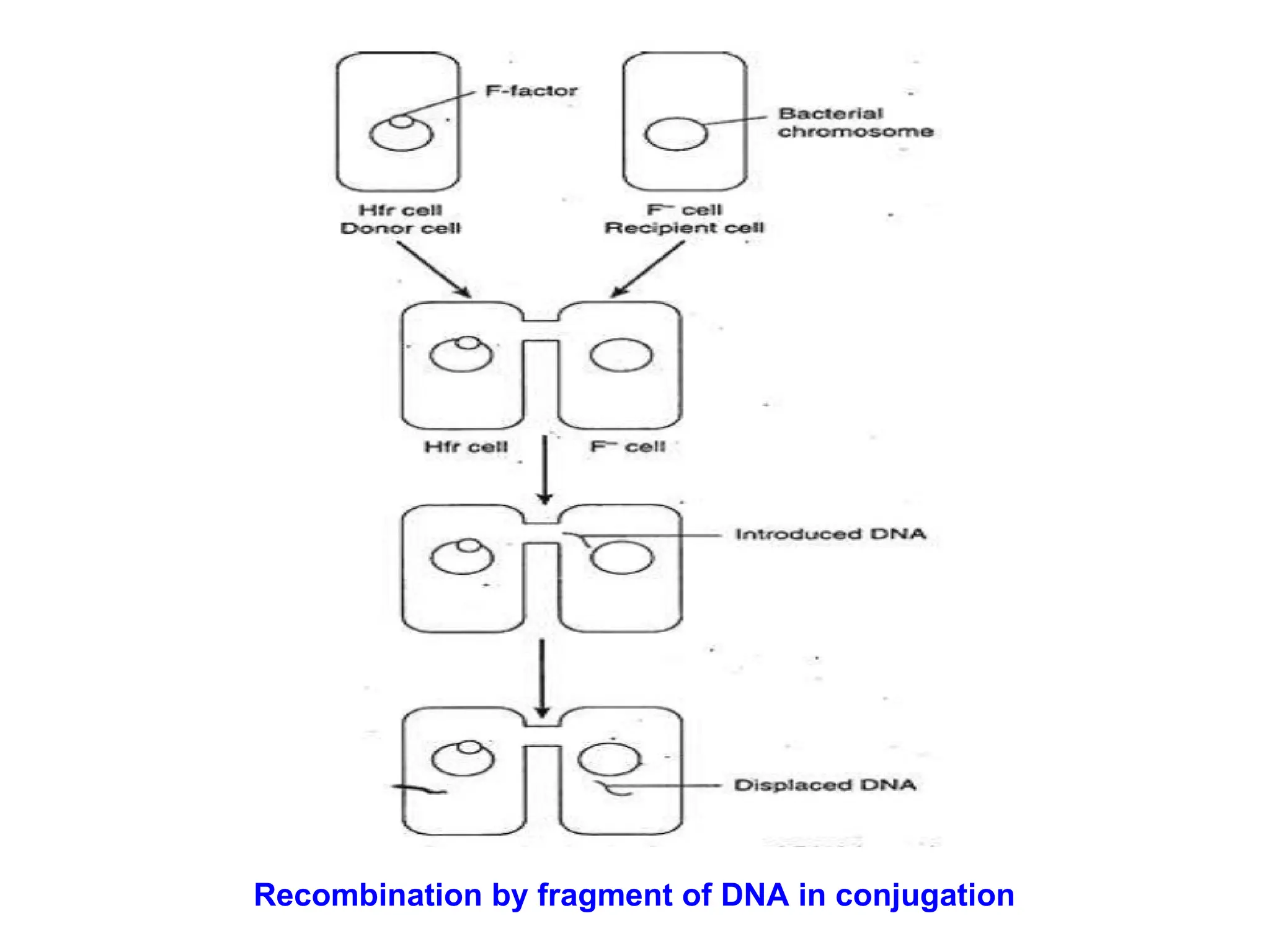
 In Hfr strain, the F factor is attached with the nucleoid DNA i.e., the
bacterial chromosome.
 In Hfr strains the F factor integrates into bacterial chromosome and
replicates as part of it.
 In this process, Hfr and F– cells become attached with each other
by sex pilus.
 At the point of attachment of F-factor, the bacterial chromosome
opens and a copy of one strand is formed by the rolling circular
mechanism.
A portion of single stranded DNA then passes into the recipient cell
through pilus.
Due to agitation in medium, the conjugation tube may not survive for
long time because of broken pilus.
Thereby, the total length of transfer DNA may not be able to take
entry to the recipient cell.
The behaviour of the transferred DNA depends on the presence and
absence of F-factor:
If F- factor is indeed transferred, then it usually remains detached
from the chromosome of recipient cell and enzymes synthesizes a
complementary DNA strand.
The factor then forms a loop and exists as a plasmid, thereby the
recipient cell becomes a donor cell.
 If F-factor remains at the rear end of the transfer DNA during its
entry to the recipient cell, the F-factor may not be able to take entry
due to broken pilus and only a portion with new genes takes up the
entry.Thus, the F– strain remains as recipient one.
 In F– strain, genetic recombination takes place between donor
fragment and recipient DNA.
 Sometimes, if the F-factor gets free from the Hfr cell and maintains
an independent status, then the Hfr cell converts to a F+ cell.
 When Hfr cells come in contact with F- cells conjugation takes
place.
 The chromosomal DNA is transferred to the recipient with high
frequency but the transfer of F factor is very low.
Thus, F–
cells rarely convert to F+
or Hfr cells and the conversion of F+
cell
in to Hfr cell is reversible.
F+↔Hfr
 When F factor reverts from integrated to free state it sometimes carry
with it some chromosomal DNA adjacent to it.
 Such F factor is named as FI
factor (Fertility inhibition) and when it
conjugates with F−
, it transfers along with the F factor and this process is
called ‘Sexduction’.
F I
X F −
Sexduction
 In this process, the recipient cell receives a portion of chromosomal DNA
which duplicates with the existing one for a specific function, thereby the
recipient cell is a partial diploid.
Recombination by fragment of DNA in conjugation
Transformation:
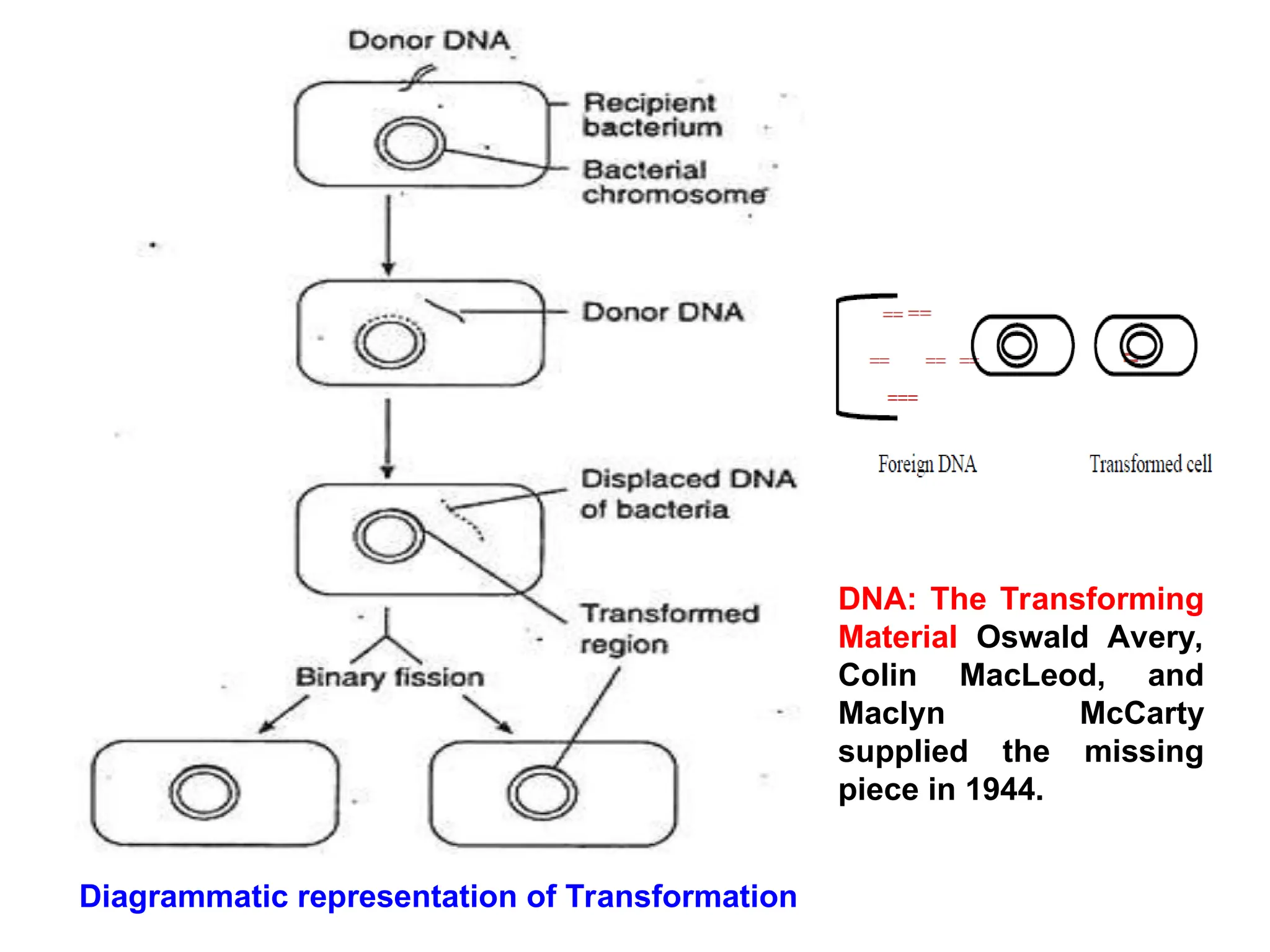
The second way in which DNA can move between bacteria is through transformation,
discovered by Fred Griffith in 1928. Transformation is the uptake by a cell of a naked
DNA molecule or fragment from the medium and the incorporation of this molecule into
the recipient chromosome in a heritable form. In natural transformation the DNA comes
from a donor bacterium. The process is random, and any portion of a genome may be
transferred between bacteria.
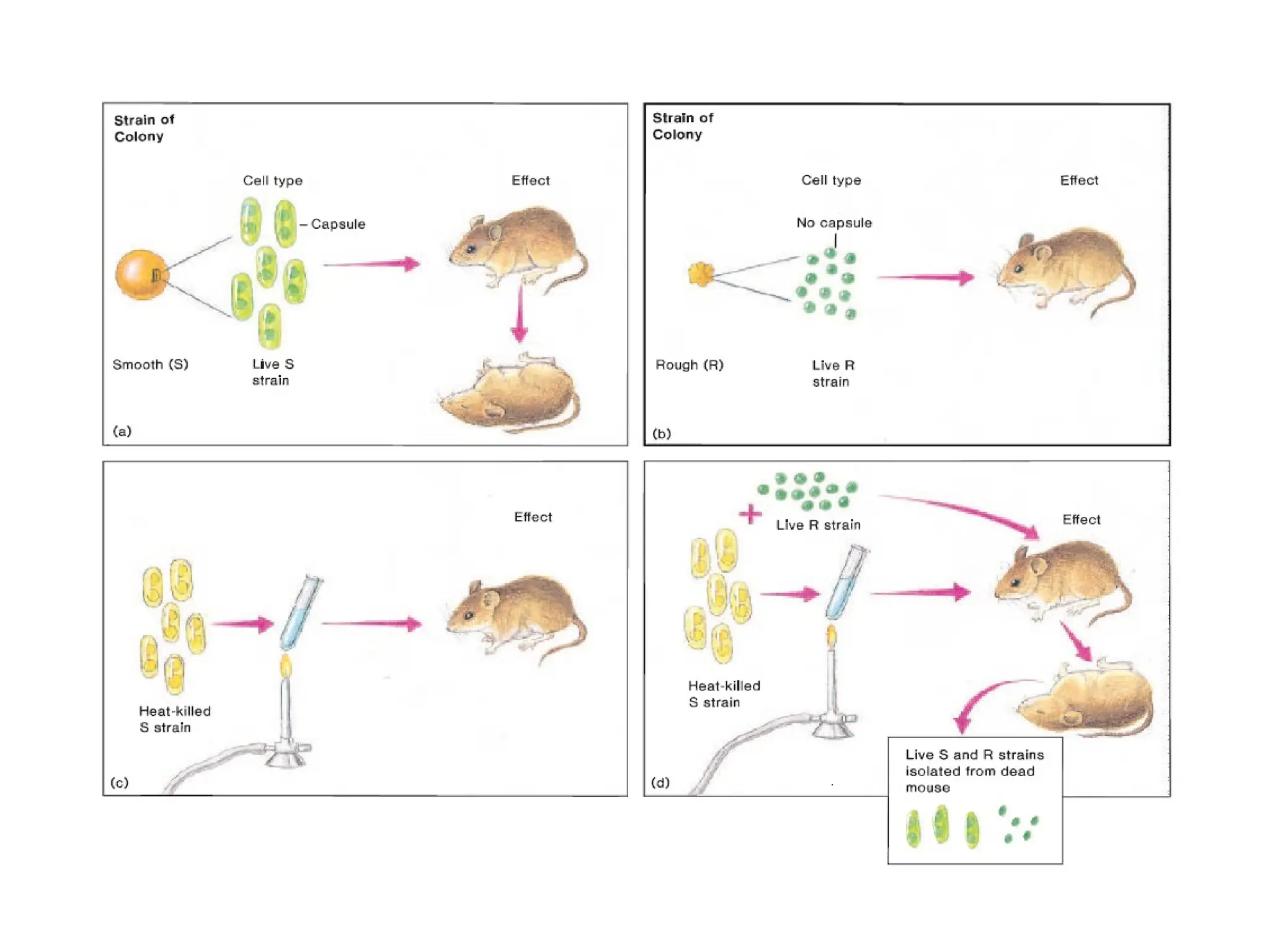
 It was first observed by Griffith (1928) in Streptococcus pneumoniae. In this there are
two stains one with capsule called smooth strain(S) and the other without capsule called
rough strain(R).
 The smooth strain is virulent and the rough strain is non- virulent.
 When the heat killed virulent strains are injected in to mice they failed to cause
disease but when a mixture of heat killed smooth and live rough strains are injected in to
mice they caused the death of the mice
 The dead mice showed the presence of capsulated smooth, virulent strains.
 It shows that non capsulated cells are changed to capsulated virulent strains due to
the transfer of genetic material from head killed smooth virulent strains to rough strains.
This process is called ‘transformation’.
 Griffith's work with Pneumococci was among the first demonstrating that
bacteria could undergo genetic changes.
 Scientists now recognize that when bacteria undergo lysis, they release
considerable amounts of DNA into the environment.
 This DNA may be picked up by a competent cell, that is, one capable of taking
up the DNA and undergoing a transformation.
 To be competent, bacteria must be in the logarithmic stage of growth, and a
competence factor needed for the transformation must be present
 During transformation, a competent cell takes up DNA and destroys one strand
of the double helix.
 A single-stranded fragment then replaces a similar but not identical fragment in
the recipient organism, and the transformation is complete.
 Transformation has been studied in detail in Streptococcus pneumoniae and
Haemophilus influenzae.
 It can be encouraged in the laboratory by treating cells with heat and calcium
chloride, a process that increases the permeability of the cell membrane to DNA.
Diagrammatic representation of Transformation
DNA: The Transforming
Material Oswald Avery,
Colin MacLeod, and
Maclyn McCarty
supplied the missing
piece in 1944.
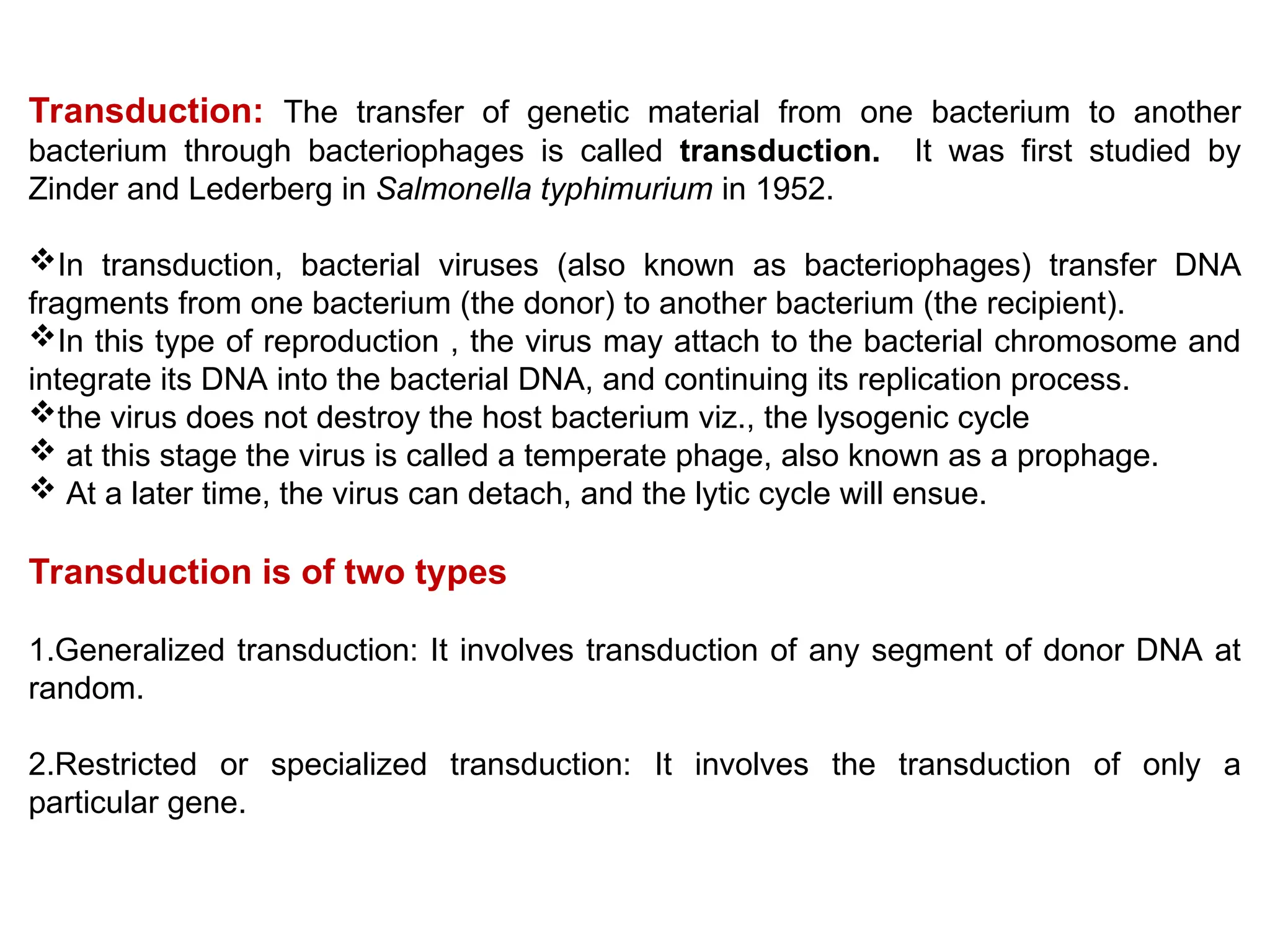
Transduction: The transfer of genetic material from one bacterium to another
bacterium through bacteriophages is called transduction. It was first studied by
Zinder and Lederberg in Salmonella typhimurium in 1952.
In transduction, bacterial viruses (also known as bacteriophages) transfer DNA
fragments from one bacterium (the donor) to another bacterium (the recipient).
In this type of reproduction , the virus may attach to the bacterial chromosome and
integrate its DNA into the bacterial DNA, and continuing its replication process.
the virus does not destroy the host bacterium viz., the lysogenic cycle
 at this stage the virus is called a temperate phage, also known as a prophage.
 At a later time, the virus can detach, and the lytic cycle will ensue.
Transduction is of two types
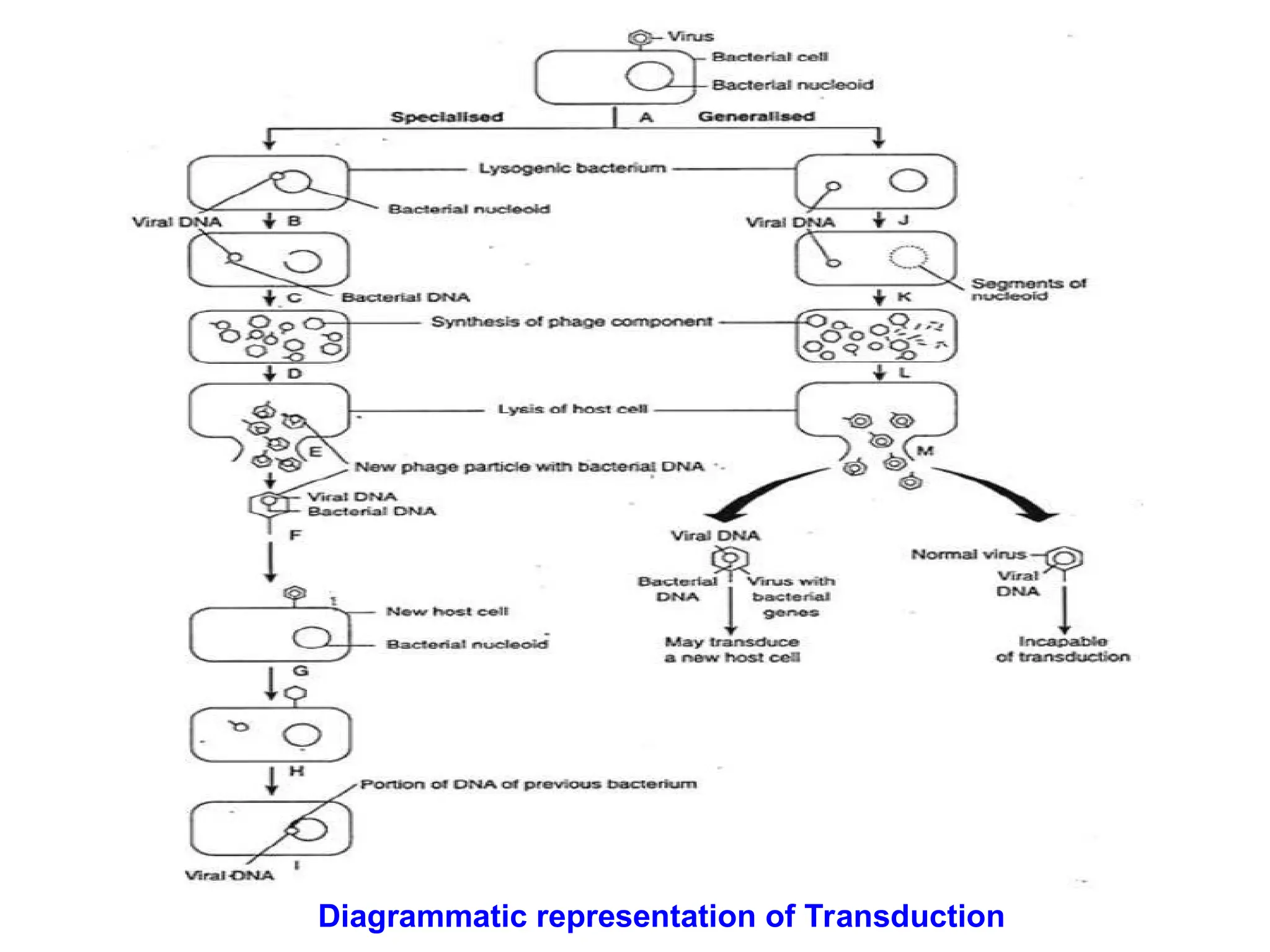
1.Generalized transduction: It involves transduction of any segment of donor DNA at
random.
2.Restricted or specialized transduction: It involves the transduction of only a
particular gene.
Diagrammatic representation of Transduction
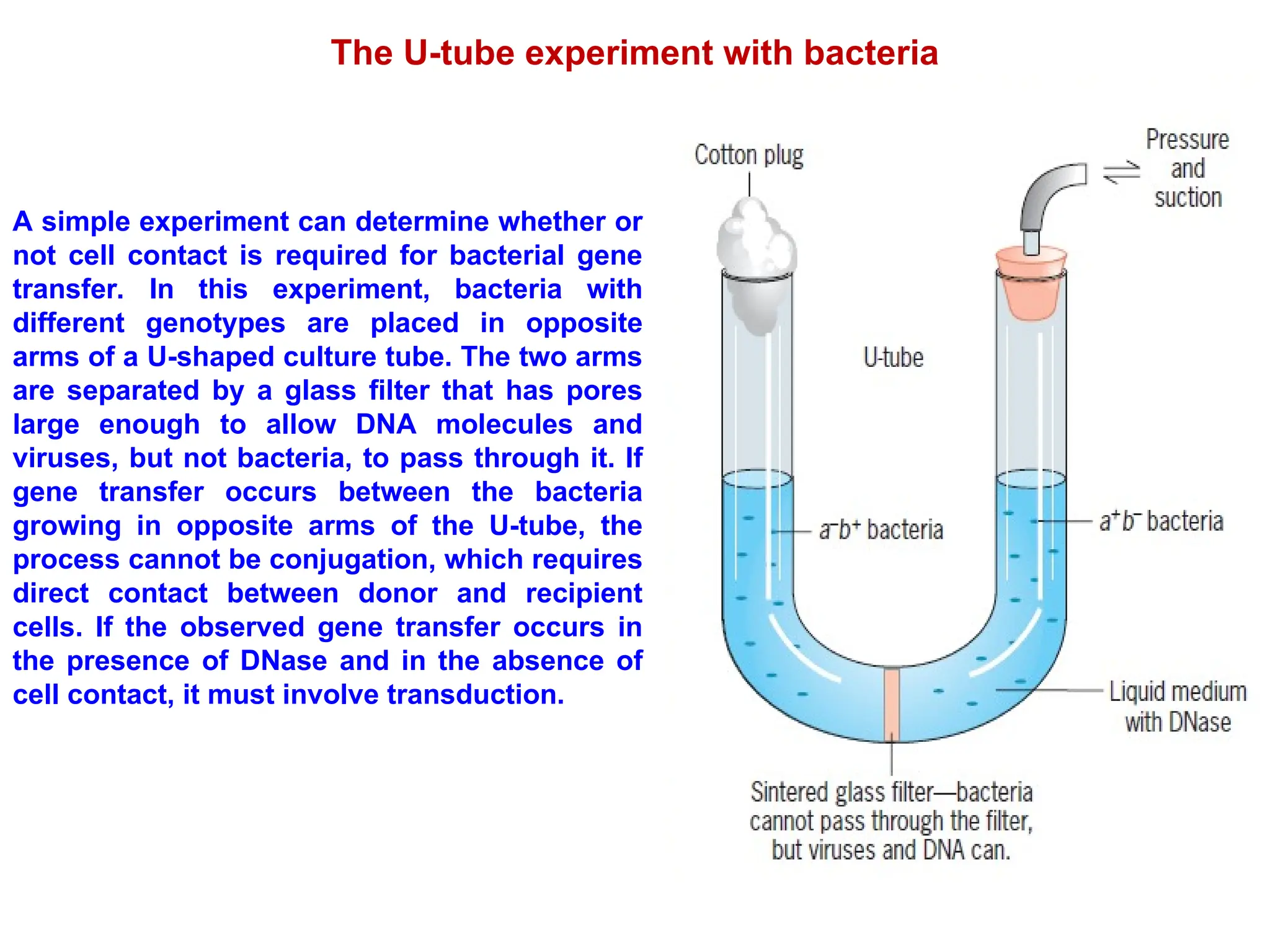
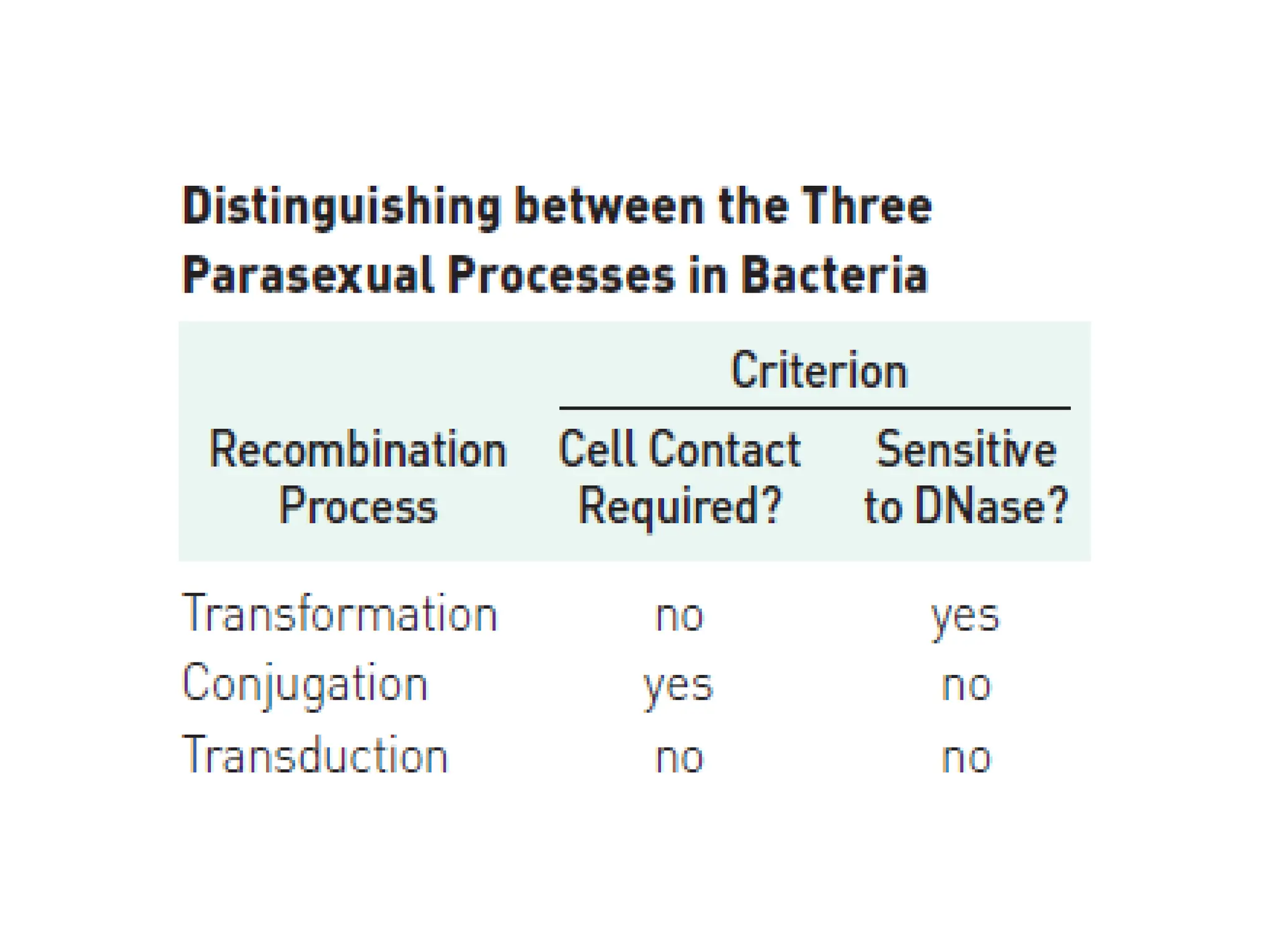
A simple experiment can determine whether or
not cell contact is required for bacterial gene
transfer. In this experiment, bacteria with
different genotypes are placed in opposite
arms of a U-shaped culture tube. The two arms
are separated by a glass filter that has pores
large enough to allow DNA molecules and
viruses, but not bacteria, to pass through it. If
gene transfer occurs between the bacteria
growing in opposite arms of the U-tube, the
process cannot be conjugation, which requires
direct contact between donor and recipient
cells. If the observed gene transfer occurs in
the presence of DNase and in the absence of
cell contact, it must involve transduction.
The U-tube experiment with bacteria
Tranformation.pp sjsis sjsis sis8bsd. Xiixd

Tranformation.pp sjsis sjsis sis8bsd. Xiixd

  • 1.
    Course Study material: UnitIV Lecture slide handouts: Genetic Recombination Course: CBZ # Cell and Molecular Biology # Raghvendra Dubey Assistant Professor, JNU, Jaipur BSc. V-SEMESTER
  • 2.
    REPRODUCTION IN BACTERIA:Bacteria reproduce mainly by asexual reproduction and genetic recombination  Asexual reproduction involves the formation of identical individuals from single parent.  Sexual reproduction is by genetic recombination without the formation of sex organs.  Asexual reproduction: Bacteria reproduce asexually by binary fission and endospores.  Besides binary fission and endospore formation bacteria also reproduces rarely by cysts, mesospores, conidiospores and budding.  Binary Fission – It is the simplest and most common method of multiplication in bacteria. In favorable conditions bacteria reproduces asexually by binary fission.
  • 3.
    SEXUAL REPRODUCTION: Bacteriado not produce sex organs but there are three methods of genetic recombination in bacteria. They are Various types of recombination 1)Transformation involves the uptake of free DNA molecules released from one bacterium (the donor cell) by another bacterium (the recipient cell). 2) Conjugation involves the direct transfer of DNA from a donor cell to a recipient cell. 3)Transduction occurs when bacterial genes are carried from a donor cell to a recipient cell by a Bacteriophage.
  • 4.
    The three typesof gene transfer in bacteria
  • 5.
    Conjugation: The initialevidence for bacterial conjugation, the transfer of genetic information by direct cell to cell contact, came from an elegant experiment performed by Joshua Lederberg and Edward L. Tatum in 1946. It was discovered in Escherichia coli (E. coli). The process was first postulated by Joshua Lederberg and Edward Tatum (1946) in Escherichia coli. They were awarded the Nobel Prize in 1958 for their work on bacterial genetics. The bacteria cells that contain F (Fertility Factor) plasmid, F+ acts as donor cells or male cells whereas the cells lacking F plasmid act as recipients (F- ) the F plasmid encodes for sex pili and it is also named as fertility factor.
  • 6.
    In the processof conjugation:  Two cells of opposites strains F+ and F- temporarily attach with each other with the help of sex pilus.  Conjugation tube is formed between them due to dissolution of the wall layer. There are two mating types of bacteria, one is. male type or F+ or donor cell, which donates some DNA. The other one is female type or F– or recipient cell, which receives DNA. Later, after receiving DNA, the recipient cell may behave as donor cell i.e., F+ type. The F-factor is the fertility factor, sex-factor or F-plasmid present in the cell of F+ i.e., donor cell or male type.
  • 7.
     The F-factoror F-plasmid is a double stranded DNA loop, present in the cytoplasm; apart from the nucleoid.  After the establishment of conjugation tube, the F-factor prepares for replication by the rolling circular mechanism.  The two strands of F factor begin to separate from each other and one of them passes to the recipient i.e., F– cell.  After reaching in F– cell, enzymes synthesize a complementary strand that forms a double helix, which bends into a loop.  The conversion process is thus completed.  In the donor cell i.e., in F+, a new DNA strand also forms to complement the left over DNA strand of the F factor.
  • 8.
  • 9.
     There isanother type of conjugation where passage of nucleoid DNA takes place through conjugation tube, it was discovered in strains of E. coli by William Hayes in 1950s. This strains of bacteria are known as High frequency of recombination (Hfr) strain “the Hfr factor is also called episome”.  In Hfr strain, the F factor is attached with the nucleoid DNA i.e., the bacterial chromosome.  In Hfr strains the F factor integrates into bacterial chromosome and replicates as part of it.  In this process, Hfr and F– cells become attached with each other by sex pilus.  At the point of attachment of F-factor, the bacterial chromosome opens and a copy of one strand is formed by the rolling circular mechanism.
  • 10.
    A portion ofsingle stranded DNA then passes into the recipient cell through pilus. Due to agitation in medium, the conjugation tube may not survive for long time because of broken pilus. Thereby, the total length of transfer DNA may not be able to take entry to the recipient cell. The behaviour of the transferred DNA depends on the presence and absence of F-factor: If F- factor is indeed transferred, then it usually remains detached from the chromosome of recipient cell and enzymes synthesizes a complementary DNA strand. The factor then forms a loop and exists as a plasmid, thereby the recipient cell becomes a donor cell.
  • 11.
     If F-factorremains at the rear end of the transfer DNA during its entry to the recipient cell, the F-factor may not be able to take entry due to broken pilus and only a portion with new genes takes up the entry.Thus, the F– strain remains as recipient one.  In F– strain, genetic recombination takes place between donor fragment and recipient DNA.  Sometimes, if the F-factor gets free from the Hfr cell and maintains an independent status, then the Hfr cell converts to a F+ cell.  When Hfr cells come in contact with F- cells conjugation takes place.  The chromosomal DNA is transferred to the recipient with high frequency but the transfer of F factor is very low.
  • 12.
    Thus, F– cells rarelyconvert to F+ or Hfr cells and the conversion of F+ cell in to Hfr cell is reversible. F+↔Hfr  When F factor reverts from integrated to free state it sometimes carry with it some chromosomal DNA adjacent to it.  Such F factor is named as FI factor (Fertility inhibition) and when it conjugates with F− , it transfers along with the F factor and this process is called ‘Sexduction’. F I X F − Sexduction  In this process, the recipient cell receives a portion of chromosomal DNA which duplicates with the existing one for a specific function, thereby the recipient cell is a partial diploid.
  • 13.
    Recombination by fragmentof DNA in conjugation
  • 14.
    Transformation: The second wayin which DNA can move between bacteria is through transformation, discovered by Fred Griffith in 1928. Transformation is the uptake by a cell of a naked DNA molecule or fragment from the medium and the incorporation of this molecule into the recipient chromosome in a heritable form. In natural transformation the DNA comes from a donor bacterium. The process is random, and any portion of a genome may be transferred between bacteria.  It was first observed by Griffith (1928) in Streptococcus pneumoniae. In this there are two stains one with capsule called smooth strain(S) and the other without capsule called rough strain(R).  The smooth strain is virulent and the rough strain is non- virulent.  When the heat killed virulent strains are injected in to mice they failed to cause disease but when a mixture of heat killed smooth and live rough strains are injected in to mice they caused the death of the mice  The dead mice showed the presence of capsulated smooth, virulent strains.  It shows that non capsulated cells are changed to capsulated virulent strains due to the transfer of genetic material from head killed smooth virulent strains to rough strains. This process is called ‘transformation’.
  • 16.
     Griffith's workwith Pneumococci was among the first demonstrating that bacteria could undergo genetic changes.  Scientists now recognize that when bacteria undergo lysis, they release considerable amounts of DNA into the environment.  This DNA may be picked up by a competent cell, that is, one capable of taking up the DNA and undergoing a transformation.  To be competent, bacteria must be in the logarithmic stage of growth, and a competence factor needed for the transformation must be present  During transformation, a competent cell takes up DNA and destroys one strand of the double helix.  A single-stranded fragment then replaces a similar but not identical fragment in the recipient organism, and the transformation is complete.  Transformation has been studied in detail in Streptococcus pneumoniae and Haemophilus influenzae.  It can be encouraged in the laboratory by treating cells with heat and calcium chloride, a process that increases the permeability of the cell membrane to DNA.
  • 17.
    Diagrammatic representation ofTransformation DNA: The Transforming Material Oswald Avery, Colin MacLeod, and Maclyn McCarty supplied the missing piece in 1944.
  • 18.
    Transduction: The transferof genetic material from one bacterium to another bacterium through bacteriophages is called transduction. It was first studied by Zinder and Lederberg in Salmonella typhimurium in 1952. In transduction, bacterial viruses (also known as bacteriophages) transfer DNA fragments from one bacterium (the donor) to another bacterium (the recipient). In this type of reproduction , the virus may attach to the bacterial chromosome and integrate its DNA into the bacterial DNA, and continuing its replication process. the virus does not destroy the host bacterium viz., the lysogenic cycle  at this stage the virus is called a temperate phage, also known as a prophage.  At a later time, the virus can detach, and the lytic cycle will ensue. Transduction is of two types 1.Generalized transduction: It involves transduction of any segment of donor DNA at random. 2.Restricted or specialized transduction: It involves the transduction of only a particular gene.
  • 19.
  • 20.
    A simple experimentcan determine whether or not cell contact is required for bacterial gene transfer. In this experiment, bacteria with different genotypes are placed in opposite arms of a U-shaped culture tube. The two arms are separated by a glass filter that has pores large enough to allow DNA molecules and viruses, but not bacteria, to pass through it. If gene transfer occurs between the bacteria growing in opposite arms of the U-tube, the process cannot be conjugation, which requires direct contact between donor and recipient cells. If the observed gene transfer occurs in the presence of DNase and in the absence of cell contact, it must involve transduction. The U-tube experiment with bacteria