TYPES OF MUTATION
Dr. A. T. Sharma
Assist. Professor
Nanded Pharmacy College, Nanded
Introduction
• The permanent change in sequence of
nucleotides.
• May occur in somatic cells or germ line cells
• Mutation in somatic cells does not pass to future
generations while mutation in germ line cells may
be passed to future generations
• Mutation may be in coding sequences (hereditary
disorder or disease) or in non-coding sequences
• Mutation may occur due exposure to mutagenic
agents and errors through DNA replication and
repair
Mutagens
• Anything that causes a mutation (a change in the DNA
of a cell).
• DNA changes caused by mutagens may harm cells and
cause certain diseases, such as cancer.
• Examples of mutagens include radioactive substances,
x-rays, ultraviolet radiation, and certain chemicals.
Types of Mutation
Based on transmission: Depending upon transmission
from one generation to generation, mutation can be
classified in to –
• Stable/fixed mutations: Mutation transferred
unaltered (unchanged)
• Unstable/dynamic mutations: Mutation undergo
variations as they pass on to families
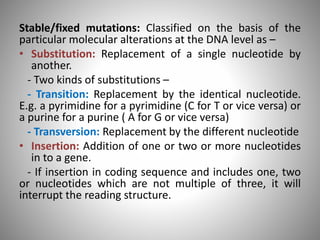
Stable/fixed mutations: Classified on the basis of the
particular molecular alterations at the DNA level as –
• Substitution: Replacement of a single nucleotide by
another.
- Two kinds of substitutions –
- Transition: Replacement by the identical nucleotide.
E.g. a pyrimidine for a pyrimidine (C for T or vice versa) or
a purine for a purine ( A for G or vice versa)
- Transversion: Replacement by the different nucleotide
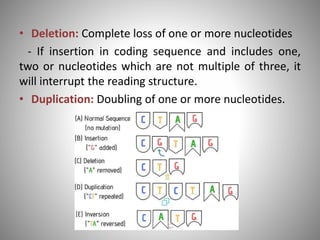
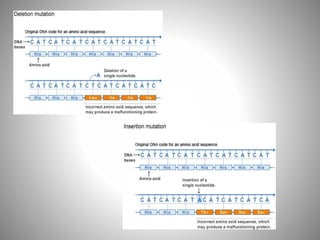
• Insertion: Addition of one or two or more nucleotides
in to a gene.
- If insertion in coding sequence and includes one, two
or nucleotides which are not multiple of three, it will
interrupt the reading structure.
• Deletion: Complete loss of one or more nucleotides
- If insertion in coding sequence and includes one,
two or nucleotides which are not multiple of three, it
will interrupt the reading structure.
• Duplication: Doubling of one or more nucleotides.
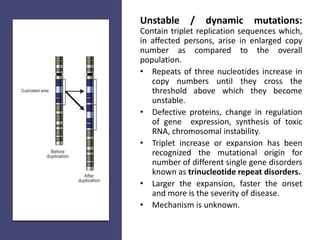
Unstable / dynamic mutations:
Contain triplet replication sequences which,
in affected persons, arise in enlarged copy
number as compared to the overall
population.
• Repeats of three nucleotides increase in
copy numbers until they cross the
threshold above which they become
unstable.
• Defective proteins, change in regulation
of gene expression, synthesis of toxic
RNA, chromosomal instability.
• Triplet increase or expansion has been
recognized the mutational origin for
number of different single gene disorders
known as trinucleotide repeat disorders.
• Larger the expansion, faster the onset
and more is the severity of disease.
• Mechanism is unknown.
Based on the effect on the encoded protein:
Depending upon the basis of effect on the
polypeptide sequence of the encoded protein, two
classes as -
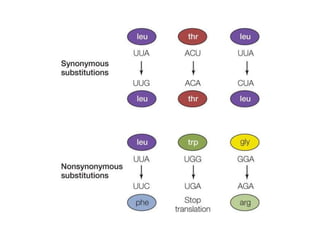
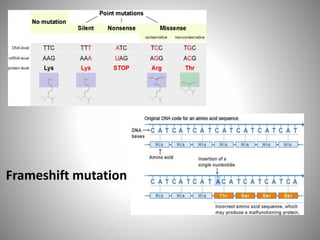
Synonymous or silent mutation: A mutation does
not change the polypeptide product of the gene
• A single base-pair substitution, particularly at
third position of a codon, produces a codon
coding for the same amino acid – no change in
properties of the protein.
Non-synonymous mutations: A mutation leading to
change in the encoded polypeptide
• Abnormal protein function
• Occurs in one of the three main ways:
- Missense: A single base-pair substitution
resulting in coding for different amino acid and
production of a changed protein.
- May or may not disturb protein function
Conservative substitution: Mutation coding for a
chemically similar amino acid and hence no effect
on protein function
Non-conservative substitution: Mutation coding
for a chemically dissimilar amino acid and hence
effect on protein structure – complete loss or
reduction of biological activity
- Nonsense: A substitution of base-pair leading to the
generation of one of the stop codons – results in premature
termination of translation of a peptide chain – reduces the
biological activity of the protein.
- Frameshift: Insertion or deletion of nucleotides not in a
multiple of three disturbing the interpretation of frame
- Usually insert premature STOP codons (along with large
number of amino acid changes, effect on protein structure)
- Reading of codon is changed, STOP codon may not be read or
may be added later or earlier site
- Protein produced may be unusually short, abnormally long
and/or contain wrong amino acids – nonfunctional protein
- Severe genetic diseases like Tay-Sachs disease, familial
hypercholesterolemia
Frameshift mutation
Based on functional effects of mutations on the
protein: The mutations effect can appear as any of
the following:
Loss-of-function mutations (Inactivating
mutations): Mutations that result in the gene
product having less or no function (being partially
or wholly inactivated). When the allele has a
complete loss of function (null allele), it is often
called an amorph or amorphic mutation.
• Loss of function mutations are generally
recessive.
• E.g. a nonsense mutation that causes polypeptide
chain termination during translation.
Gain-of-function (Activating mutations): Mutations
that change the gene product such that its effect
gets stronger (enhanced activation) or even is
superseded by a different and abnormal function.
• When the new allele is created,
a heterozygote containing the newly created
allele as well as the original, will express the new
allele (dominant phenotypes).
• Hypermorph (increased gene expression) and
neomorph (novel function).
• E.g. Loss of growth control as in oncogenes
Thank You…!!!
(Disclaimer: The images and diagrams in this presentation have
been downloaded from the google source. I am grateful to all the
publishers & the google.)

CONCEPT OF MUTATION AND ITS CLASSIFICATION .pptx

  • 1.
    TYPES OF MUTATION Dr.A. T. Sharma Assist. Professor Nanded Pharmacy College, Nanded
  • 2.
    Introduction • The permanentchange in sequence of nucleotides. • May occur in somatic cells or germ line cells • Mutation in somatic cells does not pass to future generations while mutation in germ line cells may be passed to future generations • Mutation may be in coding sequences (hereditary disorder or disease) or in non-coding sequences • Mutation may occur due exposure to mutagenic agents and errors through DNA replication and repair
  • 3.
    Mutagens • Anything thatcauses a mutation (a change in the DNA of a cell). • DNA changes caused by mutagens may harm cells and cause certain diseases, such as cancer. • Examples of mutagens include radioactive substances, x-rays, ultraviolet radiation, and certain chemicals. Types of Mutation Based on transmission: Depending upon transmission from one generation to generation, mutation can be classified in to – • Stable/fixed mutations: Mutation transferred unaltered (unchanged) • Unstable/dynamic mutations: Mutation undergo variations as they pass on to families
  • 4.
    Stable/fixed mutations: Classifiedon the basis of the particular molecular alterations at the DNA level as – • Substitution: Replacement of a single nucleotide by another. - Two kinds of substitutions – - Transition: Replacement by the identical nucleotide. E.g. a pyrimidine for a pyrimidine (C for T or vice versa) or a purine for a purine ( A for G or vice versa) - Transversion: Replacement by the different nucleotide • Insertion: Addition of one or two or more nucleotides in to a gene. - If insertion in coding sequence and includes one, two or nucleotides which are not multiple of three, it will interrupt the reading structure.
  • 5.
    • Deletion: Completeloss of one or more nucleotides - If insertion in coding sequence and includes one, two or nucleotides which are not multiple of three, it will interrupt the reading structure. • Duplication: Doubling of one or more nucleotides.
  • 7.
    Unstable / dynamicmutations: Contain triplet replication sequences which, in affected persons, arise in enlarged copy number as compared to the overall population. • Repeats of three nucleotides increase in copy numbers until they cross the threshold above which they become unstable. • Defective proteins, change in regulation of gene expression, synthesis of toxic RNA, chromosomal instability. • Triplet increase or expansion has been recognized the mutational origin for number of different single gene disorders known as trinucleotide repeat disorders. • Larger the expansion, faster the onset and more is the severity of disease. • Mechanism is unknown.
  • 8.
    Based on theeffect on the encoded protein: Depending upon the basis of effect on the polypeptide sequence of the encoded protein, two classes as - Synonymous or silent mutation: A mutation does not change the polypeptide product of the gene • A single base-pair substitution, particularly at third position of a codon, produces a codon coding for the same amino acid – no change in properties of the protein. Non-synonymous mutations: A mutation leading to change in the encoded polypeptide • Abnormal protein function
  • 10.
    • Occurs inone of the three main ways: - Missense: A single base-pair substitution resulting in coding for different amino acid and production of a changed protein. - May or may not disturb protein function Conservative substitution: Mutation coding for a chemically similar amino acid and hence no effect on protein function Non-conservative substitution: Mutation coding for a chemically dissimilar amino acid and hence effect on protein structure – complete loss or reduction of biological activity
  • 11.
    - Nonsense: Asubstitution of base-pair leading to the generation of one of the stop codons – results in premature termination of translation of a peptide chain – reduces the biological activity of the protein. - Frameshift: Insertion or deletion of nucleotides not in a multiple of three disturbing the interpretation of frame - Usually insert premature STOP codons (along with large number of amino acid changes, effect on protein structure) - Reading of codon is changed, STOP codon may not be read or may be added later or earlier site - Protein produced may be unusually short, abnormally long and/or contain wrong amino acids – nonfunctional protein - Severe genetic diseases like Tay-Sachs disease, familial hypercholesterolemia
  • 12.
  • 13.
    Based on functionaleffects of mutations on the protein: The mutations effect can appear as any of the following: Loss-of-function mutations (Inactivating mutations): Mutations that result in the gene product having less or no function (being partially or wholly inactivated). When the allele has a complete loss of function (null allele), it is often called an amorph or amorphic mutation. • Loss of function mutations are generally recessive. • E.g. a nonsense mutation that causes polypeptide chain termination during translation.
  • 14.
    Gain-of-function (Activating mutations):Mutations that change the gene product such that its effect gets stronger (enhanced activation) or even is superseded by a different and abnormal function. • When the new allele is created, a heterozygote containing the newly created allele as well as the original, will express the new allele (dominant phenotypes). • Hypermorph (increased gene expression) and neomorph (novel function). • E.g. Loss of growth control as in oncogenes
  • 15.
    Thank You…!!! (Disclaimer: Theimages and diagrams in this presentation have been downloaded from the google source. I am grateful to all the publishers & the google.)