Mixing of Pharmaceuticals
Mr. A.T. Sharma
Assistant Professor
Department of Pharmaceutics
Nanded Pharmacy College, Nanded
Mixing
• Definition: A process that tends to result in a
randomization of dissimilar particles within a
system.
• Blending
• Cohesive and Non-cohesive solids
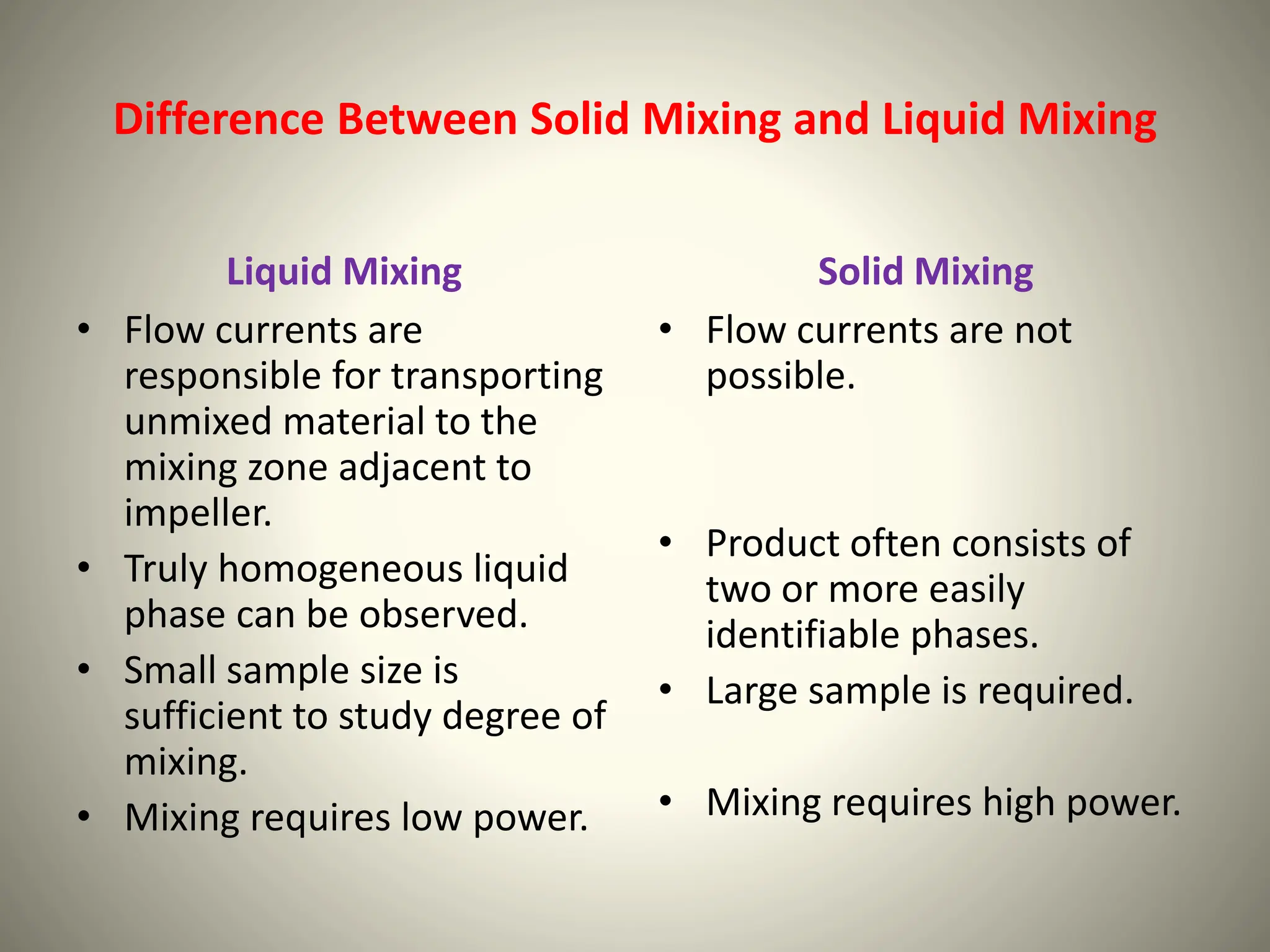
Difference Between Solid Mixing and Liquid Mixing
Liquid Mixing
• Flow currents are
responsible for transporting
unmixed material to the
mixing zone adjacent to
impeller.
• Truly homogeneous liquid
phase can be observed.
• Small sample size is
sufficient to study degree of
mixing.
• Mixing requires low power.
Solid Mixing
• Flow currents are not
possible.
• Product often consists of
two or more easily
identifiable phases.
• Large sample is required.
• Mixing requires high power.
Applications
• Wet mixing in granulation
• Dry mixing in direct compression
• Dry blending of powders
• Production of pellets
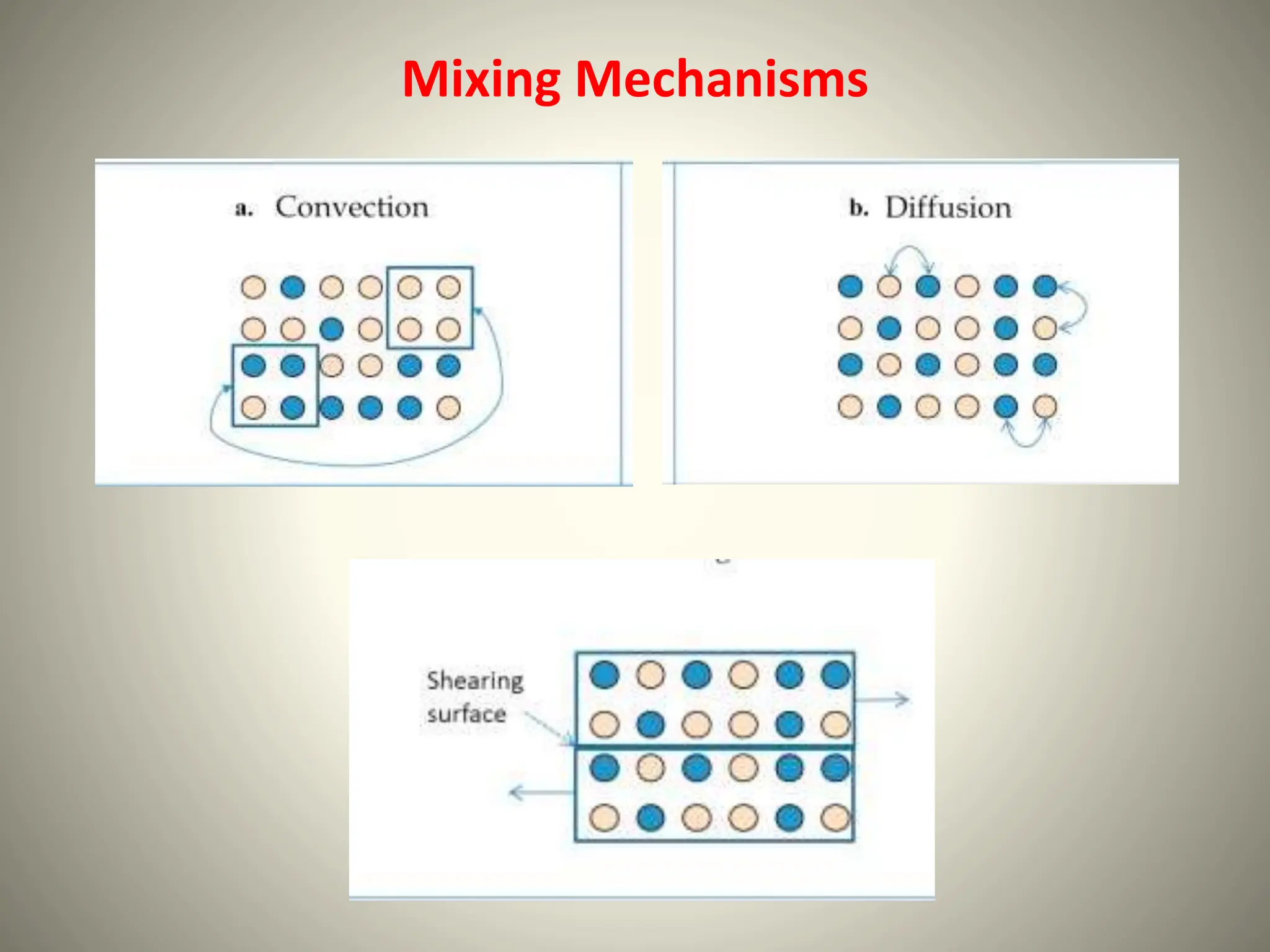
Mixing Mechanisms
Interparticle Interactions - Segregation
• Particle characteristics like size, size distribution,
shape and surface influence the interparticle
interactions in a powder bed.
• Inertial Forces: Tend to hold neighbouring
particles in a fixed relative position.
- van der Waals forces
- Electrostatic forces
- Surface forces
• Gravitational Forces
Van der Waals forces
• Weak but general attractive or repulsive forces
between neutral atoms or molecules.
• Differ from covalent or ionic bonding
Electrostatic forces
• The attractive or repulsive force between two
electrically charged objects.
Surface/ Interface forces:
• Cohesive forces – prevent intimate mixing
• Frictional forces – lumps
• Depends on SA, surface roughness, surface polarity,
surface charge, moisture
• For effective mixing, surface to surface interactions
should be minimum – surface treatment
Reasons of Segregation
• Poor flow properties of powder bed
• Wide differences in particle sizes
• Differences in mobilities of individual
ingredients
• Differences in particle density and shape
• Transporting stage
• Dusting stage
Gravitational Forces
• Tend to improve the movement of two adjacent
particles or groups of particles.
• Tumbling action promotes inter-particulate movement
due to gravitational forces.
• Motion of particles – contact with the mixer surface
or/and from contact with one other
• These motions accelerate translational and rotational
mode of single particle or group of particles
• Particle – particle collisions: Exchange of momentum
• Continuous exchange of momentum between
translational and rotational mode necessary for
effective mixing.
Efficiency of momentum transfer depends upon-
• Elasticity of collisions
• Coefficient of friction
• SA of contact
• Surface roughness
• Centrifugal forces
Factors Affecting Mixing
• Nature of the surface
• Density of the particles
• Particle size
• Particle shape
• Particle charge
• Proportion of materials
Twin Shell Blender/ V Cone Blender
• V shaped shell, stainless steel or transparent plastic
• Small – 20kg/ 35rpm
• Large – 1 tonne/ 15rpm
• Loading – two hatches
• Emptying – apex port
• Material loaded – 50 to 60% of volume
• Rotation - tumbling motion
• V inverted – splitting
• Splitting and dividing repeated
• High speed – dusting/ segregation
• Low speed – poor mixing
Double Cone Blender
• Charged and discharged – same port
• Efficient for small amount of powders
• Speed – size, shape of tumbler, nature of
material- 30-100rpm
• Method- same as V cone blender
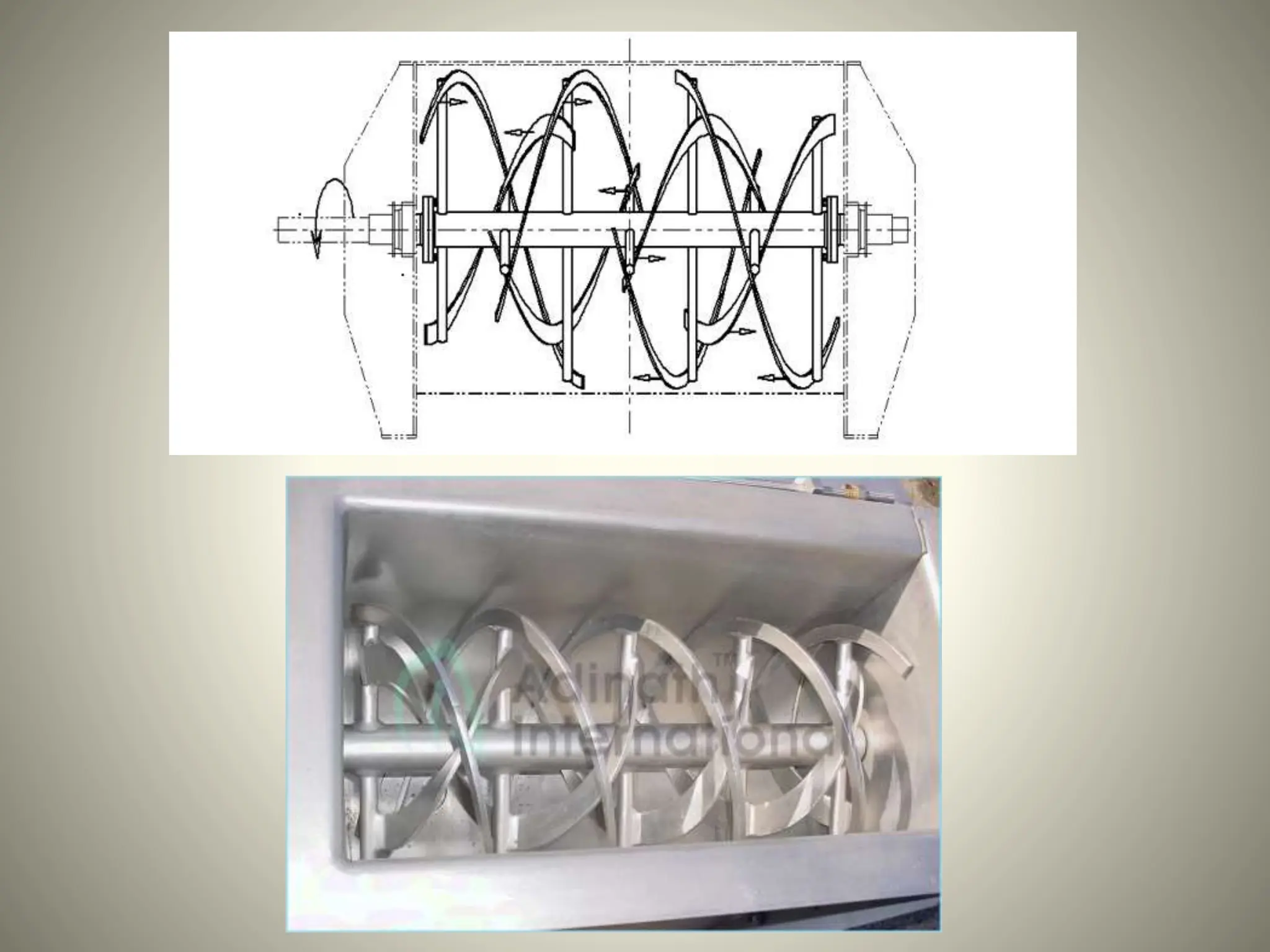
Ribbon Mixer
Principle:
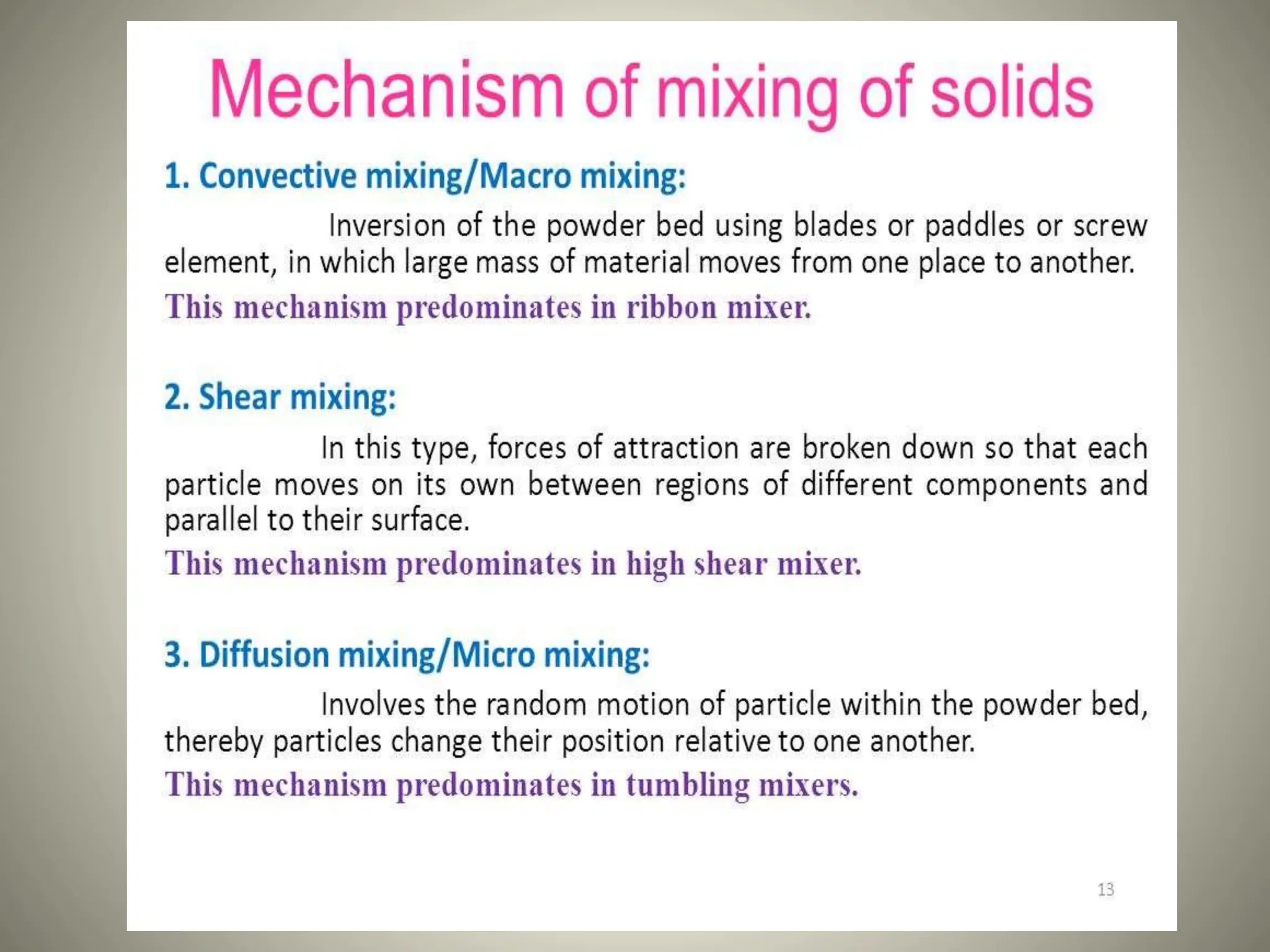
• Shear mixing by ribbon shaped moving blades – breaks
lumps and aggregates
• Convective mixing
Construction:
o Non-movable horizontal cylinder trough open at top
o Two helical blades, same shaft
o Blades with right and left twist – connected to fixed
speed drive
o Top loading, bottom discharge
o Lid at top
Sigma Blade Mixer
Principle:
• Shear mixing and kneading actions with sigma
shaped blades
• Convective mixing by cascading
Construction:
o Double trough shaped stationary bowl
o Two sigma shaped blades horizontally fitted
o Fixed speed drive
o Loading from top, unloading by tilting by rack-
and-pinion drive
Planetary Mixer
Principle:
• Shear between a moving blade and stationary
wall
• Blade tears mass apart
• Mixing arm moves in two ways, around own
axis and around central axis – no dead spot
• Plates in blade are sloped – powder makes
upward movement - convective mixing
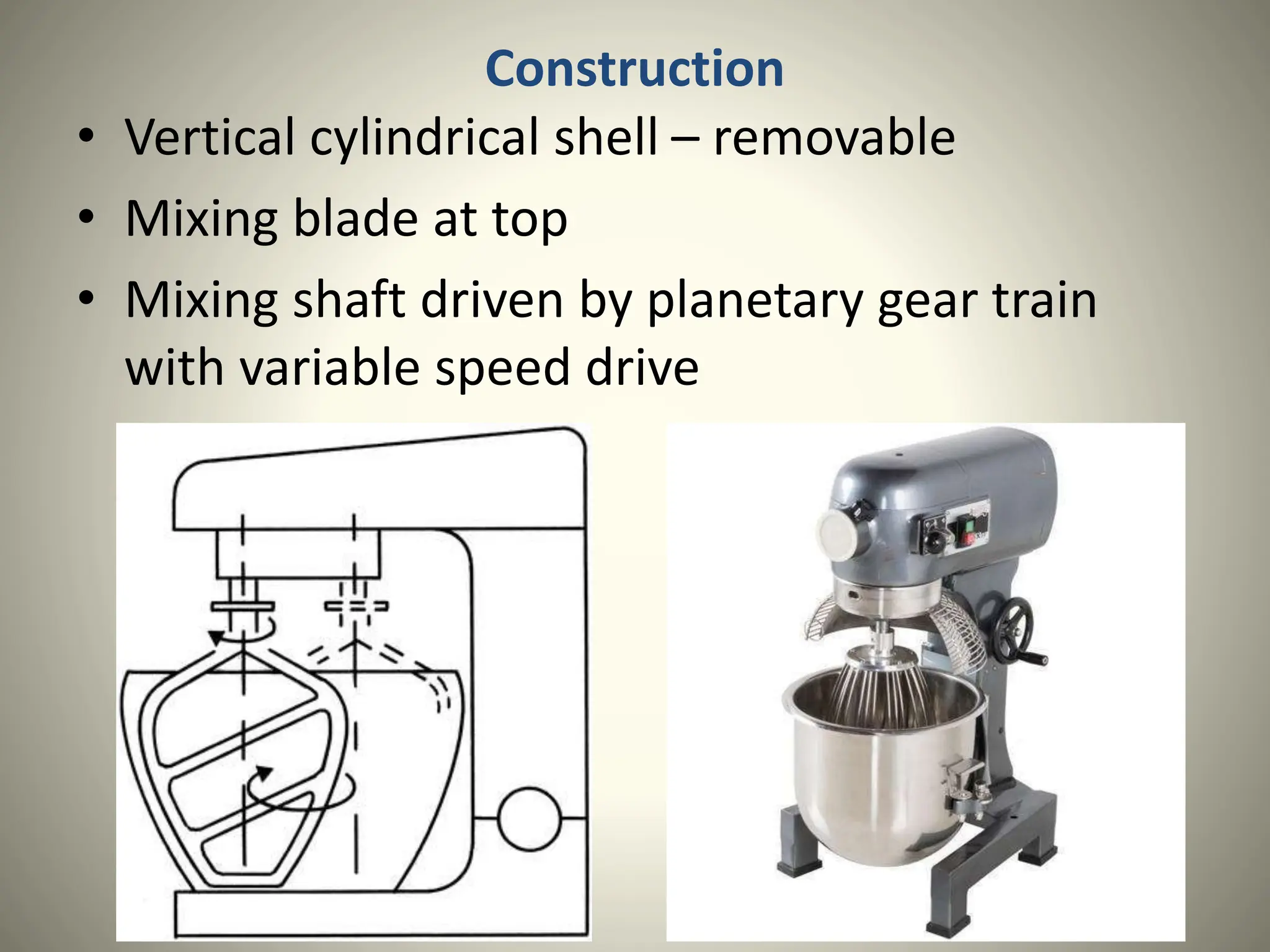
Construction
• Vertical cylindrical shell – removable
• Mixing blade at top
• Mixing shaft driven by planetary gear train
with variable speed drive
Liquid Mixing
• Formation of homogeneous mass
• Agitation: Induced motion of a material in a
specified way, usually in a circulatory pattern
inside a container
• Mixing: Random distribution into one another
of two or more separate phases
• Applications: Manufacture of emulsions,
suspensions, solutions, aerosols
Mechanism of Liquid Mixing
• Bulk transport
• Turbulent mixing
• Laminar mixing
• Molecular diffusion
Mixing Devices
Impellers
o Propellers
o Turbines
o Paddles
Propellers
• Contains a no. of blades
• Right or left handed
• Deep tank – Push-pull propeller
• Small size
• Speed 8000rpm
• Uses:
- High mixing capacity
- Liquid of maximum viscosity of 2 pascals.second,
slurries
with 10% solids
- Gas-liquid dispersions, multivitamin elixirs, disinfectant
solutions
Turbines
• A circular disc with no. of short blades
• Diameter: 30-50%
• Speed: 50-200rpm
• Blades straight, curved, pitched or vertical
• Near the turbine, zone of rapid currents, high
turbulence, and intense shear
• Diffuser ring – stationary, perforated ring
surrounding turbine – reduce swirling and
vortexing
Paddles
• A central hub with two long flat vertical
blades
• Pitched, hemispherical with large SA
• A shaft with hub-blades rotates – 100rpm
• Radial and tangential push
• Deep tanks – several blades one above other
• Very low speed – agitation in unbaffled tank
• High speed – baffled tank
Pitched Blades Vortex Formation
Silverson Mixer - Emulsifier
Principle:
• Intense shear forces and turbulence by high
speed rotors
• Liquids pass through fine interstices of
perforated metal sheets
• Circulation through head by suction in inlet at
bottom of head
• Rapid breakdown of liquid into smaller
globules
Construction:
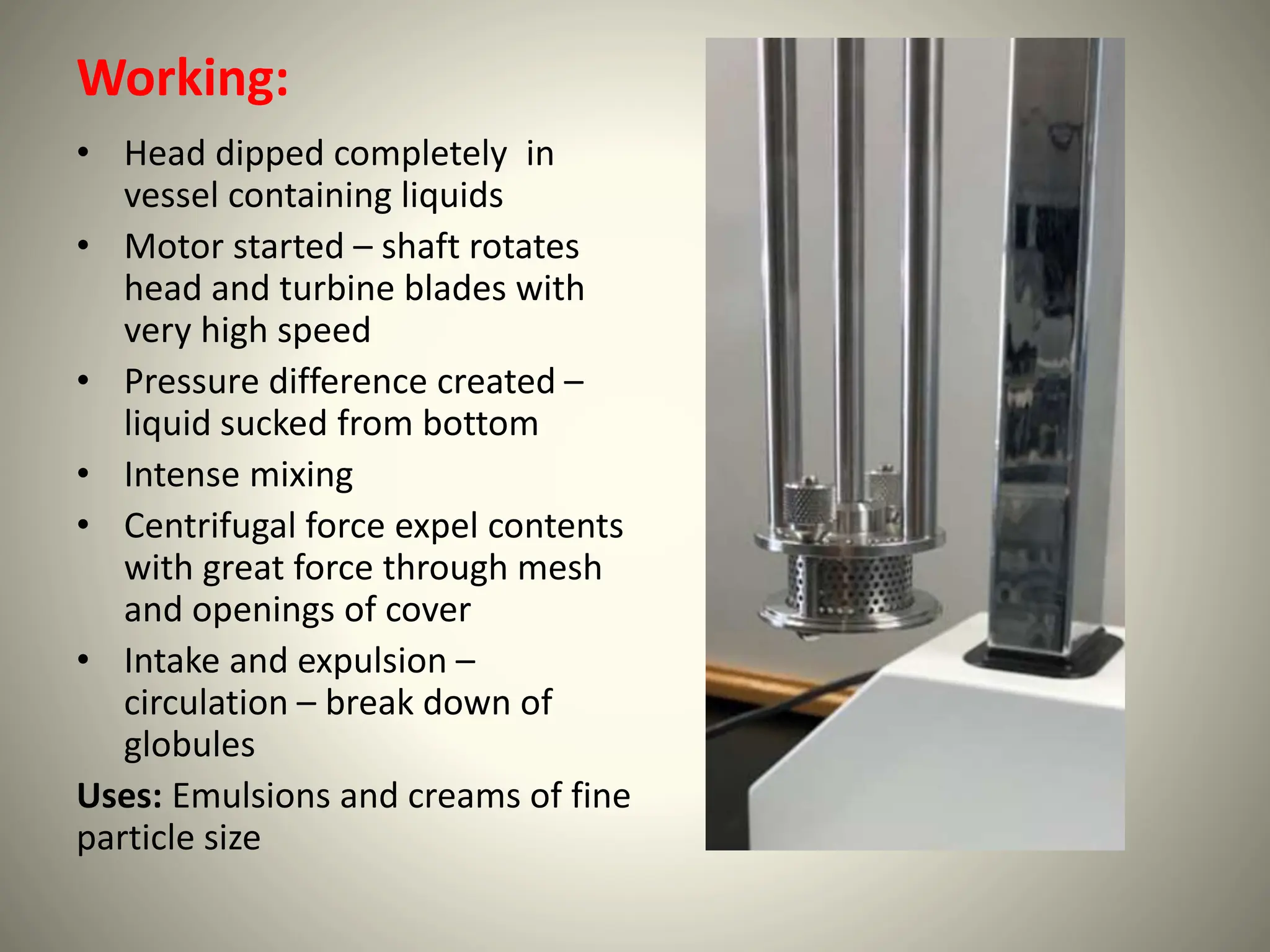
• Long supporting
columns connected to
motor – support head
• Shaft at centre – one
end to motor, other to
head
• Head has turbine
blades
• Blades surrounded by
a mesh, enclosed by a
cover with openings.
Working:
• Head dipped completely in
vessel containing liquids
• Motor started – shaft rotates
head and turbine blades with
very high speed
• Pressure difference created –
liquid sucked from bottom
• Intense mixing
• Centrifugal force expel contents
with great force through mesh
and openings of cover
• Intake and expulsion –
circulation – break down of
globules
Uses: Emulsions and creams of fine
particle size
Thank You…!!!
(Disclaimer: The images and diagrams in this
presentation have been downloaded from the google
source. I am grateful to all the publishers & the google.)

MIXING OF PHARMACEUTICALS.pptx

  • 1.
    Mixing of Pharmaceuticals Mr.A.T. Sharma Assistant Professor Department of Pharmaceutics Nanded Pharmacy College, Nanded
  • 2.
    Mixing • Definition: Aprocess that tends to result in a randomization of dissimilar particles within a system. • Blending • Cohesive and Non-cohesive solids
  • 3.
    Difference Between SolidMixing and Liquid Mixing Liquid Mixing • Flow currents are responsible for transporting unmixed material to the mixing zone adjacent to impeller. • Truly homogeneous liquid phase can be observed. • Small sample size is sufficient to study degree of mixing. • Mixing requires low power. Solid Mixing • Flow currents are not possible. • Product often consists of two or more easily identifiable phases. • Large sample is required. • Mixing requires high power.
  • 4.
    Applications • Wet mixingin granulation • Dry mixing in direct compression • Dry blending of powders • Production of pellets
  • 6.
  • 7.
    Interparticle Interactions -Segregation • Particle characteristics like size, size distribution, shape and surface influence the interparticle interactions in a powder bed. • Inertial Forces: Tend to hold neighbouring particles in a fixed relative position. - van der Waals forces - Electrostatic forces - Surface forces • Gravitational Forces
  • 8.
    Van der Waalsforces • Weak but general attractive or repulsive forces between neutral atoms or molecules. • Differ from covalent or ionic bonding Electrostatic forces • The attractive or repulsive force between two electrically charged objects. Surface/ Interface forces: • Cohesive forces – prevent intimate mixing • Frictional forces – lumps • Depends on SA, surface roughness, surface polarity, surface charge, moisture • For effective mixing, surface to surface interactions should be minimum – surface treatment
  • 9.
    Reasons of Segregation •Poor flow properties of powder bed • Wide differences in particle sizes • Differences in mobilities of individual ingredients • Differences in particle density and shape • Transporting stage • Dusting stage
  • 10.
    Gravitational Forces • Tendto improve the movement of two adjacent particles or groups of particles. • Tumbling action promotes inter-particulate movement due to gravitational forces. • Motion of particles – contact with the mixer surface or/and from contact with one other • These motions accelerate translational and rotational mode of single particle or group of particles • Particle – particle collisions: Exchange of momentum • Continuous exchange of momentum between translational and rotational mode necessary for effective mixing.
  • 11.
    Efficiency of momentumtransfer depends upon- • Elasticity of collisions • Coefficient of friction • SA of contact • Surface roughness • Centrifugal forces
  • 12.
    Factors Affecting Mixing •Nature of the surface • Density of the particles • Particle size • Particle shape • Particle charge • Proportion of materials
  • 13.
    Twin Shell Blender/V Cone Blender • V shaped shell, stainless steel or transparent plastic • Small – 20kg/ 35rpm • Large – 1 tonne/ 15rpm • Loading – two hatches • Emptying – apex port • Material loaded – 50 to 60% of volume • Rotation - tumbling motion • V inverted – splitting • Splitting and dividing repeated • High speed – dusting/ segregation • Low speed – poor mixing
  • 14.
    Double Cone Blender •Charged and discharged – same port • Efficient for small amount of powders • Speed – size, shape of tumbler, nature of material- 30-100rpm • Method- same as V cone blender
  • 15.
    Ribbon Mixer Principle: • Shearmixing by ribbon shaped moving blades – breaks lumps and aggregates • Convective mixing Construction: o Non-movable horizontal cylinder trough open at top o Two helical blades, same shaft o Blades with right and left twist – connected to fixed speed drive o Top loading, bottom discharge o Lid at top
  • 17.
    Sigma Blade Mixer Principle: •Shear mixing and kneading actions with sigma shaped blades • Convective mixing by cascading Construction: o Double trough shaped stationary bowl o Two sigma shaped blades horizontally fitted o Fixed speed drive o Loading from top, unloading by tilting by rack- and-pinion drive
  • 19.
    Planetary Mixer Principle: • Shearbetween a moving blade and stationary wall • Blade tears mass apart • Mixing arm moves in two ways, around own axis and around central axis – no dead spot • Plates in blade are sloped – powder makes upward movement - convective mixing
  • 20.
    Construction • Vertical cylindricalshell – removable • Mixing blade at top • Mixing shaft driven by planetary gear train with variable speed drive
  • 21.
    Liquid Mixing • Formationof homogeneous mass • Agitation: Induced motion of a material in a specified way, usually in a circulatory pattern inside a container • Mixing: Random distribution into one another of two or more separate phases • Applications: Manufacture of emulsions, suspensions, solutions, aerosols
  • 22.
    Mechanism of LiquidMixing • Bulk transport • Turbulent mixing • Laminar mixing • Molecular diffusion
  • 23.
  • 24.
    Propellers • Contains ano. of blades • Right or left handed • Deep tank – Push-pull propeller • Small size • Speed 8000rpm • Uses: - High mixing capacity - Liquid of maximum viscosity of 2 pascals.second, slurries with 10% solids - Gas-liquid dispersions, multivitamin elixirs, disinfectant solutions
  • 26.
    Turbines • A circulardisc with no. of short blades • Diameter: 30-50% • Speed: 50-200rpm • Blades straight, curved, pitched or vertical • Near the turbine, zone of rapid currents, high turbulence, and intense shear • Diffuser ring – stationary, perforated ring surrounding turbine – reduce swirling and vortexing
  • 28.
    Paddles • A centralhub with two long flat vertical blades • Pitched, hemispherical with large SA • A shaft with hub-blades rotates – 100rpm • Radial and tangential push • Deep tanks – several blades one above other • Very low speed – agitation in unbaffled tank • High speed – baffled tank
  • 30.
  • 31.
    Silverson Mixer -Emulsifier Principle: • Intense shear forces and turbulence by high speed rotors • Liquids pass through fine interstices of perforated metal sheets • Circulation through head by suction in inlet at bottom of head • Rapid breakdown of liquid into smaller globules
  • 32.
    Construction: • Long supporting columnsconnected to motor – support head • Shaft at centre – one end to motor, other to head • Head has turbine blades • Blades surrounded by a mesh, enclosed by a cover with openings.
  • 34.
    Working: • Head dippedcompletely in vessel containing liquids • Motor started – shaft rotates head and turbine blades with very high speed • Pressure difference created – liquid sucked from bottom • Intense mixing • Centrifugal force expel contents with great force through mesh and openings of cover • Intake and expulsion – circulation – break down of globules Uses: Emulsions and creams of fine particle size
  • 35.
    Thank You…!!! (Disclaimer: Theimages and diagrams in this presentation have been downloaded from the google source. I am grateful to all the publishers & the google.)