Construction Management
By
Akash Padole
Department of Civil Engineering
Construction Labors & Legislation
Contains
8.1 Need for legislation & Importance of labour laws.
8.2 Acts applicable to Indian construction labours
such as Payment of wages act, Minimum wages
act, Workmen’s compensation act, Factories act
etc.
Akash Padole 2
Labour law
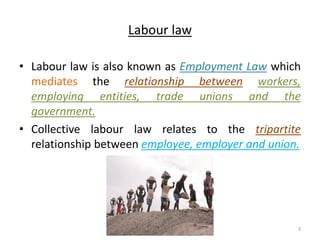
• Labour law is also known as Employment Law which
mediates the relationship between workers,
employing entities, trade unions and the
government.
• Collective labour law relates to the tripartite
relationship between employee, employer and union.
Akash Padole 3
• Labour Law is the “Body of Laws, Administrative
Rulings, & Precedents” which address the
Relationship between & among “Employers,
Employees & Labour Organizations”, often dealing
with issues of Public Law.
4
• Industrial legalizations are the laws enacted by the
Government to provide Economic and Social Justice
to the workers in industries.
• Generally these laws provide guidelines to the
employers/industrialists in dealing with the matters
of wages, wage incentives, facilitates for workers and
the working conditions of labour.
Akash Padole 5
• The terms Labour Laws & Employment Laws, are
often interchanged in the usage. This has lead to a
big confusion as to their meanings.
• The “Final Goal” of Labour Laws is to bring both
“Employer & Employee” on the same Level, thereby
mitigating the differences between the two ever-
warring groups.
Akash Padole 6
Necessity and Importance of Labour law
• Improves industrial relation i.e. employee-employer
relations and minimizes industrial disputes.
• Prospects workers form exploitation by the
employers or management.
• Helps workers in getting fair wages.
• Minimizes labour unrest
Akash Padole 7
• Reduces conflicts and strikes, etc.
• Ensures job security for workers.
• Promotes welcome environment conditions in the
industrial system.
• Fixes rest-pauses and work hours etc.
• Provides compensation to workers, who are victims
of accidents.
Akash Padole 8
Acts applicable to Indian Construction Labours
✓ Payment Of Wages Act
✓ Minimum Wages Act
✓ Workmen’s Compensation Act
✓ Factories Act
Akash Padole 9
Akash Padole 10
Payment of Wages Act - 1936
➢ Objective of the Act:-
• The “Payment of Wages Act 1936” regulates
payment of wages to Employees (Direct & Indirect).
• The Act is intended to be a remedy against
unauthorized deductions made by the “Employer” or
unjustified delay in payment of wages.
• All Employees are covered under
the Act, those are drawing Average
wages Rs:- 10,000/- per month.
Akash Padole 11
➢ Applicability of the Act: -
• The “Payment of Wages Act 1936” is applicable to all
Factories, Industrial Establishment, Tramway Service,
or Motor Transport Service engaged in carrying
Passengers or Goods both by road for hire or reward.
• Air Transport Service, Dock, Wharf, Inland Vessel,
Mechanically propelled, Mines, Quarry or Oil-Field,
Plantation, Workshop or other establishment, etc.
Akash Padole 12
➢ Meaning of Wages:-
• “Wages” means all Remuneration expressed in terms
of Money and include Remuneration payable under
any Award or Settlement, Overtime Wages, Wages
for Holiday & any sum payable on Termination of
Employment.
• However, it does not include “Bonus” which does not
form part of Remuneration payable, value of House
Accommodation, Contribution to PF & ESI, Traveling
Allowance, or Payment of Gratuity.
Akash Padole 13
Akash Padole 14
Minimum Wages Act - 1948
➢ Objective:
• To determine the minimum wages in industry and
trade where labour organizations are non-existent or
ineffective.
➢ Scope and Coverage:
• Applicable to all employees engaged to do any work,
skilled, unskilled manual or clerical, in a scheduled
employment, including out-workers.
Akash Padole 15
➢ Main provisions:
– Fixation of minimum wage of employees
– Procedure for fixing and revising minimum wages
– Rights of workers
Akash Padole 16
17
Akash Padole
The Workmen’s Compensation Act, 1923
➢ ACT :-
✓ It aims to provide workmen and /or their dependents
some relief in case of accidents arising out of and in
the course of employment & causing either death or
disablement of workmen.
Akash Padole 18
➢ Objective of the Act :-
✓ To provide compensation to workmen incapacitated
by an injury from accidents arising out of and in the
course of employment.
✓ The objective of this act is that in the case of an
employment injury, compensation provided to the
injured workmen and in case of his death to his
dependents.
Akash Padole 19
➢ Coverage of Employees:-
• All Employees of any Categories/ Capacity
Irrespective of their Status or Salaries either Directly
or hired through Contractor or a person recruited to
work abroad for the Organization.
Akash Padole 20
➢ Employer’s Liability at Compensation:
• In case of Death or Personal injury resulting into
Total or Partial Disablement or Occupational Disease
caused to a workman/ Employee by accident arising
out of and during the course of his employment, his
Employer shall be liable to pay compensation under
the Act.
Akash Padole 21
Akash Padole 22
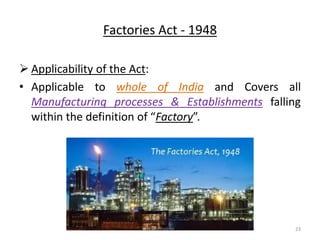
Factories Act - 1948
➢ Applicability of the Act:
• Applicable to whole of India and Covers all
Manufacturing processes & Establishments falling
within the definition of “Factory”.
Akash Padole 23
➢ Objectives of the Act:
• This Act has been come into force to Consolidate and
amend the Law Regulating the Workers working in
the factories.
• To ensure the Safeguard the interest of workers and
Protect them from exploitation, the Act prescribes
certain standards with regard to Safety, Welfare and
Working Hours of workers, apart from other
provisions.
Akash Padole 24
➢ History of Factory Act:
• The Factories Act 1948 was an “Act of Parliament”
passed in the “United Kingdom” by the Labour
Government of Clement Attlee.
• It was passed with the intention of safeguarding the
health of workers.
Akash Padole 25
THE END
Akash Padole 26

08 Construction Labors and Legislation

  • 1.
    Construction Management By Akash Padole Departmentof Civil Engineering Construction Labors & Legislation
  • 2.
    Contains 8.1 Need forlegislation & Importance of labour laws. 8.2 Acts applicable to Indian construction labours such as Payment of wages act, Minimum wages act, Workmen’s compensation act, Factories act etc. Akash Padole 2
  • 3.
    Labour law • Labourlaw is also known as Employment Law which mediates the relationship between workers, employing entities, trade unions and the government. • Collective labour law relates to the tripartite relationship between employee, employer and union. Akash Padole 3
  • 4.
    • Labour Lawis the “Body of Laws, Administrative Rulings, & Precedents” which address the Relationship between & among “Employers, Employees & Labour Organizations”, often dealing with issues of Public Law. 4
  • 5.
    • Industrial legalizationsare the laws enacted by the Government to provide Economic and Social Justice to the workers in industries. • Generally these laws provide guidelines to the employers/industrialists in dealing with the matters of wages, wage incentives, facilitates for workers and the working conditions of labour. Akash Padole 5
  • 6.
    • The termsLabour Laws & Employment Laws, are often interchanged in the usage. This has lead to a big confusion as to their meanings. • The “Final Goal” of Labour Laws is to bring both “Employer & Employee” on the same Level, thereby mitigating the differences between the two ever- warring groups. Akash Padole 6
  • 7.
    Necessity and Importanceof Labour law • Improves industrial relation i.e. employee-employer relations and minimizes industrial disputes. • Prospects workers form exploitation by the employers or management. • Helps workers in getting fair wages. • Minimizes labour unrest Akash Padole 7
  • 8.
    • Reduces conflictsand strikes, etc. • Ensures job security for workers. • Promotes welcome environment conditions in the industrial system. • Fixes rest-pauses and work hours etc. • Provides compensation to workers, who are victims of accidents. Akash Padole 8
  • 9.
    Acts applicable toIndian Construction Labours ✓ Payment Of Wages Act ✓ Minimum Wages Act ✓ Workmen’s Compensation Act ✓ Factories Act Akash Padole 9
  • 10.
  • 11.
    Payment of WagesAct - 1936 ➢ Objective of the Act:- • The “Payment of Wages Act 1936” regulates payment of wages to Employees (Direct & Indirect). • The Act is intended to be a remedy against unauthorized deductions made by the “Employer” or unjustified delay in payment of wages. • All Employees are covered under the Act, those are drawing Average wages Rs:- 10,000/- per month. Akash Padole 11
  • 12.
    ➢ Applicability ofthe Act: - • The “Payment of Wages Act 1936” is applicable to all Factories, Industrial Establishment, Tramway Service, or Motor Transport Service engaged in carrying Passengers or Goods both by road for hire or reward. • Air Transport Service, Dock, Wharf, Inland Vessel, Mechanically propelled, Mines, Quarry or Oil-Field, Plantation, Workshop or other establishment, etc. Akash Padole 12
  • 13.
    ➢ Meaning ofWages:- • “Wages” means all Remuneration expressed in terms of Money and include Remuneration payable under any Award or Settlement, Overtime Wages, Wages for Holiday & any sum payable on Termination of Employment. • However, it does not include “Bonus” which does not form part of Remuneration payable, value of House Accommodation, Contribution to PF & ESI, Traveling Allowance, or Payment of Gratuity. Akash Padole 13
  • 14.
  • 15.
    Minimum Wages Act- 1948 ➢ Objective: • To determine the minimum wages in industry and trade where labour organizations are non-existent or ineffective. ➢ Scope and Coverage: • Applicable to all employees engaged to do any work, skilled, unskilled manual or clerical, in a scheduled employment, including out-workers. Akash Padole 15
  • 16.
    ➢ Main provisions: –Fixation of minimum wage of employees – Procedure for fixing and revising minimum wages – Rights of workers Akash Padole 16
  • 17.
  • 18.
    The Workmen’s CompensationAct, 1923 ➢ ACT :- ✓ It aims to provide workmen and /or their dependents some relief in case of accidents arising out of and in the course of employment & causing either death or disablement of workmen. Akash Padole 18
  • 19.
    ➢ Objective ofthe Act :- ✓ To provide compensation to workmen incapacitated by an injury from accidents arising out of and in the course of employment. ✓ The objective of this act is that in the case of an employment injury, compensation provided to the injured workmen and in case of his death to his dependents. Akash Padole 19
  • 20.
    ➢ Coverage ofEmployees:- • All Employees of any Categories/ Capacity Irrespective of their Status or Salaries either Directly or hired through Contractor or a person recruited to work abroad for the Organization. Akash Padole 20
  • 21.
    ➢ Employer’s Liabilityat Compensation: • In case of Death or Personal injury resulting into Total or Partial Disablement or Occupational Disease caused to a workman/ Employee by accident arising out of and during the course of his employment, his Employer shall be liable to pay compensation under the Act. Akash Padole 21
  • 22.
  • 23.
    Factories Act -1948 ➢ Applicability of the Act: • Applicable to whole of India and Covers all Manufacturing processes & Establishments falling within the definition of “Factory”. Akash Padole 23
  • 24.
    ➢ Objectives ofthe Act: • This Act has been come into force to Consolidate and amend the Law Regulating the Workers working in the factories. • To ensure the Safeguard the interest of workers and Protect them from exploitation, the Act prescribes certain standards with regard to Safety, Welfare and Working Hours of workers, apart from other provisions. Akash Padole 24
  • 25.
    ➢ History ofFactory Act: • The Factories Act 1948 was an “Act of Parliament” passed in the “United Kingdom” by the Labour Government of Clement Attlee. • It was passed with the intention of safeguarding the health of workers. Akash Padole 25
  • 26.