by: Eng. Mahmoud M. Sobeh
PROCUREMENT IN CONSTRUCTION
09/12/2020
THE ISLAMIC UNIVERSITY OF GAZA
FACULTY OF ENGINEERING
CONSTRUCTION MANAGEMENT
WHAT IS PROCUREMENT?
• To acquire or purchase something.
• Project Procurement Management includes the processes necessary to
purchase or acquire products, services, or results needed from outside
the project team. (PMBOK 6th edition).
• process which creates, manages and fulfils contracts relating to the
provision of goods, services and construction works or disposals or any
combination thereof (ISO 10845)
PREFACE
• Good project management in construction means efficient utilization of labor, material
and equipment.
• Procurement system impacts project delivery methods and form of contract.
• Procurement occur during all phases of a construction project.
• The increasing scarcity of both raw materials and manufactured goods will continue to be
a challenge for the construction industry.
• Good practice will vary with the nature of the project, client, firms.
• Major procurement for a project may be handled by one organization, or it may be split
between the owner, designer, general contractor, and subcontractors.
PROCUREMENT LEVELS.
• Major equipment (long-lead items) may be procured by the owner, others
by the manager, and less critical items by each of the contractors involved
in the project.
• A general contractor may arrange for procurement materials and
equipment to be installed by his own forces.
• The job-site field office will normally procure supplies, incidental rentals,
and other requirements.
• Ethical standards are difficult to define,
• To maintain an ethical and reasonable approach, participants must have
theoretical knowledge and practical experience.
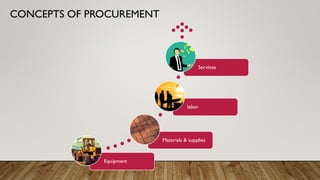
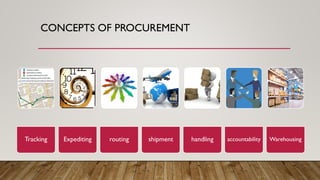
CONCEPTS OF PROCUREMENT
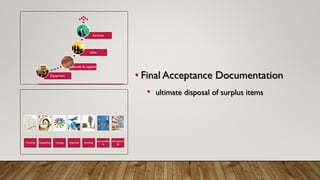
Equipment
Materials & supplies
labor
Services
CONCEPTS OF PROCUREMENT
Tracking Expediting routing shipment handling accountability Warehousing
• Final Acceptance Documentation
• ultimate disposal of surplus items
Equipment
Materials & supplies
labor
Services
Tracking Expediting routing shipment handling
accountabili
ty
Warehousi
ng
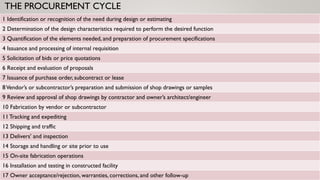
THE PROCUREMENT CYCLE
1 Identification or recognition of the need during design or estimating
2 Determination of the design characteristics required to perform the desired function
3 Quantification of the elements needed, and preparation of procurement specifications
4 Issuance and processing of internal requisition
5 Solicitation of bids or price quotations
6 Receipt and evaluation of proposals
7 Issuance of purchase order, subcontract or lease
8Vendor’s or subcontractor’s preparation and submission of shop drawings or samples
9 Review and approval of shop drawings by contractor and owner’s architect/engineer
10 Fabrication by vendor or subcontractor
11 Tracking and expediting
12 Shipping and traffic
13 Delivers' and inspection
14 Storage and handling or site prior to use
15 On-site fabrication operations
16 Installation and testing in constructed facility
17 Owner acceptance/rejection, warranties, corrections, and other follow-up
PRINCIPAL DOCUMENTS
• Prime Contract
• Subcontract
• Purchase Order
• Requisitions
• Agreements and Leases
PURCHASING AND CONTRACTING PRACTICE
Prequalification and Bid List Preparation: to ensure that the award can always be
made to the low responsive bidder, all purchasing departments develop and maintain lists of
material suppliers, specialty contractors, equipment suppliers, and other vendors.
Requests for Quotation (RFQ): shows all aspects of the proposed purchase, may be a
simple advertisement in a local journal, may be a bid package with (Specifications, Drawings,
Scope ofWork, Bills of Materials, Commercial Documents, Notice to Bidders, Proposal
Form, Contract Form,Terms and Conditions, Shipping Instructions, Schedules, Insurance
Requirements, Special Requirements, Payment and Performance Bond Form)
PURCHASING AND CONTRACTING PRACTICE
Bid Receipt end Evaluation:
public openings: Government
private open: private owners
semiprivate open: All bidders -a private meeting
Negotiations: should normally be conducted with the low bidder or others
equally in contention.
ISO 10845 Basic procurement system requirements (Fair, Equitable,Transparent,
Competitive, Cost-effective, Promotion of other objectives).
PURCHASING AND CONTRACTING PRACTICE
Recommendation for Purchase
The committees raise their recommendations to the official levels for
approval of the procurement process.
The level of approval required usually depends on the dollar value or the
potential risks associated with the transaction.
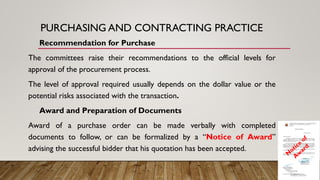
Award and Preparation of Documents
Award of a purchase order can be made verbally with completed
documents to follow, or can be formalized by a “Notice of Award”
advising the successful bidder that his quotation has been accepted.
RELATION TO OTHER CONTROL SYSTEMS
• Procurement must fit with planning and control systems
on a project.
• by merge the procurement activities with the operations
activities on a CPM diagram.
• note that in general, the procurement activities would
clearly dominate the overall schedule
REPORTING
• Reports (recurring status reports) help management to use the
procurement schedule as a reference to assure that each item is
tracking through its required steps on time.
• Where items starting to delay, special reports alert management to
take needed actions, if the operations are critical, that procurement
expediting will be necessary to bring them back or schedule.
EXPEDITING
• The essence of professional expediting is in prediction problems
before they arise and in offering solutions before delays are
occured.
• Major or critical items must be in mind by:
- periodic visits to vendors shops and factories
- frequent telephone follow-ups to check vendor progress, raw materials
supplied,..
- to be sure that the contractor have high priority among other firms.
CONTROL OF MATERIALS PROCUREMENT
• The main sources of information are documents (requisitions,
bids and quotations, purchase orders and subcontracts, shipping
documents, receiving documents, and invoices).
• In large projects, materials may be controlled by:
• 1 Requisition procedures (specs for shipping , packaging , delivery, etc.)
• 2 Minimization of rehandling and shortages
• 3 Inventory procedures and policies
• Good schedule minimize cost
INVENTORY THEORY
The general objective is to minimis total costs which is consist of:
1. Purchase costs :
1. the actual overhead incurred in requisitioning…, documented policies
2. the actual materials prices (avoid odd sized, Unit prices & quantity..)
2. Shipping costs (water<rail< truck<air, special cases must be considered)
3. Holding costs (storage space and warehouse overhead, deterioration and
obsolescence, theft, misplacement, insurance and taxes, rehandling, .)
Holding problems: materials Perishability (cement),Theft, misplacement,
4. Shortage costs (loss of sales, marketing vs supply departments, alternatives)
JUST-IN-TIME
• Just-In-Time theory was popularized by Japanese automobile companies.
• These companies came up with an ideal schedule for delivering vehicle parts
to the assembly site just in the right time without any storage costs.
• Ready-mix concrete forms a good example of a basic construction material
which by its nature must be directly incorporated into the work.
• Applications of the just-in-time principles in other construction applications
can be expected to minimize the holding costs resulting from materials being
delivered too soon, in the wrong order, and in unpredictably large quantities.
LIST OF METHODOLOGIES OF JIT MANUFACTURING:
• Housekeeping – physical organization and discipline.
• Make it right the first time – elimination of defects.
• Setup reduction – flexible changeover approaches.
• Lot sizes of one – the ultimate lot size and flexibility.
• Uniform plant load – leveling as a control mechanism.
• Balanced flow – organizing flow scheduling
throughput.
• Skill diversification – multi-functional workers.
• Control by visibility – communication media for activity.
• Preventive maintenance – flawless running, no defects.
• Fitness for use – producibility, design for process.
• Compact plant layout – product-oriented design.
• Streamlining movements – smoothing materials handling.
• Worker involvement – small group improvement activities.
DISADVANTAGES
• Store restrictions which case Difficulty in additional work.
• More planning and training is required.
• Lack of flexibility in supplies and commitment to harsh contracts
• The need for higher information technology
OPTIMUM COST ?!
• Trade-offs It should be clear by this stage that
purchase costs, holding costs, and shortage costs
are highly interrelated, especially where risk and
uncertainty are concerned, and in large measure
they are in conflict with one another.
• A great deal of research has been done to show
how their interrelationships can be modeled, and
how, at least in theory, the expected sum of their
costs can be optimized. Minimum cost
Shortage
costs
Holding
costs
Purchase
costs
REFERENCES
• PMI Standards Committee, A Guide to the Project Management Body of Knowledge,
(PMBOK Guide) 6th. Ed. Project Management Institute, USA, 2017.
• INTERNATIONAL ORGANIZATION FOR STANDARDIZATION, Construction
procurement, (ISO 10845), Switzerland. 2009
• Donald S. Barrie and Boyd C. Paulson, Professional Construction Management, 3rd.ed.,Wiley, NewYork,
1992.
• https://www.slideshare.net/theaie9/lecture-1-introduction-to-construction-procurement-process
• https://ar.wikipedia.org/wiki/%D8%A5%D9%86%D8%AA%D8%A7%D8%AC_%D9%85%D8%A8%D8%B1%D9%85%D8%AC
• https://en.wikipedia.org/wiki/Just-in-time_manufacturing
• YouTube videos:
• https://www.youtube.com/watch?v=r8jCko1L5Og&t=1s
• https://www.youtube.com/watch?v=wO37U0H3E1s
• https://www.youtube.com/channel/UCheVusUCrfa_xgdGZRGY7hw
• https://www.youtube.com/watch?v=GC7pN8Mjot8&t=2302s
THANKYOU

Procurement in construction

  • 1.
    by: Eng. MahmoudM. Sobeh PROCUREMENT IN CONSTRUCTION 09/12/2020 THE ISLAMIC UNIVERSITY OF GAZA FACULTY OF ENGINEERING CONSTRUCTION MANAGEMENT
  • 2.
    WHAT IS PROCUREMENT? •To acquire or purchase something. • Project Procurement Management includes the processes necessary to purchase or acquire products, services, or results needed from outside the project team. (PMBOK 6th edition). • process which creates, manages and fulfils contracts relating to the provision of goods, services and construction works or disposals or any combination thereof (ISO 10845)
  • 3.
    PREFACE • Good projectmanagement in construction means efficient utilization of labor, material and equipment. • Procurement system impacts project delivery methods and form of contract. • Procurement occur during all phases of a construction project. • The increasing scarcity of both raw materials and manufactured goods will continue to be a challenge for the construction industry. • Good practice will vary with the nature of the project, client, firms. • Major procurement for a project may be handled by one organization, or it may be split between the owner, designer, general contractor, and subcontractors.
  • 4.
    PROCUREMENT LEVELS. • Majorequipment (long-lead items) may be procured by the owner, others by the manager, and less critical items by each of the contractors involved in the project. • A general contractor may arrange for procurement materials and equipment to be installed by his own forces. • The job-site field office will normally procure supplies, incidental rentals, and other requirements. • Ethical standards are difficult to define, • To maintain an ethical and reasonable approach, participants must have theoretical knowledge and practical experience.
  • 5.
  • 6.
    CONCEPTS OF PROCUREMENT TrackingExpediting routing shipment handling accountability Warehousing
  • 7.
    • Final AcceptanceDocumentation • ultimate disposal of surplus items Equipment Materials & supplies labor Services Tracking Expediting routing shipment handling accountabili ty Warehousi ng
  • 8.
    THE PROCUREMENT CYCLE 1Identification or recognition of the need during design or estimating 2 Determination of the design characteristics required to perform the desired function 3 Quantification of the elements needed, and preparation of procurement specifications 4 Issuance and processing of internal requisition 5 Solicitation of bids or price quotations 6 Receipt and evaluation of proposals 7 Issuance of purchase order, subcontract or lease 8Vendor’s or subcontractor’s preparation and submission of shop drawings or samples 9 Review and approval of shop drawings by contractor and owner’s architect/engineer 10 Fabrication by vendor or subcontractor 11 Tracking and expediting 12 Shipping and traffic 13 Delivers' and inspection 14 Storage and handling or site prior to use 15 On-site fabrication operations 16 Installation and testing in constructed facility 17 Owner acceptance/rejection, warranties, corrections, and other follow-up
  • 9.
    PRINCIPAL DOCUMENTS • PrimeContract • Subcontract • Purchase Order • Requisitions • Agreements and Leases
  • 10.
    PURCHASING AND CONTRACTINGPRACTICE Prequalification and Bid List Preparation: to ensure that the award can always be made to the low responsive bidder, all purchasing departments develop and maintain lists of material suppliers, specialty contractors, equipment suppliers, and other vendors. Requests for Quotation (RFQ): shows all aspects of the proposed purchase, may be a simple advertisement in a local journal, may be a bid package with (Specifications, Drawings, Scope ofWork, Bills of Materials, Commercial Documents, Notice to Bidders, Proposal Form, Contract Form,Terms and Conditions, Shipping Instructions, Schedules, Insurance Requirements, Special Requirements, Payment and Performance Bond Form)
  • 11.
    PURCHASING AND CONTRACTINGPRACTICE Bid Receipt end Evaluation: public openings: Government private open: private owners semiprivate open: All bidders -a private meeting Negotiations: should normally be conducted with the low bidder or others equally in contention. ISO 10845 Basic procurement system requirements (Fair, Equitable,Transparent, Competitive, Cost-effective, Promotion of other objectives).
  • 12.
    PURCHASING AND CONTRACTINGPRACTICE Recommendation for Purchase The committees raise their recommendations to the official levels for approval of the procurement process. The level of approval required usually depends on the dollar value or the potential risks associated with the transaction. Award and Preparation of Documents Award of a purchase order can be made verbally with completed documents to follow, or can be formalized by a “Notice of Award” advising the successful bidder that his quotation has been accepted.
  • 13.
    RELATION TO OTHERCONTROL SYSTEMS • Procurement must fit with planning and control systems on a project. • by merge the procurement activities with the operations activities on a CPM diagram. • note that in general, the procurement activities would clearly dominate the overall schedule
  • 14.
    REPORTING • Reports (recurringstatus reports) help management to use the procurement schedule as a reference to assure that each item is tracking through its required steps on time. • Where items starting to delay, special reports alert management to take needed actions, if the operations are critical, that procurement expediting will be necessary to bring them back or schedule.
  • 15.
    EXPEDITING • The essenceof professional expediting is in prediction problems before they arise and in offering solutions before delays are occured. • Major or critical items must be in mind by: - periodic visits to vendors shops and factories - frequent telephone follow-ups to check vendor progress, raw materials supplied,.. - to be sure that the contractor have high priority among other firms.
  • 16.
    CONTROL OF MATERIALSPROCUREMENT • The main sources of information are documents (requisitions, bids and quotations, purchase orders and subcontracts, shipping documents, receiving documents, and invoices). • In large projects, materials may be controlled by: • 1 Requisition procedures (specs for shipping , packaging , delivery, etc.) • 2 Minimization of rehandling and shortages • 3 Inventory procedures and policies • Good schedule minimize cost
  • 17.
    INVENTORY THEORY The generalobjective is to minimis total costs which is consist of: 1. Purchase costs : 1. the actual overhead incurred in requisitioning…, documented policies 2. the actual materials prices (avoid odd sized, Unit prices & quantity..) 2. Shipping costs (water<rail< truck<air, special cases must be considered) 3. Holding costs (storage space and warehouse overhead, deterioration and obsolescence, theft, misplacement, insurance and taxes, rehandling, .) Holding problems: materials Perishability (cement),Theft, misplacement, 4. Shortage costs (loss of sales, marketing vs supply departments, alternatives)
  • 18.
    JUST-IN-TIME • Just-In-Time theorywas popularized by Japanese automobile companies. • These companies came up with an ideal schedule for delivering vehicle parts to the assembly site just in the right time without any storage costs. • Ready-mix concrete forms a good example of a basic construction material which by its nature must be directly incorporated into the work. • Applications of the just-in-time principles in other construction applications can be expected to minimize the holding costs resulting from materials being delivered too soon, in the wrong order, and in unpredictably large quantities.
  • 19.
    LIST OF METHODOLOGIESOF JIT MANUFACTURING: • Housekeeping – physical organization and discipline. • Make it right the first time – elimination of defects. • Setup reduction – flexible changeover approaches. • Lot sizes of one – the ultimate lot size and flexibility. • Uniform plant load – leveling as a control mechanism. • Balanced flow – organizing flow scheduling throughput. • Skill diversification – multi-functional workers. • Control by visibility – communication media for activity. • Preventive maintenance – flawless running, no defects. • Fitness for use – producibility, design for process. • Compact plant layout – product-oriented design. • Streamlining movements – smoothing materials handling. • Worker involvement – small group improvement activities.
  • 20.
    DISADVANTAGES • Store restrictionswhich case Difficulty in additional work. • More planning and training is required. • Lack of flexibility in supplies and commitment to harsh contracts • The need for higher information technology
  • 21.
    OPTIMUM COST ?! •Trade-offs It should be clear by this stage that purchase costs, holding costs, and shortage costs are highly interrelated, especially where risk and uncertainty are concerned, and in large measure they are in conflict with one another. • A great deal of research has been done to show how their interrelationships can be modeled, and how, at least in theory, the expected sum of their costs can be optimized. Minimum cost Shortage costs Holding costs Purchase costs
  • 22.
    REFERENCES • PMI StandardsCommittee, A Guide to the Project Management Body of Knowledge, (PMBOK Guide) 6th. Ed. Project Management Institute, USA, 2017. • INTERNATIONAL ORGANIZATION FOR STANDARDIZATION, Construction procurement, (ISO 10845), Switzerland. 2009 • Donald S. Barrie and Boyd C. Paulson, Professional Construction Management, 3rd.ed.,Wiley, NewYork, 1992. • https://www.slideshare.net/theaie9/lecture-1-introduction-to-construction-procurement-process • https://ar.wikipedia.org/wiki/%D8%A5%D9%86%D8%AA%D8%A7%D8%AC_%D9%85%D8%A8%D8%B1%D9%85%D8%AC • https://en.wikipedia.org/wiki/Just-in-time_manufacturing • YouTube videos: • https://www.youtube.com/watch?v=r8jCko1L5Og&t=1s • https://www.youtube.com/watch?v=wO37U0H3E1s • https://www.youtube.com/channel/UCheVusUCrfa_xgdGZRGY7hw • https://www.youtube.com/watch?v=GC7pN8Mjot8&t=2302s
  • 23.