Financial
Analysis
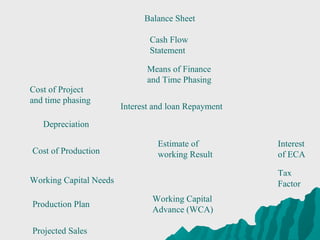
Balance Sheet

                               Cash Flow
                               Statement

                               Means of Finance
                               and Time Phasing
Cost of Project
and time phasing
                        Interest and loan Repayment

   Depreciation

                                 Estimate of          Interest
Cost of Production               working Result       of ECA

                                                      Tax
Working Capital Needs                                 Factor
                                Working Capital
Production Plan
                                Advance (WCA)

Projected Sales
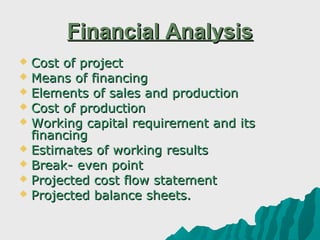
Financial Analysis
 Cost of project
 Means of financing
 Elements of sales and production
 Cost of production
 Working capital requirement and its
  financing
 Estimates of working results
 Break- even point
 Projected cost flow statement
 Projected balance sheets.
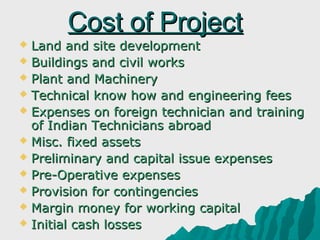
Cost of Project
 Land and site development
 Buildings and civil works
 Plant and Machinery
 Technical know how and engineering fees
 Expenses on foreign technician and training
  of Indian Technicians abroad
 Misc. fixed assets
 Preliminary and capital issue expenses
 Pre-Operative expenses
 Provision for contingencies
 Margin money for working capital
 Initial cash losses
Working Capital requirement
      and its financing

In estimating the working capital

requirement and planning for its financing,

the following points have to be borne in
mind.
1. The W.C. requirement
    consists of the following
   Raw materials and components

   WIP stock

   Stocks of finished goods

   Debtors

   Operating expenses
2. The principal sources of
working capital finance are
   The advances provided by commercial
    banks

   Trade credit

   Accruals and provisions

   Long term sources of financing
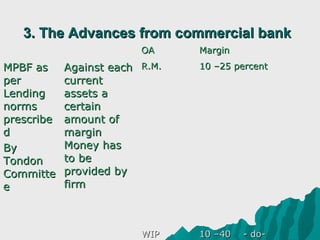
3. The Advances from commercial bank
                         OA     Margin
MPBF as     Against each R.M.   10 –25 percent
per         current
Lending     assets a
norms       certain
prescribe   amount of
d           margin
By          Money has
Tondon      to be
Committe    provided by
e           firm


                         WIP    10 –40   - do-
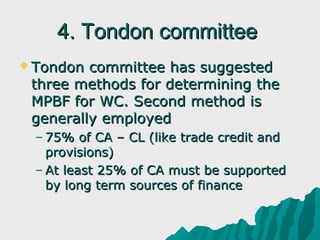
4. Tondon committee
 Tondon committee has suggested
 three methods for determining the
 MPBF for WC. Second method is
 generally employed
 – 75% of CA – CL (like trade credit and
   provisions)
 – At least 25% of CA must be supported
   by long term sources of finance
Financial Analysis based on
    Commercial profitability

Indended direct benefits of a

project is likely to achieve at the

prevailing market prices
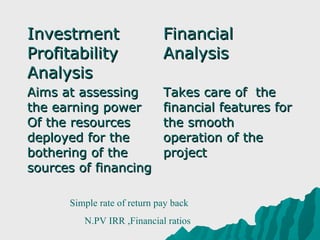
Investment                   Financial
Profitability                Analysis
Analysis
Aims at assessing            Takes care of the
the earning power            financial features for
Of the resources             the smooth
deployed for the             operation of the
bothering of the             project
sources of financing

      Simple rate of return pay back
         N.PV IRR ,Financial ratios
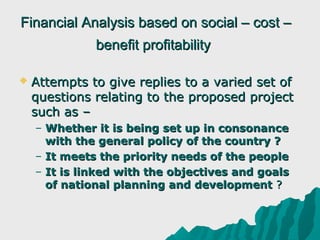
Financial Analysis based on social – cost –
              benefit profitability

   Attempts to give replies to a varied set of
    questions relating to the proposed project
    such as –
    – Whether it is being set up in consonance
      with the general policy of the country ?
    – It meets the priority needs of the people
    – It is linked with the objectives and goals
      of national planning and development ?
Financial Analysis based on
social – cost – benefit profitability
– It is fitted in to overall economics
  and social development of the
  country ?

– Who will benefit from the project ?

– Who will hurt from the project ?

– What are the requirements for the
  local people to
  contribute/participate in the project
  ?
Parameters which should weigh
     while selecting site
 Size  and cost of land
 Raw materials

 Utilities electricity, water, sanitary
  and sewerage services etc
 Manpower

 Transport facility – Sea, air, rail-road
 Incentivesand concessions –
 control and state Govt. provide –

  – Loans, capital subsidy and
    assistance
  – Transport subsidy on a/c of
    transport cost of raw materials and
    finished products between the
    selected rail-heads
  – Income-tax exemptions extendable
    up to first 10 A.Y.
  – Purchase of machinery on hire
    purchase basis
– Preferential treatment for import of raw
  materials
– Price preference on Govt. purchases
– Sales tax and other tax exemptions
– Uninterrupted supply of power at
  concessional rates
– Concessional finance
– Land acquisition and industrial estates
  development on lease and subsidized
  rent basis
– Assistance to technical entrepreneurs in
  form of loans
– Investment subsidy to the units located
  in backward areas
– Extending export support
i.   Environmental considerations-

i.   Climatic    and    Natural    hazard
     considerations temperature, humidity
     etc/cool and dry

i.   Technological Aspects – technology
     has to be selected in a way that it has
     a low running cost, cheap and easy
     maintenance, High productivity per
     unit of    capital and other scarce
     resources
Demand and supply Analysis –
        Research Methods
   Sampling scheme and its size taking care
    of   constraints    of    time  resources,
    reliability and accuracy of data –
    combination of different methods like
    quota      sampling,    random,    cluster
    systematic, stratified etc.

   Make use of mailed questionnaire,
    personal interviews, telephone interviews
    etc.

   Data collected has been   obtained through
    primary and secondary     sources – has to
    be processed analysed     and interpreted
    and presented in the       form of tables,
    charts graphs etc.
(C) Economic Analysis – determines
the viability of a project over a period of
                    time


 Capitalcost
 Working capital requirements

 Operating costs
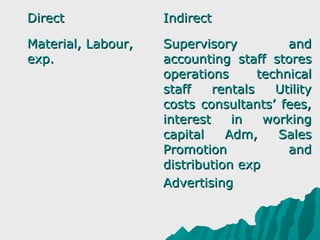
Direct              Indirect

Material, Labour,   Supervisory           and
exp.                accounting staff stores
                    operations       technical
                    staff    rentals    Utility
                    costs consultants’ fees,
                    interest    in    working
                    capital    Adm,     Sales
                    Promotion             and
                    distribution exp
                    Advertising
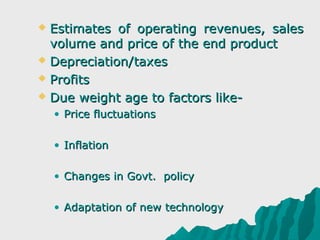
 Estimates of operating revenues, sales
  volume and price of the end product
 Depreciation/taxes

 Profits

 Due weight age to factors like-

    • Price fluctuations

    • Inflation

    • Changes in Govt. policy

    • Adaptation of new technology
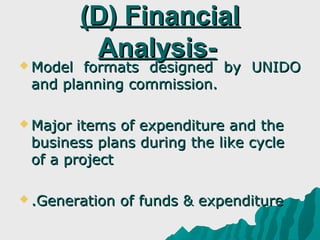
(D) Financial
 Model
           Analysis-
        formats designed by UNIDO
 and planning commission.

 Major items of expenditure and the
 business plans during the like cycle
 of a project

 .Generation   of funds & expenditure
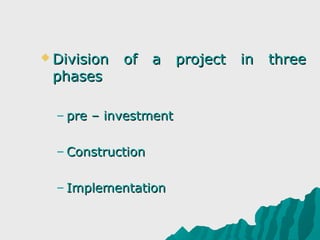
 Division   of    a   project   in   three
 phases

  – pre – investment

  – Construction

  – Implementation
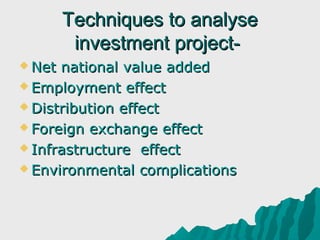
Techniques to analyse
         investment project-
 Net national value added
 Employment effect

 Distribution effect

 Foreign exchange effect

 Infrastructure effect

 Environmental complications
 All
    these details regarding Technical
 Economic,      Financial    Commercial,
 Organizational, Managerial, Social,
 Environmental when put together in
 one document known as pre-
 investment report, project report,
 feasibility reports the like.
Planning commission guidelines
  (1992)
insist that instead of the term
  feasibility report
 the term detailed FR should be used
  to
facilitate the proper appraisal of the
investment.
 The proposal to prepare feasibility
 report is considered by public
 investment Board (PIB)- It consists
 of    secretary  expenditure      as
 chairman.
 Secretary   Planning    commission
 and

 Secretary   of   adm.   Ministry   as
 members

 Project  appraisal attempts to
 consolidate the result of exercises
 made at various levels, from
 different angles on various aspects
 of the project.
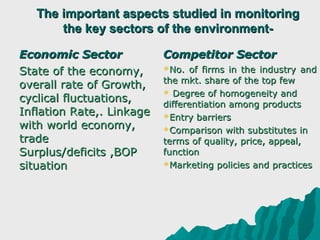
The important aspects studied in monitoring
       the key sectors of the environment-

Economic Sector            Competitor Sector
State of the economy,      No.  of firms in the industry and
                           the mkt. share of the top few
overall rate of Growth,
                            Degree of homogeneity and
cyclical fluctuations,     differentiation among products
Inflation Rate,. Linkage   Entry barriers
with world economy,        Comparison with substitutes in
trade                      terms of quality, price, appeal,
Surplus/deficits ,BOP      function
situation                  Marketing policies and practices
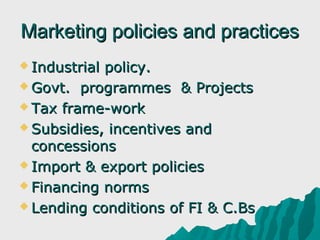
Marketing policies and practices
 Industrialpolicy.
 Govt. programmes & Projects

 Tax frame-work

 Subsidies, incentives and
  concessions
 Import & export policies

 Financing norms

 Lending conditions of FI & C.Bs
Cash Flows From Long Term
             Funds
   This method is based on the
    assumption that funds invested in a
    project come from both equity share
    holders and long term lenders.

   When calculating net cash flows using
    this method; the interest paid on long
    term loans is excluded. The rationale
    for this approach is that the net cash
    flows are defined from the view point
    of suppliers of long term funds.
   Hence the post tax cost of funds is
    used as the interest rate for
    discounting.

   The post tax cost of long term funds
    obviously includes the post tax cost of
    long term debt.

   Therefore, if the interest on long term
    debt is considered for the purpose of
    determining net cash flows, an error
    due to double counting would occur.
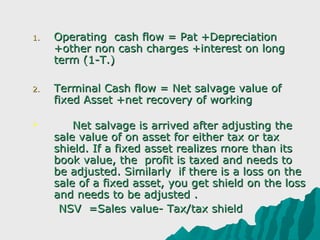
1.   Operating cash flow = Pat +Depreciation
     +other non cash charges +interest on long
     term (1-T.)

2.   Terminal Cash flow = Net salvage value of
     fixed Asset +net recovery of working

        Net salvage is arrived after adjusting the
     sale value of on asset for either tax or tax
     shield. If a fixed asset realizes more than its
     book value, the profit is taxed and needs to
     be adjusted. Similarly if there is a loss on the
     sale of a fixed asset, you get shield on the loss
     and needs to be adjusted .
      NSV =Sales value- Tax/tax shield
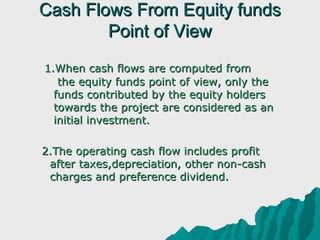
Cash Flows From Equity funds
           Point of View
     1.When cash flows are computed from 
         the equity funds point of view, only the
        funds contributed by the equity holders
        towards the project are considered as an
        initial investment.

      2.The operating cash flow includes profit
        after taxes,depreciation, other non-cash
        charges and preference dividend.
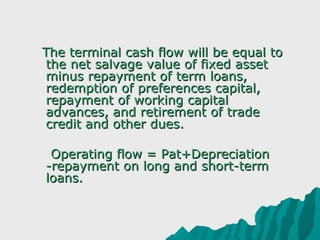
    The terminal cash flow will be equal to 
     the net salvage value of fixed asset 
     minus repayment of term loans, 
     redemption of preferences capital, 
     repayment of working capital 
     advances, and retirement of trade 
     credit and other dues.
       
      Operating flow = Pat+Depreciation
     -repayment on long and short-term 
     loans.
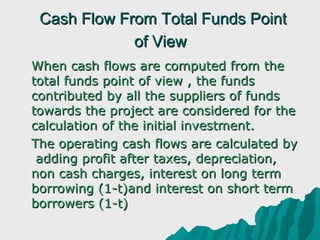
Cash Flow From Total Funds Point
                of View
 When cash flows are computed from the 
  total funds point of view , the funds 
  contributed by all the suppliers of funds 
  towards the project are considered for the 
  calculation of the initial investment.
 The operating cash flows are calculated by 
   adding profit after taxes, depreciation, 
  non cash charges, interest on long term 
  borrowing (1-t)and interest on short term 
  borrowers (1-t)
         The terminal cash flow will be 
  equal
         to the net salvage value of 
  fixed asset
         and net recovery of W.C. 
  margin. 
          Operating flow = Pat 
  +depreciation +
       interest on long and short term 
  loans(1-t)
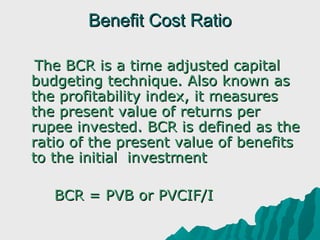
Benefit Cost Ratio

   The BCR is a time adjusted capital 
  budgeting technique. Also known as 
  the profitability index, it measures 
  the present value of returns per 
  rupee invested. BCR is defined as the 
  ratio of the present value of benefits 
  to the initial  investment 
 
       BCR = PVB or PVCIF/I
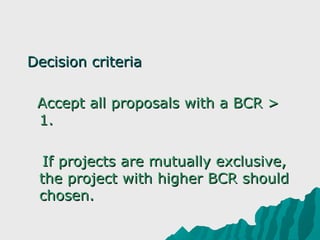
Decision criteria 
 
  Accept all proposals with a BCR > 
  1.

   If projects are mutually exclusive, 
  the project with higher BCR should 
  chosen. 
Capital Rationing Among
        Multiple Project
 An Enterprise may be planning to 
 invest in two or more project  while 
 the funds available may be 
 insufficient to take up all the project 
 for implementation, though all 
 project are considered good for 
 investment(if it satisfies any one of 
 the following investment criteria.)
 The NPV is positive

 The IRR > cost of capital

 The PI > 1.00

 The BCR > 1.00
 Capital Rationing may be defined 
 as the process of judiciously 
 allocating the available 
 demarcated funds towards the 
 capital.The capital outlay of two or 
 more project that are considered 
 good for investment, in such a way 
 that the return on investment is 
 maximized.

5 financial new

  • 1.
  • 2.
    Balance Sheet Cash Flow Statement Means of Finance and Time Phasing Cost of Project and time phasing Interest and loan Repayment Depreciation Estimate of Interest Cost of Production working Result of ECA Tax Working Capital Needs Factor Working Capital Production Plan Advance (WCA) Projected Sales
  • 3.
    Financial Analysis  Costof project  Means of financing  Elements of sales and production  Cost of production  Working capital requirement and its financing  Estimates of working results  Break- even point  Projected cost flow statement  Projected balance sheets.
  • 4.
    Cost of Project Land and site development  Buildings and civil works  Plant and Machinery  Technical know how and engineering fees  Expenses on foreign technician and training of Indian Technicians abroad  Misc. fixed assets  Preliminary and capital issue expenses  Pre-Operative expenses  Provision for contingencies  Margin money for working capital  Initial cash losses
  • 5.
    Working Capital requirement and its financing In estimating the working capital requirement and planning for its financing, the following points have to be borne in mind.
  • 6.
    1. The W.C.requirement consists of the following  Raw materials and components  WIP stock  Stocks of finished goods  Debtors  Operating expenses
  • 7.
    2. The principalsources of working capital finance are  The advances provided by commercial banks  Trade credit  Accruals and provisions  Long term sources of financing
  • 8.
    3. The Advancesfrom commercial bank OA Margin MPBF as Against each R.M. 10 –25 percent per current Lending assets a norms certain prescribe amount of d margin By Money has Tondon to be Committe provided by e firm WIP 10 –40 - do-
  • 9.
    4. Tondon committee Tondon committee has suggested three methods for determining the MPBF for WC. Second method is generally employed – 75% of CA – CL (like trade credit and provisions) – At least 25% of CA must be supported by long term sources of finance
  • 10.
    Financial Analysis basedon Commercial profitability Indended direct benefits of a project is likely to achieve at the prevailing market prices
  • 11.
    Investment Financial Profitability Analysis Analysis Aims at assessing Takes care of the the earning power financial features for Of the resources the smooth deployed for the operation of the bothering of the project sources of financing Simple rate of return pay back N.PV IRR ,Financial ratios
  • 12.
    Financial Analysis basedon social – cost – benefit profitability  Attempts to give replies to a varied set of questions relating to the proposed project such as – – Whether it is being set up in consonance with the general policy of the country ? – It meets the priority needs of the people – It is linked with the objectives and goals of national planning and development ?
  • 13.
    Financial Analysis basedon social – cost – benefit profitability – It is fitted in to overall economics and social development of the country ? – Who will benefit from the project ? – Who will hurt from the project ? – What are the requirements for the local people to contribute/participate in the project ?
  • 14.
    Parameters which shouldweigh while selecting site  Size and cost of land  Raw materials  Utilities electricity, water, sanitary and sewerage services etc  Manpower  Transport facility – Sea, air, rail-road
  • 15.
     Incentivesand concessions– control and state Govt. provide – – Loans, capital subsidy and assistance – Transport subsidy on a/c of transport cost of raw materials and finished products between the selected rail-heads – Income-tax exemptions extendable up to first 10 A.Y. – Purchase of machinery on hire purchase basis
  • 16.
    – Preferential treatmentfor import of raw materials – Price preference on Govt. purchases – Sales tax and other tax exemptions – Uninterrupted supply of power at concessional rates – Concessional finance – Land acquisition and industrial estates development on lease and subsidized rent basis – Assistance to technical entrepreneurs in form of loans – Investment subsidy to the units located in backward areas – Extending export support
  • 17.
    i. Environmental considerations- i. Climatic and Natural hazard considerations temperature, humidity etc/cool and dry i. Technological Aspects – technology has to be selected in a way that it has a low running cost, cheap and easy maintenance, High productivity per unit of capital and other scarce resources
  • 18.
    Demand and supplyAnalysis – Research Methods  Sampling scheme and its size taking care of constraints of time resources, reliability and accuracy of data – combination of different methods like quota sampling, random, cluster systematic, stratified etc.  Make use of mailed questionnaire, personal interviews, telephone interviews etc.  Data collected has been obtained through primary and secondary sources – has to be processed analysed and interpreted and presented in the form of tables, charts graphs etc.
  • 19.
    (C) Economic Analysis– determines the viability of a project over a period of time  Capitalcost  Working capital requirements  Operating costs
  • 20.
    Direct Indirect Material, Labour, Supervisory and exp. accounting staff stores operations technical staff rentals Utility costs consultants’ fees, interest in working capital Adm, Sales Promotion and distribution exp Advertising
  • 21.
     Estimates ofoperating revenues, sales volume and price of the end product  Depreciation/taxes  Profits  Due weight age to factors like- • Price fluctuations • Inflation • Changes in Govt. policy • Adaptation of new technology
  • 22.
    (D) Financial  Model Analysis- formats designed by UNIDO and planning commission.  Major items of expenditure and the business plans during the like cycle of a project  .Generation of funds & expenditure
  • 23.
     Division of a project in three phases – pre – investment – Construction – Implementation
  • 24.
    Techniques to analyse investment project-  Net national value added  Employment effect  Distribution effect  Foreign exchange effect  Infrastructure effect  Environmental complications
  • 25.
     All these details regarding Technical Economic, Financial Commercial, Organizational, Managerial, Social, Environmental when put together in one document known as pre- investment report, project report, feasibility reports the like.
  • 26.
    Planning commission guidelines (1992) insist that instead of the term feasibility report the term detailed FR should be used to facilitate the proper appraisal of the investment.
  • 27.
     The proposalto prepare feasibility report is considered by public investment Board (PIB)- It consists of secretary expenditure as chairman.
  • 28.
     Secretary Planning commission and  Secretary of adm. Ministry as members  Project appraisal attempts to consolidate the result of exercises made at various levels, from different angles on various aspects of the project.
  • 29.
    The important aspectsstudied in monitoring the key sectors of the environment- Economic Sector Competitor Sector State of the economy, No. of firms in the industry and the mkt. share of the top few overall rate of Growth,  Degree of homogeneity and cyclical fluctuations, differentiation among products Inflation Rate,. Linkage Entry barriers with world economy, Comparison with substitutes in trade terms of quality, price, appeal, Surplus/deficits ,BOP function situation Marketing policies and practices
  • 30.
    Marketing policies andpractices  Industrialpolicy.  Govt. programmes & Projects  Tax frame-work  Subsidies, incentives and concessions  Import & export policies  Financing norms  Lending conditions of FI & C.Bs
  • 31.
    Cash Flows FromLong Term Funds  This method is based on the assumption that funds invested in a project come from both equity share holders and long term lenders.  When calculating net cash flows using this method; the interest paid on long term loans is excluded. The rationale for this approach is that the net cash flows are defined from the view point of suppliers of long term funds.
  • 32.
    Hence the post tax cost of funds is used as the interest rate for discounting.  The post tax cost of long term funds obviously includes the post tax cost of long term debt.  Therefore, if the interest on long term debt is considered for the purpose of determining net cash flows, an error due to double counting would occur.
  • 33.
    1. Operating cash flow = Pat +Depreciation +other non cash charges +interest on long term (1-T.) 2. Terminal Cash flow = Net salvage value of fixed Asset +net recovery of working  Net salvage is arrived after adjusting the sale value of on asset for either tax or tax shield. If a fixed asset realizes more than its book value, the profit is taxed and needs to be adjusted. Similarly if there is a loss on the sale of a fixed asset, you get shield on the loss and needs to be adjusted . NSV =Sales value- Tax/tax shield
  • 34.
    Cash Flows FromEquity funds Point of View      1.When cash flows are computed from         the equity funds point of view, only the       funds contributed by the equity holders       towards the project are considered as an       initial investment.       2.The operating cash flow includes profit      after taxes,depreciation, other non-cash      charges and preference dividend.
  • 35.
        The terminal cash flow will be equal to  the net salvage value of fixed asset  minus repayment of term loans,  redemption of preferences capital,  repayment of working capital  advances, and retirement of trade  credit and other dues.               Operating flow = Pat+Depreciation -repayment on long and short-term  loans.
  • 36.
    Cash Flow FromTotal Funds Point of View  When cash flows are computed from the  total funds point of view , the funds  contributed by all the suppliers of funds  towards the project are considered for the  calculation of the initial investment.  The operating cash flows are calculated by   adding profit after taxes, depreciation,  non cash charges, interest on long term  borrowing (1-t)and interest on short term  borrowers (1-t)
  • 37.
             The terminal cash flow will be  equal        to the net salvage value of  fixed asset        and net recovery of W.C.  margin.          Operating flow = Pat  +depreciation +      interest on long and short term  loans(1-t)
  • 38.
    Benefit Cost Ratio    The BCR is a time adjusted capital  budgeting technique. Also known as  the profitability index, it measures  the present value of returns per  rupee invested. BCR is defined as the  ratio of the present value of benefits  to the initial  investment           BCR = PVB or PVCIF/I
  • 39.
  • 40.
    Capital Rationing Among Multiple Project  An Enterprise may be planning to  invest in two or more project  while  the funds available may be  insufficient to take up all the project  for implementation, though all  project are considered good for  investment(if it satisfies any one of  the following investment criteria.)
  • 41.
  • 42.
     Capital Rationing may be defined  as the process of judiciously  allocating the available  demarcated funds towards the  capital.The capital outlay of two or  more project that are considered  good for investment, in such a way  that the return on investment is  maximized.