Investment Decisions/Capital
Budgeting
Capital Budgeting
• Capital budgeting is the process of making investment
decision relating to capital expenditure.
• A capital expenditure may be defined as an expenditure the
benefits of which are expected to be received over period of time
exceeding one year.
• Capital expenditure is incurred in one point of time whereas
benefits of expenditure are realised in different periods of time
in future.
Meaning
❑ Capital Budgeting is the process of allocating the resources of
the organisation in the long term investment projects to generate
profit.
❑ It is the process of identifying, analysing and selecting
investment projects whose returns are expected over a series of
years in future.
Eg: A company makes a decision to invest in a new project of Rs
100 crore expecting Rs 20 crore extra profit per year for 10 years.
Features of Capital Budgeting
1. Funds are invested for long term activities.
2. It involves huge outlays.
3. Current funds are exchanged for future benefits
4. The benefits are expected over a number of years in
future.
5. It involves a high degree of risk.
6. They are not easily reversible.
7. Gestation period(i.e. Period between the initial outlay
and anticipated return) is long.
Need and importance of capital budgeting
Capital Budgeting is concerned with heavy expenditure decisions.
The benefits of such expenditure is expected to be derived from
many years in future.
Importance
1. Huge investment
2. Irreversible decision or reversible at substantial loss
3. Long term implication:
4. Huge risk:
5. Growth
6. It has impact on firm’s competitive strength
7.Most difficult decision: Capital budgeting decisions are very
difficult to make due to:
a) uncertainty of future
b) decisions are based on estimate about future years’ cash flows
c)More risk
d) The benefits and cost are affected by economic, political and technological forces
8. Long Term Commitment of funds
9. National Importance: It determines employment, economic
activities and economic growth.
Limitations of Capital Budgeting Decisions
1. The benefits are received in future. These are uncertain.
Therefore an element of risk is involved.
2. Some factors affecting investment proposals cannot be expressed
in money value. Eg: employees morale, skill, etc.
3. It is very difficult to estimate the period for which investment is
made.
4. It is very difficult to estimate the rate of return and cost of capital.
5. If the capital budgeting decisions go wrong, it may create serious
consequences on the firm’s liquidity, profitability, etc.
Types of Investment Decisions
1. Expansion and diversification: A company may
add capacity to its existing product lines to expand
existing operations. Similarly a firm may expand
its activities in a new business.
2. Replacement and modernisation: The main
objective of modernisation and replacement is to
improve operating efficiency and reduce costs.
Steps in Capital Budgeting/Capital Budgeting Process
It is a 6 step complex process
1. Project identification/generation: It involves continuous search for compatible
investment opportunities.
2. Project screening: Each project is then subject to a preliminary screening process
in order to assess whether it is technically feasible, resources required are
available and the expected returns are adequate to compensate the risks involved.
3. Project evaluation: After screening, the next step is to evaluate profitability of
each proposal.
This involves two steps:
a) estimation of costs and benefits in terms of cash flows, and
b) selecting an appropriate criterion to judge the desirability of the
project.
There are many methods which may be used for this purpose such as pay back
method, net present value method, Internal rate of return, etc.
4. Project selection: Next step is to select and approve the best
proposal.
5. Project execution and implementation: The selected project is
implemented next. This means that the proposal in paper becomes
a reality.
6. Performance review: The projects implemented must be reviewed
at regular intervals to watch the progress and take corrective
action, if required.
Estimation of cash flows
• For a capital budgeting decision, it is necessary to estimate cash
outflows and cash inflows.
• Cash outflow means investment. It is known as cost.
• Cash inflow means benefits.
• Thus, cash flow includes cost and benefits.
• On the basis of the cost-benefit analysis, the profitable project is
selected. So, cost and benefits( or cash flows) are required to be
estimated first.
• Estimation of future cash flows of a project is one of the most
important steps in capital budgeting to estimate the profitability of
the projects.
Considerations in determining cash flows
1. Cash flows or accounting profit: Theoretically, these two criteria are
available to express benefits.
2. Incremental cash flows: For capital budgeting decision only incremental
cash flow is to be considered. Incremental cash flows are those cash
flows which are directly affected by the investment decision.
3. Time value of money and inflation should be considered.
4. Effect of change in working capital should be considered.
5. Effect of tax: Cash flows after tax should be considered.
6. Effect of depreciation should also be considered.
7. Proceeding from sale of assets should be treated as cash inflow, if the
new assets is purchased to replace an existing asset.
8. Effect of overhead costs and other indirect expenses should be
considered only if they change when the project is accepted.
Types of cash flows
There are three types of cash flows:
1. Initial cash flow(Initial investment): It is the investment required
in the beginning a new project. In the case of replacement
projects, the scrap value should be deducted from the cost of
new asset.
2. Net annual cash inflows or operating cash flows: The initial
investment is expected generate a series of cash inflows from the
project. These cash inflows are called net annual cash inflows.
This may occur by two means (a) additional revenue (b) cash
saving operations. The annual cash flows should be adjusted for
taxes, depreciation, etc.
3. Terminal cash inflows: It is the cash inflows for the terminal year
of the project. It includes scrap value and working capital which
was invested in the beginning but not required further as the
project is terminated.
Other information required for capital budgeting decision
Apart from cash flows, the following information is required for
capital budgeting decision
1. Required Rate of return: An investment proposal is accepted
when the return estimated is more than the required rate of
return. It is also called cost of capita or cut off rate or hurdle
rate
2. Other information: Economic life of the project, available fund
and risk of obsolescence.
Investment appraisal methods/Techniques of capital budgeting
• Investment appraisal (Project appraisal) is the assessment of a
project to know whether it is worthwhile to invest money in it.
It is a tool to examine as to whether it would be most realistic,
reliable and reasonable to invest resources in the project.
Techniques of capital budgeting can be classified into two broad
categories:
1. Traditional Methods or Non-discounted cash flow Techniques
2. Modern Methods or Discounted Cash Flow Techniques.
Techniques of capital budgeting
1. Traditional Methods or Non-discounted cash flow Techniques
a) Urgency Method
b) Pay back Method (Profit after tax and before depreciation is
considered)
c) Accounting Rate of Return Method (Accounting profit is considered)
2. Modern Methods or Discounted cash flow Techniques.
a) Discounted Pay Back Method
b) Net Present Value Method
c) Benefit Cost Ratio(Profitability Index)
d) Internal Rate of Return
e) Net Terminal Value Method.
Traditional Methods or Non-discounted Cash flow
Techniques
Traditional Methods do not take into consideration the time value
of money.
a) Urgency Method: This method is used to justify the acceptance
of capital projects on the basis of emergency requirement or
under crisis conditions. Urgency or degree of necessity plays an
important role and the project that cannot be postponed is
undertaken first. Most urgent project is taken up first.
It is a very simple technique. The main demerits of this method
are: it is not based on scientific analysis and selection of the
project is not made on the base of economical consideration.
b) Pay Back Period Method
Pay back period is the number of years required to recover the
cost of the investment.
This method measures the period of time required to recover
the original cost of a project from the additional earnings of the
project.
Under this method, various investments are ranked according
to the length of their pay back period. The investment with a
shorter pay back period is preferred to the one which has longer
pay back period.
1. When annual cash inflows are equal:
Payback period=Original cost of the project(initial cash outlay) ÷ annual net
cash inflow
Eg: If a project involves a cash outlay or Rs 500000 and generates cash inflow
of Rs 100,000 for 7 years, pay back period will be:
Payback period: Rs 500,000 ÷ Rs 100,000= 5 years
2. When annual cash inflows are not equal
Here, Payback period is calculated by cumulating the net cash inflows until
the original investment is recovered. It is ascertained by cumulating cash
inflows till the time when the cumulative cash inflows become equal to
initial investment .
Eg:1) If the cost of the project is Rs 100,000 and the net cash flows are: 1st year-
10000,2nd year-15000, 3rd year – 25000, 4th year-30000, 5th year 20000,6th year-
50000
10000+15000+25000+30000+20000=100000
5 years
How to determine Pay Back Period
Suitability of Payback method
Payback method is appropriate in the following cases:
1. When the cost of the project is comparatively small.
2. When the project is likely to be completed in short period.
3. When only limited funds are available.
4. When the cash earning capacity of the company is low.
5. When there is a chance of obsolescence due to technological
development
Important Note: Under payback period method cash inflow means
operating profit before depreciation but after tax.
Decision Rule: The shorter the payback period the better the project.
Advantages
1. It is simple to understand and easy to apply
2. It is helpful to business which lack the appropriate skills necessary for
more sophisticated techniques.
3. It is very important for cash forecasting, budgeting and cash flow
analysis
4. This method can be used profitably for short term capital projects
which start yielding returns in the initial years.
5. In case of capital rationing, a company is compelled to invest in
projects having shortest payback period. In such cases, this method
can be used.
6. This method is most suitable when the project is very uncertain.
7. It does not involve assumptions about future interest rates.
8. It helps to minimise the possibility of losses through obsolescence.
9. It is useful to firms when experiencing liquidity constraints.
Disadvantages of traditional payback approach
1. It ignores the time value of money and cost of capital.
2. It completely ignores cash inflows after the payback period.
3. It fails to consider the whole life time of a project.
4. It does not measure the rate of return.
5. It does not measure profitability of projects. It insists only on
recovery of the cost of the project.
6. It does not consider the salvage value of an investment.
7. This method makes no attempt to measure a percentage return
on the capital invested and is often used in conjunction with
other methods.
Modern Pay Back Period Methods
Following are some of the most popular improvements to
traditional payback period concept.
a)Post pay back profitability method
b)Post pay back period method
c)Pay back reciprocals
a)Post pay back profitability method
• Under this method, entire cash inflows generated from a project
during its working life are taken into account. It is calculated as
under:
Post payback profitability=Total cash inflows in life- initial cost
If cost of various projects differs substantially, post payback
profitability index may be calculated to relative profitability of the
projects as below:
b)Post back profitability
Post back profitability=Total cash flows in life- initial cost
Project A:
(8X20000)-100000=60000
Project B:
[(3x3000)+(5x1000)]-100000= 40000
b)Post pay back period method
• This method takes into account the
period beyond a project’s payback
period.
•This method is also known as ‘surplus
life over payback method.
•Under this method, the project with
longer post payback period is preferred.
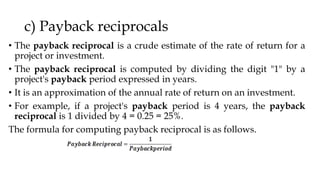
c) Payback reciprocals
• The payback reciprocal is a crude estimate of the rate of return for a
project or investment.
• The payback reciprocal is computed by dividing the digit "1" by a
project's payback period expressed in years.
• It is an approximation of the annual rate of return on an investment.
• For example, if a project's payback period is 4 years, the payback
reciprocal is 1 divided by 4 = 0.25 = 25%.
The formula for computing payback reciprocal is as follows.
c)Accounting rate of return Method.
•This method takes into account the earnings from
the investment over its whole life.
•It is based on accounting profit and not on cash
flows. That is, annual earnings after depreciation
and taxes are used to calculate ARR.
•This method is also known as unadjusted rate of
return method.
• In this method, most often the following two formulae are applied:
1. Average Rate of Return on average investment method
2. Average Rate of Return on Net investment method.
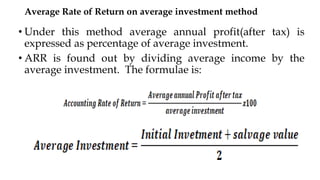
Average Rate of Return on average investment method
• Under this method average annual profit(after tax) is
expressed as percentage of average investment.
• ARR is found out by dividing average income by the
average investment. The formulae is:
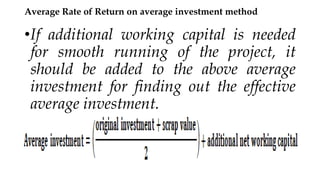
Average Rate of Return on average investment method
•If additional working capital is needed
for smooth running of the project, it
should be added to the above average
investment for finding out the effective
average investment.
Average Rate of Return on Net investment method.
The following formulae is also used fro finding out ARR.
Of the various ARR on different alternative proposals, the one having
highest rate of return is taken to be the best investment proposal.
Of the mutually exclusive projects, the project with highest ARR is
selected.
If only one project is under consideration and ARR is more than
targeted rate or return, the project is accepted. Other wise, rejected.
If two or more projects are compared:
•Project having highest ARR is taken to be
the best investment proposal.
If only one project is under consideration:
•If ARR is more than targeted rate or return,
the project is accepted. Other wise, rejected.
Evaluation of Projects by using ARR
Advantages of ARR
1. Simplicity: It is simple to understand and easy to apply
2. Entire Life covered: It takes into consideration earnings over the
entire life of the project
3. Accounting Profitability : It considers profitability of the investment
4. Comparison of projects: Projects of different character can be
compared quickly by use of ranking.
5. Accounting data: Rate of return can be readily calculated with the
help of accounting data. It is not concerned with cash flows but
rather based upon profits which are reported in annual accounts
and sent to shareholders
Disadvantages of ARR
1. Time value ignored: It does not take into account time value of money.
2. No differentiation in investment: It does not differentiate the size of the
investment required for each project. Competing investment proposals
with the same ARR may require different amount of investment
3. Cash flow ignored: It is based upon accounting profit instead of cash
flow.
4. It ignores possibility of profit re-investment: It ignores the fact that
profit can be reinvested.
5. It consider average rate of return only : It consider the average rate of
return but not the deviations in return over the life of the project.
Discounted Cashflow techniques (Time
adjusted cash flow techniques)
•Payback and ARR does not consider the time
value of money
•But in fact, the value of money received in future
is not equivalent to the value of money invested
today.
•This limitation can be overcome by using
discounted cashflow techniques which consider
time value of money.
Features of Discounted cash flow technique:
1. It consider time value of money
2. Cash flows are used instead of accounting
profit
3. Interest factor is considered
4. Entire cash flows of a project throughout the
life are considered.
a)Discounted Pay Back Method
b)Net Present Value Method
c)Benefit Cost Ratio/Profitability
Index Method
d)Internal Rate of Return
e)Net Terminal Value Method
2. Modern Methods or Discounted Cash Flow Techniques.
a)Discounted Pay Back Method
• In this modified method, cash flows are first converted into
their present values by applying suitable discounting factors
and then added to ascertain the period of time required to
recover the initial outlay on the project.
Qn
• Investment Rs 80000, discount rate 10%, Cash flows are
17600, 20400, 23200,26000 & 31,600
• Calculate discounted pay back period
b)Net Present Value Method
•Under this method, all future cash inflows and cash
outflows are discounted to present values by using
firm’s cost of capital or a predetermined rate.
•Then the present values of cash outflows is deducted
from the sum of present value of cash inflows. The
balance amount is the Net Present Value(NPV).
•NPV=
Present value of Cash Inflows – Present
value of cash outflows
b)Net Present Value Method
• NPV may be either positive or zero or negative.
• Positive NPV indicates that the actual rate of return is more
than the discount rate(cost of capital or predetermined rate
or desired rate). When NPV is positive or zero, the proposal
should be accepted.
• Negative NPV indicates that the actual rate of return is less
than the discount rate(cost of capital or predetermined rate).
When NPV is negative, the proposal should be rejected.
• If two or more projects are compared, project having the
maximum positive NPV is selected.
Steps to be followed under NPV method.
1. Determination of an appropriate rate of return/discount rate:
It should be the minimum required rate of return called cut off
rate or discount rate. The discount rate should be either the
actual rate of interest on long term loans or it should be the
opportunity cost of capital of the investor.
2. Computation of Present Value of cash inflows(profit before
depreciation and after tax) with the help of discount rate
3. Computation of Present Value of total investment outlay (cash
outflows) with the help of discount rate. If the total investment
is to be made in the initial year, the present value shall be the
same as the cost of investment.
Steps to be followed under NPV method.
4. Calculate the net present value of each project
by subtracting the present value of cash inflows
from the value of cash outflows for each project.
5. Decision
•If the NPV is zero or positive, the proposal may be
accepted, otherwise the proposal should be
rejected.
•To select mutually exclusive projects, the project
having the maximum positive net present value
should be rejected.
Treatment of working capital requirement of the project
•If additional working capital is required for the project in the
beginning, it should be added to the initial investment. If it
is required subsequently(eg: 3rd year) after commencement
of the project, its present value should be worked out. Then
the present value is added to the initial investment.
•This treatment is done because we assume that funds
initially tied up in working capital (additional working
capital) would be released only in the last year when the
investment is terminated.
Advantages of the NPV Method
1. It recognises the time value of money.
2. It is suitable to be applied in a situation with uniform or uneven
cash flows or cash flows at different periods of time.
3. It takes into account the earnings over the entire life of the project
4. It takes into consideration the objective of maximum profitability
5. NPV of different projects can be added. Eg: Project A’s NPV is Rs 20
lakh, Project B’s NPV is is Rs 12 lakh. If both projects are selected,
NPV will be equal to Rs 32 lakh.
Disadvantages of NPV Method
1. Difficult to operate: As compared to the traditional methods, the
NPV method is more difficult to understand and operate.
2. It may not give good results while comparing projects with
unequal lives. This is because the project having higher net present
value but realised in a longer life span may not be as desirable as a
project having something lesser NPV achieved in a much shorter
span of life of the asset.
3. It may not give good results while comparing projects with unequal
investment of funds.
4. It is not easy to determine an appropriate discount rate.
Benefit Cost Ratio(Profitability Index Method)
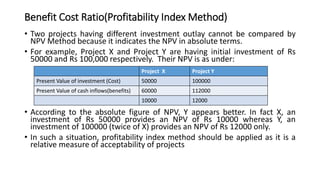
• Two projects having different investment outlay cannot be compared by
NPV Method because it indicates the NPV in absolute terms.
• For example, Project X and Project Y are having initial investment of Rs
50000 and Rs 100,000 respectively. Their NPV is as under:
• According to the absolute figure of NPV, Y appears better. In fact X, an
investment of Rs 50000 provides an NPV of Rs 10000 whereas Y, an
investment of 100000 (twice of X) provides an NPV of Rs 12000 only.
• In such a situation, profitability index method should be applied as it is a
relative measure of acceptability of projects
Project X Project Y
Present Value of investment (Cost) 50000 100000
Present Value of cash inflows(benefits) 60000 112000
10000 12000
Benefit Cost Ratio(Profitability Index Method)..contd
• It is the ratio of present value of cash inflows to the present value of
cash outflows.
• It is the ratio of present value of benefits to cost.
• It is particularly useful to compare the projects having different
investment outlays.
• It is computed as follows:
• It can be also expressed as Net Present Value Index as below.
Decision Rule
• If Profitability Index is more than 1, it can be accepted.
• If Profitability Index is less than 1, it should be rejected
• In the case of mutually exclusive projects, the project with higher
Profitability Index is to be selected.
• Higher the profitability Index, better is the project.
Internal Rate of Return (IRR) Method
• Internal Rate of Return is the rate of return
(discount rate) at which the present value of
cash inflows is equal to the present value of
cash outflows.
•In other words, it is the discount rate at which
NPV is zero.
•It is first introduced by Joel Dean.
Internal Rate of Return (IRR) Method
•In order to find out the rate of return of a
project, estimated net cash inflows of each
year are discounted at various rates till a rate
is obtained at which the present value of
cash inflow is equal to the initial investment.
•It is also called time adjusted rate of return.
Calculation of IRR
a)When cash flows are equal:
It can be explained with the help of an example.
Project cost Rs 6000, expected cash inflow of Rs 2000, life 5 years
Step 1: First of all a rough approximation may be made with reference to
Present Value Annuity Factor. This is calculated by the following formula.
Here, PVAF is 6000÷2000=3
• Step 2: Search for the value of PVAF in the PVAF Table(Table II) for the
given number of years. If PVAF is found in the table II, the
corresponding rate will be the IRR.
If not found, search for the value nearest to PV of Annuity Factor in
the given year row of PVAF Table(Table II). The rate given in the
column of the nearest PV Factor will be the approximate IRR.
In the given example, the PVAF for 5 years nearest to 3 is 2.991 and
3.127. Corresponding discount rates are 20% and 18%. Hence, the IRR
falls between 18 % and 20%. Since, the value 2.991 is nearer to 3, IRR
will be approximate 20%.
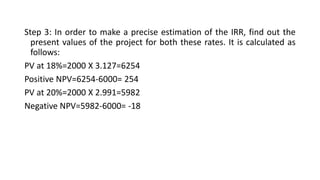
Step 3: In order to make a precise estimation of the IRR, find out the
present values of the project for both these rates. It is calculated as
follows:
PV at 18%=2000 X 3.127=6254
Positive NPV=6254-6000= 254
PV at 20%=2000 X 2.991=5982
Negative NPV=5982-6000= -18
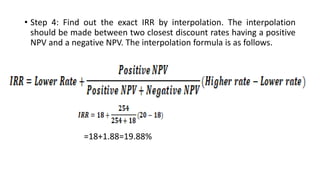
• Step 4: Find out the exact IRR by interpolation. The interpolation
should be made between two closest discount rates having a positive
NPV and a negative NPV. The interpolation formula is as follows.
=18+1.88=19.88%
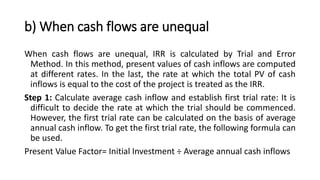
b) When cash flows are unequal
When cash flows are unequal, IRR is calculated by Trial and Error
Method. In this method, present values of cash inflows are computed
at different rates. In the last, the rate at which the total PV of cash
inflows is equal to the cost of the project is treated as the IRR.
Step 1: Calculate average cash inflow and establish first trial rate: It is
difficult to decide the rate at which the trial should be commenced.
However, the first trial rate can be calculated on the basis of average
annual cash inflow. To get the first trial rate, the following formula can
be used.
Present Value Factor= Initial Investment ÷ Average annual cash inflows
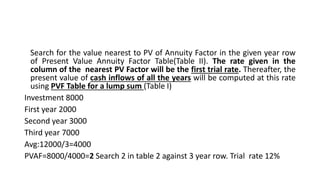
Search for the value nearest to PV of Annuity Factor in the given year row
of Present Value Annuity Factor Table(Table II). The rate given in the
column of the nearest PV Factor will be the first trial rate. Thereafter, the
present value of cash inflows of all the years will be computed at this rate
using PVF Table for a lump sum (Table I)
Investment 8000
First year 2000
Second year 3000
Third year 7000
Avg:12000/3=4000
PVAF=8000/4000=2 Search 2 in table 2 against 3 year row. Trial rate 12%
Step II: The total of the present value of cash inflows for all years
calculated by first trial rate will be compared with the cost of the
project.
If the NPV at the first rate comes positive, a higher rate should be tried.
If the NPV comes negatives, a lower rate should be tried. This exercise
is done till the NPV comes to zero. Since this is tedious, interpolation
should be applied as shown below:
Step 3. Computation of actual IRR: Application of interpolation.
Advantages of IRR
1. This method considers all the cash flows over the entire life of the
project.
2. It takes into account time value of money
3. IRR gives true picture of the profitability of the project
4. It is consistent with the shareholder wealth maximisation objective.
Whenever, IRR is greater than opportunity cost of capital, the
shareholders’ wealth will be enhances.
Disadvantages
1. The IRR method is difficult to understand and use in practice
because it involves tedious and complicated calculation.
2. This method does not consider important factors like project
duration, future costs, or the size of the project.
3. Value additivity principle does not hold good when IRR method is
used. Eg: Project A’s IRR is 20%, Project B’s IRR is 12%. If both
projects are selected, IRR will not be equal to 20+12.
4. It does not take into account liquidity issues of the organisation.
5. It does not give the details of absolute return but gives percentage
return.
Net Terminal Value Method
This method is based on the assumption that each annual cash inflow
(profit after tax but before depreciation) is received at the end of the
year and is reinvested in another asset at a certain rate of return from
the moment it is received till the termination of the project.
Then, the total compounded sum is discounted a the discount factor
of the last year (cost of capital) and present value is found out. This
present value is compared with cost of the project. The excess of the
present value over the cost of the project is the Net Terminal Value.
Hence, in NTV method both compounding and discounting technique
are used
Future Value of 1 Table
Decision Criterion
When NTV is positive or zero, the proposal should be accepted in the
case of independent projects.
When NTV is negative, the proposal should be rejected in the case of
independent projects..
To select between mutually exclusive projects(where only one project is
to be selected), projects should be ranked in order of NTV.ie. The first
preference should be given to the project having the maximum
positive NTV
Risk Analysis in Capital Budgeting
•Risk in an investment refers to the variability that is likely
to arise in future between the estimated returns and the
actual returns from the investment proposal
•It is very essential to make risk analysis of investment
proposals before the management goes ahead with the
project.
•Acceptability of projects mainly depends upon their
returns and risk.
•Generally, return and risk are positively
correlated(moving in same direction).
•A firm should consider risk while estimating
the required rate of return on a project.
Before investing funds in a project, it is
necessary to consider the risk and return
associated with all the alternative
investment options.
•The process of comparing the risk and
returns to select the most profitable
investment proposal is known as risk-return
analysis.
Methods of Risk analysis
1. Risk Adjusted Discount Rate
2.Certainty equivalent method
1.Risk Adjusted Discount Rate
Generally, if there is more risk in an investment
proposal, a higher rate of return will be expected.
Under this Risk Adjusted Discount Rate Technique,
some adjustment will be made in discount rate.
This is done according to the degree of risk
associated with the project. If risk is high the
discount rate is raised(adding risk premium to
discount rate).
1.Risk Adjusted Discount Rate
Eg: If the Management desires a rate of
return of 12%. If the project is more risky, a
risk premium, say, 3% may be added to the
12% to provide for risk. Thus risk adjusted
discount rate is 15%. This means that cash
flows will be discounted by 15%.
•Eg: If there are two projects and one project
is having more risk than the other one,
higher risk premium may added to risk free
rate in the case of riskier project and lower
risk premium may be added to risk free rate
in the other case
•Risk adjusted discount rate is equal to risk
free rate of return + risk premium for
investment in a risky project.
•Decision Rule: The risk adjusted rate
of discount can be used both in NPV
and IRR. If NPV is used, the project
with higher NPV will be selected.
• In the case of IRR, the project with
the IRR greater than the risk
adjusted rate of return are selected.
2. Certainty Equivalent method.
•Under this method, the risk involved in the project is
taken into consideration by adjusting the expected cash
flows.
•cash flows are reduced to a certain level by using a
Certainty Equivalent coefficient’. It is the ratio of risk free
cash flow to risky cash flow. It is ascertained as under:
Risk free cash flow/Risky cash flow.
It will be less than 1
Steps
1. Calculate Certainty Equivalent coefficient’. It is
the ratio of risk free cash flow to risky cash flow.
It is ascertained as under:
Risk free cash flow/Risky cash flow.
2. Calculate Risk adjusted cash flow for each year
by multiplying cash flow with Certainty Equivalent
Coefficient.
Steps
3. Find the present value of risk adjusted cash
flow for each year
4. Obtain the total of present value of all years
5. Find the NPV of the project
6. Taking the decision.(Project with higher
positive NPV will be selected.

module 2 capital budgeting.pdf financial management

  • 1.
  • 2.
    Capital Budgeting • Capitalbudgeting is the process of making investment decision relating to capital expenditure. • A capital expenditure may be defined as an expenditure the benefits of which are expected to be received over period of time exceeding one year. • Capital expenditure is incurred in one point of time whereas benefits of expenditure are realised in different periods of time in future.
  • 3.
    Meaning ❑ Capital Budgetingis the process of allocating the resources of the organisation in the long term investment projects to generate profit. ❑ It is the process of identifying, analysing and selecting investment projects whose returns are expected over a series of years in future. Eg: A company makes a decision to invest in a new project of Rs 100 crore expecting Rs 20 crore extra profit per year for 10 years.
  • 4.
    Features of CapitalBudgeting 1. Funds are invested for long term activities. 2. It involves huge outlays. 3. Current funds are exchanged for future benefits 4. The benefits are expected over a number of years in future. 5. It involves a high degree of risk. 6. They are not easily reversible. 7. Gestation period(i.e. Period between the initial outlay and anticipated return) is long.
  • 5.
    Need and importanceof capital budgeting Capital Budgeting is concerned with heavy expenditure decisions. The benefits of such expenditure is expected to be derived from many years in future. Importance 1. Huge investment 2. Irreversible decision or reversible at substantial loss 3. Long term implication: 4. Huge risk: 5. Growth
  • 6.
    6. It hasimpact on firm’s competitive strength 7.Most difficult decision: Capital budgeting decisions are very difficult to make due to: a) uncertainty of future b) decisions are based on estimate about future years’ cash flows c)More risk d) The benefits and cost are affected by economic, political and technological forces 8. Long Term Commitment of funds 9. National Importance: It determines employment, economic activities and economic growth.
  • 7.
    Limitations of CapitalBudgeting Decisions 1. The benefits are received in future. These are uncertain. Therefore an element of risk is involved. 2. Some factors affecting investment proposals cannot be expressed in money value. Eg: employees morale, skill, etc. 3. It is very difficult to estimate the period for which investment is made. 4. It is very difficult to estimate the rate of return and cost of capital. 5. If the capital budgeting decisions go wrong, it may create serious consequences on the firm’s liquidity, profitability, etc.
  • 8.
    Types of InvestmentDecisions 1. Expansion and diversification: A company may add capacity to its existing product lines to expand existing operations. Similarly a firm may expand its activities in a new business. 2. Replacement and modernisation: The main objective of modernisation and replacement is to improve operating efficiency and reduce costs.
  • 9.
    Steps in CapitalBudgeting/Capital Budgeting Process It is a 6 step complex process 1. Project identification/generation: It involves continuous search for compatible investment opportunities. 2. Project screening: Each project is then subject to a preliminary screening process in order to assess whether it is technically feasible, resources required are available and the expected returns are adequate to compensate the risks involved. 3. Project evaluation: After screening, the next step is to evaluate profitability of each proposal. This involves two steps: a) estimation of costs and benefits in terms of cash flows, and b) selecting an appropriate criterion to judge the desirability of the project. There are many methods which may be used for this purpose such as pay back method, net present value method, Internal rate of return, etc.
  • 10.
    4. Project selection:Next step is to select and approve the best proposal. 5. Project execution and implementation: The selected project is implemented next. This means that the proposal in paper becomes a reality. 6. Performance review: The projects implemented must be reviewed at regular intervals to watch the progress and take corrective action, if required.
  • 11.
    Estimation of cashflows • For a capital budgeting decision, it is necessary to estimate cash outflows and cash inflows. • Cash outflow means investment. It is known as cost. • Cash inflow means benefits. • Thus, cash flow includes cost and benefits. • On the basis of the cost-benefit analysis, the profitable project is selected. So, cost and benefits( or cash flows) are required to be estimated first. • Estimation of future cash flows of a project is one of the most important steps in capital budgeting to estimate the profitability of the projects.
  • 12.
    Considerations in determiningcash flows 1. Cash flows or accounting profit: Theoretically, these two criteria are available to express benefits. 2. Incremental cash flows: For capital budgeting decision only incremental cash flow is to be considered. Incremental cash flows are those cash flows which are directly affected by the investment decision. 3. Time value of money and inflation should be considered. 4. Effect of change in working capital should be considered. 5. Effect of tax: Cash flows after tax should be considered. 6. Effect of depreciation should also be considered. 7. Proceeding from sale of assets should be treated as cash inflow, if the new assets is purchased to replace an existing asset. 8. Effect of overhead costs and other indirect expenses should be considered only if they change when the project is accepted.
  • 13.
    Types of cashflows There are three types of cash flows: 1. Initial cash flow(Initial investment): It is the investment required in the beginning a new project. In the case of replacement projects, the scrap value should be deducted from the cost of new asset. 2. Net annual cash inflows or operating cash flows: The initial investment is expected generate a series of cash inflows from the project. These cash inflows are called net annual cash inflows. This may occur by two means (a) additional revenue (b) cash saving operations. The annual cash flows should be adjusted for taxes, depreciation, etc. 3. Terminal cash inflows: It is the cash inflows for the terminal year of the project. It includes scrap value and working capital which was invested in the beginning but not required further as the project is terminated.
  • 14.
    Other information requiredfor capital budgeting decision Apart from cash flows, the following information is required for capital budgeting decision 1. Required Rate of return: An investment proposal is accepted when the return estimated is more than the required rate of return. It is also called cost of capita or cut off rate or hurdle rate 2. Other information: Economic life of the project, available fund and risk of obsolescence.
  • 15.
    Investment appraisal methods/Techniquesof capital budgeting • Investment appraisal (Project appraisal) is the assessment of a project to know whether it is worthwhile to invest money in it. It is a tool to examine as to whether it would be most realistic, reliable and reasonable to invest resources in the project. Techniques of capital budgeting can be classified into two broad categories: 1. Traditional Methods or Non-discounted cash flow Techniques 2. Modern Methods or Discounted Cash Flow Techniques.
  • 16.
    Techniques of capitalbudgeting 1. Traditional Methods or Non-discounted cash flow Techniques a) Urgency Method b) Pay back Method (Profit after tax and before depreciation is considered) c) Accounting Rate of Return Method (Accounting profit is considered) 2. Modern Methods or Discounted cash flow Techniques. a) Discounted Pay Back Method b) Net Present Value Method c) Benefit Cost Ratio(Profitability Index) d) Internal Rate of Return e) Net Terminal Value Method.
  • 17.
    Traditional Methods orNon-discounted Cash flow Techniques Traditional Methods do not take into consideration the time value of money. a) Urgency Method: This method is used to justify the acceptance of capital projects on the basis of emergency requirement or under crisis conditions. Urgency or degree of necessity plays an important role and the project that cannot be postponed is undertaken first. Most urgent project is taken up first. It is a very simple technique. The main demerits of this method are: it is not based on scientific analysis and selection of the project is not made on the base of economical consideration.
  • 18.
    b) Pay BackPeriod Method Pay back period is the number of years required to recover the cost of the investment. This method measures the period of time required to recover the original cost of a project from the additional earnings of the project. Under this method, various investments are ranked according to the length of their pay back period. The investment with a shorter pay back period is preferred to the one which has longer pay back period.
  • 19.
    1. When annualcash inflows are equal: Payback period=Original cost of the project(initial cash outlay) ÷ annual net cash inflow Eg: If a project involves a cash outlay or Rs 500000 and generates cash inflow of Rs 100,000 for 7 years, pay back period will be: Payback period: Rs 500,000 ÷ Rs 100,000= 5 years 2. When annual cash inflows are not equal Here, Payback period is calculated by cumulating the net cash inflows until the original investment is recovered. It is ascertained by cumulating cash inflows till the time when the cumulative cash inflows become equal to initial investment . Eg:1) If the cost of the project is Rs 100,000 and the net cash flows are: 1st year- 10000,2nd year-15000, 3rd year – 25000, 4th year-30000, 5th year 20000,6th year- 50000 10000+15000+25000+30000+20000=100000 5 years How to determine Pay Back Period
  • 20.
    Suitability of Paybackmethod Payback method is appropriate in the following cases: 1. When the cost of the project is comparatively small. 2. When the project is likely to be completed in short period. 3. When only limited funds are available. 4. When the cash earning capacity of the company is low. 5. When there is a chance of obsolescence due to technological development Important Note: Under payback period method cash inflow means operating profit before depreciation but after tax. Decision Rule: The shorter the payback period the better the project.
  • 21.
    Advantages 1. It issimple to understand and easy to apply 2. It is helpful to business which lack the appropriate skills necessary for more sophisticated techniques. 3. It is very important for cash forecasting, budgeting and cash flow analysis 4. This method can be used profitably for short term capital projects which start yielding returns in the initial years. 5. In case of capital rationing, a company is compelled to invest in projects having shortest payback period. In such cases, this method can be used. 6. This method is most suitable when the project is very uncertain. 7. It does not involve assumptions about future interest rates. 8. It helps to minimise the possibility of losses through obsolescence. 9. It is useful to firms when experiencing liquidity constraints.
  • 22.
    Disadvantages of traditionalpayback approach 1. It ignores the time value of money and cost of capital. 2. It completely ignores cash inflows after the payback period. 3. It fails to consider the whole life time of a project. 4. It does not measure the rate of return. 5. It does not measure profitability of projects. It insists only on recovery of the cost of the project. 6. It does not consider the salvage value of an investment. 7. This method makes no attempt to measure a percentage return on the capital invested and is often used in conjunction with other methods.
  • 23.
    Modern Pay BackPeriod Methods Following are some of the most popular improvements to traditional payback period concept. a)Post pay back profitability method b)Post pay back period method c)Pay back reciprocals
  • 24.
    a)Post pay backprofitability method • Under this method, entire cash inflows generated from a project during its working life are taken into account. It is calculated as under: Post payback profitability=Total cash inflows in life- initial cost If cost of various projects differs substantially, post payback profitability index may be calculated to relative profitability of the projects as below:
  • 25.
    b)Post back profitability Postback profitability=Total cash flows in life- initial cost Project A: (8X20000)-100000=60000 Project B: [(3x3000)+(5x1000)]-100000= 40000
  • 26.
    b)Post pay backperiod method • This method takes into account the period beyond a project’s payback period. •This method is also known as ‘surplus life over payback method. •Under this method, the project with longer post payback period is preferred.
  • 27.
    c) Payback reciprocals •The payback reciprocal is a crude estimate of the rate of return for a project or investment. • The payback reciprocal is computed by dividing the digit "1" by a project's payback period expressed in years. • It is an approximation of the annual rate of return on an investment. • For example, if a project's payback period is 4 years, the payback reciprocal is 1 divided by 4 = 0.25 = 25%. The formula for computing payback reciprocal is as follows.
  • 28.
    c)Accounting rate ofreturn Method. •This method takes into account the earnings from the investment over its whole life. •It is based on accounting profit and not on cash flows. That is, annual earnings after depreciation and taxes are used to calculate ARR. •This method is also known as unadjusted rate of return method. • In this method, most often the following two formulae are applied: 1. Average Rate of Return on average investment method 2. Average Rate of Return on Net investment method.
  • 29.
    Average Rate ofReturn on average investment method • Under this method average annual profit(after tax) is expressed as percentage of average investment. • ARR is found out by dividing average income by the average investment. The formulae is:
  • 30.
    Average Rate ofReturn on average investment method •If additional working capital is needed for smooth running of the project, it should be added to the above average investment for finding out the effective average investment.
  • 31.
    Average Rate ofReturn on Net investment method. The following formulae is also used fro finding out ARR. Of the various ARR on different alternative proposals, the one having highest rate of return is taken to be the best investment proposal. Of the mutually exclusive projects, the project with highest ARR is selected. If only one project is under consideration and ARR is more than targeted rate or return, the project is accepted. Other wise, rejected.
  • 32.
    If two ormore projects are compared: •Project having highest ARR is taken to be the best investment proposal. If only one project is under consideration: •If ARR is more than targeted rate or return, the project is accepted. Other wise, rejected. Evaluation of Projects by using ARR
  • 33.
    Advantages of ARR 1.Simplicity: It is simple to understand and easy to apply 2. Entire Life covered: It takes into consideration earnings over the entire life of the project 3. Accounting Profitability : It considers profitability of the investment 4. Comparison of projects: Projects of different character can be compared quickly by use of ranking. 5. Accounting data: Rate of return can be readily calculated with the help of accounting data. It is not concerned with cash flows but rather based upon profits which are reported in annual accounts and sent to shareholders
  • 34.
    Disadvantages of ARR 1.Time value ignored: It does not take into account time value of money. 2. No differentiation in investment: It does not differentiate the size of the investment required for each project. Competing investment proposals with the same ARR may require different amount of investment 3. Cash flow ignored: It is based upon accounting profit instead of cash flow. 4. It ignores possibility of profit re-investment: It ignores the fact that profit can be reinvested. 5. It consider average rate of return only : It consider the average rate of return but not the deviations in return over the life of the project.
  • 35.
    Discounted Cashflow techniques(Time adjusted cash flow techniques) •Payback and ARR does not consider the time value of money •But in fact, the value of money received in future is not equivalent to the value of money invested today. •This limitation can be overcome by using discounted cashflow techniques which consider time value of money.
  • 36.
    Features of Discountedcash flow technique: 1. It consider time value of money 2. Cash flows are used instead of accounting profit 3. Interest factor is considered 4. Entire cash flows of a project throughout the life are considered.
  • 37.
    a)Discounted Pay BackMethod b)Net Present Value Method c)Benefit Cost Ratio/Profitability Index Method d)Internal Rate of Return e)Net Terminal Value Method 2. Modern Methods or Discounted Cash Flow Techniques.
  • 38.
    a)Discounted Pay BackMethod • In this modified method, cash flows are first converted into their present values by applying suitable discounting factors and then added to ascertain the period of time required to recover the initial outlay on the project. Qn • Investment Rs 80000, discount rate 10%, Cash flows are 17600, 20400, 23200,26000 & 31,600 • Calculate discounted pay back period
  • 39.
    b)Net Present ValueMethod •Under this method, all future cash inflows and cash outflows are discounted to present values by using firm’s cost of capital or a predetermined rate. •Then the present values of cash outflows is deducted from the sum of present value of cash inflows. The balance amount is the Net Present Value(NPV). •NPV= Present value of Cash Inflows – Present value of cash outflows
  • 40.
    b)Net Present ValueMethod • NPV may be either positive or zero or negative. • Positive NPV indicates that the actual rate of return is more than the discount rate(cost of capital or predetermined rate or desired rate). When NPV is positive or zero, the proposal should be accepted. • Negative NPV indicates that the actual rate of return is less than the discount rate(cost of capital or predetermined rate). When NPV is negative, the proposal should be rejected. • If two or more projects are compared, project having the maximum positive NPV is selected.
  • 41.
    Steps to befollowed under NPV method. 1. Determination of an appropriate rate of return/discount rate: It should be the minimum required rate of return called cut off rate or discount rate. The discount rate should be either the actual rate of interest on long term loans or it should be the opportunity cost of capital of the investor. 2. Computation of Present Value of cash inflows(profit before depreciation and after tax) with the help of discount rate 3. Computation of Present Value of total investment outlay (cash outflows) with the help of discount rate. If the total investment is to be made in the initial year, the present value shall be the same as the cost of investment.
  • 42.
    Steps to befollowed under NPV method. 4. Calculate the net present value of each project by subtracting the present value of cash inflows from the value of cash outflows for each project. 5. Decision •If the NPV is zero or positive, the proposal may be accepted, otherwise the proposal should be rejected. •To select mutually exclusive projects, the project having the maximum positive net present value should be rejected.
  • 43.
    Treatment of workingcapital requirement of the project •If additional working capital is required for the project in the beginning, it should be added to the initial investment. If it is required subsequently(eg: 3rd year) after commencement of the project, its present value should be worked out. Then the present value is added to the initial investment. •This treatment is done because we assume that funds initially tied up in working capital (additional working capital) would be released only in the last year when the investment is terminated.
  • 44.
    Advantages of theNPV Method 1. It recognises the time value of money. 2. It is suitable to be applied in a situation with uniform or uneven cash flows or cash flows at different periods of time. 3. It takes into account the earnings over the entire life of the project 4. It takes into consideration the objective of maximum profitability 5. NPV of different projects can be added. Eg: Project A’s NPV is Rs 20 lakh, Project B’s NPV is is Rs 12 lakh. If both projects are selected, NPV will be equal to Rs 32 lakh.
  • 45.
    Disadvantages of NPVMethod 1. Difficult to operate: As compared to the traditional methods, the NPV method is more difficult to understand and operate. 2. It may not give good results while comparing projects with unequal lives. This is because the project having higher net present value but realised in a longer life span may not be as desirable as a project having something lesser NPV achieved in a much shorter span of life of the asset. 3. It may not give good results while comparing projects with unequal investment of funds. 4. It is not easy to determine an appropriate discount rate.
  • 46.
    Benefit Cost Ratio(ProfitabilityIndex Method) • Two projects having different investment outlay cannot be compared by NPV Method because it indicates the NPV in absolute terms. • For example, Project X and Project Y are having initial investment of Rs 50000 and Rs 100,000 respectively. Their NPV is as under: • According to the absolute figure of NPV, Y appears better. In fact X, an investment of Rs 50000 provides an NPV of Rs 10000 whereas Y, an investment of 100000 (twice of X) provides an NPV of Rs 12000 only. • In such a situation, profitability index method should be applied as it is a relative measure of acceptability of projects Project X Project Y Present Value of investment (Cost) 50000 100000 Present Value of cash inflows(benefits) 60000 112000 10000 12000
  • 47.
    Benefit Cost Ratio(ProfitabilityIndex Method)..contd • It is the ratio of present value of cash inflows to the present value of cash outflows. • It is the ratio of present value of benefits to cost. • It is particularly useful to compare the projects having different investment outlays. • It is computed as follows: • It can be also expressed as Net Present Value Index as below.
  • 48.
    Decision Rule • IfProfitability Index is more than 1, it can be accepted. • If Profitability Index is less than 1, it should be rejected • In the case of mutually exclusive projects, the project with higher Profitability Index is to be selected. • Higher the profitability Index, better is the project.
  • 49.
    Internal Rate ofReturn (IRR) Method • Internal Rate of Return is the rate of return (discount rate) at which the present value of cash inflows is equal to the present value of cash outflows. •In other words, it is the discount rate at which NPV is zero. •It is first introduced by Joel Dean.
  • 50.
    Internal Rate ofReturn (IRR) Method •In order to find out the rate of return of a project, estimated net cash inflows of each year are discounted at various rates till a rate is obtained at which the present value of cash inflow is equal to the initial investment. •It is also called time adjusted rate of return.
  • 51.
    Calculation of IRR a)Whencash flows are equal: It can be explained with the help of an example. Project cost Rs 6000, expected cash inflow of Rs 2000, life 5 years Step 1: First of all a rough approximation may be made with reference to Present Value Annuity Factor. This is calculated by the following formula. Here, PVAF is 6000÷2000=3
  • 52.
    • Step 2:Search for the value of PVAF in the PVAF Table(Table II) for the given number of years. If PVAF is found in the table II, the corresponding rate will be the IRR. If not found, search for the value nearest to PV of Annuity Factor in the given year row of PVAF Table(Table II). The rate given in the column of the nearest PV Factor will be the approximate IRR. In the given example, the PVAF for 5 years nearest to 3 is 2.991 and 3.127. Corresponding discount rates are 20% and 18%. Hence, the IRR falls between 18 % and 20%. Since, the value 2.991 is nearer to 3, IRR will be approximate 20%.
  • 53.
    Step 3: Inorder to make a precise estimation of the IRR, find out the present values of the project for both these rates. It is calculated as follows: PV at 18%=2000 X 3.127=6254 Positive NPV=6254-6000= 254 PV at 20%=2000 X 2.991=5982 Negative NPV=5982-6000= -18
  • 54.
    • Step 4:Find out the exact IRR by interpolation. The interpolation should be made between two closest discount rates having a positive NPV and a negative NPV. The interpolation formula is as follows. =18+1.88=19.88%
  • 55.
    b) When cashflows are unequal When cash flows are unequal, IRR is calculated by Trial and Error Method. In this method, present values of cash inflows are computed at different rates. In the last, the rate at which the total PV of cash inflows is equal to the cost of the project is treated as the IRR. Step 1: Calculate average cash inflow and establish first trial rate: It is difficult to decide the rate at which the trial should be commenced. However, the first trial rate can be calculated on the basis of average annual cash inflow. To get the first trial rate, the following formula can be used. Present Value Factor= Initial Investment ÷ Average annual cash inflows
  • 56.
    Search for thevalue nearest to PV of Annuity Factor in the given year row of Present Value Annuity Factor Table(Table II). The rate given in the column of the nearest PV Factor will be the first trial rate. Thereafter, the present value of cash inflows of all the years will be computed at this rate using PVF Table for a lump sum (Table I) Investment 8000 First year 2000 Second year 3000 Third year 7000 Avg:12000/3=4000 PVAF=8000/4000=2 Search 2 in table 2 against 3 year row. Trial rate 12%
  • 57.
    Step II: Thetotal of the present value of cash inflows for all years calculated by first trial rate will be compared with the cost of the project. If the NPV at the first rate comes positive, a higher rate should be tried. If the NPV comes negatives, a lower rate should be tried. This exercise is done till the NPV comes to zero. Since this is tedious, interpolation should be applied as shown below:
  • 58.
    Step 3. Computationof actual IRR: Application of interpolation.
  • 59.
    Advantages of IRR 1.This method considers all the cash flows over the entire life of the project. 2. It takes into account time value of money 3. IRR gives true picture of the profitability of the project 4. It is consistent with the shareholder wealth maximisation objective. Whenever, IRR is greater than opportunity cost of capital, the shareholders’ wealth will be enhances.
  • 60.
    Disadvantages 1. The IRRmethod is difficult to understand and use in practice because it involves tedious and complicated calculation. 2. This method does not consider important factors like project duration, future costs, or the size of the project. 3. Value additivity principle does not hold good when IRR method is used. Eg: Project A’s IRR is 20%, Project B’s IRR is 12%. If both projects are selected, IRR will not be equal to 20+12. 4. It does not take into account liquidity issues of the organisation. 5. It does not give the details of absolute return but gives percentage return.
  • 61.
    Net Terminal ValueMethod This method is based on the assumption that each annual cash inflow (profit after tax but before depreciation) is received at the end of the year and is reinvested in another asset at a certain rate of return from the moment it is received till the termination of the project. Then, the total compounded sum is discounted a the discount factor of the last year (cost of capital) and present value is found out. This present value is compared with cost of the project. The excess of the present value over the cost of the project is the Net Terminal Value. Hence, in NTV method both compounding and discounting technique are used
  • 62.
  • 63.
    Decision Criterion When NTVis positive or zero, the proposal should be accepted in the case of independent projects. When NTV is negative, the proposal should be rejected in the case of independent projects.. To select between mutually exclusive projects(where only one project is to be selected), projects should be ranked in order of NTV.ie. The first preference should be given to the project having the maximum positive NTV
  • 64.
    Risk Analysis inCapital Budgeting •Risk in an investment refers to the variability that is likely to arise in future between the estimated returns and the actual returns from the investment proposal •It is very essential to make risk analysis of investment proposals before the management goes ahead with the project. •Acceptability of projects mainly depends upon their returns and risk. •Generally, return and risk are positively correlated(moving in same direction).
  • 65.
    •A firm shouldconsider risk while estimating the required rate of return on a project. Before investing funds in a project, it is necessary to consider the risk and return associated with all the alternative investment options. •The process of comparing the risk and returns to select the most profitable investment proposal is known as risk-return analysis.
  • 66.
    Methods of Riskanalysis 1. Risk Adjusted Discount Rate 2.Certainty equivalent method
  • 67.
    1.Risk Adjusted DiscountRate Generally, if there is more risk in an investment proposal, a higher rate of return will be expected. Under this Risk Adjusted Discount Rate Technique, some adjustment will be made in discount rate. This is done according to the degree of risk associated with the project. If risk is high the discount rate is raised(adding risk premium to discount rate).
  • 68.
    1.Risk Adjusted DiscountRate Eg: If the Management desires a rate of return of 12%. If the project is more risky, a risk premium, say, 3% may be added to the 12% to provide for risk. Thus risk adjusted discount rate is 15%. This means that cash flows will be discounted by 15%.
  • 69.
    •Eg: If thereare two projects and one project is having more risk than the other one, higher risk premium may added to risk free rate in the case of riskier project and lower risk premium may be added to risk free rate in the other case •Risk adjusted discount rate is equal to risk free rate of return + risk premium for investment in a risky project.
  • 70.
    •Decision Rule: Therisk adjusted rate of discount can be used both in NPV and IRR. If NPV is used, the project with higher NPV will be selected. • In the case of IRR, the project with the IRR greater than the risk adjusted rate of return are selected.
  • 71.
    2. Certainty Equivalentmethod. •Under this method, the risk involved in the project is taken into consideration by adjusting the expected cash flows. •cash flows are reduced to a certain level by using a Certainty Equivalent coefficient’. It is the ratio of risk free cash flow to risky cash flow. It is ascertained as under: Risk free cash flow/Risky cash flow. It will be less than 1
  • 72.
    Steps 1. Calculate CertaintyEquivalent coefficient’. It is the ratio of risk free cash flow to risky cash flow. It is ascertained as under: Risk free cash flow/Risky cash flow. 2. Calculate Risk adjusted cash flow for each year by multiplying cash flow with Certainty Equivalent Coefficient.
  • 73.
    Steps 3. Find thepresent value of risk adjusted cash flow for each year 4. Obtain the total of present value of all years 5. Find the NPV of the project 6. Taking the decision.(Project with higher positive NPV will be selected.