Construction Management
By
Akash Padole
Department of Civil Engineering
Construction Projects
1
Contains
2.1 Role of Construction industry in economic
development of country
2.2 Unique features of construction industry.
2.3 Construction projects- Classification,
Characteristics, Project life cycle etc.
2.4 Roles and responsibilities of various agencies
associated with a Construction project.
2.5 Pre-requisites of commencing construction work
such as sanctions, Approvals to be sought, and
feasibility studies.
2.6 Site layout, organizing & mobilizing the site
Akash Padole 2
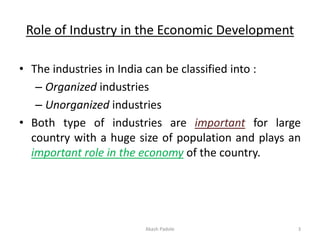
Role of Industry in the Economic Development
• The industries in India can be classified into :
– Organized industries
– Unorganized industries
• Both type of industries are important for large
country with a huge size of population and plays an
important role in the economy of the country.
Akash Padole 3
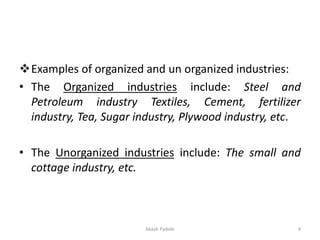
❖Examples of organized and un organized industries:
• The Organized industries include: Steel and
Petroleum industry Textiles, Cement, fertilizer
industry, Tea, Sugar industry, Plywood industry, etc.
• The Unorganized industries include: The small and
cottage industry, etc.
Akash Padole 4
Role of Construction industry
• The role the construction industry plays in socio-
economic development of a nation.
• The industry is a distinct sector of the economy
which makes its direct contribution to economic
growth like all the other sectors such as agriculture,
manufacturing and services.
• It also provides the basis upon which the other
sectors can grow, by constructing the physical
facilities required for the production and distribution
of goods and services.
Akash Padole 5
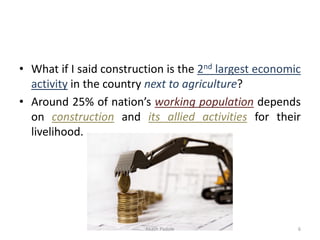
• What if I said construction is the 2nd largest economic
activity in the country next to agriculture?
• Around 25% of nation’s working population depends
on construction and its allied activities for their
livelihood.
Akash Padole 6
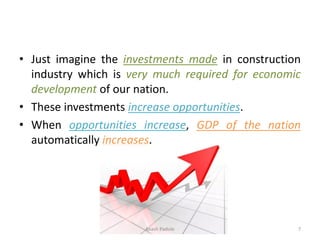
• Just imagine the investments made in construction
industry which is very much required for economic
development of our nation.
• These investments increase opportunities.
• When opportunities increase, GDP of the nation
automatically increases.
Akash Padole 7
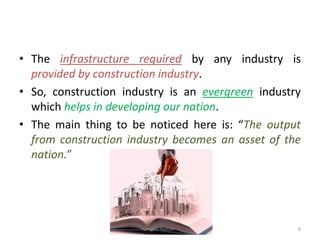
• The infrastructure required by any industry is
provided by construction industry.
• So, construction industry is an evergreen industry
which helps in developing our nation.
• The main thing to be noticed here is: “The output
from construction industry becomes an asset of the
nation.”
Akash Padole 8
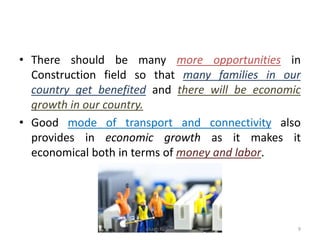
• There should be many more opportunities in
Construction field so that many families in our
country get benefited and there will be economic
growth in our country.
• Good mode of transport and connectivity also
provides in economic growth as it makes it
economical both in terms of money and labor.
Akash Padole 9
Unique features of Construction Industry
1. Complexity
• Construction projects, today, are high-tech, highly
mechanized, and complex.
• A typical construction project is characterized by the
consumption of numerous types of materials, variety
of tools, equipment, plants and machinery working in
tandem, several different contracting agencies, big
and small, sub-contractors, participating with
complex interactions, working in cooperation,
sometimes even at cross purposes.
Akash Padole 10
• In addition to this highly interactive and complex
environment at a construction site, thousands of
activities each of different nature are arranged
simultaneously.
• Thus, the construction project is much more complex
than any other production process, manufacturing,
or service industry.
Akash Padole 11
2. Multiplicity of Agencies
• Another typical characteristic of the construction
industry is the presence of multiple regulatory
agencies controlling the constructional site.
• Every one of these regulatory agencies is
independent of others.
Akash Padole 12
• Many Government, and Semi-government agencies
like Municipal Committees, Corporations, Area
Development Authorities, Urban and Rural Planning,
Mining Department, Forest Department and various
other Public Departments and a similar never-ending
plethora of controlling authorities required to issuing
clearance certificates, controlling various aspects of
construction at each project site.
Akash Padole 13
3. Involvement of the several people on ad-hoc basis
4. Limited set of resources
5. High Cost
6. A time frame for the completion
7. High risk of failure
8. No practice or rehearsal
9. High level of sub contracting
10. Uncertainty exist
Akash Padole 14
Classification of Construction Projects
A. Based on Nature of Work
i. Building:
• Residential buildings,
• Commercial buildings,
• Educational buildings,
• Recreational buildings,
• Hospitals and hotels,
• Warehouse and marketing facilities, etc.
Akash Padole 15
ii. Infrastructure Project:
• Highways and expressways,
• Dams and canals,
• Airports,
• Railways,
• Bridges
• Oil/gas pipe lines,
• Large water supply and sewerage networks,
• Docks and harbors,
• Nuclear and thermal power plants, etc.
Akash Padole 16
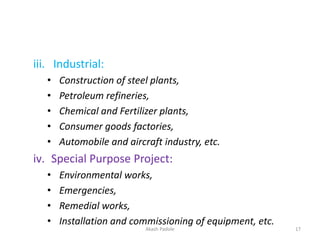
iii. Industrial:
• Construction of steel plants,
• Petroleum refineries,
• Chemical and Fertilizer plants,
• Consumer goods factories,
• Automobile and aircraft industry, etc.
iv. Special Purpose Project:
• Environmental works,
• Emergencies,
• Remedial works,
• Installation and commissioning of equipment, etc.
Akash Padole 17
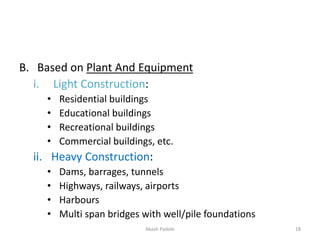
B. Based on Plant And Equipment
i. Light Construction:
• Residential buildings
• Educational buildings
• Recreational buildings
• Commercial buildings, etc.
ii. Heavy Construction:
• Dams, barrages, tunnels
• Highways, railways, airports
• Harbours
• Multi span bridges with well/pile foundations
Akash Padole 18
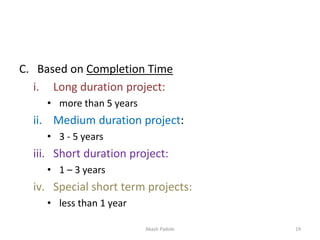
C. Based on Completion Time
i. Long duration project:
• more than 5 years
ii. Medium duration project:
• 3 - 5 years
iii. Short duration project:
• 1 – 3 years
iv. Special short term projects:
• less than 1 year
Akash Padole 19
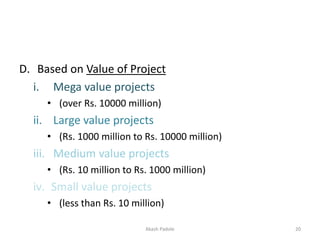
D. Based on Value of Project
i. Mega value projects
• (over Rs. 10000 million)
ii. Large value projects
• (Rs. 1000 million to Rs. 10000 million)
iii. Medium value projects
• (Rs. 10 million to Rs. 1000 million)
iv. Small value projects
• (less than Rs. 10 million)
Akash Padole 20
E. Based on Ownership
i. Private sector projects
ii. Public sector projects
iii. Joint Sector projects (PPP)
iv. Government sector projects
Akash Padole 21
Characteristics of a Construction Project
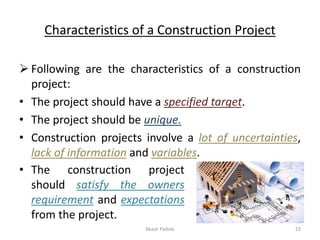
➢ Following are the characteristics of a construction
project:
• The project should have a specified target.
• The project should be unique.
• Construction projects involve a lot of uncertainties,
lack of information and variables.
• The construction project
should satisfy the owners
requirement and expectations
from the project.
Akash Padole 22
Project Life Cycle
• A project is “a temporary
endeavor undertaken to create a
unique product, service or result.”
• All projects vary in complexity but they all follow
similar life cycles.
• All projects have deliverables (meaning they always
produce something).
Akash Padole 23
• Project life cycle is a series of phases of a project
from initiation to completion.
• The life cycle gives a practical approach to problem
solving applied to all aspects of a project.
• Phases in a project life cycle encompasses sequential
and overlapping phases.
Akash Padole 24
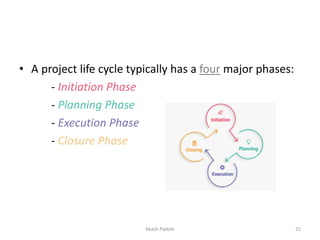
• A project life cycle typically has a four major phases:
- Initiation Phase
- Planning Phase
- Execution Phase
- Closure Phase
Akash Padole 25
Akash Padole 26
Akash Padole 27
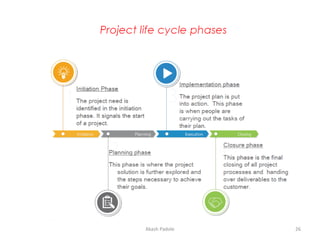
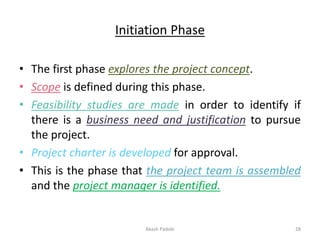
Initiation Phase
• The first phase explores the project concept.
• Scope is defined during this phase.
• Feasibility studies are made in order to identify if
there is a business need and justification to pursue
the project.
• Project charter is developed for approval.
• This is the phase that the project team is assembled
and the project manager is identified.
Akash Padole 28
Planning Phase
• This phase further details the scope of the project.
• Tasks and resources are identified and assigned
during this phase.
• Project manager coordinates the preparation of the
schedule and project budget.
• Risks are identified ahead to anticipate any project
threats.
Akash Padole 29
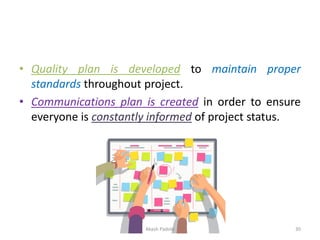
• Quality plan is developed to maintain proper
standards throughout project.
• Communications plan is created in order to ensure
everyone is constantly informed of project status.
Akash Padole 30
Implementation Phase
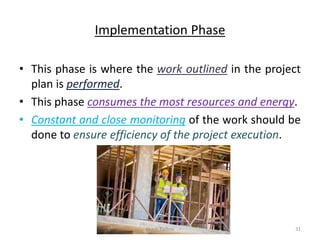
• This phase is where the work outlined in the project
plan is performed.
• This phase consumes the most resources and energy.
• Constant and close monitoring of the work should be
done to ensure efficiency of the project execution.
Akash Padole 31
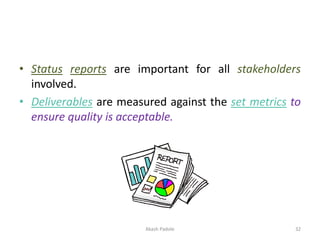
• Status reports are important for all stakeholders
involved.
• Deliverables are measured against the set metrics to
ensure quality is acceptable.
Akash Padole 32
Closure Phase
• This is the last phase of the project life cycle and
involves handing over final deliverable to the
customer.
• Contracts are properly terminated for equipment,
vendors and staff.
• All stakeholders are to be informed of project
closure.
• This phase is when the team reviews the overall
project and identify lessons learned for future
projects.
Akash Padole 33
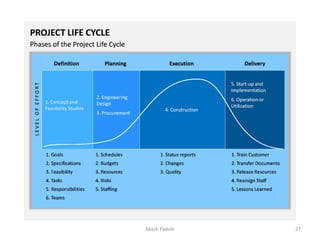
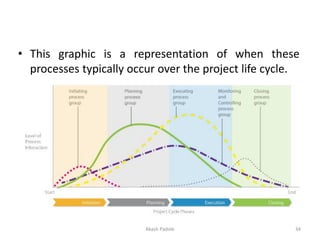
• This graphic is a representation of when these
processes typically occur over the project life cycle.
Akash Padole 34
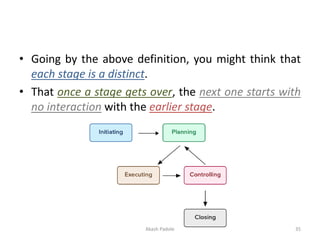
• Going by the above definition, you might think that
each stage is a distinct.
• That once a stage gets over, the next one starts with
no interaction with the earlier stage.
Akash Padole 35
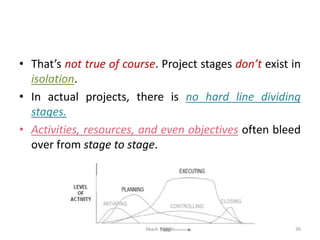
• That’s not true of course. Project stages don’t exist in
isolation.
• In actual projects, there is no hard line dividing
stages.
• Activities, resources, and even objectives often bleed
over from stage to stage.
Akash Padole 36
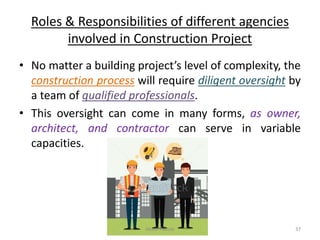
Roles & Responsibilities of different agencies
involved in Construction Project
• No matter a building project’s level of complexity, the
construction process will require diligent oversight by
a team of qualified professionals.
• This oversight can come in many forms, as owner,
architect, and contractor can serve in variable
capacities.
Akash Padole 37
Different agencies involved in
Construction Project
A construction project requires many different
people with different skill sets to execute it.
✓ Owner
✓ Construction Contractor
✓ Construction Management Consultant/ Consulting
Engineer
✓ Architect
✓ Suppliers
Akash Padole 38
Owner
• An owner is the person who owns the project and
has full authority to control the whole project.
• He is mainly involved in the process for supporting
the financial matter for the construction project to
go through easily.
• He has to pay for fees and charges associated with
the work.
• Besides, he has to work together with architect and
other consultants to achieve the goal of the
construction project.
Akash Padole 39
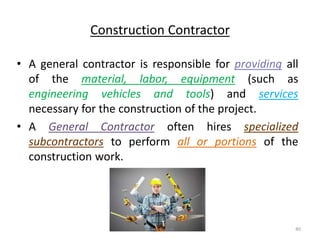
Construction Contractor
• A general contractor is responsible for providing all
of the material, labor, equipment (such as
engineering vehicles and tools) and services
necessary for the construction of the project.
• A General Contractor often hires specialized
subcontractors to perform all or portions of the
construction work.
Akash Padole 40
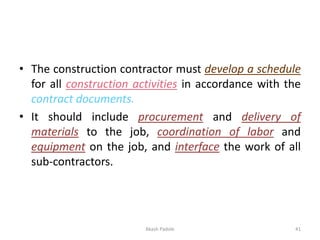
• The construction contractor must develop a schedule
for all construction activities in accordance with the
contract documents.
• It should include procurement and delivery of
materials to the job, coordination of labor and
equipment on the job, and interface the work of all
sub-contractors.
Akash Padole 41
Construction Management Consultant/
Consulting Engineer
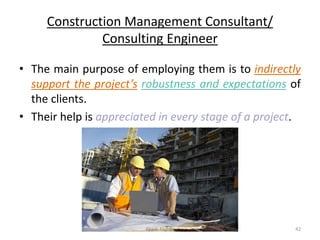
• The main purpose of employing them is to indirectly
support the project’s robustness and expectations of
the clients.
• Their help is appreciated in every stage of a project.
Akash Padole 42
▪ Coordinate functional perspectives from within and
outside project teams.
▪ Manage projects and related specific activities within
given constraints of time, budget and quality.
▪ Ensure scope, schedule and costs are reasonable and
achievable.
▪ Allocate work among team members and provide
guidance regularly.
▪ Conduct periodic and post-project reviews to ensure
project is on track.
Akash Padole 43
Architect
• An architect is a skilled professional who plans and
designs buildings and generally plays a key role in
their construction.
Akash Padole 44
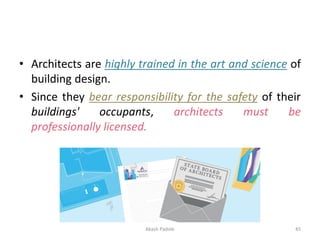
• Architects are highly trained in the art and science of
building design.
• Since they bear responsibility for the safety of their
buildings' occupants, architects must be
professionally licensed.
Akash Padole 45
• Architect monitors the construction of the project to
assure that construction is in accordance with the
plans and specifications prepared by the architect
and approved by the Owner and Contractor.
• The responsibility of an architect is to prepare
construction drawings and specifications.
• He acts as the leader of the rest of the design team
to the client’s requirements design.
Akash Padole 46
Suppliers
• Suppliers are groups that provides all materials and
services that needed for construction projects.
• As such their responsibilities varies from project to
project.
• Depending upon the project, materials and
equipment's plays big role in the construction project.
• Suppliers offer it for sale or rent.
• The best suppliers are reliable, efficient and result,
they have great relationship with their clients.
Akash Padole 47
Sanctions/ Approval required
for Construction Activity
• The builder requires to have the approval or
sanctions from the concerned authority for the
construction of a building.
• The building constructed without sanctions or
deviated more than 5 percent from approved plan
levies penalty and authorities has right to demolish
the building without any prior notice.
Akash Padole 48
• Following include the list of Approvals or Sanctions
required by builder for engaging in any construction
activity:
✓ Building Plan
✓ Layout Approval
✓ Basic Amenities
✓ No Objection Certificate (NOC)
✓ Completion Certificate
✓ Approval for Conversion of land
Akash Padole 49
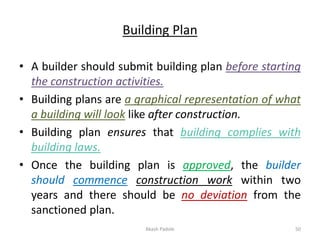
Building Plan
• A builder should submit building plan before starting
the construction activities.
• Building plans are a graphical representation of what
a building will look like after construction.
• Building plan ensures that building complies with
building laws.
• Once the building plan is approved, the builder
should commence construction work within two
years and there should be no deviation from the
sanctioned plan.
Akash Padole 50
Layout Approval
• The builder has to get approval of layout plan from
concerned authorities before starting construction of
residential or commercial building.
• Constructing building in unapproved layout will not
be given permission to be occupied or such layout
plots will be treated as unlawful and exemplary
penalties will be levied as per Municipal Laws.
Akash Padole 51
• Land which is sub-divided into plots without
permission from competent authority is considered
illegal or unapproved layout.
• No facilities such as roads, drainage, street lighting
will be extended in such areas.
Akash Padole 52
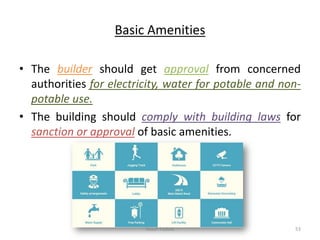
Basic Amenities
• The builder should get approval from concerned
authorities for electricity, water for potable and non-
potable use.
• The building should comply with building laws for
sanction or approval of basic amenities.
Akash Padole 53
No Objection Certificate (NOC)
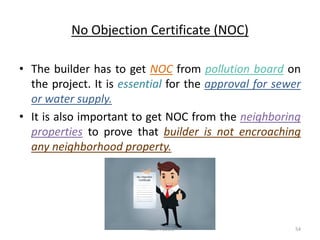
• The builder has to get NOC from pollution board on
the project. It is essential for the approval for sewer
or water supply.
• It is also important to get NOC from the neighboring
properties to prove that builder is not encroaching
any neighborhood property.
Akash Padole 54
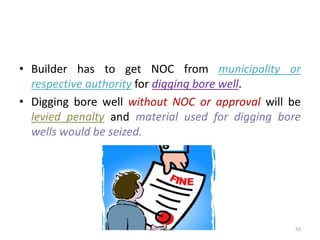
• Builder has to get NOC from municipality or
respective authority for digging bore well.
• Digging bore well without NOC or approval will be
levied penalty and material used for digging bore
wells would be seized.
Akash Padole 55
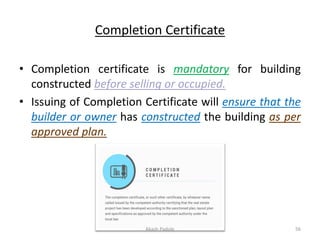
Completion Certificate
• Completion certificate is mandatory for building
constructed before selling or occupied.
• Issuing of Completion Certificate will ensure that the
builder or owner has constructed the building as per
approved plan.
Akash Padole 56
Approval for Conversion of Land
• Some builders use agricultural land for constructing
building for residential or commercial purpose.
• In such case builder need to get approval form
concerned authority to convert agricultural land to
non-agricultural (NA) purpose.
Akash Padole 57
Concerned authorities for Sanctions/Approval
in Construction Projects
• The process for applying for sanction or approval is
almost similar all over the country.
• The concerned authority having right to give sanction
or approval may vary from state to sate or region to
region.
Akash Padole 58
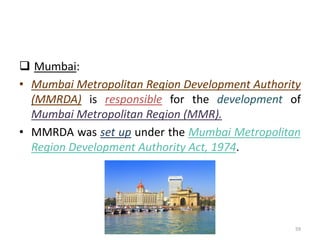
❑ Mumbai:
• Mumbai Metropolitan Region Development Authority
(MMRDA) is responsible for the development of
Mumbai Metropolitan Region (MMR).
• MMRDA was set up under the Mumbai Metropolitan
Region Development Authority Act, 1974.
Akash Padole 59
• Electricity supply in the city is managed by
Maharashtra State Electricity Distribution Co. Ltd
(MAHADISCOM).
• BrihanMumbai Municipal Corporation (BMC) is
providing Drinking Water Supply to Mumbai City and
suburbs.
Akash Padole 60
❑New Delhi:
• The Municipal Corporation of Delhi (MCD) is among the
largest municipal bodies in the world providing civic
services.
• For their convenience, the Municipal Corporation of
Delhi/Nagar Nigam has divided the city into twelve
different zones.
• The Delhi Jal Board is responsible for the Production and
Distribution of potable water after treating raw water
from various sources like river Yamuna, Upper Ganga
Canal & Groundwater and provides treatment and
disposal of waste water.Akash Padole 61
❑Bangalore:
• The builder has to approach Bangalore Development
Authority (BDA) for approval of layout plan and building
plan.
• The Bangalore Development Authority (BDA) is
designated as the Planning Authority under the
Karnataka Town and Country Planning Act, 1961.
• Electricity supply in the city is managed by Bangalore
Electricity Supply Company Ltd (BESCOM).
• The builder has to get NOC from pollution board for his
project to get new water connection from Bangalore
Water Sanitary and Sewage board (BWSSB)
Akash Padole 62
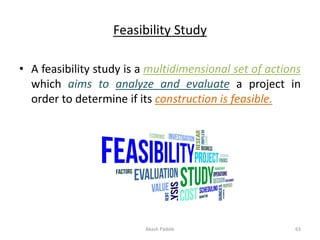
Feasibility Study
• A feasibility study is a multidimensional set of actions
which aims to analyze and evaluate a project in
order to determine if its construction is feasible.
Akash Padole 63
• Feasibility study is related to analyze the viability of
the identified project to support decision making of
investment.
• As its name implies, it is a study to decide whether
the identified project is attractive enough to go for
implementation.
• The study needs inputs from many professional
disciplines for various areas of the study.
Akash Padole 64
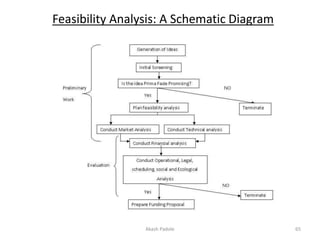
Feasibility Analysis: A Schematic Diagram
Akash Padole 65
Akash Padole 66
Akash Padole 67
Akash Padole 68
Akash Padole 69
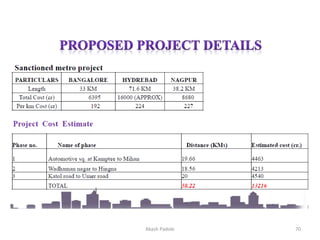
Akash Padole 70
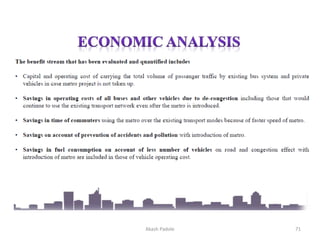
Akash Padole 71
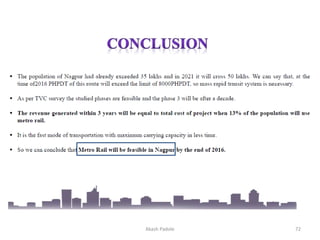
Akash Padole 72
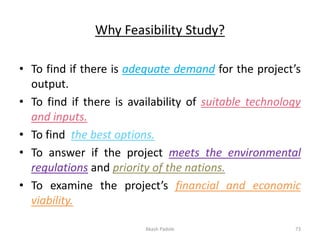
Why Feasibility Study?
• To find if there is adequate demand for the project’s
output.
• To find if there is availability of suitable technology
and inputs.
• To find the best options.
• To answer if the project meets the environmental
regulations and priority of the nations.
• To examine the project’s financial and economic
viability.
Akash Padole 73
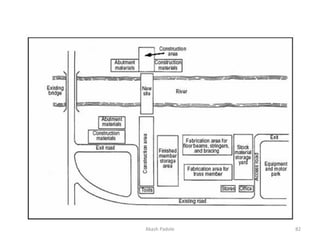
Site Layout
• Site layout planning is an important task that involves
identification of the Temporary Facilities (TFs) which
will be needed to support construction operations.
• Site layout planning is about determining the size and
shape of the TFs.
• Management must appropriately position all the
temporary facilities within the boundaries of a
construction site.
• Proper site layout planning will improve site safety
for workforce and public.
Akash Padole 74
• Construction site layout involves identifying, sizing,
and placing temporary facilities (TFs) within the
boundaries of construction site.
• Required temporary facilities and their areas are
depending in many factors including project type,
scale, design, location, and organization of
construction work.
Akash Padole 75
• Site planning in particular, has been the most
neglected aspect in the construction industry and the
attitude of the engineers has been that it will be
done as the project progress.
• It is important to realize that the site planning will be
the conditions that site personnel will live with for
the total duration of the construction period.
Akash Padole 76
• Failure to plan the site layout in advance is a prime
cause of operational inefficiency, and can increase
the overall cost of a project substantially.
• In the absence of a precise site layout plan, the
following problems may occur:
– Material stacks wrongly located
– Plant and equipment wrongly located
– Inadequate space allowed
– Site huts wrongly located in relation to their
effective use
Akash Padole 77
• In fact, site layout planning is one of the preplanning
tasks to be accomplished in a construction project.
• This task has an interactive relationship with the
other planning tasks such as scheduling, selection of
construction method, procurement and material
planning, manpower and equipment planning, and
financial planning.
• So, it becomes a task as important as other tasks that
project managers have to accomplish.
Akash Padole 78
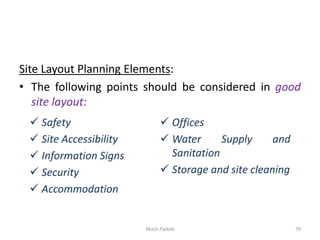
Site Layout Planning Elements:
• The following points should be considered in good
site layout:
✓ Safety
✓ Site Accessibility
✓ Information Signs
✓ Security
✓ Accommodation
✓ Offices
✓ Water Supply and
Sanitation
✓ Storage and site cleaning
Akash Padole 79
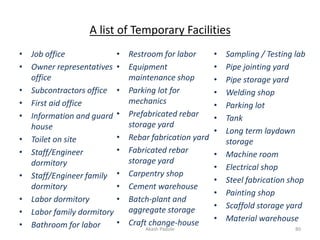
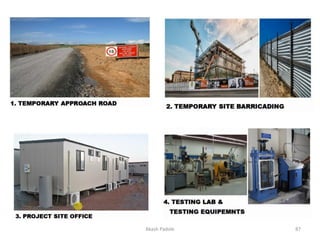
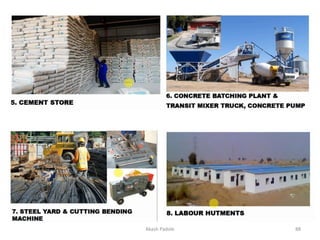
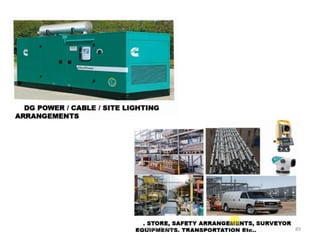
A list of Temporary Facilities
• Job office
• Owner representatives
office
• Subcontractors office
• First aid office
• Information and guard
house
• Toilet on site
• Staff/Engineer
dormitory
• Staff/Engineer family
dormitory
• Labor dormitory
• Labor family dormitory
• Bathroom for labor
• Restroom for labor
• Equipment
maintenance shop
• Parking lot for
mechanics
• Prefabricated rebar
storage yard
• Rebar fabrication yard
• Fabricated rebar
storage yard
• Carpentry shop
• Cement warehouse
• Batch-plant and
aggregate storage
• Craft change-house
• Sampling / Testing lab
• Pipe jointing yard
• Pipe storage yard
• Welding shop
• Parking lot
• Tank
• Long term laydown
storage
• Machine room
• Electrical shop
• Steel fabrication shop
• Painting shop
• Scaffold storage yard
• Material warehouse
Akash Padole 80
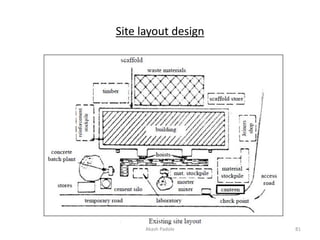
Site layout design
Akash Padole 81
Akash Padole 82
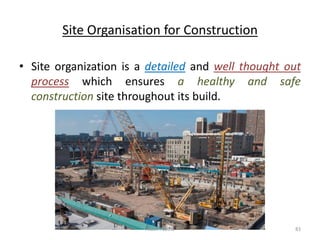
Site Organisation for Construction
• Site organization is a detailed and well thought out
process which ensures a healthy and safe
construction site throughout its build.
Akash Padole 83
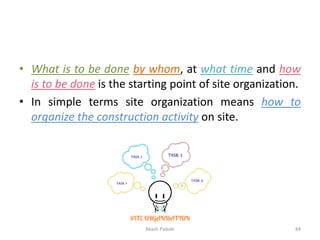
• What is to be done by whom, at what time and how
is to be done is the starting point of site organization.
• In simple terms site organization means how to
organize the construction activity on site.
Akash Padole 84
Site Mobilization
• Mobilization refers to the initial stage of a
construction project where preparations occur onsite
prior to the commencement of any work.
• It is a preparatory stage during which the majority of
activities are managed by the construction manager.
• At this point in a project, the contractor has been
selected and building plans have typically been
approved by the governing municipality.
Akash Padole 85
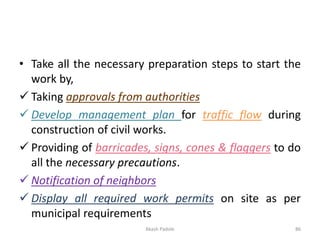
• Take all the necessary preparation steps to start the
work by,
✓ Taking approvals from authorities
✓ Develop management plan for traffic flow during
construction of civil works.
✓ Providing of barricades, signs, cones & flaggers to do
all the necessary precautions.
✓ Notification of neighbors
✓ Display all required work permits on site as per
municipal requirements
Akash Padole 86
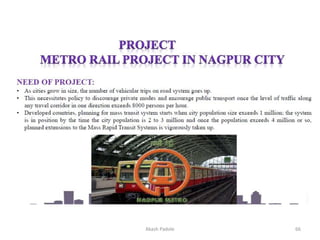
Akash Padole 87
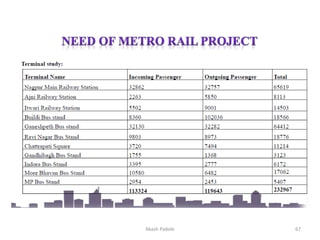
Akash Padole 88
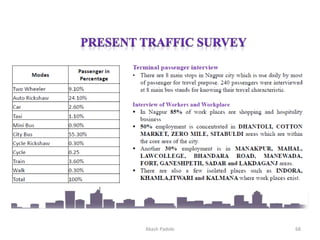
Akash Padole 89
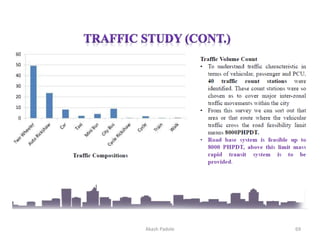
Akash Padole 90

02 Construction Projects

  • 1.
    Construction Management By Akash Padole Departmentof Civil Engineering Construction Projects 1
  • 2.
    Contains 2.1 Role ofConstruction industry in economic development of country 2.2 Unique features of construction industry. 2.3 Construction projects- Classification, Characteristics, Project life cycle etc. 2.4 Roles and responsibilities of various agencies associated with a Construction project. 2.5 Pre-requisites of commencing construction work such as sanctions, Approvals to be sought, and feasibility studies. 2.6 Site layout, organizing & mobilizing the site Akash Padole 2
  • 3.
    Role of Industryin the Economic Development • The industries in India can be classified into : – Organized industries – Unorganized industries • Both type of industries are important for large country with a huge size of population and plays an important role in the economy of the country. Akash Padole 3
  • 4.
    ❖Examples of organizedand un organized industries: • The Organized industries include: Steel and Petroleum industry Textiles, Cement, fertilizer industry, Tea, Sugar industry, Plywood industry, etc. • The Unorganized industries include: The small and cottage industry, etc. Akash Padole 4
  • 5.
    Role of Constructionindustry • The role the construction industry plays in socio- economic development of a nation. • The industry is a distinct sector of the economy which makes its direct contribution to economic growth like all the other sectors such as agriculture, manufacturing and services. • It also provides the basis upon which the other sectors can grow, by constructing the physical facilities required for the production and distribution of goods and services. Akash Padole 5
  • 6.
    • What ifI said construction is the 2nd largest economic activity in the country next to agriculture? • Around 25% of nation’s working population depends on construction and its allied activities for their livelihood. Akash Padole 6
  • 7.
    • Just imaginethe investments made in construction industry which is very much required for economic development of our nation. • These investments increase opportunities. • When opportunities increase, GDP of the nation automatically increases. Akash Padole 7
  • 8.
    • The infrastructurerequired by any industry is provided by construction industry. • So, construction industry is an evergreen industry which helps in developing our nation. • The main thing to be noticed here is: “The output from construction industry becomes an asset of the nation.” Akash Padole 8
  • 9.
    • There shouldbe many more opportunities in Construction field so that many families in our country get benefited and there will be economic growth in our country. • Good mode of transport and connectivity also provides in economic growth as it makes it economical both in terms of money and labor. Akash Padole 9
  • 10.
    Unique features ofConstruction Industry 1. Complexity • Construction projects, today, are high-tech, highly mechanized, and complex. • A typical construction project is characterized by the consumption of numerous types of materials, variety of tools, equipment, plants and machinery working in tandem, several different contracting agencies, big and small, sub-contractors, participating with complex interactions, working in cooperation, sometimes even at cross purposes. Akash Padole 10
  • 11.
    • In additionto this highly interactive and complex environment at a construction site, thousands of activities each of different nature are arranged simultaneously. • Thus, the construction project is much more complex than any other production process, manufacturing, or service industry. Akash Padole 11
  • 12.
    2. Multiplicity ofAgencies • Another typical characteristic of the construction industry is the presence of multiple regulatory agencies controlling the constructional site. • Every one of these regulatory agencies is independent of others. Akash Padole 12
  • 13.
    • Many Government,and Semi-government agencies like Municipal Committees, Corporations, Area Development Authorities, Urban and Rural Planning, Mining Department, Forest Department and various other Public Departments and a similar never-ending plethora of controlling authorities required to issuing clearance certificates, controlling various aspects of construction at each project site. Akash Padole 13
  • 14.
    3. Involvement ofthe several people on ad-hoc basis 4. Limited set of resources 5. High Cost 6. A time frame for the completion 7. High risk of failure 8. No practice or rehearsal 9. High level of sub contracting 10. Uncertainty exist Akash Padole 14
  • 15.
    Classification of ConstructionProjects A. Based on Nature of Work i. Building: • Residential buildings, • Commercial buildings, • Educational buildings, • Recreational buildings, • Hospitals and hotels, • Warehouse and marketing facilities, etc. Akash Padole 15
  • 16.
    ii. Infrastructure Project: •Highways and expressways, • Dams and canals, • Airports, • Railways, • Bridges • Oil/gas pipe lines, • Large water supply and sewerage networks, • Docks and harbors, • Nuclear and thermal power plants, etc. Akash Padole 16
  • 17.
    iii. Industrial: • Constructionof steel plants, • Petroleum refineries, • Chemical and Fertilizer plants, • Consumer goods factories, • Automobile and aircraft industry, etc. iv. Special Purpose Project: • Environmental works, • Emergencies, • Remedial works, • Installation and commissioning of equipment, etc. Akash Padole 17
  • 18.
    B. Based onPlant And Equipment i. Light Construction: • Residential buildings • Educational buildings • Recreational buildings • Commercial buildings, etc. ii. Heavy Construction: • Dams, barrages, tunnels • Highways, railways, airports • Harbours • Multi span bridges with well/pile foundations Akash Padole 18
  • 19.
    C. Based onCompletion Time i. Long duration project: • more than 5 years ii. Medium duration project: • 3 - 5 years iii. Short duration project: • 1 – 3 years iv. Special short term projects: • less than 1 year Akash Padole 19
  • 20.
    D. Based onValue of Project i. Mega value projects • (over Rs. 10000 million) ii. Large value projects • (Rs. 1000 million to Rs. 10000 million) iii. Medium value projects • (Rs. 10 million to Rs. 1000 million) iv. Small value projects • (less than Rs. 10 million) Akash Padole 20
  • 21.
    E. Based onOwnership i. Private sector projects ii. Public sector projects iii. Joint Sector projects (PPP) iv. Government sector projects Akash Padole 21
  • 22.
    Characteristics of aConstruction Project ➢ Following are the characteristics of a construction project: • The project should have a specified target. • The project should be unique. • Construction projects involve a lot of uncertainties, lack of information and variables. • The construction project should satisfy the owners requirement and expectations from the project. Akash Padole 22
  • 23.
    Project Life Cycle •A project is “a temporary endeavor undertaken to create a unique product, service or result.” • All projects vary in complexity but they all follow similar life cycles. • All projects have deliverables (meaning they always produce something). Akash Padole 23
  • 24.
    • Project lifecycle is a series of phases of a project from initiation to completion. • The life cycle gives a practical approach to problem solving applied to all aspects of a project. • Phases in a project life cycle encompasses sequential and overlapping phases. Akash Padole 24
  • 25.
    • A projectlife cycle typically has a four major phases: - Initiation Phase - Planning Phase - Execution Phase - Closure Phase Akash Padole 25
  • 26.
  • 27.
  • 28.
    Initiation Phase • Thefirst phase explores the project concept. • Scope is defined during this phase. • Feasibility studies are made in order to identify if there is a business need and justification to pursue the project. • Project charter is developed for approval. • This is the phase that the project team is assembled and the project manager is identified. Akash Padole 28
  • 29.
    Planning Phase • Thisphase further details the scope of the project. • Tasks and resources are identified and assigned during this phase. • Project manager coordinates the preparation of the schedule and project budget. • Risks are identified ahead to anticipate any project threats. Akash Padole 29
  • 30.
    • Quality planis developed to maintain proper standards throughout project. • Communications plan is created in order to ensure everyone is constantly informed of project status. Akash Padole 30
  • 31.
    Implementation Phase • Thisphase is where the work outlined in the project plan is performed. • This phase consumes the most resources and energy. • Constant and close monitoring of the work should be done to ensure efficiency of the project execution. Akash Padole 31
  • 32.
    • Status reportsare important for all stakeholders involved. • Deliverables are measured against the set metrics to ensure quality is acceptable. Akash Padole 32
  • 33.
    Closure Phase • Thisis the last phase of the project life cycle and involves handing over final deliverable to the customer. • Contracts are properly terminated for equipment, vendors and staff. • All stakeholders are to be informed of project closure. • This phase is when the team reviews the overall project and identify lessons learned for future projects. Akash Padole 33
  • 34.
    • This graphicis a representation of when these processes typically occur over the project life cycle. Akash Padole 34
  • 35.
    • Going bythe above definition, you might think that each stage is a distinct. • That once a stage gets over, the next one starts with no interaction with the earlier stage. Akash Padole 35
  • 36.
    • That’s nottrue of course. Project stages don’t exist in isolation. • In actual projects, there is no hard line dividing stages. • Activities, resources, and even objectives often bleed over from stage to stage. Akash Padole 36
  • 37.
    Roles & Responsibilitiesof different agencies involved in Construction Project • No matter a building project’s level of complexity, the construction process will require diligent oversight by a team of qualified professionals. • This oversight can come in many forms, as owner, architect, and contractor can serve in variable capacities. Akash Padole 37
  • 38.
    Different agencies involvedin Construction Project A construction project requires many different people with different skill sets to execute it. ✓ Owner ✓ Construction Contractor ✓ Construction Management Consultant/ Consulting Engineer ✓ Architect ✓ Suppliers Akash Padole 38
  • 39.
    Owner • An owneris the person who owns the project and has full authority to control the whole project. • He is mainly involved in the process for supporting the financial matter for the construction project to go through easily. • He has to pay for fees and charges associated with the work. • Besides, he has to work together with architect and other consultants to achieve the goal of the construction project. Akash Padole 39
  • 40.
    Construction Contractor • Ageneral contractor is responsible for providing all of the material, labor, equipment (such as engineering vehicles and tools) and services necessary for the construction of the project. • A General Contractor often hires specialized subcontractors to perform all or portions of the construction work. Akash Padole 40
  • 41.
    • The constructioncontractor must develop a schedule for all construction activities in accordance with the contract documents. • It should include procurement and delivery of materials to the job, coordination of labor and equipment on the job, and interface the work of all sub-contractors. Akash Padole 41
  • 42.
    Construction Management Consultant/ ConsultingEngineer • The main purpose of employing them is to indirectly support the project’s robustness and expectations of the clients. • Their help is appreciated in every stage of a project. Akash Padole 42
  • 43.
    ▪ Coordinate functionalperspectives from within and outside project teams. ▪ Manage projects and related specific activities within given constraints of time, budget and quality. ▪ Ensure scope, schedule and costs are reasonable and achievable. ▪ Allocate work among team members and provide guidance regularly. ▪ Conduct periodic and post-project reviews to ensure project is on track. Akash Padole 43
  • 44.
    Architect • An architectis a skilled professional who plans and designs buildings and generally plays a key role in their construction. Akash Padole 44
  • 45.
    • Architects arehighly trained in the art and science of building design. • Since they bear responsibility for the safety of their buildings' occupants, architects must be professionally licensed. Akash Padole 45
  • 46.
    • Architect monitorsthe construction of the project to assure that construction is in accordance with the plans and specifications prepared by the architect and approved by the Owner and Contractor. • The responsibility of an architect is to prepare construction drawings and specifications. • He acts as the leader of the rest of the design team to the client’s requirements design. Akash Padole 46
  • 47.
    Suppliers • Suppliers aregroups that provides all materials and services that needed for construction projects. • As such their responsibilities varies from project to project. • Depending upon the project, materials and equipment's plays big role in the construction project. • Suppliers offer it for sale or rent. • The best suppliers are reliable, efficient and result, they have great relationship with their clients. Akash Padole 47
  • 48.
    Sanctions/ Approval required forConstruction Activity • The builder requires to have the approval or sanctions from the concerned authority for the construction of a building. • The building constructed without sanctions or deviated more than 5 percent from approved plan levies penalty and authorities has right to demolish the building without any prior notice. Akash Padole 48
  • 49.
    • Following includethe list of Approvals or Sanctions required by builder for engaging in any construction activity: ✓ Building Plan ✓ Layout Approval ✓ Basic Amenities ✓ No Objection Certificate (NOC) ✓ Completion Certificate ✓ Approval for Conversion of land Akash Padole 49
  • 50.
    Building Plan • Abuilder should submit building plan before starting the construction activities. • Building plans are a graphical representation of what a building will look like after construction. • Building plan ensures that building complies with building laws. • Once the building plan is approved, the builder should commence construction work within two years and there should be no deviation from the sanctioned plan. Akash Padole 50
  • 51.
    Layout Approval • Thebuilder has to get approval of layout plan from concerned authorities before starting construction of residential or commercial building. • Constructing building in unapproved layout will not be given permission to be occupied or such layout plots will be treated as unlawful and exemplary penalties will be levied as per Municipal Laws. Akash Padole 51
  • 52.
    • Land whichis sub-divided into plots without permission from competent authority is considered illegal or unapproved layout. • No facilities such as roads, drainage, street lighting will be extended in such areas. Akash Padole 52
  • 53.
    Basic Amenities • Thebuilder should get approval from concerned authorities for electricity, water for potable and non- potable use. • The building should comply with building laws for sanction or approval of basic amenities. Akash Padole 53
  • 54.
    No Objection Certificate(NOC) • The builder has to get NOC from pollution board on the project. It is essential for the approval for sewer or water supply. • It is also important to get NOC from the neighboring properties to prove that builder is not encroaching any neighborhood property. Akash Padole 54
  • 55.
    • Builder hasto get NOC from municipality or respective authority for digging bore well. • Digging bore well without NOC or approval will be levied penalty and material used for digging bore wells would be seized. Akash Padole 55
  • 56.
    Completion Certificate • Completioncertificate is mandatory for building constructed before selling or occupied. • Issuing of Completion Certificate will ensure that the builder or owner has constructed the building as per approved plan. Akash Padole 56
  • 57.
    Approval for Conversionof Land • Some builders use agricultural land for constructing building for residential or commercial purpose. • In such case builder need to get approval form concerned authority to convert agricultural land to non-agricultural (NA) purpose. Akash Padole 57
  • 58.
    Concerned authorities forSanctions/Approval in Construction Projects • The process for applying for sanction or approval is almost similar all over the country. • The concerned authority having right to give sanction or approval may vary from state to sate or region to region. Akash Padole 58
  • 59.
    ❑ Mumbai: • MumbaiMetropolitan Region Development Authority (MMRDA) is responsible for the development of Mumbai Metropolitan Region (MMR). • MMRDA was set up under the Mumbai Metropolitan Region Development Authority Act, 1974. Akash Padole 59
  • 60.
    • Electricity supplyin the city is managed by Maharashtra State Electricity Distribution Co. Ltd (MAHADISCOM). • BrihanMumbai Municipal Corporation (BMC) is providing Drinking Water Supply to Mumbai City and suburbs. Akash Padole 60
  • 61.
    ❑New Delhi: • TheMunicipal Corporation of Delhi (MCD) is among the largest municipal bodies in the world providing civic services. • For their convenience, the Municipal Corporation of Delhi/Nagar Nigam has divided the city into twelve different zones. • The Delhi Jal Board is responsible for the Production and Distribution of potable water after treating raw water from various sources like river Yamuna, Upper Ganga Canal & Groundwater and provides treatment and disposal of waste water.Akash Padole 61
  • 62.
    ❑Bangalore: • The builderhas to approach Bangalore Development Authority (BDA) for approval of layout plan and building plan. • The Bangalore Development Authority (BDA) is designated as the Planning Authority under the Karnataka Town and Country Planning Act, 1961. • Electricity supply in the city is managed by Bangalore Electricity Supply Company Ltd (BESCOM). • The builder has to get NOC from pollution board for his project to get new water connection from Bangalore Water Sanitary and Sewage board (BWSSB) Akash Padole 62
  • 63.
    Feasibility Study • Afeasibility study is a multidimensional set of actions which aims to analyze and evaluate a project in order to determine if its construction is feasible. Akash Padole 63
  • 64.
    • Feasibility studyis related to analyze the viability of the identified project to support decision making of investment. • As its name implies, it is a study to decide whether the identified project is attractive enough to go for implementation. • The study needs inputs from many professional disciplines for various areas of the study. Akash Padole 64
  • 65.
    Feasibility Analysis: ASchematic Diagram Akash Padole 65
  • 66.
  • 67.
  • 68.
  • 69.
  • 70.
  • 71.
  • 72.
  • 73.
    Why Feasibility Study? •To find if there is adequate demand for the project’s output. • To find if there is availability of suitable technology and inputs. • To find the best options. • To answer if the project meets the environmental regulations and priority of the nations. • To examine the project’s financial and economic viability. Akash Padole 73
  • 74.
    Site Layout • Sitelayout planning is an important task that involves identification of the Temporary Facilities (TFs) which will be needed to support construction operations. • Site layout planning is about determining the size and shape of the TFs. • Management must appropriately position all the temporary facilities within the boundaries of a construction site. • Proper site layout planning will improve site safety for workforce and public. Akash Padole 74
  • 75.
    • Construction sitelayout involves identifying, sizing, and placing temporary facilities (TFs) within the boundaries of construction site. • Required temporary facilities and their areas are depending in many factors including project type, scale, design, location, and organization of construction work. Akash Padole 75
  • 76.
    • Site planningin particular, has been the most neglected aspect in the construction industry and the attitude of the engineers has been that it will be done as the project progress. • It is important to realize that the site planning will be the conditions that site personnel will live with for the total duration of the construction period. Akash Padole 76
  • 77.
    • Failure toplan the site layout in advance is a prime cause of operational inefficiency, and can increase the overall cost of a project substantially. • In the absence of a precise site layout plan, the following problems may occur: – Material stacks wrongly located – Plant and equipment wrongly located – Inadequate space allowed – Site huts wrongly located in relation to their effective use Akash Padole 77
  • 78.
    • In fact,site layout planning is one of the preplanning tasks to be accomplished in a construction project. • This task has an interactive relationship with the other planning tasks such as scheduling, selection of construction method, procurement and material planning, manpower and equipment planning, and financial planning. • So, it becomes a task as important as other tasks that project managers have to accomplish. Akash Padole 78
  • 79.
    Site Layout PlanningElements: • The following points should be considered in good site layout: ✓ Safety ✓ Site Accessibility ✓ Information Signs ✓ Security ✓ Accommodation ✓ Offices ✓ Water Supply and Sanitation ✓ Storage and site cleaning Akash Padole 79
  • 80.
    A list ofTemporary Facilities • Job office • Owner representatives office • Subcontractors office • First aid office • Information and guard house • Toilet on site • Staff/Engineer dormitory • Staff/Engineer family dormitory • Labor dormitory • Labor family dormitory • Bathroom for labor • Restroom for labor • Equipment maintenance shop • Parking lot for mechanics • Prefabricated rebar storage yard • Rebar fabrication yard • Fabricated rebar storage yard • Carpentry shop • Cement warehouse • Batch-plant and aggregate storage • Craft change-house • Sampling / Testing lab • Pipe jointing yard • Pipe storage yard • Welding shop • Parking lot • Tank • Long term laydown storage • Machine room • Electrical shop • Steel fabrication shop • Painting shop • Scaffold storage yard • Material warehouse Akash Padole 80
  • 81.
  • 82.
  • 83.
    Site Organisation forConstruction • Site organization is a detailed and well thought out process which ensures a healthy and safe construction site throughout its build. Akash Padole 83
  • 84.
    • What isto be done by whom, at what time and how is to be done is the starting point of site organization. • In simple terms site organization means how to organize the construction activity on site. Akash Padole 84
  • 85.
    Site Mobilization • Mobilizationrefers to the initial stage of a construction project where preparations occur onsite prior to the commencement of any work. • It is a preparatory stage during which the majority of activities are managed by the construction manager. • At this point in a project, the contractor has been selected and building plans have typically been approved by the governing municipality. Akash Padole 85
  • 86.
    • Take allthe necessary preparation steps to start the work by, ✓ Taking approvals from authorities ✓ Develop management plan for traffic flow during construction of civil works. ✓ Providing of barricades, signs, cones & flaggers to do all the necessary precautions. ✓ Notification of neighbors ✓ Display all required work permits on site as per municipal requirements Akash Padole 86
  • 87.
  • 88.
  • 89.
  • 90.