
Project Management & Control Project Funding  (LECTURE 7) Scheduling  (LECTURE 8) Issues During the Construction Project   (LECTURE 9) Materials Management and Quality Control  (LECTURE 10)
Project Funding Construction Financing Procurement  Cost Control  Professor Brandi R. Shepard© ACH 121-Materials and Methods 1
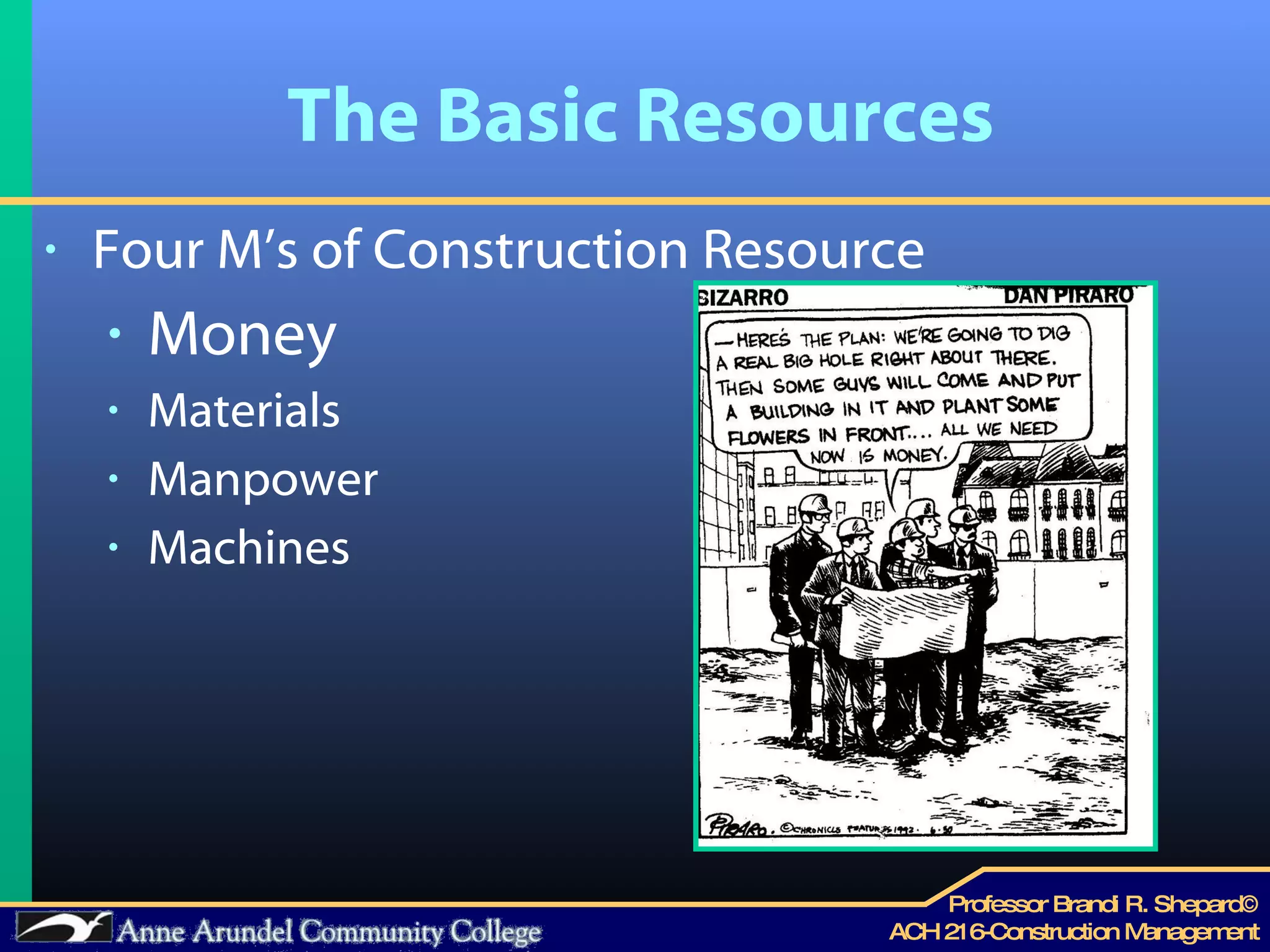
The Basic Resources Four M’s of Construction Resource Money Materials Manpower Machines
Money: a Basic Resource  Money is a cascading resource that is encountered at various levels within the project structure Owner must have it to initiate construction/design Architect has to design within it’s confounds Contractor must have cash reserves to maintain continuity of the project operations
Construction Financing Two types of project funding Short-term (construction loan) Facility construction Land purchases Land development Long-term (10-30 year mortgage)
Construction Financing Construction loans Extend over the period of construction Provided by  a lending institution Loan is given on the assurance that it will be repaid with interest by long-term loan  Mortgage loans 10, 15, 20, 25 & 30 year terms Owner must get financing for mortgage loan before construction loan is promised Bonds
Construction Financing Lending Institutions Real estate investment trusts (REIT’s) Investment or merchant banks Commercial banks Savings and loan associations/Credit Unions Insurance companies Governmental agencies (VA, FHA) International development banks Public institutions raise money by the sale of bonds
Construction Financing Lending institutions are cautious about lending moneys Vast amount of research and evaluation prior to loan commitment  Required info on loan application Financial statements of the company/owner Proof of clear title to the land for which the project will be built on  As well as appropriate zoning  Preliminary cost estimates Market/feasibility study to verify expected income Detailed pro forma showing projected income and operational expense over the life of the mortgage/loan
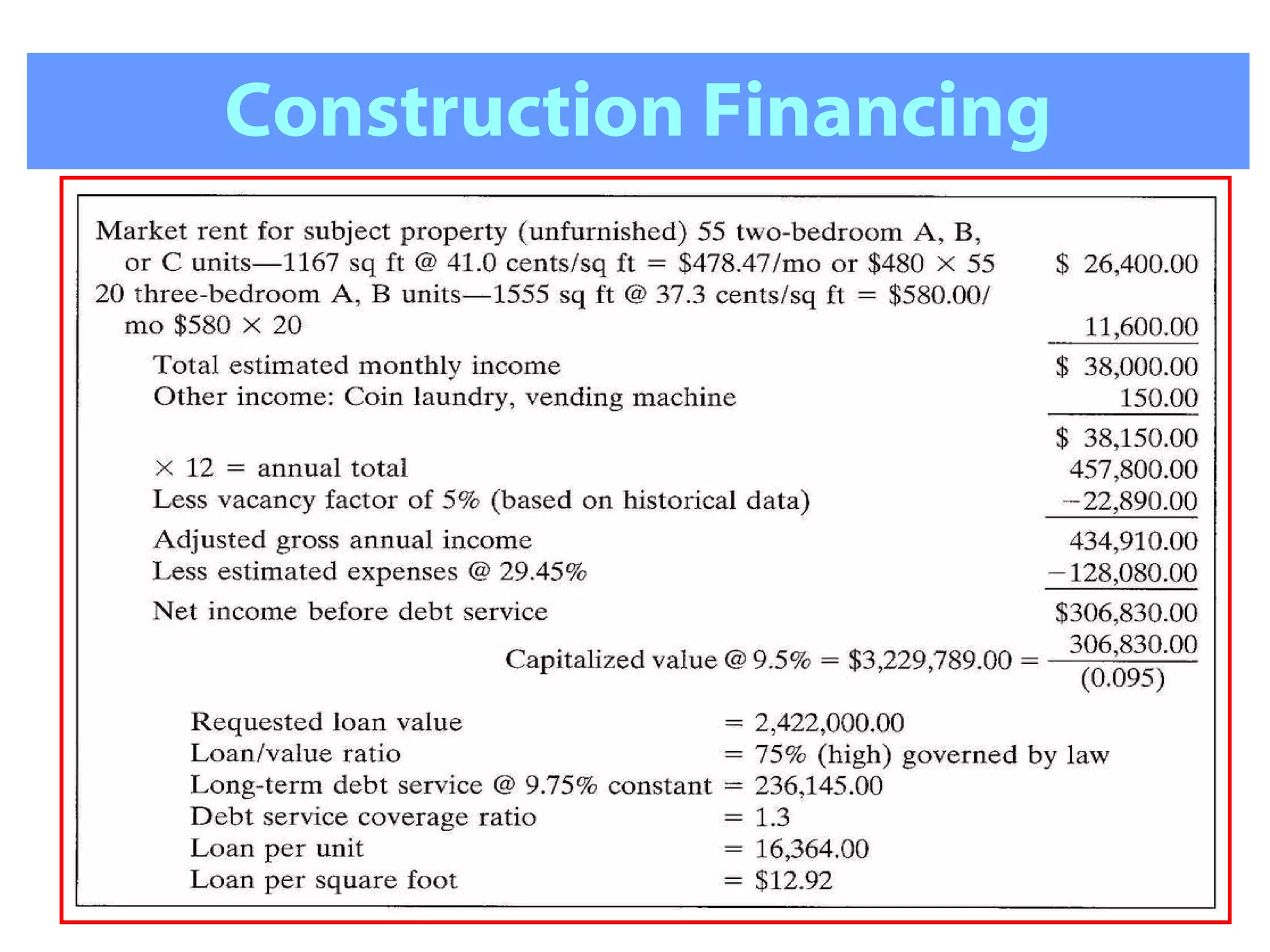
Construction Financing
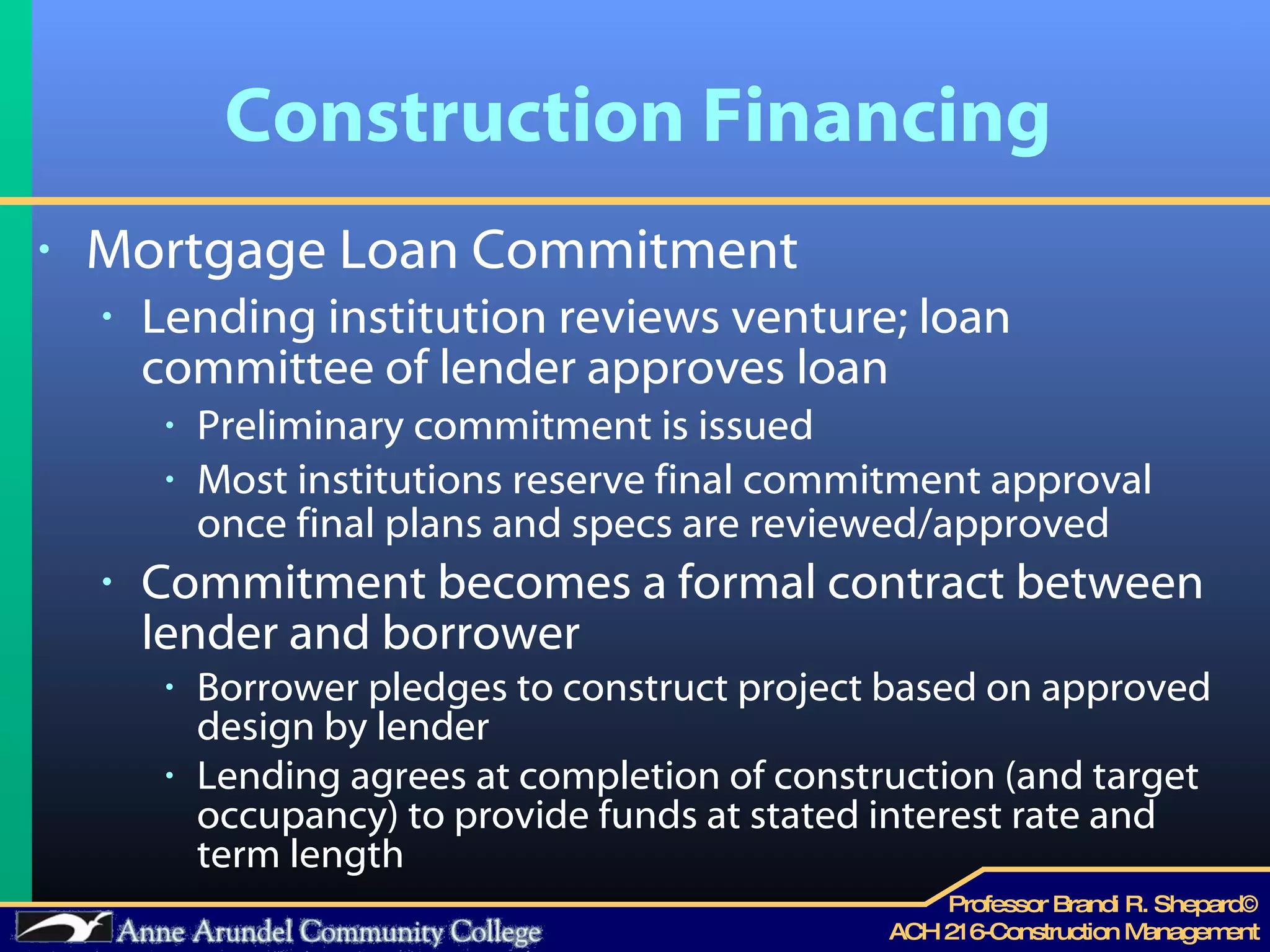
Construction Financing Mortgage Loan Commitment Lending institution reviews venture; loan committee of lender approves loan Preliminary commitment is issued Most institutions reserve final commitment approval once final plans and specs are reviewed/approved Commitment becomes a formal contract between lender and borrower Borrower pledges to construct project based on approved design by lender Lending agrees at completion of construction (and target occupancy) to provide funds at stated interest rate and term length
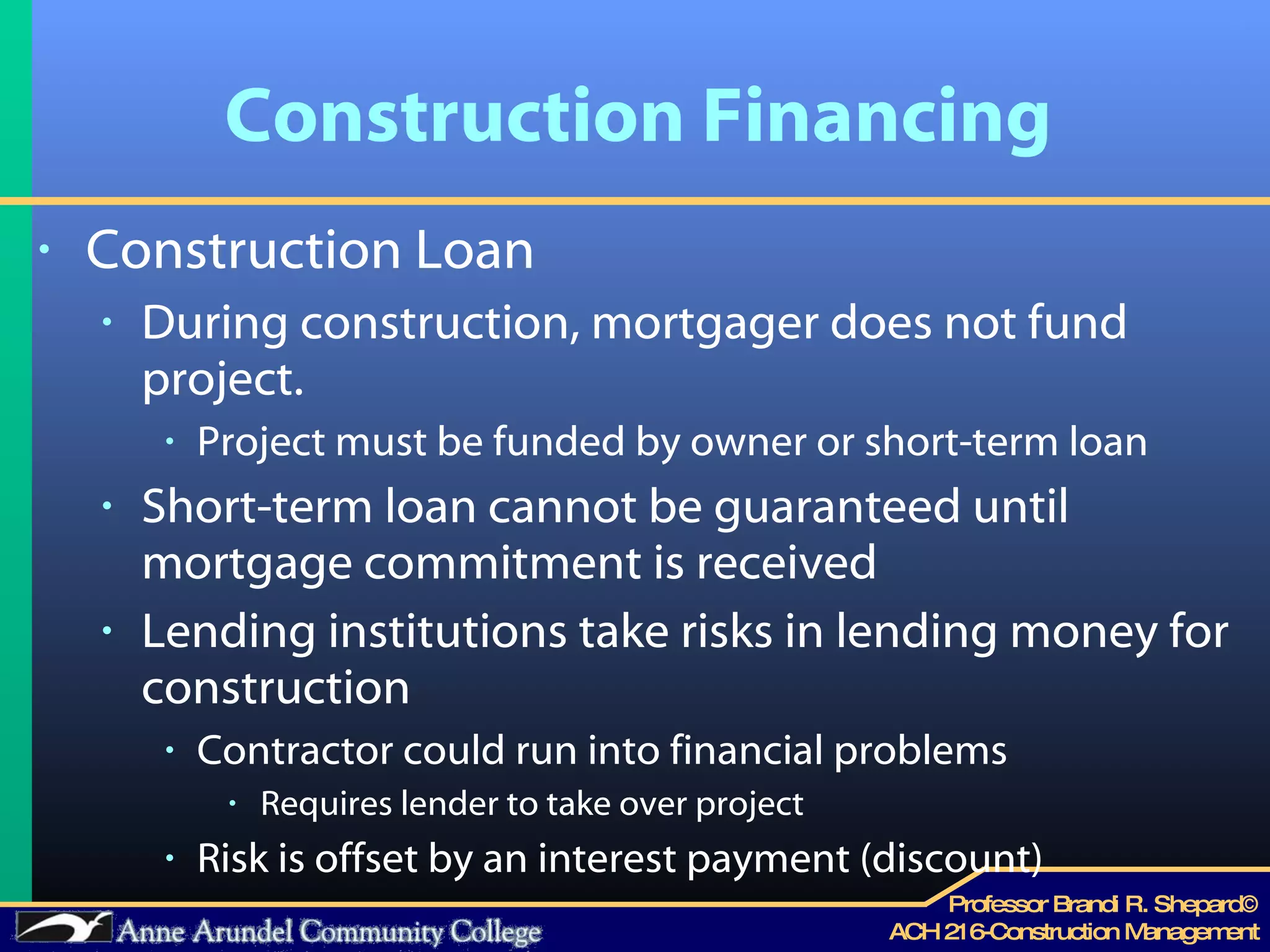
Construction Financing Construction Loan  During construction, mortgager does not fund project. Project must be funded by owner or short-term loan Short-term loan cannot be guaranteed until mortgage commitment is received Lending institutions take risks in lending money for construction Contractor could run into financial problems Requires lender to take over project Risk is offset by an interest payment (discount)
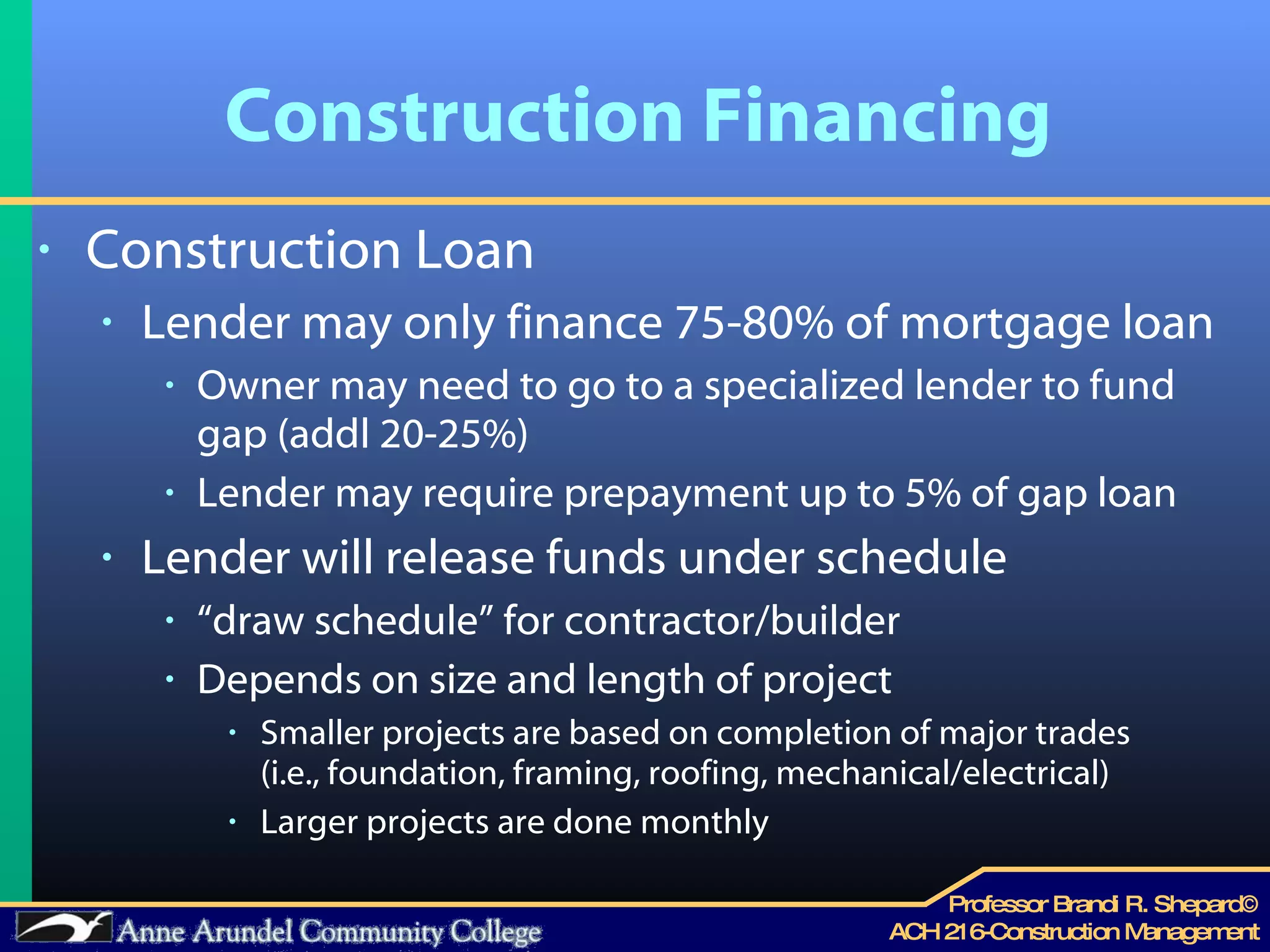
Construction Financing Construction Loan  Lender may only finance 75-80% of mortgage loan Owner may need to go to a specialized lender to fund gap (addl 20-25%)  Lender may require prepayment up to 5% of gap loan  Lender will release funds under schedule “ draw schedule” for contractor/builder Depends on size and length of project Smaller projects are based on completion of major trades  (i.e., foundation, framing, roofing, mechanical/electrical) Larger projects are done monthly
Construction Financing Retainage/Retention Deduction made from each progress payment prior to paying over the balance to the contractor Provision written into construction contract as an incentive to for contractor to continue efforts for completion Also becomes a reserve fund to cover defective work that contractor is held liable for Typically 10%, leaving contractor to collect 90% value of progress payments
Construction Financing Bonds A formal IOU issued by borrower in which he has promised to pay back sum of money at a later time Example: Joe borrows a $1000 agrees to pay back the $1000 (principal) in 10 years with annual interest of 8% Public entities issue bonds to fund construction Banks and investors purchase bonds with promise from agency to pay yearly interest and bond at the end of it’s term (10-50 years)
Procurement The process of purchasing needed resources for the execution and completion of the construction project Award of subcontracts (buying out the job) Ordering specific item for a specific amount of money to be delivered at a specific time Deals with entire cycle of material handling Purchasing    shop drawing approval    fabrication    delivery    installation    testing    turnover
Procurement Owner may purchase critical items before construction commences Mechanical  (air handlers built for specifically for project) Structural steel  Extremely long-lead items (6-12 month) An understanding of global economic conditions and local construction activities will help identify which items should be bought early.
Procurement Before purchasing resources, project manager should consider: Difference in handling cost vs. worth of item Custom items should be discussed with designer Standard products may do the same job Order in bulk to bring unit costs down Stay within production schedule to reduce need to “rush” ship items  Choose best method of shipping to get material to site in efficient, less costly manner Storage of material Cost, possibility of damage, theft, misplacement, material mobility
Procurement Project managers need to stay on top of procurement issues Talk to vendors/subs about production schedules Pinpoint delays, estimated time of delivery Consider routine plant shutdowns Additional information will be discussed during the Materials Management lecture
Project Cost Control In the planning phases, more thorough investigations and more accurate cost estimates are being required for those seeking financial backing. To remain competitive, contractors are being forced to monitor their cost accounts more closely and to know where losses are occurring.
Cost Control The project manager must establish standards to help control the construction process. Quality Productivity  Expenditures  The most important job factor the project team must control is  PRODUCTIVITY
Cost Control When  PRODUCTIVITY  of the project begins to waiver, possible corrective actions can be taken: Adding additional trades workers and crews Adding or removing equipment Working overtime Bringing in additional subcontractors Making the job more efficient Scheduling subcontractors so that they don’t interfere with each other’s operations
Cost Control Here come the formulas…… The effect of productivity on cost can be measured by the total quantity to be installed divided by the production rate Copy the formulas from the board
Cost Control THE RESULT: If you increase your production rate, you will decrease your cost AND If you decrease the production rate, you increase the cost
Cost Control Cash Flow Analysis The process of analyzing the project to determine the amount of working capital needed each month for construction execution A S-curve graph is used to predict project cash flow requirements A picture of how the project budget will be spent if the work is constructed exactly as estimated and schedule (WHICH NEVER HAPPENS) Developed by adding costs from  Work Breakdown Structure Breakdown of the scope of work for the project The S-curve becomes the  Budgeted Cost of Work Schedule
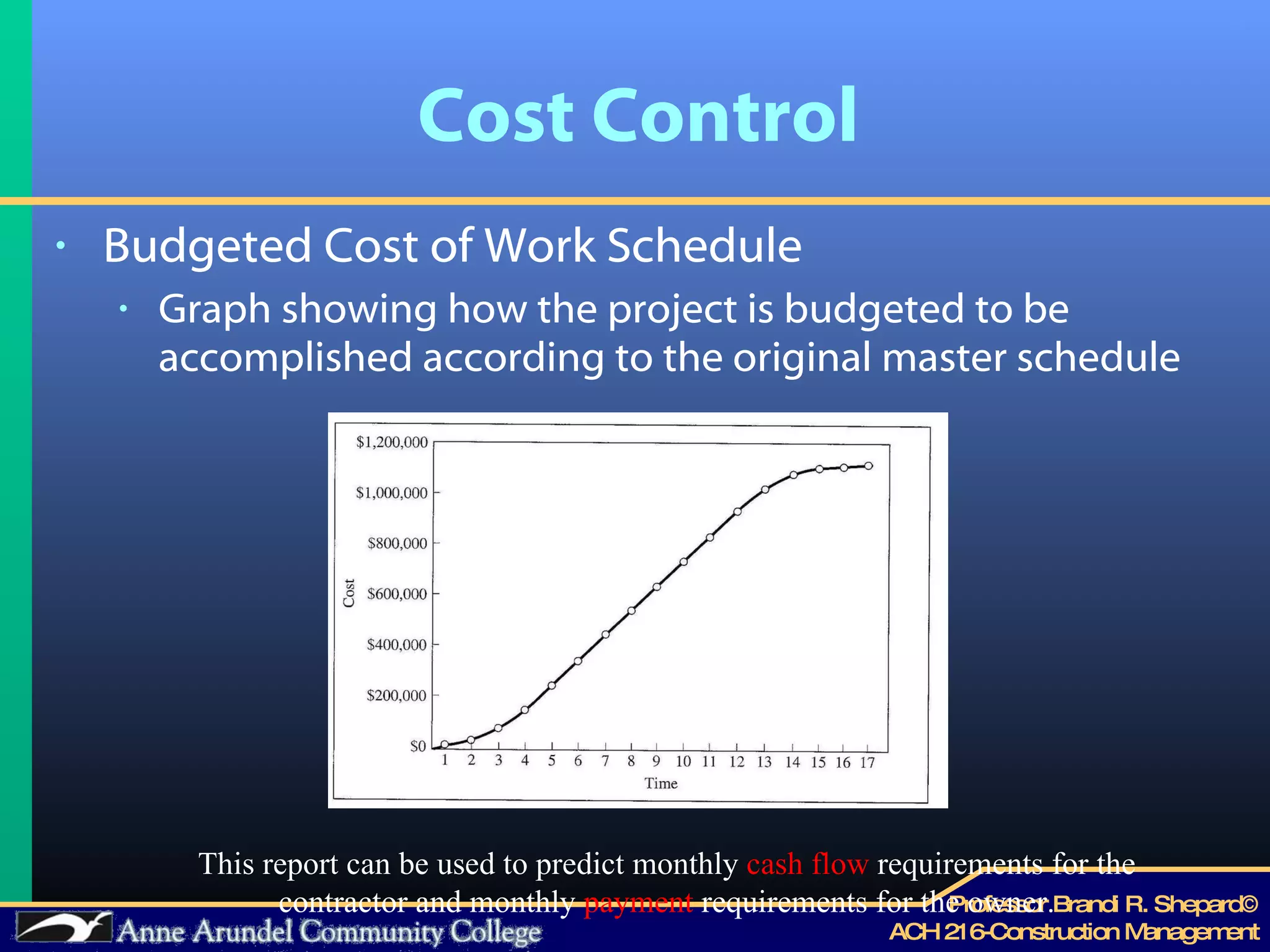
Cost Control Budgeted Cost of Work Schedule Graph showing how the project is budgeted to be accomplished according to the original master schedule Graphic 3.5 from mayo pg 79 This report can be used to predict monthly  cash flow  requirements for the contractor and monthly  payment  requirements for the owner.
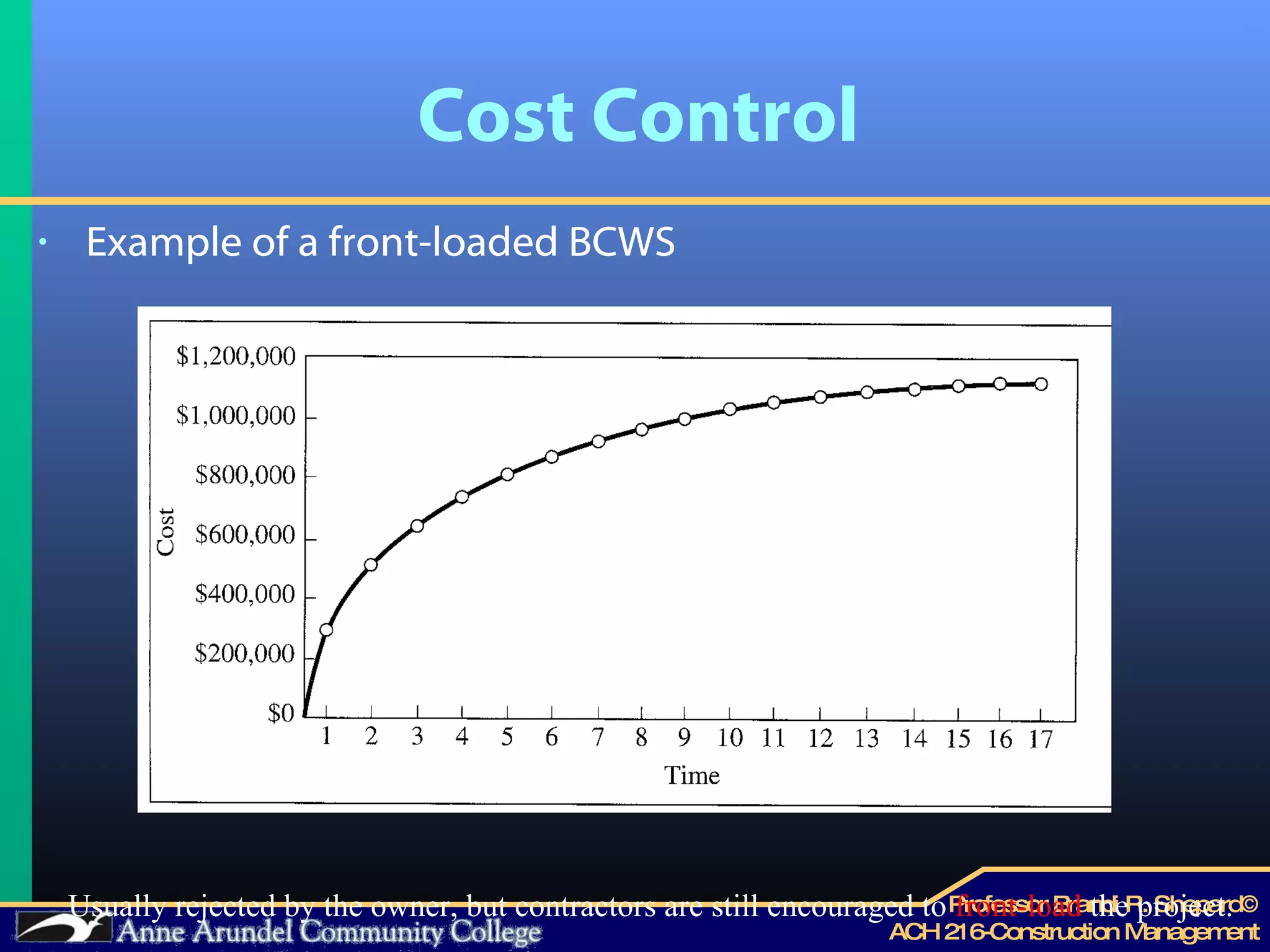
Cost Control Example of a front-loaded BCWS Usually rejected by the owner, but contractors are still encouraged to  front-load  the project.
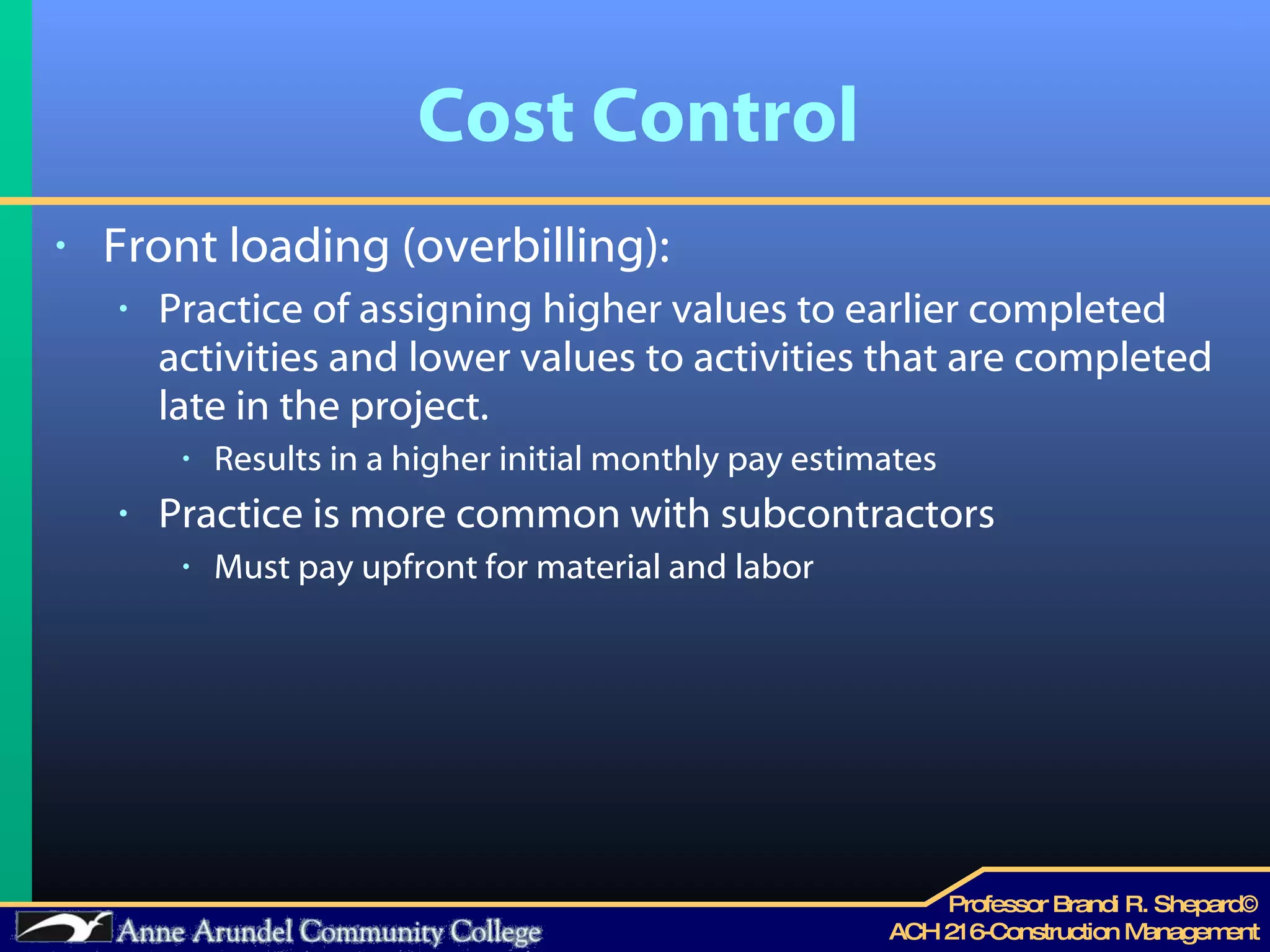
Cost Control Front loading (overbilling): Practice of assigning higher values to earlier completed activities and lower values to activities that are completed late in the project. Results in a higher initial monthly pay estimates Practice is more common with subcontractors Must pay upfront for material and labor
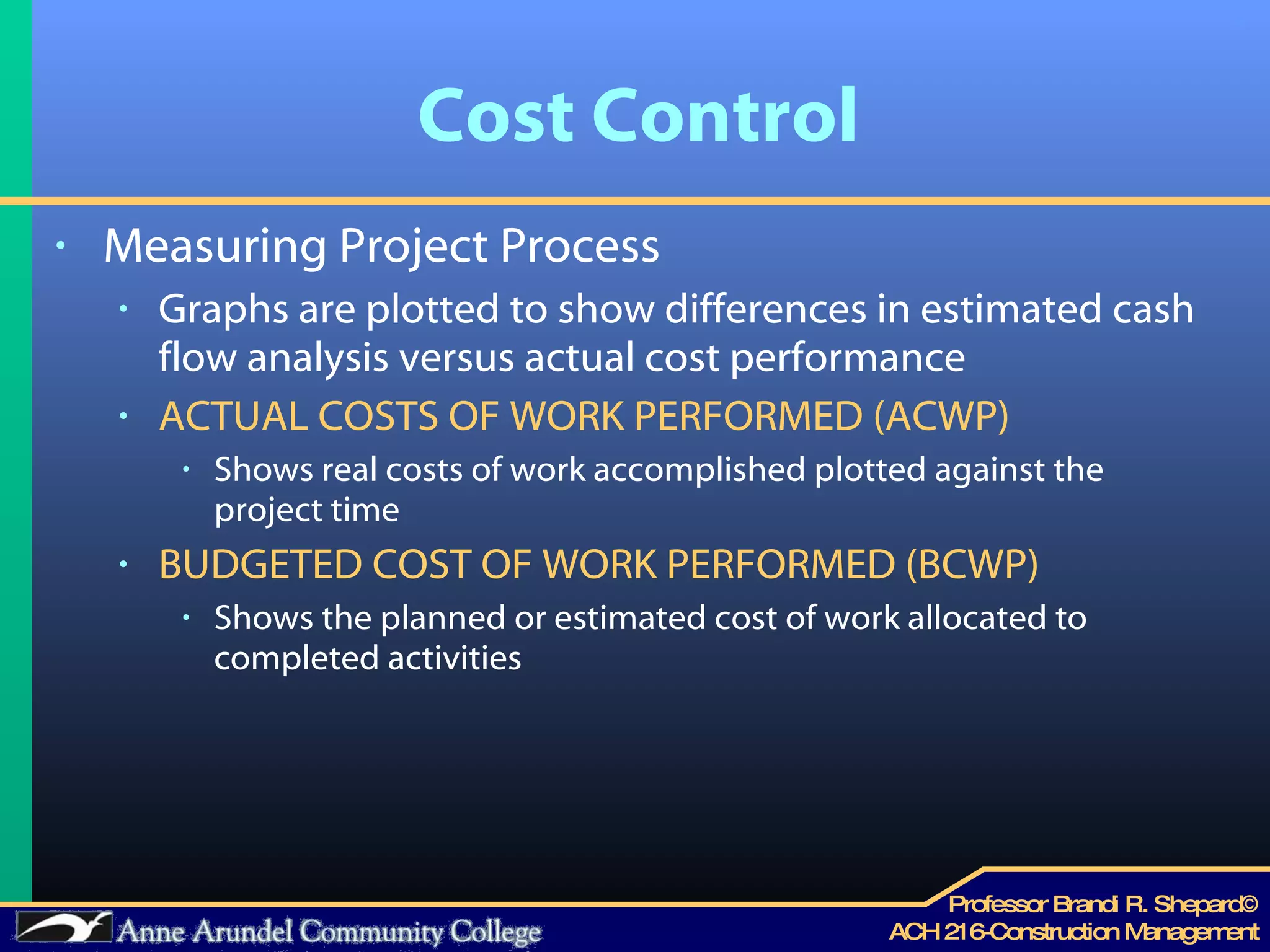
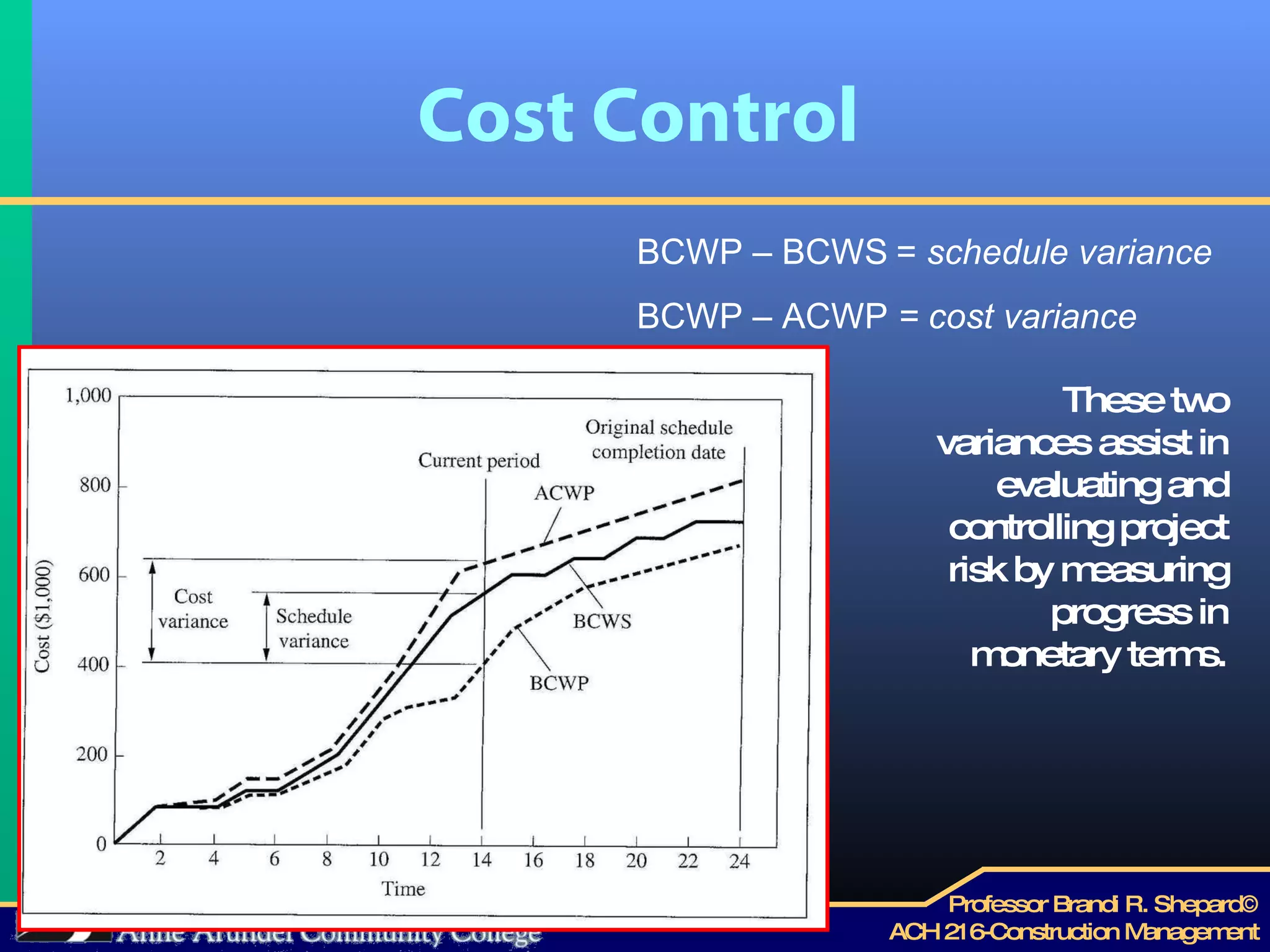
Cost Control Measuring Project Process Graphs are plotted to show differences in estimated cash flow analysis versus actual cost performance ACTUAL COSTS OF WORK PERFORMED (ACWP) Shows real costs of work accomplished plotted against the project time BUDGETED COST OF WORK PERFORMED (BCWP) Shows the planned or estimated cost of work allocated to completed activities
Cost Control BCWP – BCWS   =  schedule variance BCWP – ACWP  = cost variance These two variances assist in evaluating and controlling project risk by measuring progress in monetary terms.
Cost Control Cash flow analysis is done by both contractor and owner Contractor must evaluate need for working capital month to month  This becomes a KEY management tool for contractor because it becomes a score card for profitability Owner is contractually required to make monthly progress payments to contractor The bank will require upfront an analysis stating when draws will be made against the loan
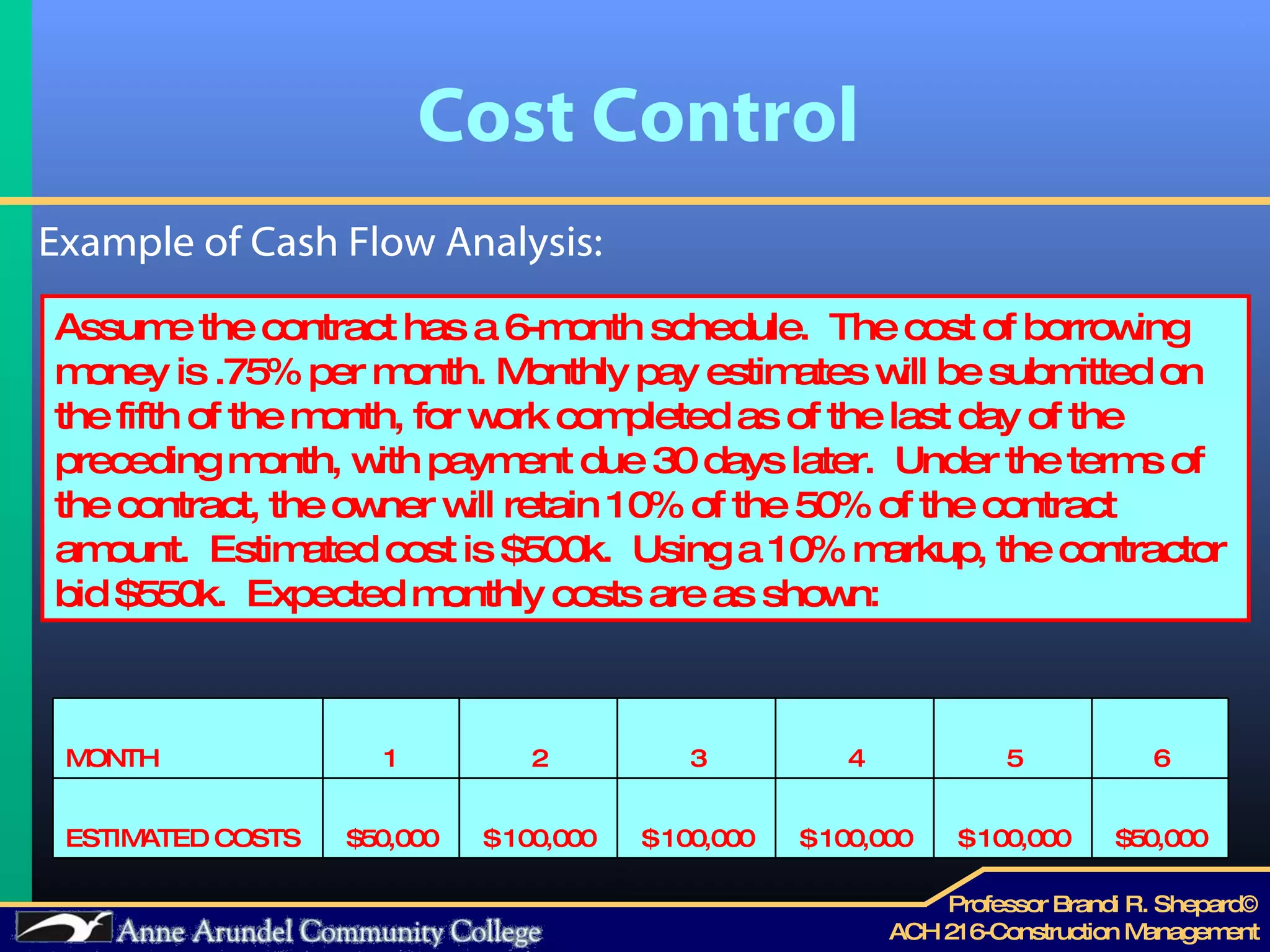
Cost Control Example of Cash Flow Analysis: Assume the contract has a 6-month schedule.  The cost of borrowing money is .75% per month. Monthly pay estimates will be submitted on the fifth of the month, for work completed as of the last day of the preceding month, with payment due 30 days later.  Under the terms of the contract, the owner will retain 10% of the 50% of the contract amount.  Estimated cost is $500k.  Using a 10% markup, the contractor bid $550k.  Expected monthly costs are as shown: MONTH 1 2 3 4 5 6 ESTIMATED COSTS $50,000  $ 100,000  $ 100,000  $ 100,000  $ 100,000  $50,000
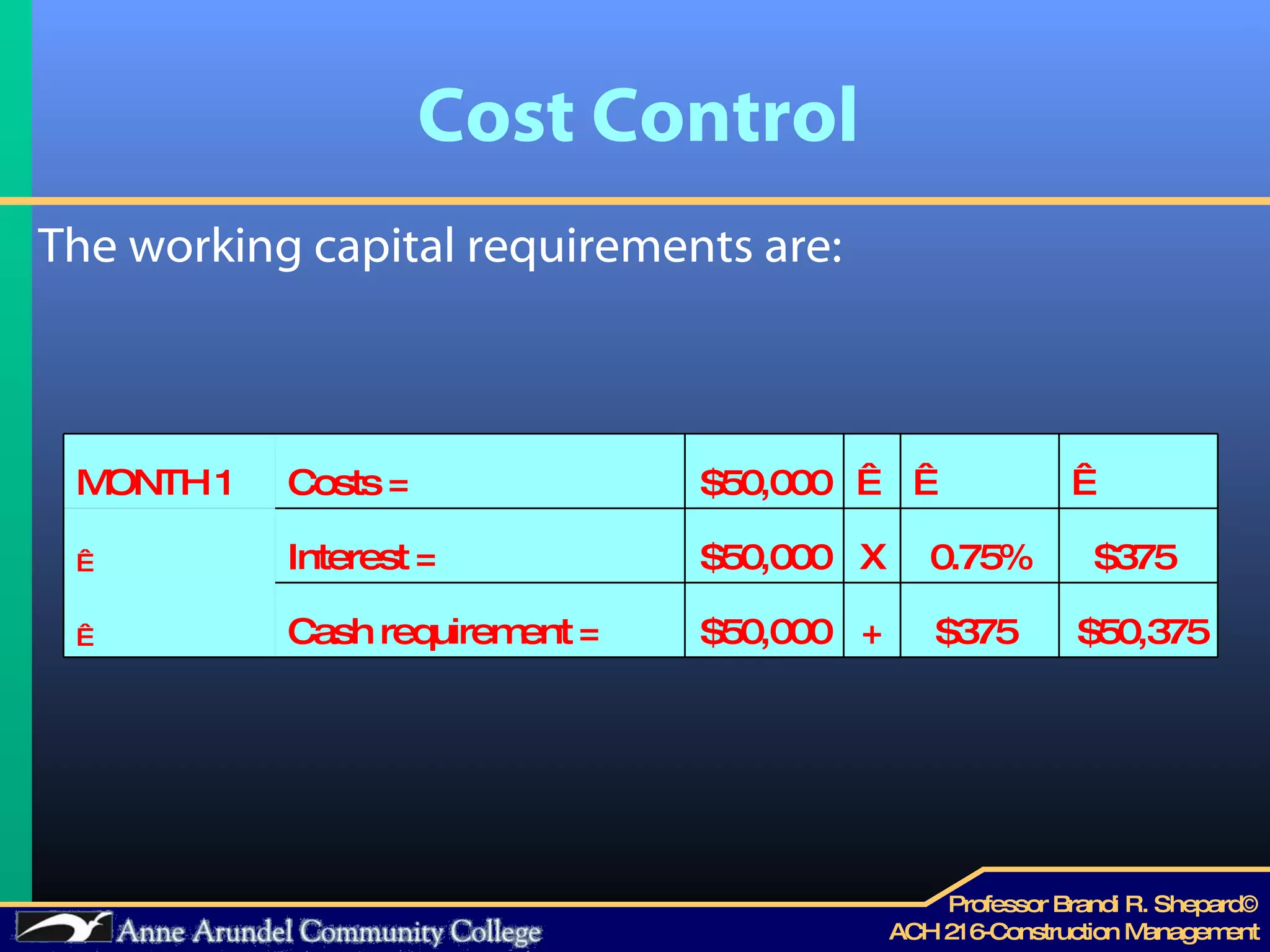
Cost Control The working capital requirements are: MONTH 1 Costs =  $50,000          Interest =  $50,000  X 0.75% $375    Cash requirement =  $50,000  + $375  $50,375
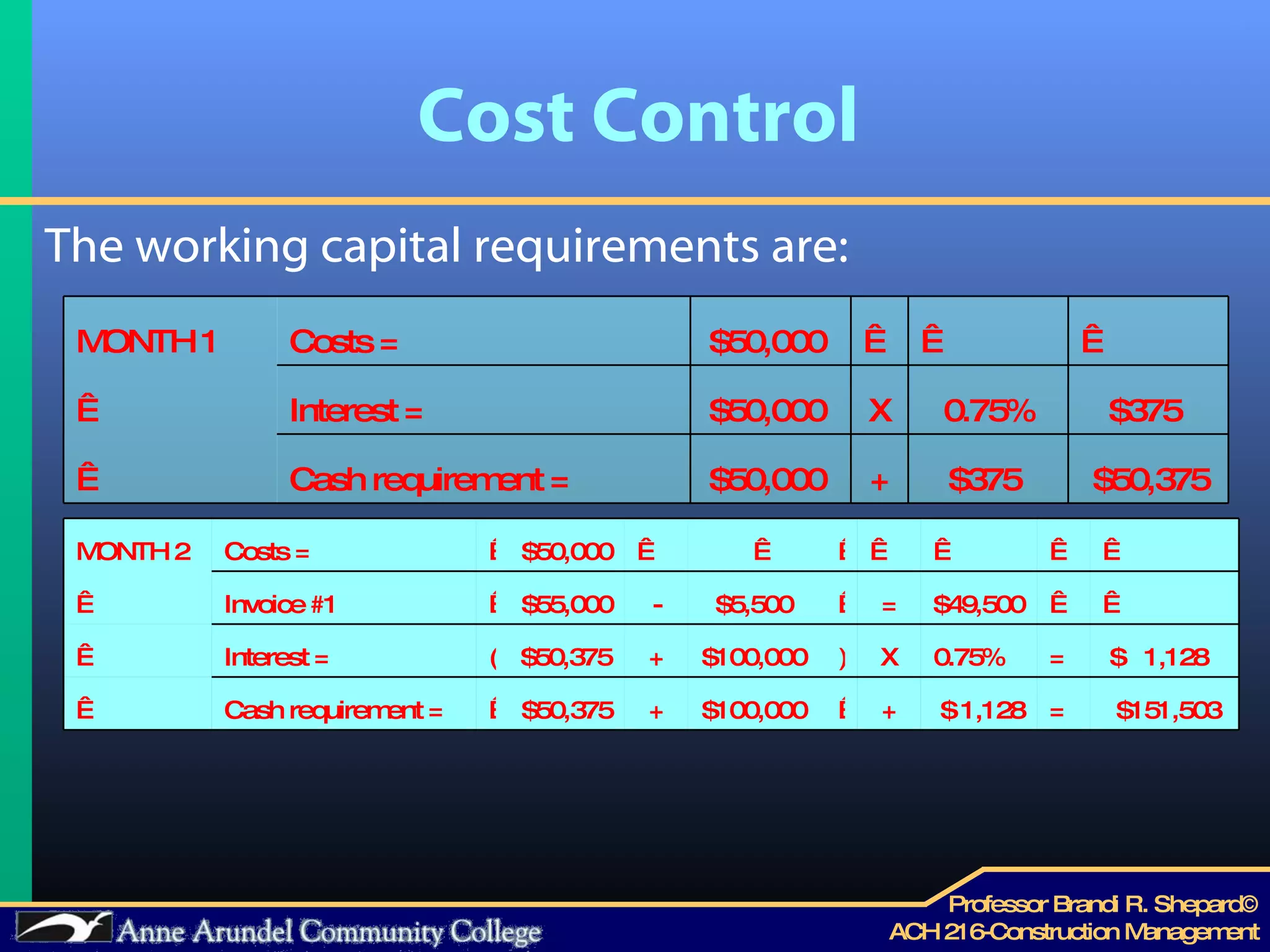
Cost Control The working capital requirements are: MONTH 1 Costs =  $50,000          Interest =  $50,000  X 0.75% $375    Cash requirement =  $50,000  + $375  $50,375  MONTH 2 Costs =    $50,000                  Invoice #1   $55,000  - $5,500    = $49,500        Interest =  ( $50,375  + $100,000  ) X 0.75% = $  1,128    Cash requirement =    $50,375  + $100,000    + $ 1,128  = $151,503
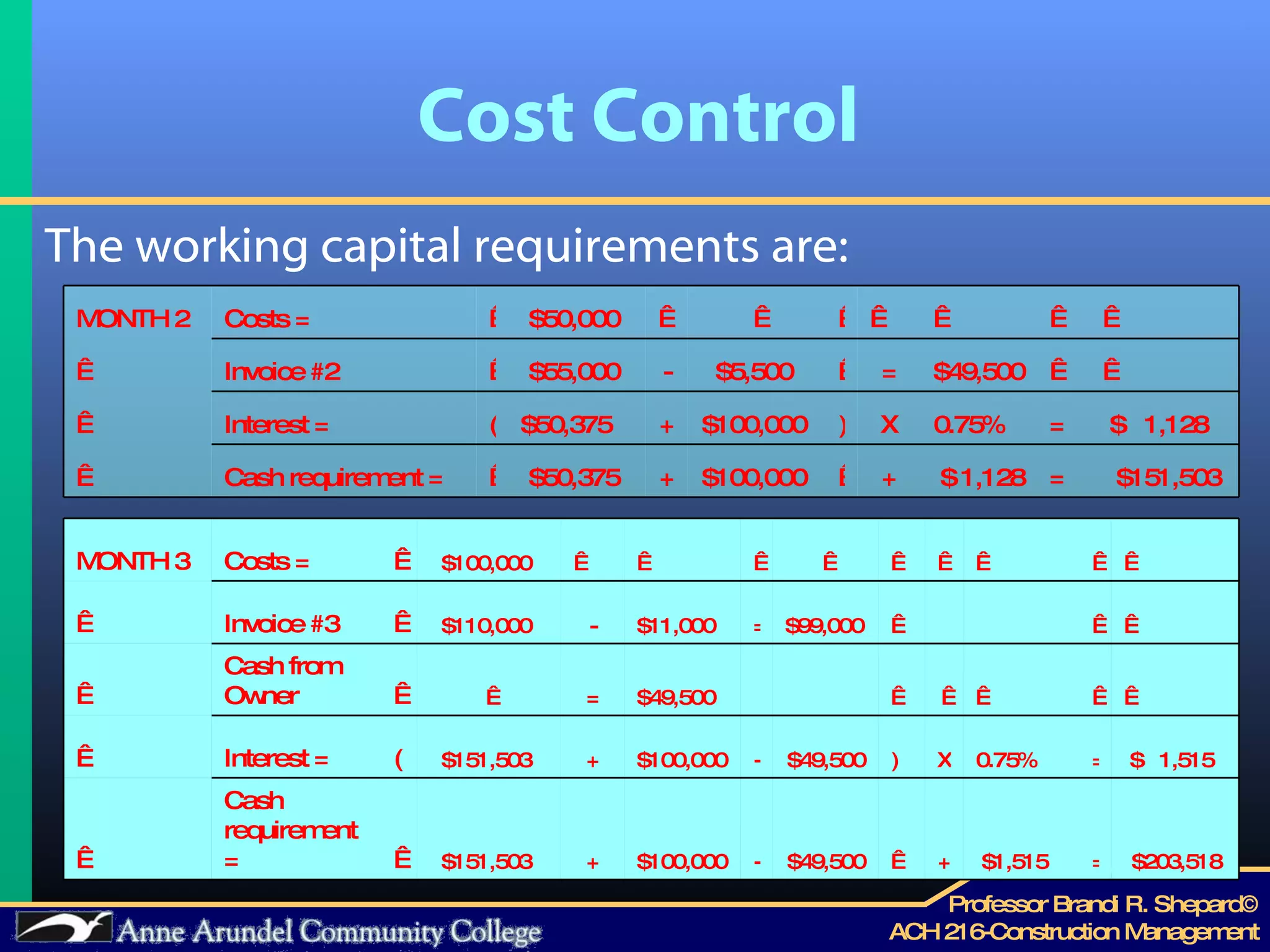
Cost Control The working capital requirements are: MONTH 2 Costs =    $50,000                  Invoice #2   $55,000  - $5,500    = $49,500        Interest =  ( $50,375  + $100,000  ) X 0.75% = $  1,128    Cash requirement =    $50,375  + $100,000    + $ 1,128  = $151,503  MONTH 3 Costs =    $100,000                      Invoice #3   $110,000  - $11,000  = $99,000          Cash from Owner     = $49,500              Interest =  ( $151,503  + $100,000  - $49,500  ) X 0.75% = $  1,515    Cash requirement =    $151,503  + $100,000  - $49,500    + $1,515  = $203,518
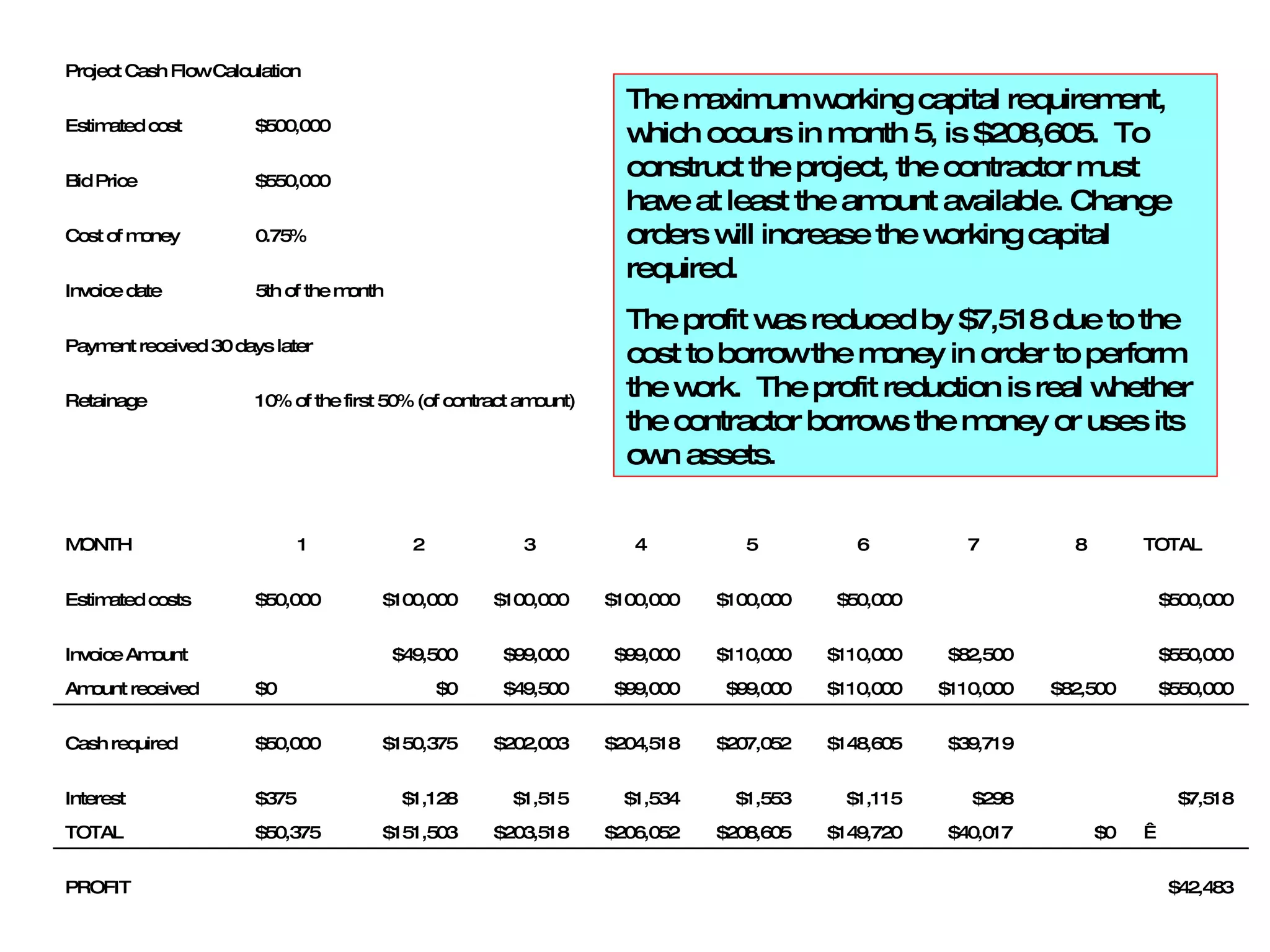
The maximum working capital requirement, which occurs in month 5, is $208,605.  To construct the project, the contractor must have at least the amount available. Change orders will increase the working capital required. The profit was reduced by $7,518 due to the cost to borrow the money in order to perform the work.  The profit reduction is real whether the contractor borrows the money or uses its own assets. Project Cash Flow Calculation Estimated cost $500,000  Bid Price  $550,000  Cost of money 0.75% Invoice date 5th of the month Payment received 30 days later Retainage 10% of the first 50% (of contract amount) MONTH 1 2 3 4 5 6 7 8 TOTAL Estimated costs $50,000  $100,000  $100,000  $100,000  $100,000  $50,000  $500,000  Invoice Amount $49,500  $99,000  $99,000  $110,000  $110,000  $82,500  $550,000  Amount received $0  $0  $49,500  $99,000  $99,000  $110,000  $110,000  $82,500  $550,000  Cash required $50,000  $150,375  $202,003  $204,518  $207,052  $148,605  $39,719  Interest $375  $1,128  $1,515  $1,534  $1,553  $1,115  $298  $7,518  TOTAL $50,375  $151,503  $203,518  $206,052  $208,605  $149,720  $40,017  $0    PROFIT $42,483
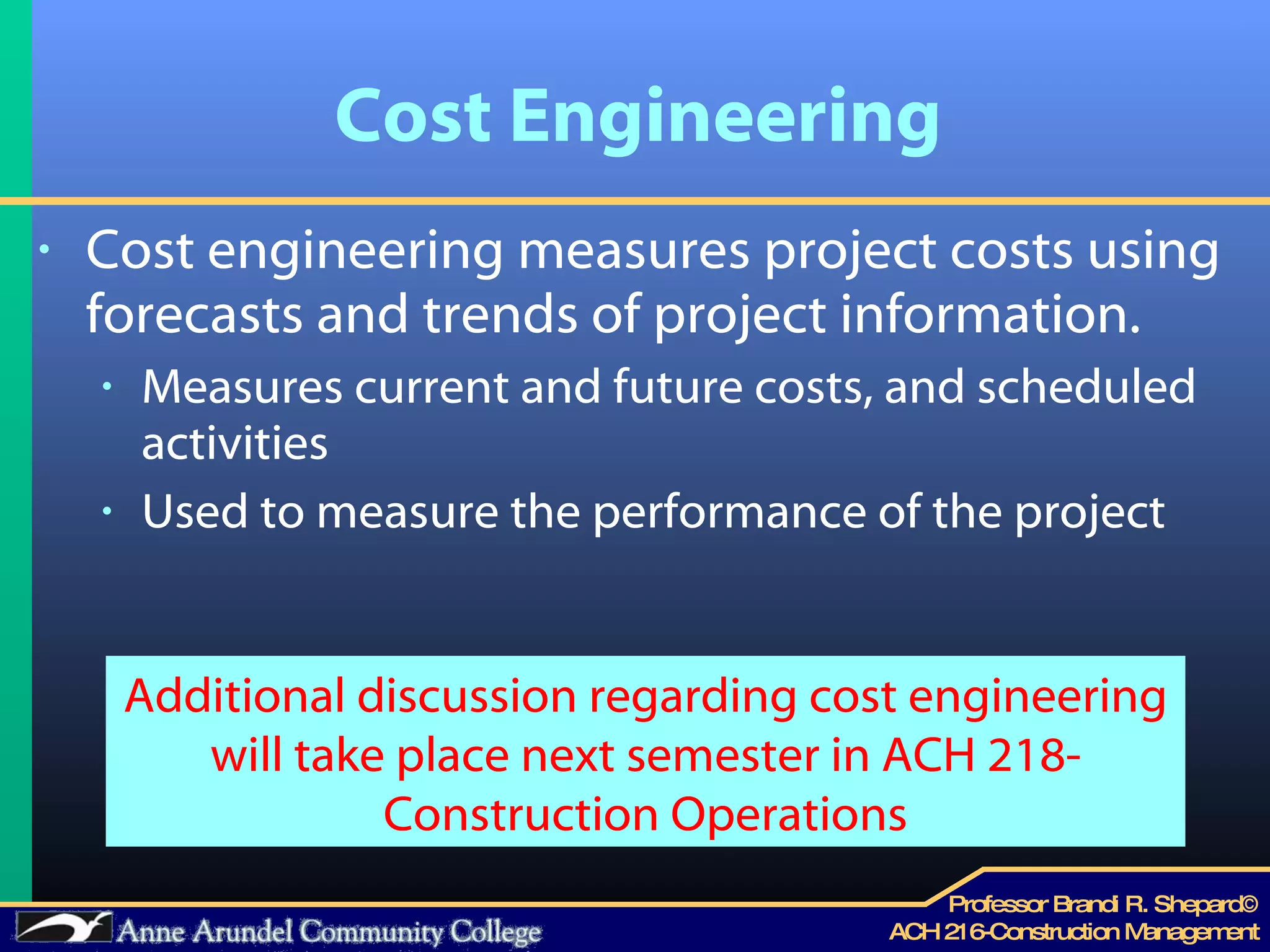
Cost Engineering Cost engineering measures project costs using forecasts and trends of project information. Measures current and future costs, and scheduled activities Used to measure the performance of the project Additional discussion regarding cost engineering will take place next semester in ACH 218-Construction Operations
Importance of Money Management Rising construction costs have increased the pressure on construction companies to carefully monitor and control the flow of money at all levels.  As a result, more emphasis is being placed on cash flow and cost control functions in construction management than ever before.
NEXT CLASS LECTURE 8 Scheduling

ACH 216 Lecture 07 (Project Funding)

  • 1.
    Project Management &Control Project Funding (LECTURE 7) Scheduling (LECTURE 8) Issues During the Construction Project (LECTURE 9) Materials Management and Quality Control (LECTURE 10)
  • 2.
    Project Funding ConstructionFinancing Procurement Cost Control Professor Brandi R. Shepard© ACH 121-Materials and Methods 1
  • 3.
    The Basic ResourcesFour M’s of Construction Resource Money Materials Manpower Machines
  • 4.
    Money: a BasicResource Money is a cascading resource that is encountered at various levels within the project structure Owner must have it to initiate construction/design Architect has to design within it’s confounds Contractor must have cash reserves to maintain continuity of the project operations
  • 5.
    Construction Financing Twotypes of project funding Short-term (construction loan) Facility construction Land purchases Land development Long-term (10-30 year mortgage)
  • 6.
    Construction Financing Constructionloans Extend over the period of construction Provided by a lending institution Loan is given on the assurance that it will be repaid with interest by long-term loan Mortgage loans 10, 15, 20, 25 & 30 year terms Owner must get financing for mortgage loan before construction loan is promised Bonds
  • 7.
    Construction Financing LendingInstitutions Real estate investment trusts (REIT’s) Investment or merchant banks Commercial banks Savings and loan associations/Credit Unions Insurance companies Governmental agencies (VA, FHA) International development banks Public institutions raise money by the sale of bonds
  • 8.
    Construction Financing Lendinginstitutions are cautious about lending moneys Vast amount of research and evaluation prior to loan commitment Required info on loan application Financial statements of the company/owner Proof of clear title to the land for which the project will be built on As well as appropriate zoning Preliminary cost estimates Market/feasibility study to verify expected income Detailed pro forma showing projected income and operational expense over the life of the mortgage/loan
  • 9.
  • 10.
    Construction Financing MortgageLoan Commitment Lending institution reviews venture; loan committee of lender approves loan Preliminary commitment is issued Most institutions reserve final commitment approval once final plans and specs are reviewed/approved Commitment becomes a formal contract between lender and borrower Borrower pledges to construct project based on approved design by lender Lending agrees at completion of construction (and target occupancy) to provide funds at stated interest rate and term length
  • 11.
    Construction Financing ConstructionLoan During construction, mortgager does not fund project. Project must be funded by owner or short-term loan Short-term loan cannot be guaranteed until mortgage commitment is received Lending institutions take risks in lending money for construction Contractor could run into financial problems Requires lender to take over project Risk is offset by an interest payment (discount)
  • 12.
    Construction Financing ConstructionLoan Lender may only finance 75-80% of mortgage loan Owner may need to go to a specialized lender to fund gap (addl 20-25%) Lender may require prepayment up to 5% of gap loan Lender will release funds under schedule “ draw schedule” for contractor/builder Depends on size and length of project Smaller projects are based on completion of major trades (i.e., foundation, framing, roofing, mechanical/electrical) Larger projects are done monthly
  • 13.
    Construction Financing Retainage/RetentionDeduction made from each progress payment prior to paying over the balance to the contractor Provision written into construction contract as an incentive to for contractor to continue efforts for completion Also becomes a reserve fund to cover defective work that contractor is held liable for Typically 10%, leaving contractor to collect 90% value of progress payments
  • 14.
    Construction Financing BondsA formal IOU issued by borrower in which he has promised to pay back sum of money at a later time Example: Joe borrows a $1000 agrees to pay back the $1000 (principal) in 10 years with annual interest of 8% Public entities issue bonds to fund construction Banks and investors purchase bonds with promise from agency to pay yearly interest and bond at the end of it’s term (10-50 years)
  • 15.
    Procurement The processof purchasing needed resources for the execution and completion of the construction project Award of subcontracts (buying out the job) Ordering specific item for a specific amount of money to be delivered at a specific time Deals with entire cycle of material handling Purchasing  shop drawing approval  fabrication  delivery  installation  testing  turnover
  • 16.
    Procurement Owner maypurchase critical items before construction commences Mechanical (air handlers built for specifically for project) Structural steel Extremely long-lead items (6-12 month) An understanding of global economic conditions and local construction activities will help identify which items should be bought early.
  • 17.
    Procurement Before purchasingresources, project manager should consider: Difference in handling cost vs. worth of item Custom items should be discussed with designer Standard products may do the same job Order in bulk to bring unit costs down Stay within production schedule to reduce need to “rush” ship items Choose best method of shipping to get material to site in efficient, less costly manner Storage of material Cost, possibility of damage, theft, misplacement, material mobility
  • 18.
    Procurement Project managersneed to stay on top of procurement issues Talk to vendors/subs about production schedules Pinpoint delays, estimated time of delivery Consider routine plant shutdowns Additional information will be discussed during the Materials Management lecture
  • 19.
    Project Cost ControlIn the planning phases, more thorough investigations and more accurate cost estimates are being required for those seeking financial backing. To remain competitive, contractors are being forced to monitor their cost accounts more closely and to know where losses are occurring.
  • 20.
    Cost Control Theproject manager must establish standards to help control the construction process. Quality Productivity Expenditures The most important job factor the project team must control is PRODUCTIVITY
  • 21.
    Cost Control When PRODUCTIVITY of the project begins to waiver, possible corrective actions can be taken: Adding additional trades workers and crews Adding or removing equipment Working overtime Bringing in additional subcontractors Making the job more efficient Scheduling subcontractors so that they don’t interfere with each other’s operations
  • 22.
    Cost Control Herecome the formulas…… The effect of productivity on cost can be measured by the total quantity to be installed divided by the production rate Copy the formulas from the board
  • 23.
    Cost Control THERESULT: If you increase your production rate, you will decrease your cost AND If you decrease the production rate, you increase the cost
  • 24.
    Cost Control CashFlow Analysis The process of analyzing the project to determine the amount of working capital needed each month for construction execution A S-curve graph is used to predict project cash flow requirements A picture of how the project budget will be spent if the work is constructed exactly as estimated and schedule (WHICH NEVER HAPPENS) Developed by adding costs from Work Breakdown Structure Breakdown of the scope of work for the project The S-curve becomes the Budgeted Cost of Work Schedule
  • 25.
    Cost Control BudgetedCost of Work Schedule Graph showing how the project is budgeted to be accomplished according to the original master schedule Graphic 3.5 from mayo pg 79 This report can be used to predict monthly cash flow requirements for the contractor and monthly payment requirements for the owner.
  • 26.
    Cost Control Exampleof a front-loaded BCWS Usually rejected by the owner, but contractors are still encouraged to front-load the project.
  • 27.
    Cost Control Frontloading (overbilling): Practice of assigning higher values to earlier completed activities and lower values to activities that are completed late in the project. Results in a higher initial monthly pay estimates Practice is more common with subcontractors Must pay upfront for material and labor
  • 28.
    Cost Control MeasuringProject Process Graphs are plotted to show differences in estimated cash flow analysis versus actual cost performance ACTUAL COSTS OF WORK PERFORMED (ACWP) Shows real costs of work accomplished plotted against the project time BUDGETED COST OF WORK PERFORMED (BCWP) Shows the planned or estimated cost of work allocated to completed activities
  • 29.
    Cost Control BCWP– BCWS = schedule variance BCWP – ACWP = cost variance These two variances assist in evaluating and controlling project risk by measuring progress in monetary terms.
  • 30.
    Cost Control Cashflow analysis is done by both contractor and owner Contractor must evaluate need for working capital month to month This becomes a KEY management tool for contractor because it becomes a score card for profitability Owner is contractually required to make monthly progress payments to contractor The bank will require upfront an analysis stating when draws will be made against the loan
  • 31.
    Cost Control Exampleof Cash Flow Analysis: Assume the contract has a 6-month schedule. The cost of borrowing money is .75% per month. Monthly pay estimates will be submitted on the fifth of the month, for work completed as of the last day of the preceding month, with payment due 30 days later. Under the terms of the contract, the owner will retain 10% of the 50% of the contract amount. Estimated cost is $500k. Using a 10% markup, the contractor bid $550k. Expected monthly costs are as shown: MONTH 1 2 3 4 5 6 ESTIMATED COSTS $50,000 $ 100,000 $ 100,000 $ 100,000 $ 100,000 $50,000
  • 32.
    Cost Control Theworking capital requirements are: MONTH 1 Costs = $50,000         Interest = $50,000 X 0.75% $375   Cash requirement = $50,000 + $375 $50,375
  • 33.
    Cost Control Theworking capital requirements are: MONTH 1 Costs = $50,000         Interest = $50,000 X 0.75% $375   Cash requirement = $50,000 + $375 $50,375 MONTH 2 Costs =   $50,000                 Invoice #1   $55,000 - $5,500   = $49,500       Interest = ( $50,375 + $100,000 ) X 0.75% = $ 1,128   Cash requirement =   $50,375 + $100,000   + $ 1,128 = $151,503
  • 34.
    Cost Control Theworking capital requirements are: MONTH 2 Costs =   $50,000                 Invoice #2   $55,000 - $5,500   = $49,500       Interest = ( $50,375 + $100,000 ) X 0.75% = $ 1,128   Cash requirement =   $50,375 + $100,000   + $ 1,128 = $151,503 MONTH 3 Costs =   $100,000                     Invoice #3   $110,000 - $11,000 = $99,000         Cash from Owner     = $49,500             Interest = ( $151,503 + $100,000 - $49,500 ) X 0.75% = $ 1,515   Cash requirement =   $151,503 + $100,000 - $49,500   + $1,515 = $203,518
  • 35.
    The maximum workingcapital requirement, which occurs in month 5, is $208,605. To construct the project, the contractor must have at least the amount available. Change orders will increase the working capital required. The profit was reduced by $7,518 due to the cost to borrow the money in order to perform the work. The profit reduction is real whether the contractor borrows the money or uses its own assets. Project Cash Flow Calculation Estimated cost $500,000 Bid Price $550,000 Cost of money 0.75% Invoice date 5th of the month Payment received 30 days later Retainage 10% of the first 50% (of contract amount) MONTH 1 2 3 4 5 6 7 8 TOTAL Estimated costs $50,000 $100,000 $100,000 $100,000 $100,000 $50,000 $500,000 Invoice Amount $49,500 $99,000 $99,000 $110,000 $110,000 $82,500 $550,000 Amount received $0 $0 $49,500 $99,000 $99,000 $110,000 $110,000 $82,500 $550,000 Cash required $50,000 $150,375 $202,003 $204,518 $207,052 $148,605 $39,719 Interest $375 $1,128 $1,515 $1,534 $1,553 $1,115 $298 $7,518 TOTAL $50,375 $151,503 $203,518 $206,052 $208,605 $149,720 $40,017 $0   PROFIT $42,483
  • 36.
    Cost Engineering Costengineering measures project costs using forecasts and trends of project information. Measures current and future costs, and scheduled activities Used to measure the performance of the project Additional discussion regarding cost engineering will take place next semester in ACH 218-Construction Operations
  • 37.
    Importance of MoneyManagement Rising construction costs have increased the pressure on construction companies to carefully monitor and control the flow of money at all levels. As a result, more emphasis is being placed on cash flow and cost control functions in construction management than ever before.
  • 38.
    NEXT CLASS LECTURE8 Scheduling