Construction Management [CENG 5194]
Civil Engineering Department
By: Melese Mengistu (MSc. Construction Engineering and Management)
Lecturer at Dire Dawa University Institute Of Technology- School Of
Civil Engineering & Architecture
E-mail: melesemngst@yahoo.com
Construction Management [CENG 5194]
Chapter 1
Introduction
Lecture # 1
2 by Melese M. DDU, SCEA
Construction Project
 A project is defined, whether it is in construction or not, by the
following characteristics:
 A defined goal or objective, Specific tasks to be performed, A
defined beginning& end, and Resources being consumed.
 Construction industry is different from other industries by its size, built
on-site, and generally unique.
 Projects begin with a stated goal established by the owner and
accomplished by the project team.
3 by Melese M. DDU, SCEA
Cont…
 Any series of construction activities and tasks that :.
 Have a specific objective to be completed within certain
specifications.
 Have defined start and end dates
 Have funding limits
 Consume human and nonhuman resources
 Generally project is ‘‘a temporary effort/endeavor undertaken to
create a unique product, service, or result’’.
4 by Melese M. DDU, SCEA
Need for Construction Project Management
 The construction industry is the largest industry in the world.
 It is more of a service than a manufacturing industry.
 Growth in this industry in fact is an indicator of the economic conditions of a
country.
 This is because the construction industry consumes a wide employment circle of
labor.
 While the manufacturing industry exhibit high-quality products, timelines of service
delivery, reasonable cost of service, and low failure rates, the construction industry,
on the other hand, is generally the opposite.
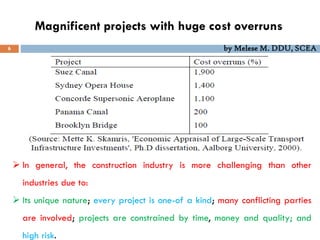
 Most projects exhibit cost overruns, time extensions, and conflicts among parties.
5 by Melese M. DDU, SCEA
Magnificent projects with huge cost overruns
6 by Melese M. DDU, SCEA
 In general, the construction industry is more challenging than other
industries due to:
 Its unique nature; every project is one-of a kind; many conflicting parties
are involved; projects are constrained by time, money and quality; and
high risk.
What is Construction Project Management
7 by Melese M. DDU, SCEA
 Construction Project management is the planning, organizing, leading,
staffing and controlling of all aspects of a project, to achieve the project’s
objective.
 management is usually considered to have five functions or principles:
Planning
 The management function that involves anticipating future trends and
determining the best strategies and tactics to achieve organizational
objectives.
Cont…
8 by Melese M. DDU, SCEA
Organizing
 The structuring of resources and activities to accomplish objectives in
an efficient and effective manner. Matching resource & work
Staffing
 Determining human resource needs, recruits, selects, trains, and
develops human resources for jobs created by an organization.
 It is undertaken to match people with jobs so that the realization of
the organization’s objectives will be facilitated
Cont…
9 by Melese M. DDU, SCEA
Leading
 Influencing others to engage in the work behaviors necessary to reach
organizational goals”.
 Creating a shared culture and values, communicating goals to employees
throughout the organization, and infusing employees to perform at a high
level.
Controlling
 process of ascertaining/checking whether organizational objectives have
been achieved; if not, why not; and determining what activities should then
be taken to achieve objectives better in future.
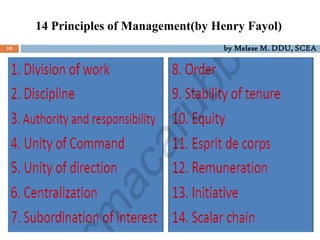
14 Principles of Management(by Henry Fayol)
10 by Melese M. DDU, SCEA
Cont…
11 by Melese M. DDU, SCEA
1. Work division
Specialization allows the individual to build up experience, and to
continuously improve his skills. Thereby he can be more productive.
2. Authority
The right to issue commands, along with which must go the balanced
responsibility for its function.
3. Discipline
Employees must obey, but this is two-sided: employees will only obey orders
if management play their part by providing good leadership.
Cont…
12 by Melese M. DDU, SCEA
4. Unity of command
 Each worker should have only one boss with no other conflicting lines of command.
5. Unity of Direction
 People engaged in the same kind of activities must have the same objectives in a
single plan.
 This is essential to ensure unity and coordination in the enterprise.
 Unity of command does not exist without unity of direction but does not
necessarily flows from it.
6. Subordination of individual interest
Management must see that the goals of the firms are always paramount
Cont…
13 by Melese M. DDU, SCEA
7. Payment/Remuneration
 Payment is an important motivator although by analysing a number of possibilities, Fayol
points out that there is no such thing as a perfect system
8. Centralization (Or Decentralization)
 This is a matter of degree depending on the condition of the business and the quality of its
personnel.
9. Scalar chain (Line of Authority)
 A hierarchy is necessary for unity of direction. But lateral communication is also
fundamental, as long as superiors know that such communication is taking place. Scalar
chain refers to the number of levels in the hierarchy from the ultimate authority to the
lowest level in the organization. It should not be over-stretched and consist of too-many
levels
Cont…
14 by Melese M. DDU, SCEA
10. Order
 Both material order and social order are necessary. The former minimizes lost time and
useless handling of materials. The latter is achieved through organization and
selection.
11. Equity
 In running a business a ‘combination of kindliness and justice’ is needed. Treating
employees well is important to achieve equity.
12. Stability of Tenure of Personnel
 Employees work better if job security and career progress are assured to them.
 An insecure tenure and a high rate of employee turnover will affect the organization
adversely.
Cont…
15 by Melese M. DDU, SCEA
13. Initiative
 Allowing all personnel to show their initiative in some way is a source of strength
for the organization.
 Even though it may well involve a sacrifice of ‘personal vanity’ on the part of many
managers.
14. Esprit de Corps
 Management must foster the morale of its employees.
 He further suggests that: “real talent is needed to coordinate effort, encourage
keenness, use each person’s abilities, and reward each one’s merit without arousing
possible jealousies and disturbing harmonious relations.”
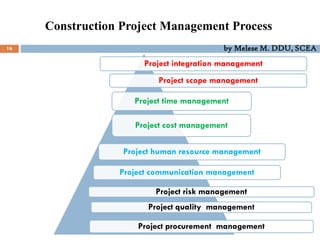
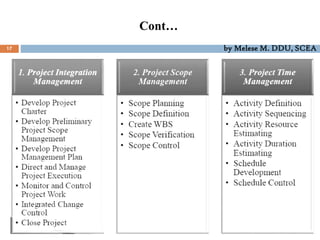
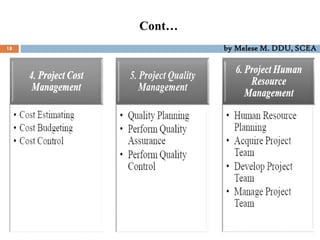
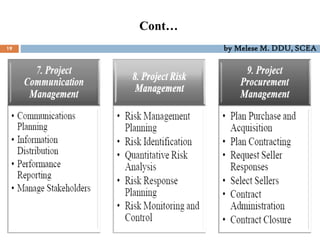
Construction Project Management Process
16 by Melese M. DDU, SCEA
Project integration management
Project scope management
Project time management
Project cost management
Project human resource management
Project communication management
Project risk management
Project quality management
Project procurement management
Cont…
17 by Melese M. DDU, SCEA
Cont…
18 by Melese M. DDU, SCEA
Cont…
19 by Melese M. DDU, SCEA
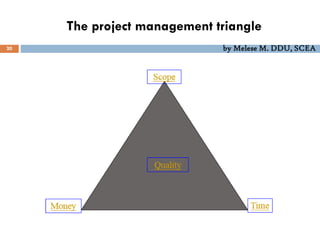
The project management triangle
20 by Melese M. DDU, SCEA
Historical Aspect, Recent Trends and Future Prospects of
Ethiopian construction industry
21
 Modern construction however had started during the region of
Emperor Menilik II (The road from Asmara to Addis Ababa).
 Italy during its invasion (1936-1941) had also contributed to the
development of the construction industry.
 It had constructed about 6000km of roads.
 After Italian invasion, the first Ministry called “Ministry of
Communication and Public Works’’ was established during the
Imperial regime.
 Now a days ministry of construction is established.
by Melese M. DDU, SCEA
Recent Trends and Future Prospects
22 by Melese M. DDU, SCEA
 Ethiopia engaged in massive construction of mega infrastructures to
satisfy large demand of its people.
 Road Construction
 Railway Construction
 Hydropower Development
 Wind power Development
 Sugar plants
 Irrigation Projects
 Industry zones
 Housing Developments
Current status of the Ethiopian construction sector
23 by Melese M. DDU, SCEA
 The general state of the domestic construction industry in Ethiopia is
characterized by the following five major deficiencies:
 An inadequate capital base;
 Old and limited numbers of equipment;
 Low levels of equipment availability and utilization;
 Deficiencies in technical, managerial, financial and
entrepreneurial skills; and
 Insufficient and ineffective use of labor-based
construction and maintenance technology
Major categories of construction industry
24 by Melese M. DDU, SCEA
 A construction is a process of constructing something by man for one
purpose or another.
 It may be a road, bridge, a dam, a dwelling place, an airport, a
commercial building, etc.
 The broad spectrum of constructed facilities may be classified into four
major categories, each with its own characteristics:
A. Residential Housing Construction:
 Includes single-family houses, multi-family dwellings, and high rise apartments.
 The residential housing market is heavily affected by general economic
conditions, tax laws, and the monetary and fiscal policy.
Cont…
25 by Melese M. DDU, SCEA
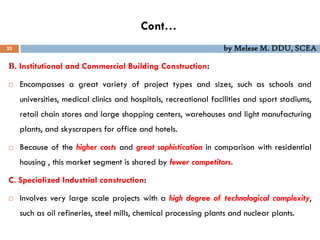
B. Institutional and Commercial Building Construction:
 Encompasses a great variety of project types and sizes, such as schools and
universities, medical clinics and hospitals, recreational facilities and sport stadiums,
retail chain stores and large shopping centers, warehouses and light manufacturing
plants, and skyscrapers for office and hotels.
 Because of the higher costs and great sophistication in comparison with residential
housing , this market segment is shared by fewer competitors.
C. Specialized Industrial construction:
 Involves very large scale projects with a high degree of technological complexity,
such as oil refineries, steel mills, chemical processing plants and nuclear plants.
Cont…
26 by Melese M. DDU, SCEA
 Long range demand forecasting is the most important factor since such
projects are capital intensive and require considerable amount of planning
and construction time.
D. Infrastructure and heavy construction:
 Includes projects such as highways, mass transit systems, tunnels, bridges,
pipelines, dams, drainage systems and sewage treatment plants.
 Most of these projects are publicly owned and therefore financed by either
through bonds, taxes, grants or aids.
 This category of construction is characterized by a high degree of
mechanization.
Construction Projects Participants
27 by Melese M. DDU, SCEA
 The Owner (The Client) : The owner is the individual or organization for
whom a project is to be built under a contract.
 Duty of the Client
 Demand for the product. For example for the building project:
 Availability and cost of land,
 Location & accessibility
 Price
 Required Infrastructure
 Legal constraints
 Current & future development
 Soil characteristics of land
 Site preparation (right of way)
 Permits
Cont…
28 by Melese M. DDU, SCEA
Consultant
The consultants’ team shall:
 Ascertain, interpret and formulate the client’s requirement into an
understandable project.
 Design the project to much requirements and constraints
 Assess client’s cost limit to decide on materials & the like.
 Prepare contract documents.
 Supervise the project and constantly inform the client on the progress
 Approve payments and Resolve contractual disputes
 Issue provisional and final acceptance certification
Cont…
29 by Melese M. DDU, SCEA
Contractor
Responsibility of contractors:
 Carry out a full site investigation prior to submission of tender,
 Submit tender,
 Plan, Program, Control the construction process.
 Notify the consultant about delays, discrepancies/disagreement,
 Effect all payments to his employees, suppliers, subcontractors,
 Rectify/repair all defects on completion of works, etc
 Provide post occupancy repair & maintenance if required.
Cont…
30 by Melese M. DDU, SCEA
Public sector clients
 Central Government Offices (Ministries)
 Local Authorities (Regional or Town)
 Public Corporations
A. Statutory Authorities
 These bodies offer technical advice during design and construction in their respective
areas.
E.g. EEPCO, AAWSA, Fire Authority - requires meeting their specific requirements.
 Thus early information to these authorities is required.
B. Municipalities and Government Authorities
 These bodies offer the basic Land permit and building permit.
Cont…
31 by Melese M. DDU, SCEA
The Design Professionals : The major role of the design professional is to
interpret or assist the owner in developing the project’s scope, budget, and
schedule and to prepare construction documents.
Architect: An architect is an individual who plans and design buildings and
their associated landscaping
Engineer: The term engineer usually refers to an individual or a firm engaged
in the design or other work associated with the design or construction.
Engineering-Construction Firm: An engineering-construction firm is a type of
organization the combines both architect/engineering and construction
contracting
Cont…
32 by Melese M. DDU, SCEA
The Construction Professionals:
The constructions Professional are the parties that responsible for
constructing the project.
 The prime contractor is responsible for delivering a complete project
in accordance with the contract documents.
The Project Manager: is the individual charged with the overall
coordination of the entire construction program for the owner.
These include planning, design, procurement, and construction.
Cont…
33 by Melese M. DDU, SCEA
 Among his/her duties:
 Clear definitions of the goals of the project.
 Investigate alternative solutions for the problems.
 Develop a detailed plan to make the selected program reality.
 Implement the plan and control the project.
 Construction Manager: The construction manager is responsible for
administering the on-site erection activities, design coordination,
proper selection of materials and methods of construction, contracts
preparation for award, cost and scheduling information and control.
Project Life Cycle
34 by Melese M. DDU, SCEA
 A process through which a project is implemented from beginning to end.
 The solutions at various stages are then integrated to obtain the final outcome.
 Although each stage requires different expertise, it usually includes both
technical and managerial activities in the knowledge domain of the specialist.
 All stages from conceptual planning and feasibility studies to the acceptance
of a facility for occupancy may be broadly lumped together and referred to
as the Design/Construct process.
 There is no single best approach in organizing project management throughout
a project's life cycle.
1. Preconstruction phase
35 by Melese M. DDU, SCEA
Project Feasibility study
 This identifies project constraints, alternatives and related assumptions
applied to the end product to be developed.
 Project feasibility is characterized by four basic components:
 Business Problem Description.
 Approach Overview to be used to develop.
 Potential Solutions of the problem.
 Preliminary Recommendations.
Cont…
36 by Melese M. DDU, SCEA
Conceptual design:
 Very important for the owner.
 During this stage the owner hires key consultants including the designer and
project manager, selects the project site, and establish a conceptual
estimate, schedule, and program.
 The owner must gather as much information as possible about the project
and The most important decision is to proceed with the project or not.
Schematic design: the project team investigates alternate design solutions,
materials and systems.
 Completion of this stage represents about 30% of the design completion.
Cont…
37 by Melese M. DDU, SCEA
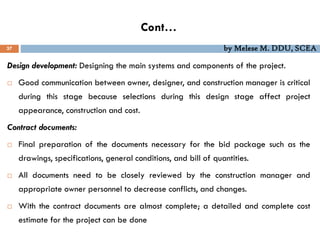
Design development: Designing the main systems and components of the project.
 Good communication between owner, designer, and construction manager is critical
during this stage because selections during this design stage affect project
appearance, construction and cost.
Contract documents:
 Final preparation of the documents necessary for the bid package such as the
drawings, specifications, general conditions, and bill of quantities.
 All documents need to be closely reviewed by the construction manager and
appropriate owner personnel to decrease conflicts, and changes.
 With the contract documents are almost complete; a detailed and complete cost
estimate for the project can be done
2. Procurement phase (Bidding and award phase)
38 by Melese M. DDU, SCEA
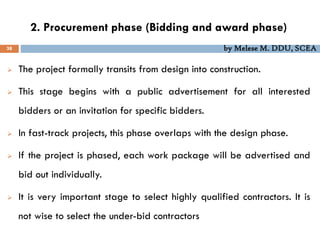
 The project formally transits from design into construction.
 This stage begins with a public advertisement for all interested
bidders or an invitation for specific bidders.
 In fast-track projects, this phase overlaps with the design phase.
 If the project is phased, each work package will be advertised and
bid out individually.
 It is very important stage to select highly qualified contractors. It is
not wise to select the under-bid contractors
3.Construction phase
39 by Melese M. DDU, SCEA
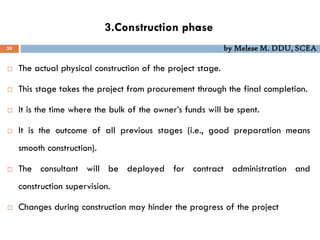
 The actual physical construction of the project stage.
 This stage takes the project from procurement through the final completion.
 It is the time where the bulk of the owner’s funds will be spent.
 It is the outcome of all previous stages (i.e., good preparation means
smooth construction).
 The consultant will be deployed for contract administration and
construction supervision.
 Changes during construction may hinder the progress of the project
4. Closeout phase
40 by Melese M. DDU, SCEA
 Transition from design and construction to the actual use of the constructed facility.
 In this stage, the management team must provide documentation, shop drawings,
as-built drawings, and operation manuals to the owner organization.
 The as-built drawings are the original contract drawings adjusted to reflect all the
changes that occurred.
 Assessment of the project team’s performance is crucial in this stage for avoiding
mistakes in the future.
 Actual activity costs and durations should be recorded and compared with that
was planned. This updated costs and durations will serve as the basis for the
estimating and scheduling of future projects.
Cont…
41 by Melese M. DDU, SCEA
Provisional acceptance
 the client accepts the completed works on provisional basis for a period one year.
 During this period all payments except the retention money (10%) are paid.
Final acceptance
 At this stage the owner completely accepts the works executed and the retention
money is released to the contractor.
 But if default found during this period, the owner can oblige the contractor to
work out that default or the client himself worked it out from the retention money.
 The contractor is assumed to have completed his contractual obligation from this
time on.
Cont…
42 by Melese M. DDU, SCEA
Project Delivery Methods
43 by Melese M. DDU, SCEA
 It is how project parties are involved in the project and how they interact
with each other.
 It can be facilitated considering the following factors:
• Size and nature of the work packages within the project.
• Selection of the design team form in-house resources external
consultants or contractors.
• Process of supervision of construction.
• Restrictions upon using combination of organizational structures within
the project.
• Expertise which the client wishes to commit to the project.
1.Traditional approach
44 by Melese M. DDU, SCEA
 The most common approach in civil engineering projects in which the
design has to be completed before construction can start.
 Design and construction are usually performed by two different parties
who interact directly and separately with the owner.
Advantages:
 Price competition
 Total cost is known before construction starts
 Well documented approach used in most government projects.
Disadvantages
 Long time and Conflict between owner, contractor and A/E
2. Direct labor
45 by Melese M. DDU, SCEA
 In this approach, owner organization performs both the design and
construction using its in-house labor force.
 Used by large authorities
 The owner performs both the design and the construction
 May use consultants for some specialized designs
 Most suitable for small projects
 Can be used when expertise are available
 Low risk projects
 Inadequate scope definition
3.Design-build
46 by Melese M. DDU, SCEA
 In this approach, a single organization is responsible for performing
both design and construction.
Advantages:
 Only one contract used
 Minimum owner involvement
 Used for fast-track projects in order to reduce time
 Co-ordination between design and construction and easier in implementing
the changes
Disadvantages
 Cost may not be known until end of the construction
 High risk to contractor and more cost to owner
 Design-build company may reduce quality to save cost
4.Turnkey
47 by Melese M. DDU, SCEA
 This approach is similar to the design-build approach but with the
organization being responsible for performing both design,
construction, know-how (if any), and project financing.
 Owner payment is then made at the completion (when the contractor
turns over the “key”).
5. Build-operate-transfer (BOT)
48 by Melese M. DDU, SCEA
 In this approach, a business entity is responsible for performing the design,
construction, long-term financing, and temporary operation of the project.
 At the end of the operation period, which can be many years, operation
of the project is transferred to the owner
 This approach has been extensively used in recent years and is expected
to continue.
 This approach has also been used extensively in large infrastructure
projects financed by the World Bank in parts of the world that cannot
afford the high investment cost of such projects.
Cont…
49 by Melese M. DDU, SCEA
 This delivery system is advantageous because of three major factors:
 It minimizes owners’ scarcity of financial resources;
 It devoid of considerable risks from the project owners and lessen
regulatory activities; and
 The facility is well operated and transferred with free of charge or
minimum compensations to project owners.
 The increasing popularity of the BOT project is largely due to a shortage
of public funding and the opinion that the facility will be more efficiently
managed by a private entity.
6. Professional construction management (PCM)
50 by Melese M. DDU, SCEA
 In this approach, the owner appoints a PCM organization (also
known as Construction Management organization) to manage and
coordinate the design and construction phases of a project using a
Teamwork approach.
 The use of PCM approach, therefore, should be considered when:
 There is a need for time saving,
 Flexibility for design changes is required, and
 Owner has insufficient management resources.
7. Contractual relationships
51 by Melese M. DDU, SCEA
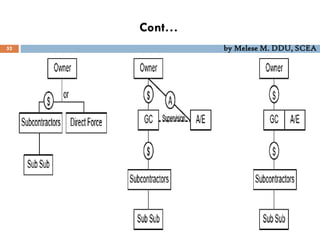
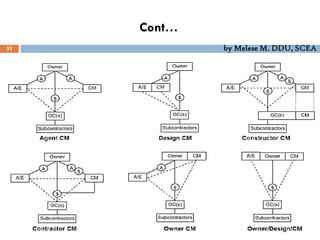
 Within each project delivery method, the contractual relationships
among the project participants can take various arrangements
 The owner needs to make a decision regarding the proper
arrangement that suits the project and the parties involved.
 The different contractual relationships associated with various
project delivery methods are illustrated in the following Figures.
Cont…
52 by Melese M. DDU, SCEA
Cont…
53 by Melese M. DDU, SCEA
End of Chapter 1
Introduction
Lecture # 1
Thank You!!!
Construction Management [CENG 5194]
by Melese M. DDU, SCEA
Construction Management [CENG 5194]
Civil Engineering Department
By: Melese Mengistu (MSc. Construction Engineering and Management)
Lecturer at Dire Dawa University Institute Of Technology- School Of
Civil Engineering & Architecture
E-mail: melesemngst@yahoo.com
Construction Management [CENG 5194]
Chapter 2 and 3
Project Planning and Scheduling
Lecture # 2 # 3
2 by Melese M. DDU, SCEA
Planning and Scheduling
3 by Melese M. DDU, SCEA
Planning and Scheduling
4 by Melese M. DDU, SCEA
 Planning and scheduling are two terms that are often thought of as synonymous,
but They are not!
 Scheduling is just one part of the planning effort.
 Project planning serves as a foundation for several related functions such as
cost estimating, scheduling, and project control.
 Project scheduling is the determination of the timing and sequence of
operations in the project and their assembly to give the overall completion time
Cont…
5 by Melese M. DDU, SCEA
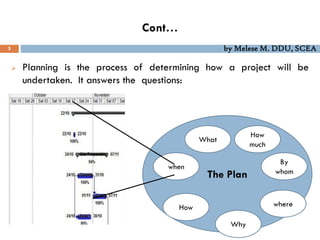
 Planning is the process of determining how a project will be
undertaken. It answers the questions:
The Plan
What
How
much
By
whom
where
Why
How
when
Why Plan and Schedule Projects ?
6 by Melese M. DDU, SCEA
 To calculate the project completion.
 To calculate the start or end of a specific activity.
 To predict and calculate the cash flow .
 To evaluate the effect of changing orders .
 To improve work efficiency.
 To resolve delay claims , this is important in critical path method
‘CPM’ discussed later..
 To serve as an effective project control tool .
Project Planning Methods
7 by Melese M. DDU, SCEA
1. Bar (Gantt) Charts
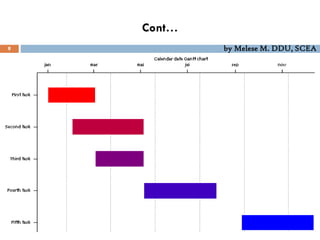
 A bar chart is ‘‘a graphic representation of project activities, shown in a
time-scaled bar line with no links shown between activities’’
 The bar may not indicate continuous work from the start of the activity until
its end. Or
 Non continuous (dashed) bars are sometimes used to distinguish between
real work (solid line) and inactive periods (gaps between solid lines)
 Before a bar chart can be constructed for a project, the project must be
broken into smaller, usually homogeneous components, each of which is
called an activity, or a task.
Cont…
8 by Melese M. DDU, SCEA
Cont…
9 by Melese M. DDU, SCEA
 Advantages Of Bar Charts
 Time-scaled and Simple to prepare
 Can be more effective and efficient if CPM based - Still the most
popular method
 Bars can be dashed to indicate work stoppage.
 Can be loaded with other information (budget, man hours, resources,
etc.)
 Disadvantages Of Bar Charts
 Does not show logic
 Not practical for projects with too many activities
Cont…
10 by Melese M. DDU, SCEA
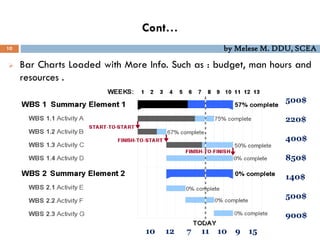
 Bar Charts Loaded with More Info. Such as : budget, man hours and
resources .
500$
220$
400$
850$
140$
500$
900$
10 12 7 11 10 9 15
2. Work Breakdown Structure (WBS)
11 by Melese M. DDU, SCEA
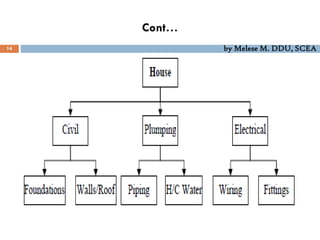
 The WBS is hierarchical structure which is designed to logically
subdivide all the work-elements of the project into a graphical
presentation.
 The full scope of work for the project is placed at the top of the
diagram, and then sub-divided smaller elements of work at each
lower level of the breakdown.
 At the lowest level of the WBS the elements of work is called a
work package.
Cont…
12 by Melese M. DDU, SCEA
 A list of project’s activities is developed from the work packages.
 Effective use of the WBS will outline the scope of the project and the
responsibility for each work package.
 There is not necessarily a right or wrong structure because what may
be an excellent fit for one discipline may be an awkward burden for
another.
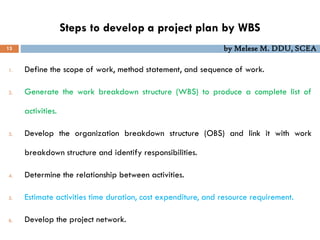
Steps to develop a project plan by WBS
13 by Melese M. DDU, SCEA
1. Define the scope of work, method statement, and sequence of work.
2. Generate the work breakdown structure (WBS) to produce a complete list of
activities.
3. Develop the organization breakdown structure (OBS) and link it with work
breakdown structure and identify responsibilities.
4. Determine the relationship between activities.
5. Estimate activities time duration, cost expenditure, and resource requirement.
6. Develop the project network.
Cont…
14 by Melese M. DDU, SCEA
Example
15 by Melese M. DDU, SCEA
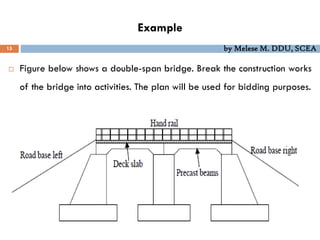
 Figure below shows a double-span bridge. Break the construction works
of the bridge into activities. The plan will be used for bidding purposes.
Cont…
16 by Melese M. DDU, SCEA
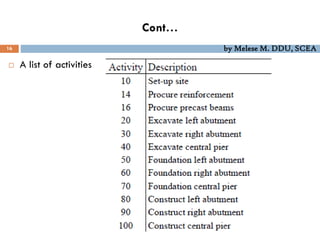
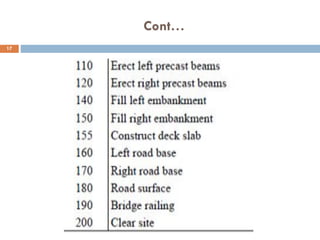
 A list of activities
Cont…
17
Activities Relationships
18 by Melese M. DDU, SCEA
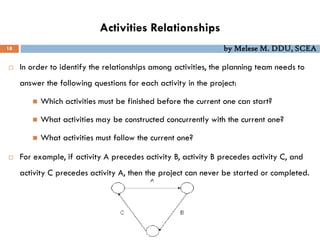
 In order to identify the relationships among activities, the planning team needs to
answer the following questions for each activity in the project:
 Which activities must be finished before the current one can start?
 What activities may be constructed concurrently with the current one?
 What activities must follow the current one?
 For example, if activity A precedes activity B, activity B precedes activity C, and
activity C precedes activity A, then the project can never be started or completed.
Relationships Between Activities
19 by Melese M. DDU, SCEA
 Activities represented by nodes and links that allow the use of four
relationships:
1) Finish to Start – FS
2) Start to Finish – SF
3) Finish to Finish – FF
4) Start to Start – SS
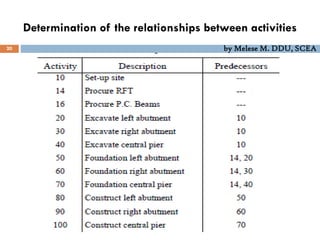
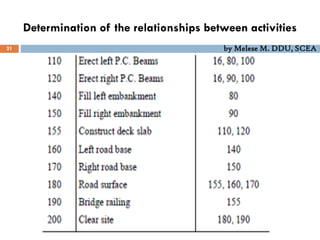
Determination of the relationships between activities
20 by Melese M. DDU, SCEA
Determination of the relationships between activities
21 by Melese M. DDU, SCEA
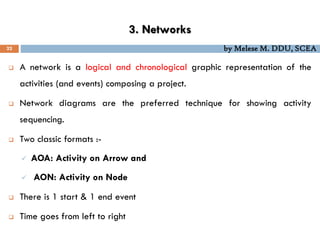
3. Networks
22 by Melese M. DDU, SCEA
 A network is a logical and chronological graphic representation of the
activities (and events) composing a project.
 Network diagrams are the preferred technique for showing activity
sequencing.
 Two classic formats :-
 AOA: Activity on Arrow and
 AON: Activity on Node
 There is 1 start & 1 end event
 Time goes from left to right
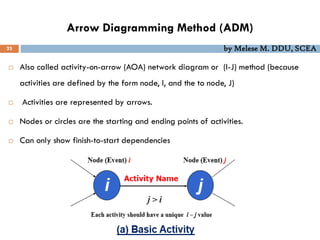
Arrow Diagramming Method (ADM)
23 by Melese M. DDU, SCEA
 Also called activity-on-arrow (AOA) network diagram or (I-J) method (because
activities are defined by the form node, I, and the to node, J)
 Activities are represented by arrows.
 Nodes or circles are the starting and ending points of activities.
 Can only show finish-to-start dependencies
Cont…
24 by Melese M. DDU, SCEA
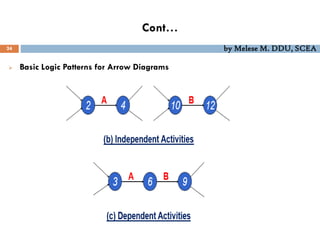
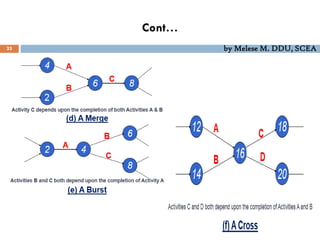
 Basic Logic Patterns for Arrow Diagrams
Cont…
25 by Melese M. DDU, SCEA
Cont…
26 by Melese M. DDU, SCEA
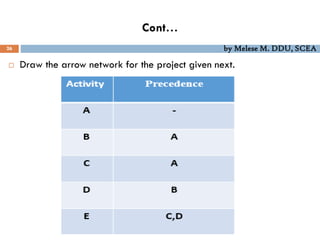
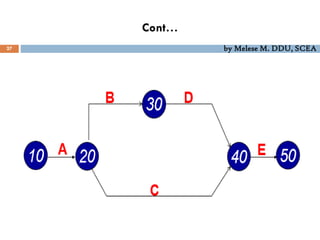
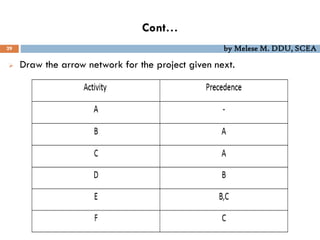
 Draw the arrow network for the project given next.
Cont…
27 by Melese M. DDU, SCEA
Cont…
28 by Melese M. DDU, SCEA
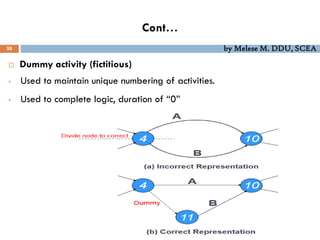
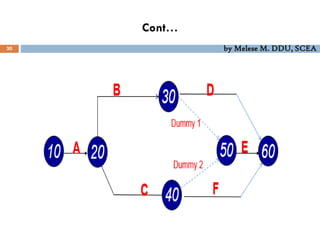
 Dummy activity (fictitious)
• Used to maintain unique numbering of activities.
• Used to complete logic, duration of “0”
Cont…
29 by Melese M. DDU, SCEA
 Draw the arrow network for the project given next.
Cont…
30 by Melese M. DDU, SCEA
Node Networks Method (AON)
31 by Melese M. DDU, SCEA
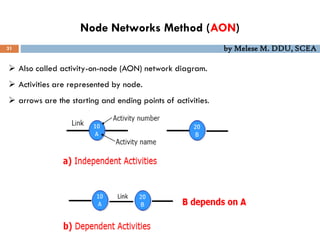
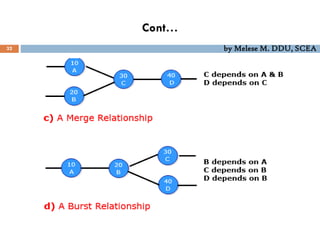
 Also called activity-on-node (AON) network diagram.
 Activities are represented by node.
 arrows are the starting and ending points of activities.
Cont…
32 by Melese M. DDU, SCEA
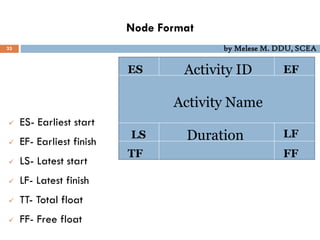
Node Format
33 by Melese M. DDU, SCEA
 ES- Earliest start
 EF- Earliest finish
 LS- Latest start
 LF- Latest finish
 TT- Total float
 FF- Free float
Activity Name
Activity ID
Duration
ES EF
LS LF
TF FF
Cont…
34 by Melese M. DDU, SCEA
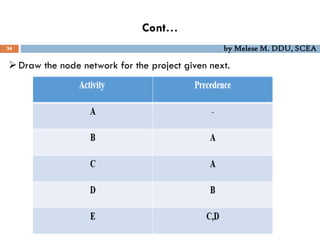
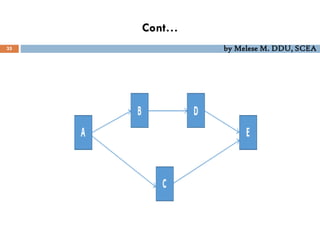
Draw the node network for the project given next.
Cont…
35 by Melese M. DDU, SCEA
Cont…
36 by Melese M. DDU, SCEA
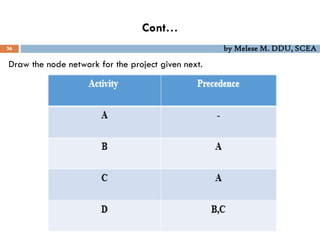
Draw the node network for the project given next.
Cont…
37 by Melese M. DDU, SCEA
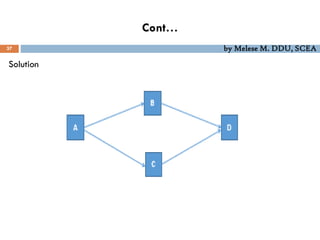
Solution
Cont…
38 by Melese M. DDU, SCEA
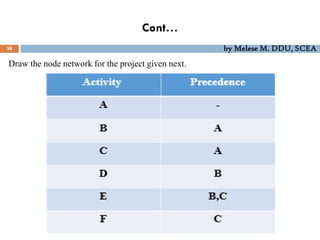
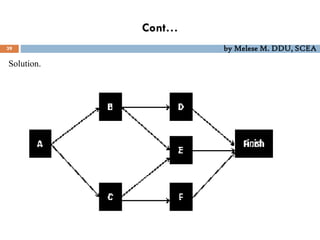
Draw the node network for the project given next.
Cont…
39 by Melese M. DDU, SCEA
Solution.
40 by Melese M. DDU, SCEA
PROJECT SCHEDULING
41 by Melese M. DDU, SCEA
 Scheduling is the determination of the timing of the activities comprising the
project to enable managers to execute the project in a timely manner.
 The project scheduling issued for:
 Knowing the activities timing and the project completion time.
 Having resources available on site in the correct time.
 Making correction actions if schedule shows that the plan will result in late
 completion.
 Assessing the value of penalties on project late completion.
 Determining the project cash flow.
 Evaluating the effect of change orders on the project completion time.
 Determining the value pf project delay and the responsible parties.
The Critical Path Method (CPM)
42 by Melese M. DDU, SCEA
 The most widely used scheduling technique is the critical path method (CPM) for
scheduling.
 This method calculates the minimum completion time for a project along with the
possible start and finish times for the project activities
 Thus, the critical path can be defined as the longest possible path through the
"network" of project activities.
 The duration of the critical path represents the minimum time required to complete
a project.
 Any delays along the critical path would imply that additional time would be
required to complete the project
Cont…
43 by Melese M. DDU, SCEA
 Critical activity : An activity on the critical path any delay on the start or
finish of a critical activity will result in a delay in the entire project.
 Critical path : The longest path in a network from start to finish. This
longest path is called the critical path. (If more than one path tie for the
longest, they all are critical paths.
 A path through a network is one of the routes following the arrows (arcs) from the
start node to the finish node.
 The length of a path is the sum of the (estimated) durations of the activities on the
path.
 The (estimated) project duration equals the length of the longest path through the
project network.
Cont…
44 by Melese M. DDU, SCEA
 There may be more than one critical path among all the project
activities, so completion of the entire project could be delayed by
delaying activities along any one of the critical paths
 The CPM is a systematic scheduling method for a project network and
involves four main steps:
 A forward path to determine activities early-start times;
 A backward path to determine activities late-finish times;
 Float calculations; and
 Identifying critical activities.
Activity-On-Arrow Networks Calculations
45 by Melese M. DDU, SCEA
 The objective of arrow network analysis is to compute for each event in
the network its early and late timings.
 These times are defined as:
 Early event time (ET) is the earliest time at which an event can occur,
considering the duration of preceding activities.
 Late event time (LT) is the latest time at which an event can occur if the
project is to be completed on schedule
Cont…
46 by Melese M. DDU, SCEA
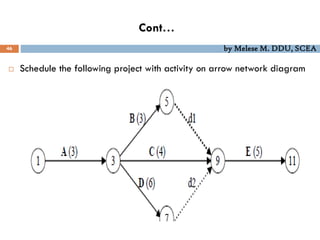
 Schedule the following project with activity on arrow network diagram
Forward path
47 by Melese M. DDU, SCEA
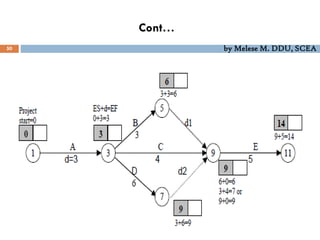
 The forward path determines the early-start times of activities.
 The forward path proceeds from the most left node in the network and
moves to the right, putting the calculations inside the shaded boxes to the
left.
 Each node in the network, in fact, is a point at which some activities end
(head arrows coming into the node)
 That node is also a point at which some activities start (tail arrows of
successor activities)
 Certainly, all successor activities can start only after the latest predecessor
is finished.
Cont…
48 by Melese M. DDU, SCEA
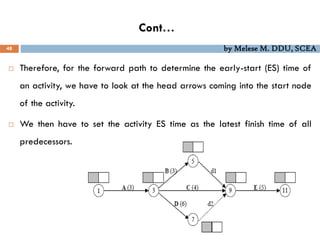
 Therefore, for the forward path to determine the early-start (ES) time of
an activity, we have to look at the head arrows coming into the start node
of the activity.
 We then have to set the activity ES time as the latest finish time of all
predecessors.
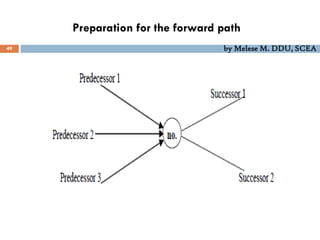
Preparation for the forward path
49 by Melese M. DDU, SCEA
Cont…
50 by Melese M. DDU, SCEA
Backward Path
51 by Melese M. DDU, SCEA
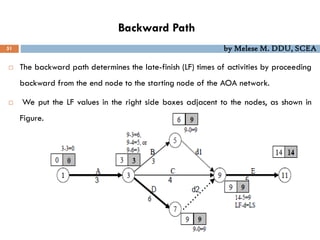
 The backward path determines the late-finish (LF) times of activities by proceeding
backward from the end node to the starting node of the AOA network.
 We put the LF values in the right side boxes adjacent to the nodes, as shown in
Figure.
Float Calculations
52 by Melese M. DDU, SCEA
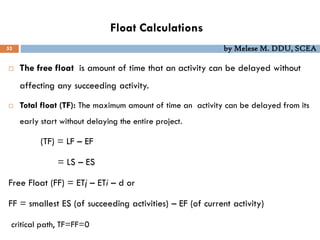
 The free float is amount of time that an activity can be delayed without
affecting any succeeding activity.
 Total float (TF): The maximum amount of time an activity can be delayed from its
early start without delaying the entire project.
(TF) = LF – EF
= LS – ES
Free Float (FF) = ETj – ETi – d or
FF = smallest ES (of succeeding activities) – EF (of current activity)
critical path, TF=FF=0
CPM results
53 by Melese M. DDU, SCEA
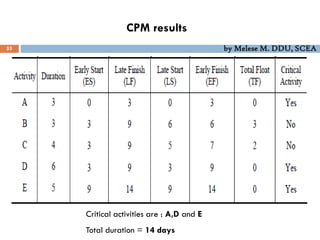
Critical activities are : A,D and E
Total duration = 14 days
Precedence Diagram Method (PDM)
54 by Melese M. DDU, SCEA
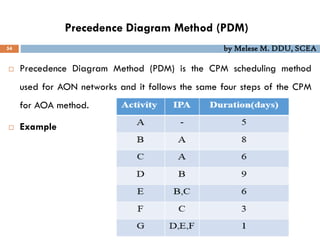
 Precedence Diagram Method (PDM) is the CPM scheduling method
used for AON networks and it follows the same four steps of the CPM
for AOA method.
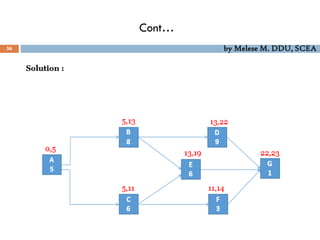
 Example
Forward pass calculations
55 by Melese M. DDU, SCEA
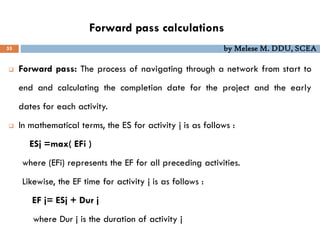
 Forward pass: The process of navigating through a network from start to
end and calculating the completion date for the project and the early
dates for each activity.
 In mathematical terms, the ES for activity j is as follows :
ESj =max( EFi )
where (EFi) represents the EF for all preceding activities.
Likewise, the EF time for activity j is as follows :
EF j= ESj + Dur j
where Dur j is the duration of activity j
Cont…
56 by Melese M. DDU, SCEA
Backward pass calculations
57 by Melese M. DDU, SCEA
Backward pass: The process of navigating through a network from end to
start and calculating the late dates for each activity.
In mathematical terms, the late finish LF for activity j is as follows
( LFj =min(LSk)
where (LSk) represents the late start date for all succeeding activities.
Likewise, the LS time for activity j (LS j) is as follows :
LS j= LFj - Dur j
where Dur j is the duration of activity
Cont…
58 by Melese M. DDU, SCEA
Floats
59 by Melese M. DDU, SCEA
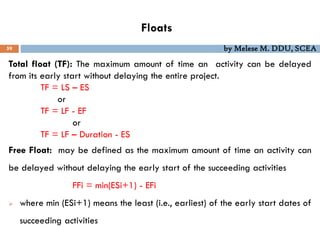
Total float (TF): The maximum amount of time an activity can be delayed
from its early start without delaying the entire project.
TF = LS – ES
or
TF = LF - EF
or
TF = LF – Duration - ES
Free Float: may be defined as the maximum amount of time an activity can
be delayed without delaying the early start of the succeeding activities
FFi = min(ESi+1) - EFi
 where min (ESi+1) means the least (i.e., earliest) of the early start dates of
succeeding activities
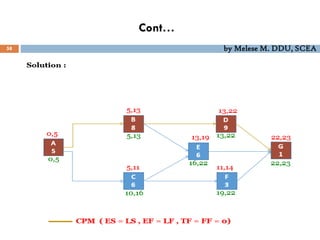
CPM Result
60 by Melese M. DDU, SCEA
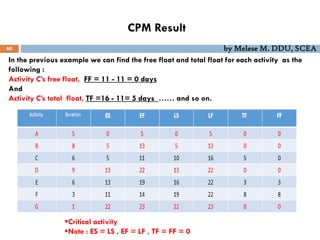
In the previous example we can find the free float and total float for each activity as the
following :
Activity C’s free float, FF = 11 - 11 = 0 days
And
Activity C’s total float, TF =16 - 11= 5 days …… and so on.
Critical activity
Note : ES = LS , EF = LF , TF = FF = 0
Example
61 by Melese M. DDU, SCEA
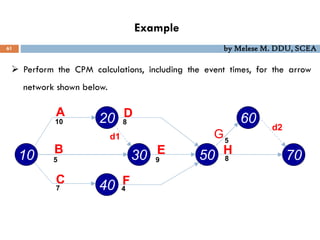
 Perform the CPM calculations, including the event times, for the arrow
network shown below.
10 30
40
20 60
C
E
B
50
D
F
70
A
G
H
10
5
7
8
9
4
5
8
d1
d2
Cont…
62 by Melese M. DDU, SCEA
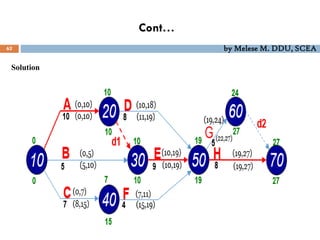
Solution
End of Chapter 2 and 3
Project Planning and Scheduling
Lecture # 2
Thank You!!!
Construction Management [CENG 5194]
by Melese M. DDU, SCEA
Construction Management [CENG 5194]
Civil Engineering Department
By: Melese Mengistu (MSc. Construction Engineering and Management)
Lecturer at Dire Dawa University Institute Of Technology- School Of
Civil Engineering & Architecture
E-mail: melesemngst@yahoo.com
by Melese M. DDU, SCEA
Construction Management [CENG 5194]
Chapter 4 and 5
Stochastic Scheduling and
Project Time-cost Trade-off
Lecture # 4 & # 5
2
by Melese M. DDU, SCEA
Stochastic Scheduling
3
 In some situations, estimating activity duration becomes a difficult task due
to ambiguity inherited in and the risks associated with some work.
 In such cases, the duration of an activity is estimated as a range of time
values rather than being a single value.
 Some scheduling procedures explicitly consider the uncertainty in activity
duration estimates by using the probabilistic distribution of activity
durations.
by Melese M. DDU, SCEA
Cont…
4
 The duration of a particular activity is assumed to be a random
variable that is distributed in a particular fashion.
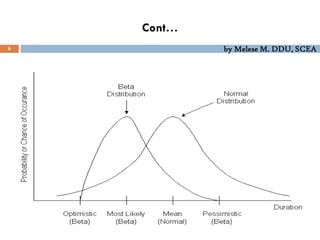
 For example, an activity duration might be assumed to be
distributed as a normal or a beta distributed random variable as
illustrated in following Figure
by Melese M. DDU, SCEA
Cont…
5
 The following figure shows the probability or chance of experiencing a
particular activity duration based on a probabilistic distribution.
 The beta distribution is often used to characterize activity durations,
since it can have an absolute minimum and an absolute maximum of
possible duration times.
 The normal distribution is a good approximation to the beta
distribution in the center of the distribution and is easy to work with, so
it is often used as an approximation
by Melese M. DDU, SCEA
Cont…
6
by Melese M. DDU, SCEA
Scheduling with Uncertain Durations
7
 The most common formal approach to incorporate uncertainty in the scheduling
process is to apply the critical path scheduling process and then analyze the
results from a probabilistic perspective referred to as the Program Evaluation and
Review Technique (PERT).
 Using expected activity durations and critical path scheduling, a critical path of
activities can be identified.
 This critical path is then used to analyze the duration of the project incorporating
the uncertainty of the activity durations along the critical path.
 The expected project duration equal to the sum of the expected durations of the
activities along the critical path.
by Melese M. DDU, SCEA
Program Evaluation and Review Technique(PERT)
8
 Both CPM and PERT were introduced at approximately the same time
and, despite their separate origins, they were very similar.
 The PERT method shares many similarities with CPM.
 Both require that a project be broken down into activities that could be
presented in the form of a network diagram showing their sequential
relationships to one another.
 Both require time estimates for each activity, which are used in routine
calculations to determine project duration and scheduling data for each
activity.
by Melese M. DDU, SCEA
Cont…
9
 CPM requires a reasonably accurate knowledge of time and cost for
each activity.
 In many situations, however, the duration of an activity can not be
accurately forecasted, and a degree of uncertainty exists
 Contrary to CPM, PERT introduces uncertainty into the estimates for
activity and project durations.
by Melese M. DDU, SCEA
Cont…
10
 It is well suited for those situations where there is either insufficient
background information to specify accurately time and cost or where
project activities require research and development.
 The method is based on the well-known “central limit theorem”.
 The theorem states that: “Where a series of sequential independent
activities lie on the critical path of a network, the sum of the individual
activity durations will be distributed in approximately normal fashion,
regardless of the distribution of the individual activities themselves.
by Melese M. DDU, SCEA
Cont…
11
 PERT, unlike CPM, uses three time estimates for each activity.
 These duration estimates are:
 Optimistic duration (o); an estimate of the minimum time required for
an activity if exceptionally good luck is experienced or under most
favorable conditions.
 Most likely or modal time (m); the time required if the activity is
repeated a number of times under essentially the same conditions.
 Pessimistic duration (p); an estimate of the maximum time required if
unusually bad luck is experienced or under most unfavorable conditions
by Melese M. DDU, SCEA
Cont…
12
 These three time estimates become the framework on which the probability
distribution curve for the activity is erected and Many authors argue that beta
distribution is mostly fit construction activities.
by Melese M. DDU, SCEA
Example: Construction Company Project
13
 The Construction Company has just made the winning bid of $5.4 million to
construct a new plant for a major manufacturer. The contract includes the following
provisions: A penalty of $300,000 if Contractor has not completed construction
within 47 weeks and A bonus of $150,000 if Contractor has completed the plant
within 40 weeks.
1. How can the project be displayed graphically to better visualize the activities?
2. What is the total time required to complete the project if no delays occur?
3. When do the individual activities need to start and finish?
4. Identify critical path & how much delay can be tolerated for each activity?
5. What is the probability the project can be completed in 47 weeks?
by Melese M. DDU, SCEA
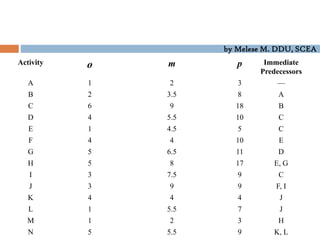
Activity o m p Immediate
Predecessors
A 1 2 3 —
B 2 3.5 8 A
C 6 9 18 B
D 4 5.5 10 C
E 1 4.5 5 C
F 4 4 10 E
G 5 6.5 11 D
H 5 8 17 E, G
I 3 7.5 9 C
J 3 9 9 F, I
K 4 4 4 J
L 1 5.5 7 J
M 1 2 3 H
N 5 5.5 9 K, L
by Melese M. DDU, SCEA
Mean and Standard Deviation
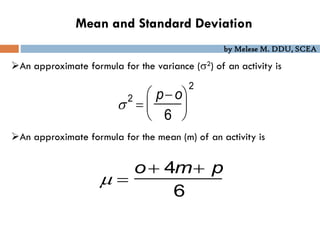
An approximate formula for the variance (2) of an activity is
An approximate formula for the mean (m) of an activity is
2

p o
6






2
 
o 4m p
6
by Melese M. DDU, SCEA
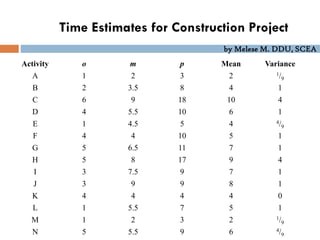
Time Estimates for Construction Project
Activity o m p Mean Variance
A 1 2 3 2 1/9
B 2 3.5 8 4 1
C 6 9 18 10 4
D 4 5.5 10 6 1
E 1 4.5 5 4 4/9
F 4 4 10 5 1
G 5 6.5 11 7 1
H 5 8 17 9 4
I 3 7.5 9 7 1
J 3 9 9 8 1
K 4 4 4 4 0
L 1 5.5 7 5 1
M 1 2 3 2 1/9
N 5 5.5 9 6 4/9
by Melese M. DDU, SCEA
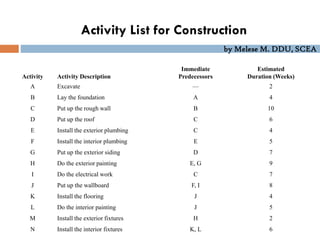
Activity List for Construction
Activity Activity Description
Immediate
Predecessors
Estimated
Duration (Weeks)
A Excavate — 2
B Lay the foundation A 4
C Put up the rough wall B 10
D Put up the roof C 6
E Install the exterior plumbing C 4
F Install the interior plumbing E 5
G Put up the exterior siding D 7
H Do the exterior painting E, G 9
I Do the electrical work C 7
J Put up the wallboard F, I 8
K Install the flooring J 4
L Do the interior painting J 5
M Install the exterior fixtures H 2
N Install the interior fixtures K, L 6
by Melese M. DDU, SCEA
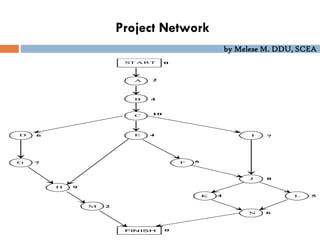
Project Network
A
START
G
H
M
F
J
K L
N
A
A
B
C
D
E
F
G
H
I
J
K
L
M
N
2
4
10
7
4
6
7
9
5
8
4 5
6
2
0
0
FINISH
D I
E
C
B
by Melese M. DDU, SCEA
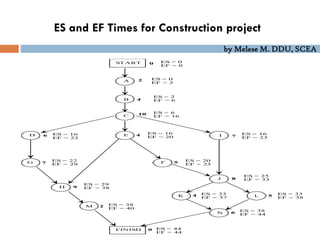
ES and EF Times for Construction project
A
START
G
H
M
F
J
FINISH
K L
N
D I
E
C
B
2
4
10
7
4
6
7
9
5
8
4 5
6
2
ES = 0
EF = 2
ES = 2
EF = 6
ES = 16
EF = 22
ES = 16
EF = 20
ES = 16
EF = 23
ES = 20
EF = 25
ES = 22
EF = 29
ES = 6
EF = 16
ES = 0
EF = 0
ES = 25
EF = 33
ES = 33
EF = 38
ES = 38
EF = 44
ES = 33
EF = 37
ES = 29
EF = 38
ES = 38
EF = 40
ES = 44
EF = 44
0
0
by Melese M. DDU, SCEA
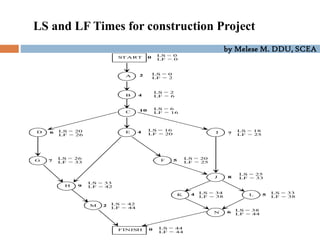
LS and LF Times for construction Project
A
START
G
H
M
F
J
FINISH
K L
N
D I
E
C
B
2
4
10
7
4
6
7
9
5
8
4 5
6
2
LS = 0
LF = 2
LS = 2
LF = 6
LS = 20
LF = 26
LS = 16
LF = 20
LS = 18
LF = 25
LS = 20
LF = 25
LS = 26
LF = 33
LS = 6
LF = 16
LS = 0
LF = 0
LS = 25
LF = 33
LS = 33
LF = 38
LS = 38
LF = 44
LS = 34
LF = 38
LS = 33
LF = 42
LS = 42
LF = 44
LS = 44
LF = 44
0
0
by Melese M. DDU, SCEA
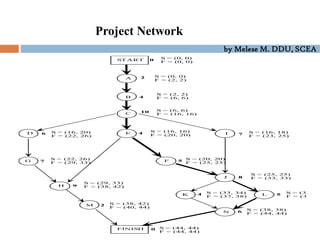
Project Network
A
START
G
H
M
F
J
FINISH
K L
N
D I
E
C
B
2
4
10
7
4
6
7
9
5
8
4 5
6
2
S = (0, 0)
F = (2, 2)
S = (2, 2)
F = (6, 6)
S = (16, 20)
F = (22, 26)
S = (16, 16)
F = (20, 20)
S = (16, 18)
F = (23, 25)
S = (20, 20)
F = (25, 25)
S = (22, 26)
F = (29, 33)
S = (6, 6)
F = (16, 16)
S = (0, 0)
F = (0, 0)
S = (25, 25)
F = (33, 33)
S = (33, 33
F = (38, 38
S = (38, 38)
F = (44, 44)
S = (33, 34)
F = (37, 38)
S = (29, 33)
F = (38, 42)
S = (38, 42)
F = (40, 44)
S = (44, 44)
F = (44, 44)
0
0
by Melese M. DDU, SCEA
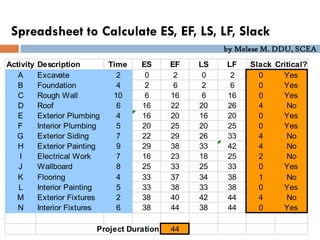
Spreadsheet to Calculate ES, EF, LS, LF, Slack
Activity Description Time ES EF LS LF Slack Critical?
A Excavate 2 0 2 0 2 0 Yes
B Foundation 4 2 6 2 6 0 Yes
C Rough Wall 10 6 16 6 16 0 Yes
D Roof 6 16 22 20 26 4 No
E Exterior Plumbing 4 16 20 16 20 0 Yes
F Interior Plumbing 5 20 25 20 25 0 Yes
G Exterior Siding 7 22 29 26 33 4 No
H Exterior Painting 9 29 38 33 42 4 No
I Electrical Work 7 16 23 18 25 2 No
J Wallboard 8 25 33 25 33 0 Yes
K Flooring 4 33 37 34 38 1 No
L Interior Painting 5 33 38 33 38 0 Yes
M Exterior Fixtures 2 38 40 42 44 4 No
N Interior Fixtures 6 38 44 38 44 0 Yes
Project Duration 44
by Melese M. DDU, SCEA
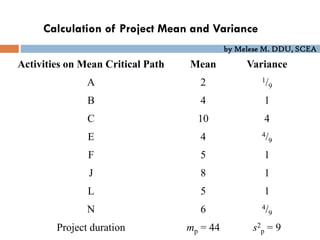
Calculation of Project Mean and Variance
Activities on Mean Critical Path Mean Variance
A 2 1/9
B 4 1
C 10 4
E 4 4/9
F 5 1
J 8 1
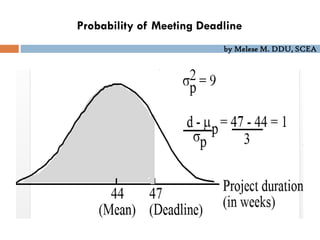
L 5 1
N 6 4/9
Project duration mp = 44 s2
p = 9
by Melese M. DDU, SCEA
Probability of Meeting Deadline
by Melese M. DDU, SCEA
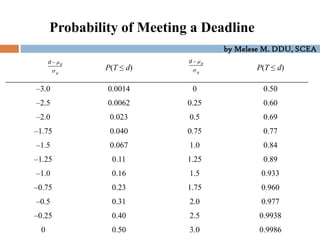
Probability of Meeting a Deadline
P(T ≤ d) P(T ≤ d)
–3.0 0.0014 0 0.50
–2.5 0.0062 0.25 0.60
–2.0 0.023 0.5 0.69
–1.75 0.040 0.75 0.77
–1.5 0.067 1.0 0.84
–1.25 0.11 1.25 0.89
–1.0 0.16 1.5 0.933
–0.75 0.23 1.75 0.960
–0.5 0.31 2.0 0.977
–0.25 0.40 2.5 0.9938
0 0.50 3.0 0.9986
d   p
 p
d   p
 p
by Melese M. DDU, SCEA
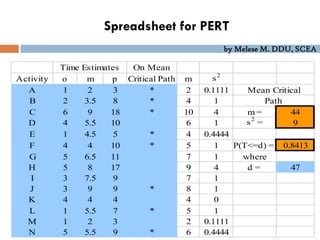
Spreadsheet for PERT
Time Estimates On Mean
Activity o m p Critical Path m s2
A 1 2 3 * 2 0.1111 Mean Critical
B 2 3.5 8 * 4 1 Path
C 6 9 18 * 10 4 m = 44
D 4 5.5 10 6 1 s2
= 9
E 1 4.5 5 * 4 0.4444
F 4 4 10 * 5 1 P(T<=d) = 0.8413
G 5 6.5 11 7 1 where
H 5 8 17 9 4 d = 47
I 3 7.5 9 7 1
J 3 9 9 * 8 1
K 4 4 4 4 0
L 1 5.5 7 * 5 1
M 1 2 3 2 0.1111
N 5 5.5 9 * 6 0.4444
by Melese M. DDU, SCEA
27
Time-cost Trade-off
Lecture # 5
by Melese M. DDU, SCEA
Project Time-cost Trade-off
 Reducing both construction projects’ cost and time is critical in today’s market-
driven economy.
 This relationship between construction projects’ time and cost is called time-cost
trade-off.
 The objective of the time-cost trade-off analysis is to reduce the original project
duration, determined form the critical path analysis, to meet a specific deadline,
with the least cost.
 Time-cost trade-off, in fact, is an important management tool for overcoming
one of the critical path method limitations of being unable to bring the project
schedule to a specified duration.
by Melese M. DDU, SCEA
Cont…
 It might be necessary to finish the project in a specific time to:
 Finish the project in a predefined deadline date.
 Recover early delays.
 Avoid liquidated damages.
 Free key resources early for other projects.
 Avoid adverse weather conditions that might affect productivity.
 Receive an early completion-bonus.
 Improve project cash flow
by Melese M. DDU, SCEA
 Reducing project duration can be done by adjusting overlaps between
activities or by reducing activities’ duration.
 What is the reason for an increase in direct cost as the activity duration
is reduced? A simple case arises in the use of overtime work.
 By scheduling weekend or evening work, the completion time for an
activity as measured in calendar days will be reduced.
 However, extra wages must be paid for such overtime work, so the cost
will increase.
 Also, overtime work is more prone to accidents and quality problems that
must be corrected, so costs may increase.
Cont…
by Melese M. DDU, SCEA
 The activity duration can be reduced by one of the following actions:
 Applying multiple-shifts work.
 Working extended hours (over time).
 Offering incentive payments to increase the productivity.
 Working on week ends and holidays.
 Using additional resources.
 Using materials with faster installation methods.
 Using alternate construction methods or sequence
by Melese M. DDU, SCEA
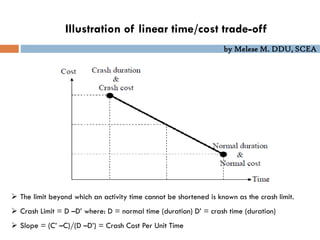
Illustration of linear time/cost trade-off
 The limit beyond which an activity time cannot be shortened is known as the crash limit.
 Crash Limit = D –D’ where: D = normal time (duration) D’ = crash time (duration)
 Slope = (C’ –C)/(D –D’) = Crash Cost Per Unit Time
by Melese M. DDU, SCEA
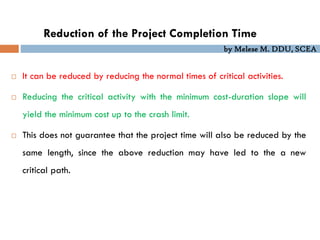
 It can be reduced by reducing the normal times of critical activities.
 Reducing the critical activity with the minimum cost-duration slope will
yield the minimum cost up to the crash limit.
 This does not guarantee that the project time will also be reduced by the
same length, since the above reduction may have led to the a new
critical path.
Reduction of the Project Completion Time
by Melese M. DDU, SCEA
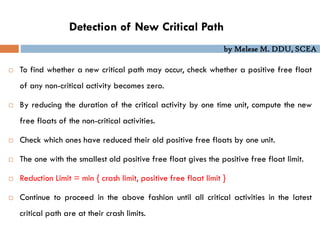
Detection of New Critical Path
 To find whether a new critical path may occur, check whether a positive free float
of any non-critical activity becomes zero.
 By reducing the duration of the critical activity by one time unit, compute the new
free floats of the non-critical activities.
 Check which ones have reduced their old positive free floats by one unit.
 The one with the smallest old positive free float gives the positive free float limit.
 Reduction Limit = min { crash limit, positive free float limit }
 Continue to proceed in the above fashion until all critical activities in the latest
critical path are at their crash limits.
by Melese M. DDU, SCEA
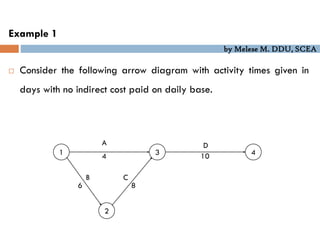
Example 1
 Consider the following arrow diagram with activity times given in
days with no indirect cost paid on daily base.
1 4
2
3
A D
C
B
4 10
8
6
by Melese M. DDU, SCEA
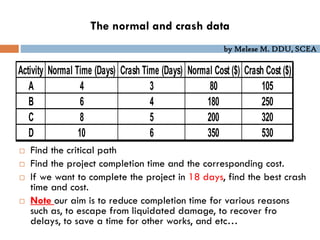
The normal and crash data
 Find the critical path
 Find the project completion time and the corresponding cost.
 If we want to complete the project in 18 days, find the best crash
time and cost.
 Note our aim is to reduce completion time for various reasons
such as, to escape from liquidated damage, to recover fro
delays, to save a time for other works, and etc…
Activity Normal Time (Days) Crash Time (Days) Normal Cost ($) Crash Cost ($)
A 4 3 80 105
B 6 4 180 250
C 8 5 200 320
D 10 6 350 530
by Melese M. DDU, SCEA
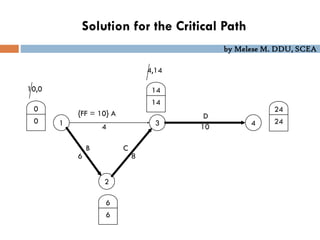
Solution for the Critical Path
1 4
2
3
{FF = 10} A D
C
B
4 10
8
6
0
0
10,0
6
6
24
24
14
14
4,14
by Melese M. DDU, SCEA
Solution
(a) Critical Path is B, C, D.
(b) Project completion time = 24 days Project cost = 80 +
180 + 200 + 350 = $810
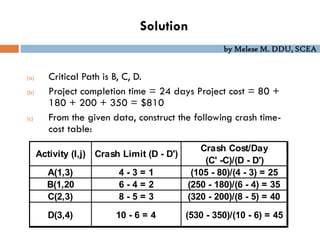
(c) From the given data, construct the following crash time-
cost table:
Activity (I,j) Crash Limit (D - D')
Crash Cost/Day
(C' -C)/(D - D')
A(1,3) 4 - 3 = 1 (105 - 80)/(4 - 3) = 25
B(1,20 6 - 4 = 2 (250 - 180)/(6 - 4) = 35
C(2,3) 8 - 5 = 3 (320 - 200)/(8 - 5) = 40
D(3,4) 10 - 6 = 4 (530 - 350)/(10 - 6) = 45
by Melese M. DDU, SCEA
Cont…
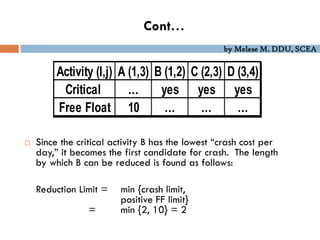
 Since the critical activity B has the lowest “crash cost per
day,” it becomes the first candidate for crash. The length
by which B can be reduced is found as follows:
Reduction Limit = min {crash limit,
positive FF limit}
= min {2, 10} = 2
Activity (I,j) A (1,3) B (1,2) C (2,3) D (3,4)
Critical … yes yes yes
Free Float 10 … … …
by Melese M. DDU, SCEA
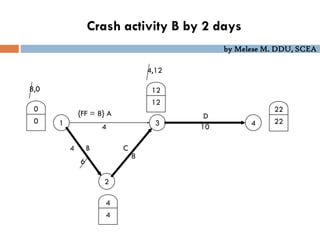
Crash activity B by 2 days
1 4
2
3
{FF = 8} A D
C
B
4 10
8
6
0
0
8,0
4
4
22
22
12
12
4,12
4
by Melese M. DDU, SCEA
Cont…
 Critical path is still B, C, D.
 Project completion time = 22 days
 Project cost = 810 + 2*35 = $880
 Since the crash limit for critical activity B is reached,
consider activity C with the next lowest “crash cost per
day” for crash.
Activity (I,j) A (1,3) B (1,2) C (2,3) D (3,4)
Critical … yes yes yes
Free Float 8 … … …
by Melese M. DDU, SCEA
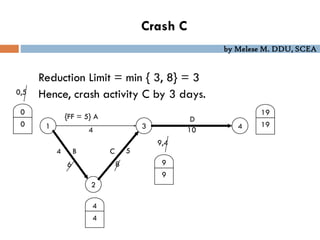
Crash C
Reduction Limit = min { 3, 8} = 3
Hence, crash activity C by 3 days.
1 4
2
3
{FF = 5} A D
C
B
4 10
8
6
0
0
0,5
4
4
19
19
9
9
9,4
4 5
by Melese M. DDU, SCEA
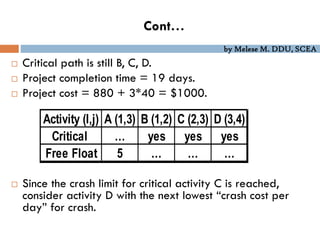
Cont…
 Critical path is still B, C, D.
 Project completion time = 19 days.
 Project cost = 880 + 3*40 = $1000.
 Since the crash limit for critical activity C is reached,
consider activity D with the next lowest “crash cost per
day” for crash.
Activity (I,j) A (1,3) B (1,2) C (2,3) D (3,4)
Critical … yes yes yes
Free Float 5 … … …
by Melese M. DDU, SCEA
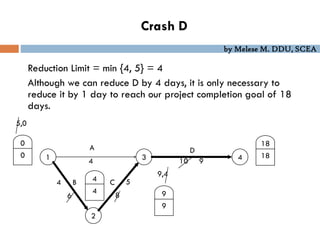
Crash D
Reduction Limit = min {4, 5} = 4
Although we can reduce D by 4 days, it is only necessary to
reduce it by 1 day to reach our project completion goal of 18
days.
1 4
2
3
A D
C
B
4 10 9
8
6
0
0
5,0
4
4
18
18
9
9
9,4
4 5
by Melese M. DDU, SCEA
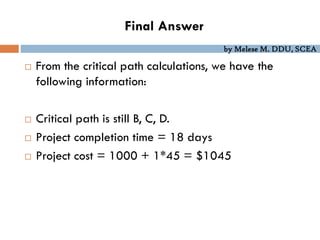
Final Answer
 From the critical path calculations, we have the
following information:
 Critical path is still B, C, D.
 Project completion time = 18 days
 Project cost = 1000 + 1*45 = $1045
by Melese M. DDU, SCEA
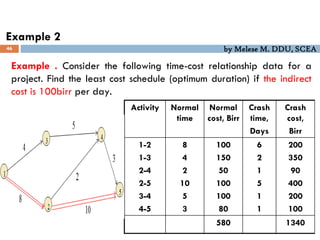
Example . Consider the following time-cost relationship data for a
project. Find the least cost schedule (optimum duration) if the indirect
cost is 100birr per day.
Activity Normal
time
Normal
cost, Birr
Crash
time,
Days
Crash
cost,
Birr
1-2
1-3
2-4
2-5
3-4
4-5
8
4
2
10
5
3
100
150
50
100
100
80
6
2
1
5
1
1
200
350
90
400
200
100
580 1340
46
Example 2
by Melese M. DDU, SCEA
Activit
y
Norma
l time
Normal
cost,
Birr
Crash
time,
Days
Crash
cost,
Birr
Cost
slope
A
B
C
D
E
F
4
8
5
2
10
3
150
100
100
50
100
80
2
6
1
1
5
1
350
200
200
90
400
100
100
50
25
40
60
10
18 580 1340
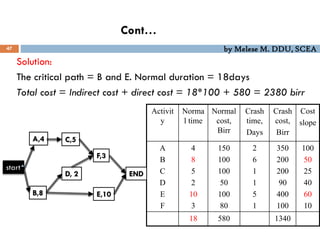
Solution:
The critical path = B and E. Normal duration = 18days
Total cost = Indirect cost + direct cost = 18*100 + 580 = 2380 birr
47
Cont…
start
A,4
B,8
D, 2
C,5
F,3
E,10
END
by Melese M. DDU, SCEA
Stage 1.
B is the critical activity of least cost slope &Crash B by 2 days.
Current Project Duration = 18-2 = 16 days & Current critical path: B and E
Current Total cost = (16*100) +580+(2*50) = 2280 birr
Stage 1
48
Cont…
Activit
y
Normal
time
Normal
cost,
Birr
Crash
time,
Days
Crash
cost,
Birr
Cost
slope
A
B
C
D
E
F
4
8
5
2
10
3
150
100
100
50
100
80
2
6
1
1
5
1
350
200
200
90
400
100
100
50
25
40
60
10
18 580 1340
by Melese M. DDU, SCEA
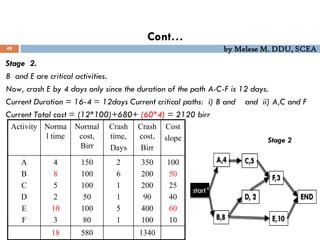
Stage 2.
B and E are critical activities.
Now, crash E by 4 days only since the duration of the path A-C-F is 12 days.
Current Duration = 16-4 = 12days Current critical paths: i) B and and ii) A,C and F
Current Total cost = (12*100)+680+ (60*4) = 2120 birr
Stage 2
49
Cont…
Activity Norma
l time
Normal
cost,
Birr
Crash
time,
Days
Crash
cost,
Birr
Cost
slope
A
B
C
D
E
F
4
8
5
2
10
3
150
100
100
50
100
80
2
6
1
1
5
1
350
200
200
90
400
100
100
50
25
40
60
10
18 580 1340
by Melese M. DDU, SCEA
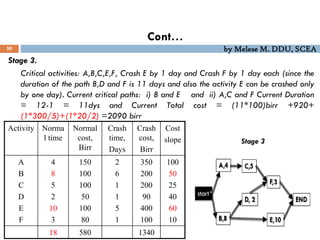
Stage 3.
Critical activities: A,B,C,E,F, Crash E by 1 day and Crash F by 1 day each (since the
duration of the path B,D and F is 11 days and also the activity E can be crashed only
by one day). Current critical paths: i) B and E and ii) A,C and F Current Duration
= 12-1 = 11dys and Current Total cost = (11*100)birr +920+
(1*300/5)+(1*20/2) =2090 birr
Stage 3
50
Cont…
Activity Norma
l time
Normal
cost,
Birr
Crash
time,
Days
Crash
cost,
Birr
Cost
slope
A
B
C
D
E
F
4
8
5
2
10
3
150
100
100
50
100
80
2
6
1
1
5
1
350
200
200
90
400
100
100
50
25
40
60
10
18 580 1340
by Melese M. DDU, SCEA
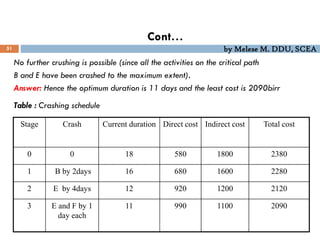
No further crushing is possible (since all the activities on the critical path
B and E have been crashed to the maximum extent).
Answer: Hence the optimum duration is 11 days and the least cost is 2090birr
Stage Crash Current duration Direct cost Indirect cost Total cost
0 0 18 580 1800 2380
1 B by 2days 16 680 1600 2280
2 E by 4days 12 920 1200 2120
3 E and F by 1
day each
11 990 1100 2090
Table : Crashing schedule
51
Cont…
by Melese M. DDU, SCEA
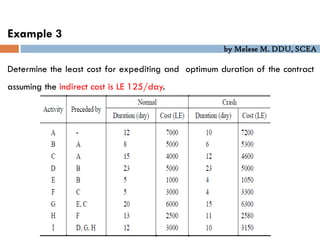
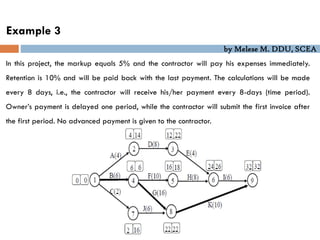
Determine the least cost for expediting and optimum duration of the contract
assuming the indirect cost is LE 125/day.
Example 3
by Melese M. DDU, SCEA
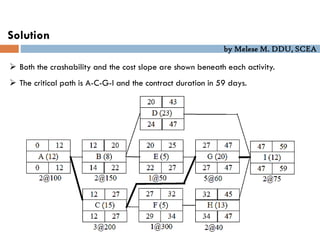
Solution
 Both the crashability and the cost slope are shown beneath each activity.
 The critical path is A-C-G-I and the contract duration in 59 days.
by Melese M. DDU, SCEA
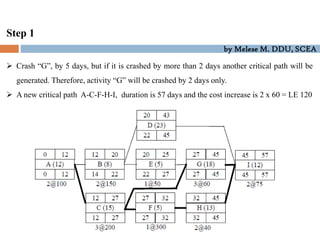
Step 1
 Crash “G”, by 5 days, but if it is crashed by more than 2 days another critical path will be
generated. Therefore, activity “G” will be crashed by 2 days only.
 A new critical path A-C-F-H-I, duration is 57 days and the cost increase is 2 x 60 = LE 120
by Melese M. DDU, SCEA
Step 2
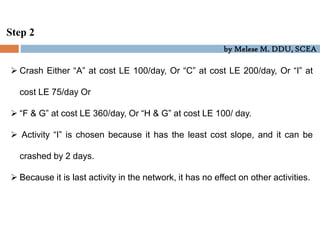
 Crash Either “A” at cost LE 100/day, Or “C” at cost LE 200/day, Or “I” at
cost LE 75/day Or
 “F & G” at cost LE 360/day, Or “H & G” at cost LE 100/ day.
 Activity “I” is chosen because it has the least cost slope, and it can be
crashed by 2 days.
 Because it is last activity in the network, it has no effect on other activities.
by Melese M. DDU, SCEA
Cont…
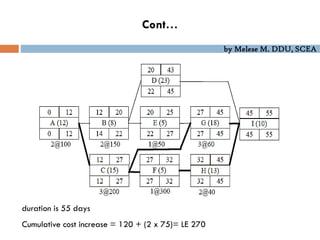
duration is 55 days
Cumulative cost increase = 120 + (2 x 75)= LE 270
by Melese M. DDU, SCEA
Step 3
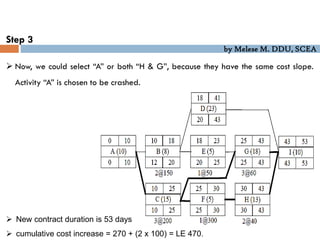
 Now, we could select “A” or both “H & G”, because they have the same cost slope.
Activity “A” is chosen to be crashed.
 New contract duration is 53 days
 cumulative cost increase = 270 + (2 x 100) = LE 470.
by Melese M. DDU, SCEA
Step 4
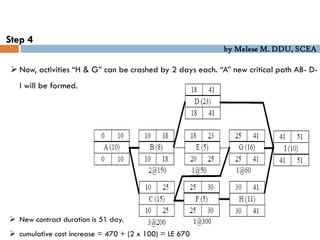
 Now, activities “H & G” can be crashed by 2 days each. “A” new critical path AB- D-
I will be formed.
 New contract duration is 51 day.
 cumulative cost increase = 470 + (2 x 100) = LE 670
by Melese M. DDU, SCEA
Step 5
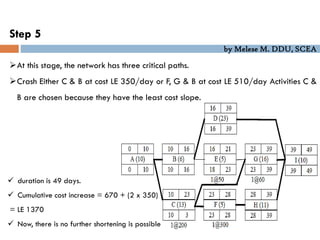
At this stage, the network has three critical paths.
Crash Either C & B at cost LE 350/day or F, G & B at cost LE 510/day Activities C &
B are chosen because they have the least cost slope.
 duration is 49 days.
 Cumulative cost increase = 670 + (2 x 350)
= LE 1370
 Now, there is no further shortening is possible
by Melese M. DDU, SCEA
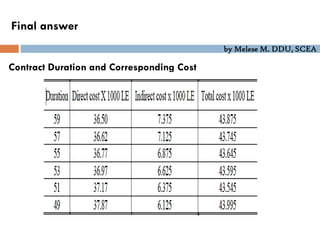
Contract Duration and Corresponding Cost
Final answer
by Melese M. DDU, SCEA
End of Chapter 4 and 5
Stochastic Scheduling and
Project Time-cost Trade-off
Lecture # 3
Thank You!!!
Construction Management [CENG 5194]
Civil Engineering Department
By: Melese Mengistu (MSc. Construction Engineering and Management)
Lecturer at Dire Dawa University Institute Of Technology- School Of
Civil Engineering & Architecture
E-mail: melesemngst@yahoo.com
by Melese M. DDU, SCEA
Construction Management [CENG 5194]
Chapter 6
Construction Resources management
Lecture # 6
2
by Melese M. DDU, SCEA
Construction Resources
3
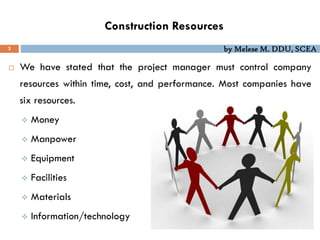
 We have stated that the project manager must control company
resources within time, cost, and performance. Most companies have
six resources.
 Money
 Manpower
 Equipment
 Facilities
 Materials
 Information/technology
by Melese M. DDU, SCEA
Human resource (Labour or Workmen)
4
 These include professional, skilled, semi skilled and unskilled laborers.
 Human resources can be understood in two values: Capacity and Capability.
 Capacity - refers to the quantity of labor for the scope defined.
 Capability - refers to knowledge, technology know-how and skill as per the demands
of the scopes ability.
 Construction Managers need to be capable of:
 Communication- Inter-personal, group interaction-skills
 Problem solving / Conflict resolution / Negotiation Skills
 Facilitating / Decision- making Skills
 Writing skills for Proposals / Reports /ToRs and
 Hard Skills- Planning, Implementing, Leading and Monitoring tools.
by Melese M. DDU, SCEA
Cont…
5
Financial Resources (Fund): Usually funds are available from among Governmental
institution, Private institutions and Donors in the form of loan or assistance.
Information Resources: Information can be understood in two terms: data whether processed
or not; and its technology
Physical Resources
 Materials: Material covers 55-70% of the total construction cost.
 Equipment: Though their initial cost is high using equipment are far more better than using
labor.
 Other assets: Physical Infrastructures and Owned Land are assets which can be collaterals
for capital base enhancement and credit facilities and are useful to develop the scarce
financial resources and getting into business access.
by Melese M. DDU, SCEA
Cont…
6
Service and Management
 Service
 Services such as acquisition of land, provisions of water supply, electric
power, communication systems, etc., are very much necessary in the
construction industry.
 Management
 Management has come to employ a disciplined approach to the use of
available resources.
by Melese M. DDU, SCEA
Cont…
 Resources may be classified according to their importance:
 Consumable Resource: such as materials that may be used once and once only, or
 Non-consumable Resource: such as people, which may be used again and again.
 Key resources: most important, expensive and non-available resources in the
project such as skilled labors, or equipment. These types of resources will have a
great attention in the resource scheduling process.
 Secondary resources: resources which have no constraints on their availability, such
as normal labor.
 General resources: used by all or most of the activities on the project such as site
overheads. General resources will not be included in the resource management
by Melese M. DDU, SCEA
Resources Management
 As we have seen in network scheduling, the basic inputs to critical-path analysis
are the individual project activities, their durations, and their dependency
relationships.
 The CPM algorithm is duration-driven and assumes that all the resources
needed for the schedule are available.
 This assumption, however, is not always true for construction projects Under
resource constraints, the schedule becomes impractical, cost and time are not
accurate, and resources may not be available when needed.
 In order to deal with such issue, a proper management of available resources is
required to adjust the schedule accordingly.
by Melese M. DDU, SCEA
 The most important resources that project managers have to plan and manage on
day-to-day basis are people, machines, materials, and money.
 Obviously, if these resources are available in abundance then the project could be
accelerated to achieve shorter project duration.
 On the other hand, if these resources are severely limited, then the result more
likely will be a delay in the project completion time.
 In general, from a scheduling perspective, projects can be classified as either time
constrained or resource constrained.
Cont…
by Melese M. DDU, SCEA
Resource scheduling
 Resource scheduling is prioritizing and allocating resources in such a
manner that there is minimal project delay.
 A project is resource constrained if the level of resource availability cannot
be exceeded.
 In those situations where resources are inadequate, project delay is
acceptable, but the delay should be minimal.
 However, it is also important to ensure that the resource limit is not
exceeded and the technical relationships in the project network are
respected.
by Melese M. DDU, SCEA
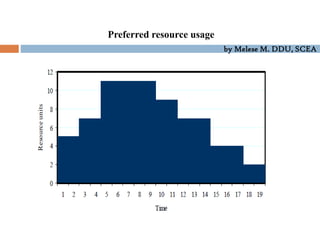
Resource leveling (smoothing)
 The primary focus, for purposes of scheduling, in time constrained projects is
to improve resource utilization.
 This process is called resource leveling or smoothing.
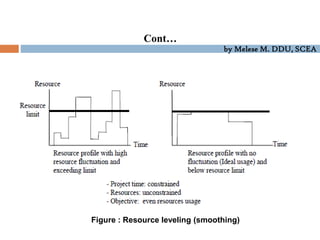
 It applies when it is desired to reduce the hiring and firing of resources and to
smooth the fluctuation in the daily demand of a resource, as shown in Figure
below.
 In this case, resources are not limited and project duration is not allowed to be
delayed.
 The objective in this case is to shift non-critical activities of the original
schedule, within their float times so that a better resource profile is achieved.
by Melese M. DDU, SCEA
Cont…
Figure : Resource leveling (smoothing)
by Melese M. DDU, SCEA
Resource Allocation
 Resource allocation, also called resource loading, is concerned with assigning the
required number of resources identified for each activity in the plan.
 More than one type of resource may be assigned to a specific activity.
 For example, fixing steel plates on a bridge deck may require different types of resources
such as: welders, laborers and a certain type of welding machine.
 From a practical view, resource allocation does not have to follow a constant pattern;
some activities may initially require fewer resources but may require more of the same
resources during the later stages of the project.
by Melese M. DDU, SCEA
Resource Aggregation
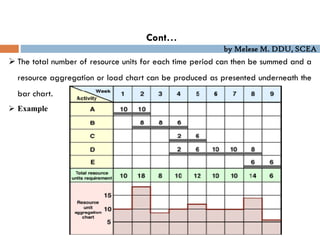
 Resource aggregation is simply the summation, on a period-by-period basis, of the
resources required to complete all activities based on the resource allocation carried out
previously.
 The results are usually shown graphically as a histogram.
 Such aggregation may be done on an hourly, daily, or weekly basis, depending on the time
unit used to allocate resources.
 When a bar chart is used, the resource aggregation is fairly simple and straightforward.
 For a given bar chart, a resource aggregation chart can be drawn underneath the bar chart.
 However, a separate graph will be required for each resource type.
 The required resource units for each time period are written on the bar chart.
by Melese M. DDU, SCEA
Cont…
 The total number of resource units for each time period can then be summed and a
resource aggregation or load chart can be produced as presented underneath the
bar chart.
 Example
by Melese M. DDU, SCEA
Cont…
 The non critical activities, do not have fixed starting and finishing times but are constrained by
the earliest and latest starting and finishing times.
 This situation offers the planner chance for adjusting the demand for resources.
 The above Figure illustrates such situation, which shows the resource aggregation when the
activities scheduled on their early times and late times.
 It can be seen that the resource requirements that arise when both earliest and latest start times
are considered are different.
 The shaded area represents the resources required by the critical activities, as these activities
have a fixed position because their early times equal their late time.
 Resources accumulate at the beginning of the project when the activities scheduled on their early
time.
 Resources accumulate at the end of the project when the activities scheduled on their late times.
by Melese M. DDU, SCEA
 The problem of resource fluctuation appears after the initial scheduling of the
project without considering the resources.
 The peaks and valleys in the resource profile indicate high day-to-day variation
in the resource demand.
 Resource smoothing is the process that attempts to determine a resource
requirement that is "smooth" and where peaks and valleys are eliminated.
 Resource leveling heuristics shift non-critical activities within their float times
so as to move resources from the peak periods (high usage) to the valley periods
(low usage),without delaying the project (i.e., area underneath the resource
profile remains constant).
Cont…
by Melese M. DDU, SCEA
Preferred resource usage
by Melese M. DDU, SCEA
Heuristic Procedure for Resource Smoothing
 steps:
 Prepare a complete activity schedule.
 Draw a bar chart of the project under study based on ES timing of the
activities.
 Critical activities to be drawn first (as these activities will not be moved).
 Write the resource usage above each bar of the related activity.
 Draw the FF as dashed line beside the upper side of the bar and the TF
beside the lower side.
 Aggregate (determine the resource sum) the resources in each time period.
 Calculate the total usage of resources = Σ unit period usage.
by Melese M. DDU, SCEA
 Calculate the average resource usage = Σ usage / utilization period.
 Shift non-critical activities within their FF first, then their TF to decrease the
peaks and raise the valleys.
 Revise activities floats.
 Aggregate resources in each time period after shifting any activity.
 When shifting activities, it is preferred to start with the activities that have
no successors, as shifting these activities will not affect other activities.
 Also, by shifting these activities, a float will be created for its
predecessors.
 Shift activities only that will enhance the resource profile.
Cont…
by Melese M. DDU, SCEA
Example
Activity Activity Duration
(Weeks)
Predecessors Resource
(units/week)
A
B
C
D
E
F
G
H
I
J
K
L
M
N
0
2
5
3
2
6
6
6
4
2
7
3
2
2
-
A
A
A
B
B
C
D
D
E, F
F, G
B, H
B, H, I
J, K, L,M
0
0
2
2
1
2
3
1
0
4
2
2
4
0
by Melese M. DDU, SCEA
Cont…
by Melese M. DDU, SCEA
Activity ES EF FF TF
A
B
C
D
E
F
G
H
I
J
K
L
M
N
0
0
0
0
2
2
5
3
3
8
11
9
9
18
0
2
5
3
4
8
11
9
7
10
18
12
11
20
0
0
0
0
4
0
0
0
2
8
0
6
7
0
0
3
0
6
12
3
0
6
9
8
0
6
7
0
Cont…
by Melese M. DDU, SCEA
Cont…
by Melese M. DDU, SCEA
Cont…
by Melese M. DDU, SCEA
Cont…
26
 The above Figure shows the bar chart and the resource histogram of
the project and the weekly usage of the resources and the total usage
of 90 resource units.
 As shown in the resource histogram, the peak resource usage is 13
units and the minimum usage is 2 units.
 The total resource usage equals 90 units with utilization period of 18
weeks. Then, the average resource usage equals 5 units (=90/18=5).
by Melese M. DDU, SCEA
Cont…
27
The resource demand on weeks 9, 10, and 11 is high, while it is low in
weeks 13 through 18.
Accordingly, the solution process will try to sift the resources from that
peak period to the period of low usage.
The following activities will be shifted:
 Activity M has a free float of 7 weeks. Shifting activity M by 7 weeks
will reduce the peak usage of the resource on weeks 10 and 11 and
increase the usage on weeks 17 and 18. Also, shifting activity M will
give chance for preceding activities to be shifted.
by Melese M. DDU, SCEA
Cont…
28
Activity J can be shifted by 6, however it has 8 weeks free float.
By shifting activity J, the free float of both activities E and F are changed.
Shift activity L by 2 weeks to optimize the resource usage.
 The free float of activity will be changed to 2 weeks.
Next, shift activity E by 10 weeks to improve the resource usage.
Shift activity H by 2 weeks.
Finally, shift activity F by 1 week
by Melese M. DDU, SCEA
Cont…
by Melese M. DDU, SCEA
Cont…
by Melese M. DDU, SCEA
Levelled resource histogram
by Melese M. DDU, SCEA
Resource-constrained Scheduling
 Shortage of resources is a major challenge for construction projects.
 Often, the number of skilled labor is limited, related equipment has
to be returned as soon as possible, and / or a limited require our
special consideration.
 Scheduling under these resource constraints becomes a complex
problem, particularly when more than one resource is limited.
by Melese M. DDU, SCEA
Resource needed exceed resource limit
by Melese M. DDU, SCEA
Cont…
 The technique that deals with limited resources has been referred to as
"resource scheduling“ or "resource-constrained scheduling”.
 The problem of resource-constrained scheduling appears after the initial
network analysis is conducted and a bar chart is drawn.
 A resource conflict occurs when at any point in the schedule several activities
are in parallel and the total amount of required resource(s) exceeds the
availability limit, for any of the resources required in these parallel activities.
 The situation is illustrated in the above Figure with activities A, B, and C that, at
time period 3, require 5, while 4 are only available per day.
by Melese M. DDU, SCEA
Cont…
 The simple solution to that situation is that we can prioritizing the parallel
activities, given the resource to higher priority activities and delay the others
until the earliest time the resource become available again.
 Notice that if we delay an activity at time period 3, to solve the situation, we
may end up with another resource conflict later in time.
 Continuing with identifying next conflict points and resolving them, determines
the new schedule and the new project duration.
 Accordingly, the objective in such situation is to delay some activities so that the
resource conflict is resolved and the project delay is minimized.
by Melese M. DDU, SCEA
Resource scheduling using least TF rule
by Melese M. DDU, SCEA
heuristic rules
 These heuristic rules are based mainly on activity characteristics.
 The two most effective and commonly used heuristic rules are the least
total-float (LTF) and the earliest late-start (ELS).
 These two rules have been proven to provide identical results, with the
ELS rule being advantageous compared to the LTF rule.
 As such, the ELS rule can be applied with much less computational effort
than the LTF rule, and accordingly has been used as a basis for the
resource scheduling.
by Melese M. DDU, SCEA
Procedure
 Prepare a complete activity schedule
 Aggregate the daily resource demand
 If demand greater than available then determine activities compete for
resources
 Prioritize these activities based on their LS
 Allocate resources to some activities and delay the others
 Put your solution in table format
by Melese M. DDU, SCEA
Example
Activity Duration
(Weeks)
Predecessors Resource (units/week)
R1≤8 R2≤1
A
B
C
D
E
F
G
H
I
J
K
4
6
2
8
4
10
16
8
6
6
10
-
-
-
A
D
B
B
F
E, H
C
G, J
3
6
4
0
4
0
4
2
4
5
2
0
1
0
1
1
1
0
0
1
1
0
For the following project determine the activities schedule start and finish times
so that the weekly resource usage does not exceed the resource limits.
by Melese M. DDU, SCEA
Cont…
by Melese M. DDU, SCEA
Cont…
by Melese M. DDU, SCEA
Cont…
by Melese M. DDU, SCEA
Final Schedule
Project Completion Time =40 Weeks
by Melese M. DDU, SCEA
End of Chapter 6
Construction Resources management
Lecture # 6
Thank You!!!
Construction Management [CENG 5194]
Civil Engineering Department
By: Melese Mengistu (MSc. Construction Engineering and Management)
Lecturer at Dire Dawa University Institute Of Technology- School Of
Civil Engineering & Architecture
E-mail: melesemngst@yahoo.com
by Melese M. DDU, SCEA
Construction Management [CENG 5194]
Chapter 7 and 8
Project finance & Contract Cash Flow and
Project control
Lecture # 7 and # 8
2
by Melese M. DDU, SCEA
Project finance and Contract Cash Flow
At the project level, a project’s cash flow is the difference between the project’s
expense and income
Cash flow = Cash in – Cash out = Income - Expense
 Forecasting cash flow is necessary for:
 To ensure that sufficient cash is available to meet the demands.
 It shows the contractor the maximum amount of cash required and when it will be
required. Thus, the contractor can made arrangements to secure the required cash.
 It provides a reliable indicator to lending institutions that loans made can be
repaid according to an agreed program.
 It ensures that cash resources are fully utilized to the benefit of the owner and
investors in the company.
by Melese M. DDU, SCEA
The three main ingredients in determination of cash flow are:
 Expenses (cash out): It is the aggregate of the payments which the contractor
will make over a period of time for all resources used in the project such as labor,
equipment, material, and subcontractors.
 Income (cash in) :It represents the receipts a contractor will receive over a
period of time for the work he/she has completed.
 Timing of payments: in cash flow analysis, we are interested in the timing of
payments related to the work done by the contractor.
Cont…
by Melese M. DDU, SCEA
Construction Project Cash out
The costs that spent on a specific activity or project can be
classified as;
Fixed cost: costs that spent once at specific point of time (e.g.,
the cost of purchasing equipment, etc.)
Time-related cost: costs spent along the activity duration (e.g.,
labor wages, equipment rental costs, etc.)
Quantity-proportional cost: costs changes with the quantities
(e.g., material cost)
by Melese M. DDU, SCEA
The cash flow calculation steps
 Perform project schedule.
 Draw bar chart based on early or late timings.
 Calculate the cost per time period.
 Calculate the cumulative cost.
 Adjust the cost according the method of paying it to produce the
expenses.
 Calculate the cumulative revenue (revenue = cost x (1 + markup)).
 Adjust the revenue based on the retention and delay of owner payment.
 Calculate the cash flow (cash flow = income – expense) at the contract
different times.
by Melese M. DDU, SCEA
Consider the construction of 8-week foundation activity with operation cost of
LE8800. The operation cost is broken down into the following elements:
 Labor LE1600 paid weekly, Plant LE4000 paid weekly after 4 weeks
credit facility, Materials LE800 paid weekly after 5 weeks credit
facility, Subcontractors LE2400 paid weekly after 3 weeks credit
facility. Determine the expenses (cash out) of this activity.
Solution
A time-scaled plan is developed for this activity for the payments for labor,
plant, material, and subcontractors. The cot will be plotted weekly with the
delay specified in Example
Example 1
by Melese M. DDU, SCEA
Cont…
by Melese M. DDU, SCEA
The S-Curve
 The curve represents the cumulative expenditures of a project direct and indirect
costs over time is called the S-curve as it take the S-shape.
 In many contracts, the owner requires the contractor to provide an S-curve of his
estimated progress and costs across the life of the project.
 This S-shaped of the curve results because early in the project, activities are
mobilizing and the expenditure curve is relatively flat.
 As many other activities come on-line, the level of expenditures increases and the
curve has a steeper middle section.
 Toward the end of a project, activities are winding down and expenditures flatten
again.
 The S-Curve is one of the most commonly techniques to control the project costs.
by Melese M. DDU, SCEA
Cont…
by Melese M. DDU, SCEA
Example 2
Consider the project shown in the following Figure . The costs of activities are
assumed as shown in The following Table. The indirect costs of tasks are calculated
considering a daily cost of LE500. It is required to draw the S-curve of the total cost
of the project.
by Melese M. DDU, SCEA
Cost data
by Melese M. DDU, SCEA
Cont…
by Melese M. DDU, SCEA
Project Income (Cash-in)
 The flow of money from the owner to the contractor is in the form of progress
payments, Advanced payment and retention money.
 Estimates of work completed are made by the contractors periodically (usually
monthly), and are verified by the owner's representative.
 Depending on the type of contract (e.g., lump sum, unit price, etc.), these estimates
are based on evaluations of the percentage of total contract completion or actual
field measurements of quantities placed.
 Owners usually retain 10% of all validated progress payment which is usually paid
with the last payment.
 When the contractor collects his/her money it is named project income (cash in).
by Melese M. DDU, SCEA
The S-Curve for the Example Project
Project revenue and income curves
by Melese M. DDU, SCEA
Calculating Contract Cash Flow
If we plotted the contract expense and income curves against each other,
then the cash flow is the difference between the points of both curves.
The contractor may request an advanced or mobilization payment from the
owner and the position of the income profile is shifted so that no overdraft
occurs.
by Melese M. DDU, SCEA
Effect of advanced payment on improving cash flow
by Melese M. DDU, SCEA
Example 3
In this project, the markup equals 5% and the contractor will pay his expenses immediately.
Retention is 10% and will be paid back with the last payment. The calculations will be made
every 8 days, i.e., the contractor will receive his/her payment every 8-days (time period).
Owner’s payment is delayed one period, while the contractor will submit the first invoice after
the first period. No advanced payment is given to the contractor.
by Melese M. DDU, SCEA
Project cost and revenue
by Melese M. DDU, SCEA
Solution
Revenue of each activity is calculated as revenue = cost (1 + markup)
By summing up the activities cost and revenue,
Total cost= LE 150,000 &
Total revenue= LE 157,500.
By considering that both the cost and the revenue are evenly distributed
over the activities durations.
Calculations will be made every 8-days and project duration is divided into
four periods each one equals 8 days.
 In addition, one period is added after project completion because of
payment delayed by one period(8 days)
by Melese M. DDU, SCEA
Cont…
Summing up the costs it became direct expenses to the contractor as there
is no delay in paying them.
The expected owner payments are then added up to from the project
revenue.
 The retention is subtracted from the owner payment and will be paid back
to the contractor with the last payment.
As the contractor receives a payment of LE 43,470, the cash flow improves
and becomes -54,530 (43,470 – 98,000).
by Melese M. DDU, SCEA
Then, the revenue is delayed by one period to form the contractor income.
The calculations in the last row are the difference between the project
income and project expense.
 Having two values in some periods shows the sudden change of the cash
flow as the contractor receives more payments from the owner.
 For example, in the second period, just before the contractor receive
his/her payment the cash flow was (0 – 98,000 = - 98,000 LE).
Cont…
by Melese M. DDU, SCEA
The maximum overdraft money (maximum cash) is LE 98,000 and will be
needed at the 16th day of the project.
Hence it shows the importance of studying the contract cash flow.
Accordingly, the contractor can made his arrangements to secure the
availability of this fund on the specified time.
Below Figure shows the contract expense and income curves.
 These curves will be needed to calculate the contractor cost of borrowing
or investment of the overdraft money (area between expense and income).
Cont…
by Melese M. DDU, SCEA
Cash flow
by Melese M. DDU, SCEA
Cash flow
by Melese M. DDU, SCEA
Minimizing Contractor Negative Cash Flow
Figure : Expense and income curves
by Melese M. DDU, SCEA
Contract net cash flow for example 3
by Melese M. DDU, SCEA
Procedures to minimize contractor negative cash flow
 Adjustment of work schedule to late start timing in order to delay
payments and be aware that completion time delay might happen and
may subjected to liquidated damages.
 Reduction of delays in receiving revenues.
 Asking for advanced or mobilization payment.
 Achieving maximum production in the field to increase the monthly
payments.
 Adjust the timing of delivery of large material orders to be with the
submittal of the monthly invoice.
 Delay in paying equipment rentals, material suppliers and subcontractors.
by Melese M. DDU, SCEA
Cost of Borrowing (Return on Investment)
Cash requirements (negative cash flows) during a project result in a
contractor either having to borrow money to meet his/her obligation or
using funds from the company reserves.
Accordingly, there should be a charge against the project for the use of
these funds.
Charge against the project is the area between the expenses and income
curves in terms of units of LE x time period (money x time) multiplying by
interest rate.
Cost of borrowing = net area x interest rate
by Melese M. DDU, SCEA
Cont…
Note that, the time may be in days, weeks, months, etc., the interest
rate should be calculated in the same time period as the time
period of the unit areas.
For example, if the units’ areas are calculated in LE. month, then the
interest rate should be in months.
by Melese M. DDU, SCEA
Example 3
Consider the above example, it is required to calculate the cost of borrowing
if the interest rate is 1% every time period (8-days).
Solution
Referring to expenses and income curves, the approximate number of unit
areas between the expense and the income curves equals 24 units.
Each unit equals LE 10,000 time period.
Then, the cost of borrowing = 24 x 10,000 x 0.01 = LE 2400.
This value must be added to the contract price.
by Melese M. DDU, SCEA
Project Cash Flow
The project cash flow deals with the whole life of the project not the construction
period only.
project cash flow studies the project finance from the feasibility studies phase till
the operation phase.
 In this case, the time is much longer than that of the contract.
At the early stage of a project, the project experience negative cash flow as
there is no income.
 In the operation stage, the revenue will increase than the expenses.
When comparing the economics of projects, the cumulative cash flow provides
indicators for such comparison as payback period, profit, and the maximum
capital.
by Melese M. DDU, SCEA
Typical project cash flow
by Melese M. DDU, SCEA
Project Profitability Indicators
Profit: It is the difference between total payments and total revenue without the
effect of time on the value of money, the project with the maximum profit is
ranked the best.
Maximum capital: It is the maximum demand of money, i.e., the summation of all
negative cash (expenditures) and The project with minimum capital required is
ranked the best.
Payback period: It is the length of time that it takes for a capital budgeting
project to recover its initial cost, where the summation of both cash out and cash in
equals zero.
When comparing alternatives, the project with the shortest payback period is
ranked the best.
by Melese M. DDU, SCEA
Example 4
Two projects A and B have annual net cash flows as show in below Table . Assume all
cash flows occur at the year-end. Establish the ranking of the projects in order of
attractiveness to the company using:
a) Maximum capital needed
b) Profit
c) Payback period
by Melese M. DDU, SCEA
Solution
Cont…
Cumulative cash flow
by Melese M. DDU, SCEA
Maximum capital: project A (LE 80,000) is better than project B (LE 110,000)
because it needs less capital.
Profit: Project B (LE 80,000) is more profitable than project A (LE 65,000).
Payback period: Project A (5 years) is better than project B (6 years) because is
has shorter payback period.
Cont…
by Melese M. DDU, SCEA
Project Control
Lecture # 8
by Melese M. DDU, SCEA
Project Control
 During the actual construction, changes are likely to delay the project and
lead to inordinate cost increases.
 As a result, the focus of project control is on fulfilling the original design
plans or indicating deviations from these plans, rather than on searching
for significant improvements and cost savings.
 In construction, no project, almost, is executed as planned.
 Control needs to be carried out due to the dynamic nature of the
construction process.
 Controlling after project finish is trivial/unimportant and updates are
usually done periodically.
by Melese M. DDU, SCEA
 The cause of delays /cost overruns:
 Change in activity durations and quantities.
 Sudden changes of the availability of resources.
 Change orders.
 Payment delay
 Dispute
 Accidents.
 Procurement delays and
Cont…
by Melese M. DDU, SCEA
Schedule Updating
 A procedure for manual schedule updating.
 Change the duration of all completed activities to zero.
 Identify all activities on which work is currently processing as Live
Activities
 Put early start time of live activities equals the updating date and
their durations equal remaining duration.
 Change duration of future activities as given in the update report.
 Carry-out network analysis in the normal way and prepare a new
activity schedule.
by Melese M. DDU, SCEA
Example
by Melese M. DDU, SCEA
 At the end of the 7th week, new filed data are collected and the project
status activities is as follows:
Activities A, B, D, and E have been completed.
Remaining Duration of activity C is one week.
Remaining Duration of activity H is 4 weeks.
Activity G will not start until beginning of week 10.
Overlap between activities K and G is one week only
Volume of work of activity L has been increased by 33%.
Activity J has been omitted.
Cont…
by Melese M. DDU, SCEA
Scheduling data
by Melese M. DDU, SCEA
 The updated precedence network and the corresponding updated
schedule are shown in the above Figure.
 It is shown that a new critical path is developed. The new project
completion time is 21 weeks which indicates that a delay of one week is
encountered.
 Corrective actions should be taken to improve project performance during
the remaining portion.
Cont…
by Melese M. DDU, SCEA
Updated network
by Melese M. DDU, SCEA
Delays Analysis
 Work changes mean changes in the volume and duration of work to be
performed from that envisaged at the start of the contract.
 Variation in the form of addition and deduction result in more or less
cost and time to execute the varied item.
 On the other hand, omissions mean less cost but not necessarily less
time.
 It might result in wasting resources.
 For instance, if the quantity of work in a critical activity is increased by
x% then the duration of the activity will be extended by x%.
by Melese M. DDU, SCEA
Cont…
The direct cost of the activity should be increased by the same ratio
while the indirect cost of the contract might be increased for the
extended period
 It is typical for construction contracts to be delayed.
 A delay that occurred on a noncritical activity does not participate
to the delaying completion date of the contract.
 Therefore, delays on non-critical paths are not considered
by Melese M. DDU, SCEA
 Compensable delays: Those over which the client has control:
 Non-excusable delays: Those over which the contractor has control
 Excusable delays: Those over which the neither party has any control;;
and
 Concurrent delays: two or more delays that occur at the same time,
either of which, if it occurred alone, would have affected contract
completion date.
Types of Delays
by Melese M. DDU, SCEA
Compensable delays
 A delay is deemed compensable to the contractor when it’s within the control of, is
the fault of, or is due to the negligence of the client.
 Examples include:
• late possession of site; and faulty design;
• incomplete drawings and specification;
• changes in scope and suspension of work;
• differing site conditions; late delivery of client-supplied materials; and
• client’s failure to disclose information vital to the contractor.
 For this type of delays, the conditions of contract should allow the contractor to be
entitled to a time extension and to monetary recompense for extra costs
associated with the delay.
by Melese M. DDU, SCEA
 In this category, the contractor’s own actions or inactions have caused
the delay.
 The contractor is entitled neither time extensions nor monetary
recompense from the client.
 He/she may pay liquidated damages according to the contract.
Non-excusable delays
by Melese M. DDU, SCEA
Excusable delays
 These are occurrences over which neither the client nor the contractor has
any control.
 Example includes:
Unforeseen future events which the contractor has not been aware;
Impracticable things which the contractor can only do at an excessive
cost;
Events in which the contractor is blameless, such as material shortage
beyond what was expected at the time of bidding.
 The contractor should declare the excusable delays.
 The sole relief for these delays is a time extension.
by Melese M. DDU, SCEA
Concurrent delays
 Concurrent delays are two or more delays that occur at the same time.
 They can be classified as follows:
 Excusable delays and non-excusable delays;
 Excusable delays and compensable delays;
 Excusable delays and compensable delays and non-excusable delays; and
 Compensable delays and non-excusable delays.
 Concurrent delays with an excusable delay will generally be considered as
excusable delays.
by Melese M. DDU, SCEA
Cont…
 For these delays, the contractor is entitled to time extension if the delays
are on the critical path.
 This protects him from any resulting liquidated damages.
 For concurrent compensable and non-excusable delays, the contractor is
allowed a time extension for completion with each party suffering his/her
own losses.
 The terms of the contract should declare the method of evaluation of such
claims.
by Melese M. DDU, SCEA
End of Chapter 7 and 8
Project finance & Contract Cash Flow and
Project control
Lecture # 7 and # 8
Thank You!!!
Construction Management [CENG 5194]
Civil Engineering Department
By: Melese Mengistu (MSc. Construction Engineering and Management)
Lecturer at Dire Dawa University Institute Of Technology- School Of
Civil Engineering & Architecture
E-mail: melesemngst@yahoo.com
by Melese M. DDU, SCEA
Construction Management [CENG 5194]
Chapter 9
Construction Safety and Insurance
Lecture # 9
2
by Melese M. DDU, SCEA
Major hazards of construction
 Falls
 Electric- shock
 Being struck by
falling objects
 Confined during
excavation
by Melese M. DDU, SCEA
Fall Protection
This section will discuss:
 Conditions that required use of fall protection
 Options available to protect workers
by Melese M. DDU, SCEA
Fall Protection
 Falls are the leading cause of fatalities in the
construction industry
 Conditions that required use of fall protection
 A fall from as little as 4-6 feet
 Can cause loss of work
 In some cases death
by Melese M. DDU, SCEA
When fall protection is needed?
 Walkways &
ramps
 Open sides &
edges
 Holes
 Concrete forms &
rebar
 Excavations
 Roofs
 Wall openings
 Bricklaying
 Residential
Construction
by Melese M. DDU, SCEA
 Safety Nets
 Hand Rails
 Safety Harness
(PFAS)
 Equipment guards
 Fall protection systems
must be in place
before work start
Fall protection and prevention
options
by Melese M. DDU, SCEA
 Must be properly
trained
 Key requirements
 No free fall more
than 6 feet
 Must be inspected
prior to use
 Safety line must be
able to support 5000
lbs
Personal Fall Arrest System, PFAS
by Melese M. DDU, SCEA
Guardrails
 Top rail between 39
to 45 inches tall
 Toeboards at least
3 inches tall
 Top rail
 Mid Rail
 Toe board
by Melese M. DDU, SCEA
Safety Nets
 Used to catch
falling workers
 Placed not more
than 30 FT below
work area
 Placed not more
than 8-13 ft from
edge of working
area
by Melese M. DDU, SCEA
Falling Objects
 Hardhats are required
 Use of canopies is
authorized
 Barricade the area to
prevent unauthorized
entry
by Melese M. DDU, SCEA
SUMMARY
 A fall of 6 ft or more protection is needed
 Use fall protection on:
 Walkways, ramps, open sides, edges, excavations,
by Melese M. DDU, SCEA
Electrical Safety
This section will discuss:
 Safety requirement
 Hazard prevention and control
 Most common injuries
 Personal Protective Equipment
by Melese M. DDU, SCEA
How it works
 Electricity is the flow of
energy from one place
to another
 Requires a source of
power (generating
station, power station or
portable generator)
 Travels in a close circuit
by Melese M. DDU, SCEA
Electrical Safety
 Always assume that all overhead wires are energized
 Never touch a down power line
 Never operate electrical equipment while standing in
water
 Coming in contact with an electrical voltage can cause
current to flow through the body, resulting in electrical
shock and burns. Serious injury or even death may occur.
by Melese M. DDU, SCEA
ELECTRICAL ACCIDENTS
Most Frequent Causes
 Contact with Power Lines
 Lack of Ground Fault Protector
 Missing Ground on electric cords
 Improper use of equipment
 Improper use of electric cords
by Melese M. DDU, SCEA
Electrical Hazards
• Electrical accidents are caused by a combination
of three factors:
• Unsafe equipment and/or installation,
• Workplaces made unsafe by the environment,
and
• Unsafe work practices
by Melese M. DDU, SCEA
Hazard: Exposed electrical parts
 Isolate electrical parts
 Use guards or barriers
 Replace covers
by Melese M. DDU, SCEA
HAZARD:Conductors entering boxes
 Shall be protected
from abrasion
 All openings shall be
closed to prevent
access
by Melese M. DDU, SCEA
HAZARD:
Overhead Power Lines
 Usually not insulated
 Carry extremely high voltage
 80% of all lineman deaths were caused by contacting
a live wire with a bare hand.
by Melese M. DDU, SCEA
HAZARD:
Overhead Power Lines (Cont)
 Equipment that could
contact power lines:
 Cranes
 Scaffolds
 Ladders
 Scissor lift
by Melese M. DDU, SCEA
MOST COMMON INJURIES
DIRECT
 Electrocution or death
 Shock
 Burns
INDIRECT
 Falls
by Melese M. DDU, SCEA
Most Common injuries
Electric shock/Electrocution
 Electric shock is received when electrical current
passes through the body.
 Can cause severe damage or death.
 You will get an electrical shock if a part of your
body completes an electrical circuit by…
 Touching a live wire and an electrical ground,
 Touching a live wire and another wire at a
different voltage.
by Melese M. DDU, SCEA
Most Common injuries:
Burns
 Most common shock-related injury
 *Electrical Burns, Arc or Flash Burns,
Thermal Burns
 Occurs when you touch electrical wiring
or equipment that is improperly used or
maintained
 Very serious injury that needs Immediate
attention
by Melese M. DDU, SCEA
Most Common injuries
Falls
 Caused by involuntary electric shock
 Occurs on personnel working in
elevated locations (ladder,
scaffolds, etc)
 May result in serious injury or death
by Melese M. DDU, SCEA
PERSONAL PROTECTIVE: EQUIPMENT
 PPE should always be first line
of defense
 Rubber gloves
 Rubber Insulated work boots,
Hoods, sleeves or blankets
by Melese M. DDU, SCEA
SAFETY WORK PRACTICES
 Only qualify person should work on electrical
equipment
 Use special insulated tools when working on fuses
with energized terminals
 Don’t use worn or frayed cords and cables
 Don’t fasten extension cords with staples, hang
from nails, or suspend by wire.
by Melese M. DDU, SCEA
SAFETY WORK PRACTICES
 De-energize live parts before commencing
work
 Lock or Tag out circuits (or both)
 Inspect extension cords
 Avoid contact with overhead lines
 Avoid wet conditions
 Check switches and insulation
by Melese M. DDU, SCEA
SUMMARY
Electrical equipment must be:
 Listed and labeled
 Free from hazards
 Used in the proper manner
If you use electrical tools you must be:
 Protected from electrical shock
 Provided necessary safety equipment
by Melese M. DDU, SCEA
30
Are You Working On A Trench Or Digging Your Grave?
by Melese M. DDU, SCEA
TRENCHING & EXCAVATION
HAZARDS
 Risks of excavation
 How to protect employees from cave-ins
 Factors that pose a hazard to employees
working in excavation
 Role of competent person
by Melese M. DDU, SCEA
EXCAVATION HAZARDS
Risks
 Most hazardous construction operation
 Cave-ins are the greatest risk
 Most accidents occurred in
5-15 ft deep
by Melese M. DDU, SCEA
EXCAVATION HAZARDS
Employee Protection
 Employees should be protected from caves-in by
using a well designed protective system
 Systems must be able to support expected loads to
the system
by Melese M. DDU, SCEA
EXCAVATION HAZARDS
Protective System Design
 A well designed system will have a correct design of
sloping and benching systems
 Correct design of support systems
 Handle materials and equipment
by Melese M. DDU, SCEA
EXCAVATION HAZARDS
Employee Protection
 Protect employees from potential
cave-ins
 Slope or bench sides of excavation
 Place shields between the side
of the excavation and work area
by Melese M. DDU, SCEA
Inadequate Worker Protection
by Melese M. DDU, SCEA
Factors that pose hazards to
employees
 Soil classification
 Depth of cut
 Water content of soil
 Changes due to weather and climate
 Other operations in the vicinity
by Melese M. DDU, SCEA
38
Types of Protection
Trench Shield
A trench shield was
built around this work
area
by Melese M. DDU, SCEA
39
Hydraulic Jacks
Hydraulic Jacks
 Easily dropped in
place and adjusted
 Trench pins installed
in case of hydraulic
failure
by Melese M. DDU, SCEA
40
Egress Systems
 A stairway, ladder, or
ramp must be present
in excavations that are
4 or more feet deep,
and within 25 feet of
the employees
 Must extend 3FT
above excavation
This ladder does not meet the
requirements of the standard
by Melese M. DDU, SCEA
EXCAVATION HAZARDS Competent Person
• Must have had specific training in and be
knowledgeable about:
• Soils classification
• The use of protective systems
• The requirements of the standard
• Must be capable of identifying hazards, and
authorized to immediately eliminate hazards
by Melese M. DDU, SCEA
EXCAVATION HAZARDS
Competent Person
• A competent person must make daily inspections of
excavations, areas around them and protective systems:
• Before work starts and as needed
• After rainstorms, high winds or other occurrence which
may increase hazards
• When you can reasonably anticipate an employee will
be exposed to hazards.
by Melese M. DDU, SCEA
SUMMARY
• The greatest risk in an excavation is a cave-in.
• Employees can be protected through sloping, shielding,
and shoring the excavation.
• A competent person is responsible to inspect the
excavation.
• Other excavation hazards include water accumulation,
oxygen deficiency, toxic fumes, falls, and mobile
equipment
PERSONAL PROTECTIVE EQUIPMENT
IN THE CONSTRUCTION INDUSTRY
29 CFR 1926.95-106
by Melese M. DDU, SCEA
What is PPE?
 Equipment that creates a barrier against workplace
hazards
 Examples include hard hats, goggles, gloves, hearing
protection, etc.
 A temporary measure
by Melese M. DDU, SCEA
 Personal protective equipment
 The employer is responsible for requiring wear of
appropriate personal protective equipment in all
operations where there is exposure to hazardous
conditions…
1926.28(a)
General Safety and Health
Provisions
by Melese M. DDU, SCEA
 Personal protective equipment
 Regulations governing the use, selection, and maintenance
of personal protective and lifesaving equipment are
described under subpart E of this part.
General Safety and Health
Provisions
by Melese M. DDU, SCEA
Criteria for PPE
 Protective equipment, including PPE for eyes, face, head
and extremities etc. … shall be provided, used, and
maintained in a sanitary condition and reliable
condition.
by Melese M. DDU, SCEA
Criteria for PPE
 Employee-owned equipment
 Where employees provide their own protective equipment,
the employer shall be responsible to assure its adequacy,
including proper maintenance, and sanitation of such
equipment.
1926.95(b)
by Melese M. DDU, SCEA
Criteria for PPE
 Design
 All personal protective equipment shall be of safe design
and construction for work to be performed.
1926.95(c)
by Melese M. DDU, SCEA
Training
 Employer shall instruct each employee in the recognition
and avoidance of unsafe conditions and the regulations
applicable to his work environment to control or
eliminate any hazards or other exposure to illness or
injury.
1926.21(b)
by Melese M. DDU, SCEA
Basic Hazard Categories
 Impact
 Penetration
 Compression
 Chemical
 Heat
 Harmful dust
 Light radiation
 Falls
by Melese M. DDU, SCEA
Hazard Sources
 Motion
 Temperature
 Chemical exposure
 Light radiation
 Elevation
 Sharp objects
 Rolling/pinching
 Electrical hazards
 Workplace layout
 Worker Location
by Melese M. DDU, SCEA
Employer Requirements
 Conduct hazard assessment
 Insure adequacy of PPE
 Provide employee training
 Maintain written certification
by Melese M. DDU, SCEA
Head Protection
 Employees working in areas where there is a possible
danger of head injury from impact, or from falling or
flying objects, or from electrical shock and burns, shall
be protected by helmets.
1926.100(a)
by Melese M. DDU, SCEA
Head Protection
 Helmets for the protection of employees against impact and
penetration of falling and flying object shall meet the
specification contained in American National Standard Institute
(ANSI), Z89.1-1969, Safety Requirements for Industrial Head
Protection.
1926.100(b)
by Melese M. DDU, SCEA
Head Protection
 Helmets for the protection of employees exposed to
high voltage electrical shock and burns shall meet the
specifications contained in American National
Standards Institute (ANSI), Z89.2-1971.
1926.100(c)
by Melese M. DDU, SCEA
Hearing Protection
 Wherever it is not feasible to reduce the noise levels or
duration of exposure to those specified in Table D-2,
Permissible Noise Exposures, in 1926.52, ear protection
devices shall be provided and used.
1926.101(a)
by Melese M. DDU, SCEA
Hearing Protection
 Ear protection devices inserted in the ear shall be fitted
or determined individually by competent persons.
 Plain cotton is not an acceptable protective device.
1926.101(b)-(c)
by Melese M. DDU, SCEA
Eye and Face Protection
 Employees shall be provided with eye and face
protection equipment when machines or operations
present potential eye or face injury from physical,
chemical, or radiation agents.
1926.102(a)(1)
by Melese M. DDU, SCEA
Eye and Face Protection
 Eye and face protection equipment required by this
Part shall meet the requirements specified in American
National Standards Institute (ANSI), Z89.1-1968,
Practice for Occupational and Education Eye and Face
Protection.
1926.102(a)(2)
by Melese M. DDU, SCEA
Eye and Face Protection
 Employees whose vision requires the use of
corrective lenses in spectacles, when required by
this regulation to wear eye protection, shall be
protected by goggles or spectacles.
1926.102(a)(3)
by Melese M. DDU, SCEA
Eye and Face Protection
 Spectacles whose protective lenses provide optical
correction
 Goggles that can be worn over corrective spectacles
without disturbing the adjustment of the spectacles
 Goggles that incorporate
corrective lenses mounted
behind the protective lenses
1926.102(a)(3)
by Melese M. DDU, SCEA
Foot Protection
 Safety-toe footwear for employees shall meet the
requirements and specifications in American National
Standard for Men’s Safety-Toe Footwear, Z41.1-1967.
1926.96
by Melese M. DDU, SCEA
Respiratory Protection
 Identical to 29 CFR 1910.134
 Written program
 Medical evaluation
 Fit testing
 Selection and use
 Maintenance and care
 Training
 Program evaluation
 Recordkeeping
1926.103
by Melese M. DDU, SCEA
Safety Belts, Lifelines, Lanyards
 Lifelines, safety belts, and
lanyards shall be used only
for employee
safeguarding.
1926.104(a)
by Melese M. DDU, SCEA
Safety Belts, Lifelines, Lanyards
 Lifelines shall be secured
above the point of operation
to an anchorage or structural
member capable of
supporting a minimum dead
weight of 5,400 pounds.
1926.104(b)
by Melese M. DDU, SCEA
Safety Belts, Lifelines, Lanyards
 Lifelines used on rock scaling operations, or in areas where the
lifeline may be subjected to cutting or abrasion, shall be a
minimum of ⅞ inch wire core manila rope.
 For all other lifeline applications, a
minimum of ¾-inch manila or
equivalent, with a minimum breaking
strength of 5,400 pounds, shall be
used.
1926.104(c)
by Melese M. DDU, SCEA
Safety Belts, Lifelines, Lanyards
 Safety belts lanyard shall be
a minimum of ½-inch nylon, or
equivalent, with a maximum
length to provide for a fall of
no greater than 6 feet.
 The rope shall have a nominal
breaking strength of 5,400
pounds.
1926.104(d)
by Melese M. DDU, SCEA
Safety Belts, Lifelines, Lanyards
 All safety belt and lanyard
hardware shall be drop forged or
pressed steel, cadmium plated in
accordance with Type 1, Class B
plating specified in Federal
Specification QQ-P-416.
 Surface shall be smooth and free of
sharp edges.
1926.104(e)
by Melese M. DDU, SCEA
Safety Belts, Lifelines, Lanyards
 All safety belts and lanyard hardware, except
rivets, shall be capable of withstanding a tensile
loading of 4,000 pounds without cracking,
breaking, or taking a permanent deformation.
1926.104(f)
by Melese M. DDU, SCEA
Working Over or Near Water
 Life jacket or buoyant work vests must be U.S. Coast
Guard approved.
 Prior to and after each use, the buoyant work vests or
life preservers shall be inspected for defects.
 Ring buoys shall be provided for rescue operations.
 Lifesaving skiff shall be immediately
available.
1926.106(a)-(d)
by Melese M. DDU, SCEA
73
by Melese M. DDU, SCEA
Construction insurance
74
 Construction insurance encompasses all contracts of indemnity within the
activities of the construction industry where insurance is chosen as the
medium through which liabilities are shifted.
by Melese M. DDU, SCEA
End of Chapter 7 and 8
Construction Safety and Insurance
Lecture # 9
Thank You!!!
Construction Management [CENG 5194]
Civil Engineering Department
By: Melese Mengistu (MSc. Construction Engineering and Management)
Lecturer at Dire Dawa University Institute Of Technology- School Of
Civil Engineering & Architecture
E-mail: melesemngst@yahoo.com
by Melese M. DDU, SCEA
Construction Management [CENG 5194]
Chapter 9
Construction Site Layout Planning and
Preparation of terms of reference
Lecture # 9
2
by Melese M. DDU, SCEA
Introduction
3
 Construction site layout involves identifying, sizing, and placing temporary
facilities (TFs) within the boundaries of construction site.
 These temporary facilities range from simple lay-down areas to
warehouses, fabrication shops, maintenance shops, batch plant, and
residence facilities. Required temporary facilities and their areas are
depending in many factors including project type, scale, design, location,
and organization of construction work.
by Melese M. DDU, SCEA
4
 Most construction sites that run into trouble do so for reasons related to
managerial factors rather than because of technical problems.
 The site-based management can make significant improvements in the cost
and time savings during the construction process without involving a mass
of additional work.
 Site management involves many tasks, such as:-
 site investigation before construction process starts,
 material delivery and procurement management,
by Melese M. DDU, SCEA
5
 keeping better site records,
 keeping good site communication and high level of information flow,
 monitoring performance regularly,
 establishing a well co-ordination system among different parts, and
 performing a good site layout planning.
 Extensive time loss and cost overruns could result in large projects, where
the number of manpower, subcontractors, and equipment involved are
high, if there is no effective and systematic approach to site planning.
by Melese M. DDU, SCEA
6
 A detailed planning of the site layout and location of temporary facilities
can enable the management to make considerable improvement by
minimizing travel time, waiting time, and increasing worker morale by
showing better and safer work environment.
 Due to its importance, this chapter focuses on the site layout planning
problem.
by Melese M. DDU, SCEA
7
 The problem of site layout planning has been solved by researchers using
two distinctly techniques: optimization and heuristics.
 Mathematical optimization procedures have been designed to produce
the optimum solutions.
 The heuristic methods, on the other hand, used to produce good but not
optimal solutions.
 However, the first category can not be adopted for large projects, and
the second category is the only available mean for solving the complex
real life projects.
by Melese M. DDU, SCEA
Problems of Failure to plan the site layout
8
Material
 Materials arriving on site should be loaded to be the correct location ant it will
cause double or triple handling of materials to another location. For example:
 Stocked over a drainage line or near the edge of excavation;
 Too far from the work area;
 Too remote from the hoist or not within the radius of the crane;
 Obstruct the smooth flow of work traffic across the site;
 Wrongly delivered on site and are not needed until much later in the project;
 breakable.
by Melese M. DDU, SCEA
9
Plant and equipment wrongly located
For example:
 The mixer is inaccessible for the delivery of materials;
 not enough room for the storage of aggregates;
 Fixed cranes are unable to reach all parts of the works;
 Hoists have insufficient capacity or height to handle the loads or badly
located in relation to the floor layout;
by Melese M. DDU, SCEA
10
Inadequate space allowed.
 Where inadequate space is allowed for the stacking of materials or
activities:
 Materials may be stacked to high or stacked on roadways causing
hazards.
 Working areas may become too cramped or additional areas may have
o be allocated with the consequent waste of time caused by having to
travel between them
by Melese M. DDU, SCEA
11
Site huts wrongly located in relation to their effective use, such as:
 - Site office located too near noisy activities such as mixer, or
 located too near to site roads in dusty conditions, or
 too remote with insufficient overview of the site.
 Warehouses having inadequate access for loading and unloading or
located in insecure area.
 before moving on to a site, it is necessary to prepare a detailed site plan,
showing the positions to be taken by every item of equipment,
accommodation, ancillary work areas and materials storage areas.
by Melese M. DDU, SCEA
Site Layout Planning Elements
12
Safety
 Fire prevention: Fire is a major cause of damage on construction sites.
 So that, fire extinguishers are basic requirements on a construction project.
 Medical services: On construction project a first aid kit is a must.
 In remote projects a well-equipped medical room with a doctor and nurse
is important.
 Construction safety clothing: Basic safety supplies like safety shoes, hard
hats, gloves, and goggles must be used by workers.
by Melese M. DDU, SCEA
13
Site Accessibility
 Easy accessibility will keep the morale of the equipment and vehicle
drivers high, minimize the chance of accidents, and save time in
maneuvering to arrive at and leave the project.
 In case of large projects, proper planning is required to layout the roads
leading from the nearest highway.
 Internal roads are necessary for easy flow of work.
 Also, Parking Lots are provided for the owner, office, and craft personnel,
but this facility must be planned where space does exist.
by Melese M. DDU, SCEA
14
Information Signs
 Site map: It should locate details of the project, and displayed in the
office of the site superintendent or project manager and posted at the
entrance gate.
 Traffic regulatory signs: For large projects, traffic regulatory signs help in
guiding the traffic on the site and avoid accidents to a considerable
extent.
 Display of labor relations’ policy and safety rules: This will help in
eliminating disputes between labor and management.
 Emergency routes and underground services: It is important to display the
emergency escape routes on every floor as the building progresses.
Locations of underground services should be marked to prevent its
damage.
by Melese M. DDU, SCEA
15
Security
 Entrance: It is necessary to have a proper guard entrance to the site
provided by a booth. Also, it is necessary to keep track of all visitors to
the project.
 Lighting: It is necessary to have a standby generator to maintain site
lighting.
 - Fencing: The boundary should be fenced off from a security point of
view
by Melese M. DDU, SCEA
16
Accommodation
 On large construction projects, it is necessary to provide camp
accommodation for all type of staff involved in the project.
Offices
 The offices should be close together, close to the site, and in a safe area.
Also, provide the offices with proper office equipment.
 The offices at the site may include job office, general contractor office,
and sub-contractors and consultants Offices.
by Melese M. DDU, SCEA
17
Water Supply and Sanitation
 It is necessary to have water and toilet facilities in convenient locations to
accommodate the work force.
Material Handling
 One third or more of all construction operations can be classified as
material handling.
 The use of proper equipment for material handling and advance
planning for minimizing multiple handling will result in direct cost and time
savings.
by Melese M. DDU, SCEA
18
Storage and site cleaning
 It is necessary to plan and reserve storage areas for materials so that
multiple movement of material is avoided.
 Laydown areas: Areas reserved for storage of large materials and
equipment and it can be short-term or long-term.
 - Warehouses: They are sheltered storage facilities where materials are
stored until they have disbursed to the job.
 - Material staging areas: They used when materials are stored near the
work on a short-term basis. They are generally as close to work as
possible.
 - Site cleaning: It is necessary at a work place and especially where the
extent of debris produced is high. Regular disposal of debris is necessary
by Melese M. DDU, SCEA
19
Craft Change-Houses
 Craft change-houses provide sheltered space for craft personnel to
change and store clothes, wash, and rest during waiting periods.
Batch plant and Fabrication Shops
 Batch plants are provided on projects where it is more economical to
produce concrete on site than to buy a ready mix.
 Aggregate storage piles, cement silos and admixture tanks will
accompany an on-site batch plant.
 Shops are used where materials and equipment are fabricated on site.
 This includes electrical, mechanical, carpentry, and paint shops. Also,
testing shops used to house the necessary testing equipment and personnel
for the project.
by Melese M. DDU, SCEA
Temporary Facilities Characteristics
20
Satisfying environmental and safety regulations:
All temporary facilities should satisfy environmental and safety regulations.
Special attention should be paid to temporary facilities like batch plants,
which have high pollution potential. Planners have to make proper
arrangements to control the air, water, and noise pollution from such facilities.
by Melese M. DDU, SCEA
21
Availability of diverse solutions for the same problem:
There are many arrangements that can be made to establish a temporary
facility. For example, if a warehouse is required, the planner can build a
warehouse on the site, use existing facilities on the site, rent a building near
the site, or plan a just in time delivery. Based on the usage of the
warehouses, each alternative can be further divided into several sub items.
For example, the material of building the facility can vary from wood, bricks,
to a steel structure.
by Melese M. DDU, SCEA
22
Relatively short life span of a specific location:
 The life span of temporary facility depends on the duration of the
project. In general, it must be removed as soon as the project is
completed.
Reutilization with a minimum loss for the same or modified function at another
location: Due to the shorter life span of temporary facility on site, planners
consider reutilization of the temporary facilities. This can result in saving the
cost of construction.
 With appropriate modifications, most of the temporary facilities can be
used for more different purposes. Therefore, good maintenance, and
storage of the building materials can increase the frequency of
reutilization and decrease construction costs significantly
by Melese M. DDU, SCEA
23
 Easy of assembly, dismantling, and exploitation: temporary facilities
structures which are easy to assemble and dismantle will reduce both
assembly and disassembly time. As mentioned above, temporary facilities
will need to be removed in a very short period of time after project
completion. Thus, temporary facilities structures should be easy to
assemble and dismantle without any damage to the structure components.
Prefabricated modules are ideal for constructing temporary facilities and
they are usually easy to assemble and dismantle.
by Melese M. DDU, SCEA
24
 Standardization of design: Standardization of design and construction of
temporary facilities can increase the frequency of reutilization and
reduce the work-hours and cost required for construction the facilities. This
approach makes the maintenance, transportation and storage of
temporary facilities easy. The benefits of the learning curve can be
gained from repetitive field operations, which results in increase of
productivity and quality. Also, benefits are obtained by providing grater
interchangeability of spare parts and reducing the variety of spare parts
stored in the warehouse.
by Melese M. DDU, SCEA
Temporary Facilities Selection
25
 Construction type: The construction of an industrial plant, such as power
plant, requires more storage and fabrication area for process mechanical
and electrical work than other projects such as a highway project.
 Type of contract: For turn-key contract, the contractor can consolidate the
administrative and construction operations, means that fewer but larger
and more efficient temporary facilities can be selected. On the other
hand, if the project is managed under a series of different contracts, this
will translate into a higher number of smaller temporary facilities serving
each individual contractor.
by Melese M. DDU, SCEA
26
 Project size: A relatively small project can be managed from a trailer or
portable structure. While a five to ten year project may need temporary
facilities of a more permanent nature.
 - Project location: Projects located in uninhabited regions or in places
where skilled labor is scarce require additional facilities for eating and
living. Project far from industrial centers require more on site services such
as batch plant, equipment maintenance shops, long term storage area,
and even some other recreational centers for the families.
by Melese M. DDU, SCEA
27
by Melese M. DDU, SCEA
End of Chapter 9
Construction Site Layout Planning and
Preparation of terms of reference
Lecture #
Thank You!!!
Construction Management [CENG 5194]

Construction Management full lecture note-By Melese Mengistu.pdf

  • 1.
    Construction Management [CENG5194] Civil Engineering Department By: Melese Mengistu (MSc. Construction Engineering and Management) Lecturer at Dire Dawa University Institute Of Technology- School Of Civil Engineering & Architecture E-mail: melesemngst@yahoo.com
  • 2.
    Construction Management [CENG5194] Chapter 1 Introduction Lecture # 1 2 by Melese M. DDU, SCEA
  • 3.
    Construction Project  Aproject is defined, whether it is in construction or not, by the following characteristics:  A defined goal or objective, Specific tasks to be performed, A defined beginning& end, and Resources being consumed.  Construction industry is different from other industries by its size, built on-site, and generally unique.  Projects begin with a stated goal established by the owner and accomplished by the project team. 3 by Melese M. DDU, SCEA
  • 4.
    Cont…  Any seriesof construction activities and tasks that :.  Have a specific objective to be completed within certain specifications.  Have defined start and end dates  Have funding limits  Consume human and nonhuman resources  Generally project is ‘‘a temporary effort/endeavor undertaken to create a unique product, service, or result’’. 4 by Melese M. DDU, SCEA
  • 5.
    Need for ConstructionProject Management  The construction industry is the largest industry in the world.  It is more of a service than a manufacturing industry.  Growth in this industry in fact is an indicator of the economic conditions of a country.  This is because the construction industry consumes a wide employment circle of labor.  While the manufacturing industry exhibit high-quality products, timelines of service delivery, reasonable cost of service, and low failure rates, the construction industry, on the other hand, is generally the opposite.  Most projects exhibit cost overruns, time extensions, and conflicts among parties. 5 by Melese M. DDU, SCEA
  • 6.
    Magnificent projects withhuge cost overruns 6 by Melese M. DDU, SCEA  In general, the construction industry is more challenging than other industries due to:  Its unique nature; every project is one-of a kind; many conflicting parties are involved; projects are constrained by time, money and quality; and high risk.
  • 7.
    What is ConstructionProject Management 7 by Melese M. DDU, SCEA  Construction Project management is the planning, organizing, leading, staffing and controlling of all aspects of a project, to achieve the project’s objective.  management is usually considered to have five functions or principles: Planning  The management function that involves anticipating future trends and determining the best strategies and tactics to achieve organizational objectives.
  • 8.
    Cont… 8 by MeleseM. DDU, SCEA Organizing  The structuring of resources and activities to accomplish objectives in an efficient and effective manner. Matching resource & work Staffing  Determining human resource needs, recruits, selects, trains, and develops human resources for jobs created by an organization.  It is undertaken to match people with jobs so that the realization of the organization’s objectives will be facilitated
  • 9.
    Cont… 9 by MeleseM. DDU, SCEA Leading  Influencing others to engage in the work behaviors necessary to reach organizational goals”.  Creating a shared culture and values, communicating goals to employees throughout the organization, and infusing employees to perform at a high level. Controlling  process of ascertaining/checking whether organizational objectives have been achieved; if not, why not; and determining what activities should then be taken to achieve objectives better in future.
  • 10.
    14 Principles ofManagement(by Henry Fayol) 10 by Melese M. DDU, SCEA
  • 11.
    Cont… 11 by MeleseM. DDU, SCEA 1. Work division Specialization allows the individual to build up experience, and to continuously improve his skills. Thereby he can be more productive. 2. Authority The right to issue commands, along with which must go the balanced responsibility for its function. 3. Discipline Employees must obey, but this is two-sided: employees will only obey orders if management play their part by providing good leadership.
  • 12.
    Cont… 12 by MeleseM. DDU, SCEA 4. Unity of command  Each worker should have only one boss with no other conflicting lines of command. 5. Unity of Direction  People engaged in the same kind of activities must have the same objectives in a single plan.  This is essential to ensure unity and coordination in the enterprise.  Unity of command does not exist without unity of direction but does not necessarily flows from it. 6. Subordination of individual interest Management must see that the goals of the firms are always paramount
  • 13.
    Cont… 13 by MeleseM. DDU, SCEA 7. Payment/Remuneration  Payment is an important motivator although by analysing a number of possibilities, Fayol points out that there is no such thing as a perfect system 8. Centralization (Or Decentralization)  This is a matter of degree depending on the condition of the business and the quality of its personnel. 9. Scalar chain (Line of Authority)  A hierarchy is necessary for unity of direction. But lateral communication is also fundamental, as long as superiors know that such communication is taking place. Scalar chain refers to the number of levels in the hierarchy from the ultimate authority to the lowest level in the organization. It should not be over-stretched and consist of too-many levels
  • 14.
    Cont… 14 by MeleseM. DDU, SCEA 10. Order  Both material order and social order are necessary. The former minimizes lost time and useless handling of materials. The latter is achieved through organization and selection. 11. Equity  In running a business a ‘combination of kindliness and justice’ is needed. Treating employees well is important to achieve equity. 12. Stability of Tenure of Personnel  Employees work better if job security and career progress are assured to them.  An insecure tenure and a high rate of employee turnover will affect the organization adversely.
  • 15.
    Cont… 15 by MeleseM. DDU, SCEA 13. Initiative  Allowing all personnel to show their initiative in some way is a source of strength for the organization.  Even though it may well involve a sacrifice of ‘personal vanity’ on the part of many managers. 14. Esprit de Corps  Management must foster the morale of its employees.  He further suggests that: “real talent is needed to coordinate effort, encourage keenness, use each person’s abilities, and reward each one’s merit without arousing possible jealousies and disturbing harmonious relations.”
  • 16.
    Construction Project ManagementProcess 16 by Melese M. DDU, SCEA Project integration management Project scope management Project time management Project cost management Project human resource management Project communication management Project risk management Project quality management Project procurement management
  • 17.
  • 18.
  • 19.
  • 20.
    The project managementtriangle 20 by Melese M. DDU, SCEA
  • 21.
    Historical Aspect, RecentTrends and Future Prospects of Ethiopian construction industry 21  Modern construction however had started during the region of Emperor Menilik II (The road from Asmara to Addis Ababa).  Italy during its invasion (1936-1941) had also contributed to the development of the construction industry.  It had constructed about 6000km of roads.  After Italian invasion, the first Ministry called “Ministry of Communication and Public Works’’ was established during the Imperial regime.  Now a days ministry of construction is established. by Melese M. DDU, SCEA
  • 22.
    Recent Trends andFuture Prospects 22 by Melese M. DDU, SCEA  Ethiopia engaged in massive construction of mega infrastructures to satisfy large demand of its people.  Road Construction  Railway Construction  Hydropower Development  Wind power Development  Sugar plants  Irrigation Projects  Industry zones  Housing Developments
  • 23.
    Current status ofthe Ethiopian construction sector 23 by Melese M. DDU, SCEA  The general state of the domestic construction industry in Ethiopia is characterized by the following five major deficiencies:  An inadequate capital base;  Old and limited numbers of equipment;  Low levels of equipment availability and utilization;  Deficiencies in technical, managerial, financial and entrepreneurial skills; and  Insufficient and ineffective use of labor-based construction and maintenance technology
  • 24.
    Major categories ofconstruction industry 24 by Melese M. DDU, SCEA  A construction is a process of constructing something by man for one purpose or another.  It may be a road, bridge, a dam, a dwelling place, an airport, a commercial building, etc.  The broad spectrum of constructed facilities may be classified into four major categories, each with its own characteristics: A. Residential Housing Construction:  Includes single-family houses, multi-family dwellings, and high rise apartments.  The residential housing market is heavily affected by general economic conditions, tax laws, and the monetary and fiscal policy.
  • 25.
    Cont… 25 by MeleseM. DDU, SCEA B. Institutional and Commercial Building Construction:  Encompasses a great variety of project types and sizes, such as schools and universities, medical clinics and hospitals, recreational facilities and sport stadiums, retail chain stores and large shopping centers, warehouses and light manufacturing plants, and skyscrapers for office and hotels.  Because of the higher costs and great sophistication in comparison with residential housing , this market segment is shared by fewer competitors. C. Specialized Industrial construction:  Involves very large scale projects with a high degree of technological complexity, such as oil refineries, steel mills, chemical processing plants and nuclear plants.
  • 26.
    Cont… 26 by MeleseM. DDU, SCEA  Long range demand forecasting is the most important factor since such projects are capital intensive and require considerable amount of planning and construction time. D. Infrastructure and heavy construction:  Includes projects such as highways, mass transit systems, tunnels, bridges, pipelines, dams, drainage systems and sewage treatment plants.  Most of these projects are publicly owned and therefore financed by either through bonds, taxes, grants or aids.  This category of construction is characterized by a high degree of mechanization.
  • 27.
    Construction Projects Participants 27by Melese M. DDU, SCEA  The Owner (The Client) : The owner is the individual or organization for whom a project is to be built under a contract.  Duty of the Client  Demand for the product. For example for the building project:  Availability and cost of land,  Location & accessibility  Price  Required Infrastructure  Legal constraints  Current & future development  Soil characteristics of land  Site preparation (right of way)  Permits
  • 28.
    Cont… 28 by MeleseM. DDU, SCEA Consultant The consultants’ team shall:  Ascertain, interpret and formulate the client’s requirement into an understandable project.  Design the project to much requirements and constraints  Assess client’s cost limit to decide on materials & the like.  Prepare contract documents.  Supervise the project and constantly inform the client on the progress  Approve payments and Resolve contractual disputes  Issue provisional and final acceptance certification
  • 29.
    Cont… 29 by MeleseM. DDU, SCEA Contractor Responsibility of contractors:  Carry out a full site investigation prior to submission of tender,  Submit tender,  Plan, Program, Control the construction process.  Notify the consultant about delays, discrepancies/disagreement,  Effect all payments to his employees, suppliers, subcontractors,  Rectify/repair all defects on completion of works, etc  Provide post occupancy repair & maintenance if required.
  • 30.
    Cont… 30 by MeleseM. DDU, SCEA Public sector clients  Central Government Offices (Ministries)  Local Authorities (Regional or Town)  Public Corporations A. Statutory Authorities  These bodies offer technical advice during design and construction in their respective areas. E.g. EEPCO, AAWSA, Fire Authority - requires meeting their specific requirements.  Thus early information to these authorities is required. B. Municipalities and Government Authorities  These bodies offer the basic Land permit and building permit.
  • 31.
    Cont… 31 by MeleseM. DDU, SCEA The Design Professionals : The major role of the design professional is to interpret or assist the owner in developing the project’s scope, budget, and schedule and to prepare construction documents. Architect: An architect is an individual who plans and design buildings and their associated landscaping Engineer: The term engineer usually refers to an individual or a firm engaged in the design or other work associated with the design or construction. Engineering-Construction Firm: An engineering-construction firm is a type of organization the combines both architect/engineering and construction contracting
  • 32.
    Cont… 32 by MeleseM. DDU, SCEA The Construction Professionals: The constructions Professional are the parties that responsible for constructing the project.  The prime contractor is responsible for delivering a complete project in accordance with the contract documents. The Project Manager: is the individual charged with the overall coordination of the entire construction program for the owner. These include planning, design, procurement, and construction.
  • 33.
    Cont… 33 by MeleseM. DDU, SCEA  Among his/her duties:  Clear definitions of the goals of the project.  Investigate alternative solutions for the problems.  Develop a detailed plan to make the selected program reality.  Implement the plan and control the project.  Construction Manager: The construction manager is responsible for administering the on-site erection activities, design coordination, proper selection of materials and methods of construction, contracts preparation for award, cost and scheduling information and control.
  • 34.
    Project Life Cycle 34by Melese M. DDU, SCEA  A process through which a project is implemented from beginning to end.  The solutions at various stages are then integrated to obtain the final outcome.  Although each stage requires different expertise, it usually includes both technical and managerial activities in the knowledge domain of the specialist.  All stages from conceptual planning and feasibility studies to the acceptance of a facility for occupancy may be broadly lumped together and referred to as the Design/Construct process.  There is no single best approach in organizing project management throughout a project's life cycle.
  • 35.
    1. Preconstruction phase 35by Melese M. DDU, SCEA Project Feasibility study  This identifies project constraints, alternatives and related assumptions applied to the end product to be developed.  Project feasibility is characterized by four basic components:  Business Problem Description.  Approach Overview to be used to develop.  Potential Solutions of the problem.  Preliminary Recommendations.
  • 36.
    Cont… 36 by MeleseM. DDU, SCEA Conceptual design:  Very important for the owner.  During this stage the owner hires key consultants including the designer and project manager, selects the project site, and establish a conceptual estimate, schedule, and program.  The owner must gather as much information as possible about the project and The most important decision is to proceed with the project or not. Schematic design: the project team investigates alternate design solutions, materials and systems.  Completion of this stage represents about 30% of the design completion.
  • 37.
    Cont… 37 by MeleseM. DDU, SCEA Design development: Designing the main systems and components of the project.  Good communication between owner, designer, and construction manager is critical during this stage because selections during this design stage affect project appearance, construction and cost. Contract documents:  Final preparation of the documents necessary for the bid package such as the drawings, specifications, general conditions, and bill of quantities.  All documents need to be closely reviewed by the construction manager and appropriate owner personnel to decrease conflicts, and changes.  With the contract documents are almost complete; a detailed and complete cost estimate for the project can be done
  • 38.
    2. Procurement phase(Bidding and award phase) 38 by Melese M. DDU, SCEA  The project formally transits from design into construction.  This stage begins with a public advertisement for all interested bidders or an invitation for specific bidders.  In fast-track projects, this phase overlaps with the design phase.  If the project is phased, each work package will be advertised and bid out individually.  It is very important stage to select highly qualified contractors. It is not wise to select the under-bid contractors
  • 39.
    3.Construction phase 39 byMelese M. DDU, SCEA  The actual physical construction of the project stage.  This stage takes the project from procurement through the final completion.  It is the time where the bulk of the owner’s funds will be spent.  It is the outcome of all previous stages (i.e., good preparation means smooth construction).  The consultant will be deployed for contract administration and construction supervision.  Changes during construction may hinder the progress of the project
  • 40.
    4. Closeout phase 40by Melese M. DDU, SCEA  Transition from design and construction to the actual use of the constructed facility.  In this stage, the management team must provide documentation, shop drawings, as-built drawings, and operation manuals to the owner organization.  The as-built drawings are the original contract drawings adjusted to reflect all the changes that occurred.  Assessment of the project team’s performance is crucial in this stage for avoiding mistakes in the future.  Actual activity costs and durations should be recorded and compared with that was planned. This updated costs and durations will serve as the basis for the estimating and scheduling of future projects.
  • 41.
    Cont… 41 by MeleseM. DDU, SCEA Provisional acceptance  the client accepts the completed works on provisional basis for a period one year.  During this period all payments except the retention money (10%) are paid. Final acceptance  At this stage the owner completely accepts the works executed and the retention money is released to the contractor.  But if default found during this period, the owner can oblige the contractor to work out that default or the client himself worked it out from the retention money.  The contractor is assumed to have completed his contractual obligation from this time on.
  • 42.
  • 43.
    Project Delivery Methods 43by Melese M. DDU, SCEA  It is how project parties are involved in the project and how they interact with each other.  It can be facilitated considering the following factors: • Size and nature of the work packages within the project. • Selection of the design team form in-house resources external consultants or contractors. • Process of supervision of construction. • Restrictions upon using combination of organizational structures within the project. • Expertise which the client wishes to commit to the project.
  • 44.
    1.Traditional approach 44 byMelese M. DDU, SCEA  The most common approach in civil engineering projects in which the design has to be completed before construction can start.  Design and construction are usually performed by two different parties who interact directly and separately with the owner. Advantages:  Price competition  Total cost is known before construction starts  Well documented approach used in most government projects. Disadvantages  Long time and Conflict between owner, contractor and A/E
  • 45.
    2. Direct labor 45by Melese M. DDU, SCEA  In this approach, owner organization performs both the design and construction using its in-house labor force.  Used by large authorities  The owner performs both the design and the construction  May use consultants for some specialized designs  Most suitable for small projects  Can be used when expertise are available  Low risk projects  Inadequate scope definition
  • 46.
    3.Design-build 46 by MeleseM. DDU, SCEA  In this approach, a single organization is responsible for performing both design and construction. Advantages:  Only one contract used  Minimum owner involvement  Used for fast-track projects in order to reduce time  Co-ordination between design and construction and easier in implementing the changes Disadvantages  Cost may not be known until end of the construction  High risk to contractor and more cost to owner  Design-build company may reduce quality to save cost
  • 47.
    4.Turnkey 47 by MeleseM. DDU, SCEA  This approach is similar to the design-build approach but with the organization being responsible for performing both design, construction, know-how (if any), and project financing.  Owner payment is then made at the completion (when the contractor turns over the “key”).
  • 48.
    5. Build-operate-transfer (BOT) 48by Melese M. DDU, SCEA  In this approach, a business entity is responsible for performing the design, construction, long-term financing, and temporary operation of the project.  At the end of the operation period, which can be many years, operation of the project is transferred to the owner  This approach has been extensively used in recent years and is expected to continue.  This approach has also been used extensively in large infrastructure projects financed by the World Bank in parts of the world that cannot afford the high investment cost of such projects.
  • 49.
    Cont… 49 by MeleseM. DDU, SCEA  This delivery system is advantageous because of three major factors:  It minimizes owners’ scarcity of financial resources;  It devoid of considerable risks from the project owners and lessen regulatory activities; and  The facility is well operated and transferred with free of charge or minimum compensations to project owners.  The increasing popularity of the BOT project is largely due to a shortage of public funding and the opinion that the facility will be more efficiently managed by a private entity.
  • 50.
    6. Professional constructionmanagement (PCM) 50 by Melese M. DDU, SCEA  In this approach, the owner appoints a PCM organization (also known as Construction Management organization) to manage and coordinate the design and construction phases of a project using a Teamwork approach.  The use of PCM approach, therefore, should be considered when:  There is a need for time saving,  Flexibility for design changes is required, and  Owner has insufficient management resources.
  • 51.
    7. Contractual relationships 51by Melese M. DDU, SCEA  Within each project delivery method, the contractual relationships among the project participants can take various arrangements  The owner needs to make a decision regarding the proper arrangement that suits the project and the parties involved.  The different contractual relationships associated with various project delivery methods are illustrated in the following Figures.
  • 52.
  • 53.
  • 54.
    End of Chapter1 Introduction Lecture # 1 Thank You!!! Construction Management [CENG 5194] by Melese M. DDU, SCEA
  • 55.
    Construction Management [CENG5194] Civil Engineering Department By: Melese Mengistu (MSc. Construction Engineering and Management) Lecturer at Dire Dawa University Institute Of Technology- School Of Civil Engineering & Architecture E-mail: melesemngst@yahoo.com
  • 56.
    Construction Management [CENG5194] Chapter 2 and 3 Project Planning and Scheduling Lecture # 2 # 3 2 by Melese M. DDU, SCEA
  • 57.
    Planning and Scheduling 3by Melese M. DDU, SCEA
  • 58.
    Planning and Scheduling 4by Melese M. DDU, SCEA  Planning and scheduling are two terms that are often thought of as synonymous, but They are not!  Scheduling is just one part of the planning effort.  Project planning serves as a foundation for several related functions such as cost estimating, scheduling, and project control.  Project scheduling is the determination of the timing and sequence of operations in the project and their assembly to give the overall completion time
  • 59.
    Cont… 5 by MeleseM. DDU, SCEA  Planning is the process of determining how a project will be undertaken. It answers the questions: The Plan What How much By whom where Why How when
  • 60.
    Why Plan andSchedule Projects ? 6 by Melese M. DDU, SCEA  To calculate the project completion.  To calculate the start or end of a specific activity.  To predict and calculate the cash flow .  To evaluate the effect of changing orders .  To improve work efficiency.  To resolve delay claims , this is important in critical path method ‘CPM’ discussed later..  To serve as an effective project control tool .
  • 61.
    Project Planning Methods 7by Melese M. DDU, SCEA 1. Bar (Gantt) Charts  A bar chart is ‘‘a graphic representation of project activities, shown in a time-scaled bar line with no links shown between activities’’  The bar may not indicate continuous work from the start of the activity until its end. Or  Non continuous (dashed) bars are sometimes used to distinguish between real work (solid line) and inactive periods (gaps between solid lines)  Before a bar chart can be constructed for a project, the project must be broken into smaller, usually homogeneous components, each of which is called an activity, or a task.
  • 62.
    Cont… 8 by MeleseM. DDU, SCEA
  • 63.
    Cont… 9 by MeleseM. DDU, SCEA  Advantages Of Bar Charts  Time-scaled and Simple to prepare  Can be more effective and efficient if CPM based - Still the most popular method  Bars can be dashed to indicate work stoppage.  Can be loaded with other information (budget, man hours, resources, etc.)  Disadvantages Of Bar Charts  Does not show logic  Not practical for projects with too many activities
  • 64.
    Cont… 10 by MeleseM. DDU, SCEA  Bar Charts Loaded with More Info. Such as : budget, man hours and resources . 500$ 220$ 400$ 850$ 140$ 500$ 900$ 10 12 7 11 10 9 15
  • 65.
    2. Work BreakdownStructure (WBS) 11 by Melese M. DDU, SCEA  The WBS is hierarchical structure which is designed to logically subdivide all the work-elements of the project into a graphical presentation.  The full scope of work for the project is placed at the top of the diagram, and then sub-divided smaller elements of work at each lower level of the breakdown.  At the lowest level of the WBS the elements of work is called a work package.
  • 66.
    Cont… 12 by MeleseM. DDU, SCEA  A list of project’s activities is developed from the work packages.  Effective use of the WBS will outline the scope of the project and the responsibility for each work package.  There is not necessarily a right or wrong structure because what may be an excellent fit for one discipline may be an awkward burden for another.
  • 67.
    Steps to developa project plan by WBS 13 by Melese M. DDU, SCEA 1. Define the scope of work, method statement, and sequence of work. 2. Generate the work breakdown structure (WBS) to produce a complete list of activities. 3. Develop the organization breakdown structure (OBS) and link it with work breakdown structure and identify responsibilities. 4. Determine the relationship between activities. 5. Estimate activities time duration, cost expenditure, and resource requirement. 6. Develop the project network.
  • 68.
  • 69.
    Example 15 by MeleseM. DDU, SCEA  Figure below shows a double-span bridge. Break the construction works of the bridge into activities. The plan will be used for bidding purposes.
  • 70.
    Cont… 16 by MeleseM. DDU, SCEA  A list of activities
  • 71.
  • 72.
    Activities Relationships 18 byMelese M. DDU, SCEA  In order to identify the relationships among activities, the planning team needs to answer the following questions for each activity in the project:  Which activities must be finished before the current one can start?  What activities may be constructed concurrently with the current one?  What activities must follow the current one?  For example, if activity A precedes activity B, activity B precedes activity C, and activity C precedes activity A, then the project can never be started or completed.
  • 73.
    Relationships Between Activities 19by Melese M. DDU, SCEA  Activities represented by nodes and links that allow the use of four relationships: 1) Finish to Start – FS 2) Start to Finish – SF 3) Finish to Finish – FF 4) Start to Start – SS
  • 74.
    Determination of therelationships between activities 20 by Melese M. DDU, SCEA
  • 75.
    Determination of therelationships between activities 21 by Melese M. DDU, SCEA
  • 76.
    3. Networks 22 byMelese M. DDU, SCEA  A network is a logical and chronological graphic representation of the activities (and events) composing a project.  Network diagrams are the preferred technique for showing activity sequencing.  Two classic formats :-  AOA: Activity on Arrow and  AON: Activity on Node  There is 1 start & 1 end event  Time goes from left to right
  • 77.
    Arrow Diagramming Method(ADM) 23 by Melese M. DDU, SCEA  Also called activity-on-arrow (AOA) network diagram or (I-J) method (because activities are defined by the form node, I, and the to node, J)  Activities are represented by arrows.  Nodes or circles are the starting and ending points of activities.  Can only show finish-to-start dependencies
  • 78.
    Cont… 24 by MeleseM. DDU, SCEA  Basic Logic Patterns for Arrow Diagrams
  • 79.
  • 80.
    Cont… 26 by MeleseM. DDU, SCEA  Draw the arrow network for the project given next.
  • 81.
  • 82.
    Cont… 28 by MeleseM. DDU, SCEA  Dummy activity (fictitious) • Used to maintain unique numbering of activities. • Used to complete logic, duration of “0”
  • 83.
    Cont… 29 by MeleseM. DDU, SCEA  Draw the arrow network for the project given next.
  • 84.
  • 85.
    Node Networks Method(AON) 31 by Melese M. DDU, SCEA  Also called activity-on-node (AON) network diagram.  Activities are represented by node.  arrows are the starting and ending points of activities.
  • 86.
  • 87.
    Node Format 33 byMelese M. DDU, SCEA  ES- Earliest start  EF- Earliest finish  LS- Latest start  LF- Latest finish  TT- Total float  FF- Free float Activity Name Activity ID Duration ES EF LS LF TF FF
  • 88.
    Cont… 34 by MeleseM. DDU, SCEA Draw the node network for the project given next.
  • 89.
  • 90.
    Cont… 36 by MeleseM. DDU, SCEA Draw the node network for the project given next.
  • 91.
    Cont… 37 by MeleseM. DDU, SCEA Solution
  • 92.
    Cont… 38 by MeleseM. DDU, SCEA Draw the node network for the project given next.
  • 93.
    Cont… 39 by MeleseM. DDU, SCEA Solution.
  • 94.
    40 by MeleseM. DDU, SCEA PROJECT SCHEDULING
  • 95.
    41 by MeleseM. DDU, SCEA  Scheduling is the determination of the timing of the activities comprising the project to enable managers to execute the project in a timely manner.  The project scheduling issued for:  Knowing the activities timing and the project completion time.  Having resources available on site in the correct time.  Making correction actions if schedule shows that the plan will result in late  completion.  Assessing the value of penalties on project late completion.  Determining the project cash flow.  Evaluating the effect of change orders on the project completion time.  Determining the value pf project delay and the responsible parties.
  • 96.
    The Critical PathMethod (CPM) 42 by Melese M. DDU, SCEA  The most widely used scheduling technique is the critical path method (CPM) for scheduling.  This method calculates the minimum completion time for a project along with the possible start and finish times for the project activities  Thus, the critical path can be defined as the longest possible path through the "network" of project activities.  The duration of the critical path represents the minimum time required to complete a project.  Any delays along the critical path would imply that additional time would be required to complete the project
  • 97.
    Cont… 43 by MeleseM. DDU, SCEA  Critical activity : An activity on the critical path any delay on the start or finish of a critical activity will result in a delay in the entire project.  Critical path : The longest path in a network from start to finish. This longest path is called the critical path. (If more than one path tie for the longest, they all are critical paths.  A path through a network is one of the routes following the arrows (arcs) from the start node to the finish node.  The length of a path is the sum of the (estimated) durations of the activities on the path.  The (estimated) project duration equals the length of the longest path through the project network.
  • 98.
    Cont… 44 by MeleseM. DDU, SCEA  There may be more than one critical path among all the project activities, so completion of the entire project could be delayed by delaying activities along any one of the critical paths  The CPM is a systematic scheduling method for a project network and involves four main steps:  A forward path to determine activities early-start times;  A backward path to determine activities late-finish times;  Float calculations; and  Identifying critical activities.
  • 99.
    Activity-On-Arrow Networks Calculations 45by Melese M. DDU, SCEA  The objective of arrow network analysis is to compute for each event in the network its early and late timings.  These times are defined as:  Early event time (ET) is the earliest time at which an event can occur, considering the duration of preceding activities.  Late event time (LT) is the latest time at which an event can occur if the project is to be completed on schedule
  • 100.
    Cont… 46 by MeleseM. DDU, SCEA  Schedule the following project with activity on arrow network diagram
  • 101.
    Forward path 47 byMelese M. DDU, SCEA  The forward path determines the early-start times of activities.  The forward path proceeds from the most left node in the network and moves to the right, putting the calculations inside the shaded boxes to the left.  Each node in the network, in fact, is a point at which some activities end (head arrows coming into the node)  That node is also a point at which some activities start (tail arrows of successor activities)  Certainly, all successor activities can start only after the latest predecessor is finished.
  • 102.
    Cont… 48 by MeleseM. DDU, SCEA  Therefore, for the forward path to determine the early-start (ES) time of an activity, we have to look at the head arrows coming into the start node of the activity.  We then have to set the activity ES time as the latest finish time of all predecessors.
  • 103.
    Preparation for theforward path 49 by Melese M. DDU, SCEA
  • 104.
  • 105.
    Backward Path 51 byMelese M. DDU, SCEA  The backward path determines the late-finish (LF) times of activities by proceeding backward from the end node to the starting node of the AOA network.  We put the LF values in the right side boxes adjacent to the nodes, as shown in Figure.
  • 106.
    Float Calculations 52 byMelese M. DDU, SCEA  The free float is amount of time that an activity can be delayed without affecting any succeeding activity.  Total float (TF): The maximum amount of time an activity can be delayed from its early start without delaying the entire project. (TF) = LF – EF = LS – ES Free Float (FF) = ETj – ETi – d or FF = smallest ES (of succeeding activities) – EF (of current activity) critical path, TF=FF=0
  • 107.
    CPM results 53 byMelese M. DDU, SCEA Critical activities are : A,D and E Total duration = 14 days
  • 108.
    Precedence Diagram Method(PDM) 54 by Melese M. DDU, SCEA  Precedence Diagram Method (PDM) is the CPM scheduling method used for AON networks and it follows the same four steps of the CPM for AOA method.  Example
  • 109.
    Forward pass calculations 55by Melese M. DDU, SCEA  Forward pass: The process of navigating through a network from start to end and calculating the completion date for the project and the early dates for each activity.  In mathematical terms, the ES for activity j is as follows : ESj =max( EFi ) where (EFi) represents the EF for all preceding activities. Likewise, the EF time for activity j is as follows : EF j= ESj + Dur j where Dur j is the duration of activity j
  • 110.
  • 111.
    Backward pass calculations 57by Melese M. DDU, SCEA Backward pass: The process of navigating through a network from end to start and calculating the late dates for each activity. In mathematical terms, the late finish LF for activity j is as follows ( LFj =min(LSk) where (LSk) represents the late start date for all succeeding activities. Likewise, the LS time for activity j (LS j) is as follows : LS j= LFj - Dur j where Dur j is the duration of activity
  • 112.
  • 113.
    Floats 59 by MeleseM. DDU, SCEA Total float (TF): The maximum amount of time an activity can be delayed from its early start without delaying the entire project. TF = LS – ES or TF = LF - EF or TF = LF – Duration - ES Free Float: may be defined as the maximum amount of time an activity can be delayed without delaying the early start of the succeeding activities FFi = min(ESi+1) - EFi  where min (ESi+1) means the least (i.e., earliest) of the early start dates of succeeding activities
  • 114.
    CPM Result 60 byMelese M. DDU, SCEA In the previous example we can find the free float and total float for each activity as the following : Activity C’s free float, FF = 11 - 11 = 0 days And Activity C’s total float, TF =16 - 11= 5 days …… and so on. Critical activity Note : ES = LS , EF = LF , TF = FF = 0
  • 115.
    Example 61 by MeleseM. DDU, SCEA  Perform the CPM calculations, including the event times, for the arrow network shown below. 10 30 40 20 60 C E B 50 D F 70 A G H 10 5 7 8 9 4 5 8 d1 d2
  • 116.
    Cont… 62 by MeleseM. DDU, SCEA Solution
  • 117.
    End of Chapter2 and 3 Project Planning and Scheduling Lecture # 2 Thank You!!! Construction Management [CENG 5194] by Melese M. DDU, SCEA
  • 118.
    Construction Management [CENG5194] Civil Engineering Department By: Melese Mengistu (MSc. Construction Engineering and Management) Lecturer at Dire Dawa University Institute Of Technology- School Of Civil Engineering & Architecture E-mail: melesemngst@yahoo.com
  • 119.
    by Melese M.DDU, SCEA Construction Management [CENG 5194] Chapter 4 and 5 Stochastic Scheduling and Project Time-cost Trade-off Lecture # 4 & # 5 2
  • 120.
    by Melese M.DDU, SCEA Stochastic Scheduling 3  In some situations, estimating activity duration becomes a difficult task due to ambiguity inherited in and the risks associated with some work.  In such cases, the duration of an activity is estimated as a range of time values rather than being a single value.  Some scheduling procedures explicitly consider the uncertainty in activity duration estimates by using the probabilistic distribution of activity durations.
  • 121.
    by Melese M.DDU, SCEA Cont… 4  The duration of a particular activity is assumed to be a random variable that is distributed in a particular fashion.  For example, an activity duration might be assumed to be distributed as a normal or a beta distributed random variable as illustrated in following Figure
  • 122.
    by Melese M.DDU, SCEA Cont… 5  The following figure shows the probability or chance of experiencing a particular activity duration based on a probabilistic distribution.  The beta distribution is often used to characterize activity durations, since it can have an absolute minimum and an absolute maximum of possible duration times.  The normal distribution is a good approximation to the beta distribution in the center of the distribution and is easy to work with, so it is often used as an approximation
  • 123.
    by Melese M.DDU, SCEA Cont… 6
  • 124.
    by Melese M.DDU, SCEA Scheduling with Uncertain Durations 7  The most common formal approach to incorporate uncertainty in the scheduling process is to apply the critical path scheduling process and then analyze the results from a probabilistic perspective referred to as the Program Evaluation and Review Technique (PERT).  Using expected activity durations and critical path scheduling, a critical path of activities can be identified.  This critical path is then used to analyze the duration of the project incorporating the uncertainty of the activity durations along the critical path.  The expected project duration equal to the sum of the expected durations of the activities along the critical path.
  • 125.
    by Melese M.DDU, SCEA Program Evaluation and Review Technique(PERT) 8  Both CPM and PERT were introduced at approximately the same time and, despite their separate origins, they were very similar.  The PERT method shares many similarities with CPM.  Both require that a project be broken down into activities that could be presented in the form of a network diagram showing their sequential relationships to one another.  Both require time estimates for each activity, which are used in routine calculations to determine project duration and scheduling data for each activity.
  • 126.
    by Melese M.DDU, SCEA Cont… 9  CPM requires a reasonably accurate knowledge of time and cost for each activity.  In many situations, however, the duration of an activity can not be accurately forecasted, and a degree of uncertainty exists  Contrary to CPM, PERT introduces uncertainty into the estimates for activity and project durations.
  • 127.
    by Melese M.DDU, SCEA Cont… 10  It is well suited for those situations where there is either insufficient background information to specify accurately time and cost or where project activities require research and development.  The method is based on the well-known “central limit theorem”.  The theorem states that: “Where a series of sequential independent activities lie on the critical path of a network, the sum of the individual activity durations will be distributed in approximately normal fashion, regardless of the distribution of the individual activities themselves.
  • 128.
    by Melese M.DDU, SCEA Cont… 11  PERT, unlike CPM, uses three time estimates for each activity.  These duration estimates are:  Optimistic duration (o); an estimate of the minimum time required for an activity if exceptionally good luck is experienced or under most favorable conditions.  Most likely or modal time (m); the time required if the activity is repeated a number of times under essentially the same conditions.  Pessimistic duration (p); an estimate of the maximum time required if unusually bad luck is experienced or under most unfavorable conditions
  • 129.
    by Melese M.DDU, SCEA Cont… 12  These three time estimates become the framework on which the probability distribution curve for the activity is erected and Many authors argue that beta distribution is mostly fit construction activities.
  • 130.
    by Melese M.DDU, SCEA Example: Construction Company Project 13  The Construction Company has just made the winning bid of $5.4 million to construct a new plant for a major manufacturer. The contract includes the following provisions: A penalty of $300,000 if Contractor has not completed construction within 47 weeks and A bonus of $150,000 if Contractor has completed the plant within 40 weeks. 1. How can the project be displayed graphically to better visualize the activities? 2. What is the total time required to complete the project if no delays occur? 3. When do the individual activities need to start and finish? 4. Identify critical path & how much delay can be tolerated for each activity? 5. What is the probability the project can be completed in 47 weeks?
  • 131.
    by Melese M.DDU, SCEA Activity o m p Immediate Predecessors A 1 2 3 — B 2 3.5 8 A C 6 9 18 B D 4 5.5 10 C E 1 4.5 5 C F 4 4 10 E G 5 6.5 11 D H 5 8 17 E, G I 3 7.5 9 C J 3 9 9 F, I K 4 4 4 J L 1 5.5 7 J M 1 2 3 H N 5 5.5 9 K, L
  • 132.
    by Melese M.DDU, SCEA Mean and Standard Deviation An approximate formula for the variance (2) of an activity is An approximate formula for the mean (m) of an activity is 2  p o 6       2   o 4m p 6
  • 133.
    by Melese M.DDU, SCEA Time Estimates for Construction Project Activity o m p Mean Variance A 1 2 3 2 1/9 B 2 3.5 8 4 1 C 6 9 18 10 4 D 4 5.5 10 6 1 E 1 4.5 5 4 4/9 F 4 4 10 5 1 G 5 6.5 11 7 1 H 5 8 17 9 4 I 3 7.5 9 7 1 J 3 9 9 8 1 K 4 4 4 4 0 L 1 5.5 7 5 1 M 1 2 3 2 1/9 N 5 5.5 9 6 4/9
  • 134.
    by Melese M.DDU, SCEA Activity List for Construction Activity Activity Description Immediate Predecessors Estimated Duration (Weeks) A Excavate — 2 B Lay the foundation A 4 C Put up the rough wall B 10 D Put up the roof C 6 E Install the exterior plumbing C 4 F Install the interior plumbing E 5 G Put up the exterior siding D 7 H Do the exterior painting E, G 9 I Do the electrical work C 7 J Put up the wallboard F, I 8 K Install the flooring J 4 L Do the interior painting J 5 M Install the exterior fixtures H 2 N Install the interior fixtures K, L 6
  • 135.
    by Melese M.DDU, SCEA Project Network A START G H M F J K L N A A B C D E F G H I J K L M N 2 4 10 7 4 6 7 9 5 8 4 5 6 2 0 0 FINISH D I E C B
  • 136.
    by Melese M.DDU, SCEA ES and EF Times for Construction project A START G H M F J FINISH K L N D I E C B 2 4 10 7 4 6 7 9 5 8 4 5 6 2 ES = 0 EF = 2 ES = 2 EF = 6 ES = 16 EF = 22 ES = 16 EF = 20 ES = 16 EF = 23 ES = 20 EF = 25 ES = 22 EF = 29 ES = 6 EF = 16 ES = 0 EF = 0 ES = 25 EF = 33 ES = 33 EF = 38 ES = 38 EF = 44 ES = 33 EF = 37 ES = 29 EF = 38 ES = 38 EF = 40 ES = 44 EF = 44 0 0
  • 137.
    by Melese M.DDU, SCEA LS and LF Times for construction Project A START G H M F J FINISH K L N D I E C B 2 4 10 7 4 6 7 9 5 8 4 5 6 2 LS = 0 LF = 2 LS = 2 LF = 6 LS = 20 LF = 26 LS = 16 LF = 20 LS = 18 LF = 25 LS = 20 LF = 25 LS = 26 LF = 33 LS = 6 LF = 16 LS = 0 LF = 0 LS = 25 LF = 33 LS = 33 LF = 38 LS = 38 LF = 44 LS = 34 LF = 38 LS = 33 LF = 42 LS = 42 LF = 44 LS = 44 LF = 44 0 0
  • 138.
    by Melese M.DDU, SCEA Project Network A START G H M F J FINISH K L N D I E C B 2 4 10 7 4 6 7 9 5 8 4 5 6 2 S = (0, 0) F = (2, 2) S = (2, 2) F = (6, 6) S = (16, 20) F = (22, 26) S = (16, 16) F = (20, 20) S = (16, 18) F = (23, 25) S = (20, 20) F = (25, 25) S = (22, 26) F = (29, 33) S = (6, 6) F = (16, 16) S = (0, 0) F = (0, 0) S = (25, 25) F = (33, 33) S = (33, 33 F = (38, 38 S = (38, 38) F = (44, 44) S = (33, 34) F = (37, 38) S = (29, 33) F = (38, 42) S = (38, 42) F = (40, 44) S = (44, 44) F = (44, 44) 0 0
  • 139.
    by Melese M.DDU, SCEA Spreadsheet to Calculate ES, EF, LS, LF, Slack Activity Description Time ES EF LS LF Slack Critical? A Excavate 2 0 2 0 2 0 Yes B Foundation 4 2 6 2 6 0 Yes C Rough Wall 10 6 16 6 16 0 Yes D Roof 6 16 22 20 26 4 No E Exterior Plumbing 4 16 20 16 20 0 Yes F Interior Plumbing 5 20 25 20 25 0 Yes G Exterior Siding 7 22 29 26 33 4 No H Exterior Painting 9 29 38 33 42 4 No I Electrical Work 7 16 23 18 25 2 No J Wallboard 8 25 33 25 33 0 Yes K Flooring 4 33 37 34 38 1 No L Interior Painting 5 33 38 33 38 0 Yes M Exterior Fixtures 2 38 40 42 44 4 No N Interior Fixtures 6 38 44 38 44 0 Yes Project Duration 44
  • 140.
    by Melese M.DDU, SCEA Calculation of Project Mean and Variance Activities on Mean Critical Path Mean Variance A 2 1/9 B 4 1 C 10 4 E 4 4/9 F 5 1 J 8 1 L 5 1 N 6 4/9 Project duration mp = 44 s2 p = 9
  • 141.
    by Melese M.DDU, SCEA Probability of Meeting Deadline
  • 142.
    by Melese M.DDU, SCEA Probability of Meeting a Deadline P(T ≤ d) P(T ≤ d) –3.0 0.0014 0 0.50 –2.5 0.0062 0.25 0.60 –2.0 0.023 0.5 0.69 –1.75 0.040 0.75 0.77 –1.5 0.067 1.0 0.84 –1.25 0.11 1.25 0.89 –1.0 0.16 1.5 0.933 –0.75 0.23 1.75 0.960 –0.5 0.31 2.0 0.977 –0.25 0.40 2.5 0.9938 0 0.50 3.0 0.9986 d   p  p d   p  p
  • 143.
    by Melese M.DDU, SCEA Spreadsheet for PERT Time Estimates On Mean Activity o m p Critical Path m s2 A 1 2 3 * 2 0.1111 Mean Critical B 2 3.5 8 * 4 1 Path C 6 9 18 * 10 4 m = 44 D 4 5.5 10 6 1 s2 = 9 E 1 4.5 5 * 4 0.4444 F 4 4 10 * 5 1 P(T<=d) = 0.8413 G 5 6.5 11 7 1 where H 5 8 17 9 4 d = 47 I 3 7.5 9 7 1 J 3 9 9 * 8 1 K 4 4 4 4 0 L 1 5.5 7 * 5 1 M 1 2 3 2 0.1111 N 5 5.5 9 * 6 0.4444
  • 144.
    by Melese M.DDU, SCEA 27 Time-cost Trade-off Lecture # 5
  • 145.
    by Melese M.DDU, SCEA Project Time-cost Trade-off  Reducing both construction projects’ cost and time is critical in today’s market- driven economy.  This relationship between construction projects’ time and cost is called time-cost trade-off.  The objective of the time-cost trade-off analysis is to reduce the original project duration, determined form the critical path analysis, to meet a specific deadline, with the least cost.  Time-cost trade-off, in fact, is an important management tool for overcoming one of the critical path method limitations of being unable to bring the project schedule to a specified duration.
  • 146.
    by Melese M.DDU, SCEA Cont…  It might be necessary to finish the project in a specific time to:  Finish the project in a predefined deadline date.  Recover early delays.  Avoid liquidated damages.  Free key resources early for other projects.  Avoid adverse weather conditions that might affect productivity.  Receive an early completion-bonus.  Improve project cash flow
  • 147.
    by Melese M.DDU, SCEA  Reducing project duration can be done by adjusting overlaps between activities or by reducing activities’ duration.  What is the reason for an increase in direct cost as the activity duration is reduced? A simple case arises in the use of overtime work.  By scheduling weekend or evening work, the completion time for an activity as measured in calendar days will be reduced.  However, extra wages must be paid for such overtime work, so the cost will increase.  Also, overtime work is more prone to accidents and quality problems that must be corrected, so costs may increase. Cont…
  • 148.
    by Melese M.DDU, SCEA  The activity duration can be reduced by one of the following actions:  Applying multiple-shifts work.  Working extended hours (over time).  Offering incentive payments to increase the productivity.  Working on week ends and holidays.  Using additional resources.  Using materials with faster installation methods.  Using alternate construction methods or sequence
  • 149.
    by Melese M.DDU, SCEA Illustration of linear time/cost trade-off  The limit beyond which an activity time cannot be shortened is known as the crash limit.  Crash Limit = D –D’ where: D = normal time (duration) D’ = crash time (duration)  Slope = (C’ –C)/(D –D’) = Crash Cost Per Unit Time
  • 150.
    by Melese M.DDU, SCEA  It can be reduced by reducing the normal times of critical activities.  Reducing the critical activity with the minimum cost-duration slope will yield the minimum cost up to the crash limit.  This does not guarantee that the project time will also be reduced by the same length, since the above reduction may have led to the a new critical path. Reduction of the Project Completion Time
  • 151.
    by Melese M.DDU, SCEA Detection of New Critical Path  To find whether a new critical path may occur, check whether a positive free float of any non-critical activity becomes zero.  By reducing the duration of the critical activity by one time unit, compute the new free floats of the non-critical activities.  Check which ones have reduced their old positive free floats by one unit.  The one with the smallest old positive free float gives the positive free float limit.  Reduction Limit = min { crash limit, positive free float limit }  Continue to proceed in the above fashion until all critical activities in the latest critical path are at their crash limits.
  • 152.
    by Melese M.DDU, SCEA Example 1  Consider the following arrow diagram with activity times given in days with no indirect cost paid on daily base. 1 4 2 3 A D C B 4 10 8 6
  • 153.
    by Melese M.DDU, SCEA The normal and crash data  Find the critical path  Find the project completion time and the corresponding cost.  If we want to complete the project in 18 days, find the best crash time and cost.  Note our aim is to reduce completion time for various reasons such as, to escape from liquidated damage, to recover fro delays, to save a time for other works, and etc… Activity Normal Time (Days) Crash Time (Days) Normal Cost ($) Crash Cost ($) A 4 3 80 105 B 6 4 180 250 C 8 5 200 320 D 10 6 350 530
  • 154.
    by Melese M.DDU, SCEA Solution for the Critical Path 1 4 2 3 {FF = 10} A D C B 4 10 8 6 0 0 10,0 6 6 24 24 14 14 4,14
  • 155.
    by Melese M.DDU, SCEA Solution (a) Critical Path is B, C, D. (b) Project completion time = 24 days Project cost = 80 + 180 + 200 + 350 = $810 (c) From the given data, construct the following crash time- cost table: Activity (I,j) Crash Limit (D - D') Crash Cost/Day (C' -C)/(D - D') A(1,3) 4 - 3 = 1 (105 - 80)/(4 - 3) = 25 B(1,20 6 - 4 = 2 (250 - 180)/(6 - 4) = 35 C(2,3) 8 - 5 = 3 (320 - 200)/(8 - 5) = 40 D(3,4) 10 - 6 = 4 (530 - 350)/(10 - 6) = 45
  • 156.
    by Melese M.DDU, SCEA Cont…  Since the critical activity B has the lowest “crash cost per day,” it becomes the first candidate for crash. The length by which B can be reduced is found as follows: Reduction Limit = min {crash limit, positive FF limit} = min {2, 10} = 2 Activity (I,j) A (1,3) B (1,2) C (2,3) D (3,4) Critical … yes yes yes Free Float 10 … … …
  • 157.
    by Melese M.DDU, SCEA Crash activity B by 2 days 1 4 2 3 {FF = 8} A D C B 4 10 8 6 0 0 8,0 4 4 22 22 12 12 4,12 4
  • 158.
    by Melese M.DDU, SCEA Cont…  Critical path is still B, C, D.  Project completion time = 22 days  Project cost = 810 + 2*35 = $880  Since the crash limit for critical activity B is reached, consider activity C with the next lowest “crash cost per day” for crash. Activity (I,j) A (1,3) B (1,2) C (2,3) D (3,4) Critical … yes yes yes Free Float 8 … … …
  • 159.
    by Melese M.DDU, SCEA Crash C Reduction Limit = min { 3, 8} = 3 Hence, crash activity C by 3 days. 1 4 2 3 {FF = 5} A D C B 4 10 8 6 0 0 0,5 4 4 19 19 9 9 9,4 4 5
  • 160.
    by Melese M.DDU, SCEA Cont…  Critical path is still B, C, D.  Project completion time = 19 days.  Project cost = 880 + 3*40 = $1000.  Since the crash limit for critical activity C is reached, consider activity D with the next lowest “crash cost per day” for crash. Activity (I,j) A (1,3) B (1,2) C (2,3) D (3,4) Critical … yes yes yes Free Float 5 … … …
  • 161.
    by Melese M.DDU, SCEA Crash D Reduction Limit = min {4, 5} = 4 Although we can reduce D by 4 days, it is only necessary to reduce it by 1 day to reach our project completion goal of 18 days. 1 4 2 3 A D C B 4 10 9 8 6 0 0 5,0 4 4 18 18 9 9 9,4 4 5
  • 162.
    by Melese M.DDU, SCEA Final Answer  From the critical path calculations, we have the following information:  Critical path is still B, C, D.  Project completion time = 18 days  Project cost = 1000 + 1*45 = $1045
  • 163.
    by Melese M.DDU, SCEA Example . Consider the following time-cost relationship data for a project. Find the least cost schedule (optimum duration) if the indirect cost is 100birr per day. Activity Normal time Normal cost, Birr Crash time, Days Crash cost, Birr 1-2 1-3 2-4 2-5 3-4 4-5 8 4 2 10 5 3 100 150 50 100 100 80 6 2 1 5 1 1 200 350 90 400 200 100 580 1340 46 Example 2
  • 164.
    by Melese M.DDU, SCEA Activit y Norma l time Normal cost, Birr Crash time, Days Crash cost, Birr Cost slope A B C D E F 4 8 5 2 10 3 150 100 100 50 100 80 2 6 1 1 5 1 350 200 200 90 400 100 100 50 25 40 60 10 18 580 1340 Solution: The critical path = B and E. Normal duration = 18days Total cost = Indirect cost + direct cost = 18*100 + 580 = 2380 birr 47 Cont… start A,4 B,8 D, 2 C,5 F,3 E,10 END
  • 165.
    by Melese M.DDU, SCEA Stage 1. B is the critical activity of least cost slope &Crash B by 2 days. Current Project Duration = 18-2 = 16 days & Current critical path: B and E Current Total cost = (16*100) +580+(2*50) = 2280 birr Stage 1 48 Cont… Activit y Normal time Normal cost, Birr Crash time, Days Crash cost, Birr Cost slope A B C D E F 4 8 5 2 10 3 150 100 100 50 100 80 2 6 1 1 5 1 350 200 200 90 400 100 100 50 25 40 60 10 18 580 1340
  • 166.
    by Melese M.DDU, SCEA Stage 2. B and E are critical activities. Now, crash E by 4 days only since the duration of the path A-C-F is 12 days. Current Duration = 16-4 = 12days Current critical paths: i) B and and ii) A,C and F Current Total cost = (12*100)+680+ (60*4) = 2120 birr Stage 2 49 Cont… Activity Norma l time Normal cost, Birr Crash time, Days Crash cost, Birr Cost slope A B C D E F 4 8 5 2 10 3 150 100 100 50 100 80 2 6 1 1 5 1 350 200 200 90 400 100 100 50 25 40 60 10 18 580 1340
  • 167.
    by Melese M.DDU, SCEA Stage 3. Critical activities: A,B,C,E,F, Crash E by 1 day and Crash F by 1 day each (since the duration of the path B,D and F is 11 days and also the activity E can be crashed only by one day). Current critical paths: i) B and E and ii) A,C and F Current Duration = 12-1 = 11dys and Current Total cost = (11*100)birr +920+ (1*300/5)+(1*20/2) =2090 birr Stage 3 50 Cont… Activity Norma l time Normal cost, Birr Crash time, Days Crash cost, Birr Cost slope A B C D E F 4 8 5 2 10 3 150 100 100 50 100 80 2 6 1 1 5 1 350 200 200 90 400 100 100 50 25 40 60 10 18 580 1340
  • 168.
    by Melese M.DDU, SCEA No further crushing is possible (since all the activities on the critical path B and E have been crashed to the maximum extent). Answer: Hence the optimum duration is 11 days and the least cost is 2090birr Stage Crash Current duration Direct cost Indirect cost Total cost 0 0 18 580 1800 2380 1 B by 2days 16 680 1600 2280 2 E by 4days 12 920 1200 2120 3 E and F by 1 day each 11 990 1100 2090 Table : Crashing schedule 51 Cont…
  • 169.
    by Melese M.DDU, SCEA Determine the least cost for expediting and optimum duration of the contract assuming the indirect cost is LE 125/day. Example 3
  • 170.
    by Melese M.DDU, SCEA Solution  Both the crashability and the cost slope are shown beneath each activity.  The critical path is A-C-G-I and the contract duration in 59 days.
  • 171.
    by Melese M.DDU, SCEA Step 1  Crash “G”, by 5 days, but if it is crashed by more than 2 days another critical path will be generated. Therefore, activity “G” will be crashed by 2 days only.  A new critical path A-C-F-H-I, duration is 57 days and the cost increase is 2 x 60 = LE 120
  • 172.
    by Melese M.DDU, SCEA Step 2  Crash Either “A” at cost LE 100/day, Or “C” at cost LE 200/day, Or “I” at cost LE 75/day Or  “F & G” at cost LE 360/day, Or “H & G” at cost LE 100/ day.  Activity “I” is chosen because it has the least cost slope, and it can be crashed by 2 days.  Because it is last activity in the network, it has no effect on other activities.
  • 173.
    by Melese M.DDU, SCEA Cont… duration is 55 days Cumulative cost increase = 120 + (2 x 75)= LE 270
  • 174.
    by Melese M.DDU, SCEA Step 3  Now, we could select “A” or both “H & G”, because they have the same cost slope. Activity “A” is chosen to be crashed.  New contract duration is 53 days  cumulative cost increase = 270 + (2 x 100) = LE 470.
  • 175.
    by Melese M.DDU, SCEA Step 4  Now, activities “H & G” can be crashed by 2 days each. “A” new critical path AB- D- I will be formed.  New contract duration is 51 day.  cumulative cost increase = 470 + (2 x 100) = LE 670
  • 176.
    by Melese M.DDU, SCEA Step 5 At this stage, the network has three critical paths. Crash Either C & B at cost LE 350/day or F, G & B at cost LE 510/day Activities C & B are chosen because they have the least cost slope.  duration is 49 days.  Cumulative cost increase = 670 + (2 x 350) = LE 1370  Now, there is no further shortening is possible
  • 177.
    by Melese M.DDU, SCEA Contract Duration and Corresponding Cost Final answer
  • 178.
    by Melese M.DDU, SCEA End of Chapter 4 and 5 Stochastic Scheduling and Project Time-cost Trade-off Lecture # 3 Thank You!!! Construction Management [CENG 5194]
  • 179.
    Construction Management [CENG5194] Civil Engineering Department By: Melese Mengistu (MSc. Construction Engineering and Management) Lecturer at Dire Dawa University Institute Of Technology- School Of Civil Engineering & Architecture E-mail: melesemngst@yahoo.com
  • 180.
    by Melese M.DDU, SCEA Construction Management [CENG 5194] Chapter 6 Construction Resources management Lecture # 6 2
  • 181.
    by Melese M.DDU, SCEA Construction Resources 3  We have stated that the project manager must control company resources within time, cost, and performance. Most companies have six resources.  Money  Manpower  Equipment  Facilities  Materials  Information/technology
  • 182.
    by Melese M.DDU, SCEA Human resource (Labour or Workmen) 4  These include professional, skilled, semi skilled and unskilled laborers.  Human resources can be understood in two values: Capacity and Capability.  Capacity - refers to the quantity of labor for the scope defined.  Capability - refers to knowledge, technology know-how and skill as per the demands of the scopes ability.  Construction Managers need to be capable of:  Communication- Inter-personal, group interaction-skills  Problem solving / Conflict resolution / Negotiation Skills  Facilitating / Decision- making Skills  Writing skills for Proposals / Reports /ToRs and  Hard Skills- Planning, Implementing, Leading and Monitoring tools.
  • 183.
    by Melese M.DDU, SCEA Cont… 5 Financial Resources (Fund): Usually funds are available from among Governmental institution, Private institutions and Donors in the form of loan or assistance. Information Resources: Information can be understood in two terms: data whether processed or not; and its technology Physical Resources  Materials: Material covers 55-70% of the total construction cost.  Equipment: Though their initial cost is high using equipment are far more better than using labor.  Other assets: Physical Infrastructures and Owned Land are assets which can be collaterals for capital base enhancement and credit facilities and are useful to develop the scarce financial resources and getting into business access.
  • 184.
    by Melese M.DDU, SCEA Cont… 6 Service and Management  Service  Services such as acquisition of land, provisions of water supply, electric power, communication systems, etc., are very much necessary in the construction industry.  Management  Management has come to employ a disciplined approach to the use of available resources.
  • 185.
    by Melese M.DDU, SCEA Cont…  Resources may be classified according to their importance:  Consumable Resource: such as materials that may be used once and once only, or  Non-consumable Resource: such as people, which may be used again and again.  Key resources: most important, expensive and non-available resources in the project such as skilled labors, or equipment. These types of resources will have a great attention in the resource scheduling process.  Secondary resources: resources which have no constraints on their availability, such as normal labor.  General resources: used by all or most of the activities on the project such as site overheads. General resources will not be included in the resource management
  • 186.
    by Melese M.DDU, SCEA Resources Management  As we have seen in network scheduling, the basic inputs to critical-path analysis are the individual project activities, their durations, and their dependency relationships.  The CPM algorithm is duration-driven and assumes that all the resources needed for the schedule are available.  This assumption, however, is not always true for construction projects Under resource constraints, the schedule becomes impractical, cost and time are not accurate, and resources may not be available when needed.  In order to deal with such issue, a proper management of available resources is required to adjust the schedule accordingly.
  • 187.
    by Melese M.DDU, SCEA  The most important resources that project managers have to plan and manage on day-to-day basis are people, machines, materials, and money.  Obviously, if these resources are available in abundance then the project could be accelerated to achieve shorter project duration.  On the other hand, if these resources are severely limited, then the result more likely will be a delay in the project completion time.  In general, from a scheduling perspective, projects can be classified as either time constrained or resource constrained. Cont…
  • 188.
    by Melese M.DDU, SCEA Resource scheduling  Resource scheduling is prioritizing and allocating resources in such a manner that there is minimal project delay.  A project is resource constrained if the level of resource availability cannot be exceeded.  In those situations where resources are inadequate, project delay is acceptable, but the delay should be minimal.  However, it is also important to ensure that the resource limit is not exceeded and the technical relationships in the project network are respected.
  • 189.
    by Melese M.DDU, SCEA Resource leveling (smoothing)  The primary focus, for purposes of scheduling, in time constrained projects is to improve resource utilization.  This process is called resource leveling or smoothing.  It applies when it is desired to reduce the hiring and firing of resources and to smooth the fluctuation in the daily demand of a resource, as shown in Figure below.  In this case, resources are not limited and project duration is not allowed to be delayed.  The objective in this case is to shift non-critical activities of the original schedule, within their float times so that a better resource profile is achieved.
  • 190.
    by Melese M.DDU, SCEA Cont… Figure : Resource leveling (smoothing)
  • 191.
    by Melese M.DDU, SCEA Resource Allocation  Resource allocation, also called resource loading, is concerned with assigning the required number of resources identified for each activity in the plan.  More than one type of resource may be assigned to a specific activity.  For example, fixing steel plates on a bridge deck may require different types of resources such as: welders, laborers and a certain type of welding machine.  From a practical view, resource allocation does not have to follow a constant pattern; some activities may initially require fewer resources but may require more of the same resources during the later stages of the project.
  • 192.
    by Melese M.DDU, SCEA Resource Aggregation  Resource aggregation is simply the summation, on a period-by-period basis, of the resources required to complete all activities based on the resource allocation carried out previously.  The results are usually shown graphically as a histogram.  Such aggregation may be done on an hourly, daily, or weekly basis, depending on the time unit used to allocate resources.  When a bar chart is used, the resource aggregation is fairly simple and straightforward.  For a given bar chart, a resource aggregation chart can be drawn underneath the bar chart.  However, a separate graph will be required for each resource type.  The required resource units for each time period are written on the bar chart.
  • 193.
    by Melese M.DDU, SCEA Cont…  The total number of resource units for each time period can then be summed and a resource aggregation or load chart can be produced as presented underneath the bar chart.  Example
  • 194.
    by Melese M.DDU, SCEA Cont…  The non critical activities, do not have fixed starting and finishing times but are constrained by the earliest and latest starting and finishing times.  This situation offers the planner chance for adjusting the demand for resources.  The above Figure illustrates such situation, which shows the resource aggregation when the activities scheduled on their early times and late times.  It can be seen that the resource requirements that arise when both earliest and latest start times are considered are different.  The shaded area represents the resources required by the critical activities, as these activities have a fixed position because their early times equal their late time.  Resources accumulate at the beginning of the project when the activities scheduled on their early time.  Resources accumulate at the end of the project when the activities scheduled on their late times.
  • 195.
    by Melese M.DDU, SCEA  The problem of resource fluctuation appears after the initial scheduling of the project without considering the resources.  The peaks and valleys in the resource profile indicate high day-to-day variation in the resource demand.  Resource smoothing is the process that attempts to determine a resource requirement that is "smooth" and where peaks and valleys are eliminated.  Resource leveling heuristics shift non-critical activities within their float times so as to move resources from the peak periods (high usage) to the valley periods (low usage),without delaying the project (i.e., area underneath the resource profile remains constant). Cont…
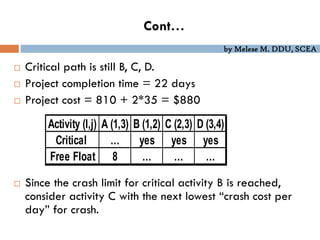
  • 196.
    by Melese M.DDU, SCEA Preferred resource usage
  • 197.
    by Melese M.DDU, SCEA Heuristic Procedure for Resource Smoothing  steps:  Prepare a complete activity schedule.  Draw a bar chart of the project under study based on ES timing of the activities.  Critical activities to be drawn first (as these activities will not be moved).  Write the resource usage above each bar of the related activity.  Draw the FF as dashed line beside the upper side of the bar and the TF beside the lower side.  Aggregate (determine the resource sum) the resources in each time period.  Calculate the total usage of resources = Σ unit period usage.
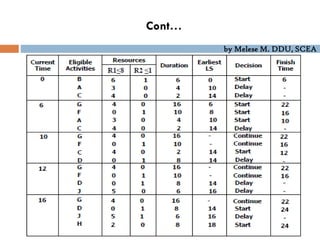
  • 198.
    by Melese M.DDU, SCEA  Calculate the average resource usage = Σ usage / utilization period.  Shift non-critical activities within their FF first, then their TF to decrease the peaks and raise the valleys.  Revise activities floats.  Aggregate resources in each time period after shifting any activity.  When shifting activities, it is preferred to start with the activities that have no successors, as shifting these activities will not affect other activities.  Also, by shifting these activities, a float will be created for its predecessors.  Shift activities only that will enhance the resource profile. Cont…
  • 199.
    by Melese M.DDU, SCEA Example Activity Activity Duration (Weeks) Predecessors Resource (units/week) A B C D E F G H I J K L M N 0 2 5 3 2 6 6 6 4 2 7 3 2 2 - A A A B B C D D E, F F, G B, H B, H, I J, K, L,M 0 0 2 2 1 2 3 1 0 4 2 2 4 0
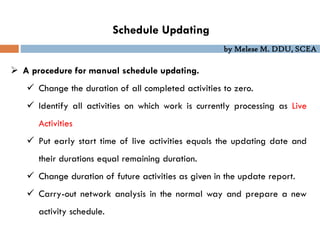
  • 200.
    by Melese M.DDU, SCEA Cont…
  • 201.
    by Melese M.DDU, SCEA Activity ES EF FF TF A B C D E F G H I J K L M N 0 0 0 0 2 2 5 3 3 8 11 9 9 18 0 2 5 3 4 8 11 9 7 10 18 12 11 20 0 0 0 0 4 0 0 0 2 8 0 6 7 0 0 3 0 6 12 3 0 6 9 8 0 6 7 0 Cont…
  • 202.
    by Melese M.DDU, SCEA Cont…
  • 203.
    by Melese M.DDU, SCEA Cont…
  • 204.
    by Melese M.DDU, SCEA Cont… 26  The above Figure shows the bar chart and the resource histogram of the project and the weekly usage of the resources and the total usage of 90 resource units.  As shown in the resource histogram, the peak resource usage is 13 units and the minimum usage is 2 units.  The total resource usage equals 90 units with utilization period of 18 weeks. Then, the average resource usage equals 5 units (=90/18=5).
  • 205.
    by Melese M.DDU, SCEA Cont… 27 The resource demand on weeks 9, 10, and 11 is high, while it is low in weeks 13 through 18. Accordingly, the solution process will try to sift the resources from that peak period to the period of low usage. The following activities will be shifted:  Activity M has a free float of 7 weeks. Shifting activity M by 7 weeks will reduce the peak usage of the resource on weeks 10 and 11 and increase the usage on weeks 17 and 18. Also, shifting activity M will give chance for preceding activities to be shifted.
  • 206.
    by Melese M.DDU, SCEA Cont… 28 Activity J can be shifted by 6, however it has 8 weeks free float. By shifting activity J, the free float of both activities E and F are changed. Shift activity L by 2 weeks to optimize the resource usage.  The free float of activity will be changed to 2 weeks. Next, shift activity E by 10 weeks to improve the resource usage. Shift activity H by 2 weeks. Finally, shift activity F by 1 week
  • 207.
    by Melese M.DDU, SCEA Cont…
  • 208.
    by Melese M.DDU, SCEA Cont…
  • 209.
    by Melese M.DDU, SCEA Levelled resource histogram
  • 210.
    by Melese M.DDU, SCEA Resource-constrained Scheduling  Shortage of resources is a major challenge for construction projects.  Often, the number of skilled labor is limited, related equipment has to be returned as soon as possible, and / or a limited require our special consideration.  Scheduling under these resource constraints becomes a complex problem, particularly when more than one resource is limited.
  • 211.
    by Melese M.DDU, SCEA Resource needed exceed resource limit
  • 212.
    by Melese M.DDU, SCEA Cont…  The technique that deals with limited resources has been referred to as "resource scheduling“ or "resource-constrained scheduling”.  The problem of resource-constrained scheduling appears after the initial network analysis is conducted and a bar chart is drawn.  A resource conflict occurs when at any point in the schedule several activities are in parallel and the total amount of required resource(s) exceeds the availability limit, for any of the resources required in these parallel activities.  The situation is illustrated in the above Figure with activities A, B, and C that, at time period 3, require 5, while 4 are only available per day.
  • 213.
    by Melese M.DDU, SCEA Cont…  The simple solution to that situation is that we can prioritizing the parallel activities, given the resource to higher priority activities and delay the others until the earliest time the resource become available again.  Notice that if we delay an activity at time period 3, to solve the situation, we may end up with another resource conflict later in time.  Continuing with identifying next conflict points and resolving them, determines the new schedule and the new project duration.  Accordingly, the objective in such situation is to delay some activities so that the resource conflict is resolved and the project delay is minimized.
  • 214.
    by Melese M.DDU, SCEA Resource scheduling using least TF rule
  • 215.
    by Melese M.DDU, SCEA heuristic rules  These heuristic rules are based mainly on activity characteristics.  The two most effective and commonly used heuristic rules are the least total-float (LTF) and the earliest late-start (ELS).  These two rules have been proven to provide identical results, with the ELS rule being advantageous compared to the LTF rule.  As such, the ELS rule can be applied with much less computational effort than the LTF rule, and accordingly has been used as a basis for the resource scheduling.
  • 216.
    by Melese M.DDU, SCEA Procedure  Prepare a complete activity schedule  Aggregate the daily resource demand  If demand greater than available then determine activities compete for resources  Prioritize these activities based on their LS  Allocate resources to some activities and delay the others  Put your solution in table format
  • 217.
    by Melese M.DDU, SCEA Example Activity Duration (Weeks) Predecessors Resource (units/week) R1≤8 R2≤1 A B C D E F G H I J K 4 6 2 8 4 10 16 8 6 6 10 - - - A D B B F E, H C G, J 3 6 4 0 4 0 4 2 4 5 2 0 1 0 1 1 1 0 0 1 1 0 For the following project determine the activities schedule start and finish times so that the weekly resource usage does not exceed the resource limits.
  • 218.
    by Melese M.DDU, SCEA Cont…
  • 219.
    by Melese M.DDU, SCEA Cont…
  • 220.
    by Melese M.DDU, SCEA Cont…
  • 221.
    by Melese M.DDU, SCEA Final Schedule Project Completion Time =40 Weeks
  • 222.
    by Melese M.DDU, SCEA End of Chapter 6 Construction Resources management Lecture # 6 Thank You!!! Construction Management [CENG 5194]
  • 223.
    Construction Management [CENG5194] Civil Engineering Department By: Melese Mengistu (MSc. Construction Engineering and Management) Lecturer at Dire Dawa University Institute Of Technology- School Of Civil Engineering & Architecture E-mail: melesemngst@yahoo.com
  • 224.
    by Melese M.DDU, SCEA Construction Management [CENG 5194] Chapter 7 and 8 Project finance & Contract Cash Flow and Project control Lecture # 7 and # 8 2
  • 225.
    by Melese M.DDU, SCEA Project finance and Contract Cash Flow At the project level, a project’s cash flow is the difference between the project’s expense and income Cash flow = Cash in – Cash out = Income - Expense  Forecasting cash flow is necessary for:  To ensure that sufficient cash is available to meet the demands.  It shows the contractor the maximum amount of cash required and when it will be required. Thus, the contractor can made arrangements to secure the required cash.  It provides a reliable indicator to lending institutions that loans made can be repaid according to an agreed program.  It ensures that cash resources are fully utilized to the benefit of the owner and investors in the company.
  • 226.
    by Melese M.DDU, SCEA The three main ingredients in determination of cash flow are:  Expenses (cash out): It is the aggregate of the payments which the contractor will make over a period of time for all resources used in the project such as labor, equipment, material, and subcontractors.  Income (cash in) :It represents the receipts a contractor will receive over a period of time for the work he/she has completed.  Timing of payments: in cash flow analysis, we are interested in the timing of payments related to the work done by the contractor. Cont…
  • 227.
    by Melese M.DDU, SCEA Construction Project Cash out The costs that spent on a specific activity or project can be classified as; Fixed cost: costs that spent once at specific point of time (e.g., the cost of purchasing equipment, etc.) Time-related cost: costs spent along the activity duration (e.g., labor wages, equipment rental costs, etc.) Quantity-proportional cost: costs changes with the quantities (e.g., material cost)
  • 228.
    by Melese M.DDU, SCEA The cash flow calculation steps  Perform project schedule.  Draw bar chart based on early or late timings.  Calculate the cost per time period.  Calculate the cumulative cost.  Adjust the cost according the method of paying it to produce the expenses.  Calculate the cumulative revenue (revenue = cost x (1 + markup)).  Adjust the revenue based on the retention and delay of owner payment.  Calculate the cash flow (cash flow = income – expense) at the contract different times.
  • 229.
    by Melese M.DDU, SCEA Consider the construction of 8-week foundation activity with operation cost of LE8800. The operation cost is broken down into the following elements:  Labor LE1600 paid weekly, Plant LE4000 paid weekly after 4 weeks credit facility, Materials LE800 paid weekly after 5 weeks credit facility, Subcontractors LE2400 paid weekly after 3 weeks credit facility. Determine the expenses (cash out) of this activity. Solution A time-scaled plan is developed for this activity for the payments for labor, plant, material, and subcontractors. The cot will be plotted weekly with the delay specified in Example Example 1
  • 230.
    by Melese M.DDU, SCEA Cont…
  • 231.
    by Melese M.DDU, SCEA The S-Curve  The curve represents the cumulative expenditures of a project direct and indirect costs over time is called the S-curve as it take the S-shape.  In many contracts, the owner requires the contractor to provide an S-curve of his estimated progress and costs across the life of the project.  This S-shaped of the curve results because early in the project, activities are mobilizing and the expenditure curve is relatively flat.  As many other activities come on-line, the level of expenditures increases and the curve has a steeper middle section.  Toward the end of a project, activities are winding down and expenditures flatten again.  The S-Curve is one of the most commonly techniques to control the project costs.
  • 232.
    by Melese M.DDU, SCEA Cont…
  • 233.
    by Melese M.DDU, SCEA Example 2 Consider the project shown in the following Figure . The costs of activities are assumed as shown in The following Table. The indirect costs of tasks are calculated considering a daily cost of LE500. It is required to draw the S-curve of the total cost of the project.
  • 234.
    by Melese M.DDU, SCEA Cost data
  • 235.
    by Melese M.DDU, SCEA Cont…
  • 236.
    by Melese M.DDU, SCEA Project Income (Cash-in)  The flow of money from the owner to the contractor is in the form of progress payments, Advanced payment and retention money.  Estimates of work completed are made by the contractors periodically (usually monthly), and are verified by the owner's representative.  Depending on the type of contract (e.g., lump sum, unit price, etc.), these estimates are based on evaluations of the percentage of total contract completion or actual field measurements of quantities placed.  Owners usually retain 10% of all validated progress payment which is usually paid with the last payment.  When the contractor collects his/her money it is named project income (cash in).
  • 237.
    by Melese M.DDU, SCEA The S-Curve for the Example Project Project revenue and income curves
  • 238.
    by Melese M.DDU, SCEA Calculating Contract Cash Flow If we plotted the contract expense and income curves against each other, then the cash flow is the difference between the points of both curves. The contractor may request an advanced or mobilization payment from the owner and the position of the income profile is shifted so that no overdraft occurs.
  • 239.
    by Melese M.DDU, SCEA Effect of advanced payment on improving cash flow
  • 240.
    by Melese M.DDU, SCEA Example 3 In this project, the markup equals 5% and the contractor will pay his expenses immediately. Retention is 10% and will be paid back with the last payment. The calculations will be made every 8 days, i.e., the contractor will receive his/her payment every 8-days (time period). Owner’s payment is delayed one period, while the contractor will submit the first invoice after the first period. No advanced payment is given to the contractor.
  • 241.
    by Melese M.DDU, SCEA Project cost and revenue
  • 242.
    by Melese M.DDU, SCEA Solution Revenue of each activity is calculated as revenue = cost (1 + markup) By summing up the activities cost and revenue, Total cost= LE 150,000 & Total revenue= LE 157,500. By considering that both the cost and the revenue are evenly distributed over the activities durations. Calculations will be made every 8-days and project duration is divided into four periods each one equals 8 days.  In addition, one period is added after project completion because of payment delayed by one period(8 days)
  • 243.
    by Melese M.DDU, SCEA Cont… Summing up the costs it became direct expenses to the contractor as there is no delay in paying them. The expected owner payments are then added up to from the project revenue.  The retention is subtracted from the owner payment and will be paid back to the contractor with the last payment. As the contractor receives a payment of LE 43,470, the cash flow improves and becomes -54,530 (43,470 – 98,000).
  • 244.
    by Melese M.DDU, SCEA Then, the revenue is delayed by one period to form the contractor income. The calculations in the last row are the difference between the project income and project expense.  Having two values in some periods shows the sudden change of the cash flow as the contractor receives more payments from the owner.  For example, in the second period, just before the contractor receive his/her payment the cash flow was (0 – 98,000 = - 98,000 LE). Cont…
  • 245.
    by Melese M.DDU, SCEA The maximum overdraft money (maximum cash) is LE 98,000 and will be needed at the 16th day of the project. Hence it shows the importance of studying the contract cash flow. Accordingly, the contractor can made his arrangements to secure the availability of this fund on the specified time. Below Figure shows the contract expense and income curves.  These curves will be needed to calculate the contractor cost of borrowing or investment of the overdraft money (area between expense and income). Cont…
  • 246.
    by Melese M.DDU, SCEA Cash flow
  • 247.
    by Melese M.DDU, SCEA Cash flow
  • 248.
    by Melese M.DDU, SCEA Minimizing Contractor Negative Cash Flow Figure : Expense and income curves
  • 249.
    by Melese M.DDU, SCEA Contract net cash flow for example 3
  • 250.
    by Melese M.DDU, SCEA Procedures to minimize contractor negative cash flow  Adjustment of work schedule to late start timing in order to delay payments and be aware that completion time delay might happen and may subjected to liquidated damages.  Reduction of delays in receiving revenues.  Asking for advanced or mobilization payment.  Achieving maximum production in the field to increase the monthly payments.  Adjust the timing of delivery of large material orders to be with the submittal of the monthly invoice.  Delay in paying equipment rentals, material suppliers and subcontractors.
  • 251.
    by Melese M.DDU, SCEA Cost of Borrowing (Return on Investment) Cash requirements (negative cash flows) during a project result in a contractor either having to borrow money to meet his/her obligation or using funds from the company reserves. Accordingly, there should be a charge against the project for the use of these funds. Charge against the project is the area between the expenses and income curves in terms of units of LE x time period (money x time) multiplying by interest rate. Cost of borrowing = net area x interest rate
  • 252.
    by Melese M.DDU, SCEA Cont… Note that, the time may be in days, weeks, months, etc., the interest rate should be calculated in the same time period as the time period of the unit areas. For example, if the units’ areas are calculated in LE. month, then the interest rate should be in months.
  • 253.
    by Melese M.DDU, SCEA Example 3 Consider the above example, it is required to calculate the cost of borrowing if the interest rate is 1% every time period (8-days). Solution Referring to expenses and income curves, the approximate number of unit areas between the expense and the income curves equals 24 units. Each unit equals LE 10,000 time period. Then, the cost of borrowing = 24 x 10,000 x 0.01 = LE 2400. This value must be added to the contract price.
  • 254.
    by Melese M.DDU, SCEA Project Cash Flow The project cash flow deals with the whole life of the project not the construction period only. project cash flow studies the project finance from the feasibility studies phase till the operation phase.  In this case, the time is much longer than that of the contract. At the early stage of a project, the project experience negative cash flow as there is no income.  In the operation stage, the revenue will increase than the expenses. When comparing the economics of projects, the cumulative cash flow provides indicators for such comparison as payback period, profit, and the maximum capital.
  • 255.
    by Melese M.DDU, SCEA Typical project cash flow
  • 256.
    by Melese M.DDU, SCEA Project Profitability Indicators Profit: It is the difference between total payments and total revenue without the effect of time on the value of money, the project with the maximum profit is ranked the best. Maximum capital: It is the maximum demand of money, i.e., the summation of all negative cash (expenditures) and The project with minimum capital required is ranked the best. Payback period: It is the length of time that it takes for a capital budgeting project to recover its initial cost, where the summation of both cash out and cash in equals zero. When comparing alternatives, the project with the shortest payback period is ranked the best.
  • 257.
    by Melese M.DDU, SCEA Example 4 Two projects A and B have annual net cash flows as show in below Table . Assume all cash flows occur at the year-end. Establish the ranking of the projects in order of attractiveness to the company using: a) Maximum capital needed b) Profit c) Payback period
  • 258.
    by Melese M.DDU, SCEA Solution Cont… Cumulative cash flow
  • 259.
    by Melese M.DDU, SCEA Maximum capital: project A (LE 80,000) is better than project B (LE 110,000) because it needs less capital. Profit: Project B (LE 80,000) is more profitable than project A (LE 65,000). Payback period: Project A (5 years) is better than project B (6 years) because is has shorter payback period. Cont…
  • 260.
    by Melese M.DDU, SCEA Project Control Lecture # 8
  • 261.
    by Melese M.DDU, SCEA Project Control  During the actual construction, changes are likely to delay the project and lead to inordinate cost increases.  As a result, the focus of project control is on fulfilling the original design plans or indicating deviations from these plans, rather than on searching for significant improvements and cost savings.  In construction, no project, almost, is executed as planned.  Control needs to be carried out due to the dynamic nature of the construction process.  Controlling after project finish is trivial/unimportant and updates are usually done periodically.
  • 262.
    by Melese M.DDU, SCEA  The cause of delays /cost overruns:  Change in activity durations and quantities.  Sudden changes of the availability of resources.  Change orders.  Payment delay  Dispute  Accidents.  Procurement delays and Cont…
  • 263.
    by Melese M.DDU, SCEA Schedule Updating  A procedure for manual schedule updating.  Change the duration of all completed activities to zero.  Identify all activities on which work is currently processing as Live Activities  Put early start time of live activities equals the updating date and their durations equal remaining duration.  Change duration of future activities as given in the update report.  Carry-out network analysis in the normal way and prepare a new activity schedule.
  • 264.
    by Melese M.DDU, SCEA Example
  • 265.
    by Melese M.DDU, SCEA  At the end of the 7th week, new filed data are collected and the project status activities is as follows: Activities A, B, D, and E have been completed. Remaining Duration of activity C is one week. Remaining Duration of activity H is 4 weeks. Activity G will not start until beginning of week 10. Overlap between activities K and G is one week only Volume of work of activity L has been increased by 33%. Activity J has been omitted. Cont…
  • 266.
    by Melese M.DDU, SCEA Scheduling data
  • 267.
    by Melese M.DDU, SCEA  The updated precedence network and the corresponding updated schedule are shown in the above Figure.  It is shown that a new critical path is developed. The new project completion time is 21 weeks which indicates that a delay of one week is encountered.  Corrective actions should be taken to improve project performance during the remaining portion. Cont…
  • 268.
    by Melese M.DDU, SCEA Updated network
  • 269.
    by Melese M.DDU, SCEA Delays Analysis  Work changes mean changes in the volume and duration of work to be performed from that envisaged at the start of the contract.  Variation in the form of addition and deduction result in more or less cost and time to execute the varied item.  On the other hand, omissions mean less cost but not necessarily less time.  It might result in wasting resources.  For instance, if the quantity of work in a critical activity is increased by x% then the duration of the activity will be extended by x%.
  • 270.
    by Melese M.DDU, SCEA Cont… The direct cost of the activity should be increased by the same ratio while the indirect cost of the contract might be increased for the extended period  It is typical for construction contracts to be delayed.  A delay that occurred on a noncritical activity does not participate to the delaying completion date of the contract.  Therefore, delays on non-critical paths are not considered
  • 271.
    by Melese M.DDU, SCEA  Compensable delays: Those over which the client has control:  Non-excusable delays: Those over which the contractor has control  Excusable delays: Those over which the neither party has any control;; and  Concurrent delays: two or more delays that occur at the same time, either of which, if it occurred alone, would have affected contract completion date. Types of Delays
  • 272.
    by Melese M.DDU, SCEA Compensable delays  A delay is deemed compensable to the contractor when it’s within the control of, is the fault of, or is due to the negligence of the client.  Examples include: • late possession of site; and faulty design; • incomplete drawings and specification; • changes in scope and suspension of work; • differing site conditions; late delivery of client-supplied materials; and • client’s failure to disclose information vital to the contractor.  For this type of delays, the conditions of contract should allow the contractor to be entitled to a time extension and to monetary recompense for extra costs associated with the delay.
  • 273.
    by Melese M.DDU, SCEA  In this category, the contractor’s own actions or inactions have caused the delay.  The contractor is entitled neither time extensions nor monetary recompense from the client.  He/she may pay liquidated damages according to the contract. Non-excusable delays
  • 274.
    by Melese M.DDU, SCEA Excusable delays  These are occurrences over which neither the client nor the contractor has any control.  Example includes: Unforeseen future events which the contractor has not been aware; Impracticable things which the contractor can only do at an excessive cost; Events in which the contractor is blameless, such as material shortage beyond what was expected at the time of bidding.  The contractor should declare the excusable delays.  The sole relief for these delays is a time extension.
  • 275.
    by Melese M.DDU, SCEA Concurrent delays  Concurrent delays are two or more delays that occur at the same time.  They can be classified as follows:  Excusable delays and non-excusable delays;  Excusable delays and compensable delays;  Excusable delays and compensable delays and non-excusable delays; and  Compensable delays and non-excusable delays.  Concurrent delays with an excusable delay will generally be considered as excusable delays.
  • 276.
    by Melese M.DDU, SCEA Cont…  For these delays, the contractor is entitled to time extension if the delays are on the critical path.  This protects him from any resulting liquidated damages.  For concurrent compensable and non-excusable delays, the contractor is allowed a time extension for completion with each party suffering his/her own losses.  The terms of the contract should declare the method of evaluation of such claims.
  • 277.
    by Melese M.DDU, SCEA End of Chapter 7 and 8 Project finance & Contract Cash Flow and Project control Lecture # 7 and # 8 Thank You!!! Construction Management [CENG 5194]
  • 278.
    Construction Management [CENG5194] Civil Engineering Department By: Melese Mengistu (MSc. Construction Engineering and Management) Lecturer at Dire Dawa University Institute Of Technology- School Of Civil Engineering & Architecture E-mail: melesemngst@yahoo.com
  • 279.
    by Melese M.DDU, SCEA Construction Management [CENG 5194] Chapter 9 Construction Safety and Insurance Lecture # 9 2
  • 280.
    by Melese M.DDU, SCEA Major hazards of construction  Falls  Electric- shock  Being struck by falling objects  Confined during excavation
  • 281.
    by Melese M.DDU, SCEA Fall Protection This section will discuss:  Conditions that required use of fall protection  Options available to protect workers
  • 282.
    by Melese M.DDU, SCEA Fall Protection  Falls are the leading cause of fatalities in the construction industry  Conditions that required use of fall protection  A fall from as little as 4-6 feet  Can cause loss of work  In some cases death
  • 283.
    by Melese M.DDU, SCEA When fall protection is needed?  Walkways & ramps  Open sides & edges  Holes  Concrete forms & rebar  Excavations  Roofs  Wall openings  Bricklaying  Residential Construction
  • 284.
    by Melese M.DDU, SCEA  Safety Nets  Hand Rails  Safety Harness (PFAS)  Equipment guards  Fall protection systems must be in place before work start Fall protection and prevention options
  • 285.
    by Melese M.DDU, SCEA  Must be properly trained  Key requirements  No free fall more than 6 feet  Must be inspected prior to use  Safety line must be able to support 5000 lbs Personal Fall Arrest System, PFAS
  • 286.
    by Melese M.DDU, SCEA Guardrails  Top rail between 39 to 45 inches tall  Toeboards at least 3 inches tall  Top rail  Mid Rail  Toe board
  • 287.
    by Melese M.DDU, SCEA Safety Nets  Used to catch falling workers  Placed not more than 30 FT below work area  Placed not more than 8-13 ft from edge of working area
  • 288.
    by Melese M.DDU, SCEA Falling Objects  Hardhats are required  Use of canopies is authorized  Barricade the area to prevent unauthorized entry
  • 289.
    by Melese M.DDU, SCEA SUMMARY  A fall of 6 ft or more protection is needed  Use fall protection on:  Walkways, ramps, open sides, edges, excavations,
  • 290.
    by Melese M.DDU, SCEA Electrical Safety This section will discuss:  Safety requirement  Hazard prevention and control  Most common injuries  Personal Protective Equipment
  • 291.
    by Melese M.DDU, SCEA How it works  Electricity is the flow of energy from one place to another  Requires a source of power (generating station, power station or portable generator)  Travels in a close circuit
  • 292.
    by Melese M.DDU, SCEA Electrical Safety  Always assume that all overhead wires are energized  Never touch a down power line  Never operate electrical equipment while standing in water  Coming in contact with an electrical voltage can cause current to flow through the body, resulting in electrical shock and burns. Serious injury or even death may occur.
  • 293.
    by Melese M.DDU, SCEA ELECTRICAL ACCIDENTS Most Frequent Causes  Contact with Power Lines  Lack of Ground Fault Protector  Missing Ground on electric cords  Improper use of equipment  Improper use of electric cords
  • 294.
    by Melese M.DDU, SCEA Electrical Hazards • Electrical accidents are caused by a combination of three factors: • Unsafe equipment and/or installation, • Workplaces made unsafe by the environment, and • Unsafe work practices
  • 295.
    by Melese M.DDU, SCEA Hazard: Exposed electrical parts  Isolate electrical parts  Use guards or barriers  Replace covers
  • 296.
    by Melese M.DDU, SCEA HAZARD:Conductors entering boxes  Shall be protected from abrasion  All openings shall be closed to prevent access
  • 297.
    by Melese M.DDU, SCEA HAZARD: Overhead Power Lines  Usually not insulated  Carry extremely high voltage  80% of all lineman deaths were caused by contacting a live wire with a bare hand.
  • 298.
    by Melese M.DDU, SCEA HAZARD: Overhead Power Lines (Cont)  Equipment that could contact power lines:  Cranes  Scaffolds  Ladders  Scissor lift
  • 299.
    by Melese M.DDU, SCEA MOST COMMON INJURIES DIRECT  Electrocution or death  Shock  Burns INDIRECT  Falls
  • 300.
    by Melese M.DDU, SCEA Most Common injuries Electric shock/Electrocution  Electric shock is received when electrical current passes through the body.  Can cause severe damage or death.  You will get an electrical shock if a part of your body completes an electrical circuit by…  Touching a live wire and an electrical ground,  Touching a live wire and another wire at a different voltage.
  • 301.
    by Melese M.DDU, SCEA Most Common injuries: Burns  Most common shock-related injury  *Electrical Burns, Arc or Flash Burns, Thermal Burns  Occurs when you touch electrical wiring or equipment that is improperly used or maintained  Very serious injury that needs Immediate attention
  • 302.
    by Melese M.DDU, SCEA Most Common injuries Falls  Caused by involuntary electric shock  Occurs on personnel working in elevated locations (ladder, scaffolds, etc)  May result in serious injury or death
  • 303.
    by Melese M.DDU, SCEA PERSONAL PROTECTIVE: EQUIPMENT  PPE should always be first line of defense  Rubber gloves  Rubber Insulated work boots, Hoods, sleeves or blankets
  • 304.
    by Melese M.DDU, SCEA SAFETY WORK PRACTICES  Only qualify person should work on electrical equipment  Use special insulated tools when working on fuses with energized terminals  Don’t use worn or frayed cords and cables  Don’t fasten extension cords with staples, hang from nails, or suspend by wire.
  • 305.
    by Melese M.DDU, SCEA SAFETY WORK PRACTICES  De-energize live parts before commencing work  Lock or Tag out circuits (or both)  Inspect extension cords  Avoid contact with overhead lines  Avoid wet conditions  Check switches and insulation
  • 306.
    by Melese M.DDU, SCEA SUMMARY Electrical equipment must be:  Listed and labeled  Free from hazards  Used in the proper manner If you use electrical tools you must be:  Protected from electrical shock  Provided necessary safety equipment
  • 307.
    by Melese M.DDU, SCEA 30 Are You Working On A Trench Or Digging Your Grave?
  • 308.
    by Melese M.DDU, SCEA TRENCHING & EXCAVATION HAZARDS  Risks of excavation  How to protect employees from cave-ins  Factors that pose a hazard to employees working in excavation  Role of competent person
  • 309.
    by Melese M.DDU, SCEA EXCAVATION HAZARDS Risks  Most hazardous construction operation  Cave-ins are the greatest risk  Most accidents occurred in 5-15 ft deep
  • 310.
    by Melese M.DDU, SCEA EXCAVATION HAZARDS Employee Protection  Employees should be protected from caves-in by using a well designed protective system  Systems must be able to support expected loads to the system
  • 311.
    by Melese M.DDU, SCEA EXCAVATION HAZARDS Protective System Design  A well designed system will have a correct design of sloping and benching systems  Correct design of support systems  Handle materials and equipment
  • 312.
    by Melese M.DDU, SCEA EXCAVATION HAZARDS Employee Protection  Protect employees from potential cave-ins  Slope or bench sides of excavation  Place shields between the side of the excavation and work area
  • 313.
    by Melese M.DDU, SCEA Inadequate Worker Protection
  • 314.
    by Melese M.DDU, SCEA Factors that pose hazards to employees  Soil classification  Depth of cut  Water content of soil  Changes due to weather and climate  Other operations in the vicinity
  • 315.
    by Melese M.DDU, SCEA 38 Types of Protection Trench Shield A trench shield was built around this work area
  • 316.
    by Melese M.DDU, SCEA 39 Hydraulic Jacks Hydraulic Jacks  Easily dropped in place and adjusted  Trench pins installed in case of hydraulic failure
  • 317.
    by Melese M.DDU, SCEA 40 Egress Systems  A stairway, ladder, or ramp must be present in excavations that are 4 or more feet deep, and within 25 feet of the employees  Must extend 3FT above excavation This ladder does not meet the requirements of the standard
  • 318.
    by Melese M.DDU, SCEA EXCAVATION HAZARDS Competent Person • Must have had specific training in and be knowledgeable about: • Soils classification • The use of protective systems • The requirements of the standard • Must be capable of identifying hazards, and authorized to immediately eliminate hazards
  • 319.
    by Melese M.DDU, SCEA EXCAVATION HAZARDS Competent Person • A competent person must make daily inspections of excavations, areas around them and protective systems: • Before work starts and as needed • After rainstorms, high winds or other occurrence which may increase hazards • When you can reasonably anticipate an employee will be exposed to hazards.
  • 320.
    by Melese M.DDU, SCEA SUMMARY • The greatest risk in an excavation is a cave-in. • Employees can be protected through sloping, shielding, and shoring the excavation. • A competent person is responsible to inspect the excavation. • Other excavation hazards include water accumulation, oxygen deficiency, toxic fumes, falls, and mobile equipment
  • 321.
    PERSONAL PROTECTIVE EQUIPMENT INTHE CONSTRUCTION INDUSTRY 29 CFR 1926.95-106
  • 322.
    by Melese M.DDU, SCEA What is PPE?  Equipment that creates a barrier against workplace hazards  Examples include hard hats, goggles, gloves, hearing protection, etc.  A temporary measure
  • 323.
    by Melese M.DDU, SCEA  Personal protective equipment  The employer is responsible for requiring wear of appropriate personal protective equipment in all operations where there is exposure to hazardous conditions… 1926.28(a) General Safety and Health Provisions
  • 324.
    by Melese M.DDU, SCEA  Personal protective equipment  Regulations governing the use, selection, and maintenance of personal protective and lifesaving equipment are described under subpart E of this part. General Safety and Health Provisions
  • 325.
    by Melese M.DDU, SCEA Criteria for PPE  Protective equipment, including PPE for eyes, face, head and extremities etc. … shall be provided, used, and maintained in a sanitary condition and reliable condition.
  • 326.
    by Melese M.DDU, SCEA Criteria for PPE  Employee-owned equipment  Where employees provide their own protective equipment, the employer shall be responsible to assure its adequacy, including proper maintenance, and sanitation of such equipment. 1926.95(b)
  • 327.
    by Melese M.DDU, SCEA Criteria for PPE  Design  All personal protective equipment shall be of safe design and construction for work to be performed. 1926.95(c)
  • 328.
    by Melese M.DDU, SCEA Training  Employer shall instruct each employee in the recognition and avoidance of unsafe conditions and the regulations applicable to his work environment to control or eliminate any hazards or other exposure to illness or injury. 1926.21(b)
  • 329.
    by Melese M.DDU, SCEA Basic Hazard Categories  Impact  Penetration  Compression  Chemical  Heat  Harmful dust  Light radiation  Falls
  • 330.
    by Melese M.DDU, SCEA Hazard Sources  Motion  Temperature  Chemical exposure  Light radiation  Elevation  Sharp objects  Rolling/pinching  Electrical hazards  Workplace layout  Worker Location
  • 331.
    by Melese M.DDU, SCEA Employer Requirements  Conduct hazard assessment  Insure adequacy of PPE  Provide employee training  Maintain written certification
  • 332.
    by Melese M.DDU, SCEA Head Protection  Employees working in areas where there is a possible danger of head injury from impact, or from falling or flying objects, or from electrical shock and burns, shall be protected by helmets. 1926.100(a)
  • 333.
    by Melese M.DDU, SCEA Head Protection  Helmets for the protection of employees against impact and penetration of falling and flying object shall meet the specification contained in American National Standard Institute (ANSI), Z89.1-1969, Safety Requirements for Industrial Head Protection. 1926.100(b)
  • 334.
    by Melese M.DDU, SCEA Head Protection  Helmets for the protection of employees exposed to high voltage electrical shock and burns shall meet the specifications contained in American National Standards Institute (ANSI), Z89.2-1971. 1926.100(c)
  • 335.
    by Melese M.DDU, SCEA Hearing Protection  Wherever it is not feasible to reduce the noise levels or duration of exposure to those specified in Table D-2, Permissible Noise Exposures, in 1926.52, ear protection devices shall be provided and used. 1926.101(a)
  • 336.
    by Melese M.DDU, SCEA Hearing Protection  Ear protection devices inserted in the ear shall be fitted or determined individually by competent persons.  Plain cotton is not an acceptable protective device. 1926.101(b)-(c)
  • 337.
    by Melese M.DDU, SCEA Eye and Face Protection  Employees shall be provided with eye and face protection equipment when machines or operations present potential eye or face injury from physical, chemical, or radiation agents. 1926.102(a)(1)
  • 338.
    by Melese M.DDU, SCEA Eye and Face Protection  Eye and face protection equipment required by this Part shall meet the requirements specified in American National Standards Institute (ANSI), Z89.1-1968, Practice for Occupational and Education Eye and Face Protection. 1926.102(a)(2)
  • 339.
    by Melese M.DDU, SCEA Eye and Face Protection  Employees whose vision requires the use of corrective lenses in spectacles, when required by this regulation to wear eye protection, shall be protected by goggles or spectacles. 1926.102(a)(3)
  • 340.
    by Melese M.DDU, SCEA Eye and Face Protection  Spectacles whose protective lenses provide optical correction  Goggles that can be worn over corrective spectacles without disturbing the adjustment of the spectacles  Goggles that incorporate corrective lenses mounted behind the protective lenses 1926.102(a)(3)
  • 341.
    by Melese M.DDU, SCEA Foot Protection  Safety-toe footwear for employees shall meet the requirements and specifications in American National Standard for Men’s Safety-Toe Footwear, Z41.1-1967. 1926.96
  • 342.
    by Melese M.DDU, SCEA Respiratory Protection  Identical to 29 CFR 1910.134  Written program  Medical evaluation  Fit testing  Selection and use  Maintenance and care  Training  Program evaluation  Recordkeeping 1926.103
  • 343.
    by Melese M.DDU, SCEA Safety Belts, Lifelines, Lanyards  Lifelines, safety belts, and lanyards shall be used only for employee safeguarding. 1926.104(a)
  • 344.
    by Melese M.DDU, SCEA Safety Belts, Lifelines, Lanyards  Lifelines shall be secured above the point of operation to an anchorage or structural member capable of supporting a minimum dead weight of 5,400 pounds. 1926.104(b)
  • 345.
    by Melese M.DDU, SCEA Safety Belts, Lifelines, Lanyards  Lifelines used on rock scaling operations, or in areas where the lifeline may be subjected to cutting or abrasion, shall be a minimum of ⅞ inch wire core manila rope.  For all other lifeline applications, a minimum of ¾-inch manila or equivalent, with a minimum breaking strength of 5,400 pounds, shall be used. 1926.104(c)
  • 346.
    by Melese M.DDU, SCEA Safety Belts, Lifelines, Lanyards  Safety belts lanyard shall be a minimum of ½-inch nylon, or equivalent, with a maximum length to provide for a fall of no greater than 6 feet.  The rope shall have a nominal breaking strength of 5,400 pounds. 1926.104(d)
  • 347.
    by Melese M.DDU, SCEA Safety Belts, Lifelines, Lanyards  All safety belt and lanyard hardware shall be drop forged or pressed steel, cadmium plated in accordance with Type 1, Class B plating specified in Federal Specification QQ-P-416.  Surface shall be smooth and free of sharp edges. 1926.104(e)
  • 348.
    by Melese M.DDU, SCEA Safety Belts, Lifelines, Lanyards  All safety belts and lanyard hardware, except rivets, shall be capable of withstanding a tensile loading of 4,000 pounds without cracking, breaking, or taking a permanent deformation. 1926.104(f)
  • 349.
    by Melese M.DDU, SCEA Working Over or Near Water  Life jacket or buoyant work vests must be U.S. Coast Guard approved.  Prior to and after each use, the buoyant work vests or life preservers shall be inspected for defects.  Ring buoys shall be provided for rescue operations.  Lifesaving skiff shall be immediately available. 1926.106(a)-(d)
  • 350.
    by Melese M.DDU, SCEA 73
  • 351.
    by Melese M.DDU, SCEA Construction insurance 74  Construction insurance encompasses all contracts of indemnity within the activities of the construction industry where insurance is chosen as the medium through which liabilities are shifted.
  • 352.
    by Melese M.DDU, SCEA End of Chapter 7 and 8 Construction Safety and Insurance Lecture # 9 Thank You!!! Construction Management [CENG 5194]
  • 353.
    Construction Management [CENG5194] Civil Engineering Department By: Melese Mengistu (MSc. Construction Engineering and Management) Lecturer at Dire Dawa University Institute Of Technology- School Of Civil Engineering & Architecture E-mail: melesemngst@yahoo.com
  • 354.
    by Melese M.DDU, SCEA Construction Management [CENG 5194] Chapter 9 Construction Site Layout Planning and Preparation of terms of reference Lecture # 9 2
  • 355.
    by Melese M.DDU, SCEA Introduction 3  Construction site layout involves identifying, sizing, and placing temporary facilities (TFs) within the boundaries of construction site.  These temporary facilities range from simple lay-down areas to warehouses, fabrication shops, maintenance shops, batch plant, and residence facilities. Required temporary facilities and their areas are depending in many factors including project type, scale, design, location, and organization of construction work.
  • 356.
    by Melese M.DDU, SCEA 4  Most construction sites that run into trouble do so for reasons related to managerial factors rather than because of technical problems.  The site-based management can make significant improvements in the cost and time savings during the construction process without involving a mass of additional work.  Site management involves many tasks, such as:-  site investigation before construction process starts,  material delivery and procurement management,
  • 357.
    by Melese M.DDU, SCEA 5  keeping better site records,  keeping good site communication and high level of information flow,  monitoring performance regularly,  establishing a well co-ordination system among different parts, and  performing a good site layout planning.  Extensive time loss and cost overruns could result in large projects, where the number of manpower, subcontractors, and equipment involved are high, if there is no effective and systematic approach to site planning.
  • 358.
    by Melese M.DDU, SCEA 6  A detailed planning of the site layout and location of temporary facilities can enable the management to make considerable improvement by minimizing travel time, waiting time, and increasing worker morale by showing better and safer work environment.  Due to its importance, this chapter focuses on the site layout planning problem.
  • 359.
    by Melese M.DDU, SCEA 7  The problem of site layout planning has been solved by researchers using two distinctly techniques: optimization and heuristics.  Mathematical optimization procedures have been designed to produce the optimum solutions.  The heuristic methods, on the other hand, used to produce good but not optimal solutions.  However, the first category can not be adopted for large projects, and the second category is the only available mean for solving the complex real life projects.
  • 360.
    by Melese M.DDU, SCEA Problems of Failure to plan the site layout 8 Material  Materials arriving on site should be loaded to be the correct location ant it will cause double or triple handling of materials to another location. For example:  Stocked over a drainage line or near the edge of excavation;  Too far from the work area;  Too remote from the hoist or not within the radius of the crane;  Obstruct the smooth flow of work traffic across the site;  Wrongly delivered on site and are not needed until much later in the project;  breakable.
  • 361.
    by Melese M.DDU, SCEA 9 Plant and equipment wrongly located For example:  The mixer is inaccessible for the delivery of materials;  not enough room for the storage of aggregates;  Fixed cranes are unable to reach all parts of the works;  Hoists have insufficient capacity or height to handle the loads or badly located in relation to the floor layout;
  • 362.
    by Melese M.DDU, SCEA 10 Inadequate space allowed.  Where inadequate space is allowed for the stacking of materials or activities:  Materials may be stacked to high or stacked on roadways causing hazards.  Working areas may become too cramped or additional areas may have o be allocated with the consequent waste of time caused by having to travel between them
  • 363.
    by Melese M.DDU, SCEA 11 Site huts wrongly located in relation to their effective use, such as:  - Site office located too near noisy activities such as mixer, or  located too near to site roads in dusty conditions, or  too remote with insufficient overview of the site.  Warehouses having inadequate access for loading and unloading or located in insecure area.  before moving on to a site, it is necessary to prepare a detailed site plan, showing the positions to be taken by every item of equipment, accommodation, ancillary work areas and materials storage areas.
  • 364.
    by Melese M.DDU, SCEA Site Layout Planning Elements 12 Safety  Fire prevention: Fire is a major cause of damage on construction sites.  So that, fire extinguishers are basic requirements on a construction project.  Medical services: On construction project a first aid kit is a must.  In remote projects a well-equipped medical room with a doctor and nurse is important.  Construction safety clothing: Basic safety supplies like safety shoes, hard hats, gloves, and goggles must be used by workers.
  • 365.
    by Melese M.DDU, SCEA 13 Site Accessibility  Easy accessibility will keep the morale of the equipment and vehicle drivers high, minimize the chance of accidents, and save time in maneuvering to arrive at and leave the project.  In case of large projects, proper planning is required to layout the roads leading from the nearest highway.  Internal roads are necessary for easy flow of work.  Also, Parking Lots are provided for the owner, office, and craft personnel, but this facility must be planned where space does exist.
  • 366.
    by Melese M.DDU, SCEA 14 Information Signs  Site map: It should locate details of the project, and displayed in the office of the site superintendent or project manager and posted at the entrance gate.  Traffic regulatory signs: For large projects, traffic regulatory signs help in guiding the traffic on the site and avoid accidents to a considerable extent.  Display of labor relations’ policy and safety rules: This will help in eliminating disputes between labor and management.  Emergency routes and underground services: It is important to display the emergency escape routes on every floor as the building progresses. Locations of underground services should be marked to prevent its damage.
  • 367.
    by Melese M.DDU, SCEA 15 Security  Entrance: It is necessary to have a proper guard entrance to the site provided by a booth. Also, it is necessary to keep track of all visitors to the project.  Lighting: It is necessary to have a standby generator to maintain site lighting.  - Fencing: The boundary should be fenced off from a security point of view
  • 368.
    by Melese M.DDU, SCEA 16 Accommodation  On large construction projects, it is necessary to provide camp accommodation for all type of staff involved in the project. Offices  The offices should be close together, close to the site, and in a safe area. Also, provide the offices with proper office equipment.  The offices at the site may include job office, general contractor office, and sub-contractors and consultants Offices.
  • 369.
    by Melese M.DDU, SCEA 17 Water Supply and Sanitation  It is necessary to have water and toilet facilities in convenient locations to accommodate the work force. Material Handling  One third or more of all construction operations can be classified as material handling.  The use of proper equipment for material handling and advance planning for minimizing multiple handling will result in direct cost and time savings.
  • 370.
    by Melese M.DDU, SCEA 18 Storage and site cleaning  It is necessary to plan and reserve storage areas for materials so that multiple movement of material is avoided.  Laydown areas: Areas reserved for storage of large materials and equipment and it can be short-term or long-term.  - Warehouses: They are sheltered storage facilities where materials are stored until they have disbursed to the job.  - Material staging areas: They used when materials are stored near the work on a short-term basis. They are generally as close to work as possible.  - Site cleaning: It is necessary at a work place and especially where the extent of debris produced is high. Regular disposal of debris is necessary
  • 371.
    by Melese M.DDU, SCEA 19 Craft Change-Houses  Craft change-houses provide sheltered space for craft personnel to change and store clothes, wash, and rest during waiting periods. Batch plant and Fabrication Shops  Batch plants are provided on projects where it is more economical to produce concrete on site than to buy a ready mix.  Aggregate storage piles, cement silos and admixture tanks will accompany an on-site batch plant.  Shops are used where materials and equipment are fabricated on site.  This includes electrical, mechanical, carpentry, and paint shops. Also, testing shops used to house the necessary testing equipment and personnel for the project.
  • 372.
    by Melese M.DDU, SCEA Temporary Facilities Characteristics 20 Satisfying environmental and safety regulations: All temporary facilities should satisfy environmental and safety regulations. Special attention should be paid to temporary facilities like batch plants, which have high pollution potential. Planners have to make proper arrangements to control the air, water, and noise pollution from such facilities.
  • 373.
    by Melese M.DDU, SCEA 21 Availability of diverse solutions for the same problem: There are many arrangements that can be made to establish a temporary facility. For example, if a warehouse is required, the planner can build a warehouse on the site, use existing facilities on the site, rent a building near the site, or plan a just in time delivery. Based on the usage of the warehouses, each alternative can be further divided into several sub items. For example, the material of building the facility can vary from wood, bricks, to a steel structure.
  • 374.
    by Melese M.DDU, SCEA 22 Relatively short life span of a specific location:  The life span of temporary facility depends on the duration of the project. In general, it must be removed as soon as the project is completed. Reutilization with a minimum loss for the same or modified function at another location: Due to the shorter life span of temporary facility on site, planners consider reutilization of the temporary facilities. This can result in saving the cost of construction.  With appropriate modifications, most of the temporary facilities can be used for more different purposes. Therefore, good maintenance, and storage of the building materials can increase the frequency of reutilization and decrease construction costs significantly
  • 375.
    by Melese M.DDU, SCEA 23  Easy of assembly, dismantling, and exploitation: temporary facilities structures which are easy to assemble and dismantle will reduce both assembly and disassembly time. As mentioned above, temporary facilities will need to be removed in a very short period of time after project completion. Thus, temporary facilities structures should be easy to assemble and dismantle without any damage to the structure components. Prefabricated modules are ideal for constructing temporary facilities and they are usually easy to assemble and dismantle.
  • 376.
    by Melese M.DDU, SCEA 24  Standardization of design: Standardization of design and construction of temporary facilities can increase the frequency of reutilization and reduce the work-hours and cost required for construction the facilities. This approach makes the maintenance, transportation and storage of temporary facilities easy. The benefits of the learning curve can be gained from repetitive field operations, which results in increase of productivity and quality. Also, benefits are obtained by providing grater interchangeability of spare parts and reducing the variety of spare parts stored in the warehouse.
  • 377.
    by Melese M.DDU, SCEA Temporary Facilities Selection 25  Construction type: The construction of an industrial plant, such as power plant, requires more storage and fabrication area for process mechanical and electrical work than other projects such as a highway project.  Type of contract: For turn-key contract, the contractor can consolidate the administrative and construction operations, means that fewer but larger and more efficient temporary facilities can be selected. On the other hand, if the project is managed under a series of different contracts, this will translate into a higher number of smaller temporary facilities serving each individual contractor.
  • 378.
    by Melese M.DDU, SCEA 26  Project size: A relatively small project can be managed from a trailer or portable structure. While a five to ten year project may need temporary facilities of a more permanent nature.  - Project location: Projects located in uninhabited regions or in places where skilled labor is scarce require additional facilities for eating and living. Project far from industrial centers require more on site services such as batch plant, equipment maintenance shops, long term storage area, and even some other recreational centers for the families.
  • 379.
    by Melese M.DDU, SCEA 27
  • 380.
    by Melese M.DDU, SCEA End of Chapter 9 Construction Site Layout Planning and Preparation of terms of reference Lecture # Thank You!!! Construction Management [CENG 5194]