A Presentation on Mobile IPv6
Presented By :
PARAS JHA
4912316
Content
• Introduction
• Feature of IPv6
• Operational Principle
• Two kinds of entities comprise a Mobile IP implementation
• IPv6 Addressing
• Difference between IPv4 and IPv6
• Why Not IPv5
• Application Of IPv6
• Advantages and Disadvantages
• Conclusion
Introduction
• Mobile IPv6 is intended to enable IPv6 nodes
to move from one IP subnet to another.
• While a mobile node is away from home
It sends information about its current location to a
home agent
The home agent intercepts packets addressed to the
mobile node and tunnels them to the mobile node’s
present location
Feature of IPv6
• Address auto configuration
• Stateless auto configuration
• Stateful auto configuration
• Neighbor discovery
• Discovers each other’s presence and find routers.
• Determine each other’s link-layer address.
• Maintain reachability information.
• Extension Headers
• Routing header
• Destination option Header
Operational Principle
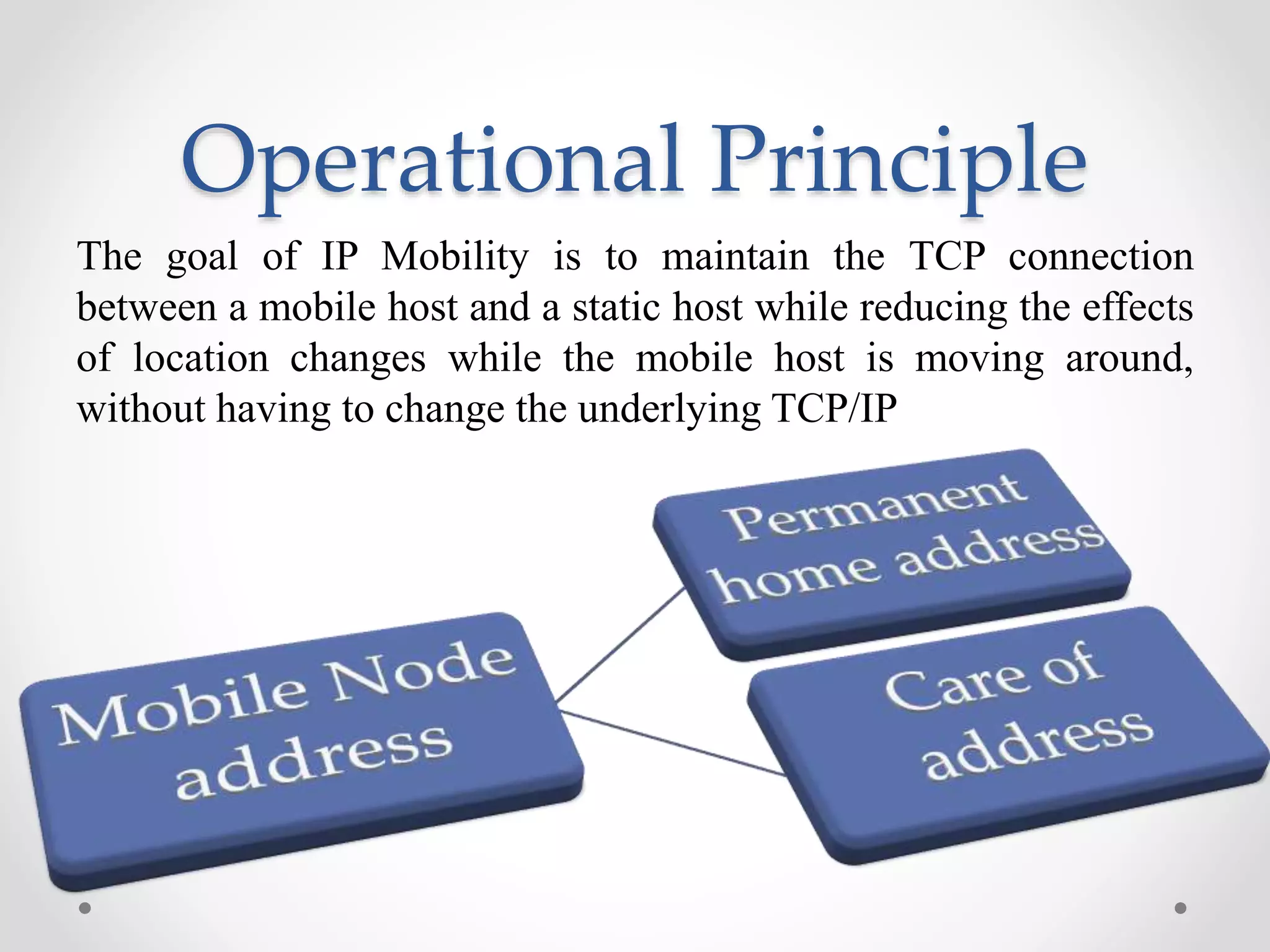
The goal of IP Mobility is to maintain the TCP connection
between a mobile host and a static host while reducing the effects
of location changes while the mobile host is moving around,
without having to change the underlying TCP/IP
Two kinds of entities comprise a
Mobile IP implementation
• A HOME AGENT (HA) stores information about mobile
nodes whose permanent home address is in the home
agent's network.
• A FOREIGN AGENT (MN) stores information about
mobile nodes visiting its network. Foreign agents also
advertise care-of addresses, which are used by Mobile
IP.
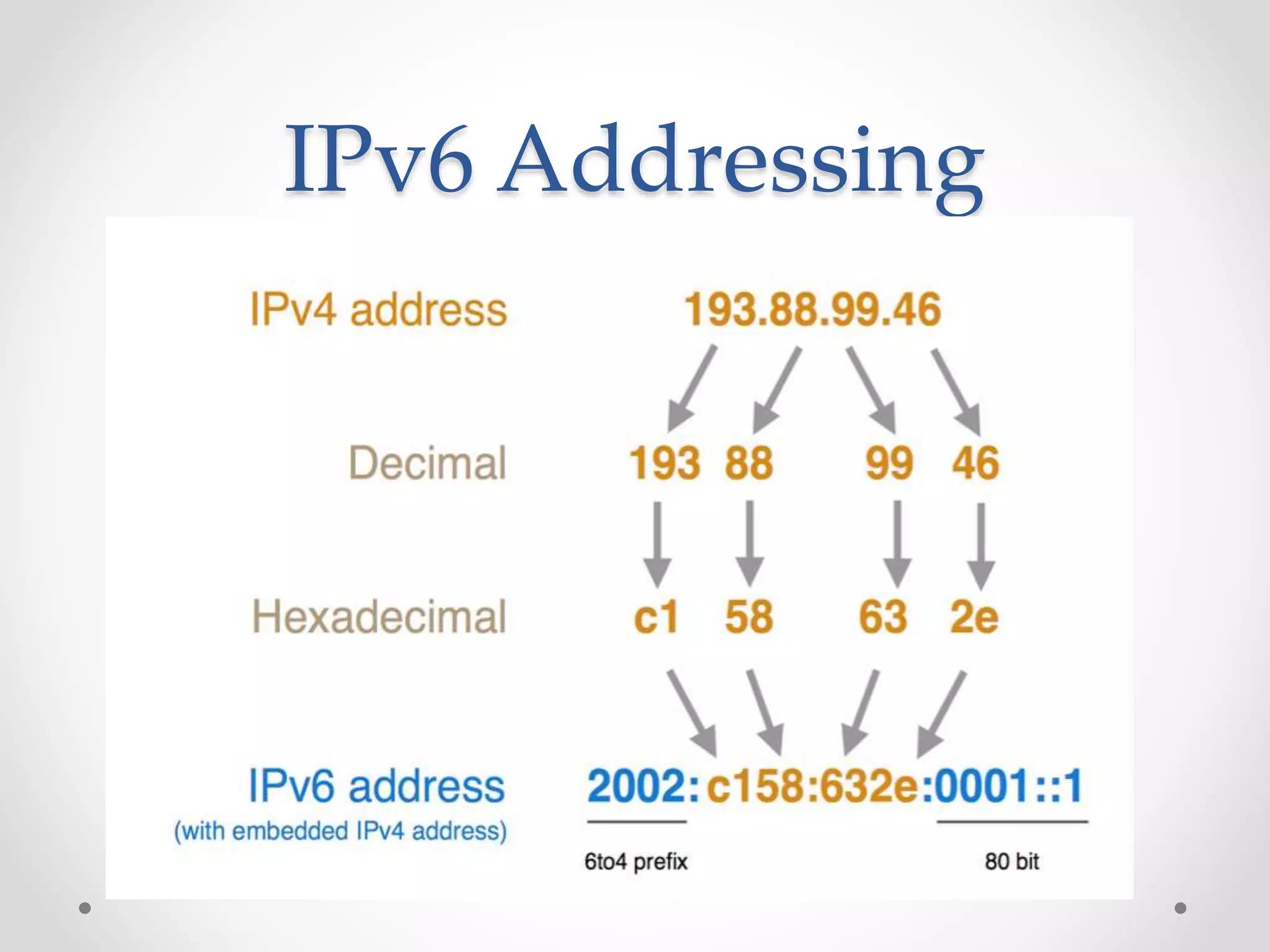
IPv6 Addressing
Difference between IPv4
and IPv6
IPv4 IPv6
• Address
32 bits (4 bytes)
• Packet size
576 bytes required
• Packet fragmentation
Routers and sending hosts
• Broadcast
YES
• Multicast
Yes
• Address
128 bit (16 bytes)
• Packet size
1280 bytes required
• Packet fragmentation
Sending host only
• Broadcasts
NO
• Multicast
Yes
Why Not IPv5
• Version 5 was used while experimenting with stream
protocol for internet
• Known as Internet Stream Protocol
• Used Internet Protocol number 5 to encapsulate its
datagram
• Though it was never brought into public use but it was
already used
Advantages and
Disadvantages of IPv6
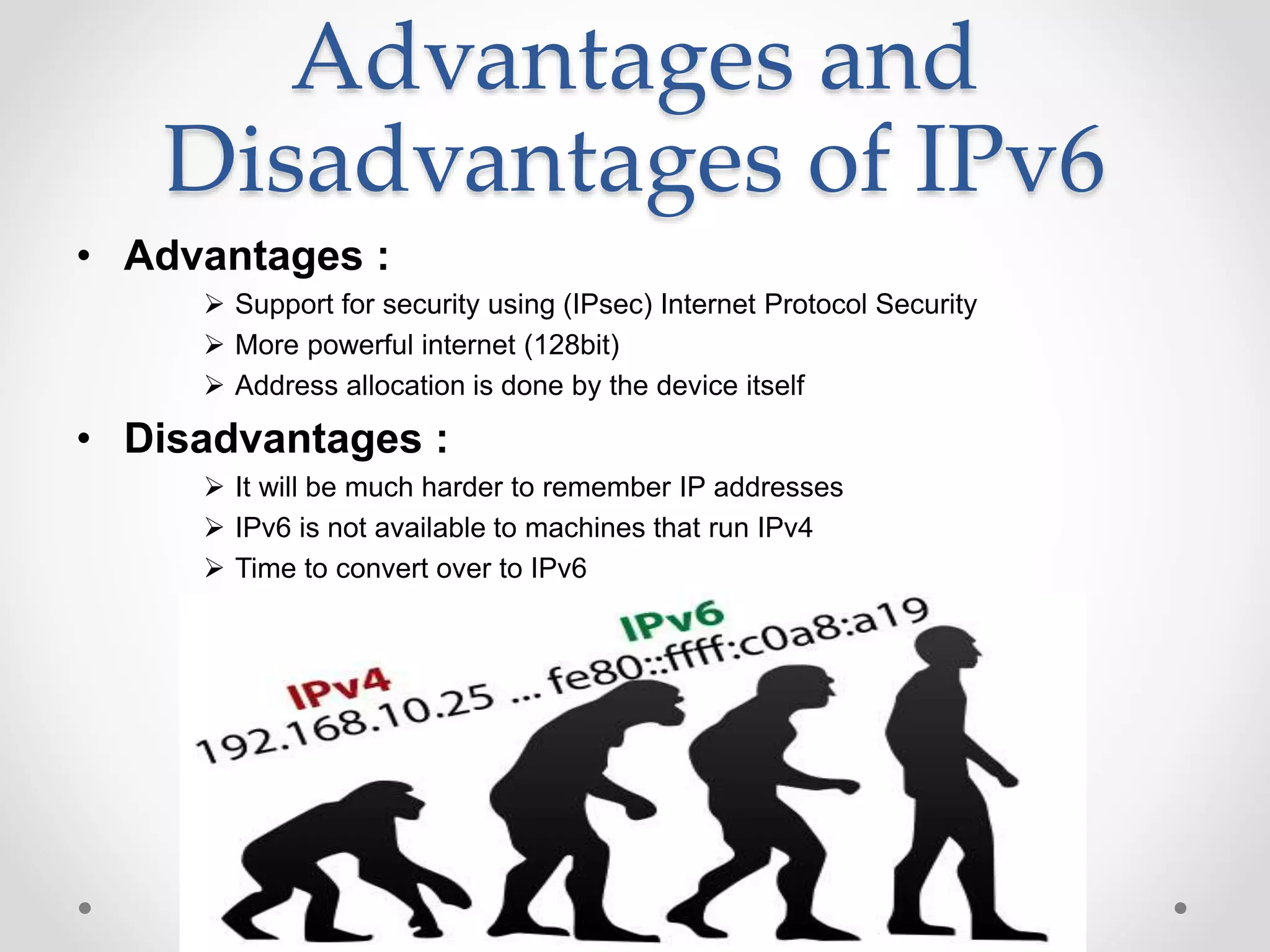
• Advantages :
 Support for security using (IPsec) Internet Protocol Security
 More powerful internet (128bit)
 Address allocation is done by the device itself
• Disadvantages :
 It will be much harder to remember IP addresses
 IPv6 is not available to machines that run IPv4
 Time to convert over to IPv6
Application Of IPv6
• FTP clients
• Telnet clients
• Internet Explore
Conclusion
• Mobile IPv6 is
An efficient and deployable Protocol for
handling mobility with IPv6
Lightweight Protocol
To minimize the control traffic needed to
effect mobility
THANK YOU

Mobile ipv6

  • 1.
    A Presentation onMobile IPv6 Presented By : PARAS JHA 4912316
  • 2.
    Content • Introduction • Featureof IPv6 • Operational Principle • Two kinds of entities comprise a Mobile IP implementation • IPv6 Addressing • Difference between IPv4 and IPv6 • Why Not IPv5 • Application Of IPv6 • Advantages and Disadvantages • Conclusion
  • 3.
    Introduction • Mobile IPv6is intended to enable IPv6 nodes to move from one IP subnet to another. • While a mobile node is away from home It sends information about its current location to a home agent The home agent intercepts packets addressed to the mobile node and tunnels them to the mobile node’s present location
  • 4.
    Feature of IPv6 •Address auto configuration • Stateless auto configuration • Stateful auto configuration • Neighbor discovery • Discovers each other’s presence and find routers. • Determine each other’s link-layer address. • Maintain reachability information. • Extension Headers • Routing header • Destination option Header
  • 5.
    Operational Principle The goalof IP Mobility is to maintain the TCP connection between a mobile host and a static host while reducing the effects of location changes while the mobile host is moving around, without having to change the underlying TCP/IP
  • 6.
    Two kinds ofentities comprise a Mobile IP implementation • A HOME AGENT (HA) stores information about mobile nodes whose permanent home address is in the home agent's network. • A FOREIGN AGENT (MN) stores information about mobile nodes visiting its network. Foreign agents also advertise care-of addresses, which are used by Mobile IP.
  • 8.
  • 9.
    Difference between IPv4 andIPv6 IPv4 IPv6 • Address 32 bits (4 bytes) • Packet size 576 bytes required • Packet fragmentation Routers and sending hosts • Broadcast YES • Multicast Yes • Address 128 bit (16 bytes) • Packet size 1280 bytes required • Packet fragmentation Sending host only • Broadcasts NO • Multicast Yes
  • 10.
    Why Not IPv5 •Version 5 was used while experimenting with stream protocol for internet • Known as Internet Stream Protocol • Used Internet Protocol number 5 to encapsulate its datagram • Though it was never brought into public use but it was already used
  • 11.
    Advantages and Disadvantages ofIPv6 • Advantages :  Support for security using (IPsec) Internet Protocol Security  More powerful internet (128bit)  Address allocation is done by the device itself • Disadvantages :  It will be much harder to remember IP addresses  IPv6 is not available to machines that run IPv4  Time to convert over to IPv6
  • 12.
    Application Of IPv6 •FTP clients • Telnet clients • Internet Explore
  • 13.
    Conclusion • Mobile IPv6is An efficient and deployable Protocol for handling mobility with IPv6 Lightweight Protocol To minimize the control traffic needed to effect mobility
  • 14.