Mobile IP
Outline
What is the problem at the routing
layer when Internet hosts move?!
Can the problem be solved?
What is the standard solution? –
mobile IP
What are the problems with the
solution?
Other approaches?
Internet hosts & Mobility
Wireless networking – allows Internet
users to become mobile
As users move, they have to be
handed over from one coverage area
to another (since the coverage areas
of access points are finite) …
Ongoing connections need to be
maintained as the user moves …
Problems?
What are the problems?
The IP address associated with a
mobile host is network dependent!
When user connects to another
network, IP address needs to change
Packets belonging to ongoing
connections somehow need to be
delivered to the mobile host
Problems (Contd.)?
What are the options?
Make IP address host specific instead
of network specific – obvious pitfalls?
Change IP address of host and start
using the new IP address in the
subsequent packets belonging to the
connections
Intuitive Solution
Take up the analogy of you moving
from one apartment to another
What do you do?
Leave a forwarding address with your
old post-office!
The old post-office forwards mails to
your new post-office, which then
forwards them to you
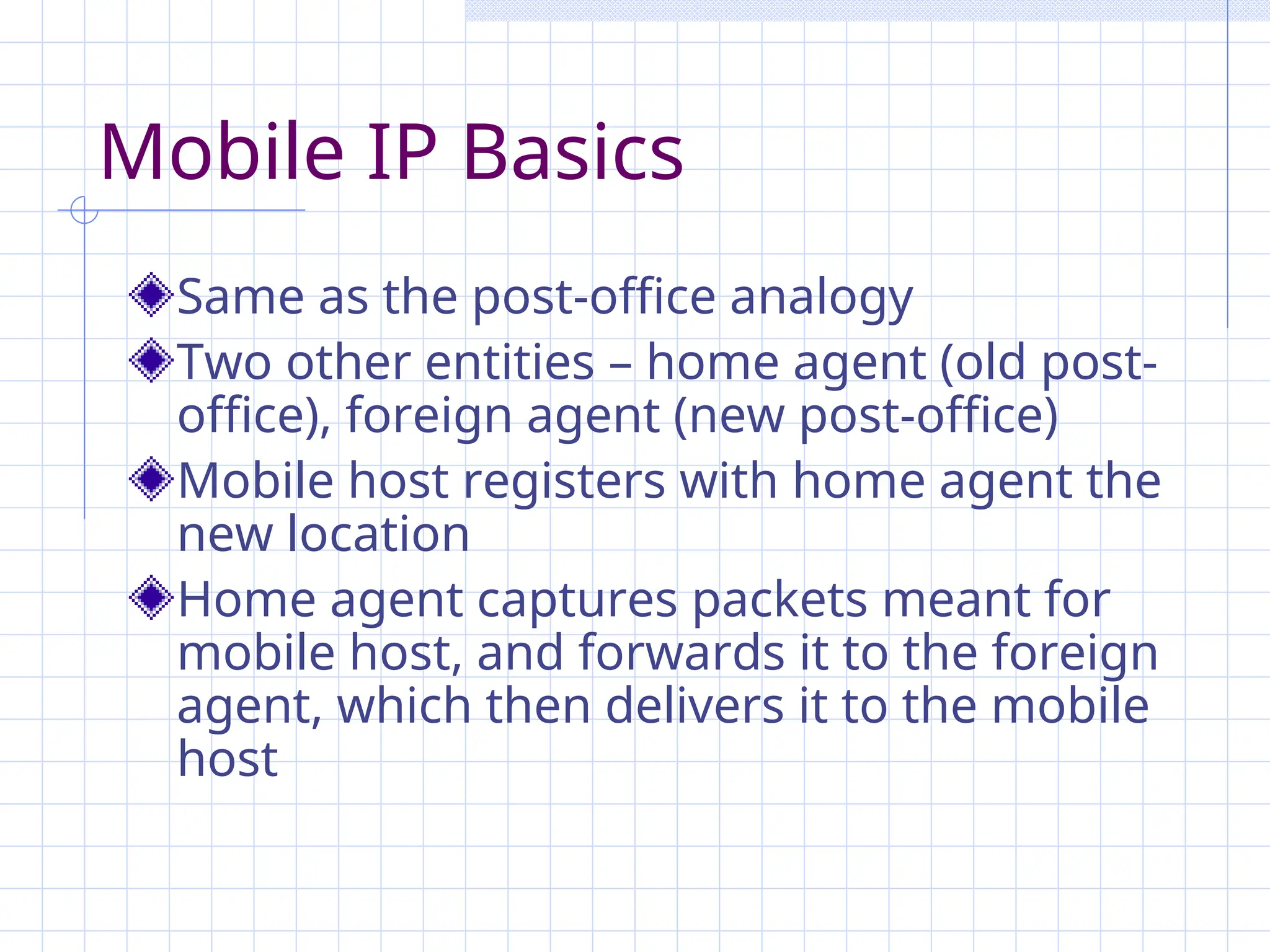
Mobile IP Basics
Same as the post-office analogy
Two other entities – home agent (old post-
office), foreign agent (new post-office)
Mobile host registers with home agent the
new location
Home agent captures packets meant for
mobile host, and forwards it to the foreign
agent, which then delivers it to the mobile
host
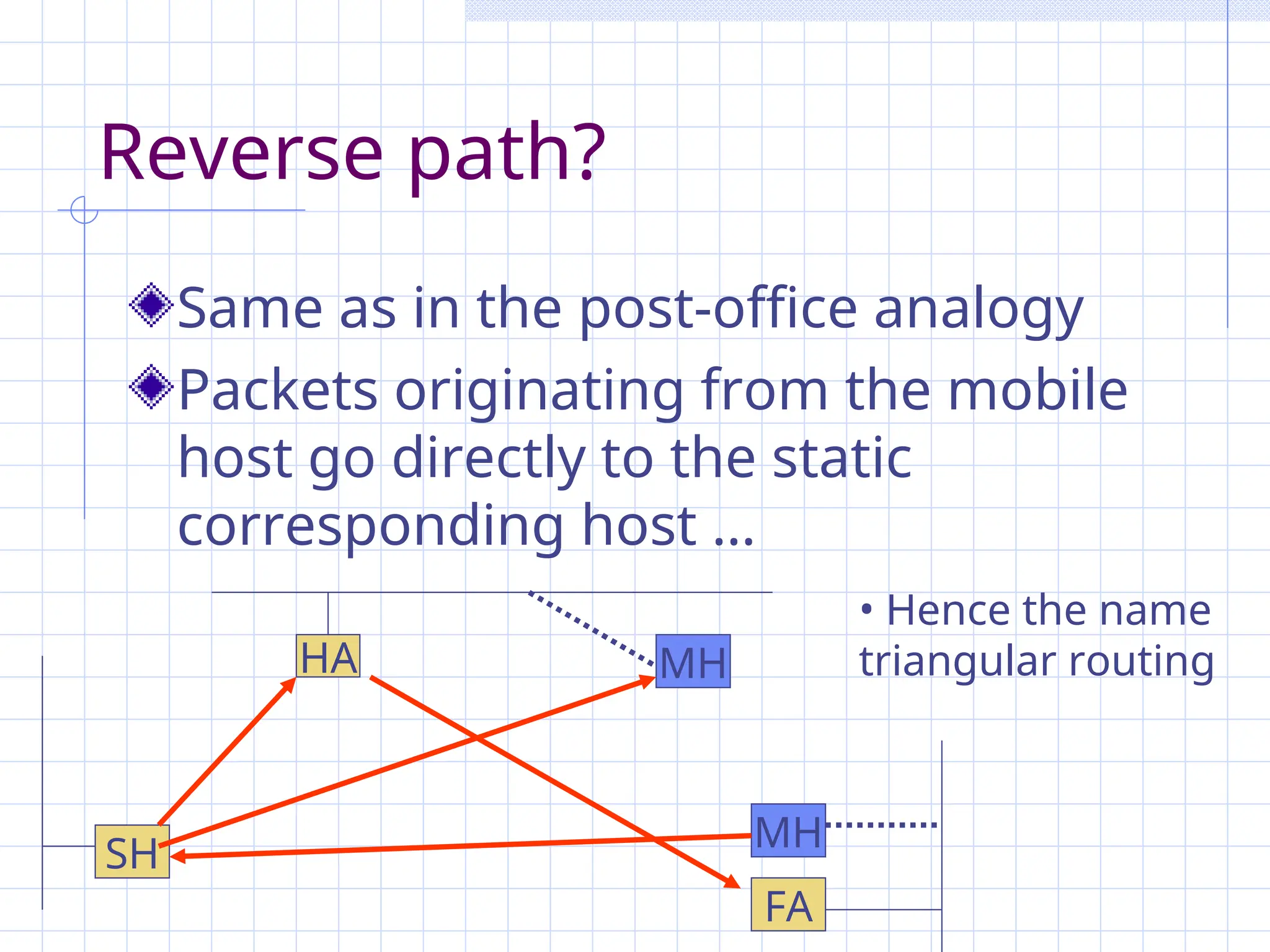
Reverse path?
Same as in the post-office analogy
Packets originating from the mobile
host go directly to the static
corresponding host …
HA
SH MH
FA
MH
• Hence the name
triangular routing
Mobile IP Entities
Mobile host
Corresponding host
Home address
Care-of address
Home agent
Foreign agent
Mobile IP in detail …
Combination of 3 separable
mechanisms:
 Discovering the care-of address
 Registering the care-of address
 Tunneling to the care-of address
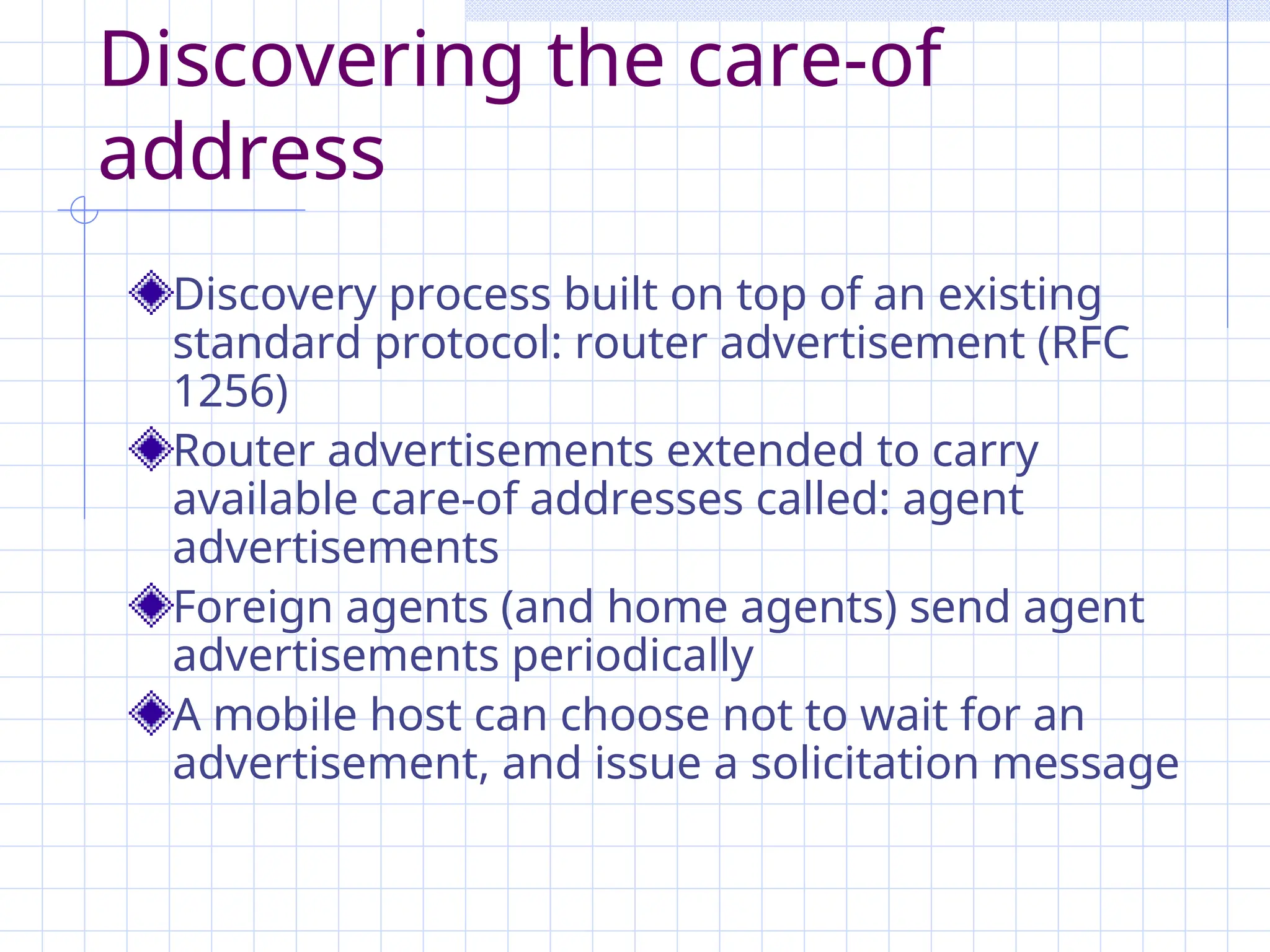
Discovering the care-of
address
Discovery process built on top of an existing
standard protocol: router advertisement (RFC
1256)
Router advertisements extended to carry
available care-of addresses called: agent
advertisements
Foreign agents (and home agents) send agent
advertisements periodically
A mobile host can choose not to wait for an
advertisement, and issue a solicitation message
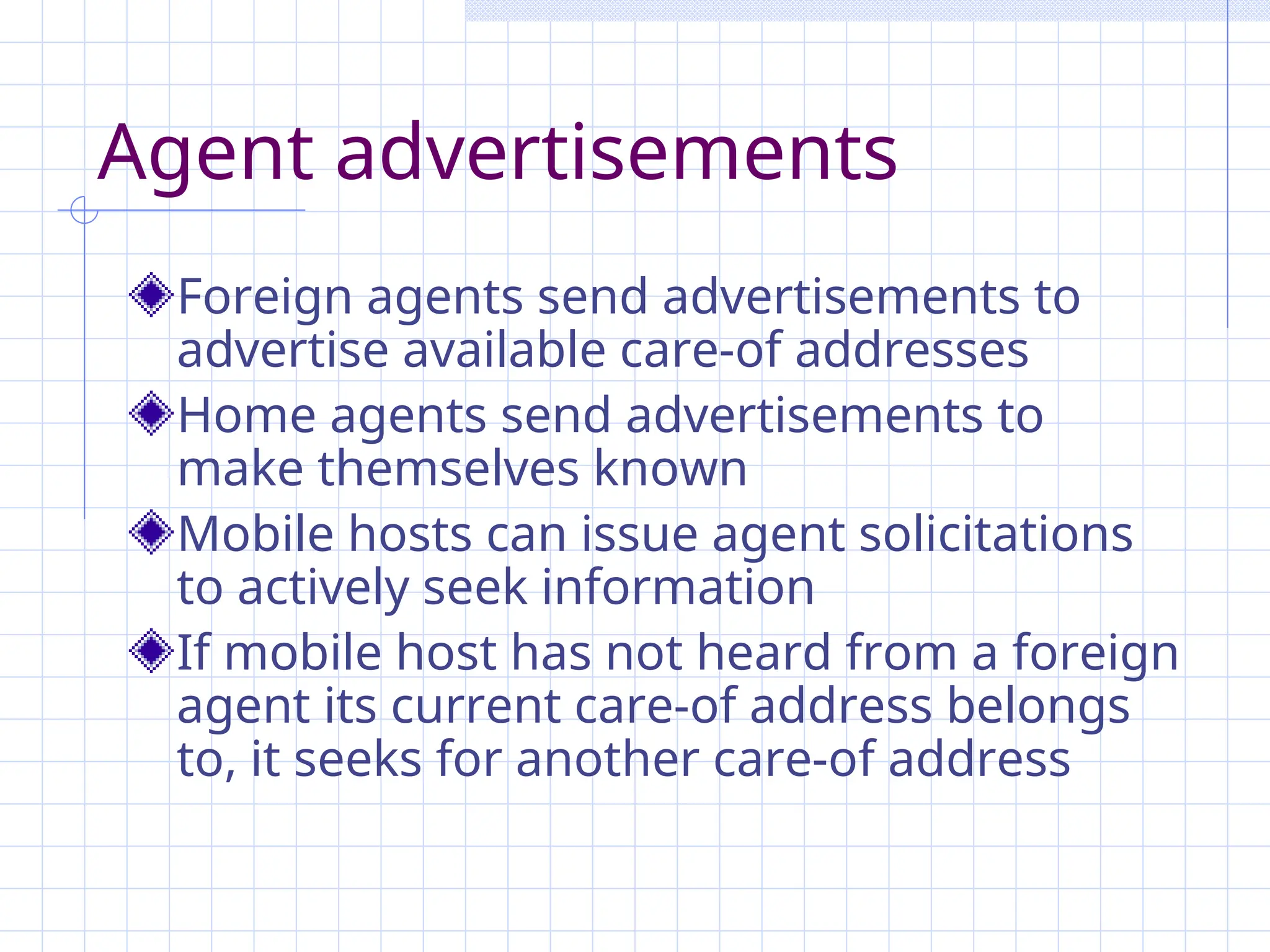
Agent advertisements
Foreign agents send advertisements to
advertise available care-of addresses
Home agents send advertisements to
make themselves known
Mobile hosts can issue agent solicitations
to actively seek information
If mobile host has not heard from a foreign
agent its current care-of address belongs
to, it seeks for another care-of address
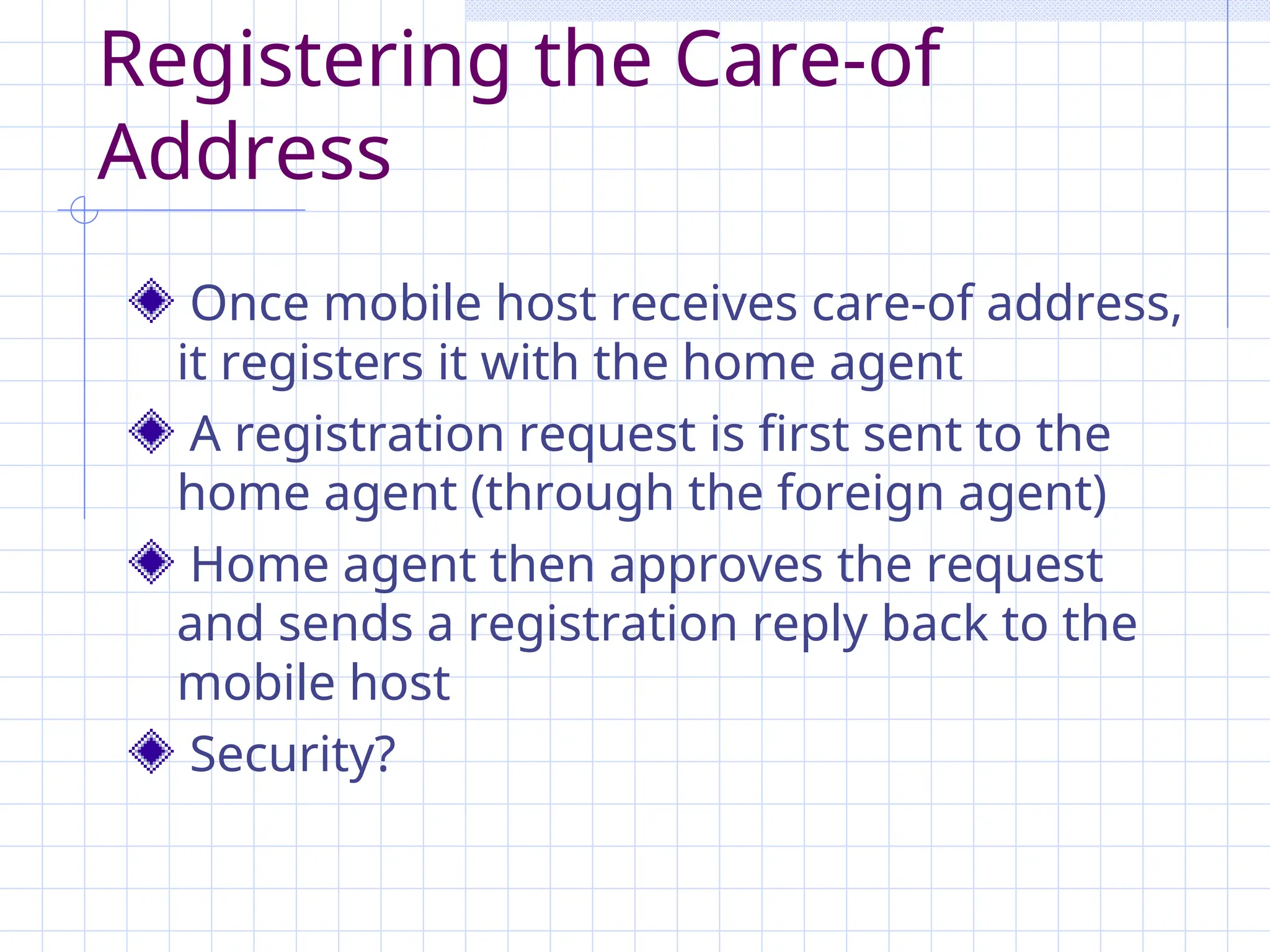
Registering the Care-of
Address
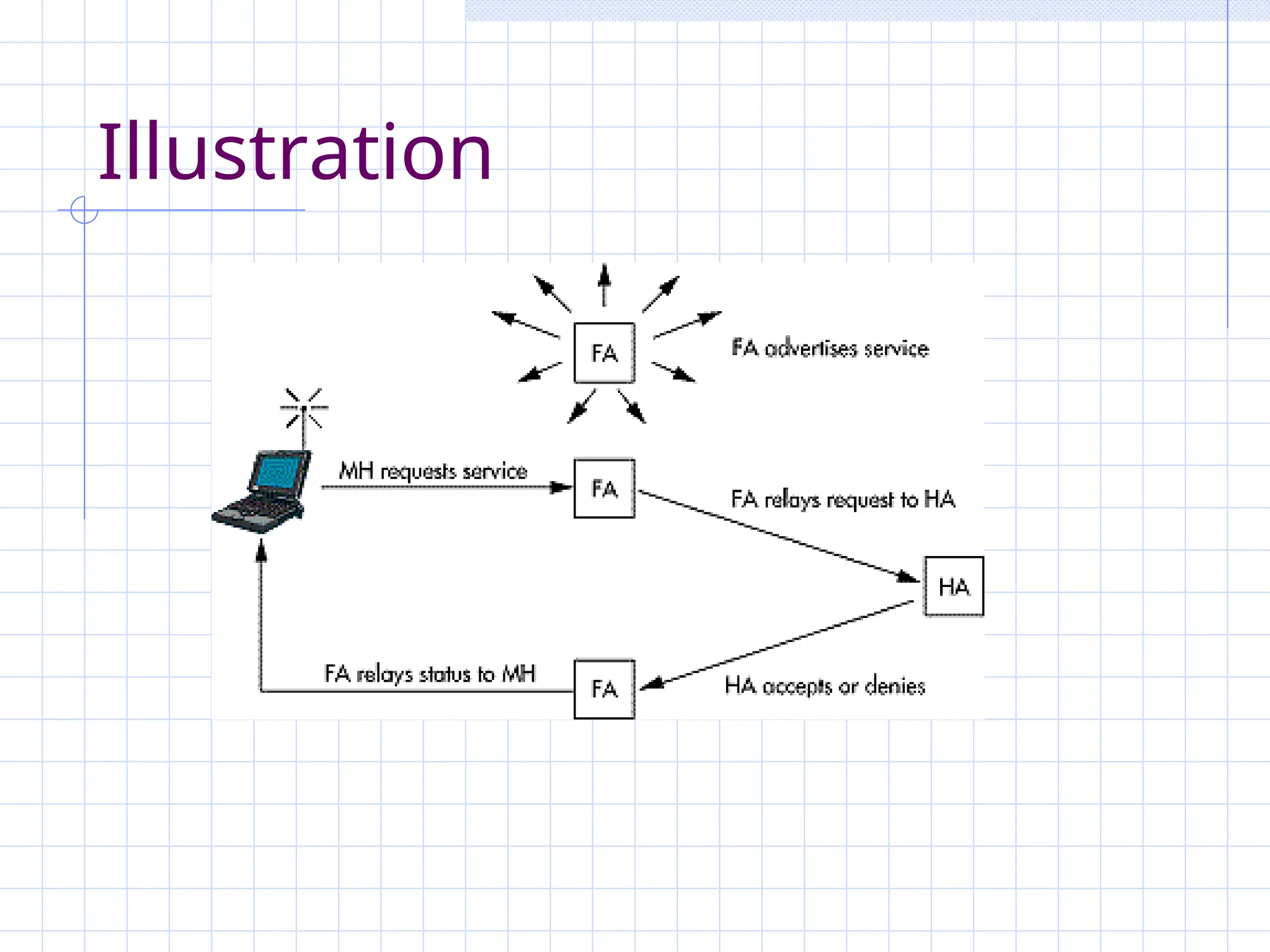
Once mobile host receives care-of address,
it registers it with the home agent
A registration request is first sent to the
home agent (through the foreign agent)
Home agent then approves the request
and sends a registration reply back to the
mobile host
Security?
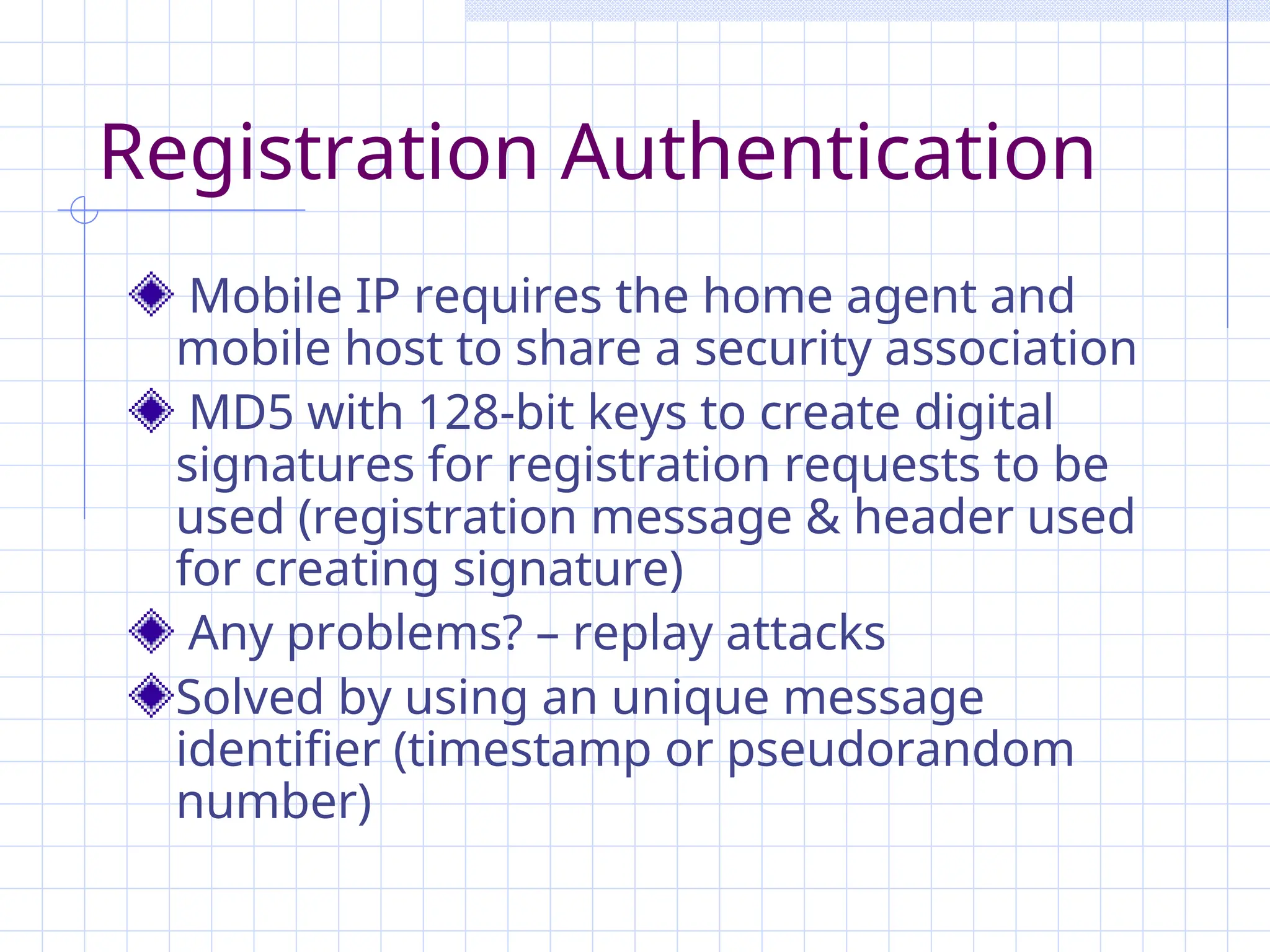
Registration Authentication
Mobile IP requires the home agent and
mobile host to share a security association
MD5 with 128-bit keys to create digital
signatures for registration requests to be
used (registration message & header used
for creating signature)
Any problems? – replay attacks
Solved by using an unique message
identifier (timestamp or pseudorandom
number)
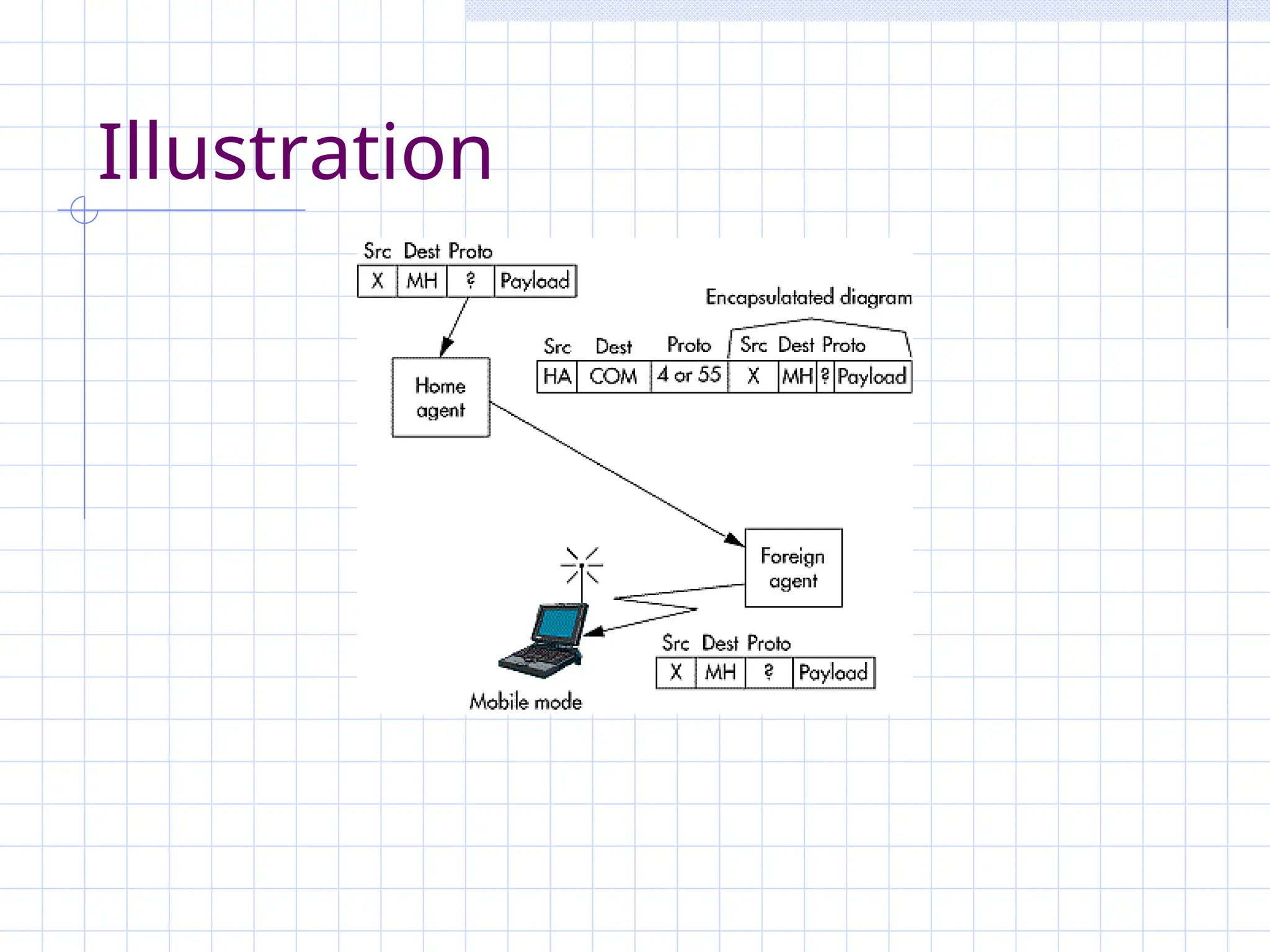
Illustration
Foreign Agent Security?
No foreign agent authentication
required
Foreign agent can potentially discard
data once registration happens
However, the problem is same as in
unauthenticated route advertisements
(RFC 1256) in the wireline context
Home agent discovery
If the mobile host is unable to
communicate with the home agent, a
home agent discovery message is used
The message is sent as a broadcast
to the home agents in the home
network
Tunneling to the Care-of
address
When home agent receives packets
addressed to mobile host, it forwards
packets to the care-of address
How does it forward it? - encapsulation
The default encapsulation mechanism that
must be supported by all mobility agents
using mobile IP is IP-within-IP (RFC 2003)
Using IP-within-IP, home agent inserts a
new IP header in front of the IP header of
any datagram
Tunneling (contd.)
Destination address set to the care-of
address
Source address set to the home agent’s
address
Tunnel header uses 4 for higher protocol
id – this ensures that IP after stripping out
the first header, processes the packet again
Tunnel header of 55 used if IP minimal
encapsulation used (RFC 2004)
Illustration
Recap
Host mobility and Internet addresses
Post-office analogy
Home agent, foreign agent, care-of
address, home address
Registration and Tunneling
IPv6 and Mobility support …
Mobile IP Basic Operation
Entities
 Mobile host, home agent, foreign agent,
corresponding host
Discovering Care-of Addresses
 Agent advertisements
Registering Care-of Address
 Security
Tunneling to Care-of Address
 IP-within-IP encapsulation
Mobile IP Problems?
Triangular routing overhead
 What is the worst case scenario?
Registration latency and associated
problems
Ingress filtering and consequences
Infrastructure required for mobile IP
support?
Firewalls
Mobile IP Optimizations
Route optimization
Smooth hand-offs
Route Optimizations
Enable direct notification of the
corresponding host
Direct tunneling from the
corresponding host to the mobile host
Binding cache maintained at
corresponding host
Management of cache not stipulated
(e.g. least used entry replacement)
Route optimizations (contd.)
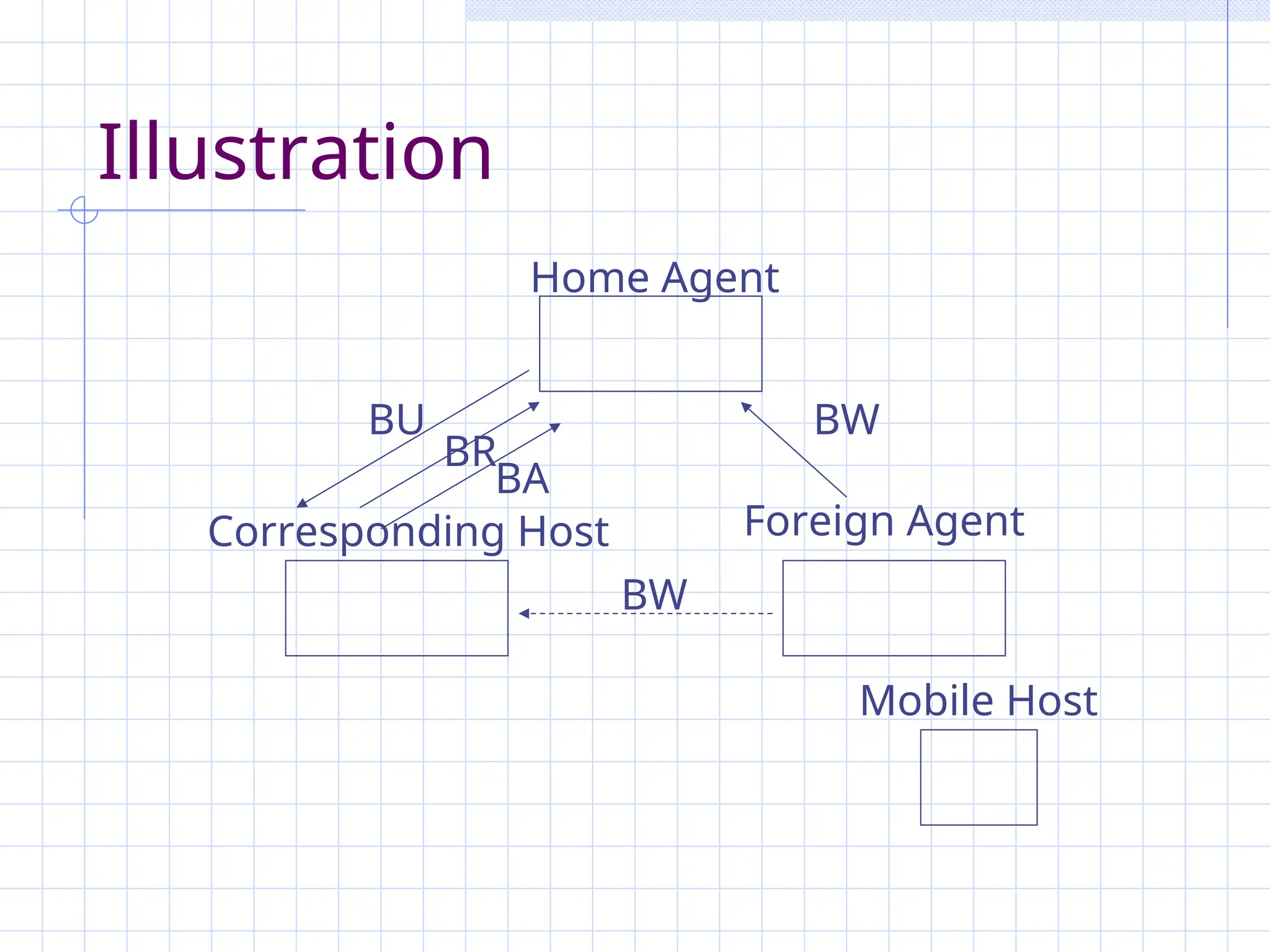
4 types of messages
 Binding update
 Binding request
 Binding warning
 Binding acknowledge
Binding Update
When a home agent receives a packet to
be tunneled to a mobile host, it sends a
binding update message to the
corresponding host
When a home agent receives a binding
request message, it replies with a binding
update message
Also used in the the smooth-handoffs
optimization
Binding Update (Contd.)
Corresponding host caches binding and
uses it for tunneling subsequent packets
Lifetime of binding?
Corresponding host that perceives a near-
expiry can choose to ask for a binding
confirmation using the binding request
message
Home agent can choose to ask for an
acknowledgement to which a corresponding
host has to reply with a binding ack message
Binding update (problem?)
What happens when a mobile host
moves?
Binding warning
When a foreign agent receives a tunneled
message, but sees no visitor entry for the
mobile host, it generates a binding warning
message to the appropriate home agent
When a home agent receives a warning, it
issues an update message to the
corresponding host
What if the foreign agent does not have
the home agent address (why?) ?
Illustration
Home Agent
Foreign Agent
Corresponding Host
Mobile Host
BU BW
BW
BR
BA
Smooth Hand-offs
When a mobile host moves from one
foreign agent to another …
Packets in flight to the old FA are lost
and are expected to be recovered
through higher layer protocols (e.g.
TCP)
How can these packets be saved?
Smooth Hand-offs
Make previous FA forward packets to the
new FA
Send binding updates to the old FA through
the new FA
Such forwarding will be done for a pre-
specified amount of time (registration
lifetime)
Update can also help old FA free any
reserved resources immediately
Why better?
Mobile IP in IPv6
Route optimization and smooth hand-offs
used in IPv6 mobility
Binding updates easier since IPv6
supports destination caches at sources
IPv6 security inherently stronger than in
IPv4. Hence, no explicit security
mechanisms needed for mobile IP
Source routing to be used instead of
encapsulation (why?)
Recap
Mobile IP problems
Mobile IP Optimizations
Mobility support in IPv6
Outline
Multicast-based architecture
Fast handoffs
MosquitoNet
End-to-end approach
Multicast-based Architecture
Very different from the mobile-IP
model
Based on the IP-multicast approach
Leverages the similarities in the two
problems (multicast and mobility)
Minor modifications to IP-multicast
required
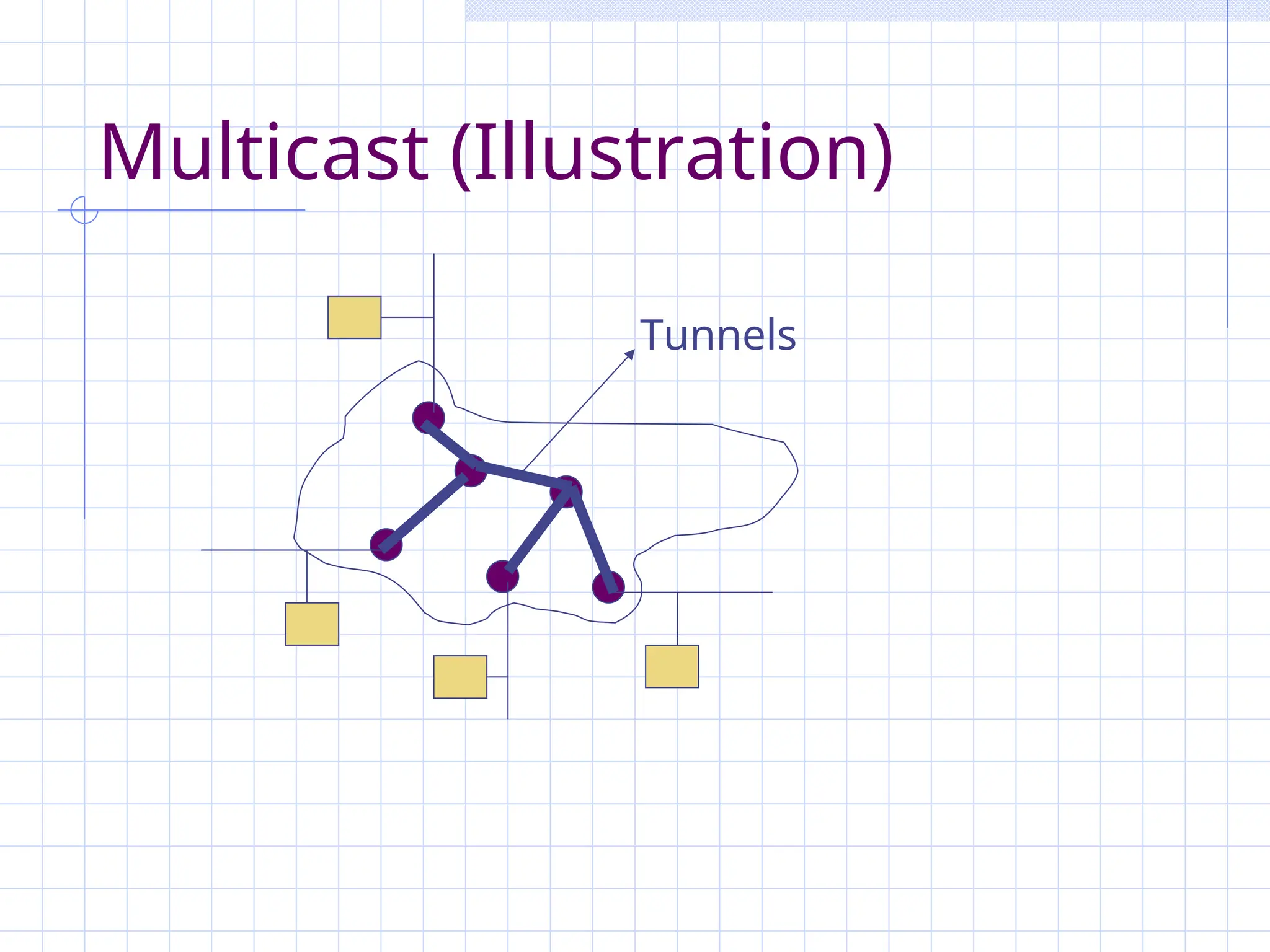
Multicast
Multicast: group membership, packets sent
to a multicast address have to be delivered to
all members of the group
Members of a multicast group can be located
“anywhere”
IP-multicast infrastructure is overlayed on the
Internet (construction of infrastructure a
separate problem by itself – DVMRP, CBT, etc.)
Forwarding of data happens on the overlayed
infrastructure, and routing is group specific
Multicast (Illustration)
Tunnels
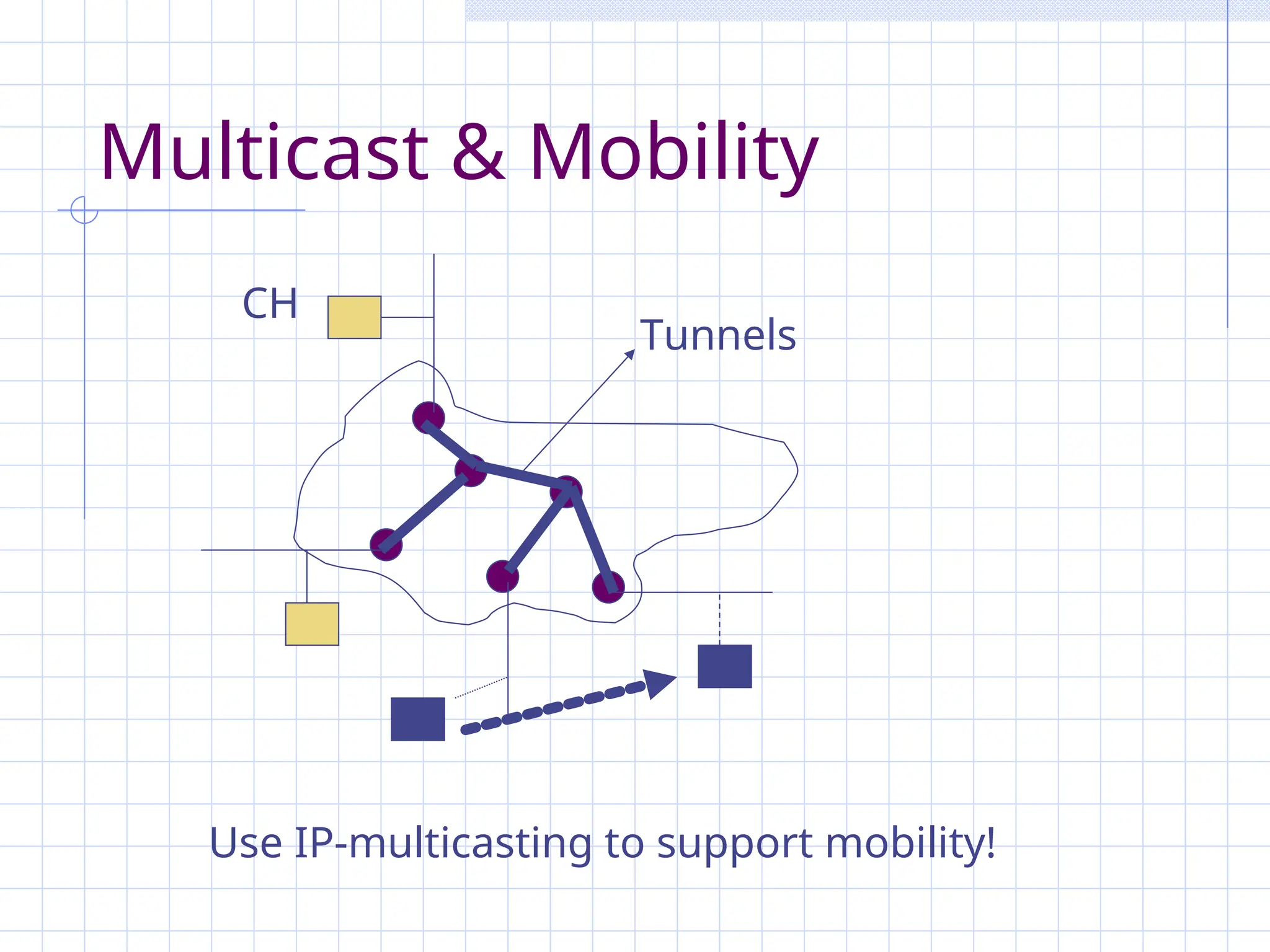
Multicast & Mobility
Tunnels
CH
Use IP-multicasting to support mobility!
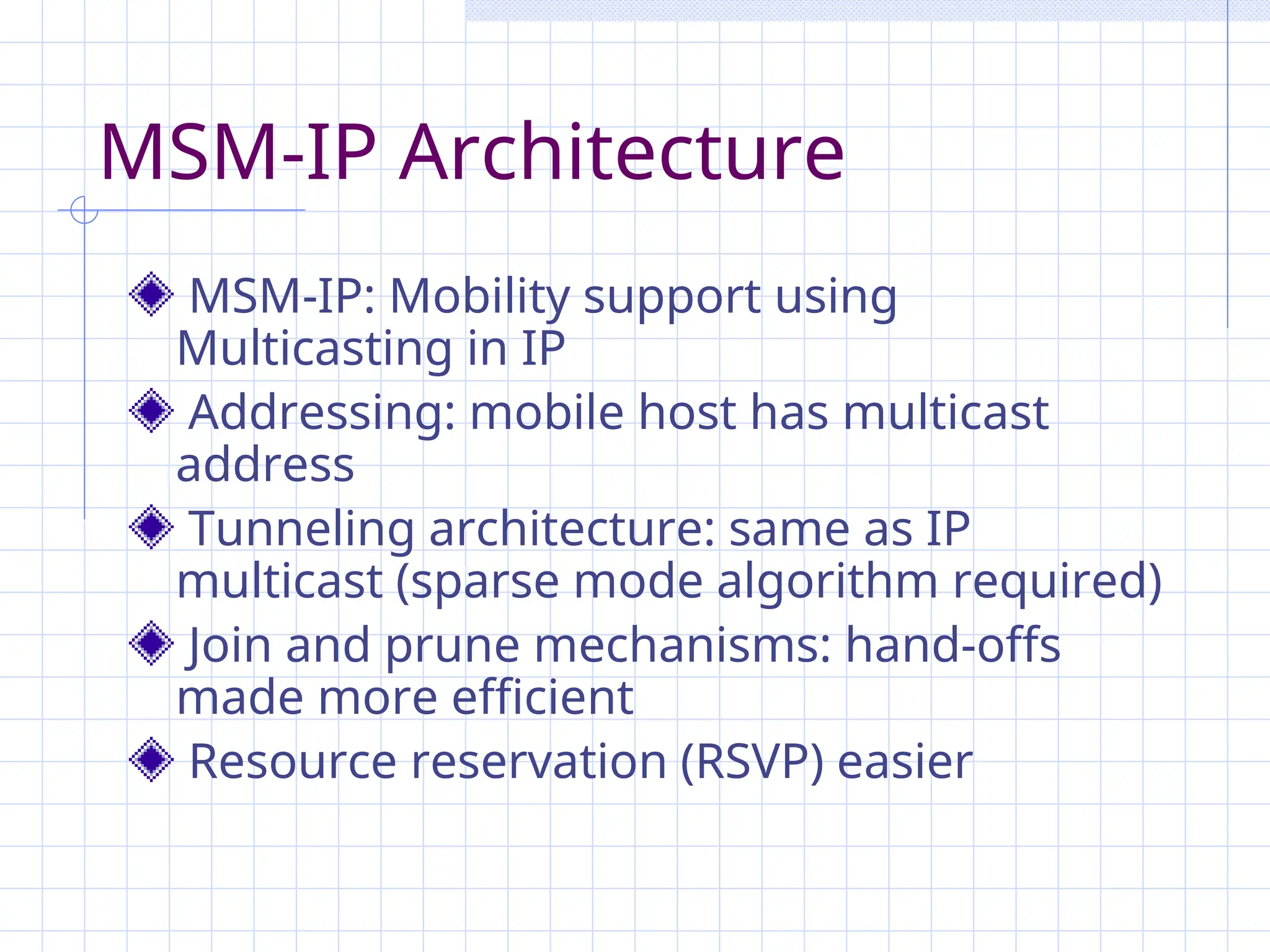
MSM-IP Architecture
MSM-IP: Mobility support using
Multicasting in IP
Addressing: mobile host has multicast
address
Tunneling architecture: same as IP
multicast (sparse mode algorithm required)
Join and prune mechanisms: hand-offs
made more efficient
Resource reservation (RSVP) easier
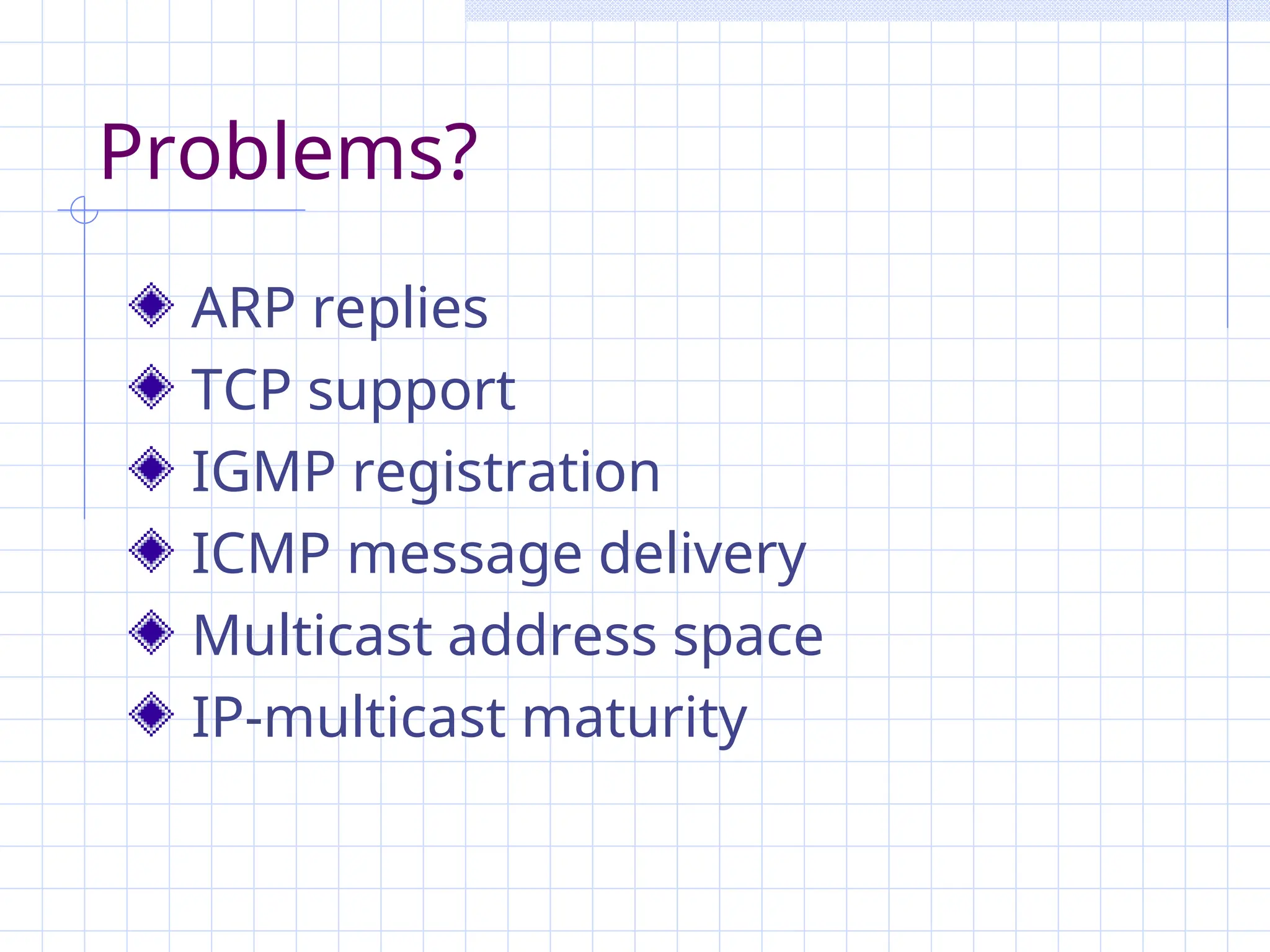
Problems?
ARP replies
TCP support
IGMP registration
ICMP message delivery
Multicast address space
IP-multicast maturity
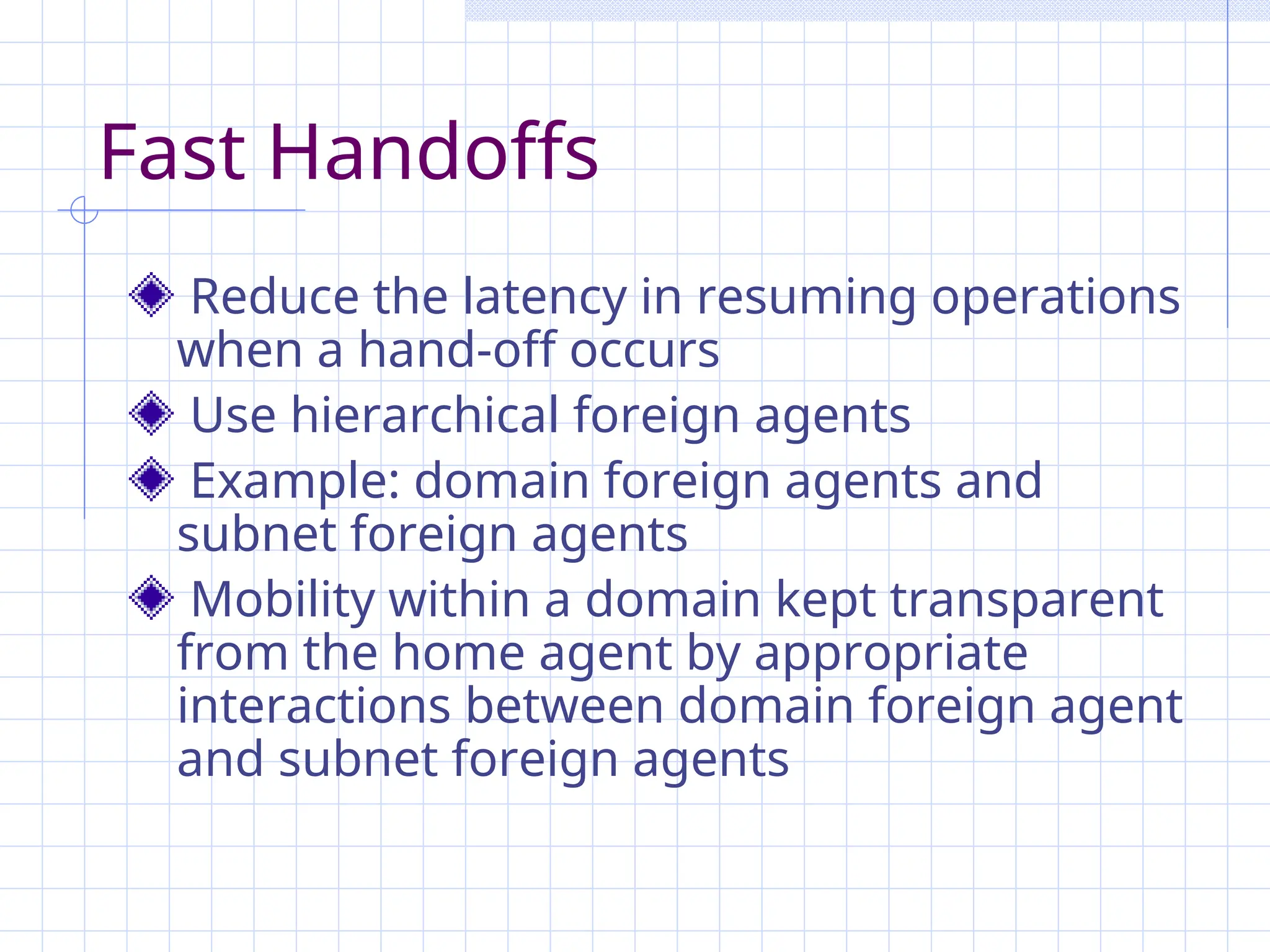
Fast Handoffs
Reduce the latency in resuming operations
when a hand-off occurs
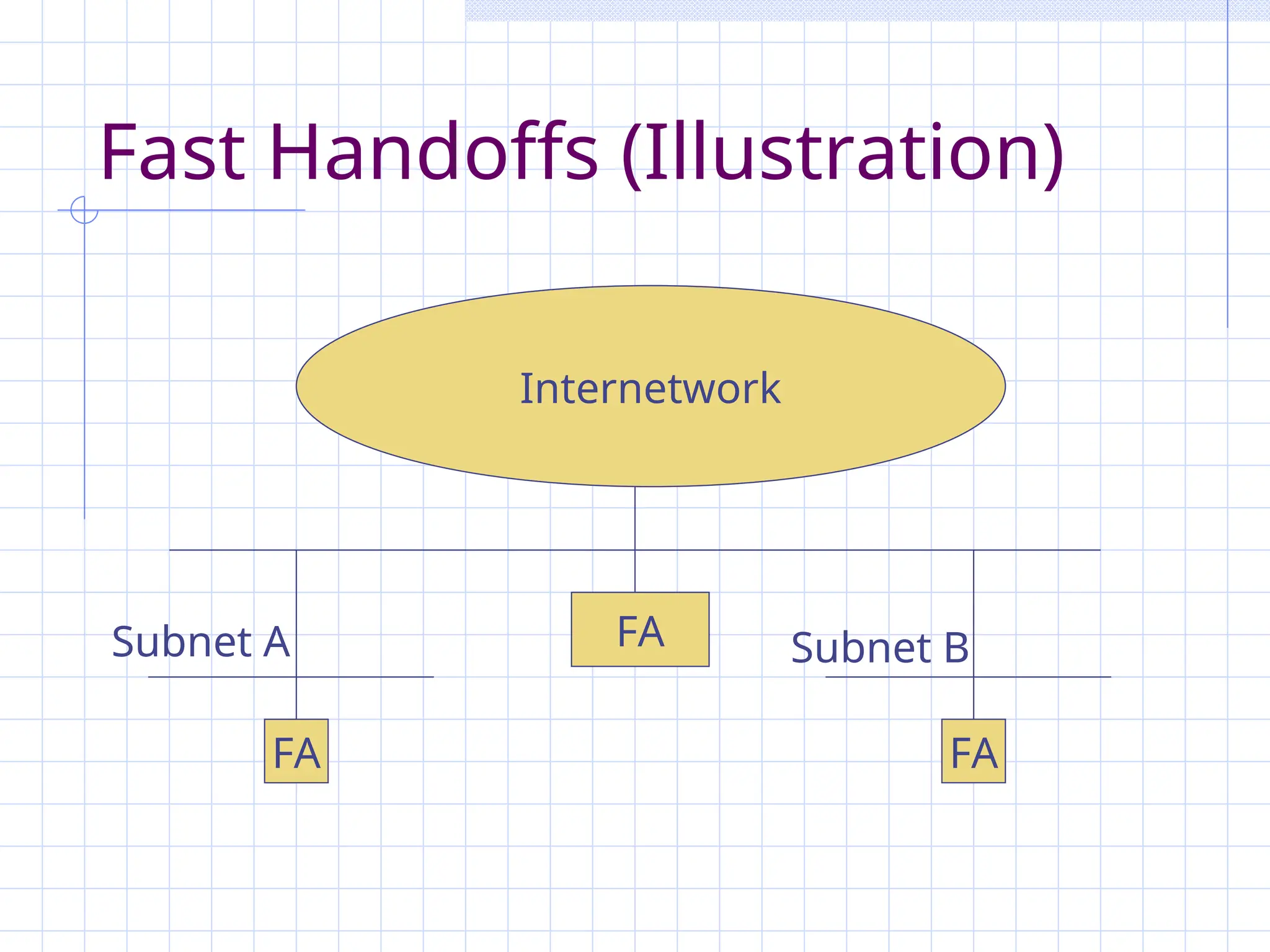
Use hierarchical foreign agents
Example: domain foreign agents and
subnet foreign agents
Mobility within a domain kept transparent
from the home agent by appropriate
interactions between domain foreign agent
and subnet foreign agents
Fast Handoffs (Illustration)
Internetwork
FA
FA
Subnet A Subnet B
FA
MosquitoNet
One of the first test-bed
implementations of Mobile IP
Introduced the notion of co-located
foreign agents
Improves deployability of the mobile-
IP approach to support host mobility
Trade-offs?
End-to-End Approach
Internet infrastructure does not
change (like in mobile IP)
Changes required at both the sender
and receiver
Does connection migration when
mobile-host moves
E2E Approach (Contd.)
Hostname used as the invariant to identify
mobile host
Mobile host uses DNS updates to change
hostname to IP address mapping
No consistency problem as DNS entries
can be made un-cacheable
If client is mobile, DNS-support not used
E2E Approach (Contd.)
When a mobile-host undergoes a handoff, it
re-issues a SYN (with a MIGRATE option
identifying the previous connection)
A unique token exchanged during initial
connection set-up used to identify connection
The receiver of the SYN changes its state to
represent the new address of the mobile-host
Connection proceeds as a regular TCP
connection from thereon
Trade-offs?
Puzzle
Power drill
Power drill that drills square holes?!
What would the cross-section of the
power drill look like?

mobileIP2 mobile IP wireless mobile newtork microproject 6th sem.ppt

  • 1.
  • 2.
    Outline What is theproblem at the routing layer when Internet hosts move?! Can the problem be solved? What is the standard solution? – mobile IP What are the problems with the solution? Other approaches?
  • 3.
    Internet hosts &Mobility Wireless networking – allows Internet users to become mobile As users move, they have to be handed over from one coverage area to another (since the coverage areas of access points are finite) … Ongoing connections need to be maintained as the user moves …
  • 4.
    Problems? What are theproblems? The IP address associated with a mobile host is network dependent! When user connects to another network, IP address needs to change Packets belonging to ongoing connections somehow need to be delivered to the mobile host
  • 5.
    Problems (Contd.)? What arethe options? Make IP address host specific instead of network specific – obvious pitfalls? Change IP address of host and start using the new IP address in the subsequent packets belonging to the connections
  • 6.
    Intuitive Solution Take upthe analogy of you moving from one apartment to another What do you do? Leave a forwarding address with your old post-office! The old post-office forwards mails to your new post-office, which then forwards them to you
  • 7.
    Mobile IP Basics Sameas the post-office analogy Two other entities – home agent (old post- office), foreign agent (new post-office) Mobile host registers with home agent the new location Home agent captures packets meant for mobile host, and forwards it to the foreign agent, which then delivers it to the mobile host
  • 8.
    Reverse path? Same asin the post-office analogy Packets originating from the mobile host go directly to the static corresponding host … HA SH MH FA MH • Hence the name triangular routing
  • 9.
    Mobile IP Entities Mobilehost Corresponding host Home address Care-of address Home agent Foreign agent
  • 10.
    Mobile IP indetail … Combination of 3 separable mechanisms:  Discovering the care-of address  Registering the care-of address  Tunneling to the care-of address
  • 11.
    Discovering the care-of address Discoveryprocess built on top of an existing standard protocol: router advertisement (RFC 1256) Router advertisements extended to carry available care-of addresses called: agent advertisements Foreign agents (and home agents) send agent advertisements periodically A mobile host can choose not to wait for an advertisement, and issue a solicitation message
  • 12.
    Agent advertisements Foreign agentssend advertisements to advertise available care-of addresses Home agents send advertisements to make themselves known Mobile hosts can issue agent solicitations to actively seek information If mobile host has not heard from a foreign agent its current care-of address belongs to, it seeks for another care-of address
  • 13.
    Registering the Care-of Address Oncemobile host receives care-of address, it registers it with the home agent A registration request is first sent to the home agent (through the foreign agent) Home agent then approves the request and sends a registration reply back to the mobile host Security?
  • 14.
    Registration Authentication Mobile IPrequires the home agent and mobile host to share a security association MD5 with 128-bit keys to create digital signatures for registration requests to be used (registration message & header used for creating signature) Any problems? – replay attacks Solved by using an unique message identifier (timestamp or pseudorandom number)
  • 15.
  • 16.
    Foreign Agent Security? Noforeign agent authentication required Foreign agent can potentially discard data once registration happens However, the problem is same as in unauthenticated route advertisements (RFC 1256) in the wireline context
  • 17.
    Home agent discovery Ifthe mobile host is unable to communicate with the home agent, a home agent discovery message is used The message is sent as a broadcast to the home agents in the home network
  • 18.
    Tunneling to theCare-of address When home agent receives packets addressed to mobile host, it forwards packets to the care-of address How does it forward it? - encapsulation The default encapsulation mechanism that must be supported by all mobility agents using mobile IP is IP-within-IP (RFC 2003) Using IP-within-IP, home agent inserts a new IP header in front of the IP header of any datagram
  • 19.
    Tunneling (contd.) Destination addressset to the care-of address Source address set to the home agent’s address Tunnel header uses 4 for higher protocol id – this ensures that IP after stripping out the first header, processes the packet again Tunnel header of 55 used if IP minimal encapsulation used (RFC 2004)
  • 20.
  • 21.
    Recap Host mobility andInternet addresses Post-office analogy Home agent, foreign agent, care-of address, home address Registration and Tunneling IPv6 and Mobility support …
  • 22.
    Mobile IP BasicOperation Entities  Mobile host, home agent, foreign agent, corresponding host Discovering Care-of Addresses  Agent advertisements Registering Care-of Address  Security Tunneling to Care-of Address  IP-within-IP encapsulation
  • 23.
    Mobile IP Problems? Triangularrouting overhead  What is the worst case scenario? Registration latency and associated problems Ingress filtering and consequences Infrastructure required for mobile IP support? Firewalls
  • 24.
    Mobile IP Optimizations Routeoptimization Smooth hand-offs
  • 25.
    Route Optimizations Enable directnotification of the corresponding host Direct tunneling from the corresponding host to the mobile host Binding cache maintained at corresponding host Management of cache not stipulated (e.g. least used entry replacement)
  • 26.
    Route optimizations (contd.) 4types of messages  Binding update  Binding request  Binding warning  Binding acknowledge
  • 27.
    Binding Update When ahome agent receives a packet to be tunneled to a mobile host, it sends a binding update message to the corresponding host When a home agent receives a binding request message, it replies with a binding update message Also used in the the smooth-handoffs optimization
  • 28.
    Binding Update (Contd.) Correspondinghost caches binding and uses it for tunneling subsequent packets Lifetime of binding? Corresponding host that perceives a near- expiry can choose to ask for a binding confirmation using the binding request message Home agent can choose to ask for an acknowledgement to which a corresponding host has to reply with a binding ack message
  • 29.
    Binding update (problem?) Whathappens when a mobile host moves?
  • 30.
    Binding warning When aforeign agent receives a tunneled message, but sees no visitor entry for the mobile host, it generates a binding warning message to the appropriate home agent When a home agent receives a warning, it issues an update message to the corresponding host What if the foreign agent does not have the home agent address (why?) ?
  • 31.
  • 32.
    Smooth Hand-offs When amobile host moves from one foreign agent to another … Packets in flight to the old FA are lost and are expected to be recovered through higher layer protocols (e.g. TCP) How can these packets be saved?
  • 33.
    Smooth Hand-offs Make previousFA forward packets to the new FA Send binding updates to the old FA through the new FA Such forwarding will be done for a pre- specified amount of time (registration lifetime) Update can also help old FA free any reserved resources immediately Why better?
  • 34.
    Mobile IP inIPv6 Route optimization and smooth hand-offs used in IPv6 mobility Binding updates easier since IPv6 supports destination caches at sources IPv6 security inherently stronger than in IPv4. Hence, no explicit security mechanisms needed for mobile IP Source routing to be used instead of encapsulation (why?)
  • 35.
    Recap Mobile IP problems MobileIP Optimizations Mobility support in IPv6
  • 36.
  • 37.
    Multicast-based Architecture Very differentfrom the mobile-IP model Based on the IP-multicast approach Leverages the similarities in the two problems (multicast and mobility) Minor modifications to IP-multicast required
  • 38.
    Multicast Multicast: group membership,packets sent to a multicast address have to be delivered to all members of the group Members of a multicast group can be located “anywhere” IP-multicast infrastructure is overlayed on the Internet (construction of infrastructure a separate problem by itself – DVMRP, CBT, etc.) Forwarding of data happens on the overlayed infrastructure, and routing is group specific
  • 39.
  • 40.
    Multicast & Mobility Tunnels CH UseIP-multicasting to support mobility!
  • 41.
    MSM-IP Architecture MSM-IP: Mobilitysupport using Multicasting in IP Addressing: mobile host has multicast address Tunneling architecture: same as IP multicast (sparse mode algorithm required) Join and prune mechanisms: hand-offs made more efficient Resource reservation (RSVP) easier
  • 42.
    Problems? ARP replies TCP support IGMPregistration ICMP message delivery Multicast address space IP-multicast maturity
  • 43.
    Fast Handoffs Reduce thelatency in resuming operations when a hand-off occurs Use hierarchical foreign agents Example: domain foreign agents and subnet foreign agents Mobility within a domain kept transparent from the home agent by appropriate interactions between domain foreign agent and subnet foreign agents
  • 44.
  • 45.
    MosquitoNet One of thefirst test-bed implementations of Mobile IP Introduced the notion of co-located foreign agents Improves deployability of the mobile- IP approach to support host mobility Trade-offs?
  • 46.
    End-to-End Approach Internet infrastructuredoes not change (like in mobile IP) Changes required at both the sender and receiver Does connection migration when mobile-host moves
  • 47.
    E2E Approach (Contd.) Hostnameused as the invariant to identify mobile host Mobile host uses DNS updates to change hostname to IP address mapping No consistency problem as DNS entries can be made un-cacheable If client is mobile, DNS-support not used
  • 48.
    E2E Approach (Contd.) Whena mobile-host undergoes a handoff, it re-issues a SYN (with a MIGRATE option identifying the previous connection) A unique token exchanged during initial connection set-up used to identify connection The receiver of the SYN changes its state to represent the new address of the mobile-host Connection proceeds as a regular TCP connection from thereon Trade-offs?
  • 49.
    Puzzle Power drill Power drillthat drills square holes?! What would the cross-section of the power drill look like?