By,
Xavier Prathap W, III BSc
St. Claret College.
• Now-a-days to lead our life we had to run with our fast materialistic
  world.

• To express our thoughts, we communicate with different people in
  different languages and in different ways.

• But, it is extremely difficult for the dumb, blind and people who are
  affected by paralysis to express their ideas in speech or text.

• Hence, there is a need to develop a platform for those people who
  are physically challenged.

• Hence, Vibration Sensors and Silent Speech Interfaces are developed
  that can be either fixed on the hands or face.
Such an Electronic device shall help,

• paralysis affected people to communicate by wearing a glove made up
  of flex sensors that can convey their ideas.

• dumb people by pressing the keypad in the device to express their
  basic needs with the text-to-speech IC.

• When the blind people speak, speech-to-text module converts it and
  viewed in a display.

• No need for “Human Interpreter” for blind people, to write.
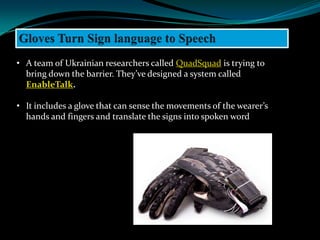
• A team of Ukrainian researchers called QuadSquad is trying to
  bring down the barrier. They’ve designed a system called
  EnableTalk.

• It includes a glove that can sense the movements of the wearer’s
  hands and fingers and translate the signs into spoken word
• Each glove is lined with more than a dozen flex .

• Built-in accelerometers can tell when the hand gestures, and in
  which direction.

• On the back of the hand lies a controller, the heart of the system
  that analyzes all these incoming signals and transmits them via
  Bluetooth to a mobile device.

• A lithium-ion battery charged via USB powers the device.

• Finally a software translates the signals into an audio signal, and
  spoken words emerge.
Flex sensors
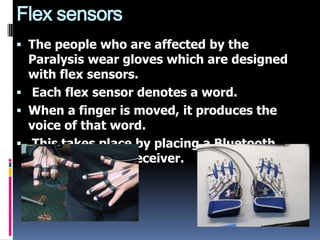
 The people who are affected by the
  Paralysis wear gloves which are designed
  with flex sensors.
 Each flex sensor denotes a word.
 When a finger is moved, it produces the
  voice of that word.
 This takes place by placing a Bluetooth
  transmitter and receiver.
Flex sensors
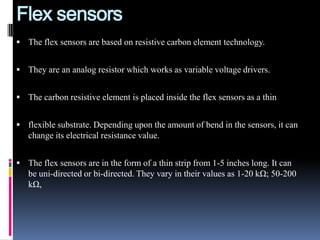
 The flex sensors are based on resistive carbon element technology.


 They are an analog resistor which works as variable voltage drivers.


 The carbon resistive element is placed inside the flex sensors as a thin


 flexible substrate. Depending upon the amount of bend in the sensors, it can
   change its electrical resistance value.


 The flex sensors are in the form of a thin strip from 1-5 inches long. It can
   be uni-directed or bi-directed. They vary in their values as 1-20 kΩ; 50-200
   kΩ,
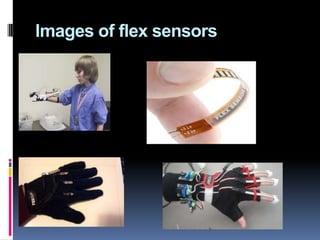
Images of flex sensors
1.   Inner speech: mental simulation of speech.

2.   Subvocal invisible speech : when a person silently reads or recites
     to him/herself, ensors under a person’s chin.

3.   Subvocal visible speech : one wanted to be seen but not
     heard, ultrasound motion of the tongue Movement captured.

4.   Non-audible murmur (NAM): softly whispered, subvocal
     invisible speech with air emission.

5.   Whispered speech: similar to NAM but heard more clearly.
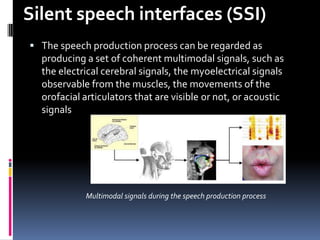
Silent speech interfaces (SSI)
 The speech production process can be regarded as
  producing a set of coherent multimodal signals, such as
  the electrical cerebral signals, the myoelectrical signals
  observable from the muscles, the movements of the
  orofacial articulators that are visible or not, or acoustic
  signals


            Multimodal signals during the speech production process
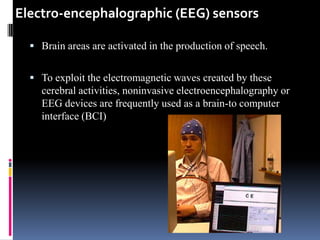
Electro-encephalographic (EEG) sensors

   Brain areas are activated in the production of speech.


   To exploit the electromagnetic waves created by these
    cerebral activities, noninvasive electroencephalography or
    EEG devices are frequently used as a brain-to computer
    interface (BCI)
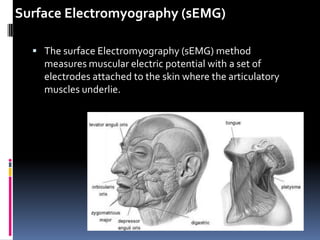
Surface Electromyography (sEMG)

   The surface Electromyography (sEMG) method
    measures muscular electric potential with a set of
    electrodes attached to the skin where the articulatory
    muscles underlie.
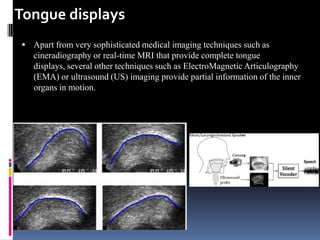
Tongue displays
 Apart from very sophisticated medical imaging techniques such as
   cineradiography or real-time MRI that provide complete tongue
   displays, several other techniques such as ElectroMagnetic Articulography
   (EMA) or ultrasound (US) imaging provide partial information of the inner
   organs in motion.
 This device is a boon for the dumb
  people, physically handicapped people
  and for the blind people.
 This single device resolves the
  maximum problems faced by those
  people. Any one of those people can
  use this device and they can reveal
  their basic thoughts with other people.
 By using this device, the people with
  disabilities can lead their life in an
  enjoyable way as all other people in the
 PHd Thesis , By Viet Anh Tran.


 http://www.smartplanet.com/blog/rethinking-
   healthcare/gloves-turn-sign-language-into-speech/9489


 http://scialert.net/abstract/index.php?doi=jai.2013.75.81


 Poster presented in Fifth Science
   Conclave, IIIT, Allahabad.
By,
Xavier Prathap W, III BSc
St. Claret College.

Enable talk

  • 1.
    By, Xavier Prathap W,III BSc St. Claret College.
  • 2.
    • Now-a-days tolead our life we had to run with our fast materialistic world. • To express our thoughts, we communicate with different people in different languages and in different ways. • But, it is extremely difficult for the dumb, blind and people who are affected by paralysis to express their ideas in speech or text. • Hence, there is a need to develop a platform for those people who are physically challenged. • Hence, Vibration Sensors and Silent Speech Interfaces are developed that can be either fixed on the hands or face.
  • 3.
    Such an Electronicdevice shall help, • paralysis affected people to communicate by wearing a glove made up of flex sensors that can convey their ideas. • dumb people by pressing the keypad in the device to express their basic needs with the text-to-speech IC. • When the blind people speak, speech-to-text module converts it and viewed in a display. • No need for “Human Interpreter” for blind people, to write.
  • 4.
    • A teamof Ukrainian researchers called QuadSquad is trying to bring down the barrier. They’ve designed a system called EnableTalk. • It includes a glove that can sense the movements of the wearer’s hands and fingers and translate the signs into spoken word
  • 5.
    • Each gloveis lined with more than a dozen flex . • Built-in accelerometers can tell when the hand gestures, and in which direction. • On the back of the hand lies a controller, the heart of the system that analyzes all these incoming signals and transmits them via Bluetooth to a mobile device. • A lithium-ion battery charged via USB powers the device. • Finally a software translates the signals into an audio signal, and spoken words emerge.
  • 6.
    Flex sensors  Thepeople who are affected by the Paralysis wear gloves which are designed with flex sensors.  Each flex sensor denotes a word.  When a finger is moved, it produces the voice of that word.  This takes place by placing a Bluetooth transmitter and receiver.
  • 7.
    Flex sensors  Theflex sensors are based on resistive carbon element technology.  They are an analog resistor which works as variable voltage drivers.  The carbon resistive element is placed inside the flex sensors as a thin  flexible substrate. Depending upon the amount of bend in the sensors, it can change its electrical resistance value.  The flex sensors are in the form of a thin strip from 1-5 inches long. It can be uni-directed or bi-directed. They vary in their values as 1-20 kΩ; 50-200 kΩ,
  • 8.
  • 9.
    1. Inner speech: mental simulation of speech. 2. Subvocal invisible speech : when a person silently reads or recites to him/herself, ensors under a person’s chin. 3. Subvocal visible speech : one wanted to be seen but not heard, ultrasound motion of the tongue Movement captured. 4. Non-audible murmur (NAM): softly whispered, subvocal invisible speech with air emission. 5. Whispered speech: similar to NAM but heard more clearly.
  • 10.
    Silent speech interfaces(SSI)  The speech production process can be regarded as producing a set of coherent multimodal signals, such as the electrical cerebral signals, the myoelectrical signals observable from the muscles, the movements of the orofacial articulators that are visible or not, or acoustic signals Multimodal signals during the speech production process
  • 11.
    Electro-encephalographic (EEG) sensors  Brain areas are activated in the production of speech.  To exploit the electromagnetic waves created by these cerebral activities, noninvasive electroencephalography or EEG devices are frequently used as a brain-to computer interface (BCI)
  • 12.
    Surface Electromyography (sEMG)  The surface Electromyography (sEMG) method measures muscular electric potential with a set of electrodes attached to the skin where the articulatory muscles underlie.
  • 13.
    Tongue displays  Apartfrom very sophisticated medical imaging techniques such as cineradiography or real-time MRI that provide complete tongue displays, several other techniques such as ElectroMagnetic Articulography (EMA) or ultrasound (US) imaging provide partial information of the inner organs in motion.
  • 14.
     This deviceis a boon for the dumb people, physically handicapped people and for the blind people.  This single device resolves the maximum problems faced by those people. Any one of those people can use this device and they can reveal their basic thoughts with other people.  By using this device, the people with disabilities can lead their life in an enjoyable way as all other people in the
  • 15.
     PHd Thesis, By Viet Anh Tran.  http://www.smartplanet.com/blog/rethinking- healthcare/gloves-turn-sign-language-into-speech/9489  http://scialert.net/abstract/index.php?doi=jai.2013.75.81  Poster presented in Fifth Science Conclave, IIIT, Allahabad.
  • 16.
    By, Xavier Prathap W,III BSc St. Claret College.