Public 
Semih Dogan 
Kocaeli University 
06.11.2014 
Temperature Sensors
Public 
Semih Dogan 
Kocaeli University 
06.11.2014 
Introduction to Temp. 
Sensors
Public, Temperature Sensors, 3 Introduction to Temp. Sensors 
Semih Dogan, Kocaeli University, 06.11.2014 
What is Temp. Sensors? 
– Temperature Sensors are devices that can sense the difference amount of heat 
between application space and reference. 
– They are used to measure temperature and change of heat transfer of a medium.
Public, Temperature Sensors, 4 Introduction to Temp. Sensors 
Semih Dogan, Kocaeli University, 06.11.2014 
Type of temperature measuring devices 
– Thermometers 
– Thermocouples 
– Resistance Temperature Detectors (RTD’s)
Public, Temperature Sensors, 5 Introduction to Temp. Sensors 
Semih Dogan, Kocaeli University, 06.11.2014 
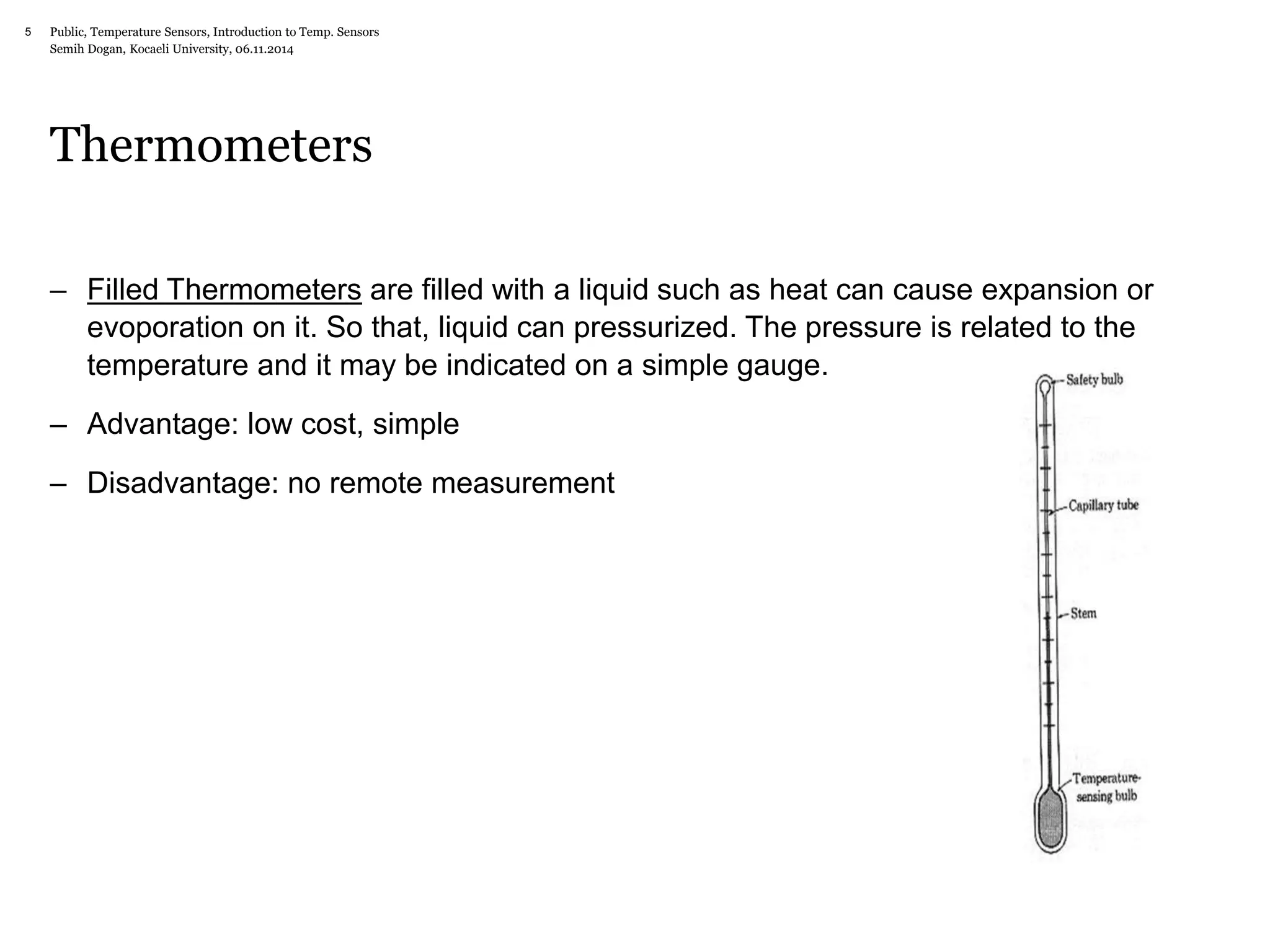
Thermometers 
– Filled Thermometers are filled with a liquid such as heat can cause expansion or 
evoporation on it. So that, liquid can pressurized. The pressure is related to the 
temperature and it may be indicated on a simple gauge. 
– Advantage: low cost, simple 
– Disadvantage: no remote measurement
Public, Temperature Sensors, 6 Introduction to Temp. Sensors 
Semih Dogan, Kocaeli University, 06.11.2014 
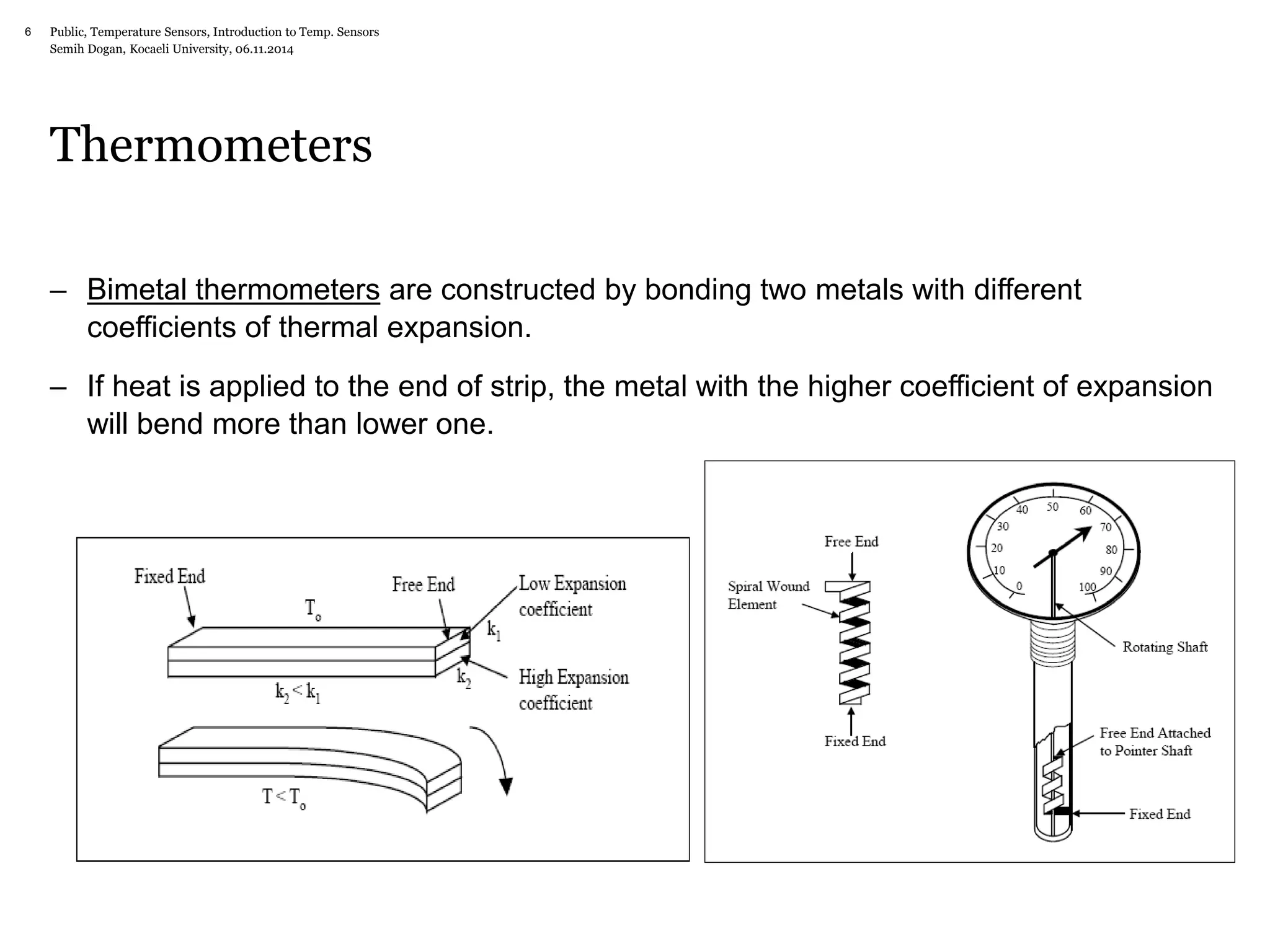
Thermometers 
– Bimetal thermometers are constructed by bonding two metals with different 
coefficients of thermal expansion. 
– If heat is applied to the end of strip, the metal with the higher coefficient of expansion 
will bend more than lower one.
Public, Temperature Sensors, 7 Introduction to Temp. Sensors 
Semih Dogan, Kocaeli University, 06.11.2014 
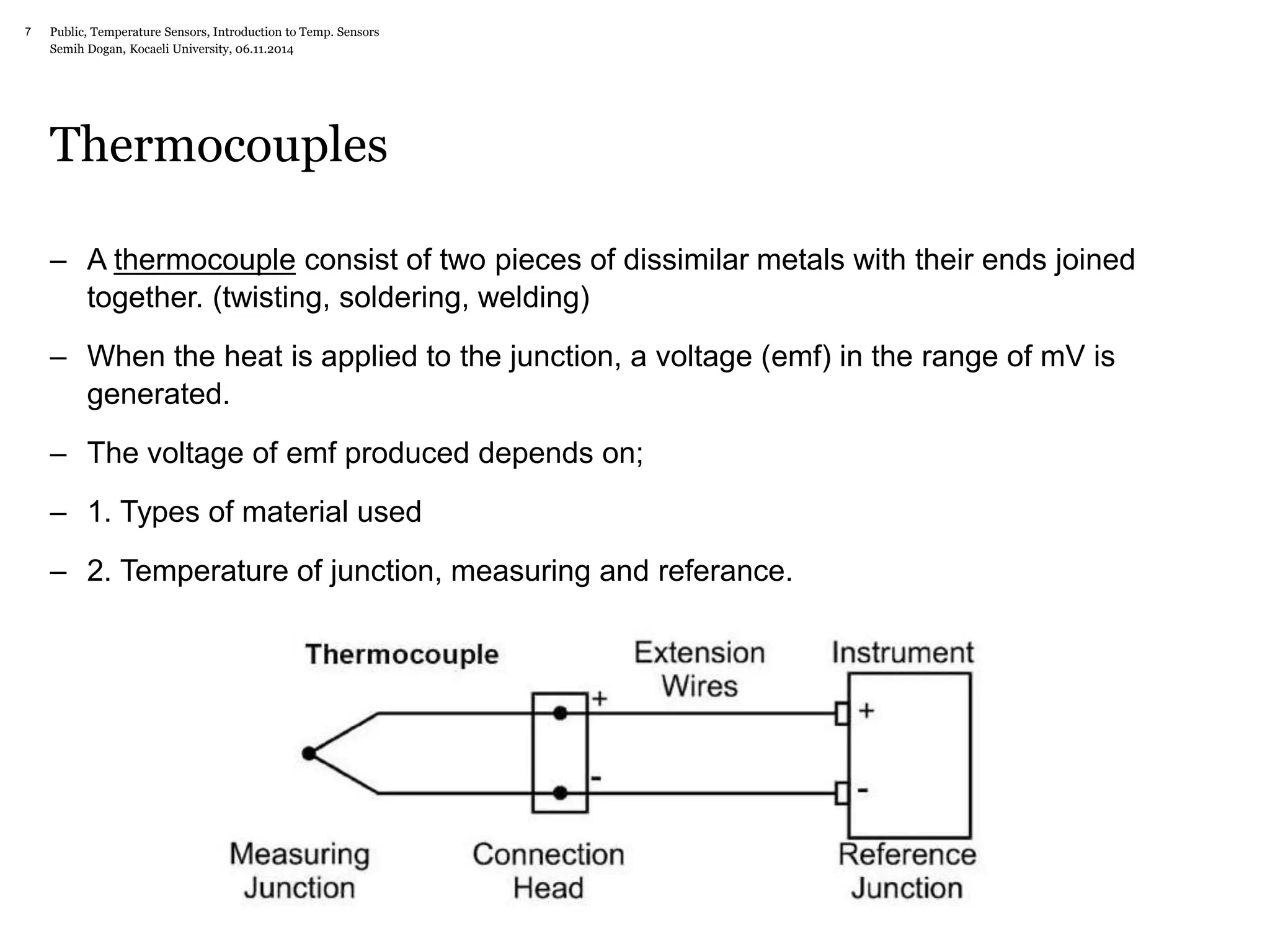
Thermocouples 
– A thermocouple consist of two pieces of dissimilar metals with their ends joined 
together. (twisting, soldering, welding) 
– When the heat is applied to the junction, a voltage (emf) in the range of mV is 
generated. 
– The voltage of emf produced depends on; 
– 1. Types of material used 
– 2. Temperature of junction, measuring and referance.
Public, Temperature Sensors, 8 Introduction to Temp. Sensors 
Semih Dogan, Kocaeli University, 06.11.2014 
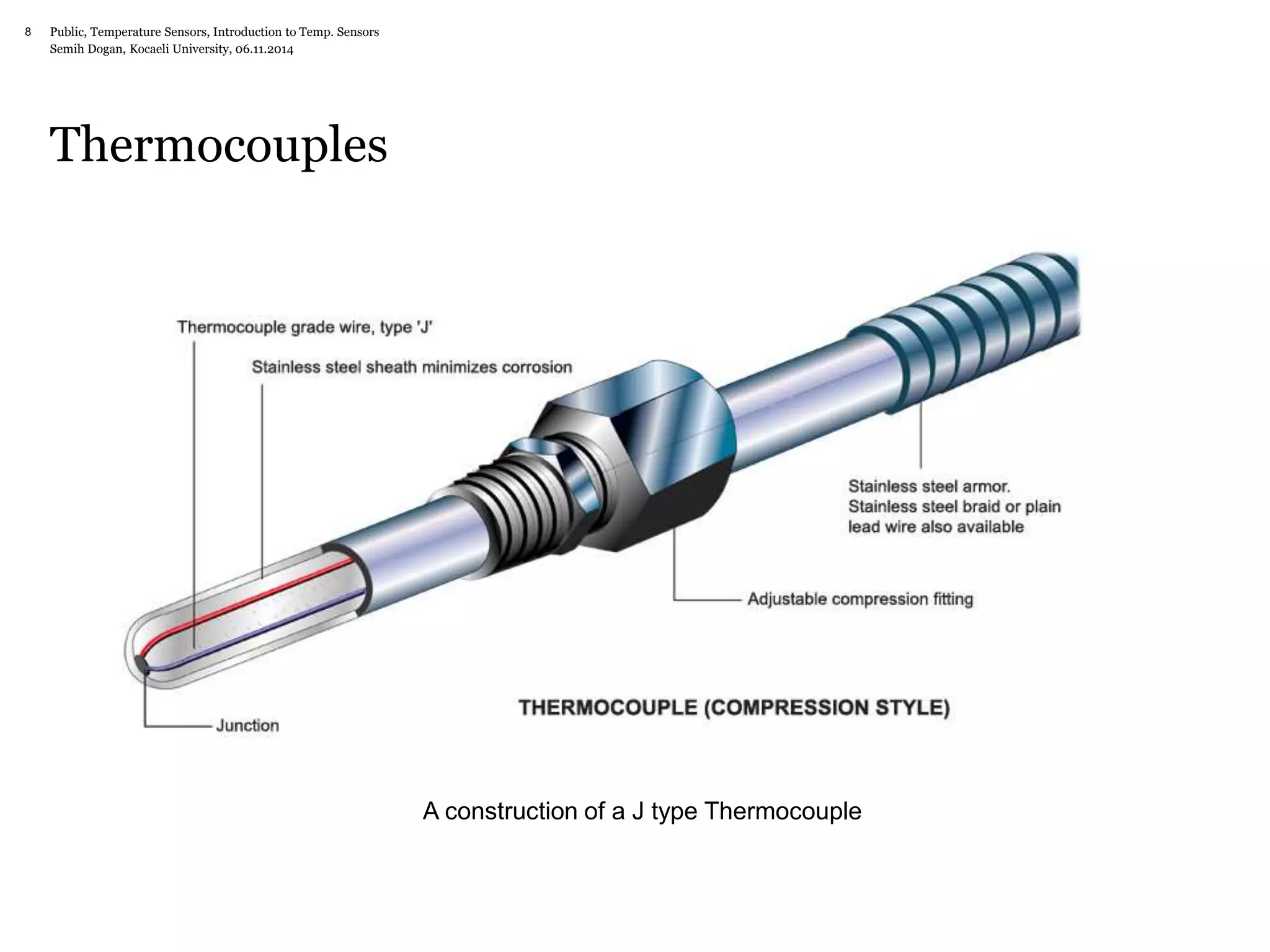
Thermocouples 
A construction of a J type Thermocouple
Public, Temperature Sensors, 9 Introduction to Temp. Sensors 
Semih Dogan, Kocaeli University, 06.11.2014 
Thermocouples 
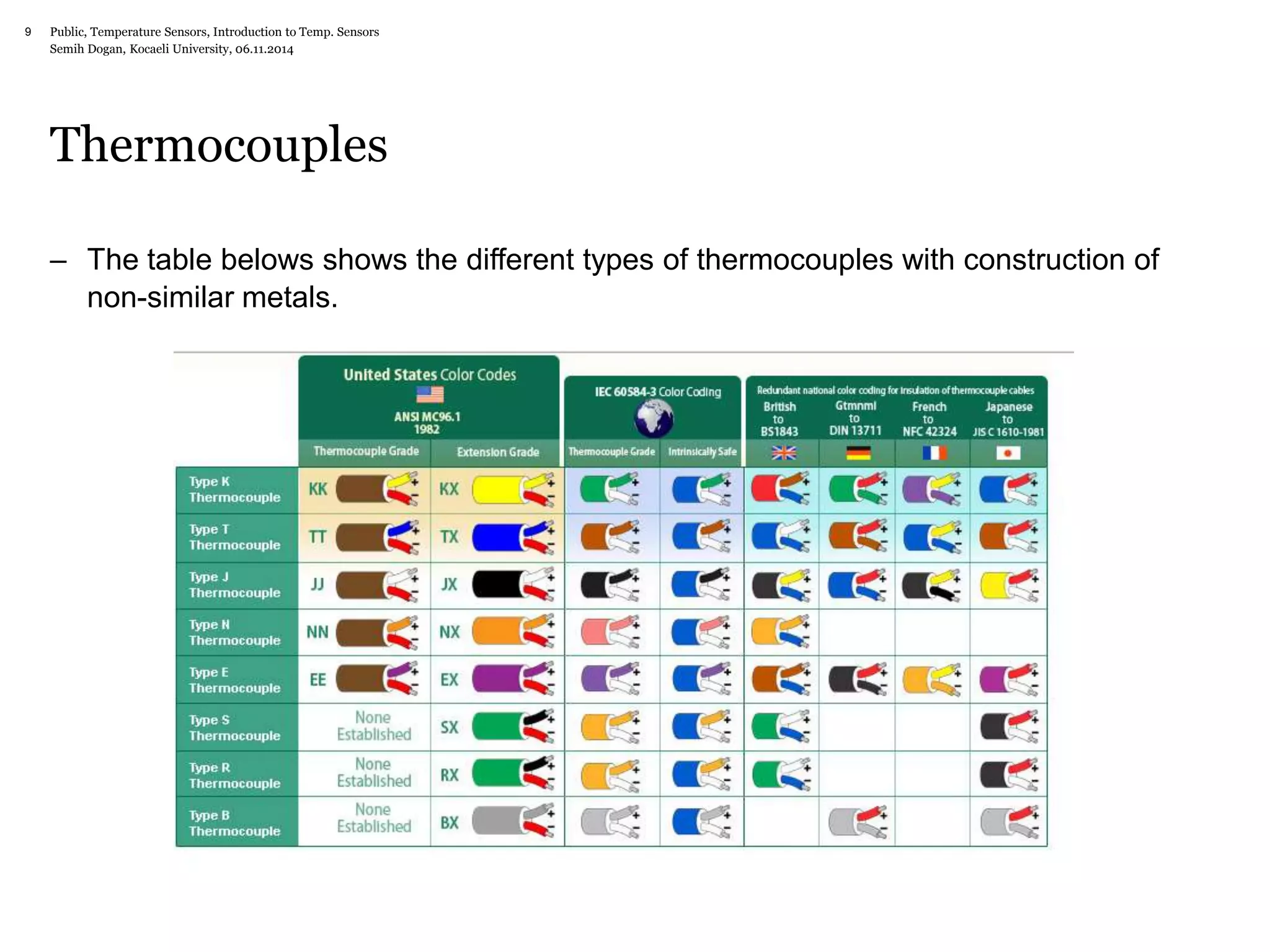
– The table belows shows the different types of thermocouples with construction of 
non-similar metals.
Public, Temperature Sensors, 10 Introduction to Temp. Sensors 
Semih Dogan, Kocaeli University, 06.11.2014 
Thermocouples 
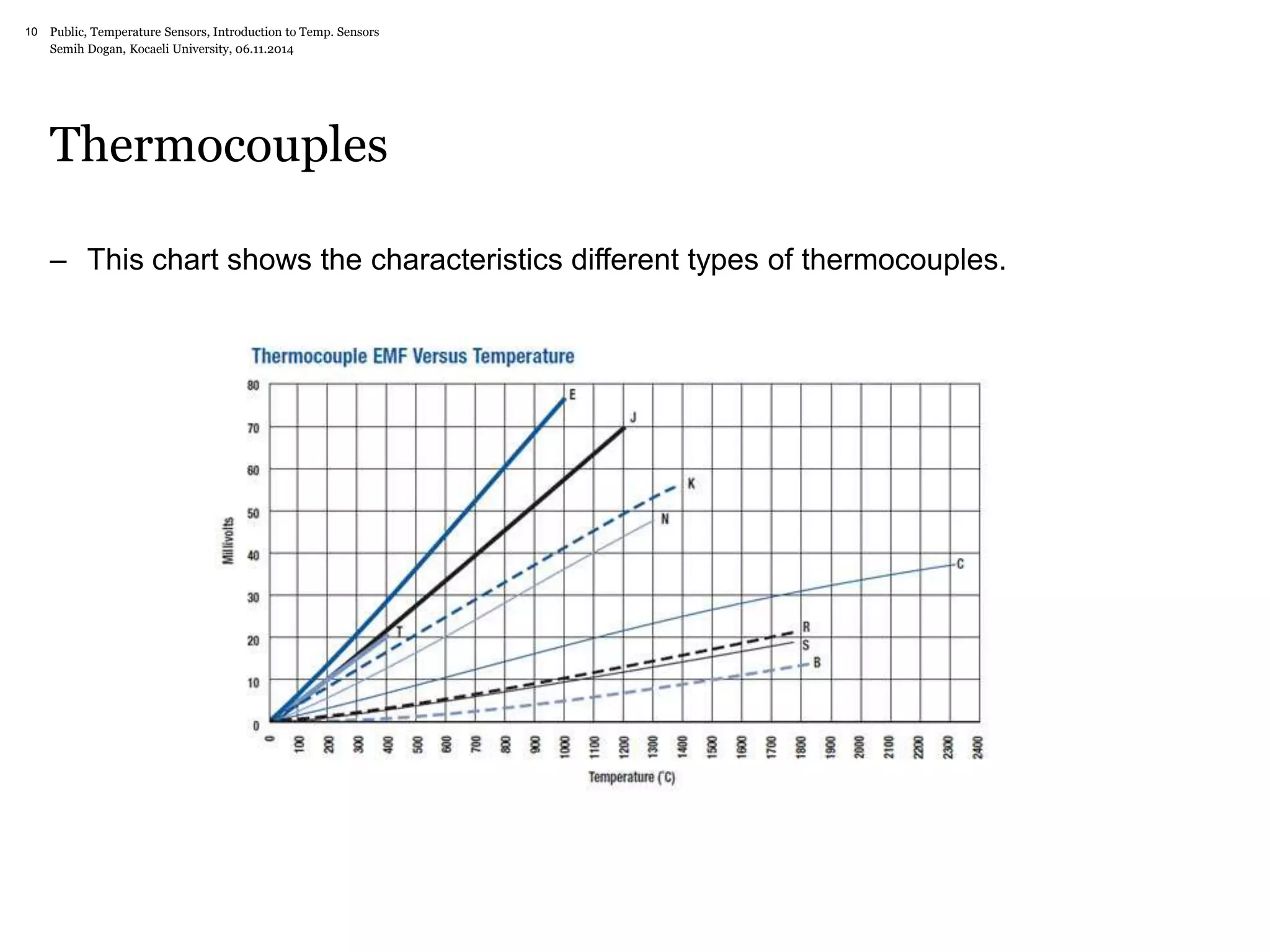
– This chart shows the characteristics different types of thermocouples.
Public, Temperature Sensors, 11 Introduction to Temp. Sensors 
Semih Dogan, Kocaeli University, 06.11.2014 
Resistance temperature detectors ( RTD ) 
– RTD’s are the resistance of a conductor usually increase as the temperature 
increase. 
– If the properties of that conductor are known, the temperature can be calculated from 
the measured resistance. 
– The most common RTD’s are PT100, PT 1000 and Ni100 
– The different RTD’s analyse 0°C with different resistive values. For example, PT 100 
is 100Ω at 0°C. 
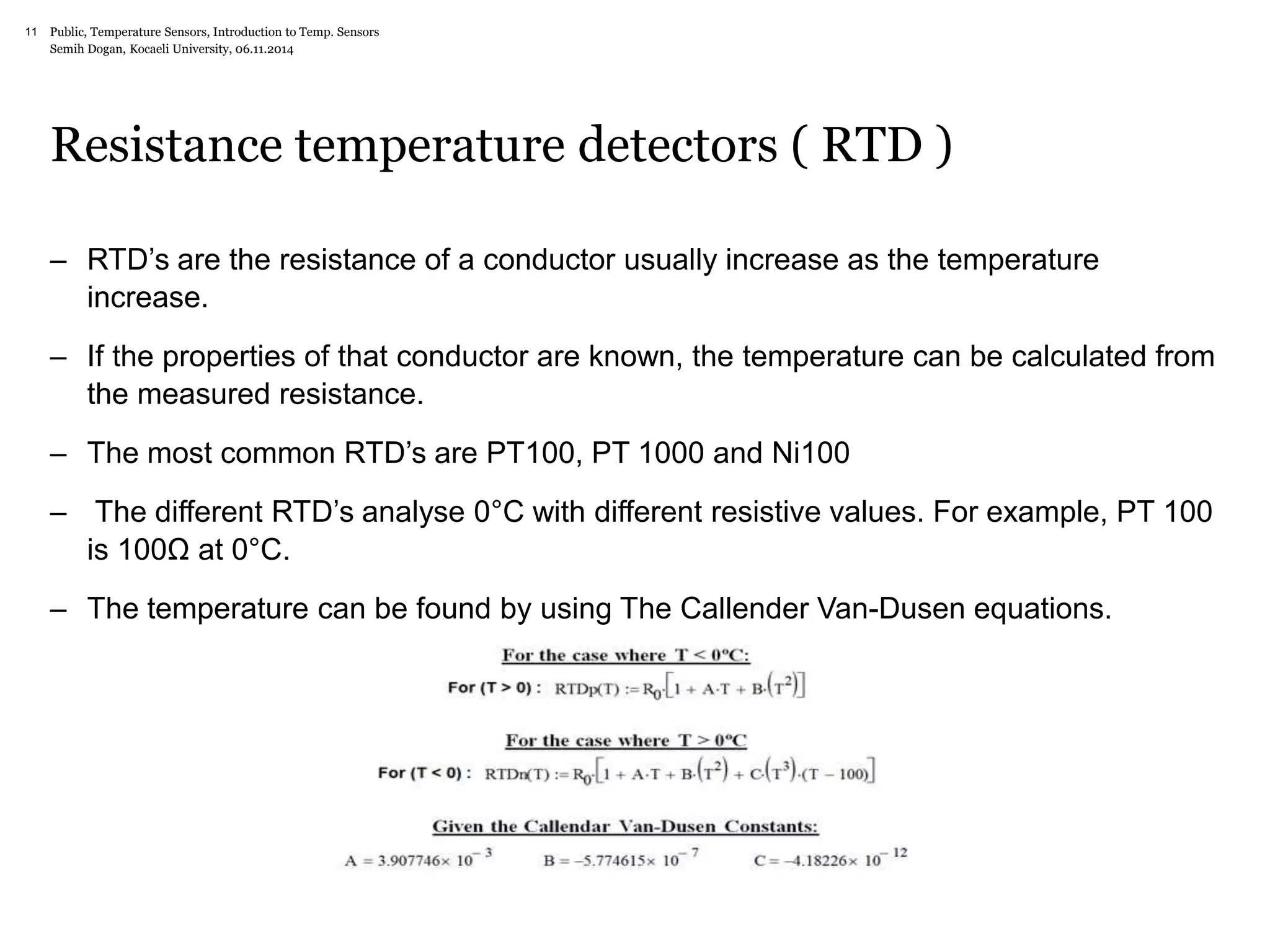
– The temperature can be found by using The Callender Van-Dusen equations.
Public, Temperature Sensors, 12 Introduction to Temp. Sensors 
Semih Dogan, Kocaeli University, 06.11.2014 
Resistance temperature detectors ( RTD ) 
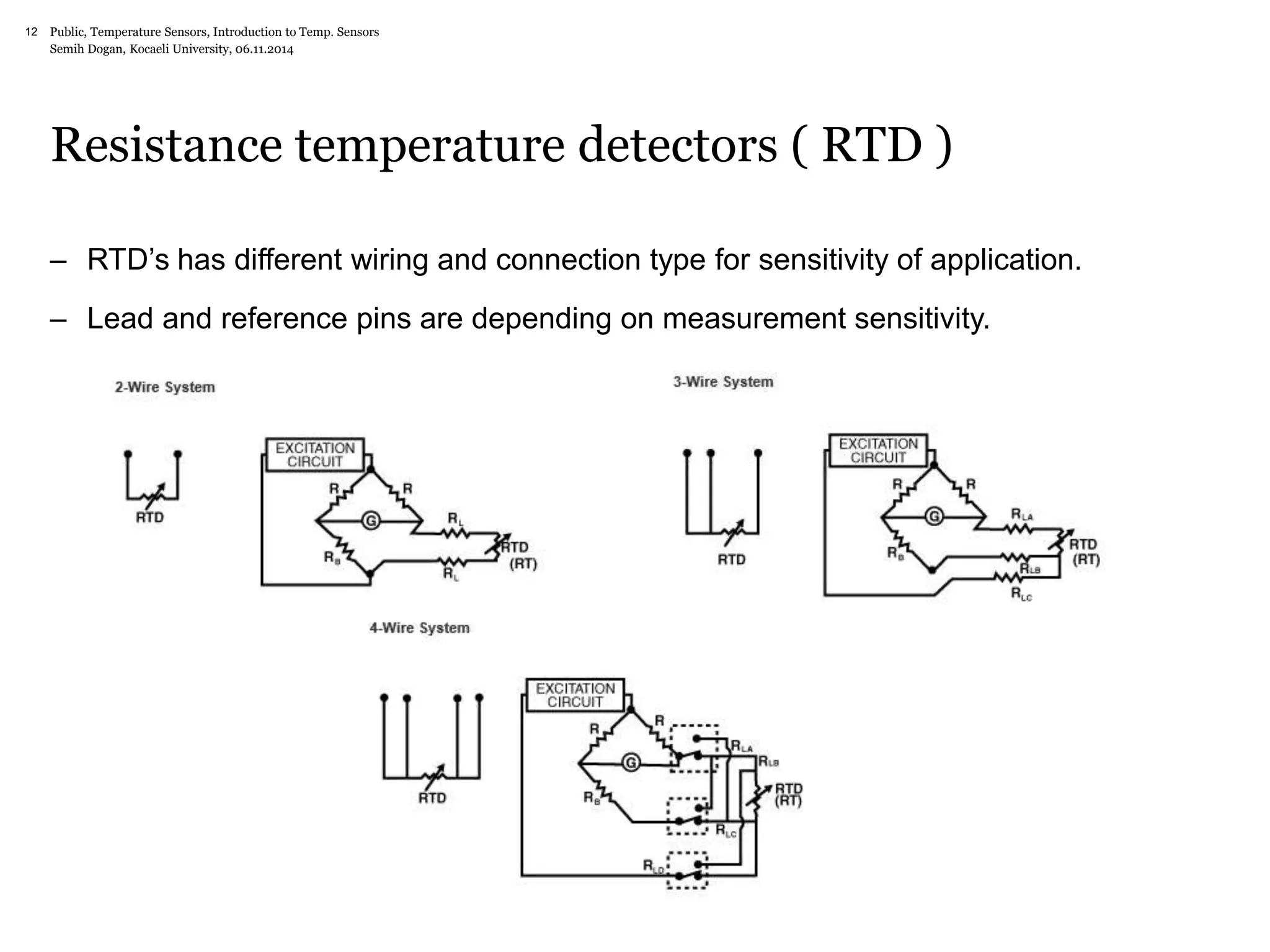
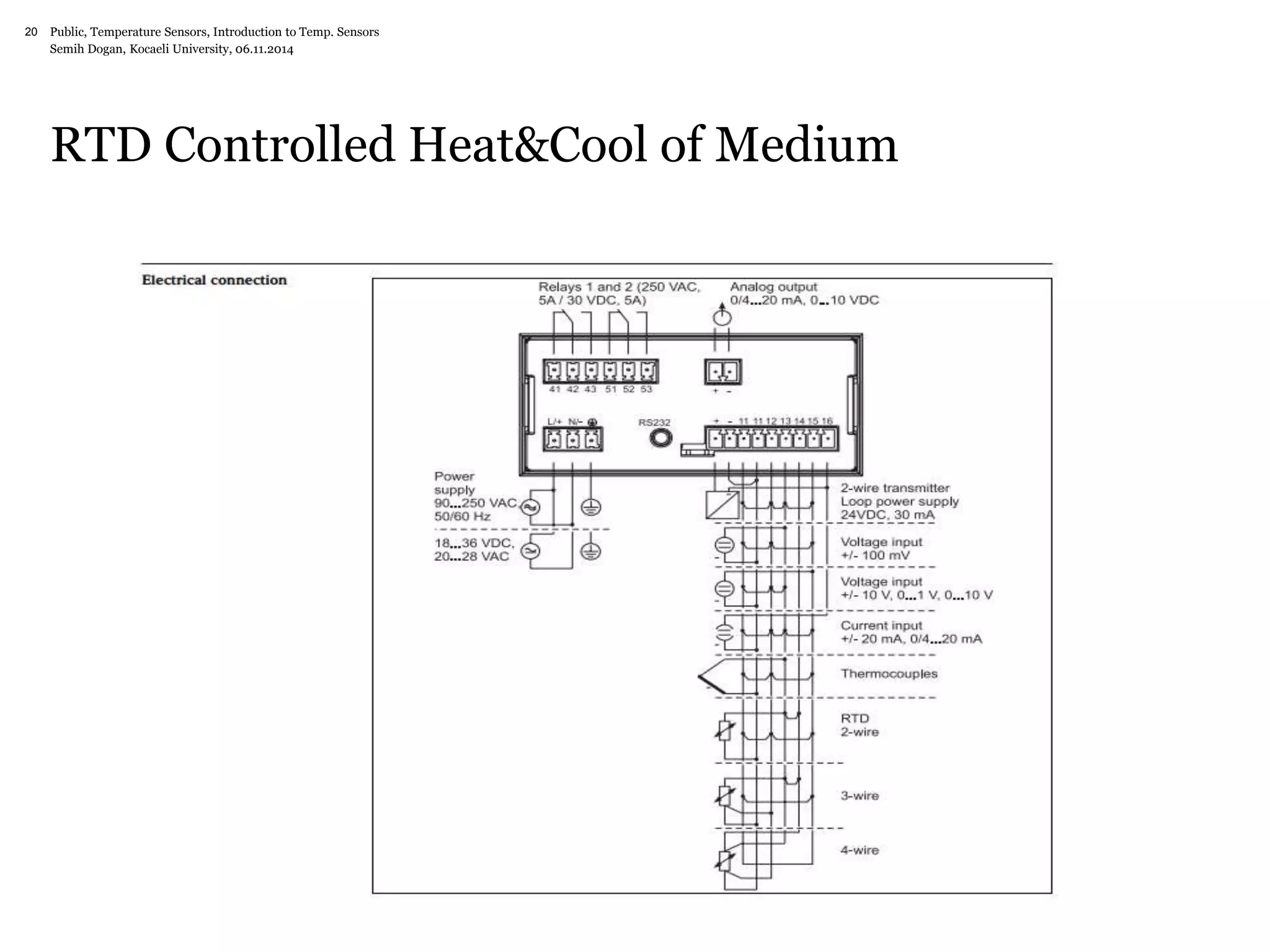
– RTD’s has different wiring and connection type for sensitivity of application. 
– Lead and reference pins are depending on measurement sensitivity.
Public, Temperature Sensors, 13 Introduction to Temp. Sensors 
Semih Dogan, Kocaeli University, 06.11.2014 
Resistance temperature detectors ( RTD ) 
– Stability in the temperature range to measured. The material must be not 
melt,correde,embattle or change electrical characteristics when subjected to the 
environment in which it will operate. 
– Linearitiy the resistance change with temperature should be as linear as possible 
over the range of interest to simplfy readout. 
– Response Time If the process requires a very fast response to temperature changes, 
RTD’s are the best choice. Time response is measured around e.g. 2.5ms to 10ms 
– Workability the material must be suitable for configurating for insertation into media. 
– Range most RTD’s can operate -200 to 600°C
Public 
Semih Dogan 
Kocaeli University 
06.11.2014 
Experiment with PT100 
(RTD) Controlled Heat and 
Cool Operation of A 
Medium
Public, Temperature Sensors, 15 Introduction to Temp. Sensors 
Semih Dogan, Kocaeli University, 06.11.2014 
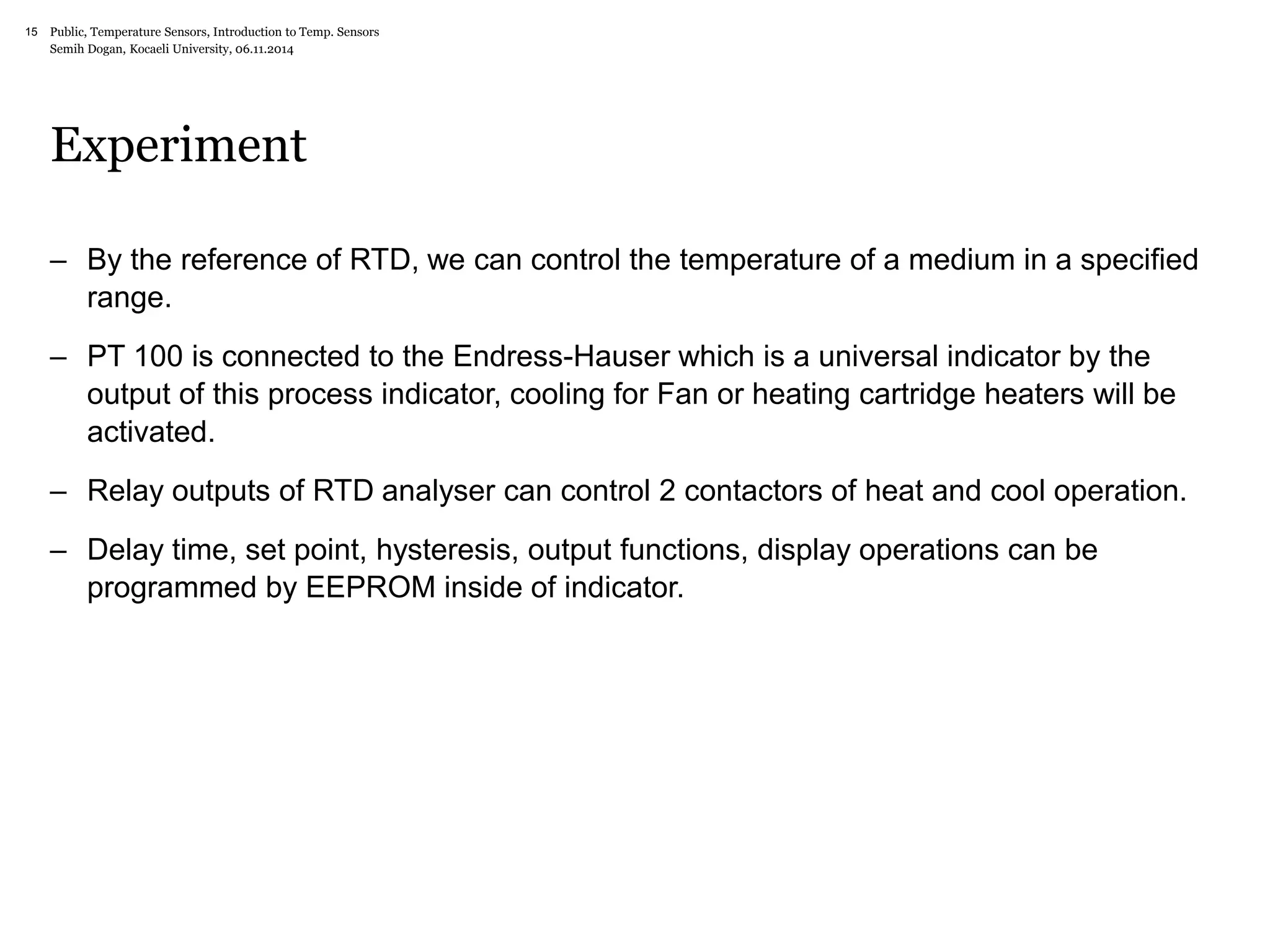
Experiment 
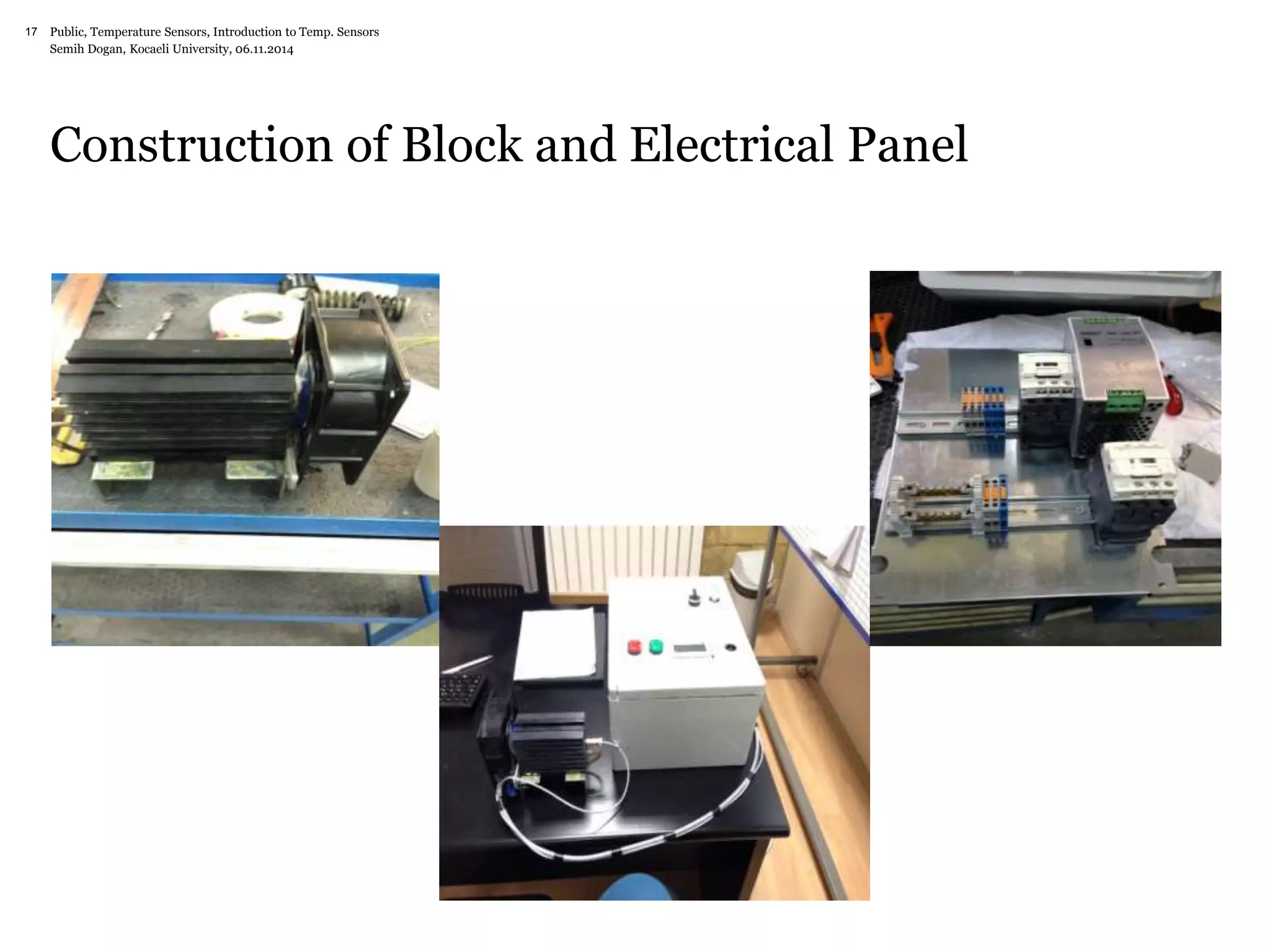
– By the reference of RTD, we can control the temperature of a medium in a specified 
range. 
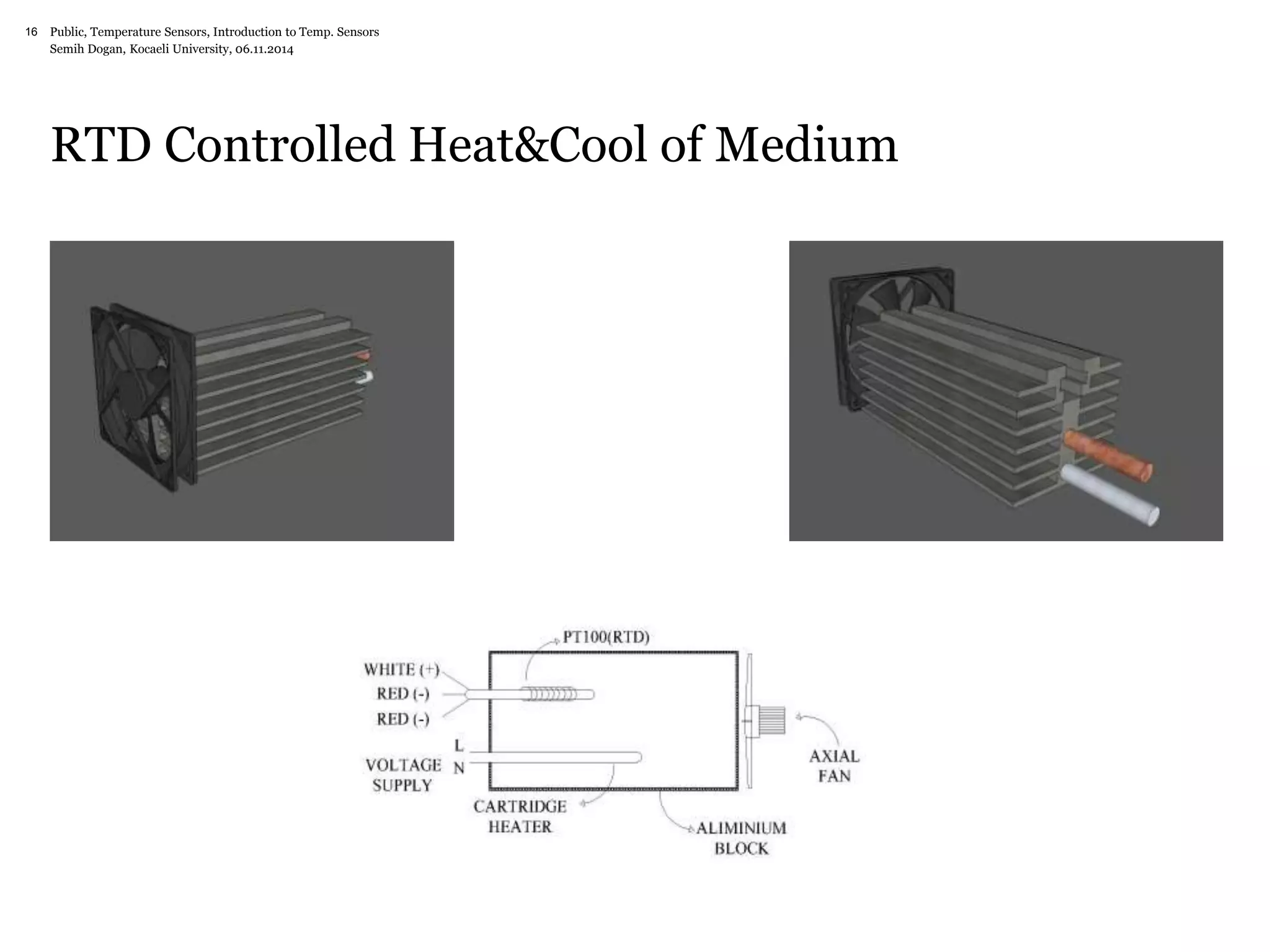
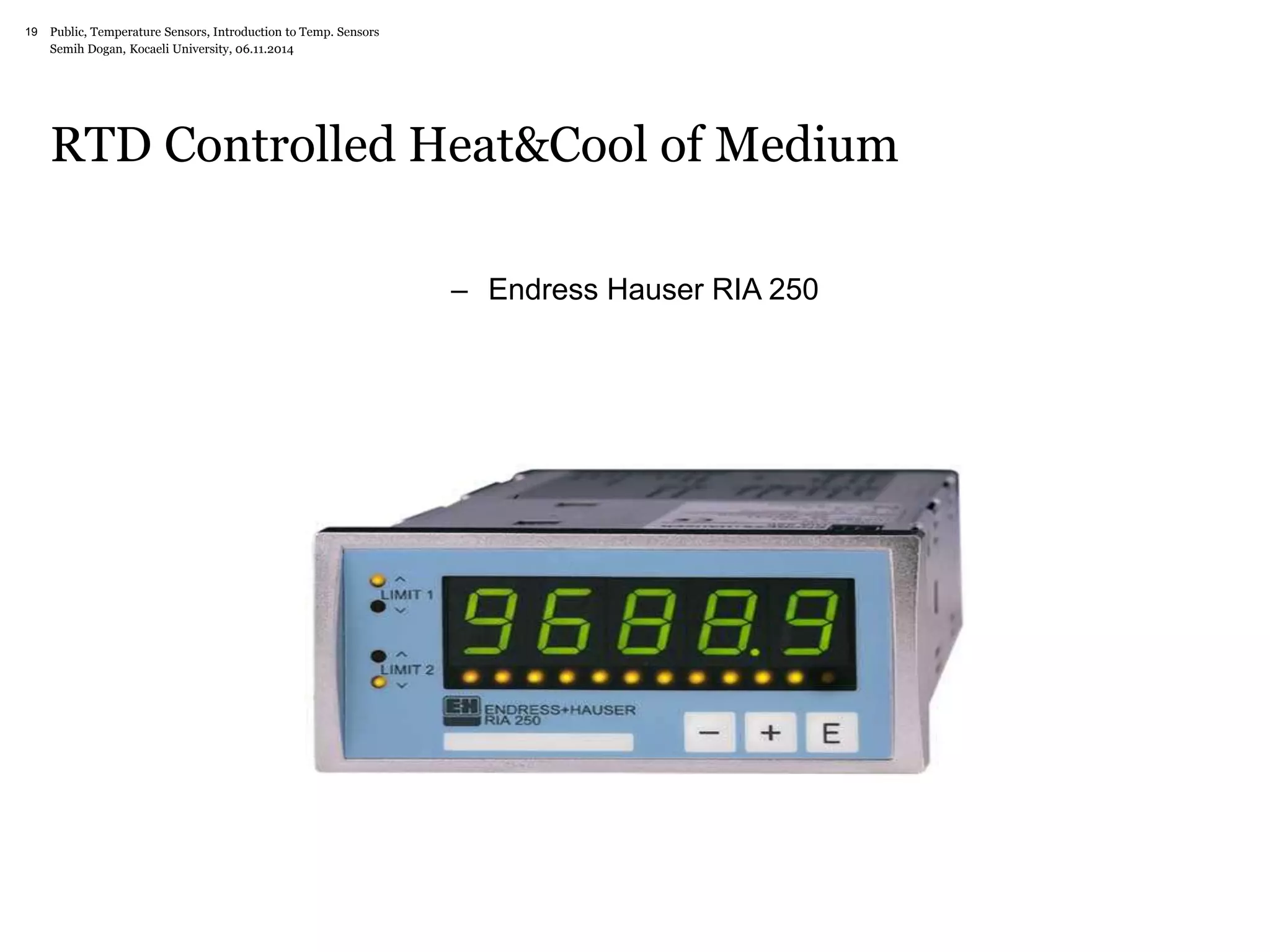
– PT 100 is connected to the Endress-Hauser which is a universal indicator by the 
output of this process indicator, cooling for Fan or heating cartridge heaters will be 
activated. 
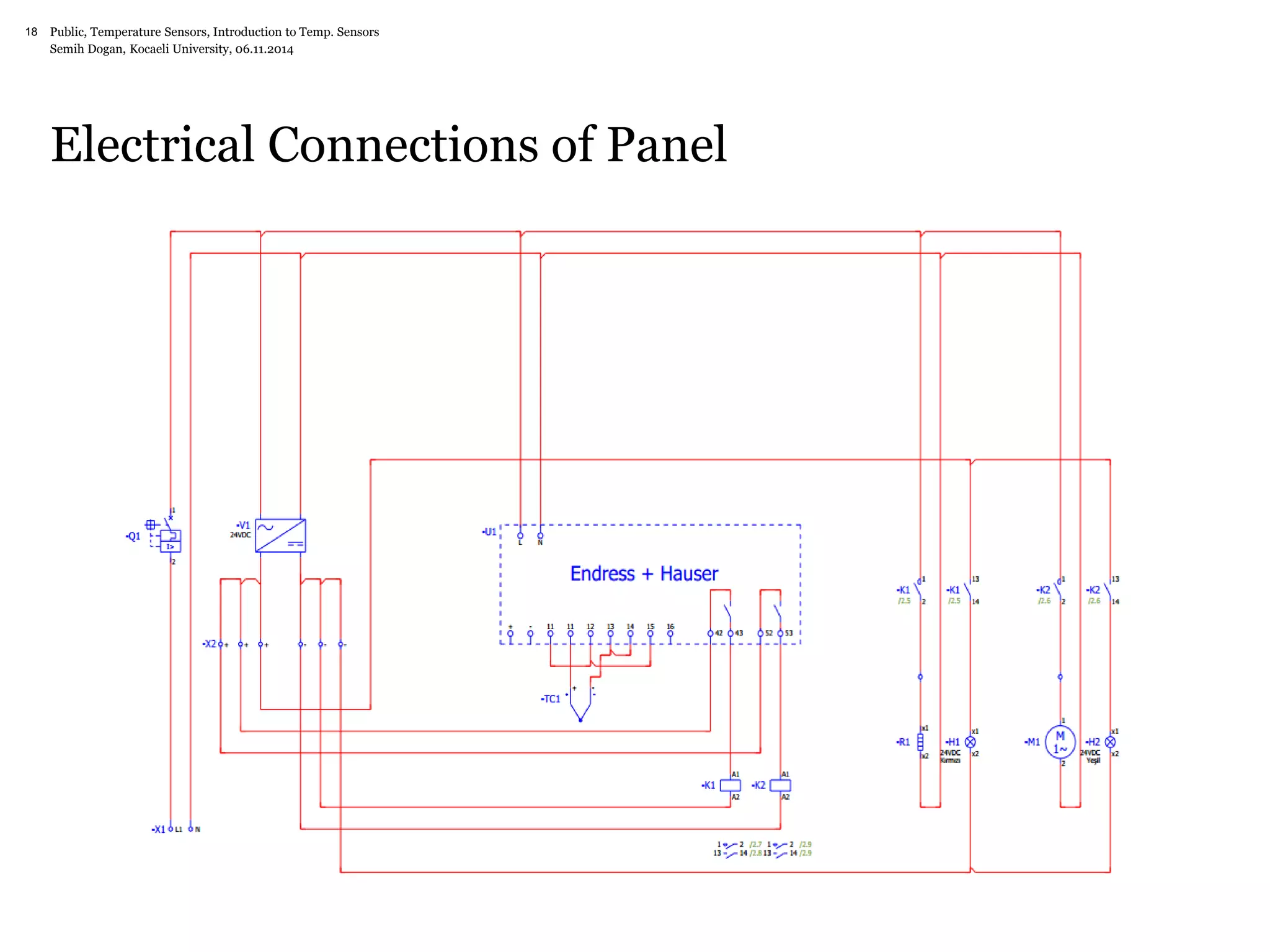
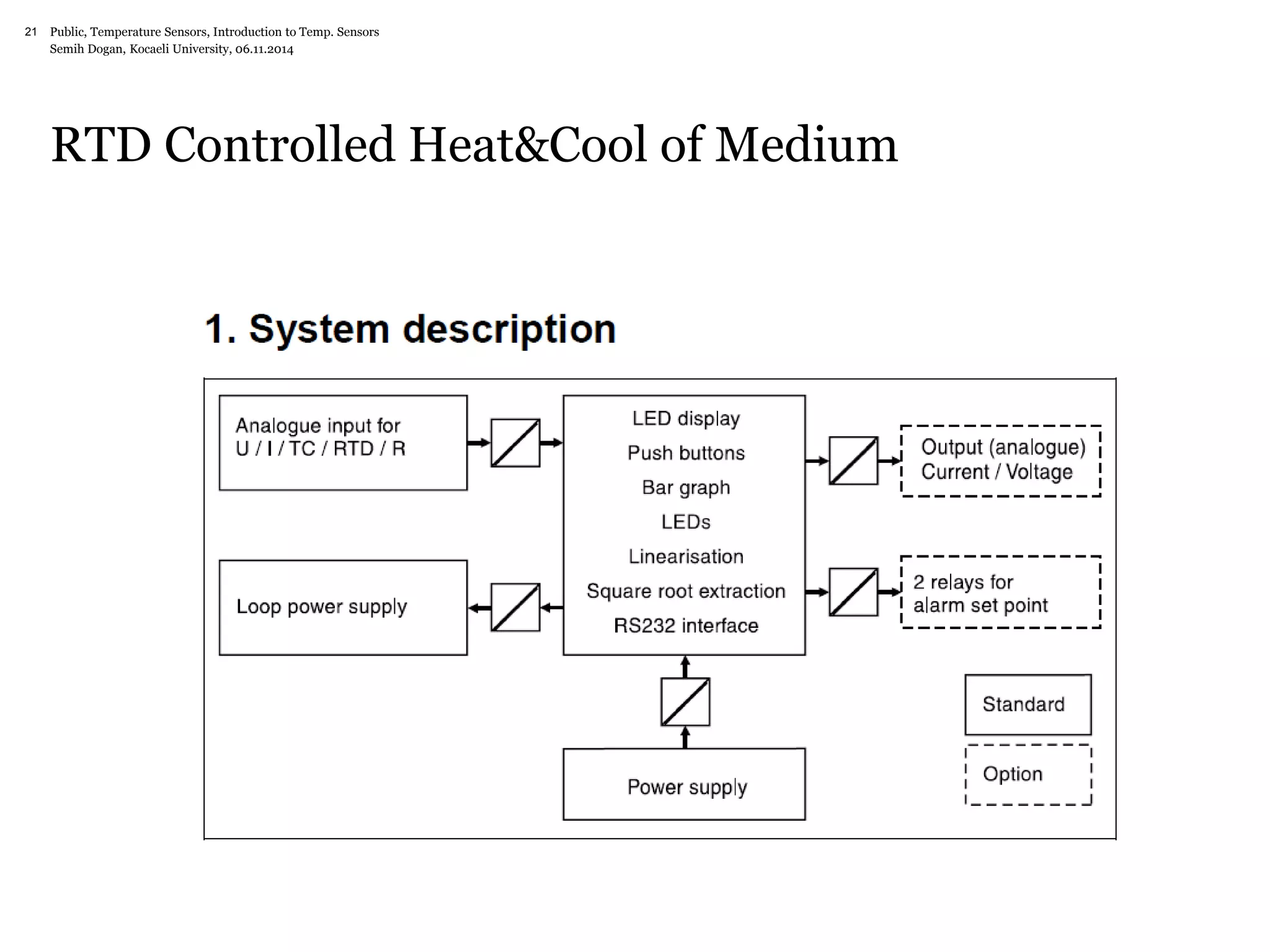
– Relay outputs of RTD analyser can control 2 contactors of heat and cool operation. 
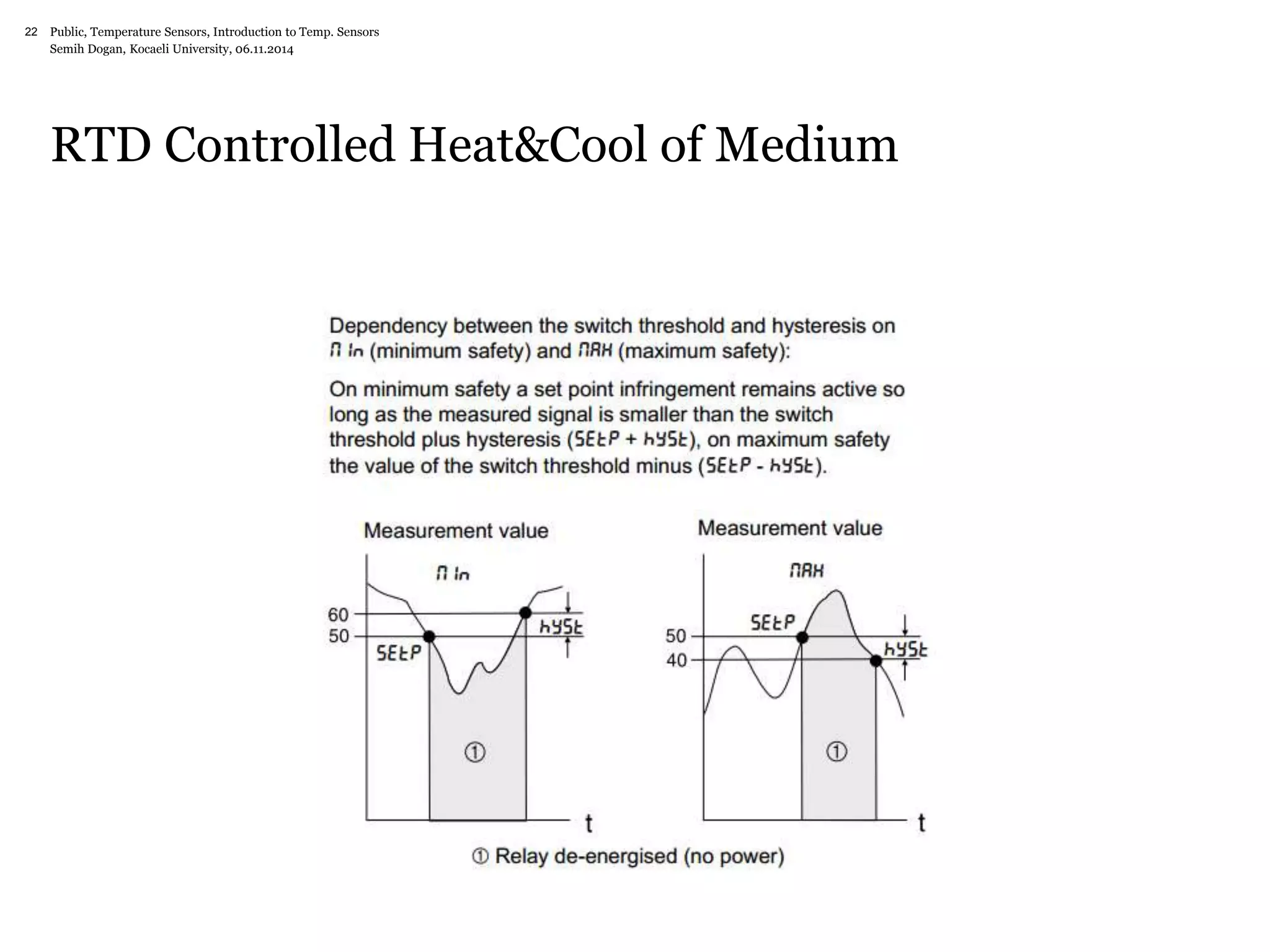
– Delay time, set point, hysteresis, output functions, display operations can be 
programmed by EEPROM inside of indicator.
Public, Temperature Sensors, 16 Introduction to Temp. Sensors 
Semih Dogan, Kocaeli University, 06.11.2014 
RTD Controlled Heat&Cool of Medium
Public, Temperature Sensors, 17 Introduction to Temp. Sensors 
Semih Dogan, Kocaeli University, 06.11.2014 
Construction of Block and Electrical Panel
Public, Temperature Sensors, 18 Introduction to Temp. Sensors 
Semih Dogan, Kocaeli University, 06.11.2014 
Electrical Connections of Panel
Public, Temperature Sensors, 19 Introduction to Temp. Sensors 
Semih Dogan, Kocaeli University, 06.11.2014 
RTD Controlled Heat&Cool of Medium 
– Endress Hauser RIA 250
Public, Temperature Sensors, 20 Introduction to Temp. Sensors 
Semih Dogan, Kocaeli University, 06.11.2014 
RTD Controlled Heat&Cool of Medium
Public, Temperature Sensors, 21 Introduction to Temp. Sensors 
Semih Dogan, Kocaeli University, 06.11.2014 
RTD Controlled Heat&Cool of Medium
Public, Temperature Sensors, 22 Introduction to Temp. Sensors 
Semih Dogan, Kocaeli University, 06.11.2014 
RTD Controlled Heat&Cool of Medium
Public, Temperature Sensors, 23 Introduction to Temp. Sensors 
Semih Dogan, Kocaeli University, 06.11.2014 
Conclusion 
– In general, thermocouples are cheaper, more durable and can measure a bigger 
range of temperature while RTD’s produce better and more reliable measurements. 
– Both temp. Sensors are versatile that have high accuracy over a wide range of 
industrial applications.
Semih Dogan, Kocaeli University, 06.11.2014 
Thank you very much 
Public, Temperature Sensors, 24 Introduction to Temp. Sensors

Temperature Sensors

  • 1.
    Public Semih Dogan Kocaeli University 06.11.2014 Temperature Sensors
  • 2.
    Public Semih Dogan Kocaeli University 06.11.2014 Introduction to Temp. Sensors
  • 3.
    Public, Temperature Sensors,3 Introduction to Temp. Sensors Semih Dogan, Kocaeli University, 06.11.2014 What is Temp. Sensors? – Temperature Sensors are devices that can sense the difference amount of heat between application space and reference. – They are used to measure temperature and change of heat transfer of a medium.
  • 4.
    Public, Temperature Sensors,4 Introduction to Temp. Sensors Semih Dogan, Kocaeli University, 06.11.2014 Type of temperature measuring devices – Thermometers – Thermocouples – Resistance Temperature Detectors (RTD’s)
  • 5.
    Public, Temperature Sensors,5 Introduction to Temp. Sensors Semih Dogan, Kocaeli University, 06.11.2014 Thermometers – Filled Thermometers are filled with a liquid such as heat can cause expansion or evoporation on it. So that, liquid can pressurized. The pressure is related to the temperature and it may be indicated on a simple gauge. – Advantage: low cost, simple – Disadvantage: no remote measurement
  • 6.
    Public, Temperature Sensors,6 Introduction to Temp. Sensors Semih Dogan, Kocaeli University, 06.11.2014 Thermometers – Bimetal thermometers are constructed by bonding two metals with different coefficients of thermal expansion. – If heat is applied to the end of strip, the metal with the higher coefficient of expansion will bend more than lower one.
  • 7.
    Public, Temperature Sensors,7 Introduction to Temp. Sensors Semih Dogan, Kocaeli University, 06.11.2014 Thermocouples – A thermocouple consist of two pieces of dissimilar metals with their ends joined together. (twisting, soldering, welding) – When the heat is applied to the junction, a voltage (emf) in the range of mV is generated. – The voltage of emf produced depends on; – 1. Types of material used – 2. Temperature of junction, measuring and referance.
  • 8.
    Public, Temperature Sensors,8 Introduction to Temp. Sensors Semih Dogan, Kocaeli University, 06.11.2014 Thermocouples A construction of a J type Thermocouple
  • 9.
    Public, Temperature Sensors,9 Introduction to Temp. Sensors Semih Dogan, Kocaeli University, 06.11.2014 Thermocouples – The table belows shows the different types of thermocouples with construction of non-similar metals.
  • 10.
    Public, Temperature Sensors,10 Introduction to Temp. Sensors Semih Dogan, Kocaeli University, 06.11.2014 Thermocouples – This chart shows the characteristics different types of thermocouples.
  • 11.
    Public, Temperature Sensors,11 Introduction to Temp. Sensors Semih Dogan, Kocaeli University, 06.11.2014 Resistance temperature detectors ( RTD ) – RTD’s are the resistance of a conductor usually increase as the temperature increase. – If the properties of that conductor are known, the temperature can be calculated from the measured resistance. – The most common RTD’s are PT100, PT 1000 and Ni100 – The different RTD’s analyse 0°C with different resistive values. For example, PT 100 is 100Ω at 0°C. – The temperature can be found by using The Callender Van-Dusen equations.
  • 12.
    Public, Temperature Sensors,12 Introduction to Temp. Sensors Semih Dogan, Kocaeli University, 06.11.2014 Resistance temperature detectors ( RTD ) – RTD’s has different wiring and connection type for sensitivity of application. – Lead and reference pins are depending on measurement sensitivity.
  • 13.
    Public, Temperature Sensors,13 Introduction to Temp. Sensors Semih Dogan, Kocaeli University, 06.11.2014 Resistance temperature detectors ( RTD ) – Stability in the temperature range to measured. The material must be not melt,correde,embattle or change electrical characteristics when subjected to the environment in which it will operate. – Linearitiy the resistance change with temperature should be as linear as possible over the range of interest to simplfy readout. – Response Time If the process requires a very fast response to temperature changes, RTD’s are the best choice. Time response is measured around e.g. 2.5ms to 10ms – Workability the material must be suitable for configurating for insertation into media. – Range most RTD’s can operate -200 to 600°C
  • 14.
    Public Semih Dogan Kocaeli University 06.11.2014 Experiment with PT100 (RTD) Controlled Heat and Cool Operation of A Medium
  • 15.
    Public, Temperature Sensors,15 Introduction to Temp. Sensors Semih Dogan, Kocaeli University, 06.11.2014 Experiment – By the reference of RTD, we can control the temperature of a medium in a specified range. – PT 100 is connected to the Endress-Hauser which is a universal indicator by the output of this process indicator, cooling for Fan or heating cartridge heaters will be activated. – Relay outputs of RTD analyser can control 2 contactors of heat and cool operation. – Delay time, set point, hysteresis, output functions, display operations can be programmed by EEPROM inside of indicator.
  • 16.
    Public, Temperature Sensors,16 Introduction to Temp. Sensors Semih Dogan, Kocaeli University, 06.11.2014 RTD Controlled Heat&Cool of Medium
  • 17.
    Public, Temperature Sensors,17 Introduction to Temp. Sensors Semih Dogan, Kocaeli University, 06.11.2014 Construction of Block and Electrical Panel
  • 18.
    Public, Temperature Sensors,18 Introduction to Temp. Sensors Semih Dogan, Kocaeli University, 06.11.2014 Electrical Connections of Panel
  • 19.
    Public, Temperature Sensors,19 Introduction to Temp. Sensors Semih Dogan, Kocaeli University, 06.11.2014 RTD Controlled Heat&Cool of Medium – Endress Hauser RIA 250
  • 20.
    Public, Temperature Sensors,20 Introduction to Temp. Sensors Semih Dogan, Kocaeli University, 06.11.2014 RTD Controlled Heat&Cool of Medium
  • 21.
    Public, Temperature Sensors,21 Introduction to Temp. Sensors Semih Dogan, Kocaeli University, 06.11.2014 RTD Controlled Heat&Cool of Medium
  • 22.
    Public, Temperature Sensors,22 Introduction to Temp. Sensors Semih Dogan, Kocaeli University, 06.11.2014 RTD Controlled Heat&Cool of Medium
  • 23.
    Public, Temperature Sensors,23 Introduction to Temp. Sensors Semih Dogan, Kocaeli University, 06.11.2014 Conclusion – In general, thermocouples are cheaper, more durable and can measure a bigger range of temperature while RTD’s produce better and more reliable measurements. – Both temp. Sensors are versatile that have high accuracy over a wide range of industrial applications.
  • 24.
    Semih Dogan, KocaeliUniversity, 06.11.2014 Thank you very much Public, Temperature Sensors, 24 Introduction to Temp. Sensors