
Mobile IPv6
Why study Mobility in IPv6?
What is so different about Mobile IPv6 ?
Broadly we can say, Mobile IPv6 benefits from opportunities provided by IPv6  From the Lessons learnt from IPv4
Problems with Mobile IPv4
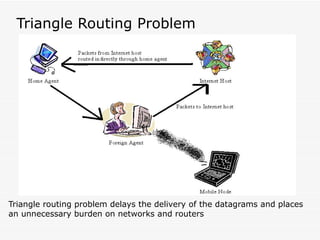
Triangle Routing Problem Triangle routing problem delays the delivery of the datagrams and places an unnecessary burden on networks and routers
Firewalls  Enterprise firewalls are typically configured to block packets from entering via the Internet that appear to emanate from internal computers
Ingress Filtering  Many border routers discard packets coming from within the enterprise if the packets do not contain a source IP address configured for one of the enterprise's internal networks
Other Security Issues Insider Attacks  Denial of Service Attack (DOS) Replay Attacks  Theft of Information: Passive  Eavesdropping Theft of Information: Session-Stealing
Is Mobile IPv6 the Solution?
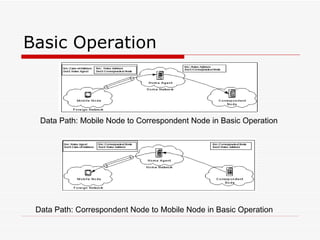
Two Modes of Operation  Basic Operation or Bi- directional tunneling Route Optimization
Basic Operation Data Path: Mobile Node to Correspondent Node in Basic Operation  Data Path: Correspondent Node to Mobile Node in Basic Operation
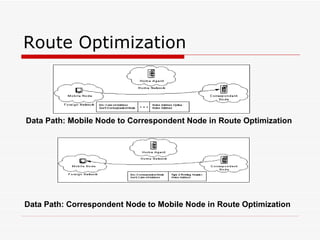
Route Optimization  Data Path: Mobile Node to Correspondent Node in Route Optimization   Data Path: Correspondent Node to Mobile Node in Route Optimization
Advantages of Route Optimization  Allows the shortest communications path to be used.  eliminates congestion at the mobile node's home agent and home link.  the impact of any possible failure of the home agent or networks on the path to or from it is reduced.
Establishing Route Optimization
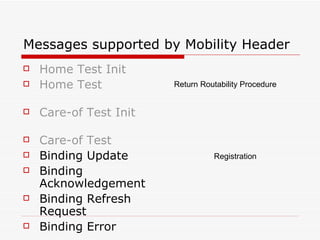
Messages supported by Mobility Header Home Test Init Home Test  Care-of Test Init    Care-of Test Binding Update  Binding Acknowledgement  Binding Refresh Request  Binding Error  Return Routability Procedure Registration
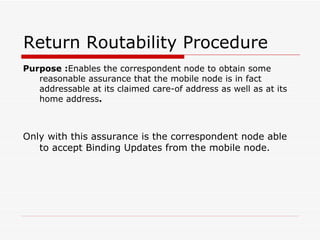
Return Routability Procedure  Purpose : Enables the correspondent node to obtain some reasonable assurance that the mobile node is in fact addressable at its claimed care-of address as well as at its home address . Only with this assurance is the correspondent node able to accept Binding Updates from the mobile node.
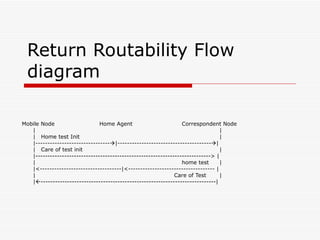
Return Routability Flow diagram Mobile Node  Home Agent Correspondent Node  |      | |  Home test Init       | |-------------------------------  |---------------------------------------  | |  Care of test init   | |-------------------------------------------------------------------------> | | home test   | |<----------------------------------|<------------------------------------ | |   Care of Test   | |  -------------------------------------------------------------------------|
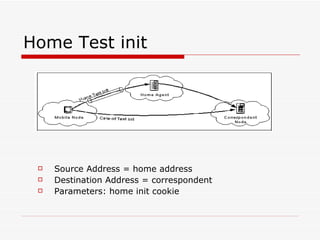
Home Test init  Source Address = home address  Destination Address = correspondent  Parameters: home init cookie
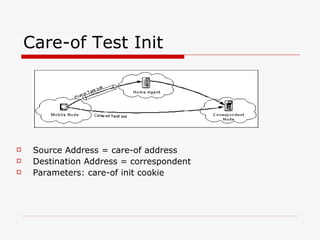
Care-of Test Init  Source Address = care-of address  Destination Address = correspondent  Parameters: care-of init cookie
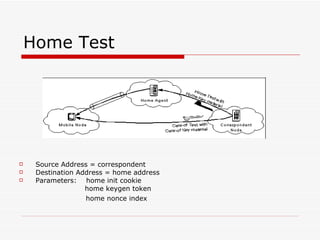
Home Test  Source Address = correspondent  Destination Address = home address  Parameters:  home init cookie  home keygen token  home nonce index
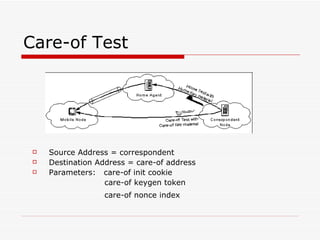
Care-of Test  Source Address = correspondent  Destination Address = care-of address Parameters:  care-of init cookie  care-of keygen token  care-of nonce index
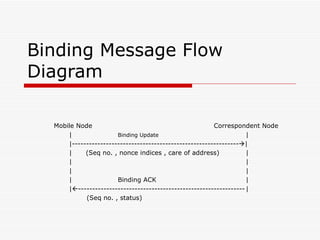
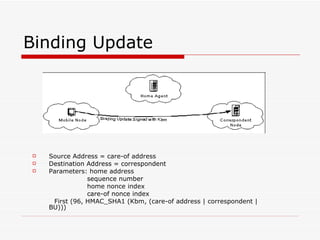
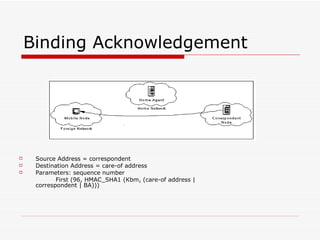
Binding Message Flow Diagram Mobile Node  Correspondent Node |  Binding Update | |-----------------------------------------------------------  | | (Seq no. , nonce indices , care of address) | | | | | | Binding ACK | |  ----------------------------------------------------------- | (Seq no. , status)
Binding Update  Source Address = care-of address  Destination Address = correspondent  Parameters: home address  sequence number  home nonce index  care-of nonce index  First (96, HMAC_SHA1 (Kbm, (care-of address | correspondent | BU)))
Binding Acknowledgement Source Address = correspondent  Destination Address = care-of address  Parameters: sequence number  First (96, HMAC_SHA1 (Kbm, (care-of address | correspondent | BA)))
Other Features and Functionality
Home Agent Option Used by Mobile Node while away from home, to inform the recipient of the mobile node's home address.
Prefix Discovery allows a Mobile Node to get network prefix information about its Home Network  Sends a Mobile Prefix Solicitation message to the Home Agent.
Dynamic Home Agent Discovery When attached to a Foreign Network, a Mobile Node might not know the address of its Home Agent  With DHAAD, Mobile Node only needs a home network prefix configured and it can dynamically find the address of a Home Agent on its home network
Returning Home and De-registering Mobile Node determines whether it is attached to its home network based on the network prefix information  Deregisters by sending a special Binding Update to its Home Agent
Neighbor/Router Discovery Provides IPv6 nodes with a means to discover the presence and link –layer addresses of other nodes  Provides methods for discovering routers Detecting when a local node becomes unreachable Resolving duplicate addresses
Stateless Autoconfiguration  Purpose: Enables nodes to decide how to autoconfigure its interfaces in IPv6  Steps: Generate a link-local address for the interface.  Obtain a Router Advertisement which specify the sort of autoconfiguration the host should do.
Performance Evaluation Security Threats reduced  Uses Source Routing which provides Highly efficient performance and avoids Triangle routing Avoids problems due to Ingress Filtering Has Inbuilt Infrastructure for Mobility Router Discovery and Address auto-configuration makes mobility a much easier task
Major Differences from Mobile IPv4 No Foreign Agents Route Optimization is a fundamental part unlike Mobile IPv4 Bi-directional tunneling is part of the core protocol unlike Mobile IPv4 Uses  Neighbor Discovery to find Link layer Addresses of neighbors unlike Mobile IPv4 which uses ARP . Hence more robust    Contd…
Dynamic Home Agent Address Discovery uses anycast addressing and returns a single reply to the mobile node unlike Mobile IPv4 which uses a directed broadcast approach and returns separate replies from each Home Agent Mobile Nodes can obtain Care-of Addresses via Stateless Address Auto-configuration unlike Mobile Ipv4 which uses Agent discovery
Vulnerabilities  in Mobile IPv6
Security – Still a Headache Biggest vulnerability is authorization of Binding Updates Firewalls and Mobile IPv6 do not work well together Number of Problems for securing Neighbor discovery Problem arises when roaming with a dual-stack architecture and interoperating between Mobile IPv4 and Mobile IPv6.
Final Words – Mobile Ipv6
“ Communications should be much faster,&quot; Deering says. &quot;We also thought it was going to be more secure. But now it doesn't look like it's going to be more secure.&quot;
“ Backers of IPv6 have suffered another setback, as security experts punched holes in their planned strategy for supporting mobile IPv6 communications.”
“Prime Minister Yoshiro Mori of Japan vouched for IPv6 in front of the Japanese parliament, declaring that by 2006 Japan would have 100 percent deployment in government, education and industry. And in February, the Korean government followed suit by promising to spend $80 billion by 2006 to develop and deploy IPv6.”
&quot;The good part is, that the IETF has identified that this is work that needs to be done as soon as possible, and they are nearing their goal”
Thank You!

Mobile I Pv6

  • 1.
  • 2.
  • 3.
    What is sodifferent about Mobile IPv6 ?
  • 4.
    Broadly we cansay, Mobile IPv6 benefits from opportunities provided by IPv6 From the Lessons learnt from IPv4
  • 5.
  • 6.
    Triangle Routing ProblemTriangle routing problem delays the delivery of the datagrams and places an unnecessary burden on networks and routers
  • 7.
    Firewalls Enterprisefirewalls are typically configured to block packets from entering via the Internet that appear to emanate from internal computers
  • 8.
    Ingress Filtering Many border routers discard packets coming from within the enterprise if the packets do not contain a source IP address configured for one of the enterprise's internal networks
  • 9.
    Other Security IssuesInsider Attacks Denial of Service Attack (DOS) Replay Attacks Theft of Information: Passive Eavesdropping Theft of Information: Session-Stealing
  • 10.
    Is Mobile IPv6the Solution?
  • 11.
    Two Modes ofOperation Basic Operation or Bi- directional tunneling Route Optimization
  • 12.
    Basic Operation DataPath: Mobile Node to Correspondent Node in Basic Operation Data Path: Correspondent Node to Mobile Node in Basic Operation
  • 13.
    Route Optimization Data Path: Mobile Node to Correspondent Node in Route Optimization Data Path: Correspondent Node to Mobile Node in Route Optimization
  • 14.
    Advantages of RouteOptimization Allows the shortest communications path to be used. eliminates congestion at the mobile node's home agent and home link. the impact of any possible failure of the home agent or networks on the path to or from it is reduced.
  • 15.
  • 16.
    Messages supported byMobility Header Home Test Init Home Test Care-of Test Init Care-of Test Binding Update Binding Acknowledgement Binding Refresh Request Binding Error Return Routability Procedure Registration
  • 17.
    Return Routability Procedure Purpose : Enables the correspondent node to obtain some reasonable assurance that the mobile node is in fact addressable at its claimed care-of address as well as at its home address . Only with this assurance is the correspondent node able to accept Binding Updates from the mobile node.
  • 18.
    Return Routability Flowdiagram Mobile Node Home Agent Correspondent Node | | | Home test Init | |-------------------------------  |---------------------------------------  | | Care of test init | |-------------------------------------------------------------------------> | | home test | |<----------------------------------|<------------------------------------ | | Care of Test | |  -------------------------------------------------------------------------|
  • 19.
    Home Test init Source Address = home address Destination Address = correspondent Parameters: home init cookie
  • 20.
    Care-of Test Init Source Address = care-of address Destination Address = correspondent Parameters: care-of init cookie
  • 21.
    Home Test Source Address = correspondent Destination Address = home address Parameters: home init cookie home keygen token home nonce index
  • 22.
    Care-of Test Source Address = correspondent Destination Address = care-of address Parameters: care-of init cookie care-of keygen token care-of nonce index
  • 23.
    Binding Message FlowDiagram Mobile Node Correspondent Node | Binding Update | |-----------------------------------------------------------  | | (Seq no. , nonce indices , care of address) | | | | | | Binding ACK | |  ----------------------------------------------------------- | (Seq no. , status)
  • 24.
    Binding Update Source Address = care-of address Destination Address = correspondent Parameters: home address sequence number home nonce index care-of nonce index First (96, HMAC_SHA1 (Kbm, (care-of address | correspondent | BU)))
  • 25.
    Binding Acknowledgement SourceAddress = correspondent Destination Address = care-of address Parameters: sequence number First (96, HMAC_SHA1 (Kbm, (care-of address | correspondent | BA)))
  • 26.
    Other Features andFunctionality
  • 27.
    Home Agent OptionUsed by Mobile Node while away from home, to inform the recipient of the mobile node's home address.
  • 28.
    Prefix Discovery allowsa Mobile Node to get network prefix information about its Home Network Sends a Mobile Prefix Solicitation message to the Home Agent.
  • 29.
    Dynamic Home AgentDiscovery When attached to a Foreign Network, a Mobile Node might not know the address of its Home Agent With DHAAD, Mobile Node only needs a home network prefix configured and it can dynamically find the address of a Home Agent on its home network
  • 30.
    Returning Home andDe-registering Mobile Node determines whether it is attached to its home network based on the network prefix information Deregisters by sending a special Binding Update to its Home Agent
  • 31.
    Neighbor/Router Discovery ProvidesIPv6 nodes with a means to discover the presence and link –layer addresses of other nodes Provides methods for discovering routers Detecting when a local node becomes unreachable Resolving duplicate addresses
  • 32.
    Stateless Autoconfiguration Purpose: Enables nodes to decide how to autoconfigure its interfaces in IPv6 Steps: Generate a link-local address for the interface. Obtain a Router Advertisement which specify the sort of autoconfiguration the host should do.
  • 33.
    Performance Evaluation SecurityThreats reduced Uses Source Routing which provides Highly efficient performance and avoids Triangle routing Avoids problems due to Ingress Filtering Has Inbuilt Infrastructure for Mobility Router Discovery and Address auto-configuration makes mobility a much easier task
  • 34.
    Major Differences fromMobile IPv4 No Foreign Agents Route Optimization is a fundamental part unlike Mobile IPv4 Bi-directional tunneling is part of the core protocol unlike Mobile IPv4 Uses Neighbor Discovery to find Link layer Addresses of neighbors unlike Mobile IPv4 which uses ARP . Hence more robust Contd…
  • 35.
    Dynamic Home AgentAddress Discovery uses anycast addressing and returns a single reply to the mobile node unlike Mobile IPv4 which uses a directed broadcast approach and returns separate replies from each Home Agent Mobile Nodes can obtain Care-of Addresses via Stateless Address Auto-configuration unlike Mobile Ipv4 which uses Agent discovery
  • 36.
    Vulnerabilities inMobile IPv6
  • 37.
    Security – Stilla Headache Biggest vulnerability is authorization of Binding Updates Firewalls and Mobile IPv6 do not work well together Number of Problems for securing Neighbor discovery Problem arises when roaming with a dual-stack architecture and interoperating between Mobile IPv4 and Mobile IPv6.
  • 38.
    Final Words –Mobile Ipv6
  • 39.
    “ Communications shouldbe much faster,&quot; Deering says. &quot;We also thought it was going to be more secure. But now it doesn't look like it's going to be more secure.&quot;
  • 40.
    “ Backers ofIPv6 have suffered another setback, as security experts punched holes in their planned strategy for supporting mobile IPv6 communications.”
  • 41.
    “Prime Minister YoshiroMori of Japan vouched for IPv6 in front of the Japanese parliament, declaring that by 2006 Japan would have 100 percent deployment in government, education and industry. And in February, the Korean government followed suit by promising to spend $80 billion by 2006 to develop and deploy IPv6.”
  • 42.
    &quot;The good partis, that the IETF has identified that this is work that needs to be done as soon as possible, and they are nearing their goal”
  • 43.