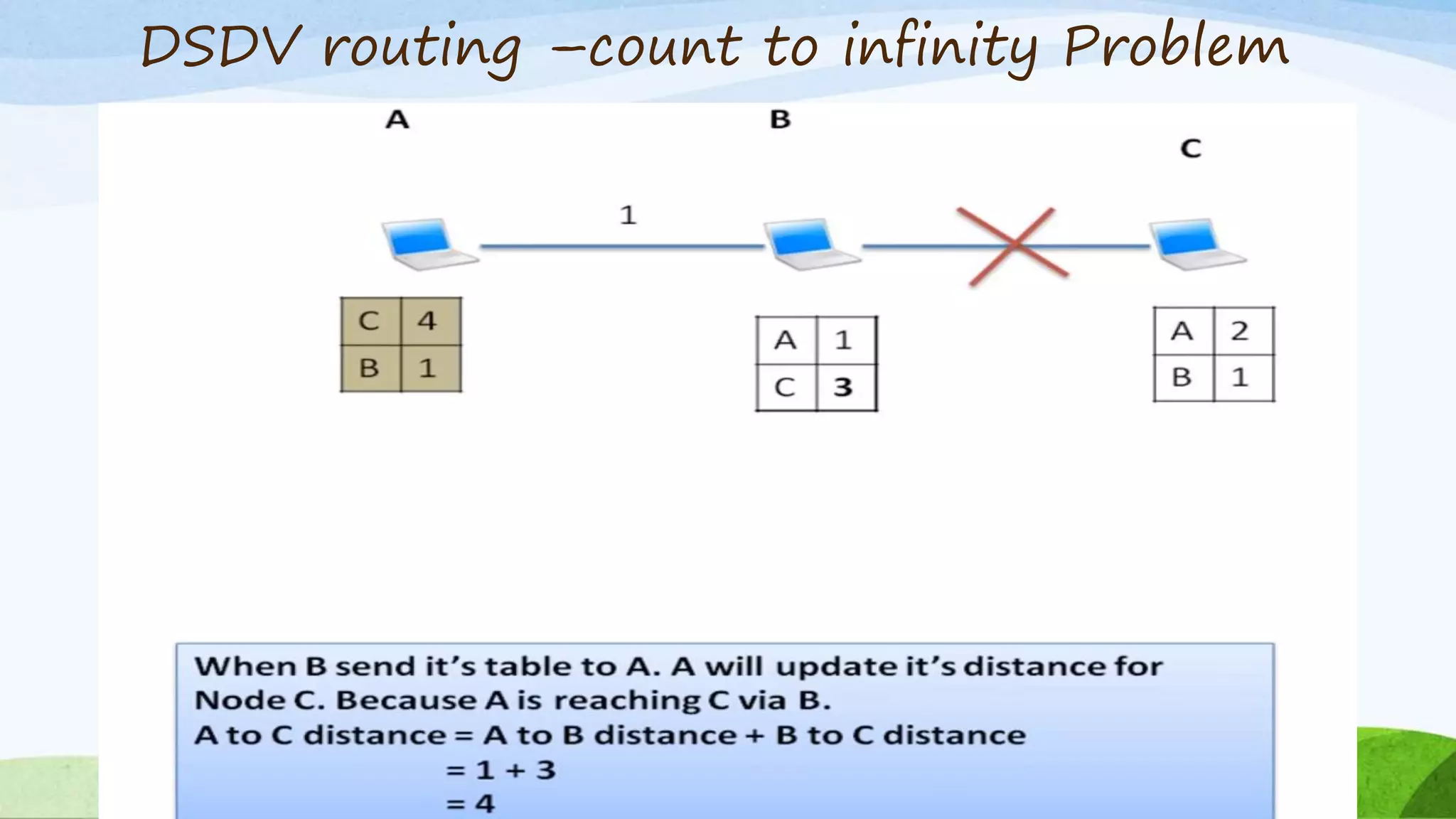
The document provides an overview of the Destination-Sequenced Distance-Vector Routing (DSDV) protocol, a proactive routing protocol used in mobile ad hoc networks (MANETs) where each node maintains a routing table containing destination information. Updates to the routing tables may either be periodic or triggered by significant events, allowing nodes to inform their neighbors of topology changes through advertisements. The protocol employs sequence numbers to ensure accurate routing information, which addresses issues related to data traffic and node mobility.
Proactive – Destination-Sequenced
Distance-VectorRouting (DSDV)
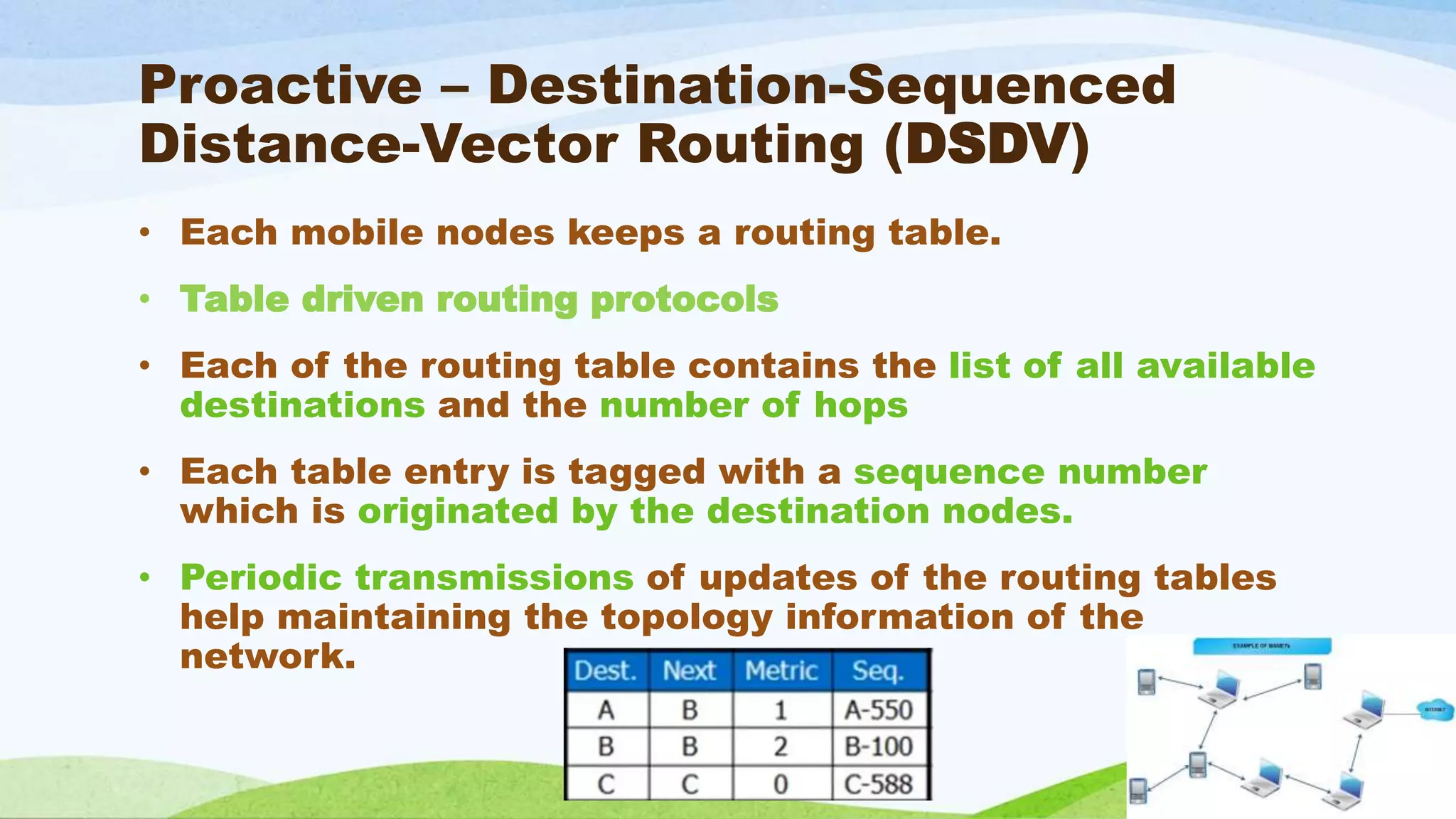
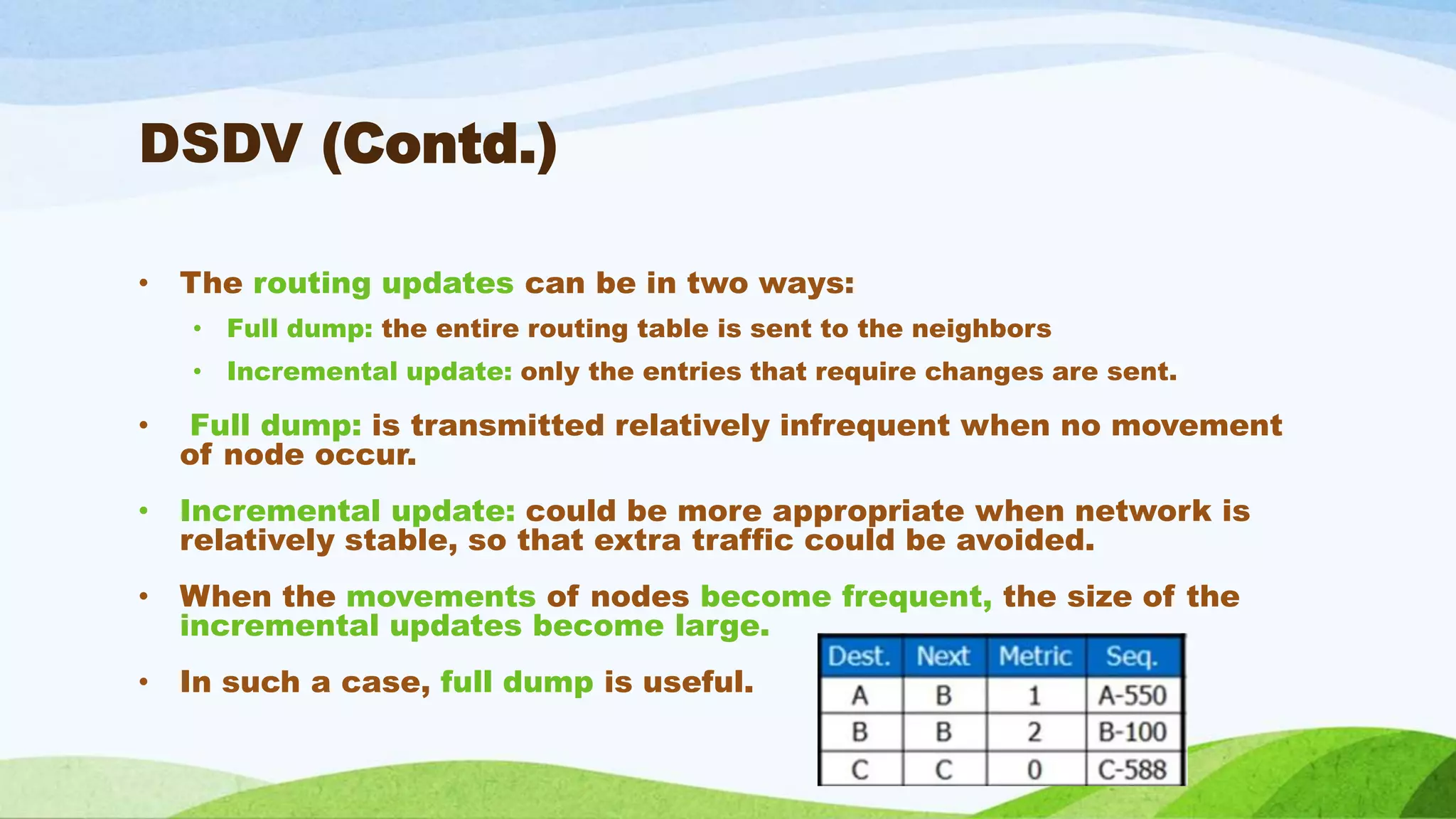
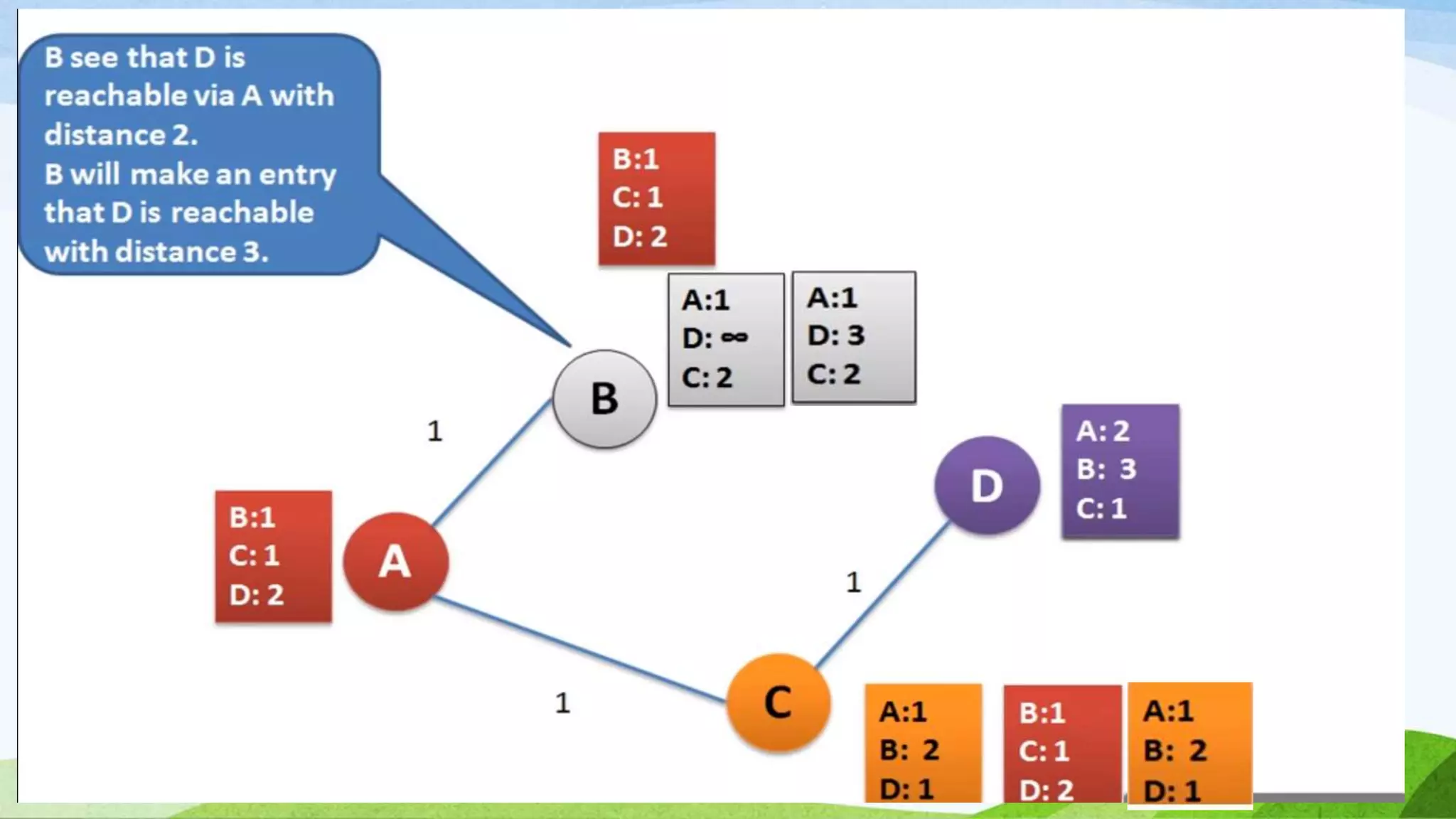
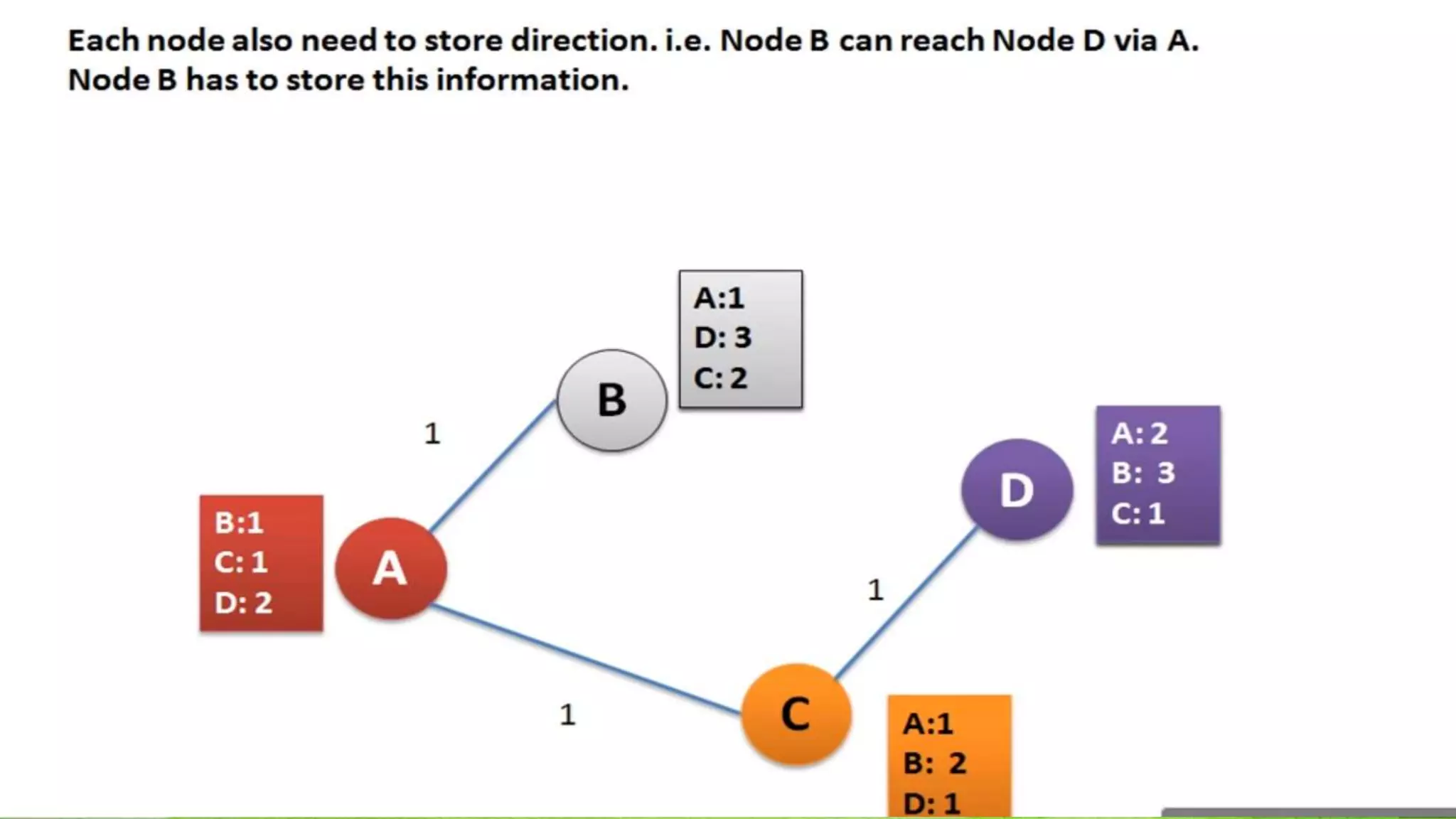
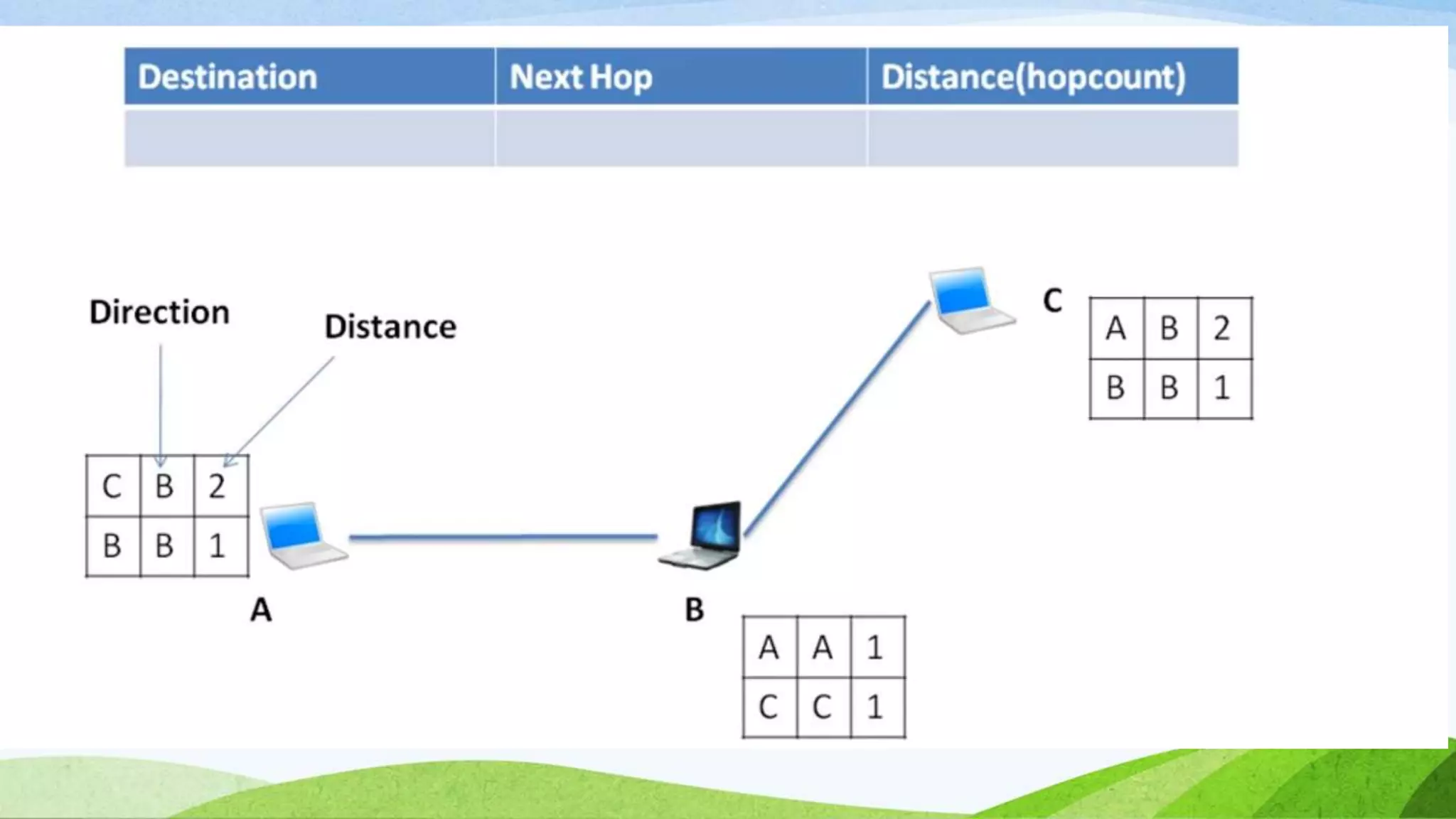
• Each mobile nodes keeps a routing table.
• Table driven routing protocols
• Each of the routing table contains the list of all available
destinations and the number of hops
• Each table entry is tagged with a sequence number
which is originated by the destination nodes.
• Periodic transmissions of updates of the routing tables
help maintaining the topology information of the
network.
4.
DSDV
• If thereis any new significant change for the routing
information, the updates are transmitted immediately
• Routing information updates might either be periodic or event
driven.
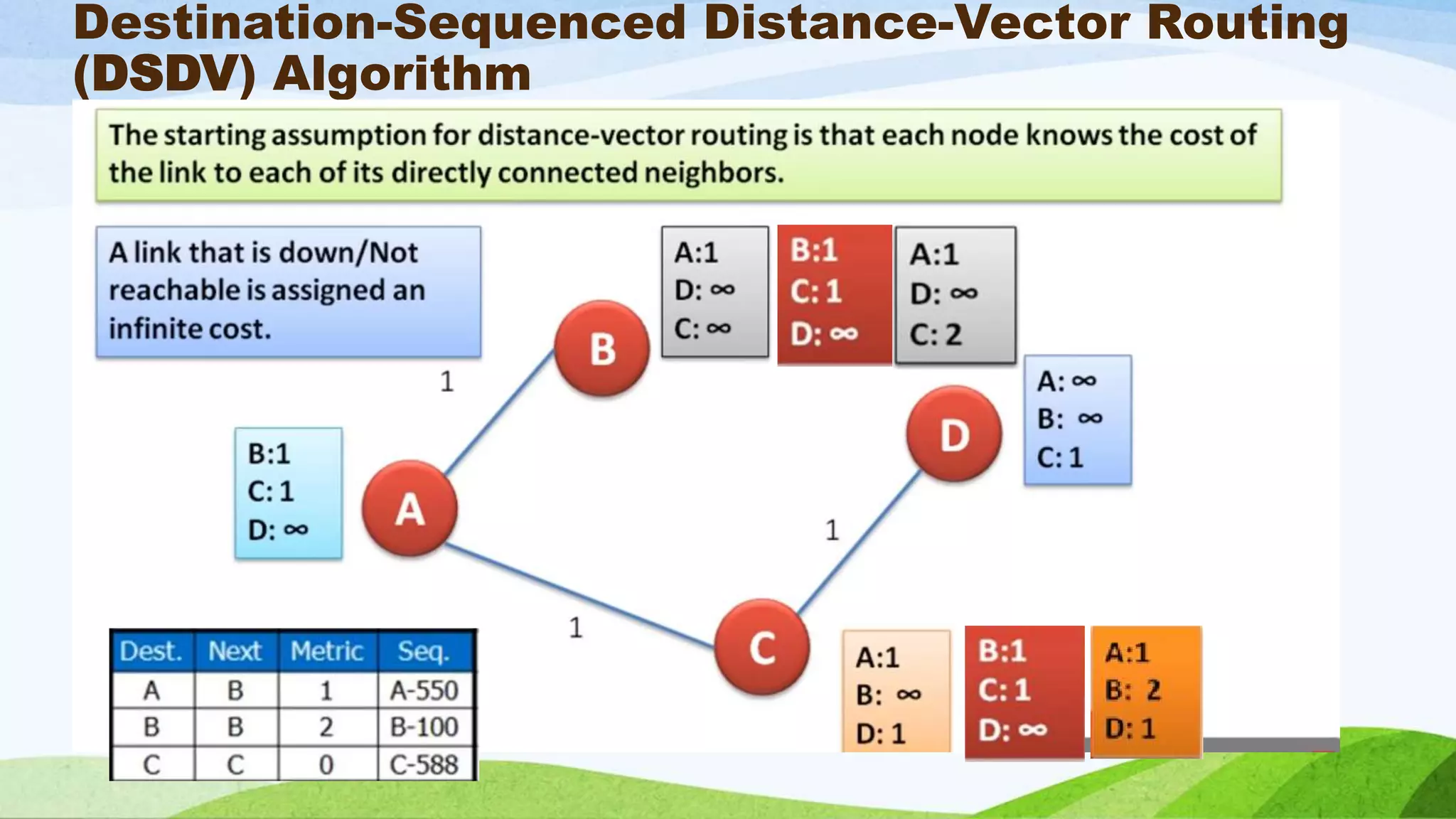
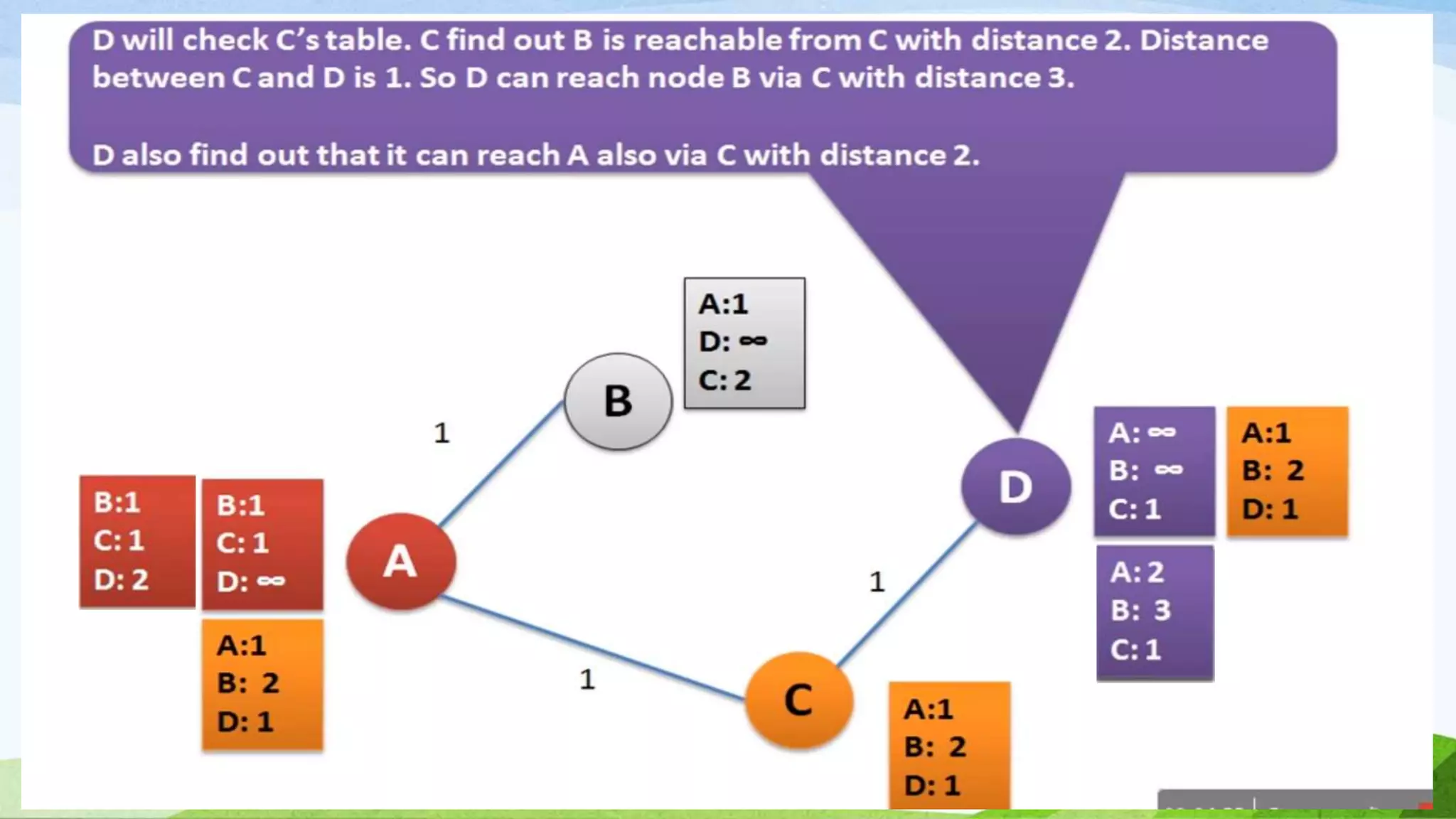
• DSDV requires each mobile nodes in the network to advertise
its own routing table to its current neighbors.
• The advertisements, is done either by broadcasting or by
multicasting.
• By the advertisements, the neighboring nodes can know about
any change that has occurred in the network due to the
movements of nodes.
5.
DSDV (Contd.)
• Therouting updates can be in two ways:
• Full dump: the entire routing table is sent to the neighbors
• Incremental update: only the entries that require changes are sent.
• Full dump: is transmitted relatively infrequent when no movement
of node occur.
• Incremental update: could be more appropriate when network is
relatively stable, so that extra traffic could be avoided.
• When the movements of nodes become frequent, the size of the
incremental updates become large.
• In such a case, full dump is useful.
6.
DSDV (Contd.)
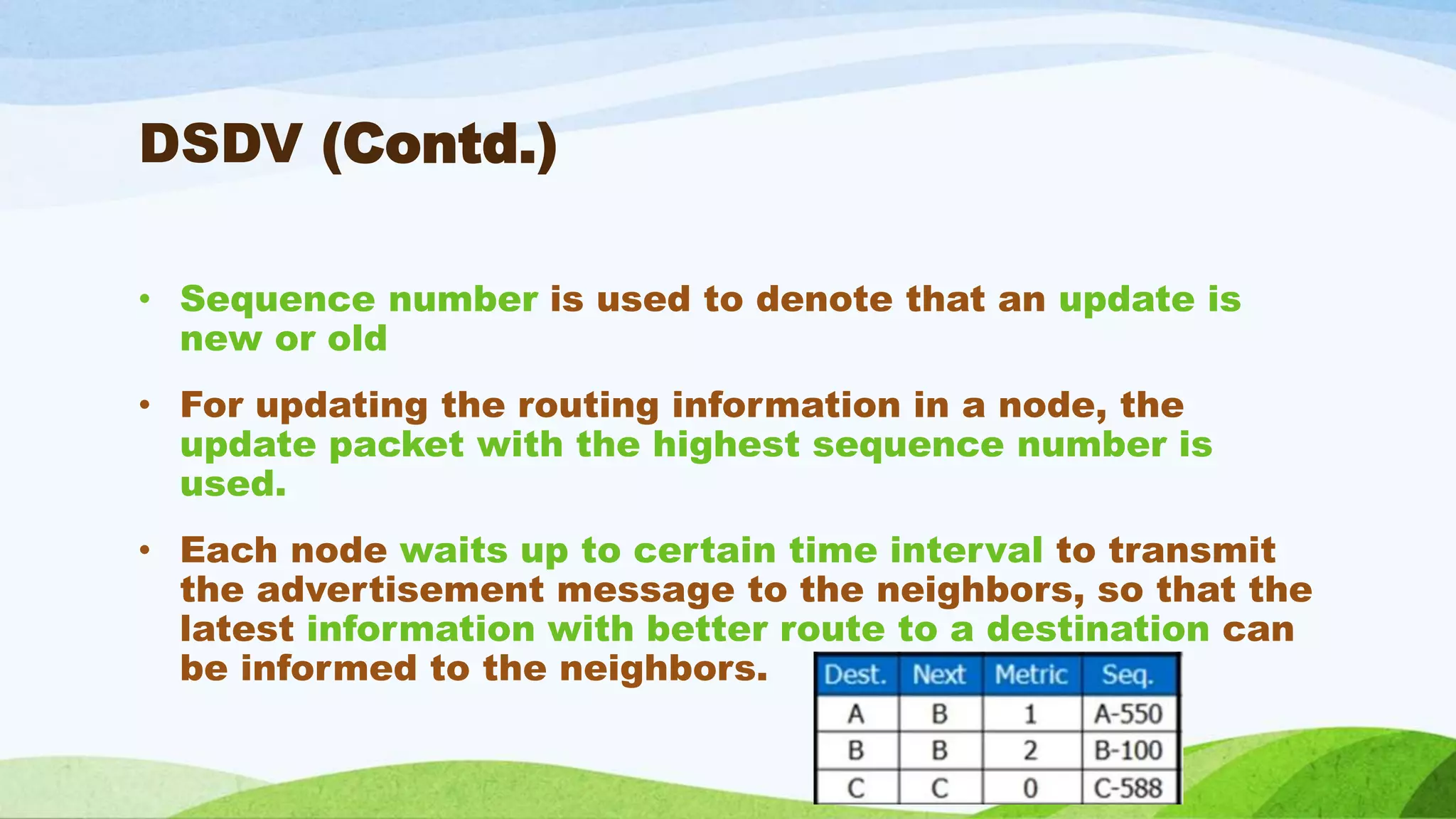
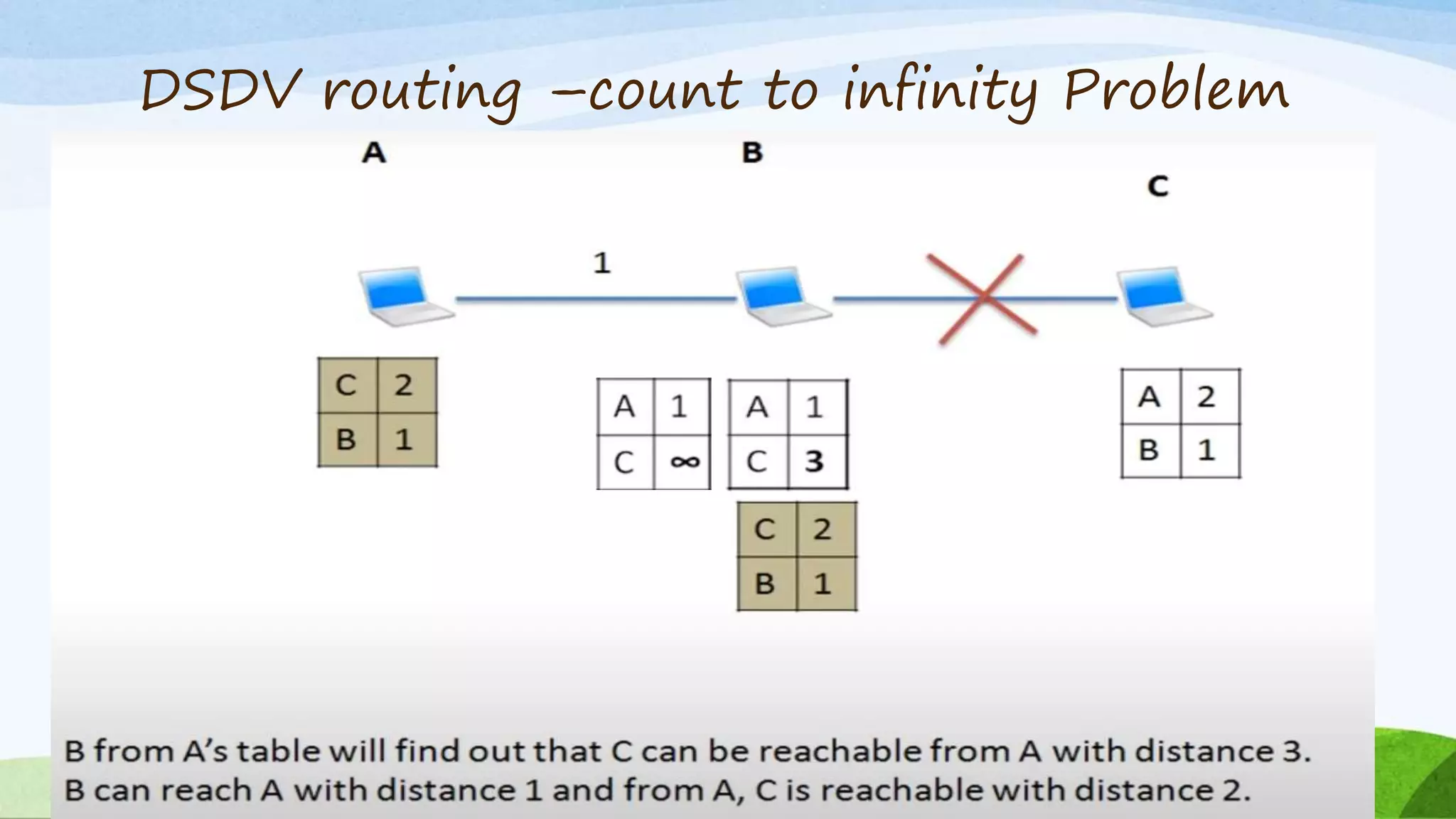
• Sequencenumber is used to denote that an update is
new or old
• For updating the routing information in a node, the
update packet with the highest sequence number is
used.
• Each node waits up to certain time interval to transmit
the advertisement message to the neighbors, so that the
latest information with better route to a destination can
be informed to the neighbors.
DSDV-Summary
• Proactive routingprotocol
• Each node maintain a routing table.
• Sequence number is used to update the topology information
• Update can be done based on event driven or periodic
• Observations
• May be energy expensive due to high mobility of the nodes
• Delay can be minimized, as path to destination is already known to
all nodes.