Broadband Over Power Lines
Introduction Broadband over Power Line (BPL) is a technology that allows Internet data to be transmitted over utility power lines. (BPL is also sometimes called Power-line Communications or PLC.)  No phone, cable or satellite connection is required. BPL operates at speeds similar to those of digital subscriber line (DSL).
Introduction BPL works by modulating high-frequency radio waves with the digital signals from the Internet using OFDM(Orthogonal frequency-division multiplexing ). All power line communications systems operate by impressing a modulated carrier signal on the wiring system.  A BPL subscriber installs a modem that plugs into an ordinary wall outlet and pays a subscription fee similar to those paid for other types of Internet service.
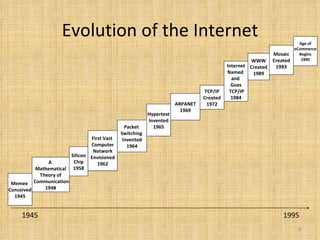
Evolution of the Internet 1945 1995 Memex  Conceived 1945 WWW Created 1989 Mosaic Created 1993 A  Mathematical Theory of Communication 1948 Packet  Switching  Invented 1964 Silicon Chip 1958 First Vast  Computer Network Envisioned 1962 ARPANET 1969 TCP/IP Created 1972 Internet Named  and  Goes TCP/IP 1984 Hypertext Invented 1965 Age of eCommerce Begins 1995
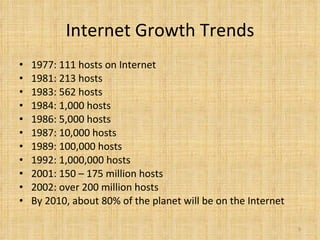
Internet Growth Trends 1977: 111 hosts on Internet 1981: 213 hosts 1983: 562 hosts 1984: 1,000 hosts 1986: 5,000 hosts 1987: 10,000 hosts 1989: 100,000 hosts 1992: 1,000,000 hosts 2001: 150 – 175 million hosts 2002: over 200 million hosts By 2010, about 80% of the planet will be on the Internet
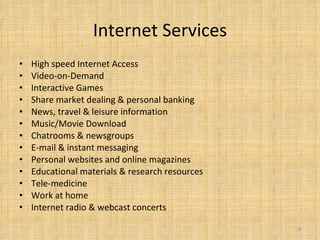
Internet Services High speed Internet Access Video-on-Demand Interactive Games Share market dealing & personal banking News, travel & leisure information Music/Movie Download Chatrooms & newsgroups E-mail & instant messaging Personal websites and online magazines Educational materials & research resources Tele-medicine Work at home Internet radio & webcast concerts
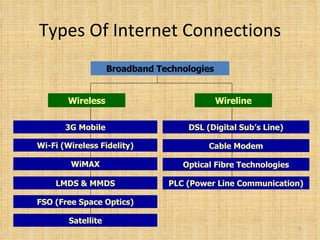
Types Of Internet Connections Broadband Technologies Wireless 3G Mobile Wireline Wi-Fi (Wireless Fidelity) LMDS & MMDS FSO (Free Space Optics) Satellite DSL (Digital Sub’s Line) Cable Modem Optical Fibre Technologies PLC (Power Line Communication) WiMAX
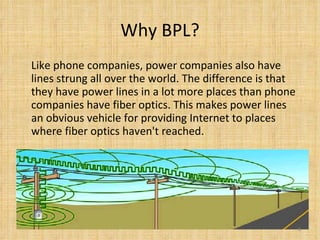
Why BPL? Like phone companies, power companies also have lines strung all over the world. The difference is that they have power lines in a lot more places than phone companies have fiber optics. This makes power lines an obvious vehicle for providing Internet to places where fiber optics haven't reached.
Key Architectural Choices For BPL System Bypass Transformer or Pierce Transformer? (MV to LV Conversion) Bypassing transformer allows lower and more predictable signal loss, piercing requires no equipment Signal Repetition Regenerating data packets at various points allows greater reach at the expense of lower bandwidth and greater latency Bandwidth and latency   Desired service offerings Latency sensitive applications – voice and gaming
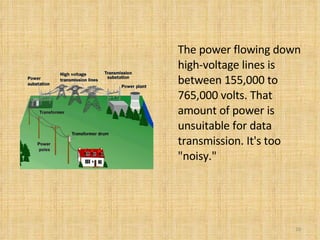
The power flowing down high-voltage lines is between 155,000 to 765,000 volts. That amount of power is unsuitable for data transmission. It's too "noisy."
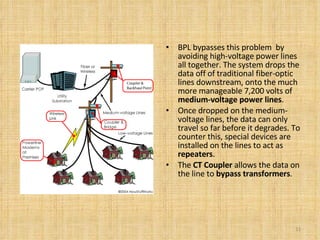
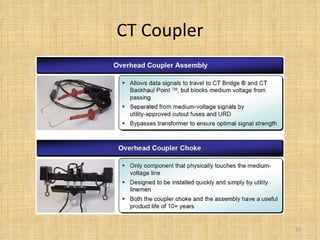
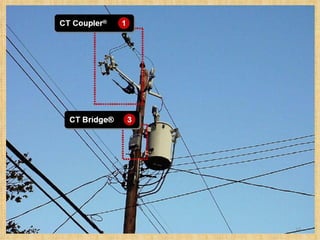
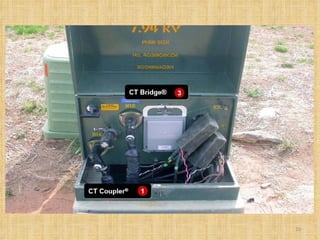
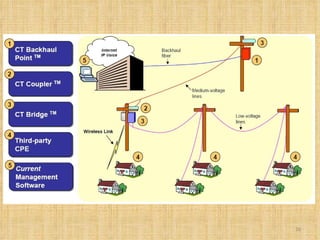
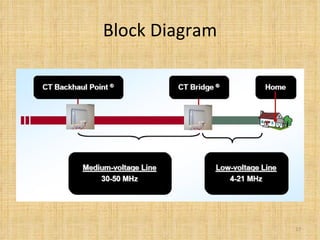
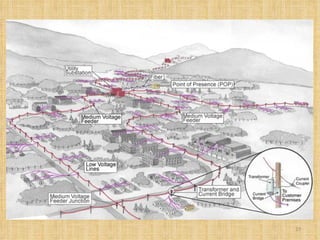
BPL bypasses this problem  by avoiding high-voltage power lines all together. The system drops the data off of traditional fiber-optic lines downstream, onto the much more manageable 7,200 volts of  medium-voltage power lines .  Once dropped on the medium-voltage lines, the data can only travel so far before it degrades. To counter this, special devices are installed on the lines to act as  repeaters .  The  CT Coupler  allows the data on the line to  bypass transformers .
CT Bridge The CT Bridge can also:  Manage symmetric data transmission to all the electrical outlets in the customer's home or office ("Symmetric" means that uploads and downloads are transmitted at the same speed.)  Support WiFi hot spots  Handle data routing  Manage subscriber information  Employ Dynamic Host Configuration Protocol (DHCP - The protocol that allows the management and assignment of IP addresses on a network)  Support security encryption of all transmissions
CT Coupler
Block Diagram
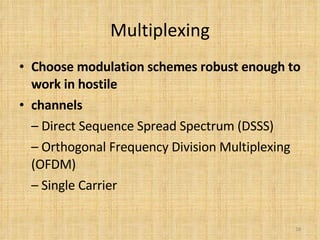
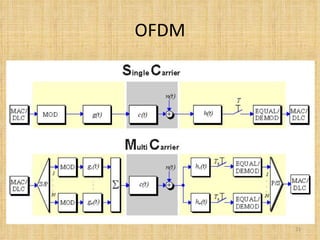
Multiplexing Choose modulation schemes robust enough to work in hostile channels –  Direct Sequence Spread Spectrum (DSSS) –  Orthogonal Frequency Division Multiplexing (OFDM) –  Single Carrier
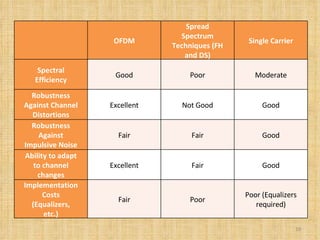
OFDM Spread Spectrum Techniques (FH and DS) Single Carrier Spectral Efficiency Good Poor Moderate Robustness Against Channel Distortions Excellent Not Good Good Robustness Against Impulsive Noise Fair Fair Good Ability to adapt to channel changes Excellent Fair Good Implementation Costs (Equalizers, etc.) Fair Poor Poor (Equalizers required)
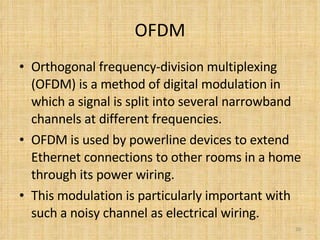
OFDM Orthogonal frequency-division multiplexing (OFDM) is a method of digital modulation in which a signal is split into several narrowband channels at different frequencies. OFDM is used by powerline devices to extend Ethernet connections to other rooms in a home through its power wiring.  This modulation is particularly important with such a noisy channel as electrical wiring.
OFDM
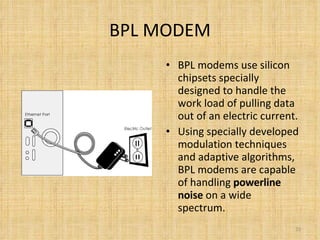
BPL MODEM BPL modems use silicon chipsets specially designed to handle the work load of pulling data out of an electric current. Using specially developed modulation techniques and adaptive algorithms, BPL modems are capable of handling  powerline noise  on a wide spectrum.
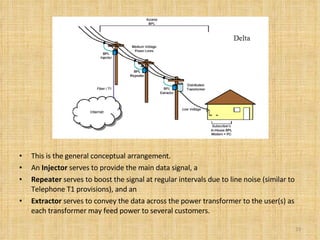
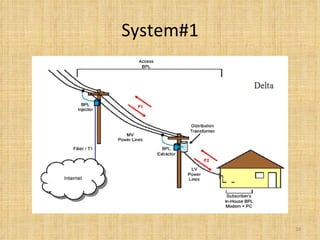
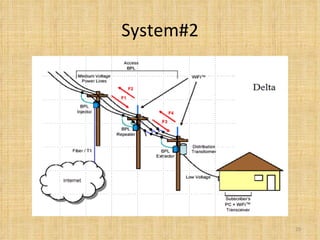
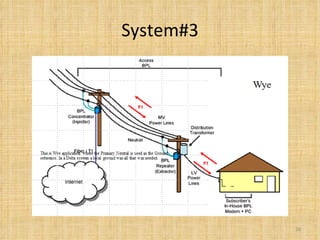
This is the general conceptual arrangement.  An  Injector  serves to provide the main data signal, a  Repeater  serves to boost the signal at regular intervals due to line noise (similar to Telephone T1 provisions), and an  Extractor  serves to convey the data across the power transformer to the user(s) as each transformer may feed power to several customers.
System#1
System#2
System#3
Applications Home networking Automotive Uses
References How stuff works wikipidia

Final rohit bpl

  • 1.
  • 2.
    Introduction Broadband overPower Line (BPL) is a technology that allows Internet data to be transmitted over utility power lines. (BPL is also sometimes called Power-line Communications or PLC.) No phone, cable or satellite connection is required. BPL operates at speeds similar to those of digital subscriber line (DSL).
  • 3.
    Introduction BPL worksby modulating high-frequency radio waves with the digital signals from the Internet using OFDM(Orthogonal frequency-division multiplexing ). All power line communications systems operate by impressing a modulated carrier signal on the wiring system. A BPL subscriber installs a modem that plugs into an ordinary wall outlet and pays a subscription fee similar to those paid for other types of Internet service.
  • 4.
    Evolution of theInternet 1945 1995 Memex Conceived 1945 WWW Created 1989 Mosaic Created 1993 A Mathematical Theory of Communication 1948 Packet Switching Invented 1964 Silicon Chip 1958 First Vast Computer Network Envisioned 1962 ARPANET 1969 TCP/IP Created 1972 Internet Named and Goes TCP/IP 1984 Hypertext Invented 1965 Age of eCommerce Begins 1995
  • 5.
    Internet Growth Trends1977: 111 hosts on Internet 1981: 213 hosts 1983: 562 hosts 1984: 1,000 hosts 1986: 5,000 hosts 1987: 10,000 hosts 1989: 100,000 hosts 1992: 1,000,000 hosts 2001: 150 – 175 million hosts 2002: over 200 million hosts By 2010, about 80% of the planet will be on the Internet
  • 6.
    Internet Services Highspeed Internet Access Video-on-Demand Interactive Games Share market dealing & personal banking News, travel & leisure information Music/Movie Download Chatrooms & newsgroups E-mail & instant messaging Personal websites and online magazines Educational materials & research resources Tele-medicine Work at home Internet radio & webcast concerts
  • 7.
    Types Of InternetConnections Broadband Technologies Wireless 3G Mobile Wireline Wi-Fi (Wireless Fidelity) LMDS & MMDS FSO (Free Space Optics) Satellite DSL (Digital Sub’s Line) Cable Modem Optical Fibre Technologies PLC (Power Line Communication) WiMAX
  • 8.
    Why BPL? Likephone companies, power companies also have lines strung all over the world. The difference is that they have power lines in a lot more places than phone companies have fiber optics. This makes power lines an obvious vehicle for providing Internet to places where fiber optics haven't reached.
  • 9.
    Key Architectural ChoicesFor BPL System Bypass Transformer or Pierce Transformer? (MV to LV Conversion) Bypassing transformer allows lower and more predictable signal loss, piercing requires no equipment Signal Repetition Regenerating data packets at various points allows greater reach at the expense of lower bandwidth and greater latency Bandwidth and latency Desired service offerings Latency sensitive applications – voice and gaming
  • 10.
    The power flowingdown high-voltage lines is between 155,000 to 765,000 volts. That amount of power is unsuitable for data transmission. It's too "noisy."
  • 11.
    BPL bypasses thisproblem by avoiding high-voltage power lines all together. The system drops the data off of traditional fiber-optic lines downstream, onto the much more manageable 7,200 volts of medium-voltage power lines . Once dropped on the medium-voltage lines, the data can only travel so far before it degrades. To counter this, special devices are installed on the lines to act as repeaters . The CT Coupler allows the data on the line to bypass transformers .
  • 12.
    CT Bridge TheCT Bridge can also: Manage symmetric data transmission to all the electrical outlets in the customer's home or office ("Symmetric" means that uploads and downloads are transmitted at the same speed.) Support WiFi hot spots Handle data routing Manage subscriber information Employ Dynamic Host Configuration Protocol (DHCP - The protocol that allows the management and assignment of IP addresses on a network) Support security encryption of all transmissions
  • 13.
  • 17.
  • 18.
    Multiplexing Choose modulationschemes robust enough to work in hostile channels – Direct Sequence Spread Spectrum (DSSS) – Orthogonal Frequency Division Multiplexing (OFDM) – Single Carrier
  • 19.
    OFDM Spread SpectrumTechniques (FH and DS) Single Carrier Spectral Efficiency Good Poor Moderate Robustness Against Channel Distortions Excellent Not Good Good Robustness Against Impulsive Noise Fair Fair Good Ability to adapt to channel changes Excellent Fair Good Implementation Costs (Equalizers, etc.) Fair Poor Poor (Equalizers required)
  • 20.
    OFDM Orthogonal frequency-divisionmultiplexing (OFDM) is a method of digital modulation in which a signal is split into several narrowband channels at different frequencies. OFDM is used by powerline devices to extend Ethernet connections to other rooms in a home through its power wiring. This modulation is particularly important with such a noisy channel as electrical wiring.
  • 21.
  • 22.
    BPL MODEM BPLmodems use silicon chipsets specially designed to handle the work load of pulling data out of an electric current. Using specially developed modulation techniques and adaptive algorithms, BPL modems are capable of handling powerline noise on a wide spectrum.
  • 23.
    This is thegeneral conceptual arrangement. An Injector serves to provide the main data signal, a Repeater serves to boost the signal at regular intervals due to line noise (similar to Telephone T1 provisions), and an Extractor serves to convey the data across the power transformer to the user(s) as each transformer may feed power to several customers.
  • 24.
  • 25.
  • 26.
  • 28.
  • 29.
    References How stuffworks wikipidia