Optical network architecture
Presented by:-
Siddharth Singh
1109131099
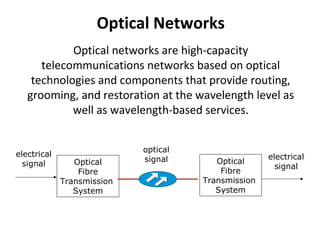
Optical Networks
Optical networks are high-capacity
telecommunications networks based on optical
technologies and components that provide routing,
grooming, and restoration at the wavelength level as
well as wavelength-based services.
Optical
Fibre
Transmission
System
Optical
Fibre
Transmission
System
electrical
signal
electrical
signal
optical
signal
Optical Network Architecture
• Network architecture: The general physical
arrangement and operational characteristics of
communicating equipment together with a common
set of communication protocols
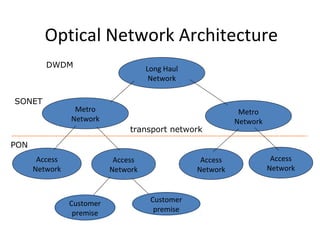
• Optical Network enables carriers to deploy an optical
service platform into regional and long haul core
transport networks to maximize service flexibility
simplify network operations.
Optical Network Architecture
Metro
Network
Long Haul
Network
Metro
Network
Access
Network
Access
Network
Access
Network
Access
Network
transport network
PON
SONET
DWDM
Customer
premise
Customer
premise
Customer
premise
Customer
premise
Synchronous Optical Networks
• SONET is the TDM optical network standard
for North America
• SONET is called Synchronous Digital
Hierarchy (SDH) in the rest of the world
• SONET is the basic physical layer standard
• Other data types such as ATM and IP can be
transmitted over SONET.
• Linear multiplexing and de-multiplexing is
possible with Add-Drop-Multiplexers
SONET/SDH
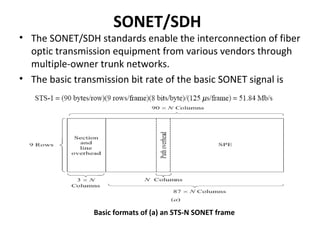
• The SONET/SDH standards enable the interconnection of fiber
optic transmission equipment from various vendors through
multiple-owner trunk networks.
• The basic transmission bit rate of the basic SONET signal is
Basic formats of (a) an STS-N SONET frame
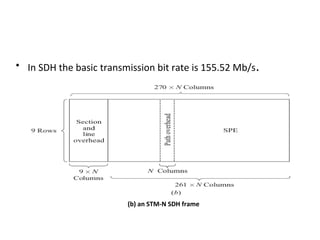
• In SDH the basic transmission bit rate is 155.52 Mb/s.
(b) an STM-N SDH frame
SONET/SDH Rings
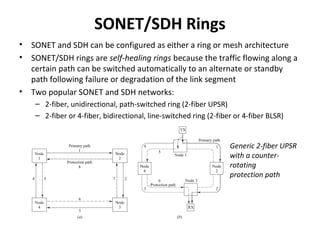
• SONET and SDH can be configured as either a ring or mesh architecture
• SONET/SDH rings are self-healing rings because the traffic flowing along a
certain path can be switched automatically to an alternate or standby
path following failure or degradation of the link segment
• Two popular SONET and SDH networks:
– 2-fiber, unidirectional, path-switched ring (2-fiber UPSR)
– 2-fiber or 4-fiber, bidirectional, line-switched ring (2-fiber or 4-fiber BLSR)
Generic 2-fiber UPSR
with a counter-
rotating
protection path
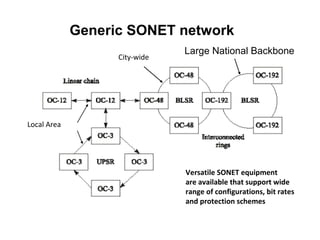
Generic SONET network
Large National Backbone
City-wide
Local Area
Versatile SONET equipment
are available that support wide
range of configurations, bit rates
and protection schemes
Passive Optical Networks
• In general, there is no O/E conversion between the
transmitter and the receiver (one continuous light path) in
PON networks
• Only passive elements used to configure the network
• Power budget and rise time calculations has to be done
from end-to-end
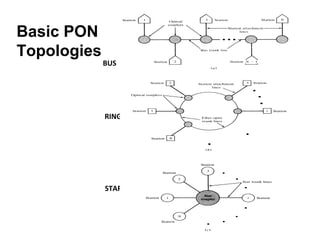
• There are star, bus, ring, mesh & tree topologies
• Currently PON Access Networks are deployed widely and
the word PON means mainly the access nw.
The PON will still need higher layer protocols (Ethernet/IP etc.) to
separate multiple users
Basic PON
Topologies
BUS
RING
STAR
Star, Tree & Bus Networks
• Tree networks are widely deployed in the access
front
• Tree couplers are similar to star couplers
(expansion in only one direction; no splitting in
the uplink)
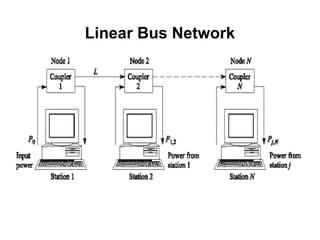
• Bus networks are widely used in LANs
• Ring networks (folded buses with protection) are
widely used in MAN
• Designing ring & bus networks is similar
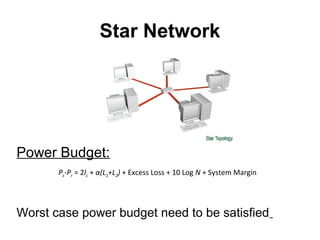
Star Network
Power Budget:
Worst case power budget need to be satisfied
Ps-Pr = 2lc + α(L1+L2) + Excess Loss + 10 Log N + System Margin
Linear Bus Network
Passive Optical Networks (PONs)
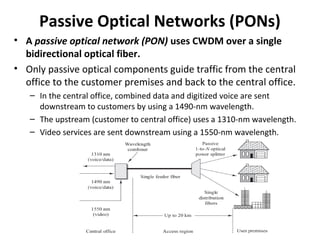
• A passive optical network (PON) uses CWDM over a single
bidirectional optical fiber.
• Only passive optical components guide traffic from the central
office to the customer premises and back to the central office.
– In the central office, combined data and digitized voice are sent
downstream to customers by using a 1490-nm wavelength.
– The upstream (customer to central office) uses a 1310-nm wavelength.
– Video services are sent downstream using a 1550-nm wavelength.
Active PON Modules
• The optical line termination (OLT) is located in a central office and
controls the bidirectional flow of information across the network.
• An optical network termination (ONT) is located directly at the customer
premises.
– The ONT provides an optical connection to the PON on the upstream
side and to interface electrically to the local customer equipment.
• An optical network unit (ONU) is similar to an ONT, but is located near
the customer and is housed in an outdoor equipment shelter.
References
IEEE Explore
http://ieeexplore.ieee.org
IEEE spectrum
www.ieee-spectrum.org/
"SONET/SDH Technical Summary". TechFest.
TechFest.com. 2002. Retrieved 2010-11-13
March 19, 2015 17

Optical network architecture

  • 1.
    Optical network architecture Presentedby:- Siddharth Singh 1109131099
  • 2.
    Optical Networks Optical networksare high-capacity telecommunications networks based on optical technologies and components that provide routing, grooming, and restoration at the wavelength level as well as wavelength-based services. Optical Fibre Transmission System Optical Fibre Transmission System electrical signal electrical signal optical signal
  • 3.
    Optical Network Architecture •Network architecture: The general physical arrangement and operational characteristics of communicating equipment together with a common set of communication protocols • Optical Network enables carriers to deploy an optical service platform into regional and long haul core transport networks to maximize service flexibility simplify network operations.
  • 4.
    Optical Network Architecture Metro Network LongHaul Network Metro Network Access Network Access Network Access Network Access Network transport network PON SONET DWDM Customer premise Customer premise Customer premise Customer premise
  • 5.
    Synchronous Optical Networks •SONET is the TDM optical network standard for North America • SONET is called Synchronous Digital Hierarchy (SDH) in the rest of the world • SONET is the basic physical layer standard • Other data types such as ATM and IP can be transmitted over SONET. • Linear multiplexing and de-multiplexing is possible with Add-Drop-Multiplexers
  • 6.
    SONET/SDH • The SONET/SDHstandards enable the interconnection of fiber optic transmission equipment from various vendors through multiple-owner trunk networks. • The basic transmission bit rate of the basic SONET signal is Basic formats of (a) an STS-N SONET frame
  • 7.
    • In SDHthe basic transmission bit rate is 155.52 Mb/s. (b) an STM-N SDH frame
  • 8.
    SONET/SDH Rings • SONETand SDH can be configured as either a ring or mesh architecture • SONET/SDH rings are self-healing rings because the traffic flowing along a certain path can be switched automatically to an alternate or standby path following failure or degradation of the link segment • Two popular SONET and SDH networks: – 2-fiber, unidirectional, path-switched ring (2-fiber UPSR) – 2-fiber or 4-fiber, bidirectional, line-switched ring (2-fiber or 4-fiber BLSR) Generic 2-fiber UPSR with a counter- rotating protection path
  • 9.
    Generic SONET network LargeNational Backbone City-wide Local Area Versatile SONET equipment are available that support wide range of configurations, bit rates and protection schemes
  • 10.
    Passive Optical Networks •In general, there is no O/E conversion between the transmitter and the receiver (one continuous light path) in PON networks • Only passive elements used to configure the network • Power budget and rise time calculations has to be done from end-to-end • There are star, bus, ring, mesh & tree topologies • Currently PON Access Networks are deployed widely and the word PON means mainly the access nw. The PON will still need higher layer protocols (Ethernet/IP etc.) to separate multiple users
  • 11.
  • 12.
    Star, Tree &Bus Networks • Tree networks are widely deployed in the access front • Tree couplers are similar to star couplers (expansion in only one direction; no splitting in the uplink) • Bus networks are widely used in LANs • Ring networks (folded buses with protection) are widely used in MAN • Designing ring & bus networks is similar
  • 13.
    Star Network Power Budget: Worstcase power budget need to be satisfied Ps-Pr = 2lc + α(L1+L2) + Excess Loss + 10 Log N + System Margin
  • 14.
  • 15.
    Passive Optical Networks(PONs) • A passive optical network (PON) uses CWDM over a single bidirectional optical fiber. • Only passive optical components guide traffic from the central office to the customer premises and back to the central office. – In the central office, combined data and digitized voice are sent downstream to customers by using a 1490-nm wavelength. – The upstream (customer to central office) uses a 1310-nm wavelength. – Video services are sent downstream using a 1550-nm wavelength.
  • 16.
    Active PON Modules •The optical line termination (OLT) is located in a central office and controls the bidirectional flow of information across the network. • An optical network termination (ONT) is located directly at the customer premises. – The ONT provides an optical connection to the PON on the upstream side and to interface electrically to the local customer equipment. • An optical network unit (ONU) is similar to an ONT, but is located near the customer and is housed in an outdoor equipment shelter.
  • 17.
    References IEEE Explore http://ieeexplore.ieee.org IEEE spectrum www.ieee-spectrum.org/ "SONET/SDHTechnical Summary". TechFest. TechFest.com. 2002. Retrieved 2010-11-13 March 19, 2015 17