EC8702 AD HOC AND
WIRELESS SENSOR
NETWORKS
Dr.Arun Chokkalingam
Professor
Department of Electronics and Communication
RMK College of Engineering and Technology
Chennai.
UNIT-1- MANET Routing Protocols
Content
1. Introduction about routing
2. Issues in designing a routing protocol
3. Characteristics of an ideal routing protocol
4. Classifications of routing protocols
MANET Protocol Stack
Three important functions of Network
layer :
1.Path determination: identifying path
between source to destination.
2.Switching: move packets from
router’s input to appropriate router
output
3. Addressing: Addressing is
necessary to identify each device on
the network uniquely.
Introduction
• The neighbors can communicate
directly and no routing is required.
But. If A and C want to communicate
with each other, they must seek help
from node B
• Nodes A knows about B and C knows
about B , so both A and C can use B as
an intermediate node for their
communications.
• Simple neighbor information could be
used here
Cont.
• With the addition of node D, we have several options to
exchange data from A can take the path, A-B-C or A-D-C
or A-D-B-C or A-B-D-C. this is where we need to employ
efficient mechanism or logic for routing the packet in
the best possible way.
• The whole scenario gets
even more complicated
with the increase of the
number of nodes in the network.
ROUTING PROTOCOLS FOR AD HOC
WIRELESS NETWORKS
• Traditional wired networks routing protocols are suitable
for ad hoc wireless networks.
Major Challenges or Issues in Designing a
Routing Protocol
1. Mobility of nodes,
2. Bandwidth Constraint
3. Error-prone channel state,
4. Hidden and Exposed terminal
problems.
5. Resource Constraints
Cont..
1.Mobility
• highly dynamic due to the movement of nodes
• Frequent path breaks.
• Must be able to perform efficient and effective mobility
management .
2.Bandwidth Constraint
• The radio band is limited
• Routing protocols use the bandwidth optimally by keeping the
overhead as low as possible.
• Due to the frequent changes in topology, results in more bandwidth
wastage
Cont.
3.Error-Prone Shared Broadcast Radio Channel
• The wireless links have time-varying
characteristics in terms of link capacity and link-
error probability.
• Ad hoc wireless networks result in collisions of
data and control packets.
• It is required that ad hoc wireless network routing
protocols find paths with less congestion.
4. Hidden and Exposed Terminal
Problems
• The hidden terminal problem refers to the collision of
packets at a receiving node due to the simultaneous
transmission of those nodes that are not within the
direct transmission range of the sender, but are within
the transmission range of the receiver.
• Collision occurs when both nodes transmit packets at
the same time without knowing about the transmission
of each other.
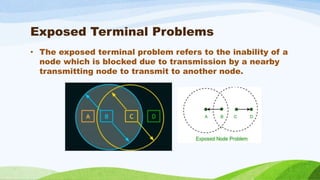
Exposed Terminal Problems
• The exposed terminal problem refers to the inability of a
node which is blocked due to transmission by a nearby
transmitting node to transmit to another node.
Solution for Hidden and Exposed
Terminal Problems
• Medium access collision avoidance
for wireless (MACAW)
• A two-way handshake control
protocol called the (request to send
/ clear to send) protocol exchange.
• RTS/CTS is the optional mechanism
used by the 802.11 wireless
networking protocol to reduce
frame collisions introduced by the
hidden node problem
5.Resource Constraints
• Two essential and limited resources that form the major
constraint for the nodes in an ad hoc wireless network
are battery life and processing power.
• Routing protocols must optimally manage these
resources.
Characteristics of an Ideal Routing
Protocol
1. Must be fully distributed, no central coordination.
2. Must be adaptive to frequent topology changes caused by the
mobility of nodes.
3. Route computation and maintenance must involve a minimum
number of nodes; that is, minimum connection setup time is desired.
4. Must be localized, as global state maintenance involves a huge
state propagation control overhead.
5. It must be loop-free and free from out dated routes.
Cont..
6. The number of packet collisions must be a minimum and the transmissions
should be reliable
7. It must converge to optimal routes once the network topology becomes
stable. The convergence must be quick.
8. It must optimally use resources such as bandwidth, computing power,
memory, and battery power.
9. Every node in the network should try to store information regarding the
stable local topology only. Changes in remote parts of the network must not
cause updates in the topology information maintained by the node.
10. It should provide QoS guarantees to support time-sensitive traffic
CLASSIFICATIONS OF ROUTING
PROTOCOLS
1. Based on routing information update mechanism
• Proactive (table-driven) routing protocols;
• Reactive (on-demand) routing protocols;
• Hybrid protocols.
2. Based on usage of temporal information
• Past temporal information;
• Future temporal information.
3. Based on the routing topology
• Flat topology routing protocols:
• Hierarchical topology routing protocols:
4. Routing based on utilization of specific resources:
• Power-aware routing;
• Geographical information assisted routing.
CLASSIFICATIONS OF ROUTING
PROTOCOLS
Cont..
1.Based on routing information update
mechanism
Proactive routing protocols
• In table-driven routing protocols, every node maintains
the network topology information in the form of routing
tables by periodically exchanging routing information.
• Sometimes called as table driven routing protocols
• Periodic update is required
Reactive routing protocols
• Protocols that fall under this category do not maintain
the network topology information.
• They obtain the necessary path when it is required, by
using a connection establishment process.
• Hence these protocols do not exchange routing
information periodically.
• Reactive protocols are also known as on demand routing
protocols.
Hybrid routing protocols
• Often reactive or proactive feature of a particular
routing protocol might not be enough.
• Instead a mixture might yield better solution, hence, in
the recent days, several hybrid protocols are also
proposed
• The hybrid protocols include some of the characteristics
of proactive protocols and some of the characteristics
of reactive protocols .
2.Based on usage of temporal information
Routing protocols using past temporal information:
• These routing protocols use information about the past status
of the links at the time of routing to make routing decisions
Routing protocols that use future temporal information:
• Protocols belonging to this category use information about the
expected future status of the wireless links to make
approximate routing decisions
• which is based on the remaining battery charge and discharge
rate, prediction of location, and prediction of link availability
3.Based on the Routing Topology
• Ad hoc wireless networks, due to their relatively smaller number of nodes, can make
use of either a flat topology or a hierarchical topology for routing.
1. Flat topology routing protocols:
• Protocols that fall under this category make use of a flat addressing scheme
similar to IEEE 802.3 Ethernet LANs.
• Flat routing protocol distributes routing information to routers that are connected
to each other without any organization or segmentation structure between them.
2. Hierarchical topology routing protocols:
• Protocols belonging to this category make use of a logical hierarchy in the
network and an associated addressing scheme.
• The hierarchy could be based on geographical information or it could be based on
hop distance.
4.Based on the Utilization of Specific
Resources
1. Power-aware routing:
• The routing decisions are based on minimizing the
power consumption either locally or globally in the
network.
2. Geographical information assisted routing:
• Protocols belonging to this category improve the
performance of routing and reduce the control overhead
by effectively utilizing the geographical information
available.
Thank you

MANET routing protocols Issues and Classifications

  • 1.
    EC8702 AD HOCAND WIRELESS SENSOR NETWORKS Dr.Arun Chokkalingam Professor Department of Electronics and Communication RMK College of Engineering and Technology Chennai. UNIT-1- MANET Routing Protocols
  • 2.
    Content 1. Introduction aboutrouting 2. Issues in designing a routing protocol 3. Characteristics of an ideal routing protocol 4. Classifications of routing protocols
  • 3.
    MANET Protocol Stack Threeimportant functions of Network layer : 1.Path determination: identifying path between source to destination. 2.Switching: move packets from router’s input to appropriate router output 3. Addressing: Addressing is necessary to identify each device on the network uniquely.
  • 4.
    Introduction • The neighborscan communicate directly and no routing is required. But. If A and C want to communicate with each other, they must seek help from node B • Nodes A knows about B and C knows about B , so both A and C can use B as an intermediate node for their communications. • Simple neighbor information could be used here
  • 5.
    Cont. • With theaddition of node D, we have several options to exchange data from A can take the path, A-B-C or A-D-C or A-D-B-C or A-B-D-C. this is where we need to employ efficient mechanism or logic for routing the packet in the best possible way. • The whole scenario gets even more complicated with the increase of the number of nodes in the network.
  • 6.
    ROUTING PROTOCOLS FORAD HOC WIRELESS NETWORKS • Traditional wired networks routing protocols are suitable for ad hoc wireless networks.
  • 7.
    Major Challenges orIssues in Designing a Routing Protocol 1. Mobility of nodes, 2. Bandwidth Constraint 3. Error-prone channel state, 4. Hidden and Exposed terminal problems. 5. Resource Constraints
  • 8.
    Cont.. 1.Mobility • highly dynamicdue to the movement of nodes • Frequent path breaks. • Must be able to perform efficient and effective mobility management . 2.Bandwidth Constraint • The radio band is limited • Routing protocols use the bandwidth optimally by keeping the overhead as low as possible. • Due to the frequent changes in topology, results in more bandwidth wastage
  • 9.
    Cont. 3.Error-Prone Shared BroadcastRadio Channel • The wireless links have time-varying characteristics in terms of link capacity and link- error probability. • Ad hoc wireless networks result in collisions of data and control packets. • It is required that ad hoc wireless network routing protocols find paths with less congestion.
  • 10.
    4. Hidden andExposed Terminal Problems • The hidden terminal problem refers to the collision of packets at a receiving node due to the simultaneous transmission of those nodes that are not within the direct transmission range of the sender, but are within the transmission range of the receiver. • Collision occurs when both nodes transmit packets at the same time without knowing about the transmission of each other.
  • 11.
    Exposed Terminal Problems •The exposed terminal problem refers to the inability of a node which is blocked due to transmission by a nearby transmitting node to transmit to another node.
  • 12.
    Solution for Hiddenand Exposed Terminal Problems • Medium access collision avoidance for wireless (MACAW) • A two-way handshake control protocol called the (request to send / clear to send) protocol exchange. • RTS/CTS is the optional mechanism used by the 802.11 wireless networking protocol to reduce frame collisions introduced by the hidden node problem
  • 13.
    5.Resource Constraints • Twoessential and limited resources that form the major constraint for the nodes in an ad hoc wireless network are battery life and processing power. • Routing protocols must optimally manage these resources.
  • 14.
    Characteristics of anIdeal Routing Protocol 1. Must be fully distributed, no central coordination. 2. Must be adaptive to frequent topology changes caused by the mobility of nodes. 3. Route computation and maintenance must involve a minimum number of nodes; that is, minimum connection setup time is desired. 4. Must be localized, as global state maintenance involves a huge state propagation control overhead. 5. It must be loop-free and free from out dated routes.
  • 15.
    Cont.. 6. The numberof packet collisions must be a minimum and the transmissions should be reliable 7. It must converge to optimal routes once the network topology becomes stable. The convergence must be quick. 8. It must optimally use resources such as bandwidth, computing power, memory, and battery power. 9. Every node in the network should try to store information regarding the stable local topology only. Changes in remote parts of the network must not cause updates in the topology information maintained by the node. 10. It should provide QoS guarantees to support time-sensitive traffic
  • 16.
    CLASSIFICATIONS OF ROUTING PROTOCOLS 1.Based on routing information update mechanism • Proactive (table-driven) routing protocols; • Reactive (on-demand) routing protocols; • Hybrid protocols. 2. Based on usage of temporal information • Past temporal information; • Future temporal information. 3. Based on the routing topology • Flat topology routing protocols: • Hierarchical topology routing protocols: 4. Routing based on utilization of specific resources: • Power-aware routing; • Geographical information assisted routing.
  • 17.
  • 18.
  • 19.
    1.Based on routinginformation update mechanism Proactive routing protocols • In table-driven routing protocols, every node maintains the network topology information in the form of routing tables by periodically exchanging routing information. • Sometimes called as table driven routing protocols • Periodic update is required
  • 20.
    Reactive routing protocols •Protocols that fall under this category do not maintain the network topology information. • They obtain the necessary path when it is required, by using a connection establishment process. • Hence these protocols do not exchange routing information periodically. • Reactive protocols are also known as on demand routing protocols.
  • 21.
    Hybrid routing protocols •Often reactive or proactive feature of a particular routing protocol might not be enough. • Instead a mixture might yield better solution, hence, in the recent days, several hybrid protocols are also proposed • The hybrid protocols include some of the characteristics of proactive protocols and some of the characteristics of reactive protocols .
  • 22.
    2.Based on usageof temporal information Routing protocols using past temporal information: • These routing protocols use information about the past status of the links at the time of routing to make routing decisions Routing protocols that use future temporal information: • Protocols belonging to this category use information about the expected future status of the wireless links to make approximate routing decisions • which is based on the remaining battery charge and discharge rate, prediction of location, and prediction of link availability
  • 23.
    3.Based on theRouting Topology • Ad hoc wireless networks, due to their relatively smaller number of nodes, can make use of either a flat topology or a hierarchical topology for routing. 1. Flat topology routing protocols: • Protocols that fall under this category make use of a flat addressing scheme similar to IEEE 802.3 Ethernet LANs. • Flat routing protocol distributes routing information to routers that are connected to each other without any organization or segmentation structure between them. 2. Hierarchical topology routing protocols: • Protocols belonging to this category make use of a logical hierarchy in the network and an associated addressing scheme. • The hierarchy could be based on geographical information or it could be based on hop distance.
  • 24.
    4.Based on theUtilization of Specific Resources 1. Power-aware routing: • The routing decisions are based on minimizing the power consumption either locally or globally in the network. 2. Geographical information assisted routing: • Protocols belonging to this category improve the performance of routing and reduce the control overhead by effectively utilizing the geographical information available.
  • 25.