SUBMITTED BY:
13MIT0062
 Mobile adhoc networks
 MobileAd hoc NET work (MANET) is a self
configuring network of mobile routers (and
associated hosts)
 connected by wireless links – the union of
which forms an arbitrary topology
 Sensor networks
 Military applications
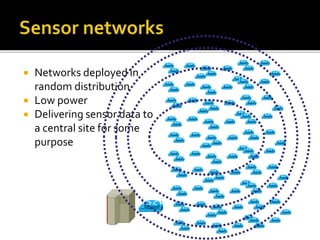
 Networks deployed in
random distribution
 Low power
 Delivering sensor data to
a central site for some
purpose
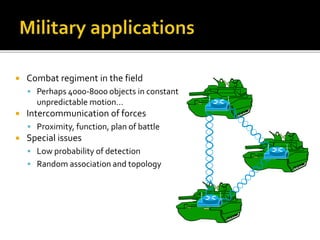
 Combat regiment in the field
 Perhaps 4000-8000 objects in constant
unpredictable motion…
 Intercommunication of forces
 Proximity, function, plan of battle
 Special issues
 Low probability of detection
 Random association and topology
 DSR is designed for MANETs
 DSR doesn’t need any network infrastructures
 Loop free routing
 No routing information in the intermediate nodes
 Nodes may easily cache this routing information for future use
 Route discovery
 Undertaken when source needs a route to a
destination
 Route maintenance
 Used when link breaks, rendering specified path
unusable
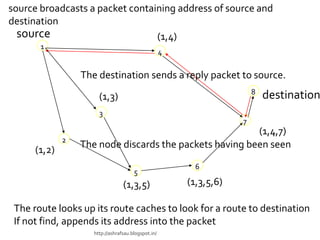
destination
source
1
6
5
4
3
2
8
7
(1,4)
(1,2)
(1,3)
(1,3,5,6)(1,3,5)
(1,4,7)
source broadcasts a packet containing address of source and
destination
The route looks up its route caches to look for a route to destination
If not find, appends its address into the packet
The destination sends a reply packet to source.
The node discards the packets having been seen
http://ashrafsau.blogspot.in/
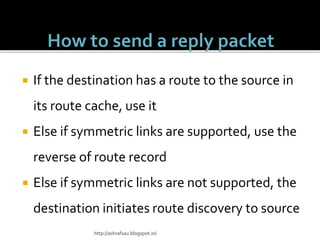
 If the destination has a route to the source in
its route cache, use it
 Else if symmetric links are supported, use the
reverse of route record
 Else if symmetric links are not supported, the
destination initiates route discovery to source
http://ashrafsau.blogspot.in/
 Whenever a node transmits a data packet, a route
reply, or a route error, it must verify that the next
hop correctly receives the packet.
 If not, the node must send a route error to the node
responsible for generating this route header
 Intermediate nodes “eavesdrop”, adjust cached
routes
 Source deletes route; tries another if one
cached, or The source restart the route discovery
http://ashrafsau.blogspot.in/
A B C D E
Route error message: C-D
is broken
http://ashrafsau.blogspot.in/
 Packet header size grows with route length
due to source routing.
 Flood route request may potentially reach all
nodes in the network.
 Route reply storm problem.
http://ashrafsau.blogspot.in/
 AODV is a packet routing protocol designed for use in mobile
ad hoc networks (MANET)
 Intended for networks that may contain thousands of nodes
 Source, destination and next hop are addressed using IP
addressing
 Each node maintains a routing table that contains
information about reaching destination nodes.
 The Ad hoc On-Demand DistanceVector
protocol is both an on-demand and a table-
driven protocol.
 The packet size in AODV is uniform unlike DSR.
Unlike DSDV, there is no need for system-wide
broadcasts due to local changes.
 AODV supports multicasting and unicasting
within a uniform framework.
14
 Each route has a lifetime after which the
route expires if it is not used.
 A route is maintained only when it is used and
hence old and expired routes are never used.
 Unlike DSR, AODV maintains only one route
between a source-destination pair.
15
 Destination IP address
 Destination Sequence Number
 Valid Destination Sequence Number Flag
 Other state and routing flags
 Network Interface
 Hop Count (needed to reach destination)
 Next Hop
 Lifetime (route expiration or deletion time)
 A lifetime is associated with the entry in the
route table.
 This is an important feature of AODV. If a
route entry is not used within the specified
lifetime, it is deleted.
 A route is maintained only when it is used. A
route that is unused for a long time is
assumed to be stale.
17
 Routing table size is minimized by only including next hop
information, not the entire route to a destination node.
 Sequence numbers for both destination and source are used.
 Managing the sequence number is the key to efficient
routing and route maintenance
 The basic message set consists of:
 RREQ – Route request
 RREP – Route reply
 RERR – Route error
 HELLO – For link status monitoring
 Route Request: “I need a route”
 Route Response: “Route advertisement”
 Route Error: “Withdraw route”
 Periodic route response to neighbors acts as
“hello”, installing and refreshing route
B?
B?
B?
B?
B?
B? B?
B
A
22
B
A
E
F
H
J
C
G
I
K
Z
Y
Represents a node that has received RREQ for D from S
M
N
L
D
S
23
B
A
E
F
H
J
C
G
I
K
Represents transmission of RREQ
Z
Y
Broadcast transmission
M
N
L
S
D
24
B
A
E
F
H
J
C
G
I
K
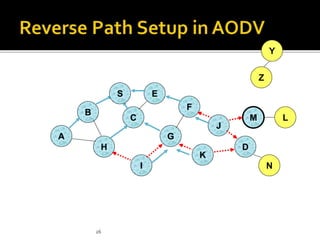
Represents links on Reverse Path
Z
Y
M
N
L
S
D
25
B
A
E
F
H
J
C
G
I
K
• Node C receives RREQ from G and H, but does not forward
it again, because node C has already forwarded RREQ once
Z
Y
M
N
L
S
D
26
B
A
E
F
H
J
C
G
I
K
Z
Y
M
N
L
S
D
27
B
A
E
F
H
J
C
G
I
K
Z
Y
• Node D does not forward RREQ, because node D
is the intended target of the RREQ
M
N
L
S
D
28
B
A
E
F
H
J
C
G
I
K
Z
Y
M
N
L
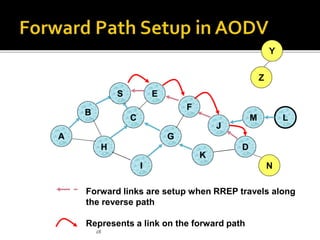
Forward links are setup when RREP travels along
the reverse path
Represents a link on the forward path
S
D
B
A
A
A
A
A
A
A
A
B D
F
C
G
E
RREQ
RREQ
RREQ
RREQ
RREQ
RREQ
RREQ
RREQ
RREQ
RREP
RREP
RREP
Source
Destination
 Broadcast RREQ messages.
 Intermediate nodes update their routing table
 Forward the RREQ if it is not the destination.
 Maintain back-pointer to the originator.
 Destination generates RREQ message.
 RREQ sent back to source using the reverse pointer set up
by the intermediate nodes.
 RREQ reaches destination, communication starts.
 A route between two nodes is found
by sending an Route Request to a
locality
 Initial locality small, grows with
failure
 After that, a little larger than the
locality target last found in
 Route Response sent
 By target if necessary
 By neighboring routing node if
possible to “join” existing route
 Network stores the route
d
j k l
ihg
f
A
e
C
B
 Routes expire if not refreshed
 routing nodes log recent
downstream users of a route
 When routes expire or are flushed,
downstream users are notified to
flush
 New route request triggered
d
j k l
ihg
f
A
e
C
B
 There are two phases
 Route Discovery.
 Route Maintenance.
 Each node maintains a routing table with knowledge about the network.
 AODV deals with route table management.
 Route information maintained even for short lived routes – reverse
pointers.
 Hello messages broadcast by active nodes periodically
HELLO_INTERVAL.
 No hello message from a neighbor in DELETE_PERIOD,link failure
identified.
 A local route repair to that next hop initiated.
 After a timeout ,error propagated both to originator and destination.
 Entries based on the node invalidated.
 One method that AODV handle congestion is:
 If the source node receives no RREP from the destination,
it may broadcast another RREQ, up to a maximum of
RREQ_RETRIES.
 For each additional attempt that a source node tried to broadcast
RREQ, the waiting time for the RREP is multiplied by 2.
 DSR is not capable of handling congestion.
 Other possible methods to improve AODV
congestion handling:
 A route may predict when congestion is about to occur
and try to avoid it by reduce the transmission rate.
 Schedule the requests so that it will not overload the
network.
 A neighbor of node X is considered active for a routing table entry
if the neighbor sent a packet within active_route_timeout interval
which was forwarded using that entry
 Neighboring nodes periodically exchange hello message
 When the next hop link in a routing table entry breaks, all active
neighbors are informed
 Link failures are propagated by means of Route Error (RERR)
messages, which also update destination sequence numbers
38
 When node X is unable to forward packet P (from node S to node
D) on link (X,Y), it generates a RERR message
 Node X increments the destination sequence number for D
cached at node X
 The incremented sequence number N is included in the RERR
 When node S receives the RERR, it initiates a new route discovery
for D using destination sequence number at least as large as N
 When node D receives the route request with destination
sequence number N, node D will set its sequence number to N,
unless it is already larger than N
39
1 Black hole attack
2 Message tampering attack
3 Message dropping attack
Routes need not be included in packet headers
Nodes maintain routing tables containing entries
only for routes that are in active use
At most one next-hop per destination maintained
at each node
 DSR may maintain several routes for a single
destination
Sequence numbers are used to avoid old/broken
routes
Sequence numbers prevent formation of routing
loops
Unused routes expire even if topology does not
change
41
I. Packet header overhead
II. Route learning capability
III. Handling multiple route replies
IV. Scalability
V. Security
AODV routing protocol

AODV routing protocol

  • 1.
  • 2.
     Mobile adhocnetworks  MobileAd hoc NET work (MANET) is a self configuring network of mobile routers (and associated hosts)  connected by wireless links – the union of which forms an arbitrary topology
  • 3.
     Sensor networks Military applications
  • 4.
     Networks deployedin random distribution  Low power  Delivering sensor data to a central site for some purpose
  • 5.
     Combat regimentin the field  Perhaps 4000-8000 objects in constant unpredictable motion…  Intercommunication of forces  Proximity, function, plan of battle  Special issues  Low probability of detection  Random association and topology
  • 6.
     DSR isdesigned for MANETs  DSR doesn’t need any network infrastructures  Loop free routing  No routing information in the intermediate nodes  Nodes may easily cache this routing information for future use
  • 7.
     Route discovery Undertaken when source needs a route to a destination  Route maintenance  Used when link breaks, rendering specified path unusable
  • 8.
    destination source 1 6 5 4 3 2 8 7 (1,4) (1,2) (1,3) (1,3,5,6)(1,3,5) (1,4,7) source broadcasts apacket containing address of source and destination The route looks up its route caches to look for a route to destination If not find, appends its address into the packet The destination sends a reply packet to source. The node discards the packets having been seen http://ashrafsau.blogspot.in/
  • 9.
     If thedestination has a route to the source in its route cache, use it  Else if symmetric links are supported, use the reverse of route record  Else if symmetric links are not supported, the destination initiates route discovery to source http://ashrafsau.blogspot.in/
  • 10.
     Whenever anode transmits a data packet, a route reply, or a route error, it must verify that the next hop correctly receives the packet.  If not, the node must send a route error to the node responsible for generating this route header  Intermediate nodes “eavesdrop”, adjust cached routes  Source deletes route; tries another if one cached, or The source restart the route discovery http://ashrafsau.blogspot.in/
  • 11.
    A B CD E Route error message: C-D is broken http://ashrafsau.blogspot.in/
  • 12.
     Packet headersize grows with route length due to source routing.  Flood route request may potentially reach all nodes in the network.  Route reply storm problem. http://ashrafsau.blogspot.in/
  • 13.
     AODV isa packet routing protocol designed for use in mobile ad hoc networks (MANET)  Intended for networks that may contain thousands of nodes  Source, destination and next hop are addressed using IP addressing  Each node maintains a routing table that contains information about reaching destination nodes.
  • 14.
     The Adhoc On-Demand DistanceVector protocol is both an on-demand and a table- driven protocol.  The packet size in AODV is uniform unlike DSR. Unlike DSDV, there is no need for system-wide broadcasts due to local changes.  AODV supports multicasting and unicasting within a uniform framework. 14
  • 15.
     Each routehas a lifetime after which the route expires if it is not used.  A route is maintained only when it is used and hence old and expired routes are never used.  Unlike DSR, AODV maintains only one route between a source-destination pair. 15
  • 16.
     Destination IPaddress  Destination Sequence Number  Valid Destination Sequence Number Flag  Other state and routing flags  Network Interface  Hop Count (needed to reach destination)  Next Hop  Lifetime (route expiration or deletion time)
  • 17.
     A lifetimeis associated with the entry in the route table.  This is an important feature of AODV. If a route entry is not used within the specified lifetime, it is deleted.  A route is maintained only when it is used. A route that is unused for a long time is assumed to be stale. 17
  • 18.
     Routing tablesize is minimized by only including next hop information, not the entire route to a destination node.  Sequence numbers for both destination and source are used.  Managing the sequence number is the key to efficient routing and route maintenance
  • 19.
     The basicmessage set consists of:  RREQ – Route request  RREP – Route reply  RERR – Route error  HELLO – For link status monitoring
  • 20.
     Route Request:“I need a route”  Route Response: “Route advertisement”  Route Error: “Withdraw route”  Periodic route response to neighbors acts as “hello”, installing and refreshing route
  • 21.
  • 22.
    22 B A E F H J C G I K Z Y Represents a nodethat has received RREQ for D from S M N L D S
  • 23.
    23 B A E F H J C G I K Represents transmission ofRREQ Z Y Broadcast transmission M N L S D
  • 24.
  • 25.
    25 B A E F H J C G I K • Node Creceives RREQ from G and H, but does not forward it again, because node C has already forwarded RREQ once Z Y M N L S D
  • 26.
  • 27.
    27 B A E F H J C G I K Z Y • Node Ddoes not forward RREQ, because node D is the intended target of the RREQ M N L S D
  • 28.
    28 B A E F H J C G I K Z Y M N L Forward links aresetup when RREP travels along the reverse path Represents a link on the forward path S D
  • 29.
  • 30.
  • 31.
     Broadcast RREQmessages.  Intermediate nodes update their routing table  Forward the RREQ if it is not the destination.  Maintain back-pointer to the originator.  Destination generates RREQ message.  RREQ sent back to source using the reverse pointer set up by the intermediate nodes.  RREQ reaches destination, communication starts.
  • 32.
     A routebetween two nodes is found by sending an Route Request to a locality  Initial locality small, grows with failure  After that, a little larger than the locality target last found in  Route Response sent  By target if necessary  By neighboring routing node if possible to “join” existing route  Network stores the route d j k l ihg f A e C B
  • 33.
     Routes expireif not refreshed  routing nodes log recent downstream users of a route  When routes expire or are flushed, downstream users are notified to flush  New route request triggered d j k l ihg f A e C B
  • 34.
     There aretwo phases  Route Discovery.  Route Maintenance.  Each node maintains a routing table with knowledge about the network.  AODV deals with route table management.  Route information maintained even for short lived routes – reverse pointers.
  • 35.
     Hello messagesbroadcast by active nodes periodically HELLO_INTERVAL.  No hello message from a neighbor in DELETE_PERIOD,link failure identified.  A local route repair to that next hop initiated.  After a timeout ,error propagated both to originator and destination.  Entries based on the node invalidated.
  • 36.
     One methodthat AODV handle congestion is:  If the source node receives no RREP from the destination, it may broadcast another RREQ, up to a maximum of RREQ_RETRIES.  For each additional attempt that a source node tried to broadcast RREQ, the waiting time for the RREP is multiplied by 2.  DSR is not capable of handling congestion.
  • 37.
     Other possiblemethods to improve AODV congestion handling:  A route may predict when congestion is about to occur and try to avoid it by reduce the transmission rate.  Schedule the requests so that it will not overload the network.
  • 38.
     A neighborof node X is considered active for a routing table entry if the neighbor sent a packet within active_route_timeout interval which was forwarded using that entry  Neighboring nodes periodically exchange hello message  When the next hop link in a routing table entry breaks, all active neighbors are informed  Link failures are propagated by means of Route Error (RERR) messages, which also update destination sequence numbers 38
  • 39.
     When nodeX is unable to forward packet P (from node S to node D) on link (X,Y), it generates a RERR message  Node X increments the destination sequence number for D cached at node X  The incremented sequence number N is included in the RERR  When node S receives the RERR, it initiates a new route discovery for D using destination sequence number at least as large as N  When node D receives the route request with destination sequence number N, node D will set its sequence number to N, unless it is already larger than N 39
  • 40.
    1 Black holeattack 2 Message tampering attack 3 Message dropping attack
  • 41.
    Routes need notbe included in packet headers Nodes maintain routing tables containing entries only for routes that are in active use At most one next-hop per destination maintained at each node  DSR may maintain several routes for a single destination Sequence numbers are used to avoid old/broken routes Sequence numbers prevent formation of routing loops Unused routes expire even if topology does not change 41
  • 42.
    I. Packet headeroverhead II. Route learning capability III. Handling multiple route replies IV. Scalability V. Security