Introduction
UNIT= 1
Prepared by:
Maulik chaudhari
 The first simple forms of life appeared on
earth more then 3 billion years ago.
 Their descendants have changed and
developed into the several million type of
animals , plants and microorganisms are
recognized.
 Microscopic forms of life are present in vast
numbers in nearly every environment like
soil, water, food, air , etc.
Microbiology:
Microbiology is the science that dealing with
the study of microorganisms.
Microorganisms:
An organism that can be seen only with the
aid of a microscope and that typically consist
of only a single cell.
 microorganisms include:
• bacteria
• fungi
• protozoa
• microscopic algae
• viruses
• various parasitic worms
Development of microscopy
 (348-322) Aristotle and other believed that
living organisms could develop from Non-
living materials.
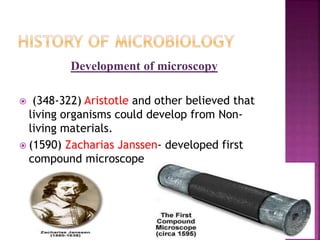
 (1590) Zacharias Janssen- developed first
compound microscope
 (1660) Robert Hooke – Published “micrographia”
drawing and detailed observation of biological
materials made with the best compound microscope
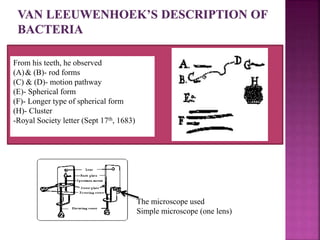
 (1676) Anton Van Leeuwenhoek- 1st person to observe
microorganisms.
From his teeth, he observed
(A)& (B)- rod forms
(C) & (D)- motion pathway
(E)- Spherical form
(F)- Longer type of spherical form
(H)- Cluster
-Royal Society letter (Sept 17th, 1683)
The microscope used
Simple microscope (one lens)
Spontaneous generation controversy
 1688: Francesco Redi (1626-1678) was an Italian
physician who refuted the idea of spontaneous
generation by showing that rotting meat carefully kept
from flies will not spontaneously produce maggots.
 1836: Theodor Schwann (1810-1882) helped develop
the cell theory of living organisms, namely that that all
living organisms are composed of one or more cells
and that the cell is the basic functional unit of living
organisms.
 1861: Louis Pasteur: ( father of microbiology)
 proposed the “Germ theory of disease”.- Ancients
believed that disease was the result of a divine
punishment. Pasteur fought to convince surgeons that
germs existed and carried diseases, and dirty
instruments and hands spread germs and therefore
disease. Pasteur's pasteurization process killed germs
and prevented the spread of disease.
 His studies on fermentation of wine led him to take
interest in microbiology. finally he proved that
microorganisms do not arise by spontaneous
generation. He is known as the founder or father
microbiology.
 Joseph Lister (1827-1912) introduced antiseptics in
surgery. By spraying carbolic acid on surgical
instruments, wounds and dressings, he reduced surgical
mortality due to bacterial infection considerably.
 He is known as father of antiseptic surgery.
Robert Koch(1843-1910) (father of bacteriology)
German bacteriologist was the first to cultivate anthrax
bacteria outside the body using blood serum at body
temperature.
introduced methods for isolation of pure strains of bacteria.
He introduced staining techniques.
 He is known as father of bacteriology.
 Beginning with Pasteur’s work, discoveries included relationship
between microbes and disease, immunity, and antimicrobial drugs
 Robert Koch Identified a bacterium as cause of anthrax
Introduced “Koch’s Postulates” and the concept
that a disease is caused by a single organism.
 Joseph Lister
Introduced the “antiseptic technique”.
Use of phenol (carbolic acid) as disinfectant.
 Martinus Beijerinck
Discovered “viruses” (toxins, poisons).
Infectious agents in tobacco plant fluids.
 Alexander Fleming
Discovered the first antibiotic - penicillin.
1.Diagnostic
 isolation & identification of causative organism from
pathological lesions.
Widal’s test – typhoid fever
2. Prognosis of disease
in widal’s test rising titer signifies active
disease & ineffective treatment . falling titer means
effective treatment & curing of disease.
3. Guidance in treatment
by culturing the organisms in pure form & then
performing drug sensitivity test that can suggest
the effective drug for the treatment of that
particular infection.
4. Source of infection
in sudden outbreak of infectious disease we can
find out the source of infection.
 - Microbiology has an impact on medicine, agriculture,
food science, ecology, genetics, biochemistry,
immunology, and many other fields.
 - Many microbiologists are primarily interested in the
biology of microorganisms, while others focus on
specific groups;
 - Virologists - viruses
 - Bacteriologists - bacteria
 - Phycologists – algae
 - Mycologist –fungi
 - Protozoologists – protozoa
 - Medical Microbiology: deals with diseases of
humans and animals; identify and plan measures to
eliminate agents causing infectious diseases.
 - Immunology: study of the immune system that
protects the body from pathogens.
 - Agricultural Microbiology: impact of
microorganisms on agriculture; combat plant diseases
that attack important food crops.
 Food and Dairy Microbiology: prevent microbial
spoilage of food & transmission of food-borne diseases
(e.g. salmonellosis); use microorganisms to make food
such as cheeses, yogurts, pickles, beer, etc.
 - Industrial Microbiology: using microorganisms to
make products such as antibiotics, vaccines, steroids,
alcohols & other solvents, vitamins, amino acids,
enzymes, etc.
 - Genetic Engineering: Engineered microorganisms
used to make hormones, antibiotics, vaccines and other
products.
Branches of microbiology
 1. Medical microbiology
 2. Industrial microbiology
 3. Food microbiology
 4. soil microbiology
 5. Plant microbiology

Microbiology unit 1

  • 1.
  • 2.
     The firstsimple forms of life appeared on earth more then 3 billion years ago.  Their descendants have changed and developed into the several million type of animals , plants and microorganisms are recognized.  Microscopic forms of life are present in vast numbers in nearly every environment like soil, water, food, air , etc.
  • 3.
    Microbiology: Microbiology is thescience that dealing with the study of microorganisms. Microorganisms: An organism that can be seen only with the aid of a microscope and that typically consist of only a single cell.
  • 4.
     microorganisms include: •bacteria • fungi • protozoa • microscopic algae • viruses • various parasitic worms
  • 5.
    Development of microscopy (348-322) Aristotle and other believed that living organisms could develop from Non- living materials.  (1590) Zacharias Janssen- developed first compound microscope
  • 6.
     (1660) RobertHooke – Published “micrographia” drawing and detailed observation of biological materials made with the best compound microscope  (1676) Anton Van Leeuwenhoek- 1st person to observe microorganisms.
  • 7.
    From his teeth,he observed (A)& (B)- rod forms (C) & (D)- motion pathway (E)- Spherical form (F)- Longer type of spherical form (H)- Cluster -Royal Society letter (Sept 17th, 1683) The microscope used Simple microscope (one lens)
  • 8.
    Spontaneous generation controversy 1688: Francesco Redi (1626-1678) was an Italian physician who refuted the idea of spontaneous generation by showing that rotting meat carefully kept from flies will not spontaneously produce maggots.  1836: Theodor Schwann (1810-1882) helped develop the cell theory of living organisms, namely that that all living organisms are composed of one or more cells and that the cell is the basic functional unit of living organisms.
  • 9.
     1861: LouisPasteur: ( father of microbiology)  proposed the “Germ theory of disease”.- Ancients believed that disease was the result of a divine punishment. Pasteur fought to convince surgeons that germs existed and carried diseases, and dirty instruments and hands spread germs and therefore disease. Pasteur's pasteurization process killed germs and prevented the spread of disease.  His studies on fermentation of wine led him to take interest in microbiology. finally he proved that microorganisms do not arise by spontaneous generation. He is known as the founder or father microbiology.
  • 10.
     Joseph Lister(1827-1912) introduced antiseptics in surgery. By spraying carbolic acid on surgical instruments, wounds and dressings, he reduced surgical mortality due to bacterial infection considerably.  He is known as father of antiseptic surgery.
  • 11.
    Robert Koch(1843-1910) (fatherof bacteriology) German bacteriologist was the first to cultivate anthrax bacteria outside the body using blood serum at body temperature. introduced methods for isolation of pure strains of bacteria. He introduced staining techniques.  He is known as father of bacteriology.
  • 12.
     Beginning withPasteur’s work, discoveries included relationship between microbes and disease, immunity, and antimicrobial drugs  Robert Koch Identified a bacterium as cause of anthrax Introduced “Koch’s Postulates” and the concept that a disease is caused by a single organism.  Joseph Lister Introduced the “antiseptic technique”. Use of phenol (carbolic acid) as disinfectant.  Martinus Beijerinck Discovered “viruses” (toxins, poisons). Infectious agents in tobacco plant fluids.  Alexander Fleming Discovered the first antibiotic - penicillin.
  • 13.
    1.Diagnostic  isolation &identification of causative organism from pathological lesions. Widal’s test – typhoid fever 2. Prognosis of disease in widal’s test rising titer signifies active disease & ineffective treatment . falling titer means effective treatment & curing of disease.
  • 14.
    3. Guidance intreatment by culturing the organisms in pure form & then performing drug sensitivity test that can suggest the effective drug for the treatment of that particular infection. 4. Source of infection in sudden outbreak of infectious disease we can find out the source of infection.
  • 15.
     - Microbiologyhas an impact on medicine, agriculture, food science, ecology, genetics, biochemistry, immunology, and many other fields.  - Many microbiologists are primarily interested in the biology of microorganisms, while others focus on specific groups;  - Virologists - viruses  - Bacteriologists - bacteria  - Phycologists – algae  - Mycologist –fungi  - Protozoologists – protozoa
  • 16.
     - MedicalMicrobiology: deals with diseases of humans and animals; identify and plan measures to eliminate agents causing infectious diseases.  - Immunology: study of the immune system that protects the body from pathogens.  - Agricultural Microbiology: impact of microorganisms on agriculture; combat plant diseases that attack important food crops.  Food and Dairy Microbiology: prevent microbial spoilage of food & transmission of food-borne diseases (e.g. salmonellosis); use microorganisms to make food such as cheeses, yogurts, pickles, beer, etc.
  • 17.
     - IndustrialMicrobiology: using microorganisms to make products such as antibiotics, vaccines, steroids, alcohols & other solvents, vitamins, amino acids, enzymes, etc.  - Genetic Engineering: Engineered microorganisms used to make hormones, antibiotics, vaccines and other products.
  • 18.
    Branches of microbiology 1. Medical microbiology  2. Industrial microbiology  3. Food microbiology  4. soil microbiology  5. Plant microbiology