Microbiology
An introduction to microbiology
designed for allied health majors
By BugLady
How to Ace this Class
Book and slides are no substitute for active
engagement
Participate: post questions and ask for help
Don’t wait to ask
Take notes aka active learning
Jul-14 2
Writing Essays
Take brief notes as you go
Record all references
Create an outline
Rewrite information in your own words Use peer-review
or credible sources
 PMC: full length, peer-reviewed articles
 HON: Health on the Net; look for badge on the website
Jul-14 3
Introduction to Microbiology
Overview of course
What is microbiology?
History of microbiology
Jul-14 4
Course Overview
Biochemistry and Microscopy
Biology of microorganisms
Metabolism
Growth and Ecology
Containment of Microorganisms
Genetics and Bioengineering
Mutations and Bacterial Recombination
Viruses
Jul-14 5
Course Overview
Antibiotics
Innate Immune System
Adaptive Immune System
Host Microbe Interactions
Disorders of the Immune System
Epidemiology
Classification
Jul-14 6
Microbiology
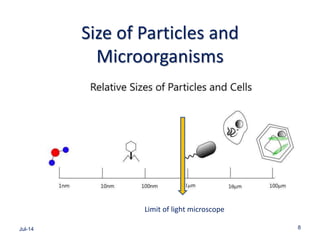
Microbiology is the study of all the
organisms that are too small to be seen
with the naked eye (<0.1mm)
Jul-14 7
Size of Particles and
Microorganisms
Jul-14 8
Limit of light microscope
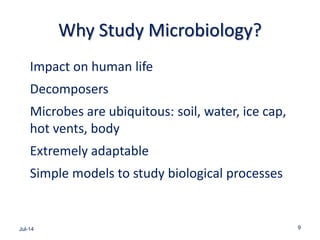
Why Study Microbiology?
Impact on human life
Decomposers
Microbes are ubiquitous: soil, water, ice cap,
hot vents, body
Extremely adaptable
Simple models to study biological processes
Jul-14 9
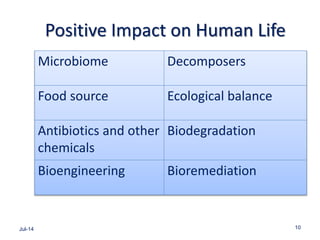
Positive Impact on Human Life
Jul-14 10
Microbiome Decomposers
Food source Ecological balance
Antibiotics and other
chemicals
Biodegradation
Bioengineering Bioremediation
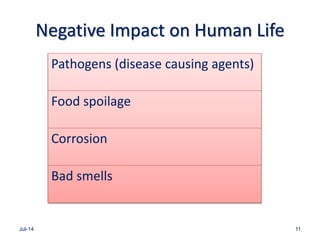
Negative Impact on Human Life
Jul-14 11
Pathogens (disease causing agents)
Food spoilage
Corrosion
Bad smells
Scientific Names
Escherichia coli
o Honors the discoverer, Theodor Escherich, and
describes the bacterium’s habitat, the large intestine
or colon.
Staphylococcus aureus
o Describes the clustered arrangement of the cells
(staphylo-) and the golden color of the colonies.
After the first use, scientific names may be abbreviated with
the first letter of the genus and the species:
• Staphylococcus aureus and Escherichia coli are found in the human body: S
aureus on skin and E coli in the large intestine.
Jul-14 12
Use of Latin
One bacterium – many bacteria
One medium – several media
One bacillus – many bacilli
One staphylococcus – many
staphylococci
Jul-14 13
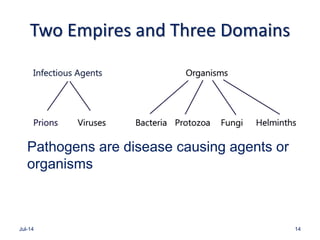
Two Empires and Three Domains
Jul-14 14
Pathogens are disease causing agents or
organisms
Prions
Prions Proteinaceous infectious particles
Diseases linked to the presence of prions
are transmissible spongiform
encephalopathies (e.g. mad cow disease).
Misfolded proteins
Slow infection (20-30 years)
No cure
Jul-14
15
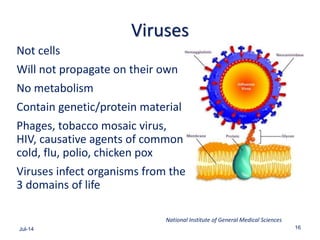
Viruses
Not cells
Will not propagate on their own
No metabolism
Contain genetic/protein material
Phages, tobacco mosaic virus,
HIV, causative agents of common
cold, flu, polio, chicken pox
Viruses infect organisms from the
3 domains of life
Jul-14 16
National Institute of General Medical Sciences
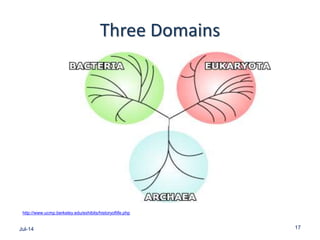
Three Domains
Jul-14 17
http://www.ucmp.berkeley.edu/exhibits/historyoflife.php
Prokaryotes and Eukaryotes
Prokaryote = no nucleus
Archaea and Bacteria are prokaryotes
Eukaryote = true nucleus
Protists, plants, fungi, and animals are
eukaryotes
Jul-14 18
Archaea are Prokaryotes
No true nucleus, no organelles, 1-5µ length
Classified as Bacteria until 1979
Molecular structures closer to Eukaryotes
Eukaryotes and Bacteria diverged from
Archaea
Oldest known organisms on Earth.
o Fossil records show over 3.6 BILLION years ago
No known pathogens
Jul-14
19
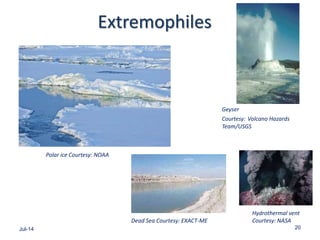
Extremophiles
Jul-14 20
Hydrothermal vent
Courtesy: NASADead Sea Courtesy: EXACT-ME
Geyser
Courtesy: Volcano Hazards
Team/USGS
Polar ice Courtesy: NOAA
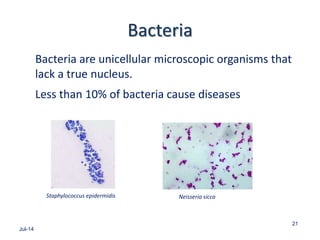
Bacteria
Bacteria are unicellular microscopic organisms that
lack a true nucleus.
Less than 10% of bacteria cause diseases
Jul-14
21
Staphylococcus epidermidis Neisseria sicca
Bacteria or Eubacteria
Bacteria grow in a wide variety of habitats
and conditions.
Bacteria have a wide range of environmental
and nutritive requirements.
Bacteria play important roles in the global
ecosystem.
Jul-14 22
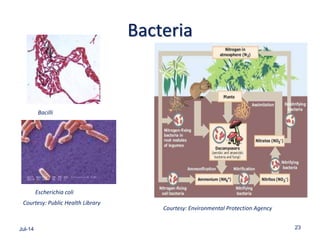
Bacteria
Jul-14 23
Bacilli
Escherichia coli
Courtesy: Public Health Library
Courtesy: Environmental Protection Agency
Eukarya
The word 'eukaryote' means 'true nucleus’
Eukaryotes contain a true nucleus and membrane-
bound organelles
Nucleus: genetic material
Organelles:
o specific function
o subcellular structures bound by membranes
Jul-14
24
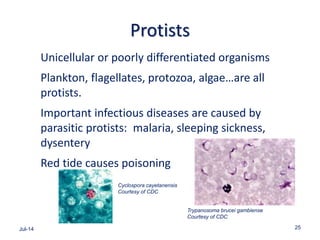
Protists
Unicellular or poorly differentiated organisms
Plankton, flagellates, protozoa, algae…are all
protists.
Important infectious diseases are caused by
parasitic protists: malaria, sleeping sickness,
dysentery
Red tide causes poisoning
Jul-14 25
Trypanosoma brucei gambiense
Courtesy of CDC
Cyclospora cayetanensis
Courtesy of CDC
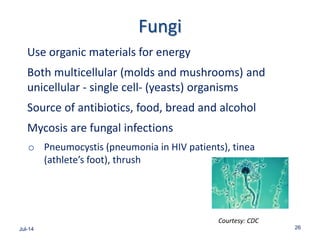
Fungi
Use organic materials for energy
Both multicellular (molds and mushrooms) and
unicellular - single cell- (yeasts) organisms
Source of antibiotics, food, bread and alcohol
Mycosis are fungal infections
o Pneumocystis (pneumonia in HIV patients), tinea
(athlete’s foot), thrush
Jul-14 26
Courtesy: CDC
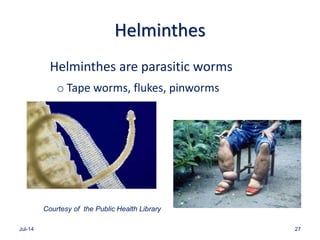
Helminthes
Helminthes are parasitic worms
o Tape worms, flukes, pinworms
Jul-14 27
Courtesy of the Public Health Library
Review
http://www.quia.com/rr/240939.html
Jul-14 28
History of Microbiology
The Golden Ages
1850s: Gram, Pasteur, Koch…
1940-1950s: antibiotics
Now: Microbiome, metagenomics,
probiotics, asthma, MS, RA
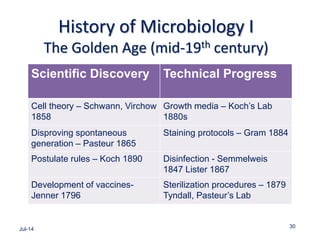
History of Microbiology I
The Golden Age (mid-19th century)
Jul-14
30
Scientific Discovery Technical Progress
Cell theory – Schwann, Virchow
1858
Growth media – Koch’s Lab
1880s
Disproving spontaneous
generation – Pasteur 1865
Staining protocols – Gram 1884
Postulate rules – Koch 1890 Disinfection - Semmelweis
1847 Lister 1867
Development of vaccines-
Jenner 1796
Sterilization procedures – 1879
Tyndall, Pasteur’s Lab
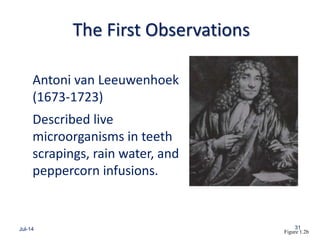
The First Observations
Antoni van Leeuwenhoek
(1673-1723)
Described live
microorganisms in teeth
scrapings, rain water, and
peppercorn infusions.
Jul-14 31
Figure 1.2b
Vaccination
1796: Edward Jenner and cowpox
Called vaccination from vacca for cow
The protection is called acquired immunity
Jul-14 32
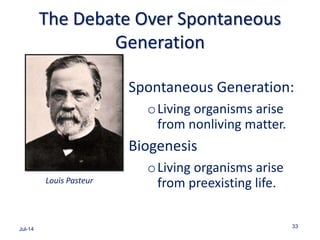
The Debate Over Spontaneous
Generation
Spontaneous Generation:
oLiving organisms arise
from nonliving matter.
Biogenesis
oLiving organisms arise
from preexisting life.
Jul-14
33
Louis Pasteur
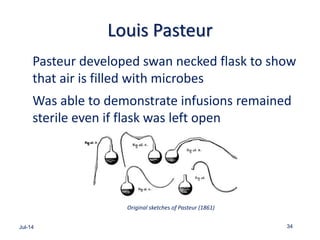
Louis Pasteur
Pasteur developed swan necked flask to show
that air is filled with microbes
Was able to demonstrate infusions remained
sterile even if flask was left open
Jul-14 34
Original sketches of Pasteur (1861)
The Germ Theory of Disease
Pasteur’s work showed microbes are in the air, can
spoil food, and cause animal diseases
Joseph Lister (1860s)
o used a chemical disinfectant to prevent surgical
wound infections.
Robert Koch (1876)
o provided proof that a bacterium causes
anthrax
Jul-14 35
Koch’s Postulates
The agent must be present in every case of
infection and absent from healthy individuals
The agent can be isolated from infected organism
and grown in a pure culture
The disease can be reproduced by inoculating a
healthy organism with a pure culture
The agent can be isolated from the newly
infected organism
Jul-14 36
Jul-14 37
Courtesy: CDC Adapted from: Hosp Epidemiol Infect Control, 2nd Edition, 1999
History of Microbiology II
Antibiotics 1940-current
Biotechnology 1978-current
Genetics 1920-current
Human Microbiome Project
Jul-14 38
Gentlemen, microbes will have the last
word!
“…It is time to close the book on infectious diseases…”
William Stewart, US Surgeon General in a message to Congress
1969
Antibiotics resistance
The big 3: TB, HIV, malaria
Microbiome, obesity, allergies
New threats: Health Acquired Infection (HAI), MERS,
H7N9, Ebola virus
Ecological balance
Bioremediation
Jul-14 39

Microbiology for Nursing Students: 1. Introduction to Microbiology

  • 1.
    Microbiology An introduction tomicrobiology designed for allied health majors By BugLady
  • 2.
    How to Acethis Class Book and slides are no substitute for active engagement Participate: post questions and ask for help Don’t wait to ask Take notes aka active learning Jul-14 2
  • 3.
    Writing Essays Take briefnotes as you go Record all references Create an outline Rewrite information in your own words Use peer-review or credible sources  PMC: full length, peer-reviewed articles  HON: Health on the Net; look for badge on the website Jul-14 3
  • 4.
    Introduction to Microbiology Overviewof course What is microbiology? History of microbiology Jul-14 4
  • 5.
    Course Overview Biochemistry andMicroscopy Biology of microorganisms Metabolism Growth and Ecology Containment of Microorganisms Genetics and Bioengineering Mutations and Bacterial Recombination Viruses Jul-14 5
  • 6.
    Course Overview Antibiotics Innate ImmuneSystem Adaptive Immune System Host Microbe Interactions Disorders of the Immune System Epidemiology Classification Jul-14 6
  • 7.
    Microbiology Microbiology is thestudy of all the organisms that are too small to be seen with the naked eye (<0.1mm) Jul-14 7
  • 8.
    Size of Particlesand Microorganisms Jul-14 8 Limit of light microscope
  • 9.
    Why Study Microbiology? Impacton human life Decomposers Microbes are ubiquitous: soil, water, ice cap, hot vents, body Extremely adaptable Simple models to study biological processes Jul-14 9
  • 10.
    Positive Impact onHuman Life Jul-14 10 Microbiome Decomposers Food source Ecological balance Antibiotics and other chemicals Biodegradation Bioengineering Bioremediation
  • 11.
    Negative Impact onHuman Life Jul-14 11 Pathogens (disease causing agents) Food spoilage Corrosion Bad smells
  • 12.
    Scientific Names Escherichia coli oHonors the discoverer, Theodor Escherich, and describes the bacterium’s habitat, the large intestine or colon. Staphylococcus aureus o Describes the clustered arrangement of the cells (staphylo-) and the golden color of the colonies. After the first use, scientific names may be abbreviated with the first letter of the genus and the species: • Staphylococcus aureus and Escherichia coli are found in the human body: S aureus on skin and E coli in the large intestine. Jul-14 12
  • 13.
    Use of Latin Onebacterium – many bacteria One medium – several media One bacillus – many bacilli One staphylococcus – many staphylococci Jul-14 13
  • 14.
    Two Empires andThree Domains Jul-14 14 Pathogens are disease causing agents or organisms
  • 15.
    Prions Prions Proteinaceous infectiousparticles Diseases linked to the presence of prions are transmissible spongiform encephalopathies (e.g. mad cow disease). Misfolded proteins Slow infection (20-30 years) No cure Jul-14 15
  • 16.
    Viruses Not cells Will notpropagate on their own No metabolism Contain genetic/protein material Phages, tobacco mosaic virus, HIV, causative agents of common cold, flu, polio, chicken pox Viruses infect organisms from the 3 domains of life Jul-14 16 National Institute of General Medical Sciences
  • 17.
  • 18.
    Prokaryotes and Eukaryotes Prokaryote= no nucleus Archaea and Bacteria are prokaryotes Eukaryote = true nucleus Protists, plants, fungi, and animals are eukaryotes Jul-14 18
  • 19.
    Archaea are Prokaryotes Notrue nucleus, no organelles, 1-5µ length Classified as Bacteria until 1979 Molecular structures closer to Eukaryotes Eukaryotes and Bacteria diverged from Archaea Oldest known organisms on Earth. o Fossil records show over 3.6 BILLION years ago No known pathogens Jul-14 19
  • 20.
    Extremophiles Jul-14 20 Hydrothermal vent Courtesy:NASADead Sea Courtesy: EXACT-ME Geyser Courtesy: Volcano Hazards Team/USGS Polar ice Courtesy: NOAA
  • 21.
    Bacteria Bacteria are unicellularmicroscopic organisms that lack a true nucleus. Less than 10% of bacteria cause diseases Jul-14 21 Staphylococcus epidermidis Neisseria sicca
  • 22.
    Bacteria or Eubacteria Bacteriagrow in a wide variety of habitats and conditions. Bacteria have a wide range of environmental and nutritive requirements. Bacteria play important roles in the global ecosystem. Jul-14 22
  • 23.
    Bacteria Jul-14 23 Bacilli Escherichia coli Courtesy:Public Health Library Courtesy: Environmental Protection Agency
  • 24.
    Eukarya The word 'eukaryote'means 'true nucleus’ Eukaryotes contain a true nucleus and membrane- bound organelles Nucleus: genetic material Organelles: o specific function o subcellular structures bound by membranes Jul-14 24
  • 25.
    Protists Unicellular or poorlydifferentiated organisms Plankton, flagellates, protozoa, algae…are all protists. Important infectious diseases are caused by parasitic protists: malaria, sleeping sickness, dysentery Red tide causes poisoning Jul-14 25 Trypanosoma brucei gambiense Courtesy of CDC Cyclospora cayetanensis Courtesy of CDC
  • 26.
    Fungi Use organic materialsfor energy Both multicellular (molds and mushrooms) and unicellular - single cell- (yeasts) organisms Source of antibiotics, food, bread and alcohol Mycosis are fungal infections o Pneumocystis (pneumonia in HIV patients), tinea (athlete’s foot), thrush Jul-14 26 Courtesy: CDC
  • 27.
    Helminthes Helminthes are parasiticworms o Tape worms, flukes, pinworms Jul-14 27 Courtesy of the Public Health Library
  • 28.
  • 29.
    History of Microbiology TheGolden Ages 1850s: Gram, Pasteur, Koch… 1940-1950s: antibiotics Now: Microbiome, metagenomics, probiotics, asthma, MS, RA
  • 30.
    History of MicrobiologyI The Golden Age (mid-19th century) Jul-14 30 Scientific Discovery Technical Progress Cell theory – Schwann, Virchow 1858 Growth media – Koch’s Lab 1880s Disproving spontaneous generation – Pasteur 1865 Staining protocols – Gram 1884 Postulate rules – Koch 1890 Disinfection - Semmelweis 1847 Lister 1867 Development of vaccines- Jenner 1796 Sterilization procedures – 1879 Tyndall, Pasteur’s Lab
  • 31.
    The First Observations Antonivan Leeuwenhoek (1673-1723) Described live microorganisms in teeth scrapings, rain water, and peppercorn infusions. Jul-14 31 Figure 1.2b
  • 32.
    Vaccination 1796: Edward Jennerand cowpox Called vaccination from vacca for cow The protection is called acquired immunity Jul-14 32
  • 33.
    The Debate OverSpontaneous Generation Spontaneous Generation: oLiving organisms arise from nonliving matter. Biogenesis oLiving organisms arise from preexisting life. Jul-14 33 Louis Pasteur
  • 34.
    Louis Pasteur Pasteur developedswan necked flask to show that air is filled with microbes Was able to demonstrate infusions remained sterile even if flask was left open Jul-14 34 Original sketches of Pasteur (1861)
  • 35.
    The Germ Theoryof Disease Pasteur’s work showed microbes are in the air, can spoil food, and cause animal diseases Joseph Lister (1860s) o used a chemical disinfectant to prevent surgical wound infections. Robert Koch (1876) o provided proof that a bacterium causes anthrax Jul-14 35
  • 36.
    Koch’s Postulates The agentmust be present in every case of infection and absent from healthy individuals The agent can be isolated from infected organism and grown in a pure culture The disease can be reproduced by inoculating a healthy organism with a pure culture The agent can be isolated from the newly infected organism Jul-14 36
  • 37.
    Jul-14 37 Courtesy: CDCAdapted from: Hosp Epidemiol Infect Control, 2nd Edition, 1999
  • 38.
    History of MicrobiologyII Antibiotics 1940-current Biotechnology 1978-current Genetics 1920-current Human Microbiome Project Jul-14 38
  • 39.
    Gentlemen, microbes willhave the last word! “…It is time to close the book on infectious diseases…” William Stewart, US Surgeon General in a message to Congress 1969 Antibiotics resistance The big 3: TB, HIV, malaria Microbiome, obesity, allergies New threats: Health Acquired Infection (HAI), MERS, H7N9, Ebola virus Ecological balance Bioremediation Jul-14 39