HISTORY AND SCOPE OF
MICROBIOLOGY
Dr.D.Arvind Prasanth
History
•1665 Robert Hooke observed
living plant tissues (20X
mag.)
ā€¢ā€œLittle boxesā€ or Cells
•Used simple magnifying lens
•Suggested all living things
are made of cells
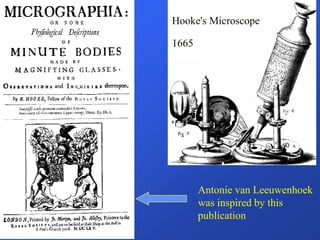
Hooke's Microscope
1665
Antonie van Leeuwenhoek
was inspired by this
publication
Antonie van Leeuwenhoek
(1677) (ā€œlayu-wen-hookā€)
–First observation of living cells
(200-300X mag.)
ā€“ā€œAnimalculesā€
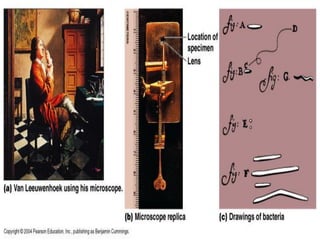
–Single lens Microscope (Self
made)—simple microscope
–Tooth plaque
–Rain water
–Diarrheal feces
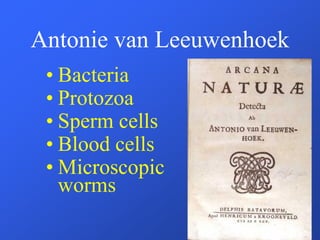
Antonie van Leeuwenhoek
• Bacteria
• Protozoa
• Sperm cells
• Blood cells
• Microscopic
worms
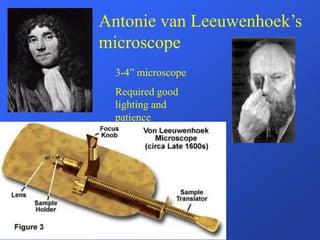
Antonie van Leeuwenhoek’s
microscope
3-4ā€ microscope
Required good
lighting and
patience
Spontaneous Generation
• The idea that life could arise
spontaneously from nonliving
matter
–Ex: Toads and Mice could arise
from soil
–Until the 18th century this
believe existed
History (cont.)
• 1668 Francesco
Redi
–1st one to
disprove
spontaneous
generation
Francesco Redi’s experiments
with meat
uncovered covered
Maggots No maggots
Disproved that maggots arise from decaying meat!!
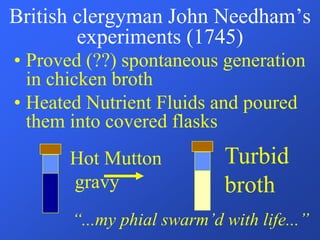
• Proved (??) spontaneous generation
in chicken broth
• Heated Nutrient Fluids and poured
them into covered flasks
British clergyman John Needham’s
experiments (1745)
Hot Mutton
gravy
Turbid
broth
ā€œ...my phial swarm’d with life...ā€
Italian priest Lazzaro
Spallanzani (1765)
• Similar to Needham’s
Experiments
• He showed that heating a
sealed flask of meat broth
prevented growth of organism
• Skeptics claimed—lack of O2
prevented growth!!
The Golden Age of
Microbiology!
•Louis Pasteur (finally disproved
spontaneous generation after many years
of debate)
•Robert Koch (proof of germ theory)
•Other pioneers in Microbiology
Pasteur—Father of
microbiology
•1857- Louis Pasteur saves France’s wine
industry
•Napoleon III begged Pasteur (a chemist
by training) to help solve a problem
•Sailors were mutinying b/c their wine
was spoiling after only a few weeks at sea
•Pasteur armed with his trusty
microscope accepted the challenge
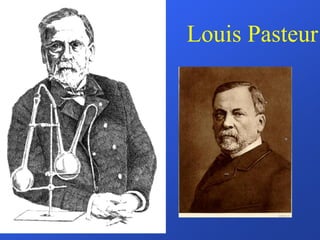
Louis Pasteur
–Spontaneous Generation finally
disproved
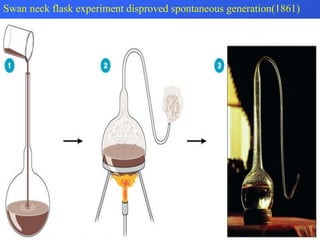
–Boiled broth in long-s-shaped necked
flasks (unsealed)
•Remained sterile
•Proved that microorganisms are
present in air, but air does not create
microbes
–Beginning of the golden age of
microbiology
Louis Pasteur (1861)
Swan neck flask experiment disproved spontaneous generation(1861)
History (cont.)
• 1861 Pasteur
–Proved Microorganisms are present in
nonliving matter
–Microbes can be destroyed by heat
•Aseptic Technique
• Fermentation mediated by yeast, not air
–Pasteurization to prevent wine and beer
spoilage (by bacteria)
1857-Louis Pasteur saves
France’s wine
1)Good wine contained yeast
2)Sour wine contained bacterium (Bacteria
that use alcohol and produce acetic acid spoil wine by turning it to
vinegar (acetic acid).
3)He reasoned that if wine is heated to
destroy the harmful bacteria it
wouldn’t spoil (process known as
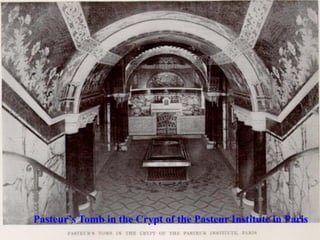
Pasteur’s Tomb in the Crypt of the Pasteur Institute in Paris
Germ Theory of Disease
• Pasteur proposed that wine
spoiling in an analogy for
disease (bacterial growth made the
wine ā€œsickā€)
• He hypothesized in 1857 that
microorganisms are responsible
for infectious diseases
Edward Jenner (country doctor)
–Milkmaid didn’t get smallpox b/c they
contracted the milder form of cowpox
–Immune system cannot distinguish btw
cowpox/smallpox
–Scratched a farmboy w/ a needle bearing
fluid from cowpox
–Small pox Vaccine
- -Vacca-cow
- Vaccination w/ cowpox provided
immunity for smallpox
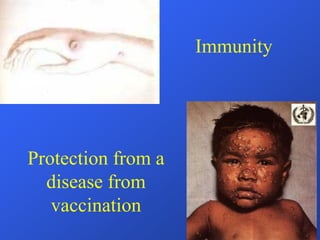
Protection from a
disease from
vaccination
Immunity
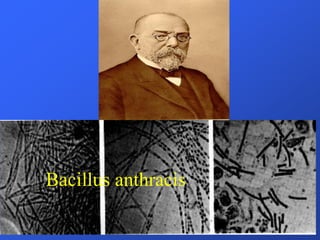
Robert Koch (1843-1910)
• German country physician who developed
microbiology into a science
• Developed pure culture techniques (used
potato slices to grow bacteria) developed agar later on
• Proof of the germ theory
• Work with anthrax
• Koch’s postulates
Bacillus anthracis
Pure Culture Key to Studying
Microbes
Definition: Pure culture is a
population of organism, all of which
are the progeny of a single organism
-In nature, microbes almost never
occur as pure cultures
AGAR
•Is a complex polysaccharide derived from
seaweed
•Was suggested by Fannie Hesse wife of
Koch’s co-worker Walther Hesse
ā€¢ā€œwhy do your jellies and pudding stay solid in warm weatherā€?
•AGAR-AGAR had been used as a gelling
agent in Asia for centuries
•Fannie learned to use AGAR-AGAR from a
Dutch neighbor in New York who spent time in
Asia
Koch’s postulates
1)Specific microorganism is present in all
cases of the disease
2)Organism can be obtained in pure
culture outside of the host
3)Organism when re-inoculated into host
causes the same symptoms
4)Organism can be isolated in pure culture
from experimentally infected host
Koch’s findings
Koch and his coworkers discovered that
bacteria caused
•TUBERCULOSIS
•CHOLERA
•DIPTHERIA
•TYPHOID FEVER
•GONORRHEA
•PNEUMONIA
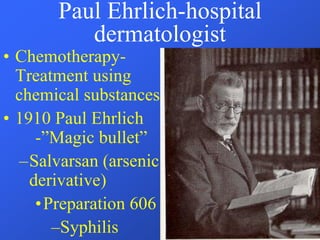
Paul Ehrlich-hospital
dermatologist
• Chemotherapy-
Treatment using
chemical substances
• 1910 Paul Ehrlich
-ā€Magic bulletā€
–Salvarsan (arsenic
derivative)
•Preparation 606
–Syphilis
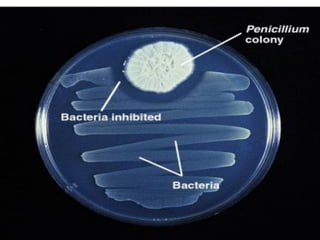
Alexander Fleming –scottish
researcher--1928
• Discovered Penicillin (fungus) by
accident
• Was convinced that nasal mucus
had antibacterial effects
• Left his Staphylococcus culture on
an agar plate for 2 weeks-went on
vacation-came back &found mold
on his plate which prevented
bacterial growth (a mycology lab
underneath him had this rare spore drift)
Founders of Microbiology
(Review)
•First observed microbes—
Leeuwenhoek
•Proved living cells can arise only from
other living cells---Pasteur
•Confirmed the Germ Theory of Disease
--Koch
Scope of microbiology
Bacteria
•Medical importance
–Gastroenteritis
–Syphilis
–Tetanus
–Lyme disease
–Plague
Bacteria (cont.)
• Industrial importance
–Food supplements
•Amino acids & Vitamins
–Organic solvents
•Acetone
Bacteria (cont.)
• Pharmaceutical
importance
–Antibiotics
•polymyxin
–Hormones
•Insulin
Biotechnology and
Recombinant DNA
• Biotechnology:
–The use of microorganisms, cells, or
cell components to make a product
–Foods, antibiotics, vitamins, enzymes
• Recombinant DNA Technology:
–Insertion or modification of genes to
produce desired proteins
Bacteria (cont.)
• Environmental importance
–Biodegradation
•Oil spills
•Wastewater treatment
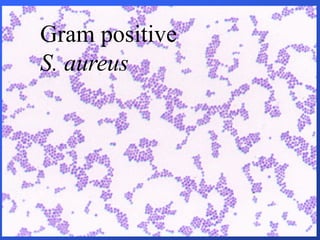
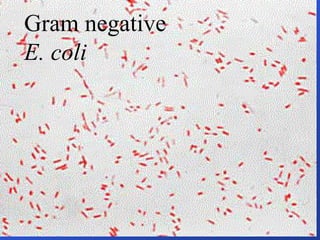
Gram positive
S. aureus
Gram negative
E. coli
Fungi
•Medical importance
–Valley fever
–Candidiasis
–Athlete's foot
Fungi (cont.)
• Industrial importance
–Fermentation
•Wine
•Beer
•Bread
Fungi (cont.)
•Pharmaceutical importance
–Antibiotics
•Penicillin
Fungi (cont.)
• Environmental importance
–Wastewater treatment
–Degradation of complex
organic matter
•Lignin in wood
Viruses
• Medical importance
–HIV
–Influenza
–Rabies
–Common cold

History and scope