CLASIFFICATION OF
           MICROORGANISMS
                                           Topic 1.1


07/08/09      1.1_Classificationofmicros      Review
Learning Outcomes

  •1. List the characteristics of
   various types of
   microorganisms
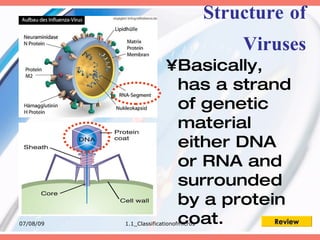
  •2. Classify microorganisms
   into bacteria, fungi,
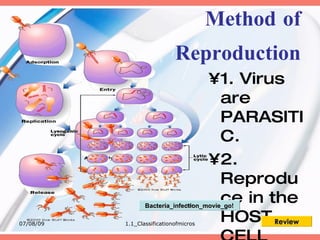
   protozoa, viruses and algae
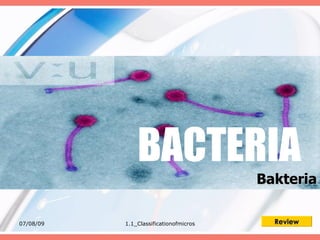
  •3. Describe the
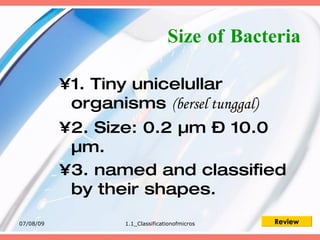
   characteristics of each
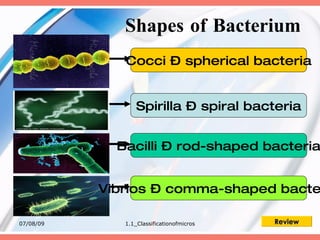
07/08/09                       Review
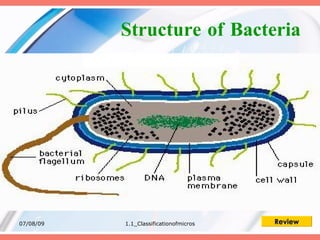
              1.1_Classificationofmicros
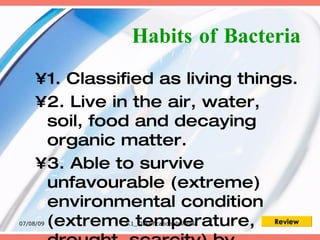
Microorganisms
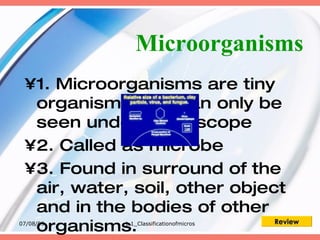
 •1. Microorganisms are tiny
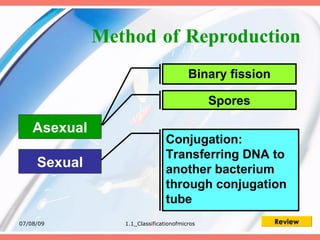
  organisms that can only be
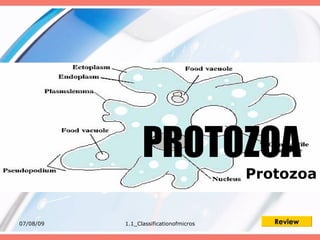
  seen under microscope
 •2. Called as microbe
 •3. Found in surround of the
  air, water, soil, other object
  and in the bodies of other
  organisms.
07/08/09                       Review
              1.1_Classificationofmicros
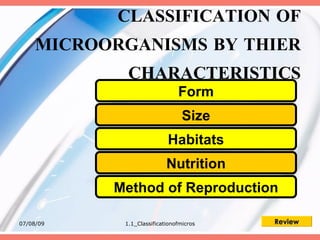
CLASSIFICATION OF
     MICROORGANISMS BY THIER
             CHARACTERISTICS
                               Form
                                 Size
                           Habitats
                           Nutrition
           Method of Reproduction

07/08/09    1.1_Classificationofmicros   Review
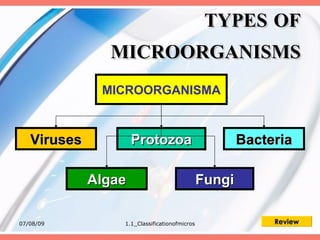
TYPES OF
               MICROORGANISMS
              MICROORGANISMA


   Viruses           Protozoa                         Bacteria

             Algae                            Fungi

07/08/09         1.1_Classificationofmicros                Review
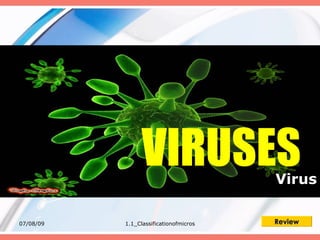
VIRUSES                Virus

07/08/09   1.1_Classificationofmicros   Review
Size of Viruses
           •1. Smallest
            microorganisms.
           •2. Visible under electron
            microscope.
           •3. Different types of
            viruses have different
            shapes.
07/08/09   •4. Size: 0.0006 µm – 0.4Review
                   1.1_Classificationofmicros
Structure of
                                            Viruses
                          •Basically,
                           has a strand
                           of genetic
                           material
                           either DNA
                           or RNA and
                           surrounded
                           by a protein
07/08/09                   coat.
           1.1_Classificationofmicros Review
Viruses Nutrition
           •Are non-living things
            because they DO NOT
            feed, respire, grow and
            respond to stimuli.
     Viruses Habits
 •Live in the living cells
  of bacteria,
  protozoa, fungi,
  algae, plants and
07/08/09         1.1_Classificationofmicros   Review
Method of
                             Reproduction
                                        •1. Virus
                                         are
                                         PARASITI
                                         C.
                                        •2.
                                         Reprodu
                                         ce in the
                  Bacteria_infection_movie_go!

07/08/09   1.1_Classificationofmicros
                                         HOST Review
BACTERIA
                                        Bakteria

07/08/09   1.1_Classificationofmicros     Review
Size of Bacteria

           •1. Tiny unicelullar
            organisms (bersel tunggal)
           •2. Size: 0.2 µm – 10.0
            µm.
           •3. named and classified
            by their shapes.
07/08/09           1.1_Classificationofmicros   Review
Shapes of Bacterium
              Cocci – spherical bacteria


                  Spirilla – spiral bacteria


             Bacilli – rod-shaped bacteria


           Vibrios – comma-shaped bacte

07/08/09      1.1_Classificationofmicros   Review
Structure of Bacteria


07/08/09   1.1_Classificationofmicros   Review
Habits of Bacteria
     •1. Classified as living things.
     •2. Live in the air, water,
      soil, food and decaying
      organic matter.
     •3. Able to survive
      unfavourable (extreme)
      environmental condition
      (extreme temperature, Review
07/08/09       1.1_Classificationofmicros
Nutrition of Bacteria
            •1. Different types
             of them obtain
             nutrients in the
             different ways.
            •a. Autotrophic
              bacteria:

07/08/09    •b. Parasitic bacteria:
                                  Review
            1.1_Classificationofmicros
Method of Reproduction
                                        Binary fission

                                              Spores

    Asexual
                                Conjugation:
                                Transferring DNA to
     Sexual                     another bacterium
                                through conjugation
                                tube
07/08/09         1.1_Classificationofmicros              Review
PROTOZOA
                                        Protozoa


07/08/09   1.1_Classificationofmicros      Review
Size of Protozoa

           •1. Unicelullar
            organisms.
           •2. Size: 5 µm – 250
            µm.
           •3. Shape: various type
            – round, spherical,
07/08/09
            spindle-shaped.
                  1.1_Classificationofmicros   Review
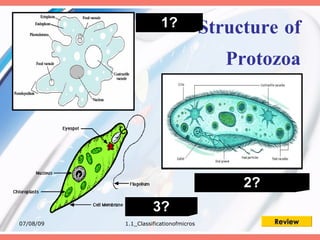
1?
                AMOEBA Structure                  of
                                          Protozoa


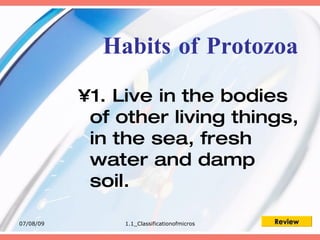
                                            2?
                                        PARAMECIUM
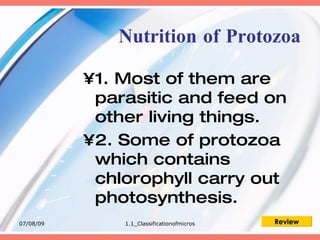
               3?
             EUGLENA
07/08/09   1.1_Classificationofmicros           Review
Habits of Protozoa

           •1. Live in the bodies
            of other living things,
            in the sea, fresh
            water and damp
            soil.

07/08/09        1.1_Classificationofmicros   Review
Nutrition of Protozoa

           •1. Most of them are
            parasitic and feed on
            other living things.
           •2. Some of protozoa
            which contains
            chlorophyll carry out
            photosynthesis.
07/08/09       1.1_Classificationofmicros   Review
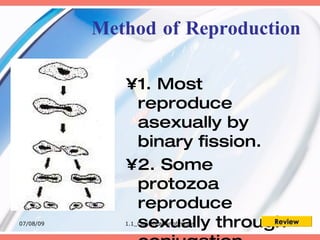
Method of Reproduction

              •1. Most
               reproduce
               asexually by
               binary fission.
              •2. Some
               protozoa
               reproduce
07/08/09       sexually throughReview
              1.1_Classificationofmicros
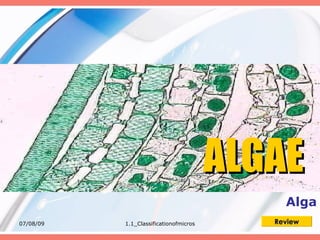
ALGAE
                                             Alga
07/08/09   1.1_Classificationofmicros      Review
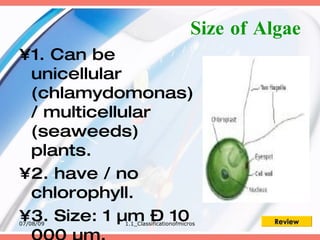
Size of Algae
•1. Can be
 unicellular
 (chlamydomonas)
 / multicellular
 (seaweeds)
 plants.
•2. have / no
 chlorophyll.
•3. Size: 1 µm – 10
07/08/09   1.1_Classificationofmicros       Review
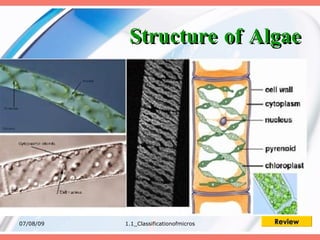
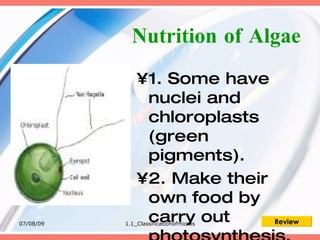
Structure of Algae


07/08/09   1.1_Classificationofmicros   Review
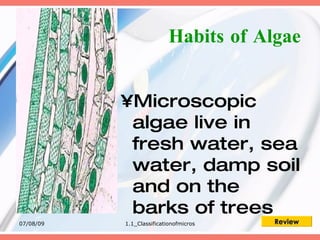
Habits of Algae


           •Microscopic
            algae live in
            fresh water, sea
            water, damp soil
            and on the
            barks of trees
07/08/09   1.1_Classificationofmicros   Review
Nutrition of Algae
               •1. Some have
                nuclei and
                chloroplasts
                (green
                pigments).
               •2. Make their
                own food by
07/08/09
                carry out
           1.1_Classificationofmicros   Review
Method of Reproduction

                           •1. Asexual: by
           Movie 1          binary fission,
                            fragmentation
                            and spore
           Movie 2
                            formation.
                           •2. Sexual: by
                            conjugation
07/08/09                1.1_Classificationofmicros   Review
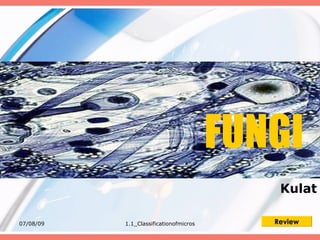
FUNGI
                                            Kulat

07/08/09   1.1_Classificationofmicros      Review
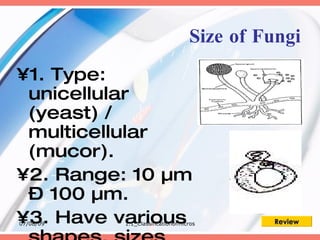
Size of Fungi
•1. Type:
 unicellular
 (yeast) /
 multicellular
 (mucor).
•2. Range: 10 µm
 – 100 µm.
•3. Have various
07/08/09   1.1_Classificationofmicros      Review
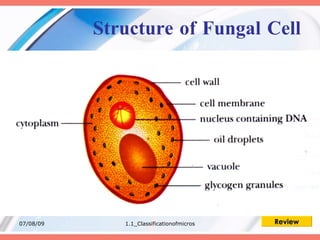
Structure of Fungal Cell


07/08/09      1.1_Classificationofmicros   Review
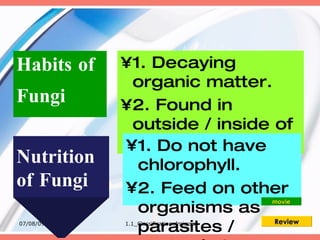
Habits of   •1. Decaying
             organic matter.
Fungi       •2. Found in
             outside / inside of
            •1. Do things.
             living not have
Nutrition     chlorophyll.
of Fungi    •2. Feed on other
              organisms as
                                         movie


07/08/09
              parasites /     Review
            1.1_Classificationofmicros
Method of
                                 Reproduction
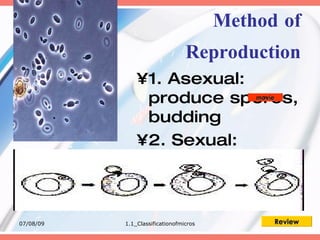
               •1. Asexual:
                produce spores,             movie


                budding
               •2. Sexual:
                conjugation


07/08/09   1.1_Classificationofmicros           Review
Classification of Microorganisms
Learning outcomes
                                                    Review 1.1
1.0 Microorganisms
1.1 Viruses
1.2 Bacteria
1.3 Protozoa
1.4 Algae
1.5 Fungi
Exercise 1.1

                                                      EXIT
 07/08/09              1.1_Classificationofmicros
Practice 1.1


•1. Viruses             •A. are not
 differ from             classified as
 other types             living things
 of                     •B. can
 microorgani             reproduce
 sms                    •C. cannot be
 because                 seen with our
 they …
07/08/09                 eyes
           1.1_Classificationofmicros Review
• A. Bacteria,
                 fungi, viruses
•2. Which of
               • B. Fungi,
 the following
                 bacteria,
 shows the       viruses
 microorganis
               • C. Viruses,
 ms in           fungi, bacteria
 descending
               • D. Viruses,
 order of size   bacteria, fungi
  from the
07/08/09     1.1_Classificationofmicros   Review
CLASIFFICATION OF
           MICROORGANISMS
                                          The end


07/08/09     1.1_Classificationofmicros     Review

1.1 Classsification Of Microorganisms

  • 1.
    CLASIFFICATION OF MICROORGANISMS Topic 1.1 07/08/09 1.1_Classificationofmicros Review
  • 2.
    Learning Outcomes •1. List the characteristics of various types of microorganisms •2. Classify microorganisms into bacteria, fungi, protozoa, viruses and algae •3. Describe the characteristics of each 07/08/09 Review 1.1_Classificationofmicros
  • 3.
    Microorganisms •1. Microorganismsare tiny organisms that can only be seen under microscope •2. Called as microbe •3. Found in surround of the air, water, soil, other object and in the bodies of other organisms. 07/08/09 Review 1.1_Classificationofmicros
  • 4.
    CLASSIFICATION OF MICROORGANISMS BY THIER CHARACTERISTICS Form Size Habitats Nutrition Method of Reproduction 07/08/09 1.1_Classificationofmicros Review
  • 5.
    TYPES OF MICROORGANISMS MICROORGANISMA Viruses Protozoa Bacteria Algae Fungi 07/08/09 1.1_Classificationofmicros Review
  • 6.
    VIRUSES Virus 07/08/09 1.1_Classificationofmicros Review
  • 7.
    Size of Viruses •1. Smallest microorganisms. •2. Visible under electron microscope. •3. Different types of viruses have different shapes. 07/08/09 •4. Size: 0.0006 µm – 0.4Review 1.1_Classificationofmicros
  • 8.
    Structure of Viruses •Basically, has a strand of genetic material either DNA or RNA and surrounded by a protein 07/08/09 coat. 1.1_Classificationofmicros Review
  • 9.
    Viruses Nutrition •Are non-living things because they DO NOT feed, respire, grow and respond to stimuli. Viruses Habits •Live in the living cells of bacteria, protozoa, fungi, algae, plants and 07/08/09 1.1_Classificationofmicros Review
  • 10.
    Method of Reproduction •1. Virus are PARASITI C. •2. Reprodu ce in the Bacteria_infection_movie_go! 07/08/09 1.1_Classificationofmicros HOST Review
  • 11.
    BACTERIA Bakteria 07/08/09 1.1_Classificationofmicros Review
  • 12.
    Size of Bacteria •1. Tiny unicelullar organisms (bersel tunggal) •2. Size: 0.2 µm – 10.0 µm. •3. named and classified by their shapes. 07/08/09 1.1_Classificationofmicros Review
  • 13.
    Shapes of Bacterium Cocci – spherical bacteria Spirilla – spiral bacteria Bacilli – rod-shaped bacteria Vibrios – comma-shaped bacte 07/08/09 1.1_Classificationofmicros Review
  • 14.
    Structure of Bacteria 07/08/09 1.1_Classificationofmicros Review
  • 15.
    Habits of Bacteria •1. Classified as living things. •2. Live in the air, water, soil, food and decaying organic matter. •3. Able to survive unfavourable (extreme) environmental condition (extreme temperature, Review 07/08/09 1.1_Classificationofmicros
  • 16.
    Nutrition of Bacteria •1. Different types of them obtain nutrients in the different ways. •a. Autotrophic bacteria: 07/08/09 •b. Parasitic bacteria: Review 1.1_Classificationofmicros
  • 17.
    Method of Reproduction Binary fission Spores Asexual Conjugation: Transferring DNA to Sexual another bacterium through conjugation tube 07/08/09 1.1_Classificationofmicros Review
  • 18.
    PROTOZOA Protozoa 07/08/09 1.1_Classificationofmicros Review
  • 19.
    Size of Protozoa •1. Unicelullar organisms. •2. Size: 5 µm – 250 µm. •3. Shape: various type – round, spherical, 07/08/09 spindle-shaped. 1.1_Classificationofmicros Review
  • 20.
    1? AMOEBA Structure of Protozoa 2? PARAMECIUM 3? EUGLENA 07/08/09 1.1_Classificationofmicros Review
  • 21.
    Habits of Protozoa •1. Live in the bodies of other living things, in the sea, fresh water and damp soil. 07/08/09 1.1_Classificationofmicros Review
  • 22.
    Nutrition of Protozoa •1. Most of them are parasitic and feed on other living things. •2. Some of protozoa which contains chlorophyll carry out photosynthesis. 07/08/09 1.1_Classificationofmicros Review
  • 23.
    Method of Reproduction •1. Most reproduce asexually by binary fission. •2. Some protozoa reproduce 07/08/09 sexually throughReview 1.1_Classificationofmicros
  • 24.
    ALGAE Alga 07/08/09 1.1_Classificationofmicros Review
  • 25.
    Size of Algae •1.Can be unicellular (chlamydomonas) / multicellular (seaweeds) plants. •2. have / no chlorophyll. •3. Size: 1 µm – 10 07/08/09 1.1_Classificationofmicros Review
  • 26.
    Structure of Algae 07/08/09 1.1_Classificationofmicros Review
  • 27.
    Habits of Algae •Microscopic algae live in fresh water, sea water, damp soil and on the barks of trees 07/08/09 1.1_Classificationofmicros Review
  • 28.
    Nutrition of Algae •1. Some have nuclei and chloroplasts (green pigments). •2. Make their own food by 07/08/09 carry out 1.1_Classificationofmicros Review
  • 29.
    Method of Reproduction •1. Asexual: by Movie 1 binary fission, fragmentation and spore Movie 2 formation. •2. Sexual: by conjugation 07/08/09 1.1_Classificationofmicros Review
  • 30.
    FUNGI Kulat 07/08/09 1.1_Classificationofmicros Review
  • 31.
    Size of Fungi •1.Type: unicellular (yeast) / multicellular (mucor). •2. Range: 10 µm – 100 µm. •3. Have various 07/08/09 1.1_Classificationofmicros Review
  • 32.
    Structure of FungalCell 07/08/09 1.1_Classificationofmicros Review
  • 33.
    Habits of •1. Decaying organic matter. Fungi •2. Found in outside / inside of •1. Do things. living not have Nutrition chlorophyll. of Fungi •2. Feed on other organisms as movie 07/08/09 parasites / Review 1.1_Classificationofmicros
  • 34.
    Method of Reproduction •1. Asexual: produce spores, movie budding •2. Sexual: conjugation 07/08/09 1.1_Classificationofmicros Review
  • 35.
    Classification of Microorganisms Learningoutcomes Review 1.1 1.0 Microorganisms 1.1 Viruses 1.2 Bacteria 1.3 Protozoa 1.4 Algae 1.5 Fungi Exercise 1.1 EXIT 07/08/09 1.1_Classificationofmicros
  • 36.
    Practice 1.1 •1. Viruses •A. are not differ from classified as other types living things of •B. can microorgani reproduce sms •C. cannot be because seen with our they … 07/08/09 eyes 1.1_Classificationofmicros Review
  • 37.
    • A. Bacteria, fungi, viruses •2. Which of • B. Fungi, the following bacteria, shows the viruses microorganis • C. Viruses, ms in fungi, bacteria descending • D. Viruses, order of size bacteria, fungi from the 07/08/09 1.1_Classificationofmicros Review
  • 38.
    CLASIFFICATION OF MICROORGANISMS The end 07/08/09 1.1_Classificationofmicros Review