

Microorganism
• An organism is a living thing that ingests and break down
food for energy and nutrient, excretes und ingested food as
waste and is capable of reproduction.
• Microorganisms arc tiny organisms that live around us and
inside our body.
• Microorganism are of two types, They are
• Pathogenic and
• Non-pathogenic microorganism
Pathogenic microorganism
• An infection is caused by the disease-causing microorganism
known as a pathogenic microorganism.
• Some pathogenic microorganisms infect humans. but not
other animals and plants. Some microorganisms that infect
animals or plants also infect humans.
• Mycobacterium tuberculosis is the bacterium transmits
infection through droplets of respiratory secretion or dry
sputum from infected person lo uninfected person.
Non-pathogenic microorganism
• Non-Pathogenic microorganisms don’t cause disease but
helpful in different ways.
• Some microorganism helps lo maintain homeostasis in human
body and is used in the production of food and other
commercial products.
• For example, flora is microorganisms found in intestines that
helpful in the digestion of food and play role in formation of
vitamins such as vitamin B and vitamin K. Moreover. it helps
in breakdown of large molecules into small molecules.
Field of microbiology
• Microbiology are organized into six fields of study:
• Bacteriology
• Virology
• Mycology
• Phycology
• Protozoology and
• Parasitology
Classification of organisms
• Taxonomy
• Taxonomy is the science of organisms based on a
presumed natural relationship.
• Scientist observe each organism, noting its characteristics.
Organism that have similar characteristics are presumed to
have a natural relationship and therefore are placed in the
same group.
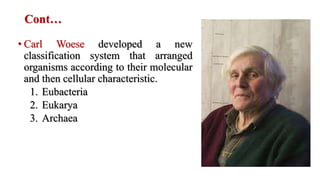
Cont…
• Carl Woese developed a new
classification system that arranged
organisms according to their molecular
and then cellular characteristic.
1. Eubacteria
2. Eukarya
3. Archaea
General characteristics of bacteria
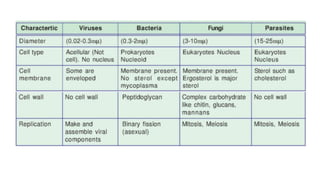
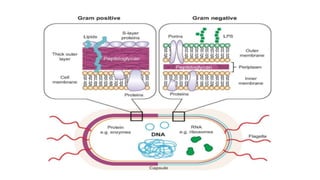
• Bacteria are microscopic prokaryotic organisms whose cells lack a nucleus
or nuclear membrane.
• The bacteria may found in different shapes.
• Bacteria have unique cell walls. reproduce by binary fission and exist in
most environments on earth.
• Bacterial species vary in size.
• The smallest bacterium (Mycoplasma) are about 0.3 µm in diameter.
approximately the size of the largest viruses (poxviruses).
• Escherichia coli bacterium of about 1.1 to 1.5 µm wide by 2.0 to 6.0
µm long.
• Most spherical bacteria have diameters of 0.5 to 2.0 µm and rod-shaped
cells are generally 0.2 to 2.0 µm wide and 1- l0 µm long.
Classification of bacteria
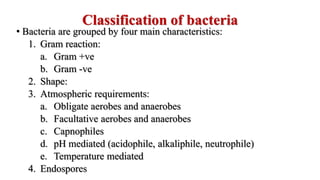
• Bacteria are grouped by four main characteristics:
1. Gram reaction:
a. Gram +ve
b. Gram -ve
2. Shape:
3. Atmospheric requirements:
a. Obligate aerobes and anaerobes
b. Facultative aerobes and anaerobes
c. Capnophiles
d. pH mediated (acidophile, alkaliphile, neutrophile)
e. Temperature mediated
4. Endospores
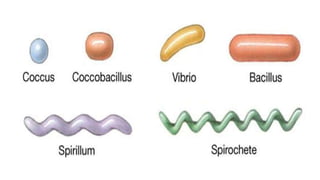
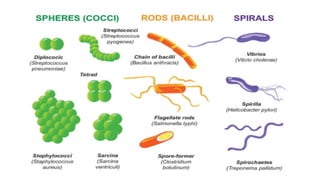
• Bacteria found in different shapes
• Cocci - Round or oval cells
• Bacilli - Rod shaped cells
• Spirilla - Non flexuous spiral forms
• Vibrio - Curved or comma-shaped rods
• Spirochetes- Slender and flexuous spiral forms
• Mycoplasma - Cell wall absent so bacteria found as round
or oval cells
• Actinomycetes- Branched filamentous bacteria
• Some bacteria are arranged in groups are
• Diplococci - Cocci arranged in pairs
• Streptococci - Cocci arranged in chains
• Staphylococci - Cocci arranged in clusters
• Coccobacilli - Both length and width are approximately
same in the bacteria
• Streptobacilli - Bacilli arranged in chains
• Chinese letter or Cuneiform pattern - resemble like
Chinese letter
• Tetrad - Cocci arranged as four cells
• Sarcina - Cocci arranged as cluster of eight cells
Bacterial motility
• In the most bacterial species, motility is the property of
swimming by means of flagellar impulsion
• Bacteria flagellum contain filament which is rigid helix
structure and the bacterium moves when this helix rotates.
• The direction of flagellar rotation determines the nature of the
movement. To move forward flagella rotate counter
clockwise (viewed from outside the cell). Whereas, cell itself
rotate slowly clockwise.
• The bacteria can swim from 20 to almost 90 µm per second.
Flagella
• Flagella are threadlike locomotor appendages extending outward from the
plasma membrane and cell wall.
• Most bacteria move with use of flagella is termed motility.
• Flagella are slender, rigid structure, about 20 nm width and up to 15 or 20
micrometer long.
• The detailed structure of a flagellum can only be seen in the electron
microscope.
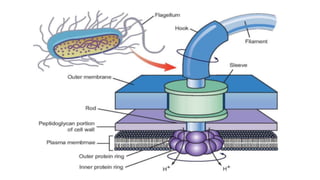
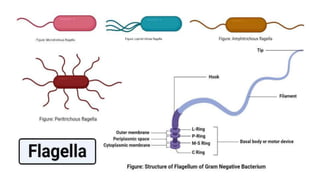
• The bacterial flagellum composed of three parts:
i. Filament,
ii. Hook and
iii. Basal body
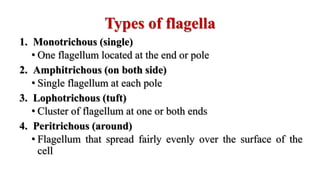
Types of flagella
1. Monotrichous (single)
• One flagellum located at the end or pole
2. Amphitrichous (on both side)
• Single flagellum at each pole
3. Lophotrichous (tuft)
• Cluster of flagellum at one or both ends
4. Peritrichous (around)
• Flagellum that spread fairly evenly over the surface of the
cell
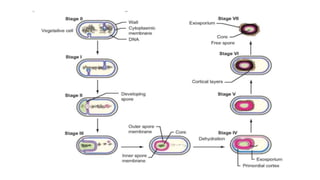
Bacterial Endospore
• Endospore are small dehydrated metabolically quiescent forms
that arc produced by some bacteria in response to nutrient
limitation.
• Endospores develop within vegetative bacterial cells of several
genera: Bacillus and Clostridium (rods), Sparosarcina (cocci) and
others.
• These structures arc extraordinarily resistance to environmental
stresses such as heat, ultraviolet radiation, gamma radiation.
chemical disinfectant and desiccation.
• These endospores produce resistance, because of this these
considered as dangerous pathogen, they can often survive boiling
for an hour or more.
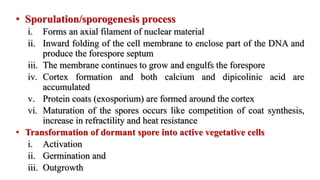
• Sporulation/sporogenesis process
i. Forms an axial filament of nuclear material
ii. Inward folding of the cell membrane to enclose part of the DNA and
produce the forespore septum
iii. The membrane continues to grow and engulfs the forespore
iv. Cortex formation and both calcium and dipicolinic acid are
accumulated
v. Protein coats (exosporium) are formed around the cortex
vi. Maturation of the spores occurs like competition of coat synthesis,
increase in refractility and heat resistance
• Transformation of dormant spore into active vegetative cells
i. Activation
ii. Germination and
iii. Outgrowth
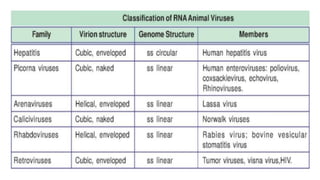
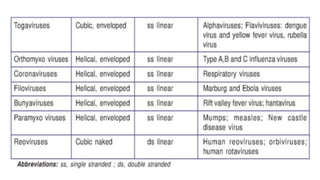
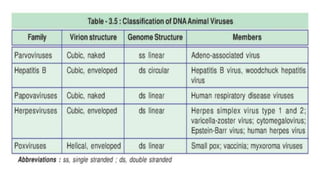
General characteristics of virus
• Viruses are strict intracellular parasite which live inside the other
living cells.
• Viruses are simple forms contain biologically active particle that
carry genetic information in either DNA or RNA molecules.
• Matured viruses, have nucleic acid covered with protein coat.
• Viruses lack the protein-synthesizing enzymes and structural
apparatus necessary for replication. Replication is controlled by
host cell.
• A virus is a set of genes, composed of either DNA or RNA,
packaged in a protein containing coat. This particle is called a
Virion.
Size and shape of virus
• Viruses are usually much smaller than bacteria and are submicroscopic.
• Most range of viruses is in size from 5 to 300 nanometers (nm). Some
paramyxoviruses are up to 14,000 nm long.
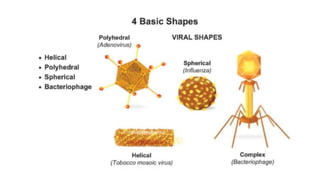
• Animal viruses have many shapes, ranging from cubical, bullet-shaped,
polygonal, spherical, filamentous or helical, to a complexed layered
morphology.
• One of the most common morphologies of the viral capsid is, the
Icoshedron. which consists of 20 triangular faces (capsomeres) that
coalesce to form a roughly spherical structure enclosing the viral nucleic
acid.
• Four common shapes of viruses are Helical, Polyhedral, Enveloped and
Binal (complex) viruses.
•Virus multiplication: Two possible outcome of a virus
infection area productive or lytic response and non
productive response also called Lysogeny.
i. Absorption of the host cell
ii. Penetration or entry
iii. Uncoating to release the genome
iv. Virion component production
v. Assembly
vi. Release from the cell
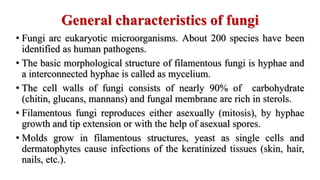
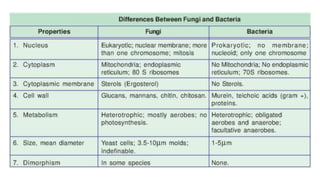
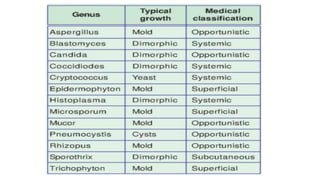
General characteristics of fungi
• Fungi arc eukaryotic microorganisms. About 200 species have been
identified as human pathogens.
• The basic morphological structure of filamentous fungi is hyphae and
a interconnected hyphae is called as mycelium.
• The cell walls of fungi consists of nearly 90% of carbohydrate
(chitin, glucans, mannans) and fungal membrane are rich in sterols.
• Filamentous fungi reproduces either asexually (mitosis), by hyphae
growth and tip extension or with the help of asexual spores.
• Molds grow in filamentous structures, yeast as single cells and
dermatophytes cause infections of the keratinized tissues (skin, hair,
nails, etc.).
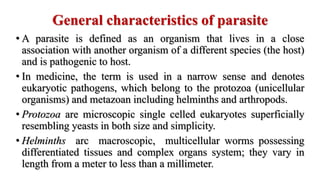
General characteristics of parasite
• A parasite is defined as an organism that lives in a close
association with another organism of a different species (the host)
and is pathogenic to host.
• In medicine, the term is used in a narrow sense and denotes
eukaryotic pathogens, which belong to the protozoa (unicellular
organisms) and metazoan including helminths and arthropods.
• Protozoa are microscopic single celled eukaryotes superficially
resembling yeasts in both size and simplicity.
• Helminths arc macroscopic, multicellular worms possessing
differentiated tissues and complex organs system; they vary in
length from a meter to less than a millimeter.
General characteristics of protozoa
• Protozoa are eukaryotic, single celled microorganisms about 1-150µm in
size and enclosed by a cell membrane.
• They exist in almost every type of environment, over a wide range of
pH (3 - 9.5), temperature and salinity.
• Reproduction is asexually by binary or multiple fission of the cell or
sexual.
• Movement of the parasitic protozoa is by flagella, cilia or pseudopodia.
• Some species of protozoa produces resistant cysts and oocysts in which
the parasite can survive outside of their host for longer periods.
• It receive nutrients by breaking down organic matter (heterotrophic) and
can grow in both aerobic and anaerobic environments. such a protozoa
that live in the intestine of animals.
General characteristics of protozoa
• It obtain food in one of the three way: Absorption, Ingestion and
Engulf
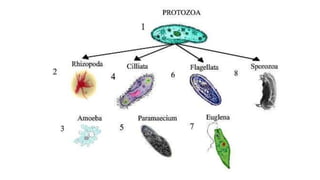
• Protozoa can be subdivided into four main groups:
• Sporozoa (e.g., Microsporidium, Plasmodium, Toxoplasma)
• Flagellates (e.g., Leishmania, Trypanosoma, Trichomonas)
• Amoeboid (e.g., Entamoeba histolytica, Acanthamoeba spp.)
• Ciliates (e.g., Balantidium coli)
2. General characteristics of microbes (Microbiology)

2. General characteristics of microbes (Microbiology)

  • 3.
    Microorganism • An organismis a living thing that ingests and break down food for energy and nutrient, excretes und ingested food as waste and is capable of reproduction. • Microorganisms arc tiny organisms that live around us and inside our body. • Microorganism are of two types, They are • Pathogenic and • Non-pathogenic microorganism
  • 4.
    Pathogenic microorganism • Aninfection is caused by the disease-causing microorganism known as a pathogenic microorganism. • Some pathogenic microorganisms infect humans. but not other animals and plants. Some microorganisms that infect animals or plants also infect humans. • Mycobacterium tuberculosis is the bacterium transmits infection through droplets of respiratory secretion or dry sputum from infected person lo uninfected person.
  • 5.
    Non-pathogenic microorganism • Non-Pathogenicmicroorganisms don’t cause disease but helpful in different ways. • Some microorganism helps lo maintain homeostasis in human body and is used in the production of food and other commercial products. • For example, flora is microorganisms found in intestines that helpful in the digestion of food and play role in formation of vitamins such as vitamin B and vitamin K. Moreover. it helps in breakdown of large molecules into small molecules.
  • 6.
    Field of microbiology •Microbiology are organized into six fields of study: • Bacteriology • Virology • Mycology • Phycology • Protozoology and • Parasitology
  • 7.
    Classification of organisms •Taxonomy • Taxonomy is the science of organisms based on a presumed natural relationship. • Scientist observe each organism, noting its characteristics. Organism that have similar characteristics are presumed to have a natural relationship and therefore are placed in the same group.
  • 8.
    Cont… • Carl Woesedeveloped a new classification system that arranged organisms according to their molecular and then cellular characteristic. 1. Eubacteria 2. Eukarya 3. Archaea
  • 10.
    General characteristics ofbacteria • Bacteria are microscopic prokaryotic organisms whose cells lack a nucleus or nuclear membrane. • The bacteria may found in different shapes. • Bacteria have unique cell walls. reproduce by binary fission and exist in most environments on earth. • Bacterial species vary in size. • The smallest bacterium (Mycoplasma) are about 0.3 µm in diameter. approximately the size of the largest viruses (poxviruses). • Escherichia coli bacterium of about 1.1 to 1.5 µm wide by 2.0 to 6.0 µm long. • Most spherical bacteria have diameters of 0.5 to 2.0 µm and rod-shaped cells are generally 0.2 to 2.0 µm wide and 1- l0 µm long.
  • 12.
    Classification of bacteria •Bacteria are grouped by four main characteristics: 1. Gram reaction: a. Gram +ve b. Gram -ve 2. Shape: 3. Atmospheric requirements: a. Obligate aerobes and anaerobes b. Facultative aerobes and anaerobes c. Capnophiles d. pH mediated (acidophile, alkaliphile, neutrophile) e. Temperature mediated 4. Endospores
  • 15.
    • Bacteria foundin different shapes • Cocci - Round or oval cells • Bacilli - Rod shaped cells • Spirilla - Non flexuous spiral forms • Vibrio - Curved or comma-shaped rods • Spirochetes- Slender and flexuous spiral forms • Mycoplasma - Cell wall absent so bacteria found as round or oval cells • Actinomycetes- Branched filamentous bacteria
  • 17.
    • Some bacteriaare arranged in groups are • Diplococci - Cocci arranged in pairs • Streptococci - Cocci arranged in chains • Staphylococci - Cocci arranged in clusters • Coccobacilli - Both length and width are approximately same in the bacteria • Streptobacilli - Bacilli arranged in chains • Chinese letter or Cuneiform pattern - resemble like Chinese letter • Tetrad - Cocci arranged as four cells • Sarcina - Cocci arranged as cluster of eight cells
  • 19.
    Bacterial motility • Inthe most bacterial species, motility is the property of swimming by means of flagellar impulsion • Bacteria flagellum contain filament which is rigid helix structure and the bacterium moves when this helix rotates. • The direction of flagellar rotation determines the nature of the movement. To move forward flagella rotate counter clockwise (viewed from outside the cell). Whereas, cell itself rotate slowly clockwise. • The bacteria can swim from 20 to almost 90 µm per second.
  • 20.
    Flagella • Flagella arethreadlike locomotor appendages extending outward from the plasma membrane and cell wall. • Most bacteria move with use of flagella is termed motility. • Flagella are slender, rigid structure, about 20 nm width and up to 15 or 20 micrometer long. • The detailed structure of a flagellum can only be seen in the electron microscope. • The bacterial flagellum composed of three parts: i. Filament, ii. Hook and iii. Basal body
  • 22.
    Types of flagella 1.Monotrichous (single) • One flagellum located at the end or pole 2. Amphitrichous (on both side) • Single flagellum at each pole 3. Lophotrichous (tuft) • Cluster of flagellum at one or both ends 4. Peritrichous (around) • Flagellum that spread fairly evenly over the surface of the cell
  • 24.
    Bacterial Endospore • Endosporeare small dehydrated metabolically quiescent forms that arc produced by some bacteria in response to nutrient limitation. • Endospores develop within vegetative bacterial cells of several genera: Bacillus and Clostridium (rods), Sparosarcina (cocci) and others. • These structures arc extraordinarily resistance to environmental stresses such as heat, ultraviolet radiation, gamma radiation. chemical disinfectant and desiccation. • These endospores produce resistance, because of this these considered as dangerous pathogen, they can often survive boiling for an hour or more.
  • 25.
    • Sporulation/sporogenesis process i.Forms an axial filament of nuclear material ii. Inward folding of the cell membrane to enclose part of the DNA and produce the forespore septum iii. The membrane continues to grow and engulfs the forespore iv. Cortex formation and both calcium and dipicolinic acid are accumulated v. Protein coats (exosporium) are formed around the cortex vi. Maturation of the spores occurs like competition of coat synthesis, increase in refractility and heat resistance • Transformation of dormant spore into active vegetative cells i. Activation ii. Germination and iii. Outgrowth
  • 27.
    General characteristics ofvirus • Viruses are strict intracellular parasite which live inside the other living cells. • Viruses are simple forms contain biologically active particle that carry genetic information in either DNA or RNA molecules. • Matured viruses, have nucleic acid covered with protein coat. • Viruses lack the protein-synthesizing enzymes and structural apparatus necessary for replication. Replication is controlled by host cell. • A virus is a set of genes, composed of either DNA or RNA, packaged in a protein containing coat. This particle is called a Virion.
  • 28.
    Size and shapeof virus • Viruses are usually much smaller than bacteria and are submicroscopic. • Most range of viruses is in size from 5 to 300 nanometers (nm). Some paramyxoviruses are up to 14,000 nm long. • Animal viruses have many shapes, ranging from cubical, bullet-shaped, polygonal, spherical, filamentous or helical, to a complexed layered morphology. • One of the most common morphologies of the viral capsid is, the Icoshedron. which consists of 20 triangular faces (capsomeres) that coalesce to form a roughly spherical structure enclosing the viral nucleic acid. • Four common shapes of viruses are Helical, Polyhedral, Enveloped and Binal (complex) viruses.
  • 33.
    •Virus multiplication: Twopossible outcome of a virus infection area productive or lytic response and non productive response also called Lysogeny. i. Absorption of the host cell ii. Penetration or entry iii. Uncoating to release the genome iv. Virion component production v. Assembly vi. Release from the cell
  • 34.
    General characteristics offungi • Fungi arc eukaryotic microorganisms. About 200 species have been identified as human pathogens. • The basic morphological structure of filamentous fungi is hyphae and a interconnected hyphae is called as mycelium. • The cell walls of fungi consists of nearly 90% of carbohydrate (chitin, glucans, mannans) and fungal membrane are rich in sterols. • Filamentous fungi reproduces either asexually (mitosis), by hyphae growth and tip extension or with the help of asexual spores. • Molds grow in filamentous structures, yeast as single cells and dermatophytes cause infections of the keratinized tissues (skin, hair, nails, etc.).
  • 37.
    General characteristics ofparasite • A parasite is defined as an organism that lives in a close association with another organism of a different species (the host) and is pathogenic to host. • In medicine, the term is used in a narrow sense and denotes eukaryotic pathogens, which belong to the protozoa (unicellular organisms) and metazoan including helminths and arthropods. • Protozoa are microscopic single celled eukaryotes superficially resembling yeasts in both size and simplicity. • Helminths arc macroscopic, multicellular worms possessing differentiated tissues and complex organs system; they vary in length from a meter to less than a millimeter.
  • 38.
    General characteristics ofprotozoa • Protozoa are eukaryotic, single celled microorganisms about 1-150µm in size and enclosed by a cell membrane. • They exist in almost every type of environment, over a wide range of pH (3 - 9.5), temperature and salinity. • Reproduction is asexually by binary or multiple fission of the cell or sexual. • Movement of the parasitic protozoa is by flagella, cilia or pseudopodia. • Some species of protozoa produces resistant cysts and oocysts in which the parasite can survive outside of their host for longer periods. • It receive nutrients by breaking down organic matter (heterotrophic) and can grow in both aerobic and anaerobic environments. such a protozoa that live in the intestine of animals.
  • 39.
    General characteristics ofprotozoa • It obtain food in one of the three way: Absorption, Ingestion and Engulf • Protozoa can be subdivided into four main groups: • Sporozoa (e.g., Microsporidium, Plasmodium, Toxoplasma) • Flagellates (e.g., Leishmania, Trypanosoma, Trichomonas) • Amoeboid (e.g., Entamoeba histolytica, Acanthamoeba spp.) • Ciliates (e.g., Balantidium coli)