(bacterial cell division)
Prepared by:
Maulik chaudhari
Bacteria ‘s growth can be take place
by binary fission and during that so many
phases happen during that different events
takes place.
five type of growth curves:
1) Growth cycle
2) Biphasic growth
3) Maintenance of cells in exponencial phase
4) Synchronous growth
5) Bacterial growth in vivo
 Bacterial growth is regulated by nutritional
environment. When suitable environment is
there that time bacterium is incubated,its
growth leads to increase in number of cells
which allow definite course.
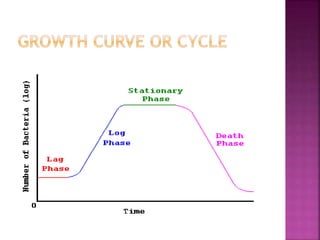
 The growth curve has got four phases:
 Lag phase
 Log phase(logarithmic) or exponential phase
 Stationary phase
 Decline phase
 bacteria adapt themselves to growth
conditions. It is the period where the
individual bacteria are maturing and not yet
able to divide. During the lag phase of the
bacterial growth cycle, synthesis of RNA,
enzymes and other molecules occurs.
 Length of this phase depend on type of
bacterial spesis, culture medium, and
environmental factors.
 (sometimes called the log phase or the
logarithmic phase)
 it is a period characterized by cell doubling. The
number of new bacteria appearing per unit time
is proportional to the present population. If
growth is not limited, doubling will continue at a
constant rate so both the number of cells and
the rate of population increase doubles with
each consecutive time period. For this type of
exponential growth, plotting the natural
logarithm of cell number against time produces a
straight line.
 The slope of this line is the specific growth rate
of the organism, which is a measure of the
number of divisions per cell per unit time.The
actual rate of this depends upon the growth
conditions, which affect the frequency of cell
division events and the probability of both
daughter cells surviving. Under controlled
conditions, cyanobacteria can double their
population four times a day.
 Exponential growth cannot continue indefinitely,
however, because the medium is soon depleted
of nutrients and enriched with wastes.
 The "stationary phase" is due to a growth-limiting
factor; this is mostly depletion of a nutrient,
and/or the formation of inhibitory products such
as organic acids. An awkward but unfortunately
widespread explanation is that the stationary
phase results from a situation in which growth
rate and death rate have the same values (newly
formed cells per time = dying cells per time);but
this is not logical, and it is better to forget this.
 Such an explanation would not be in accordance
with the observed substrate depletion and also
could never explain the rather “smooth,”
horizontal linear part of the curve during the
stationary phase.
 Death of cells as a function of time is rather
unpredictable and very difficult to
explain.Another not really logical explanation of
the stationary phase is that there isn’t anymore
enough space for the cells
 However, under the microscope you will see that
there is still plenty of water between the cells
Only in an agar colony with densely packed cells
space is obviously limiting.
 bacteria run out of nutrients and die although
number of cells remain constant.
 The decline phase is brought by exhaution of
nutrients, accumalation of toxic products and
autolytic enzymes
 Sometimes a small numbers of survivors may
persist for month even after death of majority of
cells these few surviving cells probably grow at
expence of nutrients released
 Bacteria grow nonsynchronously in ordinary
culture medium, i.e at any moment cells are
present in different stage of growth cycle.
 When all bacterial cells in culture medium divide
simultaneously growth thus obtained is known as
synchronous growth.
 Such growth is required for studing the sequence
of event occuring in single cell like studies on
DNA synthesis or susceptibility of cell to lethal
agent
 There exists a significant difference of bacterial
growth in humn body and artificial culture
medium.
 They grow much faster in vitro than in vivo.
 Various factor in vivo include: nutritional status
of body, generation time, defence mechanism,
redox potential, hydrogen iron concentration ,
localisation of nutrients.
Bacterial growth curves

Bacterial growth curves

  • 1.
  • 2.
    Bacteria ‘s growthcan be take place by binary fission and during that so many phases happen during that different events takes place. five type of growth curves: 1) Growth cycle 2) Biphasic growth 3) Maintenance of cells in exponencial phase 4) Synchronous growth 5) Bacterial growth in vivo
  • 3.
     Bacterial growthis regulated by nutritional environment. When suitable environment is there that time bacterium is incubated,its growth leads to increase in number of cells which allow definite course.  The growth curve has got four phases:  Lag phase  Log phase(logarithmic) or exponential phase  Stationary phase  Decline phase
  • 5.
     bacteria adaptthemselves to growth conditions. It is the period where the individual bacteria are maturing and not yet able to divide. During the lag phase of the bacterial growth cycle, synthesis of RNA, enzymes and other molecules occurs.  Length of this phase depend on type of bacterial spesis, culture medium, and environmental factors.
  • 6.
     (sometimes calledthe log phase or the logarithmic phase)  it is a period characterized by cell doubling. The number of new bacteria appearing per unit time is proportional to the present population. If growth is not limited, doubling will continue at a constant rate so both the number of cells and the rate of population increase doubles with each consecutive time period. For this type of exponential growth, plotting the natural logarithm of cell number against time produces a straight line.
  • 7.
     The slopeof this line is the specific growth rate of the organism, which is a measure of the number of divisions per cell per unit time.The actual rate of this depends upon the growth conditions, which affect the frequency of cell division events and the probability of both daughter cells surviving. Under controlled conditions, cyanobacteria can double their population four times a day.  Exponential growth cannot continue indefinitely, however, because the medium is soon depleted of nutrients and enriched with wastes.
  • 8.
     The "stationaryphase" is due to a growth-limiting factor; this is mostly depletion of a nutrient, and/or the formation of inhibitory products such as organic acids. An awkward but unfortunately widespread explanation is that the stationary phase results from a situation in which growth rate and death rate have the same values (newly formed cells per time = dying cells per time);but this is not logical, and it is better to forget this.  Such an explanation would not be in accordance with the observed substrate depletion and also could never explain the rather “smooth,” horizontal linear part of the curve during the stationary phase.
  • 9.
     Death ofcells as a function of time is rather unpredictable and very difficult to explain.Another not really logical explanation of the stationary phase is that there isn’t anymore enough space for the cells  However, under the microscope you will see that there is still plenty of water between the cells Only in an agar colony with densely packed cells space is obviously limiting.
  • 10.
     bacteria runout of nutrients and die although number of cells remain constant.  The decline phase is brought by exhaution of nutrients, accumalation of toxic products and autolytic enzymes  Sometimes a small numbers of survivors may persist for month even after death of majority of cells these few surviving cells probably grow at expence of nutrients released
  • 11.
     Bacteria grownonsynchronously in ordinary culture medium, i.e at any moment cells are present in different stage of growth cycle.  When all bacterial cells in culture medium divide simultaneously growth thus obtained is known as synchronous growth.  Such growth is required for studing the sequence of event occuring in single cell like studies on DNA synthesis or susceptibility of cell to lethal agent
  • 12.
     There existsa significant difference of bacterial growth in humn body and artificial culture medium.  They grow much faster in vitro than in vivo.  Various factor in vivo include: nutritional status of body, generation time, defence mechanism, redox potential, hydrogen iron concentration , localisation of nutrients.