Akash Mahadev Iyer
2nd semester
M.Sc Biochemistry
University of Kerala
1. Microscopic methods
2. Cultural methods
3. Physiological methods
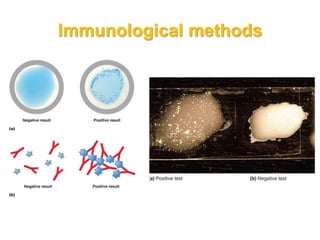
4. Immunological methods
5. Molecular methods (Nucleic acid
based methods)
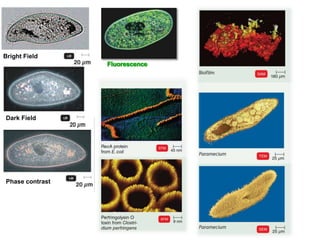
Bright Field
Dark Field
Phase contrast
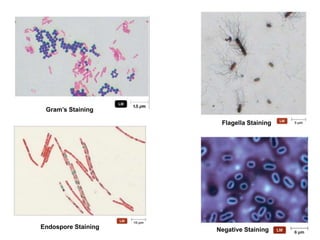
Gram’s Staining
Flagella Staining
Endospore Staining Negative Staining
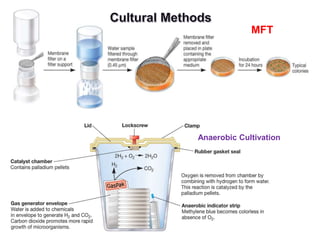
MFT
Anaerobic Cultivation
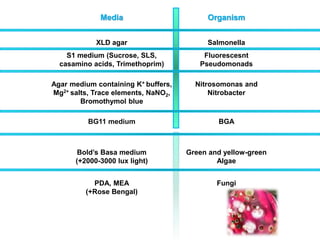
Media Organism
XLD agar Salmonella
S1 medium (Sucrose, SLS,
casamino acids, Trimethoprim)
Fluorescesnt
Pseudomonads
Agar medium containing K+ buffers,
Mg2+ salts, Trace elements, NaNO2,
Bromothymol blue
Nitrosomonas and
Nitrobacter
BG11 medium BGA
Bold’s Basa medium
(+2000-3000 lux light)
Green and yellow-green
Algae
PDA, MEA
(+Rose Bengal)
Fungi
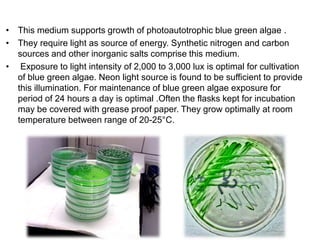
• This medium supports growth of photoautotrophic blue green algae .
• They require light as source of energy. Synthetic nitrogen and carbon
sources and other inorganic salts comprise this medium.
• Exposure to light intensity of 2,000 to 3,000 lux is optimal for cultivation
of blue green algae. Neon light source is found to be sufficient to provide
this illumination. For maintenance of blue green algae exposure for
period of 24 hours a day is optimal .Often the flasks kept for incubation
may be covered with grease proof paper. They grow optimally at room
temperature between range of 20-25°C.
 Provides information about what activities are carried out
in microbial communities- Contribution of microbe in the
environment
 Detection and characterization of unknown compounds-
MS
 Distinguish metals- , eg; Measures oxidation of S0
to sulphate.
 Estimates sulphate as a precipitate with Barium chloride
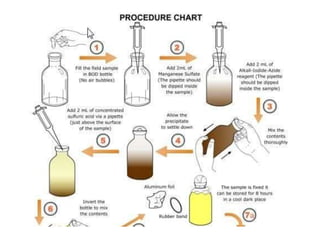
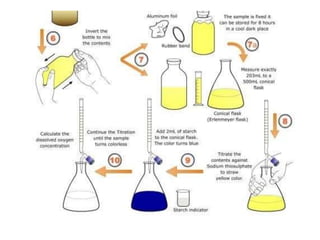
DO- Based on precipitation of dissolved oxygen
using
 Manganous sulphate and a KOH-KI mixture
 The oxygen precipitate, MnO2 reacts with sulfuric acid to form
manganic sulphate which inturn reacts with KI to liberate iodine
 No. of moles of Iodine No. of moles of oxygen present
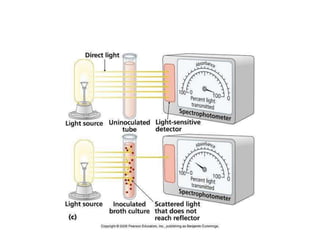
 Cell mass- Turbidimetric method
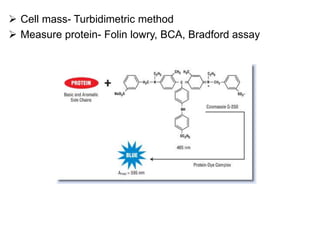
 Measure protein- Folin lowry, BCA, Bradford assay
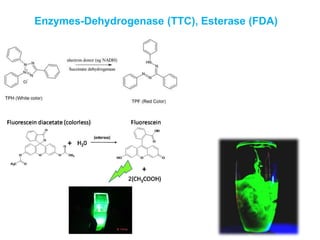
Enzymes-Dehydrogenase (TTC), Esterase (FDA)
Immunological methods
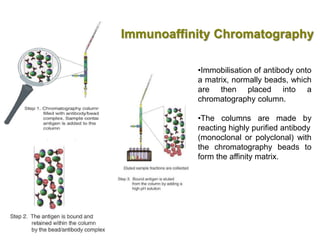
Immunoaffinity Chromatography
•Immobilisation of antibody onto
a matrix, normally beads, which
are then placed into a
chromatography column.
•The columns are made by
reacting highly purified antibody
(monoclonal or polyclonal) with
the chromatography beads to
form the affinity matrix.
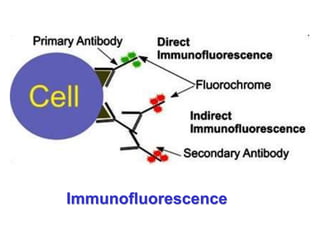
Immunofluorescence
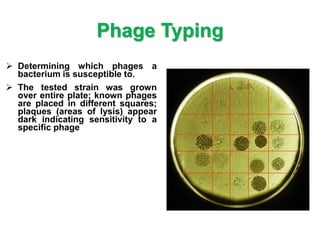
Phage Typing
 Determining which phages a
bacterium is susceptible to.
 The tested strain was grown
over entire plate; known phages
are placed in different squares;
plaques (areas of lysis) appear
dark indicating sensitivity to a
specific phage
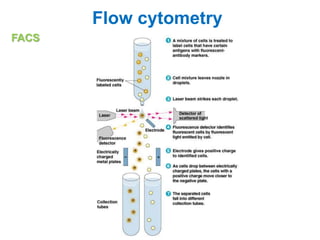
Flow cytometry
FACS
 DNA base composition- Guanine + cytosine moles% (GC)
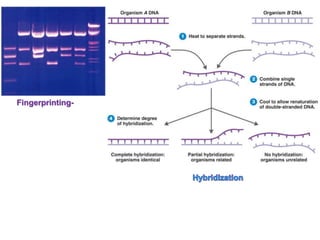
 DNA fingerprinting- Electrophoresis of restriction enzyme digests
 rRNA sequencing
 Gene Probing- ssDNA fragments to identify particular nucleic acid
sequence
 Hybridization
 Microarray
 Polymerase chain reaction (PCR)
 Metagenomics
Fingerprinting-
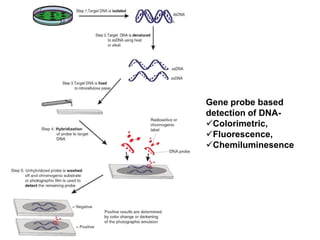
Gene probe based
detection of DNA-
Colorimetric,
Fluorescence,
Chemiluminesence
Microarray
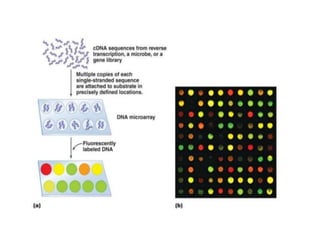
 A microarray is a laboratory tool
used to detect the expression of
thousands of genes at the same
time.
 DNA microarrays are microscope
slides that are printed with
thousands of tiny spots in
defined positions, with each spot
containing a known DNA
sequence or gene.
 Often, these slides are referred to
as gene chips or DNA chips.
 The DNA molecules attached to
each slide act as probes to
detect gene expression.
FISH Analysis of Sewage Sludge
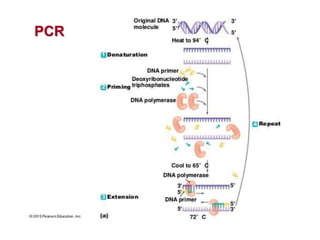
PCR
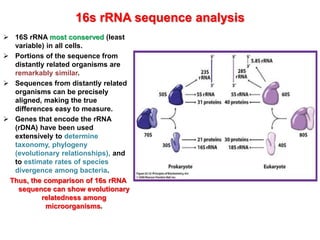
16s rRNA sequence analysis
 16S rRNA most conserved (least
variable) in all cells.
 Portions of the sequence from
distantly related organisms are
remarkably similar.
 Sequences from distantly related
organisms can be precisely
aligned, making the true
differences easy to measure.
 Genes that encode the rRNA
(rDNA) have been used
extensively to determine
taxonomy, phylogeny
(evolutionary relationships), and
to estimate rates of species
divergence among bacteria.
Thus, the comparison of 16s rRNA
sequence can show evolutionary
relatedness among
microorganisms.
RIBOSOMAL RNA •
 To infer relationships that span the diversity of known life, it is necessary
to look at genes conserved through the billions of years of evolutionary
divergence.
 Examples of genes in this category are those that define the ribosomal
RNAs (rRNAs).
 In Bacteria, Archaea, Mitochondria, and Chloroplasts, the small ribosomal
subunit contains the 16S rRNA (where the S in 16S represents Svedberg
units).
 The large ribosomal subunit contains two rRNA species (the 5S and 23S
 rRNAs).
 Most prokaryotes have three rRNAs, called the 5S, 16S and 23S rRNA.
Bacterial 16S, 23S, and 5S rRNA genes are typically organized as a co-
transcribed operon.
 There may be one or more copies of the operon dispersed in the genome
(for example, E coli has seven).
 The Archaea contains either a single rDNA operon or multiple copies of the
operon rRNA targets were studied originally, most researchers now target
the corresponding ribosomal DNA (rDNA) because DNA is more stable and
easier to analyse
 Conventional microbiology techniques -to identify most of the
bacteria, fungi and other pathogens- about 8 to 20 hours for an
accurate result.
 The presence of hyper variable regions in the 16S rRNA gene
provides a species specific signature sequence which is useful for
bacterial identification process.
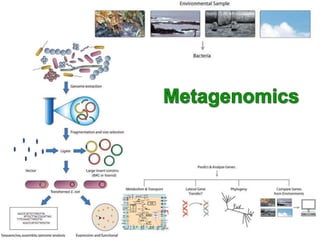
Metagenomics is the study of the metagenome—the collective genome
of microorganisms from an environmental sample—to provide
information on the microbial diversity and ecology of a specific
environment.
 DNA is cloned from microbial community and sequenced
 Detects as many genes as possible
 Yields picture of gene pool in environment
 Powerful tool for assessing the phylogenetic and metabolic diversity
of an environment
Identification of micro organisms

Identification of micro organisms

  • 1.
    Akash Mahadev Iyer 2ndsemester M.Sc Biochemistry University of Kerala
  • 2.
    1. Microscopic methods 2.Cultural methods 3. Physiological methods 4. Immunological methods 5. Molecular methods (Nucleic acid based methods)
  • 4.
  • 5.
  • 6.
  • 9.
    Media Organism XLD agarSalmonella S1 medium (Sucrose, SLS, casamino acids, Trimethoprim) Fluorescesnt Pseudomonads Agar medium containing K+ buffers, Mg2+ salts, Trace elements, NaNO2, Bromothymol blue Nitrosomonas and Nitrobacter BG11 medium BGA Bold’s Basa medium (+2000-3000 lux light) Green and yellow-green Algae PDA, MEA (+Rose Bengal) Fungi
  • 10.
    • This mediumsupports growth of photoautotrophic blue green algae . • They require light as source of energy. Synthetic nitrogen and carbon sources and other inorganic salts comprise this medium. • Exposure to light intensity of 2,000 to 3,000 lux is optimal for cultivation of blue green algae. Neon light source is found to be sufficient to provide this illumination. For maintenance of blue green algae exposure for period of 24 hours a day is optimal .Often the flasks kept for incubation may be covered with grease proof paper. They grow optimally at room temperature between range of 20-25°C.
  • 11.
     Provides informationabout what activities are carried out in microbial communities- Contribution of microbe in the environment  Detection and characterization of unknown compounds- MS  Distinguish metals- , eg; Measures oxidation of S0 to sulphate.  Estimates sulphate as a precipitate with Barium chloride DO- Based on precipitation of dissolved oxygen using  Manganous sulphate and a KOH-KI mixture  The oxygen precipitate, MnO2 reacts with sulfuric acid to form manganic sulphate which inturn reacts with KI to liberate iodine  No. of moles of Iodine No. of moles of oxygen present
  • 14.
     Cell mass-Turbidimetric method  Measure protein- Folin lowry, BCA, Bradford assay
  • 16.
  • 18.
  • 19.
    Immunoaffinity Chromatography •Immobilisation ofantibody onto a matrix, normally beads, which are then placed into a chromatography column. •The columns are made by reacting highly purified antibody (monoclonal or polyclonal) with the chromatography beads to form the affinity matrix.
  • 20.
  • 21.
    Phage Typing  Determiningwhich phages a bacterium is susceptible to.  The tested strain was grown over entire plate; known phages are placed in different squares; plaques (areas of lysis) appear dark indicating sensitivity to a specific phage
  • 22.
  • 23.
     DNA basecomposition- Guanine + cytosine moles% (GC)  DNA fingerprinting- Electrophoresis of restriction enzyme digests  rRNA sequencing  Gene Probing- ssDNA fragments to identify particular nucleic acid sequence  Hybridization  Microarray  Polymerase chain reaction (PCR)  Metagenomics
  • 24.
  • 25.
    Gene probe based detectionof DNA- Colorimetric, Fluorescence, Chemiluminesence
  • 26.
    Microarray  A microarrayis a laboratory tool used to detect the expression of thousands of genes at the same time.  DNA microarrays are microscope slides that are printed with thousands of tiny spots in defined positions, with each spot containing a known DNA sequence or gene.  Often, these slides are referred to as gene chips or DNA chips.  The DNA molecules attached to each slide act as probes to detect gene expression.
  • 28.
    FISH Analysis ofSewage Sludge
  • 29.
  • 30.
    16s rRNA sequenceanalysis  16S rRNA most conserved (least variable) in all cells.  Portions of the sequence from distantly related organisms are remarkably similar.  Sequences from distantly related organisms can be precisely aligned, making the true differences easy to measure.  Genes that encode the rRNA (rDNA) have been used extensively to determine taxonomy, phylogeny (evolutionary relationships), and to estimate rates of species divergence among bacteria. Thus, the comparison of 16s rRNA sequence can show evolutionary relatedness among microorganisms.
  • 31.
    RIBOSOMAL RNA • To infer relationships that span the diversity of known life, it is necessary to look at genes conserved through the billions of years of evolutionary divergence.  Examples of genes in this category are those that define the ribosomal RNAs (rRNAs).  In Bacteria, Archaea, Mitochondria, and Chloroplasts, the small ribosomal subunit contains the 16S rRNA (where the S in 16S represents Svedberg units).  The large ribosomal subunit contains two rRNA species (the 5S and 23S  rRNAs).  Most prokaryotes have three rRNAs, called the 5S, 16S and 23S rRNA. Bacterial 16S, 23S, and 5S rRNA genes are typically organized as a co- transcribed operon.  There may be one or more copies of the operon dispersed in the genome (for example, E coli has seven).  The Archaea contains either a single rDNA operon or multiple copies of the operon rRNA targets were studied originally, most researchers now target the corresponding ribosomal DNA (rDNA) because DNA is more stable and easier to analyse
  • 32.
     Conventional microbiologytechniques -to identify most of the bacteria, fungi and other pathogens- about 8 to 20 hours for an accurate result.  The presence of hyper variable regions in the 16S rRNA gene provides a species specific signature sequence which is useful for bacterial identification process.
  • 33.
    Metagenomics is thestudy of the metagenome—the collective genome of microorganisms from an environmental sample—to provide information on the microbial diversity and ecology of a specific environment.  DNA is cloned from microbial community and sequenced  Detects as many genes as possible  Yields picture of gene pool in environment  Powerful tool for assessing the phylogenetic and metabolic diversity of an environment

Editor's Notes