MICROBIOLOGY
Rubina Akbar(Microbiologist)
MSc. Clinical Microbiology
Objective
At the end of session the students will be able to:
 Describe the development of microbiology
 Define microbiology
 Explain different types of microbiology
 Discuss Spontaneous Generation Controversy
 Classify the microbiology
 Identify the scope of microbiology.
2
In this unit we will discuss about introduction to microbiology and its
importance in nursing field
Brief introduction of scientists in the field of microbiology
Define cell, their types and difference between eukaryotic and prokaryotic
cell
Basic properties of virus
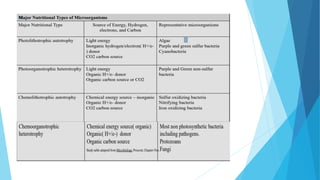
Classification of micro organisms on the basis of nutritional requirements
Why study microbiology?
 Microorganisms are part of the human environment and
are therefore important to human health and activities.
 The study of microorganisms provides insight into life
processes in all forms of life
4
Development of Microbiology
 Aristotle (322-384) and others believed that living
organisms could develop from non living materials.
 Girolamo Fracastoro published a book in 1546 which
suggested three ways for the transmission of infection
by direct contact, by fomites, and by the air.
 1590: Hans and Zacharias Janssen (Dutch lens grinders)
mounted two lenses in a tube to produce the first
microscope.
 1660: Robert Hooke (1635-1703) published micrographia,
containing drawings and detailed observations of
biological materials made with the best compound
microscope and illumination system of the time.
5
Development of Microbiology
 1668 Francesco Redi disapproved the myth of
spontaneous generation.
 1676 Anton Van Leeuwenhoek using his own designed
microscope, observed and accurately described the
invisible creature (Animalcules) of the microbial world.
this was the beginning of a new science.
 1798 Edward Jenner introduced vaccination for smallpox.
 Middle 19th century John Tyndall given the concept of
sterilization by discontinuous heating called
Tyndallization.
 1856 Louis Pasteur discussed alcoholic and lactic acid
fermentation by yeast and microorganisms
 1861 Louis Pasteur disapproved theory of spontaneous
generation. 6
Development of Microbiology
 1863 Louis Pasteur introduced method of destroying
bacteria called pasteurization.
 1867 Joseph Lister perform antiseptic surgery.
 1876 Robert Koch identify Anthrax disease caused by
Bacillus Anthracis.
 1881 Robert Koch introduced pure culture methods to
study bacteria and develop anthrax vaccine.
 1884 Robert Koch discussed Koch’s postulates.
 1884 Christian Gram discover staining method for
bacteria.
 1885 Louis Pasteur develops rabies vaccine.
7
Development of Microbiology
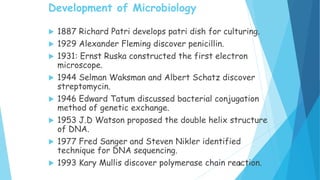
 1887 Richard Patri develops patri dish for culturing.
 1929 Alexander Fleming discover penicillin.
 1931: Ernst Ruska constructed the first electron
microscope.
 1944 Selman Waksman and Albert Schatz discover
streptomycin.
 1946 Edward Tatum discussed bacterial conjugation
method of genetic exchange.
 1953 J.D Watson proposed the double helix structure
of DNA.
 1977 Fred Sanger and Steven Nikler identified
technique for DNA sequencing.
 1993 Kary Mullis discover polymerase chain reaction.
8
Spontaneous Generation
 The belief that life could originate from non-living
or decomposing matter
9
Spontaneous Generation Controversy
supported by
 Aristotle (384-322 BC) Believed that simple
invertebrates could arise by spontaneous
generation.
 John Needham (1713-1781) Boiled mutton broth,
then sealed and still observed growth after a
period of time
 Felix Pouchet (1859) Proved growth without
contamination from air
10
Spontaneous Generation Controversy
 1688: Francesco Redi (1626-1678) was an Italian
physician who refuted the idea of spontaneous generation
 1836: Theodor Schwann (1810-1882) helped develop the
cell theory of living organisms, namely that all living
organisms are composed of one or more cells and that the
cell is the basic functional unit of living organisms.
 1861: Louis Pasteur's (1822-1895) famous experiments
with swan-necked flasks finally proved that
microorganisms do not arise by spontaneous generation.
11
Proof that Microbes Cause Disease
 1546: Girolamo Fracastoro wrote "On Contagion" the first
known discussion of the phenomenon of contagious
infection.
 1847: Ignaz Semmelweiss (1818-1865), a Hungarian
physician who decided that doctors in Vienna hospitals
were spreading childbed fever while delivering babies. He
started forcing doctors under his supervision to wash
their hands before touching patients.
12
Proof that Microbes Cause Disease
 1857: Louis Pasteur proposed the "germ theory" of
disease.
 1867: Joseph Lister (1827-1912) introduced antiseptics in
surgery. By spraying carbolic acid on surgical instruments,
wounds and dressings, he reduced surgical mortality due
to bacterial infection considerably.
 1876: Robert Koch (1843-1910). German bacteriologist
was the first to cultivate anthrax bacteria outside the
body using blood serum at body temperature. Building on
pasteur's "germ theory“.
13
Introduction to Microbiology
 The things on our planet may generally be classified
into two categories.
 Animate (have life)
 Inanimate (don’t have life)
 Microbiology may be defined as the study of very small
living organisms.
 Micro= small Bio= living Logos= study
 They are often called microbes, single called organisms,
and germs.
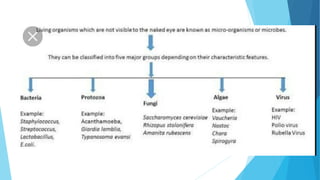
 These microorganisms include bacteria, algae, protozoa,
fungi, and viruses. 14
Classification of Microbiology
 Microbiology is subdivided into the following groups
 Bacteriology (the study of bacteria)
 Mycology (the study of fungi)
 Protozoology (the study of protozoa)
 Virology (the study of viruses)
 Phycology (the study of algae)
 Parasitology (the study of parasites)
15
Scope of Microbiology
 Microbiology constitute an important part of our world
establishing a very close relationship with people in
different geological area.
General Microbiology
 The study and classification of microorganisms and how
they function is known as general microbiology. It
encompasses all areas of microbiology
16
Scope of Microbiology
Medical microbiology
 The field medical microbiology involves the study of
 Pathogens
 The body defenses against diseases.
 Epidemiology
 Transmission of pathogens
 Disease prevention measures
 Aseptic techniques
 Treatment of infectious diseases
17
Scope of Microbiology
Veterinary microbiology
 Veterinary microbiology deals with the infectious
diseases among animals. Its also includes
 The production of food from livestock
 Transmission of diseases from animals to humans
18
Scope of Microbiology
Agricultural microbiology
 Agricultural microbiology deals with both the beneficial
and harmful roles of microbes in soil formation and
fertility. It is also concerned with
 Carbon, nitrogen, phosphorus, and sulfur cycles
 Diseases of plants
 Production, processing, and storage of crops and foods.
 Prevention of food spoilage, and food toxicity.
19
Scope of Microbiology
Sanitary microbiology
 Sanitary microbiology includes the processing and disposal
of garbage and sewage wastes as well as the purification and
processing of water supplies to ensure that no pathogens
are carried to the consumer by drinking water.
Industrial microbiology
 Many business and industries depend on the proper growth
and maintenance of certain microbes to produce beer, wine,
alcohol, and organic materials such as antibiotics.
20
MICROBIOLOGY?????
 Micro means (Small), Bio means(Life) , Logy means(Study)
 Microbiology is the study of all kinds of micro-organisms which can’t be seen
by naked eyes.
 Either pathogenic or non-pathogenic which are only visible by the microscope.
Examples; Bacteria, Viruses, Protozoa or Fungus etc.
 Different branches of microbiology includes:
1. Bacteriology (study of bacteria) 5.ecology(environmental life history of
organsims
2. Virology ( viruses) 6. Mycology( fungi)
3. Parasitology (protozoa)
4. Immunology ( immunity)
Importance Of Microbiology for Nurses:
 Gain the knowledge of prevention from diseases by sterilization etc.
 Gain the knowledge of Handling the patient from the communicable diseases.
 Gain the knowledge in keeping the vaccine against the various diseases.
 Gain the knowledge about diseases and prevent ourselves as well as patients
 Gain the knowledge of various types of microorganisms and their effects on
the environment.
 Gain the knowledge about proper disposal of hospital waste
 Understand about the importance of infection control
WHAT IS CELL & TYPES OF
CELLS?
DIFFERENCE BETWEEN
PROKARYOTIC & EUKARYOTIC
CELLS?
DEFINE CELL
 The cell Latin cella, meaning "small room.
Basic structural, functional and biological unit of all
known living organisms.
 Cells are the smallest unit of life that can replicate
independently "building blocks of life“
There are two types of cells, Eukaryotes,
which contain a nucleus, and prokaryotes, which do not.
FUNCTION OF CELL
 A boundary that keeps the cellular contents separate from the
external environment but allows for the transfer of some
substances into and out of the cell.
 Replication of DNA
 Synthesis of cellular components
 The ability to obtain energy through metabolic processes.
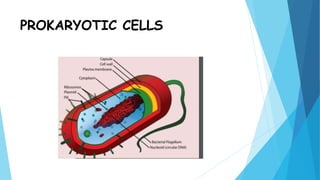
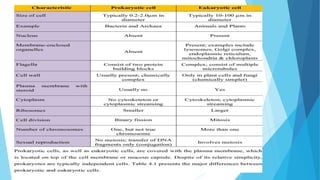
PROKARYOTIC CELLS
 PROKARYOTIC CELLS
 Prokaryote is an organism that does not have a nucleus
(like bacteria), It still has DNA of course, but not
enclosed in a neat little sack.
 Prokaryotes consist of different organelles with specific
functions:
1. Cell Wall 5.Ribosomes
2. Cytoplasm
3. Plasma membrane
4. Genetic material
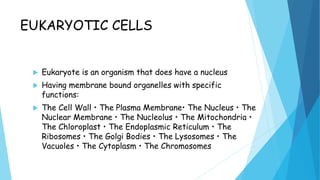
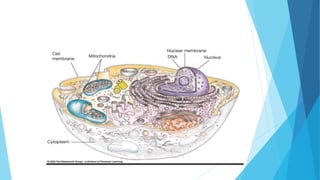
EUKARYOTIC CELLS
 Eukaryote is an organism that does have a nucleus
 Having membrane bound organelles with specific
functions:
 The Cell Wall • The Plasma Membrane• The Nucleus • The
Nuclear Membrane • The Nucleolus • The Mitochondria •
The Chloroplast • The Endoplasmic Reticulum • The
Ribosomes • The Golgi Bodies • The Lysosomes • The
Vacuoles • The Cytoplasm • The Chromosomes
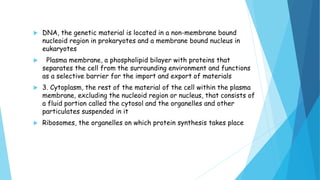
 DNA, the genetic material is located in a non-membrane bound
nucleoid region in prokaryotes and a membrane bound nucleus in
eukaryotes
 Plasma membrane, a phospholipid bilayer with proteins that
separates the cell from the surrounding environment and functions
as a selective barrier for the import and export of materials
 3. Cytoplasm, the rest of the material of the cell within the plasma
membrane, excluding the nucleoid region or nucleus, that consists of
a fluid portion called the cytosol and the organelles and other
particulates suspended in it
 Ribosomes, the organelles on which protein synthesis takes place
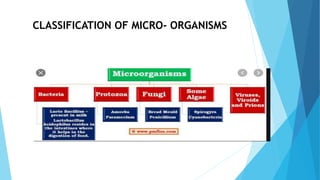
CLASSIFICATION OF MICRO- ORGANISMS
BASIC PROPERTIES OF VIRUS
BASIC STRUCTURAL PROPERTIES
OF VIRUS
 Virus is the obligate intracellular agents contain one type of nucleic
acid(DNA/RNA)
 Genome enclosed within capsid and it surrounded by lipid containing
membrane called envelop
 The entire virus: nucleic acid capsid envelop and glycoprotein spikes
altogether call virion
 Virus do not have cell wall, ribosomes ,cellular enzymes, no
sensitivity to antibacterial agents
 It occupies in between living and non living organisms
SIZE & SHAPE
 Viral size ranges from 20-400nm
 Largest virus-small pox virus -400nm
 Smallest virus –parvovirus -20nm
 Parvovirus smallest than bacteria it is filterable and
cannot observe under light microscope only in ultra
microscope
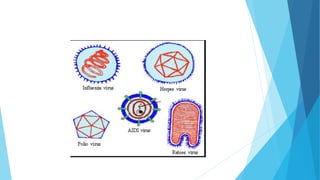
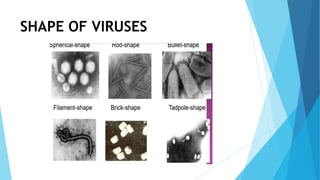
SHAPE OF VIRUSES
STRUCTURE
 A simple virus consist of DNA/RNA packaged into capsid called
nucleocapsid
 Some virus have additional protective layer called envelop Virus without
envelop called naked
 either DNA/RNA as nucleic acid RNA virus single stranded and DNA
virus double stranded
 Genome can be linear or circular Most have linear genome except
papovavirus it have supercoiled circular DNA
 Capsid: it is protein shell that encloses nucleic acid It composed of
protein subunit capsomeres and capsomeres made up of polypeptides called
protomers
 Function of capsid Protect nucleic acid from nucleases Helps in
attachment and penetration
ENVELOP
 It is a lipid bilayer
 It have always virus encoding glycoproteins protruding from
envelop and exposed on the external surface of virion
 These glycoprotein projection is called polymers
 For many virus it seems like spikes
 A virus contain more than one type of polymer eg: influenza virus
Viral replication
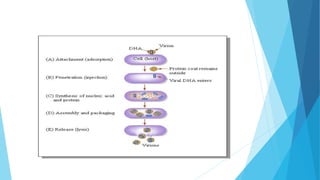
 Replication involves 6 steps: adsorption, penetration, uncoating ,
biosynthesis , maturation & release.
 During eclipse there are no intact virions
 Maturation begins with packaging of nucleic acid
 Latent period begins at entry and ends with release
 Lysis results in one-step growth Burst size = yield
CLASSIFICATION OF VIRUSES;
 Classified into 2 main classes based on the types of nucleic acid they
possess:
 Riboviruses (containing RNA )
 Deoxyriboviruses (containing DNA)
RNA viruses:
 Enteroviruses (Poliovirus)
 Hepatovirus (hepatitis A , C virus)
 Influenza virus, mumps virus, rabies virus, coronavirus , HIV ,
 DNA viruses:
 Poxvirus, herpes virus, hepatitis B , etc
 http://biosci.blog/notes/core-virology-virus-structure-and-classification/
BACTERIA
 Unicellular organisms(single-celled), prokaryotic cell
 Size 0.2 micrometer to 10.0 micrometer
 Some of them are aerobic and some an-anerobic
 Classified by shapes/ types/nutritional requirements
Classification of bacteria on the basis of Gram
staining
1. Gram positive bacteria:
cell wall of these bacteria is composed of peptidoglycan layer only.
Eg. Staphylococcus, Streptococcus, micrococcus
2. Gram negative bacteria:
cell wall of these bacteria is composed of Peptidoglycan and lipoprotein
Eg. E. coli, Salmonella
CLASSIFICATION OF MICRO
ORGANISMS ON THE BASIS
OF NUTRITIONAL
REQUIRMENT
NUTRITIONAL REQUIRMENT OF
MICRO ORGANISMS
 Nutrient Requirements: Microbial cell composition shows that 95% of cell
dry weight is made up of a few major elements: Carbon, oxygen, hydrogen,
nitrogen, sulfur, phosphorous, potassium, calcium, magnesium and iron.
Macronutrients or macro elements: These are required
by microorganisms in relatively large amounts.
 Macro elements (macronutrients) C, O, H, N, S, P, K, Ca, Mg, and Fe
required in relatively large amounts
 Micronutrients (trace elements) Mn, Zn, Co, Mo, Ni, and Cu required in
trace amounts often supplied in water or in media components
AUTOTROPH & HETEROTROPH
 Autotrophs use carbon dioxide as their sole or principal carbon source
 They can synthesize their food by their own while
 Heterotroph use organic molecules as carbon sources
 Get their food from different sources like dead materials of plants or
animals in organic form.
 Autotrophs: CO2 is used by many microorganisms as the source of Carbon.
 Autotrophs have the capacity to reduce it , to form organic molecules.
 Photoautotrophs that are able to fix CO2 and use light as their energy
source.
 Chemoautotrophs don’t require sunlight. They derive energy from inorganic
compounds and build cellular molecules from carbon dioxide.
 Heterotrophs depend on organic compounds in the environment to meet
their needs for energy as well as carbon sources to make their own organic
molecules. Heterotrophs get energy from sugars, starches, fats and other
organic material in their environment.
 Example : Methylo -trophic bacteria utilize methanol, methane, and formic
acid.
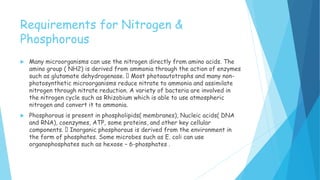
Requirements for Nitrogen &
Phosphorous
 Many microorganisms can use the nitrogen directly from amino acids. The
amino group ( NH2) is derived from ammonia through the action of enzymes
such as glutamate dehydrogenase. Most photoautotrophs and many non-
photosynthetic microorganisms reduce nitrate to ammonia and assimilate
nitrogen through nitrate reduction. A variety of bacteria are involved in
the nitrogen cycle such as Rhizobium which is able to use atmospheric
nitrogen and convert it to ammonia.
 Phosphorous is present in phospholipids( membranes), Nucleic acids( DNA
and RNA), coenzymes, ATP, some proteins, and other key cellular
components. Inorganic phosphorous is derived from the environment in
the form of phosphates. Some microbes such as E. coli can use
organophosphates such as hexose – 6-phosphates .
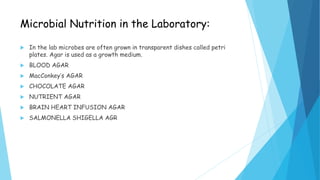
Microbial Nutrition in the Laboratory:
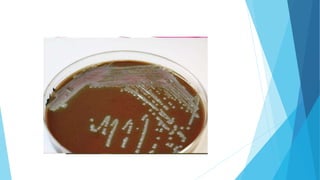
 In the lab microbes are often grown in transparent dishes called petri
plates. Agar is used as a growth medium.
 BLOOD AGAR
 MacConkey’s AGAR
 CHOCOLATE AGAR
 NUTRIENT AGAR
 BRAIN HEART INFUSION AGAR
 SALMONELLA SHIGELLA AGR
CLASSIFICATION OF BACTERIA
ON THE BASIS OF MORPHOLOGY
Morphological classification
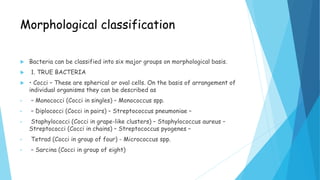
 Bacteria can be classified into six major groups on morphological basis.
 1. TRUE BACTERIA
 • Cocci – These are spherical or oval cells. On the basis of arrangement of
individual organisms they can be described as
• – Monococci (Cocci in singles) – Monococcus spp.
• – Diplococci (Cocci in pairs) – Streptococcus pneumoniae –
• Staphylococci (Cocci in grape-like clusters) – Staphylococcus aureus –
Streptococci (Cocci in chains) – Streptococcus pyogenes –
• Tetrad (Cocci in group of four) - Micrococcus spp.
• – Sarcina (Cocci in group of eight)
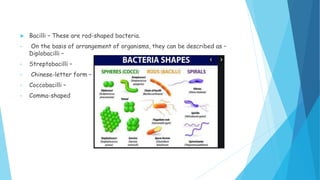
 Bacilli – These are rod-shaped bacteria.
• On the basis of arrangement of organisms, they can be described as –
Diplobacilli –
• Streptobacilli –
• Chinese-letter form –
• Coccobacilli –
• Comma-shaped
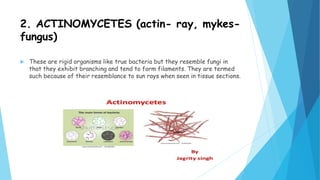
2. ACTINOMYCETES (actin- ray, mykes-
fungus)
 These are rigid organisms like true bacteria but they resemble fungi in
that they exhibit branching and tend to form filaments. They are termed
such because of their resemblance to sun rays when seen in tissue sections.
3. Spirochaetes
 These are relatively longer, slender, non-branched microorganisms of spiral
shape having several coils.
 4. Mycoplasmas
These bacteria lack in rigid cell wall (cell wall lacking) and are highly
pleomorphic and of indefinite shape. They occur in round or oval bodies and in
interlacing filaments.
 5. Rickettsiae and Chlamydiae
These are very small, obligate parasites, and at one time were considered
closely related to the viruses. Now, these are regarded as bacteria.
Based on Anatomical features
 Capsule – Capsulate– Streptococcus pneumoniae – Non-capsulate – Viridans
streptococci
 Flagella – Flagellate – • Monotrichous • Lophotrichous • Amphitrichous •
Peritrichous – Aflagellate – Shigella spp.
 Spore – Spore-forming – Bacillus spp. – Non-sporing – Escherichia coli
REFERENCES
1. Pelczar,J.M. (1993). Microbiology concepts & Applications . New York;
McGraw Hill
2. Tortora , J.G., & , R.B. (1995). Microbiology an introduction . New York :
The Benjamin/cumming
3. THANK YOU………..

Introduction to microbiology UNIT 1

  • 1.
  • 2.
    Objective At the endof session the students will be able to:  Describe the development of microbiology  Define microbiology  Explain different types of microbiology  Discuss Spontaneous Generation Controversy  Classify the microbiology  Identify the scope of microbiology. 2
  • 3.
    In this unitwe will discuss about introduction to microbiology and its importance in nursing field Brief introduction of scientists in the field of microbiology Define cell, their types and difference between eukaryotic and prokaryotic cell Basic properties of virus Classification of micro organisms on the basis of nutritional requirements
  • 4.
    Why study microbiology? Microorganisms are part of the human environment and are therefore important to human health and activities.  The study of microorganisms provides insight into life processes in all forms of life 4
  • 5.
    Development of Microbiology Aristotle (322-384) and others believed that living organisms could develop from non living materials.  Girolamo Fracastoro published a book in 1546 which suggested three ways for the transmission of infection by direct contact, by fomites, and by the air.  1590: Hans and Zacharias Janssen (Dutch lens grinders) mounted two lenses in a tube to produce the first microscope.  1660: Robert Hooke (1635-1703) published micrographia, containing drawings and detailed observations of biological materials made with the best compound microscope and illumination system of the time. 5
  • 6.
    Development of Microbiology 1668 Francesco Redi disapproved the myth of spontaneous generation.  1676 Anton Van Leeuwenhoek using his own designed microscope, observed and accurately described the invisible creature (Animalcules) of the microbial world. this was the beginning of a new science.  1798 Edward Jenner introduced vaccination for smallpox.  Middle 19th century John Tyndall given the concept of sterilization by discontinuous heating called Tyndallization.  1856 Louis Pasteur discussed alcoholic and lactic acid fermentation by yeast and microorganisms  1861 Louis Pasteur disapproved theory of spontaneous generation. 6
  • 7.
    Development of Microbiology 1863 Louis Pasteur introduced method of destroying bacteria called pasteurization.  1867 Joseph Lister perform antiseptic surgery.  1876 Robert Koch identify Anthrax disease caused by Bacillus Anthracis.  1881 Robert Koch introduced pure culture methods to study bacteria and develop anthrax vaccine.  1884 Robert Koch discussed Koch’s postulates.  1884 Christian Gram discover staining method for bacteria.  1885 Louis Pasteur develops rabies vaccine. 7
  • 8.
    Development of Microbiology 1887 Richard Patri develops patri dish for culturing.  1929 Alexander Fleming discover penicillin.  1931: Ernst Ruska constructed the first electron microscope.  1944 Selman Waksman and Albert Schatz discover streptomycin.  1946 Edward Tatum discussed bacterial conjugation method of genetic exchange.  1953 J.D Watson proposed the double helix structure of DNA.  1977 Fred Sanger and Steven Nikler identified technique for DNA sequencing.  1993 Kary Mullis discover polymerase chain reaction. 8
  • 9.
    Spontaneous Generation  Thebelief that life could originate from non-living or decomposing matter 9
  • 10.
    Spontaneous Generation Controversy supportedby  Aristotle (384-322 BC) Believed that simple invertebrates could arise by spontaneous generation.  John Needham (1713-1781) Boiled mutton broth, then sealed and still observed growth after a period of time  Felix Pouchet (1859) Proved growth without contamination from air 10
  • 11.
    Spontaneous Generation Controversy 1688: Francesco Redi (1626-1678) was an Italian physician who refuted the idea of spontaneous generation  1836: Theodor Schwann (1810-1882) helped develop the cell theory of living organisms, namely that all living organisms are composed of one or more cells and that the cell is the basic functional unit of living organisms.  1861: Louis Pasteur's (1822-1895) famous experiments with swan-necked flasks finally proved that microorganisms do not arise by spontaneous generation. 11
  • 12.
    Proof that MicrobesCause Disease  1546: Girolamo Fracastoro wrote "On Contagion" the first known discussion of the phenomenon of contagious infection.  1847: Ignaz Semmelweiss (1818-1865), a Hungarian physician who decided that doctors in Vienna hospitals were spreading childbed fever while delivering babies. He started forcing doctors under his supervision to wash their hands before touching patients. 12
  • 13.
    Proof that MicrobesCause Disease  1857: Louis Pasteur proposed the "germ theory" of disease.  1867: Joseph Lister (1827-1912) introduced antiseptics in surgery. By spraying carbolic acid on surgical instruments, wounds and dressings, he reduced surgical mortality due to bacterial infection considerably.  1876: Robert Koch (1843-1910). German bacteriologist was the first to cultivate anthrax bacteria outside the body using blood serum at body temperature. Building on pasteur's "germ theory“. 13
  • 14.
    Introduction to Microbiology The things on our planet may generally be classified into two categories.  Animate (have life)  Inanimate (don’t have life)  Microbiology may be defined as the study of very small living organisms.  Micro= small Bio= living Logos= study  They are often called microbes, single called organisms, and germs.  These microorganisms include bacteria, algae, protozoa, fungi, and viruses. 14
  • 15.
    Classification of Microbiology Microbiology is subdivided into the following groups  Bacteriology (the study of bacteria)  Mycology (the study of fungi)  Protozoology (the study of protozoa)  Virology (the study of viruses)  Phycology (the study of algae)  Parasitology (the study of parasites) 15
  • 16.
    Scope of Microbiology Microbiology constitute an important part of our world establishing a very close relationship with people in different geological area. General Microbiology  The study and classification of microorganisms and how they function is known as general microbiology. It encompasses all areas of microbiology 16
  • 17.
    Scope of Microbiology Medicalmicrobiology  The field medical microbiology involves the study of  Pathogens  The body defenses against diseases.  Epidemiology  Transmission of pathogens  Disease prevention measures  Aseptic techniques  Treatment of infectious diseases 17
  • 18.
    Scope of Microbiology Veterinarymicrobiology  Veterinary microbiology deals with the infectious diseases among animals. Its also includes  The production of food from livestock  Transmission of diseases from animals to humans 18
  • 19.
    Scope of Microbiology Agriculturalmicrobiology  Agricultural microbiology deals with both the beneficial and harmful roles of microbes in soil formation and fertility. It is also concerned with  Carbon, nitrogen, phosphorus, and sulfur cycles  Diseases of plants  Production, processing, and storage of crops and foods.  Prevention of food spoilage, and food toxicity. 19
  • 20.
    Scope of Microbiology Sanitarymicrobiology  Sanitary microbiology includes the processing and disposal of garbage and sewage wastes as well as the purification and processing of water supplies to ensure that no pathogens are carried to the consumer by drinking water. Industrial microbiology  Many business and industries depend on the proper growth and maintenance of certain microbes to produce beer, wine, alcohol, and organic materials such as antibiotics. 20
  • 21.
    MICROBIOLOGY?????  Micro means(Small), Bio means(Life) , Logy means(Study)  Microbiology is the study of all kinds of micro-organisms which can’t be seen by naked eyes.  Either pathogenic or non-pathogenic which are only visible by the microscope. Examples; Bacteria, Viruses, Protozoa or Fungus etc.  Different branches of microbiology includes: 1. Bacteriology (study of bacteria) 5.ecology(environmental life history of organsims 2. Virology ( viruses) 6. Mycology( fungi) 3. Parasitology (protozoa) 4. Immunology ( immunity)
  • 22.
    Importance Of Microbiologyfor Nurses:  Gain the knowledge of prevention from diseases by sterilization etc.  Gain the knowledge of Handling the patient from the communicable diseases.  Gain the knowledge in keeping the vaccine against the various diseases.  Gain the knowledge about diseases and prevent ourselves as well as patients  Gain the knowledge of various types of microorganisms and their effects on the environment.  Gain the knowledge about proper disposal of hospital waste  Understand about the importance of infection control
  • 23.
    WHAT IS CELL& TYPES OF CELLS? DIFFERENCE BETWEEN PROKARYOTIC & EUKARYOTIC CELLS?
  • 24.
    DEFINE CELL  Thecell Latin cella, meaning "small room. Basic structural, functional and biological unit of all known living organisms.  Cells are the smallest unit of life that can replicate independently "building blocks of life“ There are two types of cells, Eukaryotes, which contain a nucleus, and prokaryotes, which do not.
  • 25.
    FUNCTION OF CELL A boundary that keeps the cellular contents separate from the external environment but allows for the transfer of some substances into and out of the cell.  Replication of DNA  Synthesis of cellular components  The ability to obtain energy through metabolic processes.
  • 26.
  • 27.
     PROKARYOTIC CELLS Prokaryote is an organism that does not have a nucleus (like bacteria), It still has DNA of course, but not enclosed in a neat little sack.  Prokaryotes consist of different organelles with specific functions: 1. Cell Wall 5.Ribosomes 2. Cytoplasm 3. Plasma membrane 4. Genetic material
  • 28.
    EUKARYOTIC CELLS  Eukaryoteis an organism that does have a nucleus  Having membrane bound organelles with specific functions:  The Cell Wall • The Plasma Membrane• The Nucleus • The Nuclear Membrane • The Nucleolus • The Mitochondria • The Chloroplast • The Endoplasmic Reticulum • The Ribosomes • The Golgi Bodies • The Lysosomes • The Vacuoles • The Cytoplasm • The Chromosomes
  • 30.
     DNA, thegenetic material is located in a non-membrane bound nucleoid region in prokaryotes and a membrane bound nucleus in eukaryotes  Plasma membrane, a phospholipid bilayer with proteins that separates the cell from the surrounding environment and functions as a selective barrier for the import and export of materials  3. Cytoplasm, the rest of the material of the cell within the plasma membrane, excluding the nucleoid region or nucleus, that consists of a fluid portion called the cytosol and the organelles and other particulates suspended in it  Ribosomes, the organelles on which protein synthesis takes place
  • 32.
  • 34.
  • 35.
    BASIC STRUCTURAL PROPERTIES OFVIRUS  Virus is the obligate intracellular agents contain one type of nucleic acid(DNA/RNA)  Genome enclosed within capsid and it surrounded by lipid containing membrane called envelop  The entire virus: nucleic acid capsid envelop and glycoprotein spikes altogether call virion  Virus do not have cell wall, ribosomes ,cellular enzymes, no sensitivity to antibacterial agents  It occupies in between living and non living organisms
  • 36.
    SIZE & SHAPE Viral size ranges from 20-400nm  Largest virus-small pox virus -400nm  Smallest virus –parvovirus -20nm  Parvovirus smallest than bacteria it is filterable and cannot observe under light microscope only in ultra microscope
  • 37.
  • 38.
    STRUCTURE  A simplevirus consist of DNA/RNA packaged into capsid called nucleocapsid  Some virus have additional protective layer called envelop Virus without envelop called naked  either DNA/RNA as nucleic acid RNA virus single stranded and DNA virus double stranded  Genome can be linear or circular Most have linear genome except papovavirus it have supercoiled circular DNA  Capsid: it is protein shell that encloses nucleic acid It composed of protein subunit capsomeres and capsomeres made up of polypeptides called protomers  Function of capsid Protect nucleic acid from nucleases Helps in attachment and penetration
  • 39.
    ENVELOP  It isa lipid bilayer  It have always virus encoding glycoproteins protruding from envelop and exposed on the external surface of virion  These glycoprotein projection is called polymers  For many virus it seems like spikes  A virus contain more than one type of polymer eg: influenza virus
  • 40.
    Viral replication  Replicationinvolves 6 steps: adsorption, penetration, uncoating , biosynthesis , maturation & release.  During eclipse there are no intact virions  Maturation begins with packaging of nucleic acid  Latent period begins at entry and ends with release  Lysis results in one-step growth Burst size = yield
  • 42.
    CLASSIFICATION OF VIRUSES; Classified into 2 main classes based on the types of nucleic acid they possess:  Riboviruses (containing RNA )  Deoxyriboviruses (containing DNA) RNA viruses:  Enteroviruses (Poliovirus)  Hepatovirus (hepatitis A , C virus)  Influenza virus, mumps virus, rabies virus, coronavirus , HIV ,  DNA viruses:  Poxvirus, herpes virus, hepatitis B , etc
  • 43.
  • 45.
    BACTERIA  Unicellular organisms(single-celled),prokaryotic cell  Size 0.2 micrometer to 10.0 micrometer  Some of them are aerobic and some an-anerobic  Classified by shapes/ types/nutritional requirements
  • 46.
    Classification of bacteriaon the basis of Gram staining 1. Gram positive bacteria: cell wall of these bacteria is composed of peptidoglycan layer only. Eg. Staphylococcus, Streptococcus, micrococcus 2. Gram negative bacteria: cell wall of these bacteria is composed of Peptidoglycan and lipoprotein Eg. E. coli, Salmonella
  • 47.
    CLASSIFICATION OF MICRO ORGANISMSON THE BASIS OF NUTRITIONAL REQUIRMENT
  • 48.
    NUTRITIONAL REQUIRMENT OF MICROORGANISMS  Nutrient Requirements: Microbial cell composition shows that 95% of cell dry weight is made up of a few major elements: Carbon, oxygen, hydrogen, nitrogen, sulfur, phosphorous, potassium, calcium, magnesium and iron. Macronutrients or macro elements: These are required by microorganisms in relatively large amounts.  Macro elements (macronutrients) C, O, H, N, S, P, K, Ca, Mg, and Fe required in relatively large amounts  Micronutrients (trace elements) Mn, Zn, Co, Mo, Ni, and Cu required in trace amounts often supplied in water or in media components
  • 49.
    AUTOTROPH & HETEROTROPH Autotrophs use carbon dioxide as their sole or principal carbon source  They can synthesize their food by their own while  Heterotroph use organic molecules as carbon sources  Get their food from different sources like dead materials of plants or animals in organic form.
  • 50.
     Autotrophs: CO2is used by many microorganisms as the source of Carbon.  Autotrophs have the capacity to reduce it , to form organic molecules.  Photoautotrophs that are able to fix CO2 and use light as their energy source.  Chemoautotrophs don’t require sunlight. They derive energy from inorganic compounds and build cellular molecules from carbon dioxide.  Heterotrophs depend on organic compounds in the environment to meet their needs for energy as well as carbon sources to make their own organic molecules. Heterotrophs get energy from sugars, starches, fats and other organic material in their environment.  Example : Methylo -trophic bacteria utilize methanol, methane, and formic acid.
  • 52.
    Requirements for Nitrogen& Phosphorous  Many microorganisms can use the nitrogen directly from amino acids. The amino group ( NH2) is derived from ammonia through the action of enzymes such as glutamate dehydrogenase. Most photoautotrophs and many non- photosynthetic microorganisms reduce nitrate to ammonia and assimilate nitrogen through nitrate reduction. A variety of bacteria are involved in the nitrogen cycle such as Rhizobium which is able to use atmospheric nitrogen and convert it to ammonia.  Phosphorous is present in phospholipids( membranes), Nucleic acids( DNA and RNA), coenzymes, ATP, some proteins, and other key cellular components. Inorganic phosphorous is derived from the environment in the form of phosphates. Some microbes such as E. coli can use organophosphates such as hexose – 6-phosphates .
  • 53.
    Microbial Nutrition inthe Laboratory:  In the lab microbes are often grown in transparent dishes called petri plates. Agar is used as a growth medium.  BLOOD AGAR  MacConkey’s AGAR  CHOCOLATE AGAR  NUTRIENT AGAR  BRAIN HEART INFUSION AGAR  SALMONELLA SHIGELLA AGR
  • 55.
    CLASSIFICATION OF BACTERIA ONTHE BASIS OF MORPHOLOGY
  • 56.
    Morphological classification  Bacteriacan be classified into six major groups on morphological basis.  1. TRUE BACTERIA  • Cocci – These are spherical or oval cells. On the basis of arrangement of individual organisms they can be described as • – Monococci (Cocci in singles) – Monococcus spp. • – Diplococci (Cocci in pairs) – Streptococcus pneumoniae – • Staphylococci (Cocci in grape-like clusters) – Staphylococcus aureus – Streptococci (Cocci in chains) – Streptococcus pyogenes – • Tetrad (Cocci in group of four) - Micrococcus spp. • – Sarcina (Cocci in group of eight)
  • 57.
     Bacilli –These are rod-shaped bacteria. • On the basis of arrangement of organisms, they can be described as – Diplobacilli – • Streptobacilli – • Chinese-letter form – • Coccobacilli – • Comma-shaped
  • 58.
    2. ACTINOMYCETES (actin-ray, mykes- fungus)  These are rigid organisms like true bacteria but they resemble fungi in that they exhibit branching and tend to form filaments. They are termed such because of their resemblance to sun rays when seen in tissue sections.
  • 59.
    3. Spirochaetes  Theseare relatively longer, slender, non-branched microorganisms of spiral shape having several coils.  4. Mycoplasmas These bacteria lack in rigid cell wall (cell wall lacking) and are highly pleomorphic and of indefinite shape. They occur in round or oval bodies and in interlacing filaments.  5. Rickettsiae and Chlamydiae These are very small, obligate parasites, and at one time were considered closely related to the viruses. Now, these are regarded as bacteria.
  • 60.
    Based on Anatomicalfeatures  Capsule – Capsulate– Streptococcus pneumoniae – Non-capsulate – Viridans streptococci  Flagella – Flagellate – • Monotrichous • Lophotrichous • Amphitrichous • Peritrichous – Aflagellate – Shigella spp.  Spore – Spore-forming – Bacillus spp. – Non-sporing – Escherichia coli
  • 61.
    REFERENCES 1. Pelczar,J.M. (1993).Microbiology concepts & Applications . New York; McGraw Hill 2. Tortora , J.G., & , R.B. (1995). Microbiology an introduction . New York : The Benjamin/cumming 3. THANK YOU………..