Microbiology  Chapter 1
Part I  Introduction to Microbiology
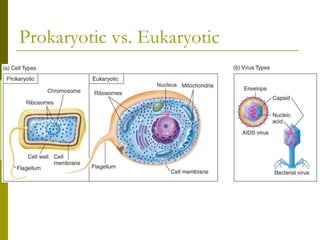
Scope of Microbiology  Microbes Life forms which require magnification for viewing Ubiquitous  Each group has a distinct set of biological characteristics Single celled vs. multi-celled Prokaryotic vs. eukaryotic  Cell wall vs. no cell wall  Autotrophic vs. heterotrophic  Cellular vs. acellular
Prokaryotic vs. Eukaryotic
Assigning Characteristics  Bacteria Protozoa Fungi  Algae  Helminths  Viruses Assign common characteristics to each group
(Top) Coccidioidomycosis Arthrospores  (Bottom) Development of Arthrospores  Into spherule in lung tissue Fungal Infection of the lung Schistosoma (worms) at  two different stages of  development – liver  Disease and other symptoms  Staphylococcus Aureus Gram positive bacteria Staph infections and MRSA Trypanosoma  Eukaryotic pathogen African Sleeping Sickness Treponema pallidum Bacterial spirochete Causes syphilis Mycobacterium tuberculosis.  Acid fast bacteria (shown in pink) like this causes TB and leprosy.  Light blue is Staph epi, a common bacteria cocci which inhabits the Skin.  Not a common pathogen  Herpes Virus
Size Comparisons
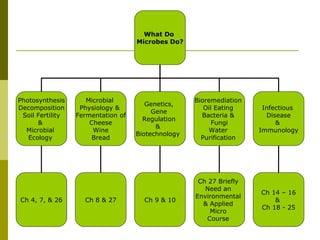
What Do  Microbes Do? Photosynthesis Decomposition Soil Fertility &  Microbial  Ecology  Microbial  Physiology &  Fermentation of Cheese Wine Bread Genetics,  Gene  Regulation  &  Biotechnology  Bioremediation  Oil Eating  Bacteria &  Fungi Water  Purification  Infectious  Disease &  Immunology Ch 4, 7, & 26 Ch 8 & 27 Ch 9 & 10 Ch 27 Briefly  Need an  Environmental  & Applied  Micro  Course  Ch 14 – 16 &  Ch 18 - 25
Part II  Historical Figures in Microbiology
Superstition of Microbiology  Spontaneous generation  For thousands of years people believed that living things arose from vital forces present in non living matter Mushrooms appearing on rotting wood Afflicted people were thought to be cursed Controversy between…  Abiogenesis and biogenesis
First Look at Microbes  In the 1600s   Robert Hooke (English) reported that living things were composed of little boxes or cells Antonie van Leeuwenhoek construction microscopes which could magnify 300X Described microorganisms that he observed in teeth scrapings & rain water
Abiogenesis vs. Biogenesis Franceso Redi He wanted to ascertain whether maggots arose from some “vital force” of the meat or were offspring of flies
Abiogenesis vs. Biogenesis Conclusions of Redi’s Experiment This and related experiments proved that complex animals such as insects and mice develop through biogenesis However, meat leaf out but covered with gauze would still rot Therefore, the idea that simpler organism could arise from abiogenesis was still accepted
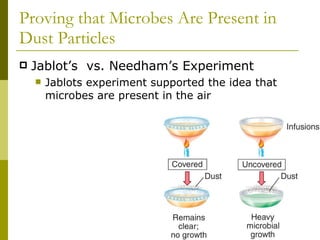
Proving that Microbes Are Present in Dust Particles  Jablot’s  vs. Needham’s Experiment Jablots experiment supported the idea that microbes are present in the air
Proving that Microbes Are Present in Dust Particles However, support for Jablot’s experiment faltered when Needham’s results were reported  Needham performed the same experiment with mutton gravy Microbial growth was in both containers What do you think happened here?
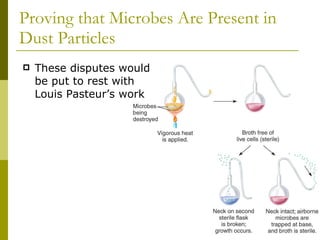
These disputes would be put to rest with Louis Pasteur’s work  Proving that Microbes Are Present in Dust Particles
Pasteurization Pasteur also demonstrated that spoilage bacteria could be killed by heat that was not hot enough to evaporate the alcohol in wine. This application of a high heat for a short time is called pasteurization
Lister’s Work English physician advanced the idea of antisepsis in health care setting 1860’s Dressed wounds with carbolic acid (phenol) Reduced deaths among patients by 2/3 Listerine Mouthwash
Koch’s Postulates 1876 Robert Koch provided proof that a bacterium causes anthrax and provided the experimental steps, postulates, used to prove that a specific microbe causes a specific disease Koch was a physician and Pasteur’s young rival
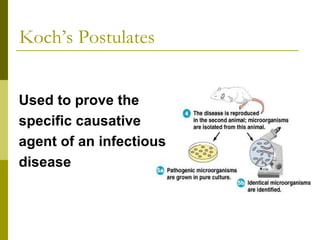
Koch’s Postulates Mouse dies with sores Take scraping and plate on agar A heterogeneous population of bacteria Grow – which one is the causative agent Isolate all different strains and types and  inject into healthy mice and see which mice develop similar phenotype and symptoms Take a sample again from mice which died of same symptoms and isolate the  causative agent again
Koch’s Postulates A sequence of experimental steps to relate a specific microbe to a specific disease
Koch’s Postulates Used to prove the  specific causative  agent of an infectious  disease
Jenner’s Work Observed that milkmaids did not acquire smallpox Milkmaids were exposed to chronic low doses of cowpox and therefore acquired specific immunity 1796 Jenner inoculated a person with cowpox virus and found this person was then protected against acquiring small pox This protection is known as immunity Called vaccinatin from vacca for cow
Alexander Fleming’s Work In 1928 Fleming discovered the first antibiotic by accident  He observed that Penicillium fungus secreted a substance which killed bacteria Explain why a fungus would do this In 1940s penicillin was tested clinically and mass produced
Germ Theory of Disease All of these aforementioned people and others helped give rise to the germ theory of disease Germ Theory states that microorganisms can invade other organisms and cause disease Before this many time politics and religion would spur on erroneous theories
Part III  Introduction to Disease
Chronic vs. Infectious Disease  Chronic Disease which persists over a long period of time Atherosclerosis, cancer & heart failure  Infectious  Organism enters and tissues & grows Bacterial – Prokaryotic  Viral – Acellular  Protozoan – Eukaryotic  Causes symptoms in patients
Conquering Infectious Disease  The triumph over infectious disease? Antibiotics discovered in 1940s Vaccinations routinely delivered in the 1950s through today  Eradication of polio and small pox But then… MRSA Drug resistant TB HIV Ebola Avia Flu And more
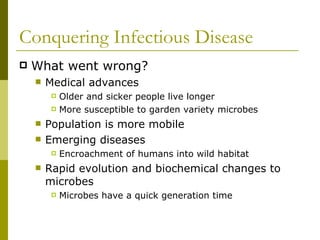
Conquering Infectious Disease What went wrong? Medical advances Older and sicker people live longer More susceptible to garden variety microbes Population is more mobile Emerging diseases  Encroachment of humans into wild habitat Rapid evolution and biochemical changes to microbes Microbes have a quick generation time
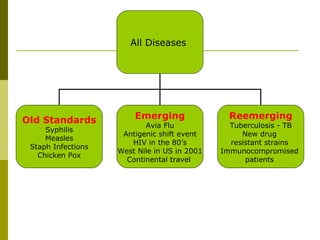
All Diseases  Old Standards Syphilis Measles Staph Infections Chicken Pox Emerging Avia Flu Antigenic shift event HIV in the 80’s West Nile in US in 2001 Continental travel  Reemerging Tuberculosis - TB New drug  resistant strains  Immunocompromised  patients
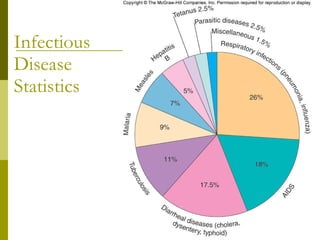
Top Causes of Death * Stands for lower respiratory disease Infectious Diseases are shown in  red 1.19 x 10 6 10. Accidents  33,865 10.Septicemia  1.27 x 10 6 9.  Malaria 40,970 9. Kidney problems 1.57 x 10 6 8.  Tuberculosis 58,870 8. Alzheimer disease 1.80 x 10 6 7.  Diarrheal disease 65,680 7. Flu & Pneumonia 2.75 x 10 6 6.  Chronic LRD* 73,250 6. Diabetes 2.78 x 10 6 5.  HIV/AIDS 106,740 5. Accidents 3.33 x 10 6 4.  Cancer 124,800 4. Chronic LRD* 3.88 x 10 6 3.  Res infection   162,670 3. Stroke 5.51 x 10 6 2.  Stroke 557,270 2. Cancer 8.12 x 10 6 1.  Heart Disease 696,950 1. Heart Disease Deaths Worldwide Deaths United States
Infectious  Disease  Statistics
Part IV Taxonomy & Biological Classification
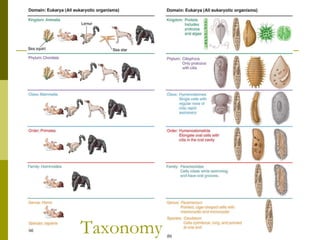
Organizing Life Classification  Orderly arrangement of organisms into groups that indicate evolutionary relationships Nomenclature  Assigning names to various taxonomic rankings  Identification Correct placement of organism into taxonomic scheme
Taxonomy  Origins of organizing biological life Carl von Linne or Linnaeus 1701 – 1778 System of recognizing and defining properties of living organism followed by the placement into specific slots Grouped according to similar properties Grouped according to evolutionary relatedness Constantly being revised and refined
Taxonomy
Nomenclature  Scientists use a standard binomial system  Overseen by an international group  Verify that standard procedures were followed Ascertain the uniqueness of each name  Make sure no other name exists
Nomenclature  Staphylococcus aureus  Staphule – bunch of grapes  Aureus – golden  Campylobacter jejuni Kampylos – curved Bakterion – little rod Jejunum – section of small intestine Giardia lamblia Alfred Giard – French microbiologist  Vilem Lambl – Bohemian physician
Evolution & Phylogeny  Evolution  All new species originate from preexisting species  Closely related organism have similar feature due to evolution from common ancestral forms  Phylogeny  Tree of life  Classification based on evolutionary relatedness
Whittaker’s  System
Whittaker’s System  Although used for many years this system has problems in terms of evolutionary relatedness  Kingdom Protista Autotrophs & heterotrops are groups together Archaea Although these organisms are prokaryotic they are more closely related to eukaryotic cells
Solution to Whittaker’s Tree Biologist no longer group organisms into a 5 kingdom system Currently a three domain system  Many original kingdoms still work Plants, animals, fungi However, Kingdom Protista & Kingdom Monera have been extensively reorganized into many different kingdoms
Three Domain System

Microbiology ch 1(2)

  • 1.
  • 2.
    Part I Introduction to Microbiology
  • 3.
    Scope of Microbiology Microbes Life forms which require magnification for viewing Ubiquitous Each group has a distinct set of biological characteristics Single celled vs. multi-celled Prokaryotic vs. eukaryotic Cell wall vs. no cell wall Autotrophic vs. heterotrophic Cellular vs. acellular
  • 4.
  • 5.
    Assigning Characteristics Bacteria Protozoa Fungi Algae Helminths Viruses Assign common characteristics to each group
  • 6.
    (Top) Coccidioidomycosis Arthrospores (Bottom) Development of Arthrospores Into spherule in lung tissue Fungal Infection of the lung Schistosoma (worms) at two different stages of development – liver Disease and other symptoms Staphylococcus Aureus Gram positive bacteria Staph infections and MRSA Trypanosoma Eukaryotic pathogen African Sleeping Sickness Treponema pallidum Bacterial spirochete Causes syphilis Mycobacterium tuberculosis. Acid fast bacteria (shown in pink) like this causes TB and leprosy. Light blue is Staph epi, a common bacteria cocci which inhabits the Skin. Not a common pathogen Herpes Virus
  • 7.
  • 8.
    What Do Microbes Do? Photosynthesis Decomposition Soil Fertility & Microbial Ecology Microbial Physiology & Fermentation of Cheese Wine Bread Genetics, Gene Regulation & Biotechnology Bioremediation Oil Eating Bacteria & Fungi Water Purification Infectious Disease & Immunology Ch 4, 7, & 26 Ch 8 & 27 Ch 9 & 10 Ch 27 Briefly Need an Environmental & Applied Micro Course Ch 14 – 16 & Ch 18 - 25
  • 9.
    Part II Historical Figures in Microbiology
  • 10.
    Superstition of Microbiology Spontaneous generation For thousands of years people believed that living things arose from vital forces present in non living matter Mushrooms appearing on rotting wood Afflicted people were thought to be cursed Controversy between… Abiogenesis and biogenesis
  • 11.
    First Look atMicrobes In the 1600s Robert Hooke (English) reported that living things were composed of little boxes or cells Antonie van Leeuwenhoek construction microscopes which could magnify 300X Described microorganisms that he observed in teeth scrapings & rain water
  • 12.
    Abiogenesis vs. BiogenesisFranceso Redi He wanted to ascertain whether maggots arose from some “vital force” of the meat or were offspring of flies
  • 13.
    Abiogenesis vs. BiogenesisConclusions of Redi’s Experiment This and related experiments proved that complex animals such as insects and mice develop through biogenesis However, meat leaf out but covered with gauze would still rot Therefore, the idea that simpler organism could arise from abiogenesis was still accepted
  • 14.
    Proving that MicrobesAre Present in Dust Particles Jablot’s vs. Needham’s Experiment Jablots experiment supported the idea that microbes are present in the air
  • 15.
    Proving that MicrobesAre Present in Dust Particles However, support for Jablot’s experiment faltered when Needham’s results were reported Needham performed the same experiment with mutton gravy Microbial growth was in both containers What do you think happened here?
  • 16.
    These disputes wouldbe put to rest with Louis Pasteur’s work Proving that Microbes Are Present in Dust Particles
  • 17.
    Pasteurization Pasteur alsodemonstrated that spoilage bacteria could be killed by heat that was not hot enough to evaporate the alcohol in wine. This application of a high heat for a short time is called pasteurization
  • 18.
    Lister’s Work Englishphysician advanced the idea of antisepsis in health care setting 1860’s Dressed wounds with carbolic acid (phenol) Reduced deaths among patients by 2/3 Listerine Mouthwash
  • 19.
    Koch’s Postulates 1876Robert Koch provided proof that a bacterium causes anthrax and provided the experimental steps, postulates, used to prove that a specific microbe causes a specific disease Koch was a physician and Pasteur’s young rival
  • 20.
    Koch’s Postulates Mousedies with sores Take scraping and plate on agar A heterogeneous population of bacteria Grow – which one is the causative agent Isolate all different strains and types and inject into healthy mice and see which mice develop similar phenotype and symptoms Take a sample again from mice which died of same symptoms and isolate the causative agent again
  • 21.
    Koch’s Postulates Asequence of experimental steps to relate a specific microbe to a specific disease
  • 22.
    Koch’s Postulates Usedto prove the specific causative agent of an infectious disease
  • 23.
    Jenner’s Work Observedthat milkmaids did not acquire smallpox Milkmaids were exposed to chronic low doses of cowpox and therefore acquired specific immunity 1796 Jenner inoculated a person with cowpox virus and found this person was then protected against acquiring small pox This protection is known as immunity Called vaccinatin from vacca for cow
  • 24.
    Alexander Fleming’s WorkIn 1928 Fleming discovered the first antibiotic by accident He observed that Penicillium fungus secreted a substance which killed bacteria Explain why a fungus would do this In 1940s penicillin was tested clinically and mass produced
  • 25.
    Germ Theory ofDisease All of these aforementioned people and others helped give rise to the germ theory of disease Germ Theory states that microorganisms can invade other organisms and cause disease Before this many time politics and religion would spur on erroneous theories
  • 26.
    Part III Introduction to Disease
  • 27.
    Chronic vs. InfectiousDisease Chronic Disease which persists over a long period of time Atherosclerosis, cancer & heart failure Infectious Organism enters and tissues & grows Bacterial – Prokaryotic Viral – Acellular Protozoan – Eukaryotic Causes symptoms in patients
  • 28.
    Conquering Infectious Disease The triumph over infectious disease? Antibiotics discovered in 1940s Vaccinations routinely delivered in the 1950s through today Eradication of polio and small pox But then… MRSA Drug resistant TB HIV Ebola Avia Flu And more
  • 29.
    Conquering Infectious DiseaseWhat went wrong? Medical advances Older and sicker people live longer More susceptible to garden variety microbes Population is more mobile Emerging diseases Encroachment of humans into wild habitat Rapid evolution and biochemical changes to microbes Microbes have a quick generation time
  • 30.
    All Diseases Old Standards Syphilis Measles Staph Infections Chicken Pox Emerging Avia Flu Antigenic shift event HIV in the 80’s West Nile in US in 2001 Continental travel Reemerging Tuberculosis - TB New drug resistant strains Immunocompromised patients
  • 31.
    Top Causes ofDeath * Stands for lower respiratory disease Infectious Diseases are shown in red 1.19 x 10 6 10. Accidents 33,865 10.Septicemia 1.27 x 10 6 9. Malaria 40,970 9. Kidney problems 1.57 x 10 6 8. Tuberculosis 58,870 8. Alzheimer disease 1.80 x 10 6 7. Diarrheal disease 65,680 7. Flu & Pneumonia 2.75 x 10 6 6. Chronic LRD* 73,250 6. Diabetes 2.78 x 10 6 5. HIV/AIDS 106,740 5. Accidents 3.33 x 10 6 4. Cancer 124,800 4. Chronic LRD* 3.88 x 10 6 3. Res infection 162,670 3. Stroke 5.51 x 10 6 2. Stroke 557,270 2. Cancer 8.12 x 10 6 1. Heart Disease 696,950 1. Heart Disease Deaths Worldwide Deaths United States
  • 32.
    Infectious Disease Statistics
  • 33.
    Part IV Taxonomy& Biological Classification
  • 34.
    Organizing Life Classification Orderly arrangement of organisms into groups that indicate evolutionary relationships Nomenclature Assigning names to various taxonomic rankings Identification Correct placement of organism into taxonomic scheme
  • 35.
    Taxonomy Originsof organizing biological life Carl von Linne or Linnaeus 1701 – 1778 System of recognizing and defining properties of living organism followed by the placement into specific slots Grouped according to similar properties Grouped according to evolutionary relatedness Constantly being revised and refined
  • 36.
  • 37.
    Nomenclature Scientistsuse a standard binomial system Overseen by an international group Verify that standard procedures were followed Ascertain the uniqueness of each name Make sure no other name exists
  • 38.
    Nomenclature Staphylococcusaureus Staphule – bunch of grapes Aureus – golden Campylobacter jejuni Kampylos – curved Bakterion – little rod Jejunum – section of small intestine Giardia lamblia Alfred Giard – French microbiologist Vilem Lambl – Bohemian physician
  • 39.
    Evolution & Phylogeny Evolution All new species originate from preexisting species Closely related organism have similar feature due to evolution from common ancestral forms Phylogeny Tree of life Classification based on evolutionary relatedness
  • 40.
  • 41.
    Whittaker’s System Although used for many years this system has problems in terms of evolutionary relatedness Kingdom Protista Autotrophs & heterotrops are groups together Archaea Although these organisms are prokaryotic they are more closely related to eukaryotic cells
  • 42.
    Solution to Whittaker’sTree Biologist no longer group organisms into a 5 kingdom system Currently a three domain system Many original kingdoms still work Plants, animals, fungi However, Kingdom Protista & Kingdom Monera have been extensively reorganized into many different kingdoms
  • 43.