History and Scope of Microbiology
Lecture 1
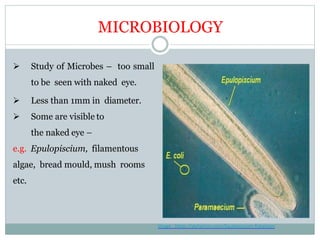
MICROBIOLOGY
 Study of Microbes – too small
to be seen with naked eye.
 Less than 1mm in diameter.
 Some are visible to
the naked eye –
e.g. Epulopiscium, filamentous
algae, bread mould, mush rooms
etc.
Image : https://alchetron.com/Epulopiscium-fishelsoni
MICROBES
 Extremely diverse group
• Bacteria ( Study of Bacteria -Bacteriology)
• Algae ( Study of Algae - Phycology)
• Fungi ( Study of Fungi - Mycology)
• Viruses (Study of Viruses - Virology)
• Protozoa ( Study of Protozoa - Protozoology)
Types of Microbiology
 Theoretical or Pure Microbiology
 Practical or Applied Microbiology
Theoretical(pure) Microbiology
• Study of occurrence
• Form
• Structure
• Classification
• Physiology
• Reproduction
• Heredity
• Variation and Evolution of microbes
Applied Microbiology
 Exploitation of beneficial microbes
Control the activities of harmful microbes
Types:
• Medical Microbiology – Study of role of
microbes in human & animal diseases.
• Agricultural Microbiology–Role of microbes in plant
diseases, soil fertility and spoilage of agricultural
products.
Microbiology - Utilisation of
• Industrial
microbes for the production of alcoholic
beverages, antibiotics, amino acids, organic
acids –acetic acid, lactic acid, citric acid etc.
• Food Microbiology – Role of microbes in food spoilage,
their prevention and to increase the shelf life of various
food products ; production of cheese, butter, fermented
milk etc.
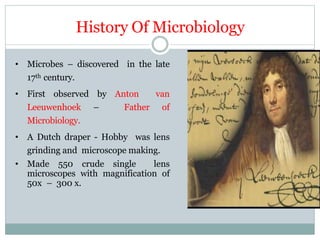
History Of Microbiology
• Microbes – discovered in the late
17th century.
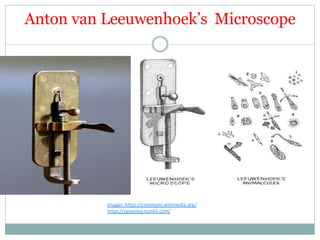
• First observed by Anton van
Leeuwenhoek – Father of
Microbiology.
• A Dutch draper - Hobby was lens
grinding and microscope making.
• Made 550 crude single lens
microscopes with magnification of
50x – 300 x.
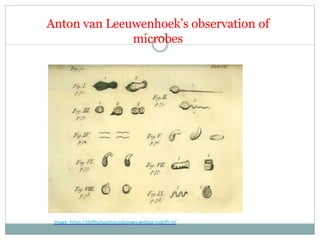
Anton van Leeuwenhoek’s Microscope
Images: https://commons.wikimedia.org/
https://yalepress.tumblr.com/
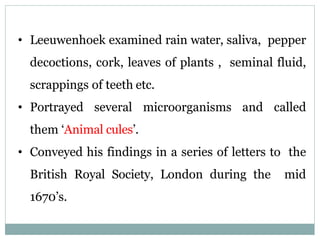
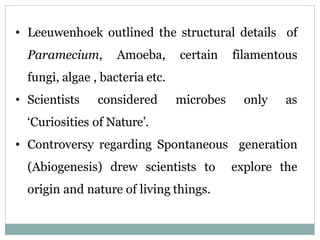
Anton van Leeuwenhoek’s observation of
microbes
Image: https://delftschoolmicrobiology.weblog.tudelft.nl/
• Leeuwenhoek examined rain water, saliva, pepper
decoctions, cork, leaves of plants , seminal fluid,
scrappings of teeth etc.
• Portrayed several microorganisms and called
them ‘Animal cules’.
• Conveyed his findings in a series of letters to the
British Royal Society, London during the mid
1670’s.
• Leeuwenhoek outlined the structural details of
Paramecium, Amoeba, certain filamentous
fungi, algae , bacteria etc.
• Scientists considered microbes only as
‘Curiosities of Nature’.
• Controversy regarding Spontaneous generation
(Abiogenesis) drew scientists to explore the
origin and nature of living things.
• Spontaneous generation(Abiogenesis)
A belief in ancient times that living
organisms could develop from non –
living matter.
• Theory of Biogenesis – Living
organismsarise only from preexisting
organisms.
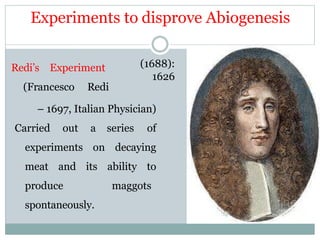
Experiments to disprove Abiogenesis
Redi’s Experiment
(Francesco Redi
(1688):
1626
– 1697, Italian Physician)
Carried out a series of
experiments on decaying
meat and its ability to
produce maggots
spontaneously.
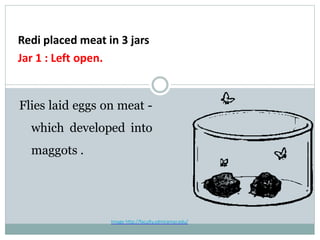
Redi placed meat in 3 jars
Jar 1 : Left open.
Flies laid eggs on meat -
which developed into
maggots .
Image http://faculty.sdmiramar.edu/
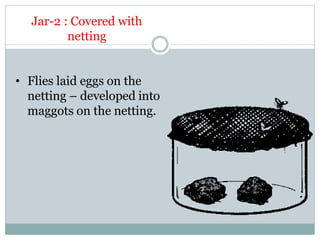
Jar-2 : Covered with
netting
• Flies laid eggs on the
netting – developed into
maggots on the netting.
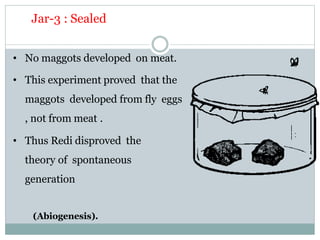
Jar-3 : Sealed
• No maggots developed on meat.
• This experiment proved that the
maggots developed from fly eggs
, not from meat .
• Thus Redi disproved the
theory of spontaneous
generation
(Abiogenesis).
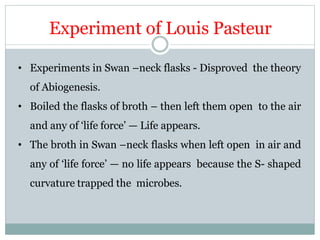
Experiment of Louis Pasteur
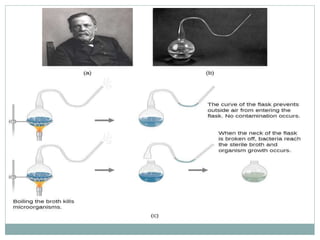
• Experiments in Swan –neck flasks - Disproved the theory
of Abiogenesis.
• Boiled the flasks of broth – then left them open to the air
and any of ‘life force’ — Life appears.
• The broth in Swan –neck flasks when left open in air and
any of ‘life force’ — no life appears because the S- shaped
curvature trapped the microbes.
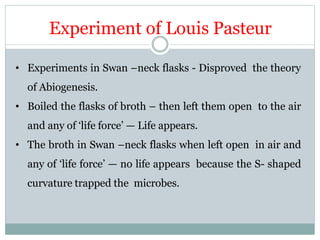
Experiment of Louis Pasteur
• Experiments in Swan –neck flasks - Disproved the theory
of Abiogenesis.
• Boiled the flasks of broth – then left them open to the air
and any of ‘life force’ — Life appears.
• The broth in Swan –neck flasks when left open in air and
any of ‘life force’ — no life appears because the S- shaped
curvature trapped the microbes.
• In 1800s, the scientists
believed that the infectious
diseases were spread by
an entity ‘miasms’- an
altered chemical quality
of atmosphere.
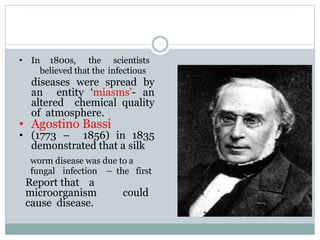
• Agostino Bassi
• (1773 – 1856) in 1835
demonstrated that a silk
worm disease was due to a
fungal infection – the first
Report that a
microorganism could
cause disease.
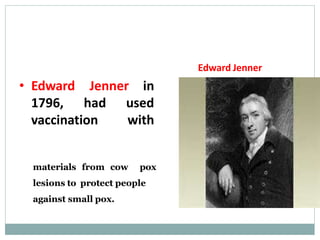
Jenner in
• Edward
1796, had
vaccination
used
with
materials from cow pox
lesions to protect people
against small pox.
Edward Jenner
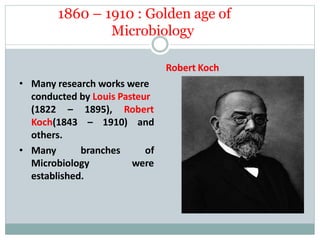
1860 – 1910 : Golden age of
Microbiology
1895), Robert
– 1910) and
(1822 –
Koch(1843
others.
• Many branches of
were
Microbiology
established.
Robert Koch
• Many research works were
conducted by Louis Pasteur
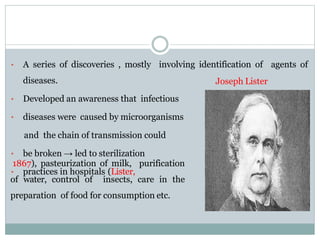
• A series of discoveries , mostly involving identification of agents of
diseases.
• Developed an awareness that infectious
• diseases were caused by microorganisms
and the chain of transmission could
• be broken → led to sterilization
• practices in hospitals (Lister,
1867), pasteurization of milk, purification
of water, control of insects, care in the
preparation of food for consumption etc.
Joseph Lister
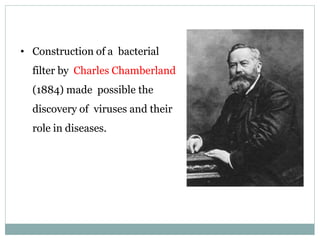
• Construction of a bacterial
filter by Charles Chamberland
(1884) made possible the
discovery of viruses and their
role in diseases.
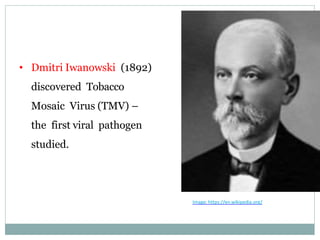
• Dmitri Iwanowski (1892)
discovered Tobacco
Mosaic Virus (TMV) –
the first viral pathogen
studied.
Image: https://en.wikipedia.org/
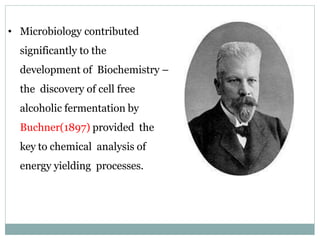
• Microbiology contributed
significantly to the
development of Biochemistry –
the discovery of cell free
alcoholic fermentation by
Buchner(1897) provided the
key to chemical analysis of
energy yielding processes.
Contributions of Louis Pasteur-
Father of Industrial Microbiology
• Put an end to the theory of
Abiogenesis.First
demonstrated that air
contain microbes.
Discovered anaerobic life.
• Introduced the terms
aerobic and anaerobic.
• Established the Germ
theory of fermentation-
chemical changes like
fermentation are vital
processes brought about
by the activity of
microbes like yeasts and
bacteria.
• Established germ theory of disease –
microorganisms are responsible for infectious
diseases.
• Developed various methods of sterilization-
steam sterilization, hot air oven, autoclave.
• Coined the term vaccine.
• Developed vaccines for anthrax and rabies.
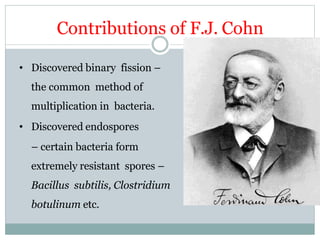
Contributions of F.J. Cohn
• Discovered binary fission –
the common method of
multiplication in bacteria.
• Discovered endospores
– certain bacteria form
extremely resistant spores –
Bacillus subtilis, Clostridium
botulinum etc.
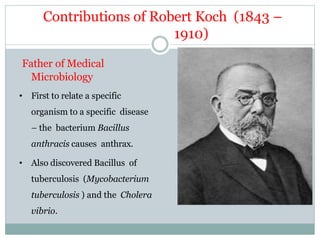
Contributions of Robert Koch (1843 –
1910)
Father of Medical
Microbiology
• First to relate a specific
organism to a specific disease
– the bacterium Bacillus
anthracis causes anthrax.
• Also discovered Bacillus of
tuberculosis (Mycobacterium
tuberculosis ) and the Cholera
vibrio.
KOCH’S POSTULATES
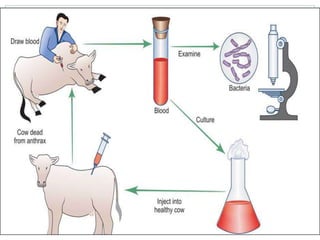
• Robert Koch developed a series of procedures by which
a specific organism could be related to a specific disease.
These steps are called Koch’s postulates.
i) The microorganism must be present in every case of the
disease but absent from healthy organisms.
ii) The suspected microorganism must be isolated
and grown in a pure culture.
iii) The same disease must result when the isolated
microorganism is inoculated into a healthy host.
iv) The same micro organism must be isolated again from
the diseased host.
By these procedures, a specific organism could be related
to a specific disease.
• Also developed many staining methods for bacteria.
Exceptions to Koch's Postulates
 Some of the exceptions of these postulates are:
a. Inability to grow Treponema pallidum and
Mycobacterium leprae-known causative agents of syphilis
and leprosy respectively on artificial media
b. Inability to grow many viruses and rickettsial pathogens
on artificial media.
• Use of solid culture medium to grow bacteria.
• Developed pure culture techniques
• In the last decade of the 19 th century, microbiologist’s
interests were concentrated on the role of microbes as
agents of infectious diseases.
• Many of the important pathogenic organisms have been
discovered and their casual roles established.
• The students of Pasteur, Koch and others discovered in
rapid succession a group of bacteria capable of causing
specific diseases , techniques and laboratory procedures.
• During the last decade of the 19th
century, Microbiology became an
established discipline with a
distinct set of concepts and
techniques.
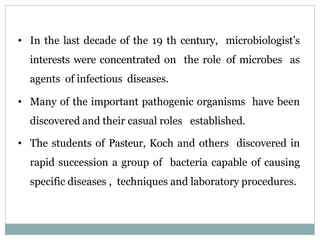
• During the early part of 20 th
century, Microbiology
developed independently of
other biological disciplines.
• Discovery of Electron
microscope (1934) , Tissue
culture technique etc.
Ernst Ruska & Max Knoll Electron
microscope
• Development of drugs or chemicals
which could kill infectious agents while
being non-toxic to the host.
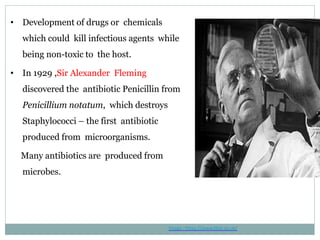
• In 1929 ,Sir Alexander Fleming
discovered the antibiotic Penicillin from
Penicillium notatum, which destroys
Staphylococci – the first antibiotic
produced from microorganisms.
Many antibiotics are produced from
microbes.
Image : https://www.tbat.co.uk/
• Microbiology established a closer
relationship with other disciplines
in 1940s.
• The first important connection
between Genetics and
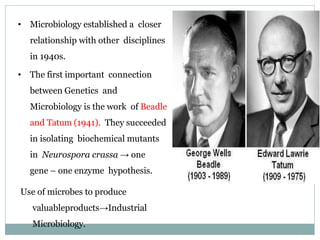
Microbiology is the work of Beadle
and Tatum (1941). They succeeded
in isolating biochemical mutants
in Neurospora crassa → one
gene – one enzyme hypothesis.
Use of microbes to produce
valuableproducts→Industrial
Microbiology.
• Development of rDNA technology (Gene
cloning or Genetic Engineering).
• Genetically modified microbes that can be used
as factory cells for the synthesis of valuable
pharmaceutical products like human insulin,
hormones, vaccines etc.
• Space Microbiology ( a branch of Exobiology-
investigating the possibility of extraterrestrial
life and the effects of extraterrestrial
environments on living organisms from the
earth.) investigates the possibility of using
microbes as sources of food and oxygen.
developed
Modern Microbiology is a well
discipline with established
concepts and techniques.
SCOPE OF MICROBIOLOGY
Many microbiologists focus on a specific group of
microorganisms.
• Virologists – on Viruses
• Bacteriologists – on Bacteria
• Phycologists – on Algae
• Mycologists – on Fungi
• Protozoologists –on Protozoa.
Different fields :
• Microbial Morphology
• Microbial Physiology
• Microbial Cytology
• Microbial Ecology
• Microbial Genetics & Molecular Biology
• Microbial Taxonomy
• Medical Microbiology
• Public health Microbiology
• Food Microbiology
• Dairy Microbiology
• Immunology
Microbes - Extremely useful as experimental
materials.
• Simple
• Grow rapidly
• Can culture in large quantities in test tubes, flasks,
require less space and maintenance than large plants
and animals.
• Easy – to – work –with material for studying complex
processes of metabolism.
• Metabolic processes – similar to higher plants
and animals
• Microbes can be used to study synthesis of
antibiotics ,toxins, energy production, survival
mechanism in harsh environmental
conditions, microbial nitrogen fixation etc.
lecture 1 microbiology.pptx

lecture 1 microbiology.pptx

  • 1.
    History and Scopeof Microbiology Lecture 1
  • 2.
    MICROBIOLOGY  Study ofMicrobes – too small to be seen with naked eye.  Less than 1mm in diameter.  Some are visible to the naked eye – e.g. Epulopiscium, filamentous algae, bread mould, mush rooms etc. Image : https://alchetron.com/Epulopiscium-fishelsoni
  • 3.
    MICROBES  Extremely diversegroup • Bacteria ( Study of Bacteria -Bacteriology) • Algae ( Study of Algae - Phycology) • Fungi ( Study of Fungi - Mycology) • Viruses (Study of Viruses - Virology) • Protozoa ( Study of Protozoa - Protozoology)
  • 4.
    Types of Microbiology Theoretical or Pure Microbiology  Practical or Applied Microbiology
  • 5.
    Theoretical(pure) Microbiology • Studyof occurrence • Form • Structure • Classification • Physiology • Reproduction • Heredity • Variation and Evolution of microbes
  • 6.
    Applied Microbiology  Exploitationof beneficial microbes Control the activities of harmful microbes Types: • Medical Microbiology – Study of role of microbes in human & animal diseases. • Agricultural Microbiology–Role of microbes in plant diseases, soil fertility and spoilage of agricultural products.
  • 7.
    Microbiology - Utilisationof • Industrial microbes for the production of alcoholic beverages, antibiotics, amino acids, organic acids –acetic acid, lactic acid, citric acid etc. • Food Microbiology – Role of microbes in food spoilage, their prevention and to increase the shelf life of various food products ; production of cheese, butter, fermented milk etc.
  • 8.
    History Of Microbiology •Microbes – discovered in the late 17th century. • First observed by Anton van Leeuwenhoek – Father of Microbiology. • A Dutch draper - Hobby was lens grinding and microscope making. • Made 550 crude single lens microscopes with magnification of 50x – 300 x.
  • 9.
    Anton van Leeuwenhoek’sMicroscope Images: https://commons.wikimedia.org/ https://yalepress.tumblr.com/
  • 10.
    Anton van Leeuwenhoek’sobservation of microbes Image: https://delftschoolmicrobiology.weblog.tudelft.nl/
  • 11.
    • Leeuwenhoek examinedrain water, saliva, pepper decoctions, cork, leaves of plants , seminal fluid, scrappings of teeth etc. • Portrayed several microorganisms and called them ‘Animal cules’. • Conveyed his findings in a series of letters to the British Royal Society, London during the mid 1670’s.
  • 12.
    • Leeuwenhoek outlinedthe structural details of Paramecium, Amoeba, certain filamentous fungi, algae , bacteria etc. • Scientists considered microbes only as ‘Curiosities of Nature’. • Controversy regarding Spontaneous generation (Abiogenesis) drew scientists to explore the origin and nature of living things.
  • 13.
    • Spontaneous generation(Abiogenesis) Abelief in ancient times that living organisms could develop from non – living matter. • Theory of Biogenesis – Living organismsarise only from preexisting organisms.
  • 14.
    Experiments to disproveAbiogenesis Redi’s Experiment (Francesco Redi (1688): 1626 – 1697, Italian Physician) Carried out a series of experiments on decaying meat and its ability to produce maggots spontaneously.
  • 15.
    Redi placed meatin 3 jars Jar 1 : Left open. Flies laid eggs on meat - which developed into maggots . Image http://faculty.sdmiramar.edu/
  • 16.
    Jar-2 : Coveredwith netting • Flies laid eggs on the netting – developed into maggots on the netting.
  • 17.
    Jar-3 : Sealed •No maggots developed on meat. • This experiment proved that the maggots developed from fly eggs , not from meat . • Thus Redi disproved the theory of spontaneous generation (Abiogenesis).
  • 18.
    Experiment of LouisPasteur • Experiments in Swan –neck flasks - Disproved the theory of Abiogenesis. • Boiled the flasks of broth – then left them open to the air and any of ‘life force’ — Life appears. • The broth in Swan –neck flasks when left open in air and any of ‘life force’ — no life appears because the S- shaped curvature trapped the microbes.
  • 19.
    Experiment of LouisPasteur • Experiments in Swan –neck flasks - Disproved the theory of Abiogenesis. • Boiled the flasks of broth – then left them open to the air and any of ‘life force’ — Life appears. • The broth in Swan –neck flasks when left open in air and any of ‘life force’ — no life appears because the S- shaped curvature trapped the microbes.
  • 21.
    • In 1800s,the scientists believed that the infectious diseases were spread by an entity ‘miasms’- an altered chemical quality of atmosphere. • Agostino Bassi • (1773 – 1856) in 1835 demonstrated that a silk worm disease was due to a fungal infection – the first Report that a microorganism could cause disease.
  • 22.
    Jenner in • Edward 1796,had vaccination used with materials from cow pox lesions to protect people against small pox. Edward Jenner
  • 23.
    1860 – 1910: Golden age of Microbiology 1895), Robert – 1910) and (1822 – Koch(1843 others. • Many branches of were Microbiology established. Robert Koch • Many research works were conducted by Louis Pasteur
  • 24.
    • A seriesof discoveries , mostly involving identification of agents of diseases. • Developed an awareness that infectious • diseases were caused by microorganisms and the chain of transmission could • be broken → led to sterilization • practices in hospitals (Lister, 1867), pasteurization of milk, purification of water, control of insects, care in the preparation of food for consumption etc. Joseph Lister
  • 25.
    • Construction ofa bacterial filter by Charles Chamberland (1884) made possible the discovery of viruses and their role in diseases.
  • 26.
    • Dmitri Iwanowski(1892) discovered Tobacco Mosaic Virus (TMV) – the first viral pathogen studied. Image: https://en.wikipedia.org/
  • 27.
    • Microbiology contributed significantlyto the development of Biochemistry – the discovery of cell free alcoholic fermentation by Buchner(1897) provided the key to chemical analysis of energy yielding processes.
  • 28.
    Contributions of LouisPasteur- Father of Industrial Microbiology • Put an end to the theory of Abiogenesis.First demonstrated that air contain microbes. Discovered anaerobic life. • Introduced the terms aerobic and anaerobic. • Established the Germ theory of fermentation- chemical changes like fermentation are vital processes brought about by the activity of microbes like yeasts and bacteria.
  • 29.
    • Established germtheory of disease – microorganisms are responsible for infectious diseases. • Developed various methods of sterilization- steam sterilization, hot air oven, autoclave. • Coined the term vaccine. • Developed vaccines for anthrax and rabies.
  • 30.
    Contributions of F.J.Cohn • Discovered binary fission – the common method of multiplication in bacteria. • Discovered endospores – certain bacteria form extremely resistant spores – Bacillus subtilis, Clostridium botulinum etc.
  • 31.
    Contributions of RobertKoch (1843 – 1910) Father of Medical Microbiology • First to relate a specific organism to a specific disease – the bacterium Bacillus anthracis causes anthrax. • Also discovered Bacillus of tuberculosis (Mycobacterium tuberculosis ) and the Cholera vibrio.
  • 32.
    KOCH’S POSTULATES • RobertKoch developed a series of procedures by which a specific organism could be related to a specific disease. These steps are called Koch’s postulates. i) The microorganism must be present in every case of the disease but absent from healthy organisms. ii) The suspected microorganism must be isolated and grown in a pure culture.
  • 33.
    iii) The samedisease must result when the isolated microorganism is inoculated into a healthy host. iv) The same micro organism must be isolated again from the diseased host. By these procedures, a specific organism could be related to a specific disease. • Also developed many staining methods for bacteria.
  • 35.
    Exceptions to Koch'sPostulates  Some of the exceptions of these postulates are: a. Inability to grow Treponema pallidum and Mycobacterium leprae-known causative agents of syphilis and leprosy respectively on artificial media b. Inability to grow many viruses and rickettsial pathogens on artificial media.
  • 36.
    • Use ofsolid culture medium to grow bacteria. • Developed pure culture techniques
  • 37.
    • In thelast decade of the 19 th century, microbiologist’s interests were concentrated on the role of microbes as agents of infectious diseases. • Many of the important pathogenic organisms have been discovered and their casual roles established. • The students of Pasteur, Koch and others discovered in rapid succession a group of bacteria capable of causing specific diseases , techniques and laboratory procedures.
  • 38.
    • During thelast decade of the 19th century, Microbiology became an established discipline with a distinct set of concepts and techniques. • During the early part of 20 th century, Microbiology developed independently of other biological disciplines. • Discovery of Electron microscope (1934) , Tissue culture technique etc. Ernst Ruska & Max Knoll Electron microscope
  • 39.
    • Development ofdrugs or chemicals which could kill infectious agents while being non-toxic to the host. • In 1929 ,Sir Alexander Fleming discovered the antibiotic Penicillin from Penicillium notatum, which destroys Staphylococci – the first antibiotic produced from microorganisms. Many antibiotics are produced from microbes. Image : https://www.tbat.co.uk/
  • 40.
    • Microbiology establisheda closer relationship with other disciplines in 1940s. • The first important connection between Genetics and Microbiology is the work of Beadle and Tatum (1941). They succeeded in isolating biochemical mutants in Neurospora crassa → one gene – one enzyme hypothesis. Use of microbes to produce valuableproducts→Industrial Microbiology.
  • 41.
    • Development ofrDNA technology (Gene cloning or Genetic Engineering). • Genetically modified microbes that can be used as factory cells for the synthesis of valuable pharmaceutical products like human insulin, hormones, vaccines etc.
  • 42.
    • Space Microbiology( a branch of Exobiology- investigating the possibility of extraterrestrial life and the effects of extraterrestrial environments on living organisms from the earth.) investigates the possibility of using microbes as sources of food and oxygen.
  • 43.
    developed Modern Microbiology isa well discipline with established concepts and techniques.
  • 44.
    SCOPE OF MICROBIOLOGY Manymicrobiologists focus on a specific group of microorganisms. • Virologists – on Viruses • Bacteriologists – on Bacteria • Phycologists – on Algae • Mycologists – on Fungi • Protozoologists –on Protozoa.
  • 45.
    Different fields : •Microbial Morphology • Microbial Physiology • Microbial Cytology • Microbial Ecology • Microbial Genetics & Molecular Biology • Microbial Taxonomy • Medical Microbiology
  • 46.
    • Public healthMicrobiology • Food Microbiology • Dairy Microbiology • Immunology
  • 47.
    Microbes - Extremelyuseful as experimental materials. • Simple • Grow rapidly • Can culture in large quantities in test tubes, flasks, require less space and maintenance than large plants and animals. • Easy – to – work –with material for studying complex processes of metabolism.
  • 48.
    • Metabolic processes– similar to higher plants and animals • Microbes can be used to study synthesis of antibiotics ,toxins, energy production, survival mechanism in harsh environmental conditions, microbial nitrogen fixation etc.