

DR.FARIA MALIK
HEAD OF MICROBIOLOGY
SIMS
SPIROCHETALIS
TWO FAMILIES
1. SPIROCHETACEAE: 0.1-0.3um
• 3 GENERA of free-living, large spirals
2. TREPONEMATACEA: 3 genera
• Treponema
• Borrelia
• Leptospira
TREPONEMA
• Treponema pallidum subspecies pallidum
SYPHILIS
ENDEMIC SYPHILIS
• Treponema pallidum subspecie pertenue
YAWS
• Treponema pallidum subspecie carateum
PINTA
MORPHOLOGY
• Gram negative bacilli, cockscrew-shaped
• Slender spirals: length 5-15um * 0.2um
• regular tight coils at l um intervals 8-
14/cell
• Active motility around flagellum by
attaching to tissue by tapering end, secrete
hyaluronidase
• Sluggish, drifting; active motility
structure
• Outer sheath or glycosaminoglycan coat
• Outer membrane…PPG/structural integrity
• Periplasmic space inside for endoflagella
• Endoflagella start at ends, overlap in mid
Wind around axil
• Inner membrane; osmotic stability
• Protoplasmic cylinder
GROWTH
• T pallidum: In Vitro not grown:
non pathogenic Rieters strain can be grown
• Can Maintain at 25 C , 4-7 days
anaerobic,albumin,NaHCO3,pyruvate,serum
• Rabbit epitheleal cells:
multiply several generations 10-100
• Division:
transverse fission : doubling time 30hours
• Microaerophilic 1-4% O2
• Blood:Transfusiontransmissionstore2-6Cfor3-5days/low risk,screeneddonors.survive 24hrs 4c
HISTORICAL NAMES
Great pox" in the 16th
century
• Scotland, Grandgore
• French army outbreak morbus gallicus French dis
. OR the la maladie anglaise (the English Dis
• Italians called it "Spanish disease", & “Italian
disease" or “Neapolitan disease”,
• Russians called it : “Polish disease",
• Arabs called it the "Disease of the Christians”.
terms "lues" and "Cupid's Disease" were used.
HISTORY
• ORIGIN
• Europe 15 century Mediterranian-epidemic
• New World Columbus crew got it West Indies, so
reached Spain
• Africa endemic for centuries-Europe by armies &
civil populations
• 18 Century d/d gonorrhea
• 1905,Schaudinn and Hoffman etiologic agent
• 1906 Wassermann serological tests introduced
TRANSMISSION
1.Intimate Contact with infected person,
• From spirochete containing lesion of
skin/mm (genitalia, mouth, rectum) to
skin/mm
• Sexual/accidental; physician, pathologist
2. Pregnanat woman to fetus
3. Blood transfusion
• Site of Inoculation: Genetalia/genital tract
• Survival outside host: limited
PATHOGENESIS
• No enzymes & toxins produced
• Infects endothelium of small BV called “
Endarteritis
affects BV of brain & CVS seen in tertiary syphilus
Perivascular areas affected.
After invasion organisms multiply and disseminate
rapidly and widely via the above routes
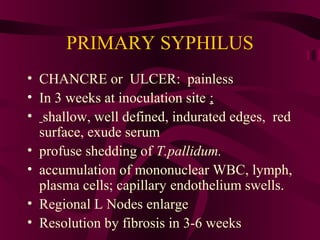
PRIMARY SYPHILUS
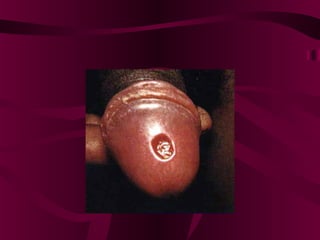
• CHANCRE or ULCER: painless
• In 3 weeks at inoculation site ;
• shallow, well defined, indurated edges, red
surface, exude serum
• profuse shedding of T.pallidum.
• accumulation of mononuclear WBC, lymph,
plasma cells; capillary endothelium swells.
• Regional L Nodes enlarge
• Resolution by fibrosis in 3-6 weeks
CLINICAL MANIFESTATION
ACQUIRED SYPHILIS
• Human host, sexual contact
• External genitalia: Abraded skin & intact mm
• Other sites: 10-20%
• PRIMARY LESION: 2-10 WEEKS
PAPULE: Local multiplication, breaks to ulcer
HARD CHANCRE: hard base
Inflammatory cells: lymphocytes & plasma cells
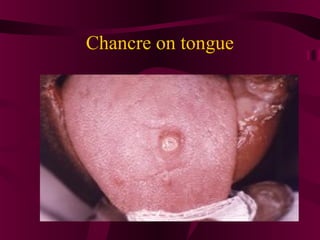
Chancre on tongue
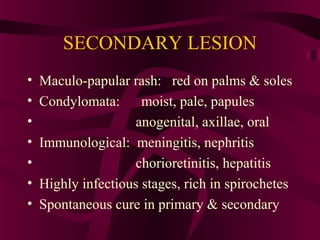
SECONDARY LESION
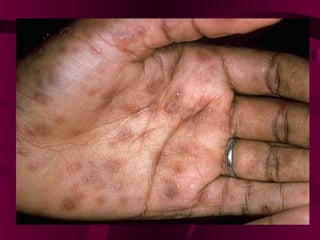
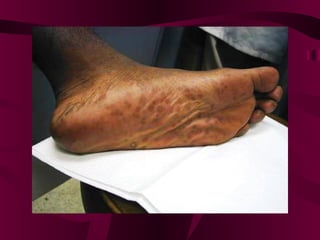
• Maculo-papular rash: red on palms & soles
• Condylomata: moist, pale, papules
• anogenital, axillae, oral
• Immunological: meningitis, nephritis
• chorioretinitis, hepatitis
• Highly infectious stages, rich in spirochetes
• Spontaneous cure in primary & secondary
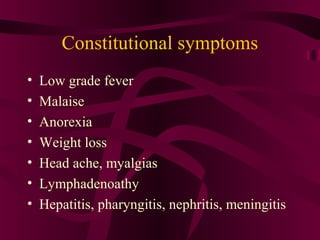
Constitutional symptoms
• Low grade fever
• Malaise
• Anorexia
• Weight loss
• Head ache, myalgias
• Lymphadenoathy
• Hepatitis, pharyngitis, nephritis, meningitis
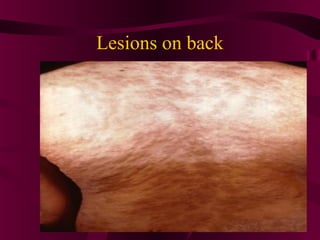
Lesions on back
Latent syphilis
LATENT DISEASE:
Early-latent ----------< 2 yrs of infection;
Late latent----------- > 2 yrs
Pt no symptom but is sero-reactive
not effected by therapy .
Untreated: 40% with symptom; 60% no symptom
• Sequelae of Syphilis 30% cure,
• 30% latent,
• 40% tertiary
SEQUAELAE
1 Spontaneous cure; no t/m
• 1/3 primary & secondary cases
2 Latent: 1/3
No lesions appear but serological tests
positive denoting infection.
EARLY LATENT: lasts 1-2 yrs of secondary
stage, symptoms may reappear & pt
infective
LATE STAGE OR TERTIARY
SYHPILIS 30% UNTREATED
PTS
• Duration: lasts many years; 3-10 yrs after 2 sta
• Sparse spirochetes
1. GUMMAS;
• benign tertiary syphilis
• bone, skin organs-liver, stomach
• dermal lesions,
• immunologic reaction
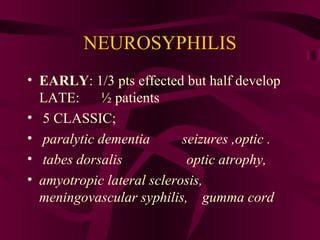
NEUROSYPHILIS
• EARLY: 1/3 pts effected but half develop
LATE: ½ patients
• 5 CLASSIC;
• paralytic dementia seizures ,optic .
• tabes dorsalis optic atrophy,
• amyotropic lateral sclerosis,
meningovascular syphilis, gumma cord
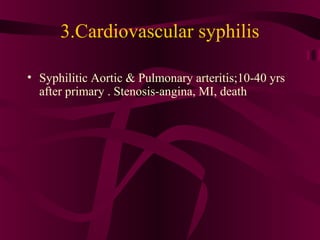
3.Cardiovascular syphilis
• Syphilitic Aortic & Pulmonary arteritis;10-40 yrs
after primary . Stenosis-angina, MI, death
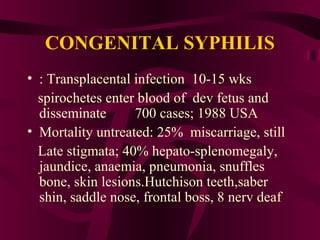
CONGENITAL SYPHILIS
• : Transplacental infection 10-15 wks
spirochetes enter blood of dev fetus and
disseminate 700 cases; 1988 USA
• Mortality untreated: 25% miscarriage, still
Late stigmata; 40% hepato-splenomegaly,
jaundice, anaemia, pneumonia, snuffles
bone, skin lesions.Hutchison teeth,saber
shin, saddle nose, frontal boss, 8 nerv deaf
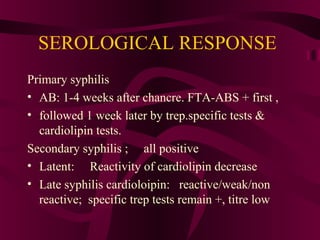
SEROLOGICAL RESPONSE
Primary syphilis
• AB: 1-4 weeks after chancre. FTA-ABS + first ,
• followed 1 week later by trep.specific tests &
cardiolipin tests.
Secondary syphilis ; all positive
• Latent: Reactivity of cardiolipin decrease
• Late syphilis cardioloipin: reactive/weak/non
reactive; specific trep tests remain +, titre low
LABORATORY DIAGNOSIS
SPECIMENS
1 SEROUS FLUID chancre, secondary
skin lesions (moist areas) motile T pallidum
spirochetes seen in primary, secondary, early
congenital, infectious relapsing syphilis.
• Within a few hours of taking AB , treponemes
disappear, so ask pt. of H/O drugs.
2. BLOOD: 3-5ml serum/plasma
(should not hemolysed, lipemic, contaminated).
• CAUTION: GLOVES,SAFE WASTE DISPOSAL
• 1 MICROSCOPY
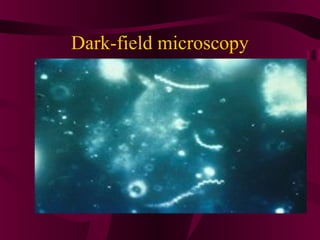
• Dark field direct vision ; viable & actively
motile in primary & active secondary lesion
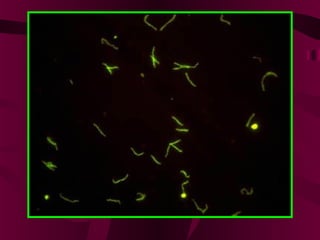
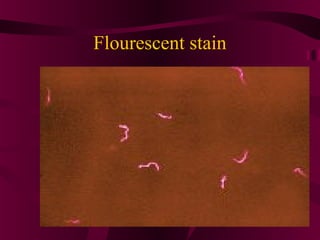
• Direct Florescent antibody; DFA
exudate taken on slide or capillary
tube
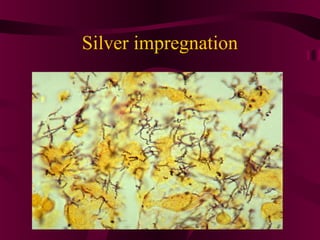
• Special stains
• 2 Animal inoculation 10-100generations in
rabbit
• 3 SEROLOGICAL REACTIONS
Dark-field microscopy
Silver impregnation
Flourescent stain
SEROLOGICAL TESTS
• 1.Non Treponemal Tests
• Wassermanns 1906 used syphilitic tissue as a
complement –fixing antigen to detect antibody
induced by T.pall:
beef heart, cardiolipin, lecithin similar properties
• CARDIOLIPIN-LECITHIN ANTIGEN used in
1. Complement fixation tests;
Wassermann & Kolmer
• 2 Flocculation tests: VDRL, Hinton, Rapid reagin
• 90% Reactive in secondary,78% each in primary
& secondary: false +&- results.
NON TREPONEMAL
ANTIGEN
• AB: Pt serum
• Ag: beef cardiolipin
• AB: REAGIN AB: IgM, IgG
VDRL
• RPR
• POSITIVE: primary, secondary stage;
• titre decrease with tm
REAGINIC AB
• REAGIN is a mixture of IgM & IgG AB
• Formed against Cadiolipin-cholestrol-
lecithin.
• Cardiolipin is an important component of
treponemal Ag
• Cardiolipin also extracted from normal
mammalian tissue eg beef heart; so cross
reactions
NON SPECIFIC CARDIOLIPIN
REAGIN TESTS
• SCREENING TESTS:
• VDRL:
Heat inactivated serum (to destroy
complement) is reacted with freshly
prepared cardiolipin- cholestrol-lecithin Ag
and resultant flocculation read
microscopically by 10x.
• Quantitation done by double dilution
RAPID PLASMA REAGIN
RPR
• Plasma/serum can be used
• CCL Ag has choline chloride added.
No heat-inactivation needed
• Carbon added to Ag which are trapped in
floccules on a card.
• Result read Macroscopically .Can quantify
• Ag stable, ready to use state –6months at 4-
10 C
TOULIDINE RED UNHEATED
SERUM TEST(TRUST)
• Red instead of black particles of RPR used to
visualise the reaction.
• Red particles caught in mesh of Ag &AB complex
• Result in few minutes if agitated
• can keep room temperature.
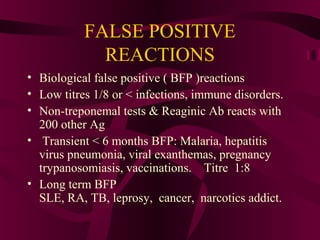
FALSE POSITIVE
REACTIONS
• Biological false positive ( BFP )reactions
• Low titres 1/8 or < infections, immune disorders.
• Non-treponemal tests & Reaginic Ab reacts with
200 other Ag
• Transient < 6 months BFP: Malaria, hepatitis
virus pneumonia, viral exanthemas, pregnancy
trypanosomiasis, vaccinations. Titre 1:8
• Long term BFP
SLE, RA, TB, leprosy, cancer, narcotics addict.
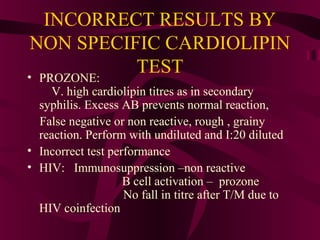
INCORRECT RESULTS BY
NON SPECIFIC CARDIOLIPIN
TEST• PROZONE:
V. high cardiolipin titres as in secondary
syphilis. Excess AB prevents normal reaction,
False negative or non reactive, rough , grainy
reaction. Perform with undiluted and I:20 diluted
• Incorrect test performance
• HIV: Immunosuppression –non reactive
B cell activation – prozone
No fall in titre after T/M due to
HIV coinfection
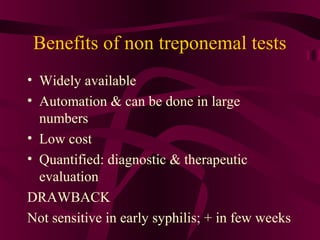
Benefits of non treponemal tests
• Widely available
• Automation & can be done in large
numbers
• Low cost
• Quantified: diagnostic & therapeutic
evaluation
DRAWBACK
Not sensitive in early syphilis; + in few weeks
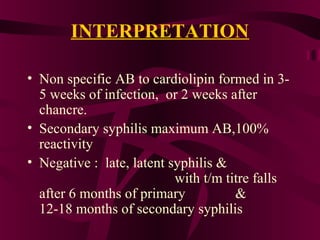
INTERPRETATION
• Non specific AB to cardiolipin formed in 3-
5 weeks of infection, or 2 weeks after
chancre.
• Secondary syphilis maximum AB,100%
reactivity
• Negative : late, latent syphilis &
with t/m titre falls
after 6 months of primary &
12-18 months of secondary syphilis
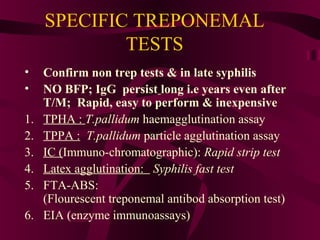
SPECIFIC TREPONEMAL
TESTS
• Confirm non trep tests & in late syphilis
• NO BFP; IgG persist long i.e years even after
T/M; Rapid, easy to perform & inexpensive
1. TPHA : T.pallidum haemagglutination assay
2. TPPA : T.pallidum particle agglutination assay
3. IC (Immuno-chromatographic): Rapid strip test
4. Latex agglutination: Syphilis fast test
5. FTA-ABS:
(Flourescent treponemal antibod absorption test)
6. EIA (enzyme immunoassays)
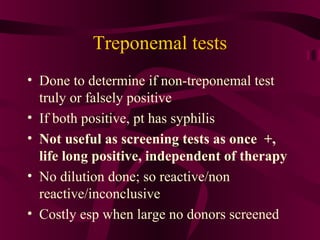
Treponemal tests
• Done to determine if non-treponemal test
truly or falsely positive
• If both positive, pt has syphilis
• Not useful as screening tests as once +,
life long positive, independent of therapy
• No dilution done; so reactive/non
reactive/inconclusive
• Costly esp when large no donors screened
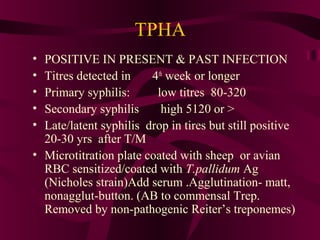
TPHA
• POSITIVE IN PRESENT & PAST INFECTION
• Titres detected in 4th
week or longer
• Primary syphilis: low titres 80-320
• Secondary syphilis high 5120 or >
• Late/latent syphilis drop in tires but still positive
20-30 yrs after T/M
• Microtitration plate coated with sheep or avian
RBC sensitized/coated with T.pallidum Ag
(Nicholes strain)Add serum .Agglutination- matt,
nonagglut-button. (AB to commensal Trep.
Removed by non-pathogenic Reiter’s treponemes)
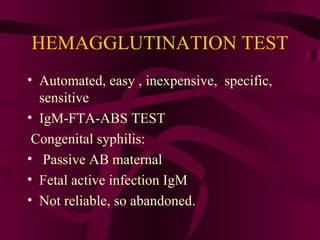
HEMAGGLUTINATION TEST
• Automated, easy , inexpensive, specific,
sensitive
• IgM-FTA-ABS TEST
Congenital syphilis:
• Passive AB maternal
• Fetal active infection IgM
• Not reliable, so abandoned.
TPPA & IC
• Gelatin particles used instead of RBC, stability
better
• Positive clumping seen
• Modification: capillary whole blood used instead
of venous
• IC: Rapid 15 minutes, simple, low cost for
specific AB to Trep pallidum (recombinant Ag)
in serum, plasma. 100ul serum in tube , strip
immersed and look for 2 pink bands in +
LATEX SYPHILIS FAST TEST
• Latex coated with Trep.pall Ag added to 20
ul serum on a card. Positive test in 8 mins
TREATMENT
• Pencillin 0.03units/ml single I/M injection
• treponemicidal < 1yr duration
• Older/latent disease 3 doses at weekly
interv
• Congenital: i/v
OTHER SPECIFIC TESTS
• T.P Immobilization Test(TPI) A suspension of
living & motile treponemes maintained in rabbit
testes are immobilized by reaginic antibody and
complement, seen by dark field microscopy.
Difficult,expensive and false + for non venereal
treponemes.Done in research labs to compare
other tests
• RIETER PROTEIN COMPLEMENT FIXATION
TEST;Ag extract of non virulent strain Reiter
cultured in vitro. Group Ag ;false +/-
FLOURESCENT ANTIBODY
TEST in reference lab
• First test to be positive in 3-4 weeks in Primary
sphilis
• Trep.antibody detected by flourescein labeled anti
human antibody
• Used; congenital syphilis, late stage syphilis,
positive reaginic test
• Sensitive, reliable
• FTA;( Florescent Tryp. Antibody test)Nichol’s
strain organisms used as AG ,fixed on slide,test
serum applied,allowed to react. Then layered by
fl.antihuman AB seen by fl.microscope
• Expensive, time consuming
CONGENITAL SYPHILIS
• INFANTS: Symptoms suggestive
• Skin lesion/nasal discharge: motile treponemes by
dark field microscopy
• Serology Reactive specific test at 3 months ,
maternal IgG
• Active Infection IgM raised
Higher AB titre than mother and
continues to rise
• MOTHER ; AB tested with infants
TREATMENT
• PENCILLIN MIC 0.004U/ml
• Most sensitive organism but R increasing
• Early syphilis 0.03 units/ ml serum 7-10 days
totally arrests disease
• Late 21 days
• Erythromycin, tetracycline, cephaloridin but less
passage to fetus so cong.syph can occur
• Evaluate: 3 months quantitative cardiolipin tests
• Relapse titre increases
PREVENTION
• AIDS association so avoid drug abusers,
STD pts, HIV pts
• T/M case contacts, examine them, treat as
primary syphilis as long incubation gives
time for prevention.
[Micro] syphilis
[Micro] syphilis
[Micro] syphilis

[Micro] syphilis

  • 1.
    DR.FARIA MALIK HEAD OFMICROBIOLOGY SIMS
  • 2.
    SPIROCHETALIS TWO FAMILIES 1. SPIROCHETACEAE:0.1-0.3um • 3 GENERA of free-living, large spirals 2. TREPONEMATACEA: 3 genera • Treponema • Borrelia • Leptospira
  • 3.
    TREPONEMA • Treponema pallidumsubspecies pallidum SYPHILIS ENDEMIC SYPHILIS • Treponema pallidum subspecie pertenue YAWS • Treponema pallidum subspecie carateum PINTA
  • 4.
    MORPHOLOGY • Gram negativebacilli, cockscrew-shaped • Slender spirals: length 5-15um * 0.2um • regular tight coils at l um intervals 8- 14/cell • Active motility around flagellum by attaching to tissue by tapering end, secrete hyaluronidase • Sluggish, drifting; active motility
  • 5.
    structure • Outer sheathor glycosaminoglycan coat • Outer membrane…PPG/structural integrity • Periplasmic space inside for endoflagella • Endoflagella start at ends, overlap in mid Wind around axil • Inner membrane; osmotic stability • Protoplasmic cylinder
  • 6.
    GROWTH • T pallidum:In Vitro not grown: non pathogenic Rieters strain can be grown • Can Maintain at 25 C , 4-7 days anaerobic,albumin,NaHCO3,pyruvate,serum • Rabbit epitheleal cells: multiply several generations 10-100 • Division: transverse fission : doubling time 30hours • Microaerophilic 1-4% O2 • Blood:Transfusiontransmissionstore2-6Cfor3-5days/low risk,screeneddonors.survive 24hrs 4c
  • 7.
    HISTORICAL NAMES Great pox"in the 16th century • Scotland, Grandgore • French army outbreak morbus gallicus French dis . OR the la maladie anglaise (the English Dis • Italians called it "Spanish disease", & “Italian disease" or “Neapolitan disease”, • Russians called it : “Polish disease", • Arabs called it the "Disease of the Christians”. terms "lues" and "Cupid's Disease" were used.
  • 8.
    HISTORY • ORIGIN • Europe15 century Mediterranian-epidemic • New World Columbus crew got it West Indies, so reached Spain • Africa endemic for centuries-Europe by armies & civil populations • 18 Century d/d gonorrhea • 1905,Schaudinn and Hoffman etiologic agent • 1906 Wassermann serological tests introduced
  • 9.
    TRANSMISSION 1.Intimate Contact withinfected person, • From spirochete containing lesion of skin/mm (genitalia, mouth, rectum) to skin/mm • Sexual/accidental; physician, pathologist 2. Pregnanat woman to fetus 3. Blood transfusion • Site of Inoculation: Genetalia/genital tract • Survival outside host: limited
  • 10.
    PATHOGENESIS • No enzymes& toxins produced • Infects endothelium of small BV called “ Endarteritis affects BV of brain & CVS seen in tertiary syphilus Perivascular areas affected. After invasion organisms multiply and disseminate rapidly and widely via the above routes
  • 11.
    PRIMARY SYPHILUS • CHANCREor ULCER: painless • In 3 weeks at inoculation site ; • shallow, well defined, indurated edges, red surface, exude serum • profuse shedding of T.pallidum. • accumulation of mononuclear WBC, lymph, plasma cells; capillary endothelium swells. • Regional L Nodes enlarge • Resolution by fibrosis in 3-6 weeks
  • 12.
    CLINICAL MANIFESTATION ACQUIRED SYPHILIS •Human host, sexual contact • External genitalia: Abraded skin & intact mm • Other sites: 10-20% • PRIMARY LESION: 2-10 WEEKS PAPULE: Local multiplication, breaks to ulcer HARD CHANCRE: hard base Inflammatory cells: lymphocytes & plasma cells
  • 14.
  • 15.
    SECONDARY LESION • Maculo-papularrash: red on palms & soles • Condylomata: moist, pale, papules • anogenital, axillae, oral • Immunological: meningitis, nephritis • chorioretinitis, hepatitis • Highly infectious stages, rich in spirochetes • Spontaneous cure in primary & secondary
  • 16.
    Constitutional symptoms • Lowgrade fever • Malaise • Anorexia • Weight loss • Head ache, myalgias • Lymphadenoathy • Hepatitis, pharyngitis, nephritis, meningitis
  • 19.
  • 20.
    Latent syphilis LATENT DISEASE: Early-latent----------< 2 yrs of infection; Late latent----------- > 2 yrs Pt no symptom but is sero-reactive not effected by therapy . Untreated: 40% with symptom; 60% no symptom • Sequelae of Syphilis 30% cure, • 30% latent, • 40% tertiary
  • 21.
    SEQUAELAE 1 Spontaneous cure;no t/m • 1/3 primary & secondary cases 2 Latent: 1/3 No lesions appear but serological tests positive denoting infection. EARLY LATENT: lasts 1-2 yrs of secondary stage, symptoms may reappear & pt infective
  • 22.
    LATE STAGE ORTERTIARY SYHPILIS 30% UNTREATED PTS • Duration: lasts many years; 3-10 yrs after 2 sta • Sparse spirochetes 1. GUMMAS; • benign tertiary syphilis • bone, skin organs-liver, stomach • dermal lesions, • immunologic reaction
  • 23.
    NEUROSYPHILIS • EARLY: 1/3pts effected but half develop LATE: ½ patients • 5 CLASSIC; • paralytic dementia seizures ,optic . • tabes dorsalis optic atrophy, • amyotropic lateral sclerosis, meningovascular syphilis, gumma cord
  • 24.
    3.Cardiovascular syphilis • SyphiliticAortic & Pulmonary arteritis;10-40 yrs after primary . Stenosis-angina, MI, death
  • 25.
    CONGENITAL SYPHILIS • :Transplacental infection 10-15 wks spirochetes enter blood of dev fetus and disseminate 700 cases; 1988 USA • Mortality untreated: 25% miscarriage, still Late stigmata; 40% hepato-splenomegaly, jaundice, anaemia, pneumonia, snuffles bone, skin lesions.Hutchison teeth,saber shin, saddle nose, frontal boss, 8 nerv deaf
  • 26.
    SEROLOGICAL RESPONSE Primary syphilis •AB: 1-4 weeks after chancre. FTA-ABS + first , • followed 1 week later by trep.specific tests & cardiolipin tests. Secondary syphilis ; all positive • Latent: Reactivity of cardiolipin decrease • Late syphilis cardioloipin: reactive/weak/non reactive; specific trep tests remain +, titre low
  • 27.
    LABORATORY DIAGNOSIS SPECIMENS 1 SEROUSFLUID chancre, secondary skin lesions (moist areas) motile T pallidum spirochetes seen in primary, secondary, early congenital, infectious relapsing syphilis. • Within a few hours of taking AB , treponemes disappear, so ask pt. of H/O drugs. 2. BLOOD: 3-5ml serum/plasma (should not hemolysed, lipemic, contaminated). • CAUTION: GLOVES,SAFE WASTE DISPOSAL
  • 28.
    • 1 MICROSCOPY •Dark field direct vision ; viable & actively motile in primary & active secondary lesion • Direct Florescent antibody; DFA exudate taken on slide or capillary tube • Special stains • 2 Animal inoculation 10-100generations in rabbit • 3 SEROLOGICAL REACTIONS
  • 29.
  • 30.
  • 32.
  • 33.
    SEROLOGICAL TESTS • 1.NonTreponemal Tests • Wassermanns 1906 used syphilitic tissue as a complement –fixing antigen to detect antibody induced by T.pall: beef heart, cardiolipin, lecithin similar properties • CARDIOLIPIN-LECITHIN ANTIGEN used in 1. Complement fixation tests; Wassermann & Kolmer • 2 Flocculation tests: VDRL, Hinton, Rapid reagin • 90% Reactive in secondary,78% each in primary & secondary: false +&- results.
  • 34.
    NON TREPONEMAL ANTIGEN • AB:Pt serum • Ag: beef cardiolipin • AB: REAGIN AB: IgM, IgG VDRL • RPR • POSITIVE: primary, secondary stage; • titre decrease with tm
  • 35.
    REAGINIC AB • REAGINis a mixture of IgM & IgG AB • Formed against Cadiolipin-cholestrol- lecithin. • Cardiolipin is an important component of treponemal Ag • Cardiolipin also extracted from normal mammalian tissue eg beef heart; so cross reactions
  • 36.
    NON SPECIFIC CARDIOLIPIN REAGINTESTS • SCREENING TESTS: • VDRL: Heat inactivated serum (to destroy complement) is reacted with freshly prepared cardiolipin- cholestrol-lecithin Ag and resultant flocculation read microscopically by 10x. • Quantitation done by double dilution
  • 37.
    RAPID PLASMA REAGIN RPR •Plasma/serum can be used • CCL Ag has choline chloride added. No heat-inactivation needed • Carbon added to Ag which are trapped in floccules on a card. • Result read Macroscopically .Can quantify • Ag stable, ready to use state –6months at 4- 10 C
  • 38.
    TOULIDINE RED UNHEATED SERUMTEST(TRUST) • Red instead of black particles of RPR used to visualise the reaction. • Red particles caught in mesh of Ag &AB complex • Result in few minutes if agitated • can keep room temperature.
  • 39.
    FALSE POSITIVE REACTIONS • Biologicalfalse positive ( BFP )reactions • Low titres 1/8 or < infections, immune disorders. • Non-treponemal tests & Reaginic Ab reacts with 200 other Ag • Transient < 6 months BFP: Malaria, hepatitis virus pneumonia, viral exanthemas, pregnancy trypanosomiasis, vaccinations. Titre 1:8 • Long term BFP SLE, RA, TB, leprosy, cancer, narcotics addict.
  • 40.
    INCORRECT RESULTS BY NONSPECIFIC CARDIOLIPIN TEST• PROZONE: V. high cardiolipin titres as in secondary syphilis. Excess AB prevents normal reaction, False negative or non reactive, rough , grainy reaction. Perform with undiluted and I:20 diluted • Incorrect test performance • HIV: Immunosuppression –non reactive B cell activation – prozone No fall in titre after T/M due to HIV coinfection
  • 41.
    Benefits of nontreponemal tests • Widely available • Automation & can be done in large numbers • Low cost • Quantified: diagnostic & therapeutic evaluation DRAWBACK Not sensitive in early syphilis; + in few weeks
  • 42.
    INTERPRETATION • Non specificAB to cardiolipin formed in 3- 5 weeks of infection, or 2 weeks after chancre. • Secondary syphilis maximum AB,100% reactivity • Negative : late, latent syphilis & with t/m titre falls after 6 months of primary & 12-18 months of secondary syphilis
  • 43.
    SPECIFIC TREPONEMAL TESTS • Confirmnon trep tests & in late syphilis • NO BFP; IgG persist long i.e years even after T/M; Rapid, easy to perform & inexpensive 1. TPHA : T.pallidum haemagglutination assay 2. TPPA : T.pallidum particle agglutination assay 3. IC (Immuno-chromatographic): Rapid strip test 4. Latex agglutination: Syphilis fast test 5. FTA-ABS: (Flourescent treponemal antibod absorption test) 6. EIA (enzyme immunoassays)
  • 44.
    Treponemal tests • Doneto determine if non-treponemal test truly or falsely positive • If both positive, pt has syphilis • Not useful as screening tests as once +, life long positive, independent of therapy • No dilution done; so reactive/non reactive/inconclusive • Costly esp when large no donors screened
  • 45.
    TPHA • POSITIVE INPRESENT & PAST INFECTION • Titres detected in 4th week or longer • Primary syphilis: low titres 80-320 • Secondary syphilis high 5120 or > • Late/latent syphilis drop in tires but still positive 20-30 yrs after T/M • Microtitration plate coated with sheep or avian RBC sensitized/coated with T.pallidum Ag (Nicholes strain)Add serum .Agglutination- matt, nonagglut-button. (AB to commensal Trep. Removed by non-pathogenic Reiter’s treponemes)
  • 46.
    HEMAGGLUTINATION TEST • Automated,easy , inexpensive, specific, sensitive • IgM-FTA-ABS TEST Congenital syphilis: • Passive AB maternal • Fetal active infection IgM • Not reliable, so abandoned.
  • 47.
    TPPA & IC •Gelatin particles used instead of RBC, stability better • Positive clumping seen • Modification: capillary whole blood used instead of venous • IC: Rapid 15 minutes, simple, low cost for specific AB to Trep pallidum (recombinant Ag) in serum, plasma. 100ul serum in tube , strip immersed and look for 2 pink bands in +
  • 48.
    LATEX SYPHILIS FASTTEST • Latex coated with Trep.pall Ag added to 20 ul serum on a card. Positive test in 8 mins TREATMENT • Pencillin 0.03units/ml single I/M injection • treponemicidal < 1yr duration • Older/latent disease 3 doses at weekly interv • Congenital: i/v
  • 49.
    OTHER SPECIFIC TESTS •T.P Immobilization Test(TPI) A suspension of living & motile treponemes maintained in rabbit testes are immobilized by reaginic antibody and complement, seen by dark field microscopy. Difficult,expensive and false + for non venereal treponemes.Done in research labs to compare other tests • RIETER PROTEIN COMPLEMENT FIXATION TEST;Ag extract of non virulent strain Reiter cultured in vitro. Group Ag ;false +/-
  • 50.
    FLOURESCENT ANTIBODY TEST inreference lab • First test to be positive in 3-4 weeks in Primary sphilis • Trep.antibody detected by flourescein labeled anti human antibody • Used; congenital syphilis, late stage syphilis, positive reaginic test • Sensitive, reliable • FTA;( Florescent Tryp. Antibody test)Nichol’s strain organisms used as AG ,fixed on slide,test serum applied,allowed to react. Then layered by fl.antihuman AB seen by fl.microscope • Expensive, time consuming
  • 51.
    CONGENITAL SYPHILIS • INFANTS:Symptoms suggestive • Skin lesion/nasal discharge: motile treponemes by dark field microscopy • Serology Reactive specific test at 3 months , maternal IgG • Active Infection IgM raised Higher AB titre than mother and continues to rise • MOTHER ; AB tested with infants
  • 52.
    TREATMENT • PENCILLIN MIC0.004U/ml • Most sensitive organism but R increasing • Early syphilis 0.03 units/ ml serum 7-10 days totally arrests disease • Late 21 days • Erythromycin, tetracycline, cephaloridin but less passage to fetus so cong.syph can occur • Evaluate: 3 months quantitative cardiolipin tests • Relapse titre increases
  • 53.
    PREVENTION • AIDS associationso avoid drug abusers, STD pts, HIV pts • T/M case contacts, examine them, treat as primary syphilis as long incubation gives time for prevention.