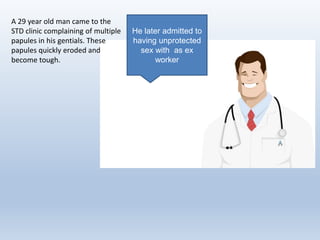
A 29-year-old man presented to an STD clinic complaining of multiple papules on his genitals. Examination revealed indurated papules that were painless. Tests determined it was a case of primary syphilis caused by the bacterium Treponema pallidum.
A 29 yearold man came to the
STD clinic complaining of multiple
papules in his gentials. These
papules quickly eroded and
become tough.
He later admitted to
having unprotected
sex with as ex
worker
2.
•There was regional
lymphadenopathywith
moderately enlarged,
firm, non suppurative,
painless lymph nodes or
satellite buboes.
O/E we noticed papules which
were indurated. It was painless.
3.
•So from theabove case what can we
assume
•Its an STD
4.
•There after varioustests
•It was found to be a case of Primary Syphilis
•Syphilis comes under
Ultrastructure
•Lipid rich outermembrane- Increased
susceptibility to detergents
•Show hardly any antigenic variations
•Saprophytic spirochetes are generally coarser.
Endoflagella lie inside outer
membrane and inserted at
tapering portion
•Cannot be grownin artificial culture media
•Cannot determine metabolic, physical and
pathogenic features.
•Non pathogenic trep is Reiter strain and Noguchi
strain.
•Virulent strains(eg. Nichol’s strain) has been
maintained by serial passages in rabbit testicles
•Recently grown in tissue cultures of rabbit
epithelial cells
12.
Epidemiology
•Modes of transmission
–Sexualcontact
–Placenta
–Kissing
–Close contact
–Contaminated fresh blood
•Fantastic history of syphilis with exact source
not known.
•All known contacts post diagnosis needs to be
considered.
13.
Blood vessel andlymphatics
Enters blood and
dissipates to various
organs in the body
Pathogenesis
Untreated Syphilis- Progress from
1. Primary
2. Secondary
3. Latent
4. Tertiary stages
14.
Clinical features (contd )
Veneral syphilis
•Organism divides 30-33 hours.
•Generally incubation period a month.
•Early spirochetemia inevitably
develops during this phase
•Left untreated at least 2/3
spontaneously clear
•1/3 progress
15.
Those that progressafter 3 weeks
Bacteria multiply at initial entry site and progress to
form a chancre on the genital.
Painless chancre
Usually single except immunocompromised patients
Superficial Ulcer has clean appearance and no exudate.
Painless or slightly tender to touch
16.
Primary syphilis
•Indurated andsuperficially ulcerated
•Base usually smooth, borders raised and firm and cartilaginous consistency.
•Known as Hard chancre
•Most common site penis, cervix or labia and anal canal, rectum or
mouth
•Regional lymphadenopathy consisting of enlarged, firm, non suppurative,
painless lymph nodes or satellite buboes accompanies primary lesion
•Chancre heals within 3-6 weeks and 2-12 weeks later the symptoms of
secondary syphilis develops
17.
Secondary syphilis
•Clinically mostflorid stage of infection
•Involves skin
•Multiplication and wide dissemination of
spirochete and last until sufficient host response
develops to exert some immune control.
•Begins 2-8 weeks after appearance of chancre.
18.
Secondary syphilis
•Nonpruritic macular,maculopapular, papular or
pustular lesions. Begin on the trunk and
proximal extremities. Any surface area becomes
involved.
•Macules evolve to papules. Other sites palms,
soles, hair follicles.
19.
Secondary syphilis
•Warm, moistintertriginous areas ( perianal
area, vulva, scrotum, inner aspects of thigh, skin
under breast) papules enlarge, coalesce and
erode to produce
painless, broad, moist, gray-
white to erythematous highly infectious plaques
termed condylomata lata
21.
Secondary syphilis
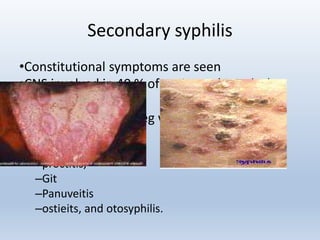
•Constitutional symptomsare seen
•CNS involved in 40 % of patients. ( Headache
and meningismus).
•Any organ involved, eg with
–Renal involements,
–syphilitis hepatis
–proctitis,
–Git
–Panuveitis
–ostieits, and otosyphilis.
22.
Latent syphilis
•Period ofquiescence.
•No clinical manifestation
•Serological tests.
•Individuals with late latent syphilis are not
considered infectious.
•May still transmit infection.
•Early latent syphlis is when clinical relapse
occurs.
•Diagnosis during this period using serological
tests.
23.
Late syphilis
•Slowly progressivedestructive inflammatory
disease that can affect any organ in body to
produce clinical illness 5-30 or more years after
initial infection.
–Neurosyphilis
–Cardiovascular syphilis
–Gummatous- rare granulomatous lesion of
skeleton, skin and mucocutaneous tissues
24.
Congenital syphilis
•Women withearly syphilis can infect her fetus
much more commonly(75-90%) than with
syphilis over 2yrs duration(35%)
•Lesions of congenital- develop 4th month of
gestation when fetal immune competence starts
appearing (suggests pathogenesis requires
immune response from fetus)
•Congenital syphilis prevent if given adequate
treatment
•Abortions normal.
25.
NON-VENEREAL SYPHILIS
•Occupationally indoctors or nurses the natural
evolution is as in venereal syphilis, except that
the chancre is extragenital, usually on fingers
•In syphilis transmitted by blood transfusion,1 ̊
chancre does not occur
•Transplacental transmission-any stage of
pregnancy
Specimen
•Collected with care.
•Lesioncleared with a guaze soaked in warm
saline & the margins gently scraped
•Gentle pressure applied to the base of lesion &
serum that exudes is collected
•Blood also is taken
•Serous transudate from moist lesions- Primary
chancre, condyloma latum or mucous patch
28.
Direct examination
•Primary, secondaryand early congenital
syphilis- Immunostaining, PCR, darkfield
examination
•Wet film prepared by exudate examined under
dark ground microscope
•Needs to be differentiated from saprophytes
•Not specific and requires 104 per ml of
spirochetes.
29.
•In case lesionsis cleaned with antiseptic-Direct
immunofluorescent antibody staining and
immunohistochemical staining better.
•Best observed from chancre, condyloma and
mucous patches.
•3 negatives before final.
30.
Biopsy specimen
•Warthin starrystain.
•Levaditi and Fontaina method are silver staining
methods.
•Preferred methods of staining is
immunohistochemical staining.
31.
MAJOR SEROLOGICAL TESTSFOR SYPHILIS
A.Non-specific(Reagin Ab) tests using cardiolipin Ag (STANDARD
TESTS FOR SYPHILIS)
oWasserman complement fixation reaction
oKahn flocculation test
oVDRL test
oRapid plasma reagin(RPR)
oAutomated RPR
oVDRL-ELISA test
B. Group specific test using cultivable treponemal(Reiter strain) Ag
oReiter protein complement fixation(RPCF) test
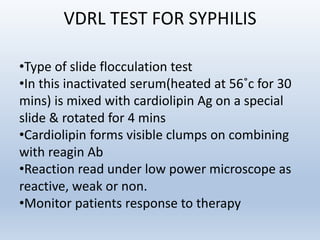
VDRL TEST FORSYPHILIS
•Type of slide flocculation test
•In this inactivated serum(heated at 56˚c for 30
mins) is mixed with cardiolipin Ag on a special
slide & rotated for 4 mins
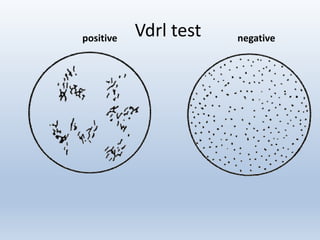
•Cardiolipin forms visible clumps on combining
with reagin Ab
•Reaction read under low power microscope as
reactive, weak or non.
•Monitor patients response to therapy
34.
RPR
•Common test inlabs now.
•Employs carbon particles and read
macroscopically.
•Black carbon particles are bound to caridolipin,
when mixed with positive serum on disposable
card.
•Agglutination is easily observed.
•Prozone phenomenon in upto 2% of cases
especially in secondary and pregnancy
RPR
•Advantages
–Enables the resultto be read by eye
–Useful in field studies
–RPR done with unheated serum or plasma
–Fingerprick sample is sufficient
•Dis advantages
–Cant test CSF
37.
•Trust-Toloudine red unheatedserum test.
•Instead of carbon particle we use toloudine red
•Automated reagin antibody test-
38.
•4 fold changein titre important.
•Highest prevalence during secondary syphilis.
•Quantitative test should become non reactive 1
year after treatment in primary and 5 years in
secondary.
39.
BIOLOGICAL FALSE POSITIVE(BFP)REACTIONS
•As cardiolipin Ag is present both in T.Pallidum and in
mammalian tissues, reagin Abs may be induced by treponemal
or host tissue antigens which accounts for BIOLOGICAL FALSE
POSITIVE(BFP)
•BFP defined as “positive reactions” obtained in cardiolipin tests,
with negative results in specific treponemal tests, in the absence
of past or present treponemal infections and not by technical
faults
•They represent non-treponemal cardiolipin antibody responses
40.
BFP Abis usually IgM while Reagin Ab in syphilis is IgG
Represent non treponemal cardiolipin Ab responses
Clinically BFP reactions classified as acute & chronic
Acute BFP-last only for weeks or months, associated ē acute
infections, injuries or inflammatory conditions
Chronic BFP-persist longer than 6 months, seen in SLE & other
collagen diseases
Other conditions associated ē BFP reactions r leprosy, malaria, relapsing
fever, infectious mononucleosis, hepatitis & tropical eosinophilia
41.
•To avoid BFPreactions, tests using cultivable
treponemes(REITER STRAIN) as Ags were developed
•Most common-Reiter Protein Complement Fixation(RPCF) using
lipopolysaccharide-protein complex Ag derived fron treponeme
•Sensitivity & specificity- lower than tests using T. Pallidum
•RPCF-generally free from BFP but gave false positive reactions
GROUP SPECIFIC TREPONEMAL TESTS
42.
Specific test- Nicholsstrain
•TPI-
–Historical concept
–Ability of Antibody + complement to immobilize
live T. pallidum visualized under darkground
microscope.
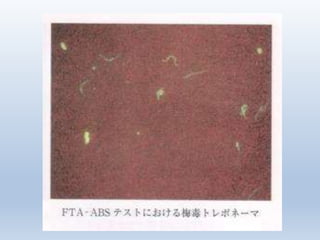
•Flurescent treponemal antibody-
–Indirect Immunofluorescence test using smears
prepared on slides with Nichol’s strain of T.Pallidum
43.
•FTA- Absorption- Patientsserum first absorbed
with non pathogenic trep antigen ( sorbent ) to
remove low titer, natural cross reacting
antibodies
•Difficult to standardize hence Particulate
agglutination test is preferred.
45.
T.PALLIDUM HAEMAGGLUTINATION
ASSAY(TPHA)
•Uses tannedethrocytes sensitized with a sonicated extact of
T.Pallidum as Ag
•Test sera for TPHA are absorbed with a diluent containing
components of the Reiter treponeme,rabbit testis & sheep
erythrocytes
•Sera screened at initial dilution of 1:80 but titres of 5120 or
more-common in 2˚stage
•TPHA-as specific as FTA-ABS, almost sensitive except in 1˚
•These advantages have made TPHA-Standard Confirmatory
Test
46.
FREQUENCY OF REACTIVESEROLOGICAL TESTS IN UNTREATED SYPHILIS(%)
Stage VDRL/RPR FTA-ABS TPHA
Primary 70-80 85-100 65-85
Secondary 100 100 100
Latent/Late 60-70 95-100 95-100
Congenital syphilis
•IgM immunoblotting-presence of IgM in
neonates confirm diagnosis.
•Best way of monitoring is with serial
quantitative non treponemal tests.
•Most reliable is test mother at time of birth
TREATMENT
•Single inj. Of2.4 million units of benzathine penicilliin G-adequate
in early cases
•For latent syphilis-this amt repeated weekly for 3 wks
•Pts allergic to penicillin-doxycyline used
•Ceftriaxone-effective in neurosyphilis
•Penicillin treatment sometimes induces-JARISCH-HERXHEIMER
REACTION-consisting of fever, malaise & exacerbation of
symptoms(due to liberation of toxic products like TNF from the
destruction of treponemes or due to hypersensitivity)
•Harmless in 1 ˚& 2˚ & managed ē bed rest & aspirin
•Dangerous in gummatous,CV or neurosyphilis
53.
Nonvenereal treponematoses
ENDEMIC SYPHILIS
Commonin young children
Primary chancre is not seen, except sometimes on nipples of
mothers infected by their children
Usually seen with manifestation of secondary syphilis ,such as
mucous patches &skin eruptions
Disease progresses to tertiary lesions ,particularly gummatous
Lab diagnosis &treatment same as venereal syphilis
54.
Yaws
•Causative agent isT.pallidum subspecies pertenue
•The primary lesion(mother jaw) is an extra genital papule
which enlarges & breaks down to form ulcerating granuloma
•As in syphilis 2˚ & 3˚ manifestations follow
•Destructive gummatous lesions of the bones are common
•Infection by direct contact, flies may act as mechanical
vectors
•Lab diagnosis & treatment are same as for venereal syphilis
55.
PINTA
•Causative agent isT.carateum
•The primary lesion is an extra genital papule which
does not ulcerate but develops into a
lichenoid/psoriaform patch
•Secondary skin lesions are charecterized by
hyperpigmentation/hypopigmentation
•Tissues other than skin are seldom effected
Editor's Notes
#7 First case 1905
John Hunter’s unfortunate self-inoculation with urethral pus containing both Neisseria gonorrhoeae and T. pallidum only served to prolong misconception s, because the two diseases were considered the same for some time thereafter. However, by the mid-19th century, the cause, epidemiology, and clinical manifestations of syphilis were well known
#8 Outer membrane is lipid rich
This has led to the hypothesis that this microorganism acts as a “stealth” organism by minimizing the number of surface membrane–bound targets for the host’s immune system to recognize until a sufficient number of spirochetes are present.
#10 The genome consists of a single circular chromosome of approximately 1,138,006 base pairs, which places it close to the lowest end of the range for bacteria. Unlike most pathogenic bacteria, its genome lacks apparent transposable elements, suggesting that the genome is extremely conserved and stable
#17 Unless secondarilyinfected, the ulcer has a clean appearance and no exudate; it is painless or slightly tender to the touch, a conspicuous aspect of the ulcerative
#18 The secondary or disseminated stage becomes evident 2 to 12 weeks (mean, 6 weeks) after contact. This generalized condition with parenchymal, constitutional, and mucocutaneous manifestations occurs when the greatest number of treponemes (high antigen load) is present in the body, particularly in the bloodstream
The classic and most commonly recognized lesions involve the skin. Nonpruritic macular, maculopapular, papular, or pustular lesions, and combinations and variations thereof, all occur.
#19 After the secondary stage subsides, the untreated patient enters a latent period, during which the diagnosis can be made only by obtaining a positive serologic test response for syphilis. Because relapses of secondary syphilis in immunocompetent persons can occur up to 4 years after contracting syphilis, this period is divided into early latent (relapses possible) and late latent (relapses very unlikely) stages; 75% of relapses occur within the frst year and are likely a consequence of waning immunity.
#24 Cardiovascular syphilis
Consist of lesions including aneurysms, chronic granulomata and meningovascular manifestation.
Gummatous syphis
Rare granulomatous lesion of skeleton, skin or mucocutaneous tissues.
Neurosyphilis
Neurological manifestation such as tabes dorsalis or general paralysis
#29 Direct diagnostic methods include the detection of T pallidum by microscopic examination of fluid or smears from lesions, histological examination of tissues or nucleic acid amplification methods such as polymerase chain reaction (PCR). Indirect diagnosis is based on serological tests for the detection of antibodies. Serological tests fall into two categories: nontreponemal tests for screening, and treponemal tests for confirmation