Dr Bilal Ahmad MalikDr Bilal Ahmad Malik
Sources of DrugSources of Drug
&&
Active principle of DrugActive principle of Drug
ObjectivesObjectives
After completing the discussion, the student will be able toAfter completing the discussion, the student will be able to
 Define drug and medicineDefine drug and medicine
 Describe different sources of drugDescribe different sources of drug
 Identify the active principles of a drugIdentify the active principles of a drug
 Select authorative sources of drugSelect authorative sources of drug
information.information.
Do Drugs play any role in our lives ?
MedicinesMedicines
 Part of our way of LifePart of our way of Life
 Birth DeathBirth Death..
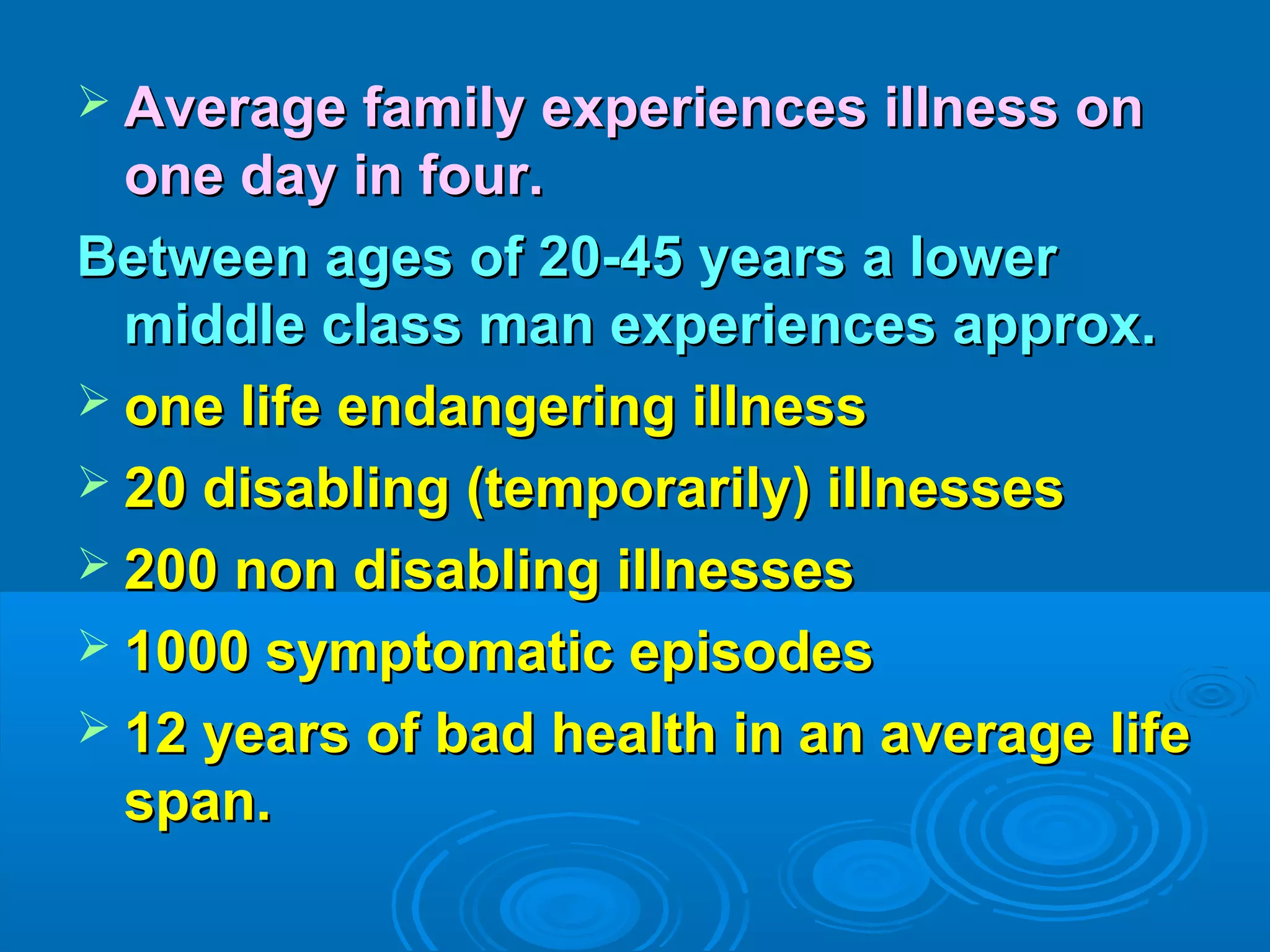
 Average family experiences illness onAverage family experiences illness on
one day in four.one day in four.
Between ages of 20-45 years a lowerBetween ages of 20-45 years a lower
middle class man experiences approx.middle class man experiences approx.
 one life endangering illnessone life endangering illness
 20 disabling (temporarily) illnesses20 disabling (temporarily) illnesses
 200 non disabling illnesses200 non disabling illnesses
 1000 symptomatic episodes1000 symptomatic episodes
 12 years of bad health in an average life12 years of bad health in an average life
span.span.
What is Drug ?What is Drug ?
What is Medicine ?
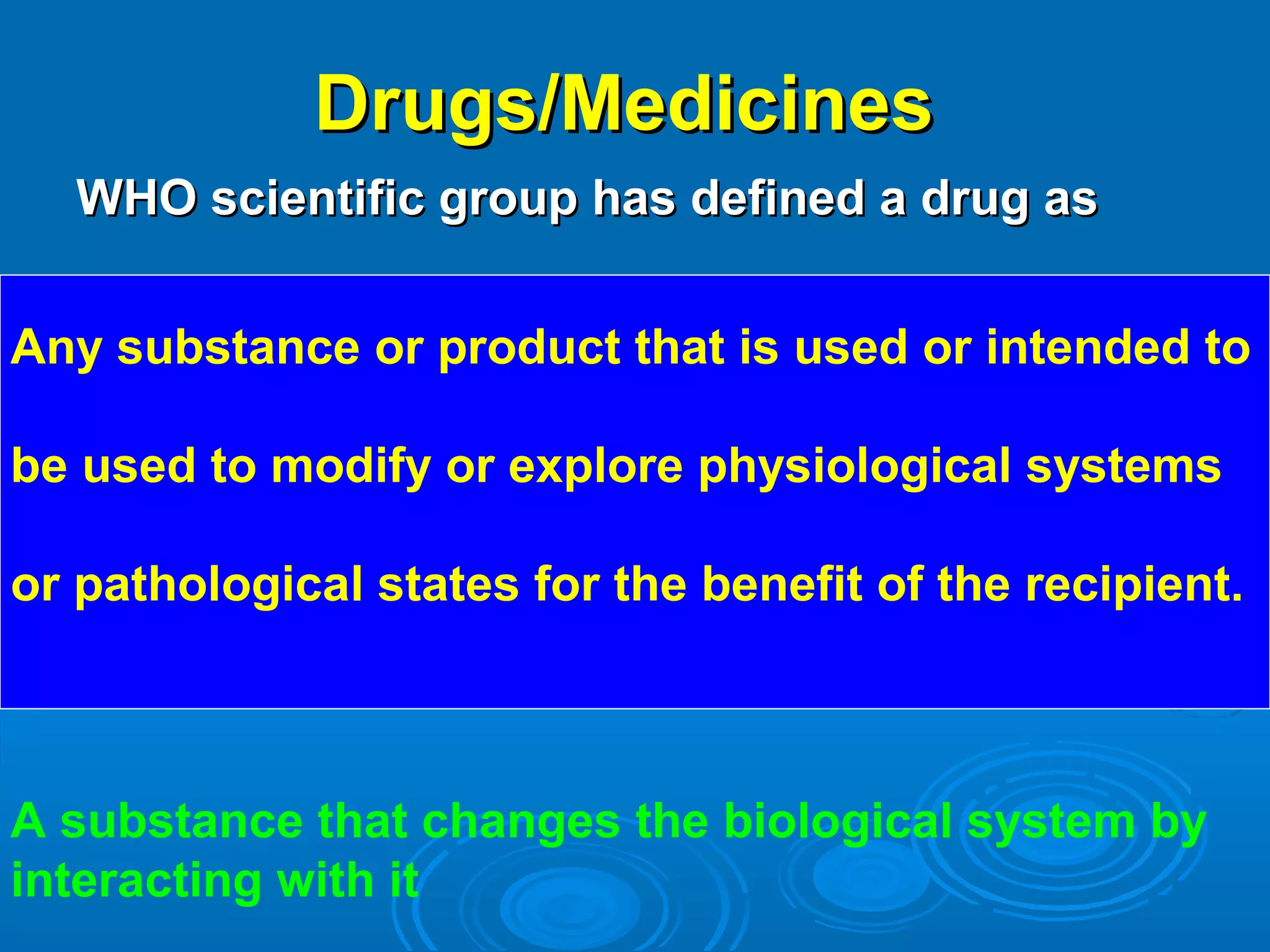
Drugs/MedicinesDrugs/Medicines
WHO scientific group has defined a drug asWHO scientific group has defined a drug as
Any substance or product that is used or intended to
be used to modify or explore physiological systems
or pathological states for the benefit of the recipient.
A substance that changes the biological system by
interacting with it
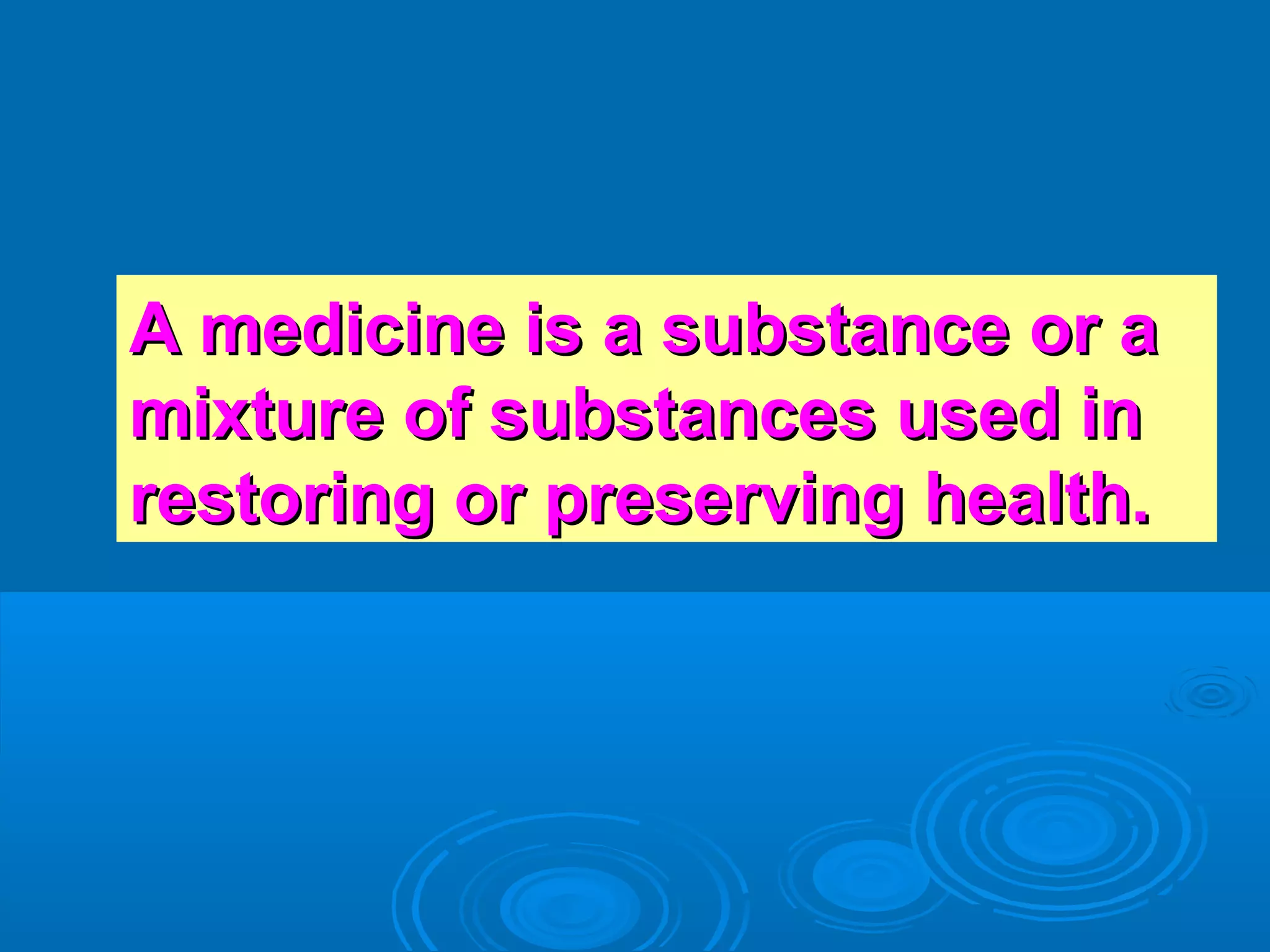
A medicine is a substance or aA medicine is a substance or a
mixture of substances used inmixture of substances used in
restoring or preserving health.restoring or preserving health.
 A drug is a single chemical substanceA drug is a single chemical substance
that forms the active ingredient of athat forms the active ingredient of a
medicine.medicine.
 A medicine may contain many otherA medicine may contain many other
substances to deliver the drug in asubstances to deliver the drug in a
stable form, acceptable and convenientstable form, acceptable and convenient
to the patient.to the patient.
Drug vs Medicine?
Why do weWhy do we
need/ Useneed/ Use
Drugs/Drugs/
Medicines?Medicines?
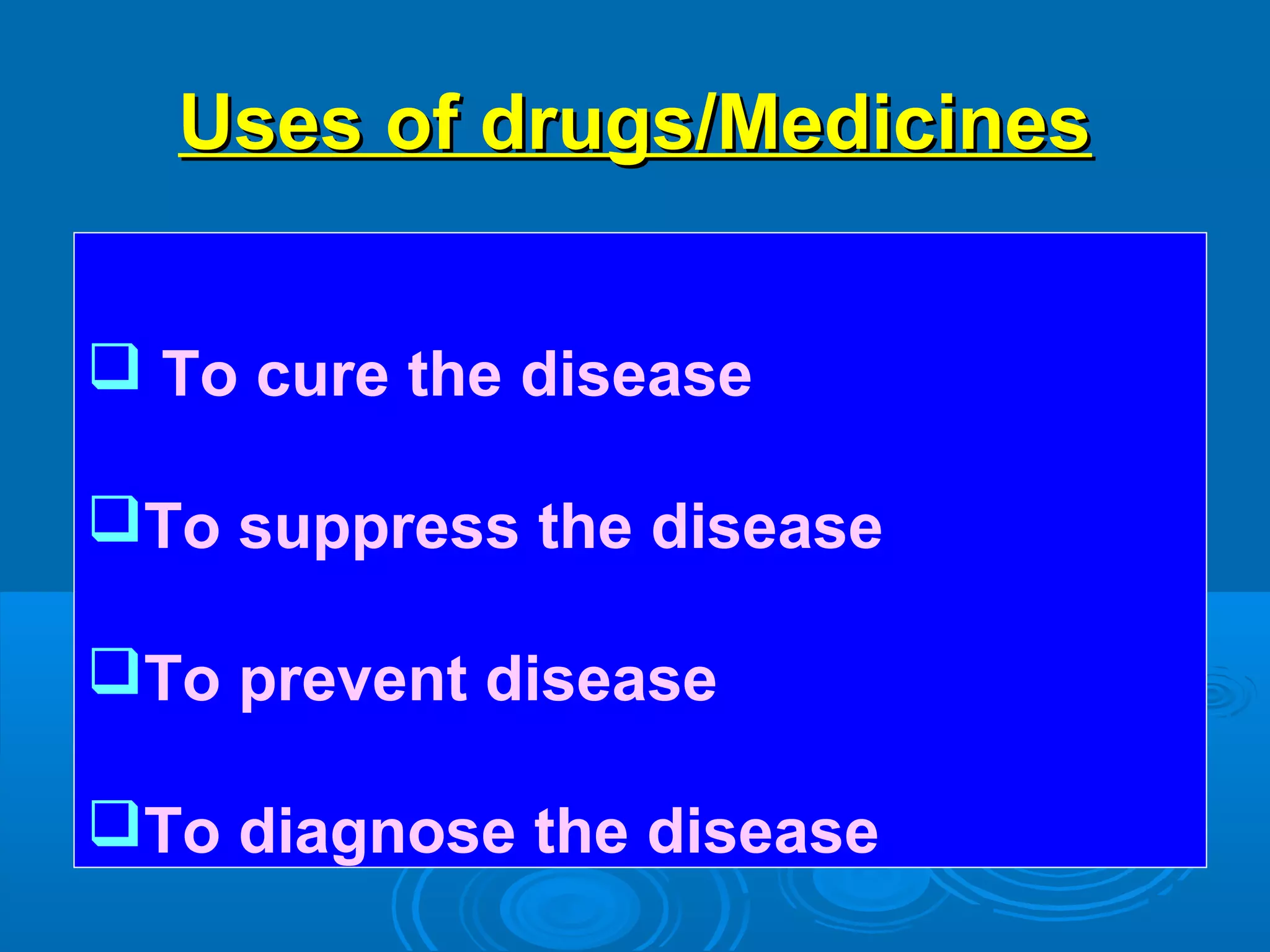
Uses of drugs/MedicinesUses of drugs/Medicines
 To cure the disease
To suppress the disease
To prevent disease
To diagnose the disease
PharmacologyPharmacology
Study of pharmacology involves the study ofStudy of pharmacology involves the study of
 origin of drugsorigin of drugs
 Chemical and physical properties of drugsChemical and physical properties of drugs
 Physiologic effects and site of action in thePhysiologic effects and site of action in the
bodybody
 Absorption, distribution, metabolism, andAbsorption, distribution, metabolism, and
excretion.excretion.
 Safe/effective dosage regimen & route ofSafe/effective dosage regimen & route of
administration.administration.
 Adverse reactions, toxic effects & drug-drugAdverse reactions, toxic effects & drug-drug
interactionsinteractions
Sources of DrugsSources of Drugs
 Naturally occurringNaturally occurring
 Modified natural drugsModified natural drugs
 Mineral sourcesMineral sources
 Microbial sourcesMicrobial sources
 Human sourcesHuman sources
 Synthetic sourcesSynthetic sources
 Genetic engineeringGenetic engineering
Active principles of drugActive principles of drug
A constituent of aA constituent of a drugdrug, upon the, upon the
presence of which thepresence of which the characteristiccharacteristic
therapeutictherapeutic actionaction of theof the substancesubstance
largely depends.largely depends.
ExamplesExamples
 AlkaloidsAlkaloids
 GlycodiesGlycodies
 TanninsTannins
 Oleo-resinsOleo-resins
 OilsOils
 GumsGums
Natural sources of drugsNatural sources of drugs
Animals
Plants
Plant SourcesPlant Sources
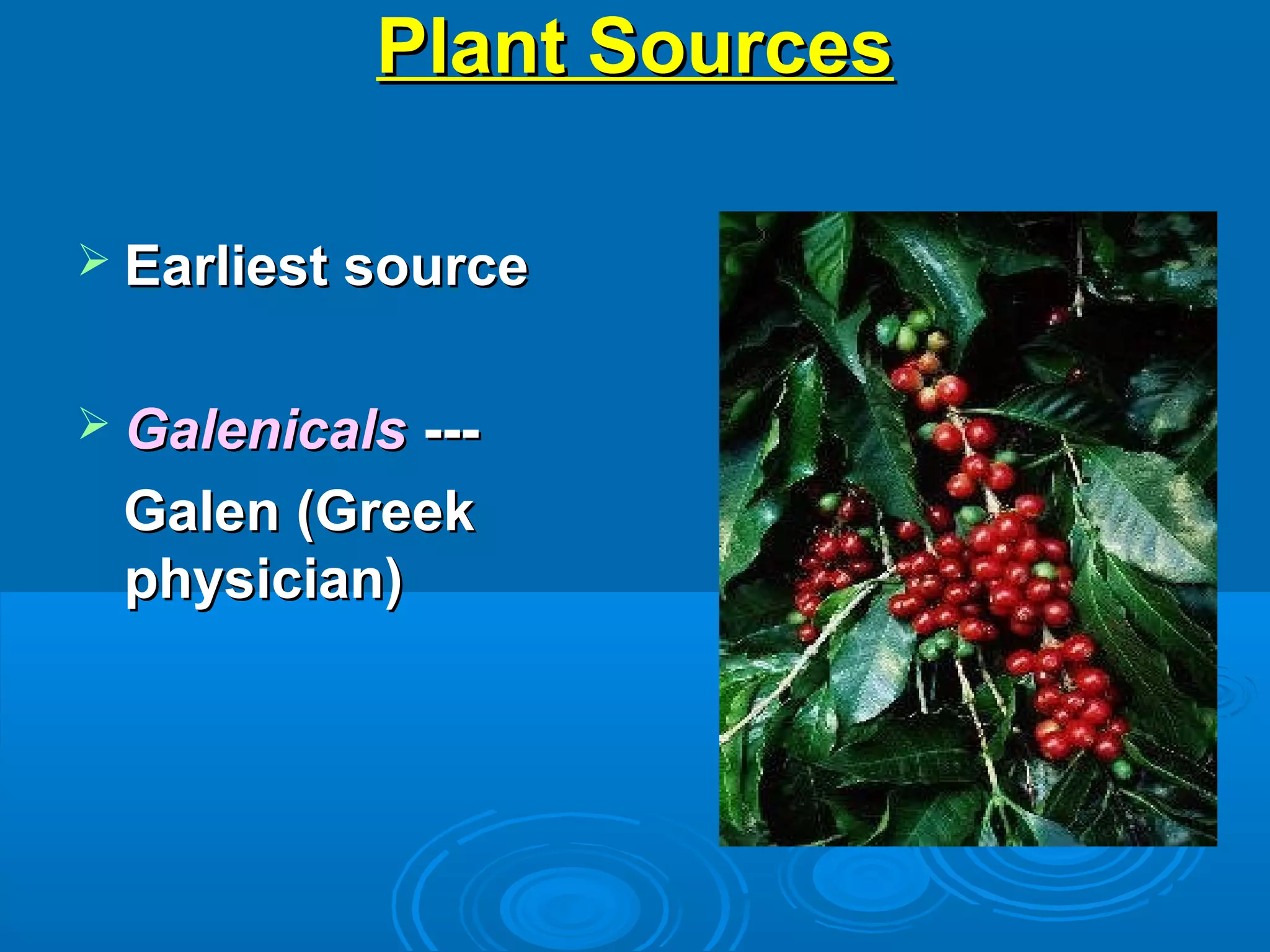
 Earliest sourceEarliest source
 GalenicalsGalenicals ------
Galen (GreekGalen (Greek
physician)physician)
Active PrinciplesActive Principles
inin
PlantsPlants
1. Alkaloids1. Alkaloids
 organicorganic nitrogenousnitrogenous substancessubstances
 bitterbitter

insoluble in waterinsoluble in water

react with acids to form saltsreact with acids to form salts

salts are soluble in body fluidssalts are soluble in body fluids
Examples areExamples are
atropineatropine,, caffeinecaffeine,,,, morphinemorphine,, nicotinenicotine,, quininequinine,,
reserpine, emetine, codeine, tubocurarine.reserpine, emetine, codeine, tubocurarine.
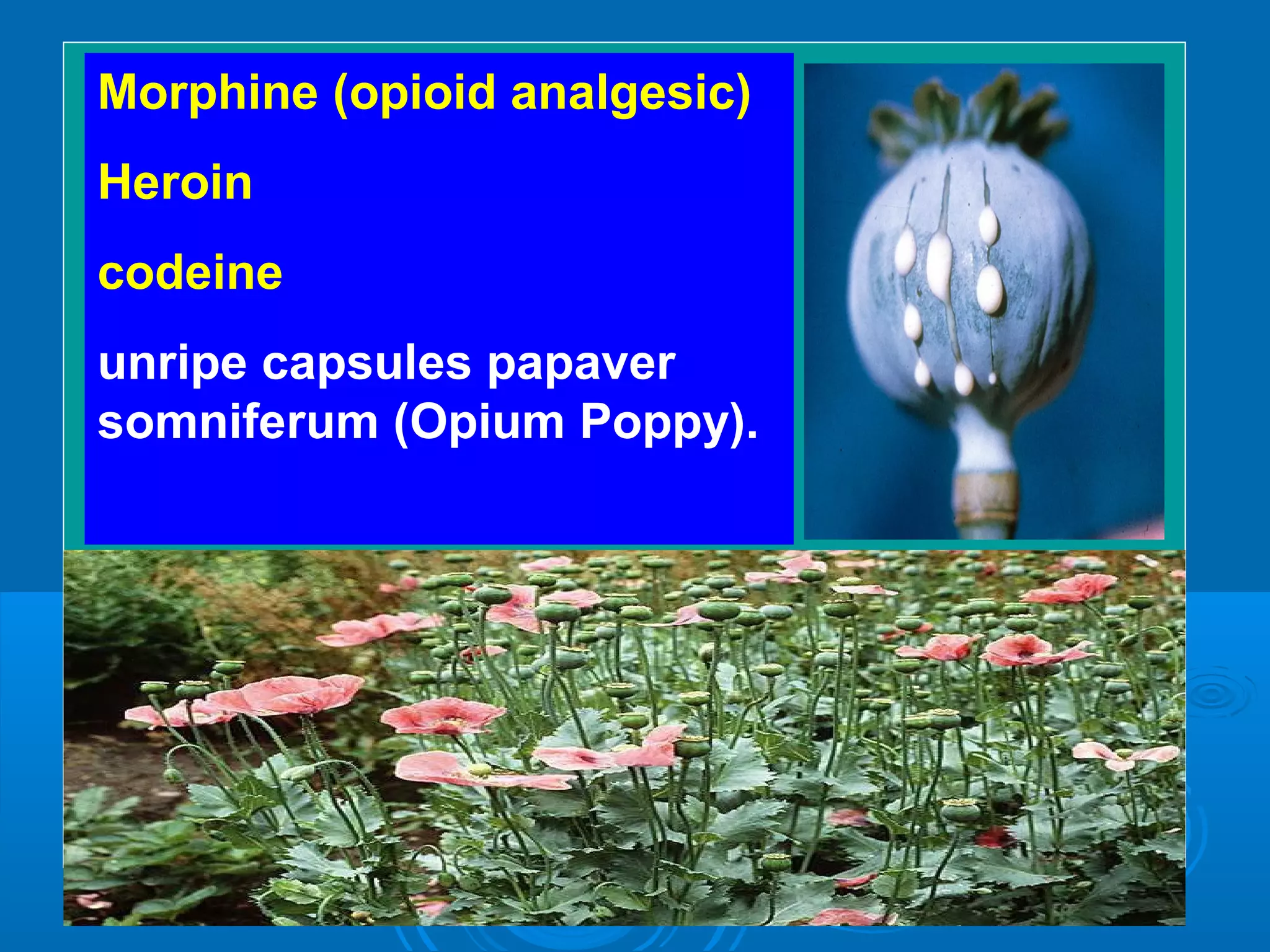
Morphine (opioid analgesic)
Heroin
codeine
unripe capsules papaver
somniferum (Opium Poppy).
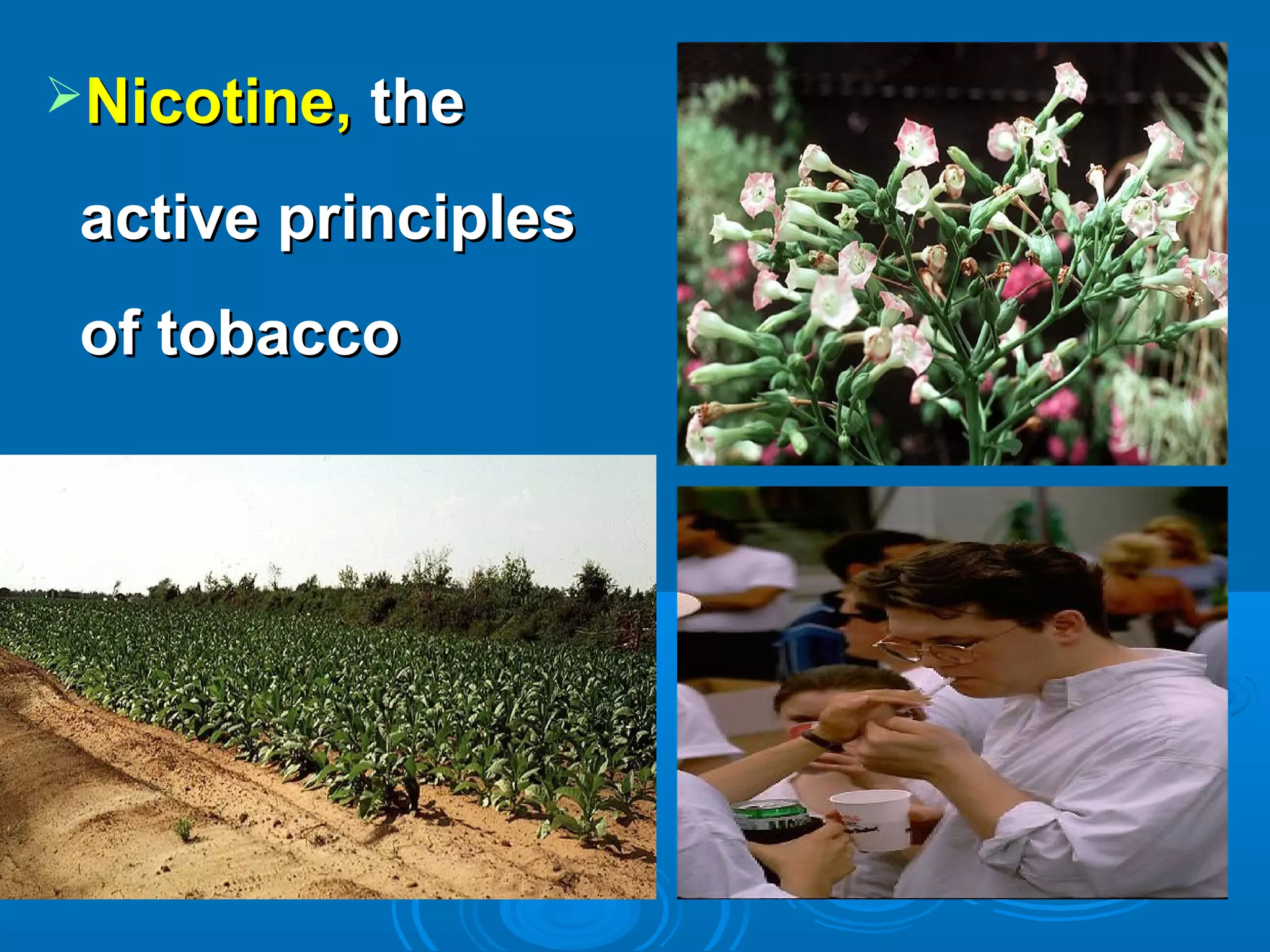
Nicotine,Nicotine, thethe
active principlesactive principles
of tobaccoof tobacco
Caffeine (CNS Stimulant)Caffeine (CNS Stimulant) is the activeis the active
principle in tea, coffee.principle in tea, coffee.
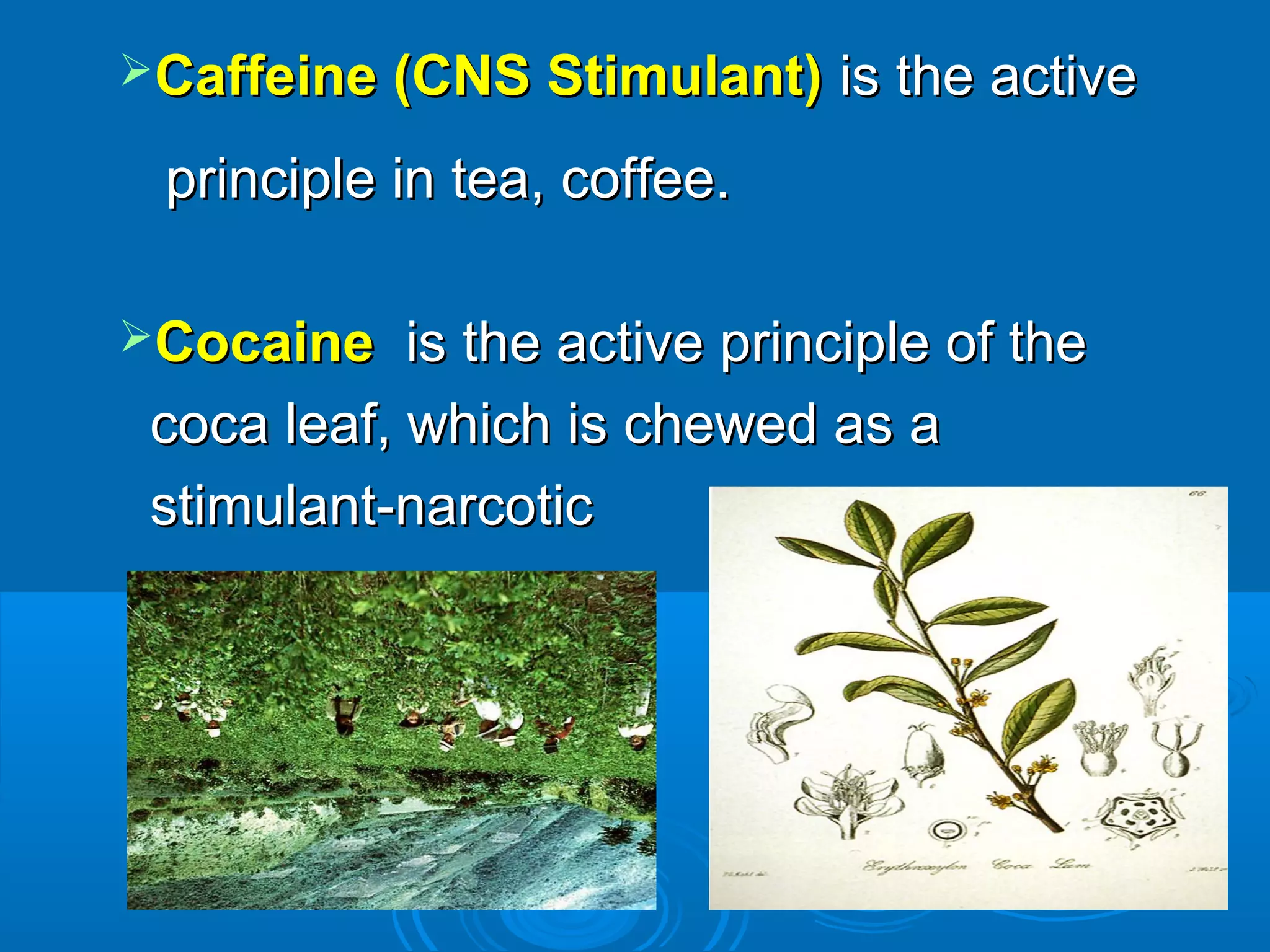
CocaineCocaine is the active principle of theis the active principle of the
coca leaf, which is chewed as acoca leaf, which is chewed as a
stimulant-narcoticstimulant-narcotic
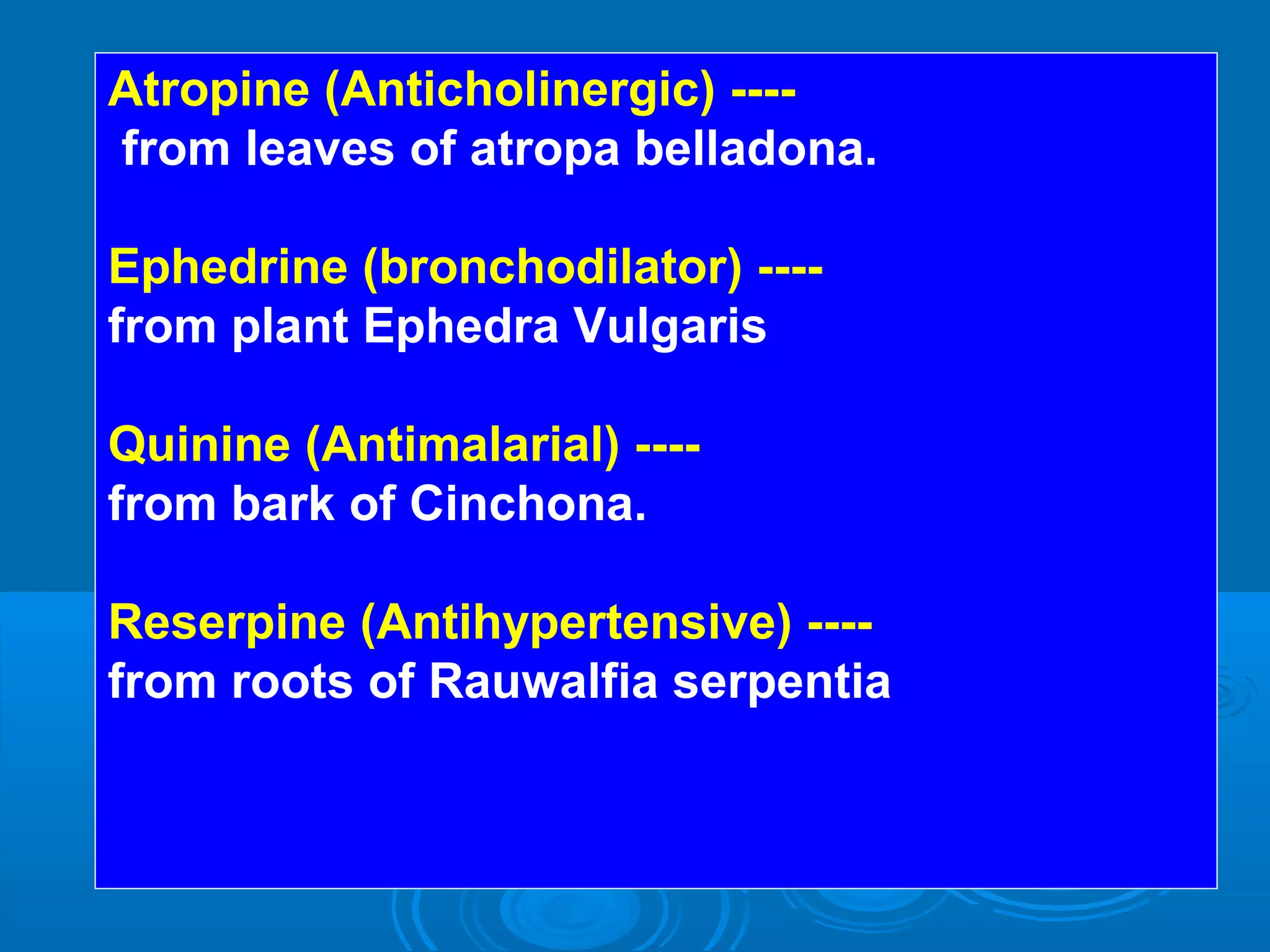
Atropine (Anticholinergic) ----
from leaves of atropa belladona.
Ephedrine (bronchodilator) ----
from plant Ephedra Vulgaris
Quinine (Antimalarial) ----
from bark of Cinchona.
Reserpine (Antihypertensive) ----
from roots of Rauwalfia serpentia
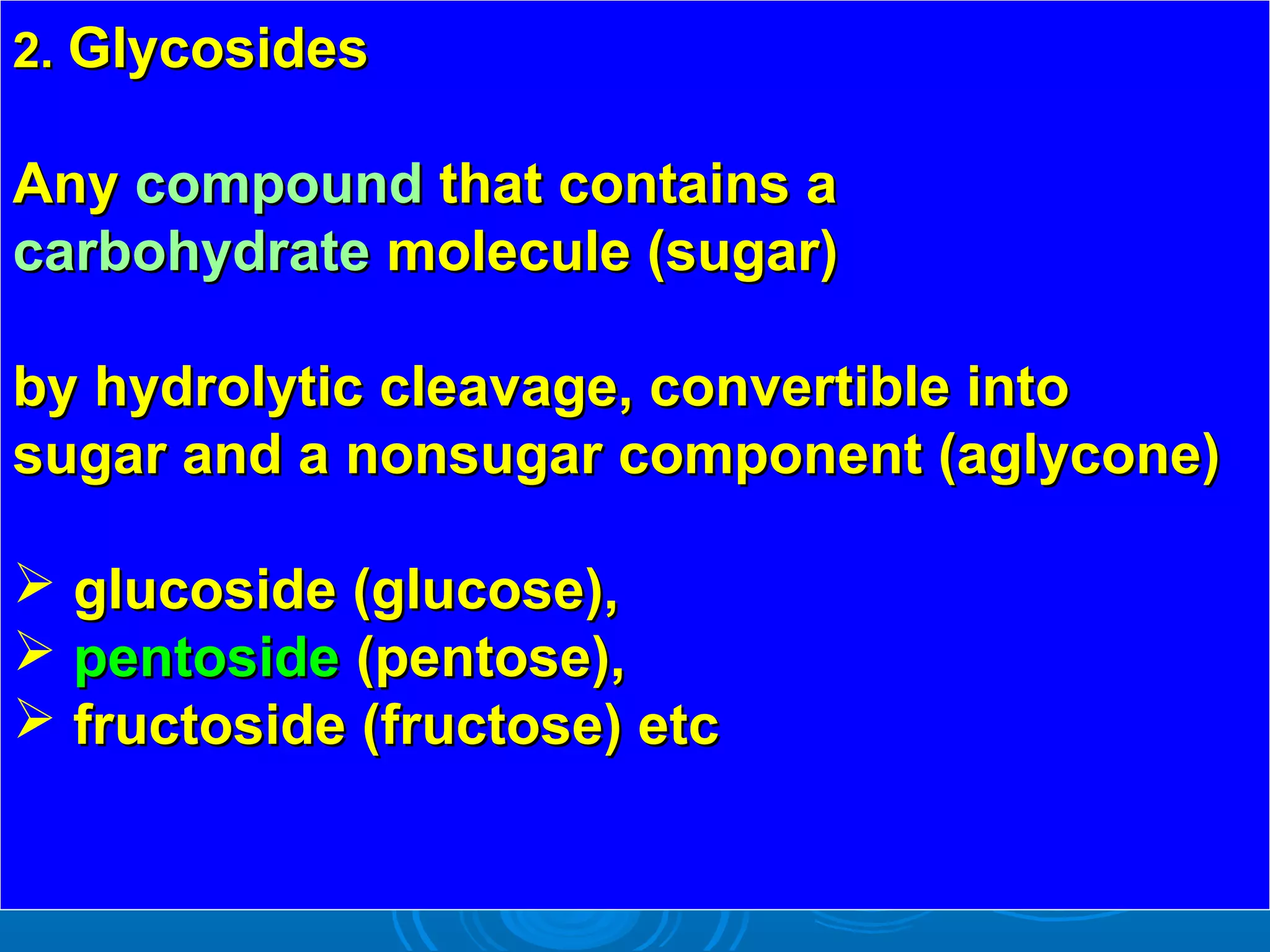
2.2. GlycosidesGlycosides
AnyAny compoundcompound that contains athat contains a
carbohydratecarbohydrate molecule (sugar)molecule (sugar)
by hydrolytic cleavage, convertible intoby hydrolytic cleavage, convertible into
sugar and a nonsugar component (aglycone)sugar and a nonsugar component (aglycone)
 glucoside (glucose),glucoside (glucose),
 pentosidepentoside (pentose),(pentose),
 fructoside (fructose) etcfructoside (fructose) etc
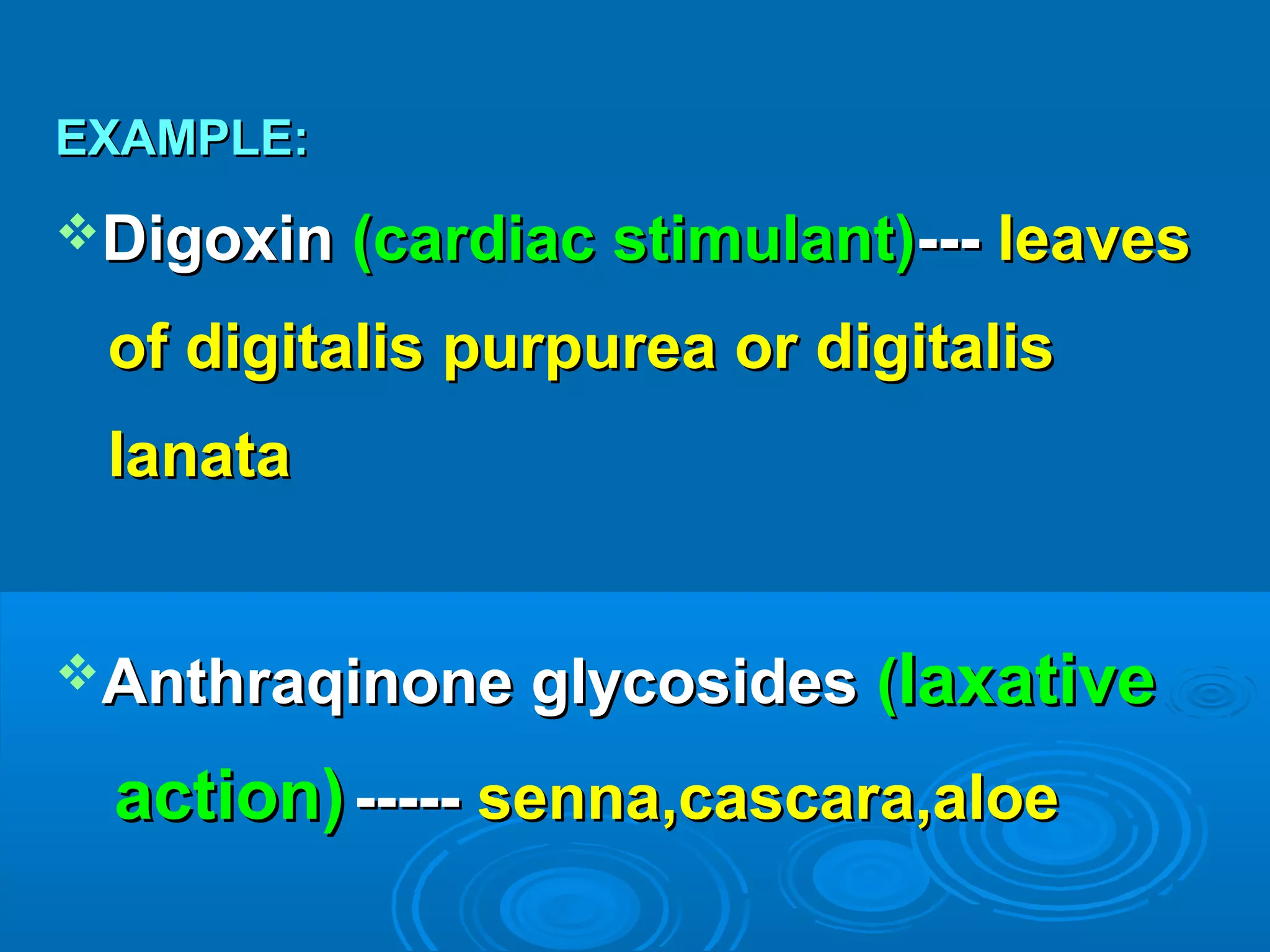
EXAMPLE:EXAMPLE:
DigoxinDigoxin (cardiac stimulant)(cardiac stimulant)------ leavesleaves
of digitalis purpurea or digitalisof digitalis purpurea or digitalis
lanatalanata
Anthraqinone glycosidesAnthraqinone glycosides ((laxativelaxative
action)action) ---------- senna,cascara,aloesenna,cascara,aloe
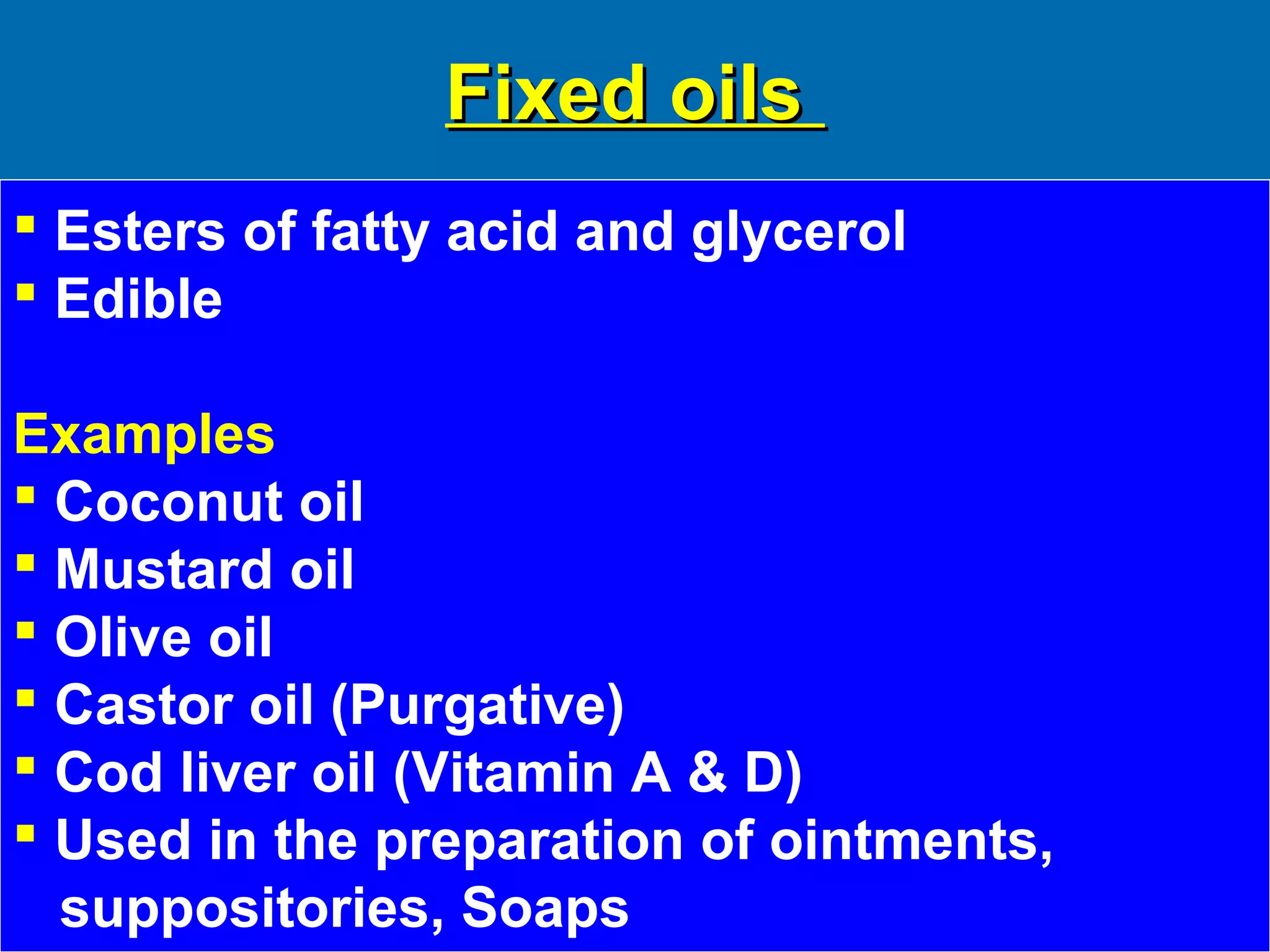
3.3. OilsOils
 Fixed oils
 Volatile oils
 Mineral oils
Fixed oilsFixed oils
 Esters of fatty acid and glycerol
 Edible
Examples
 Coconut oil
 Mustard oil
 Olive oil
 Castor oil (Purgative)
 Cod liver oil (Vitamin A & D)
 Used in the preparation of ointments,
suppositories, Soaps
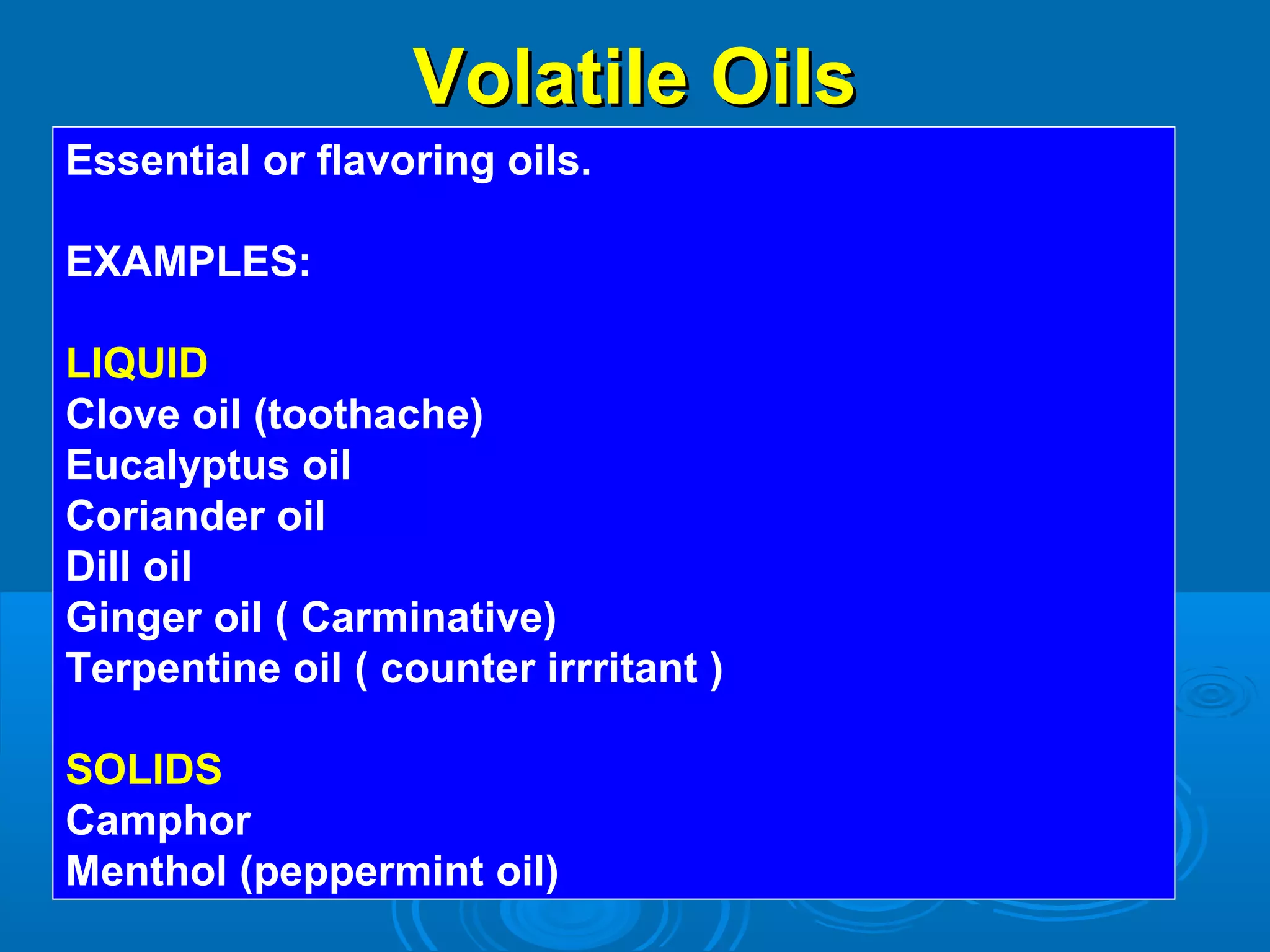
Volatile OilsVolatile Oils
Essential or flavoring oils.
EXAMPLES:
LIQUID
Clove oil (toothache)
Eucalyptus oil
Coriander oil
Dill oil
Ginger oil ( Carminative)
Terpentine oil ( counter irrritant )
SOLIDS
Camphor
Menthol (peppermint oil)
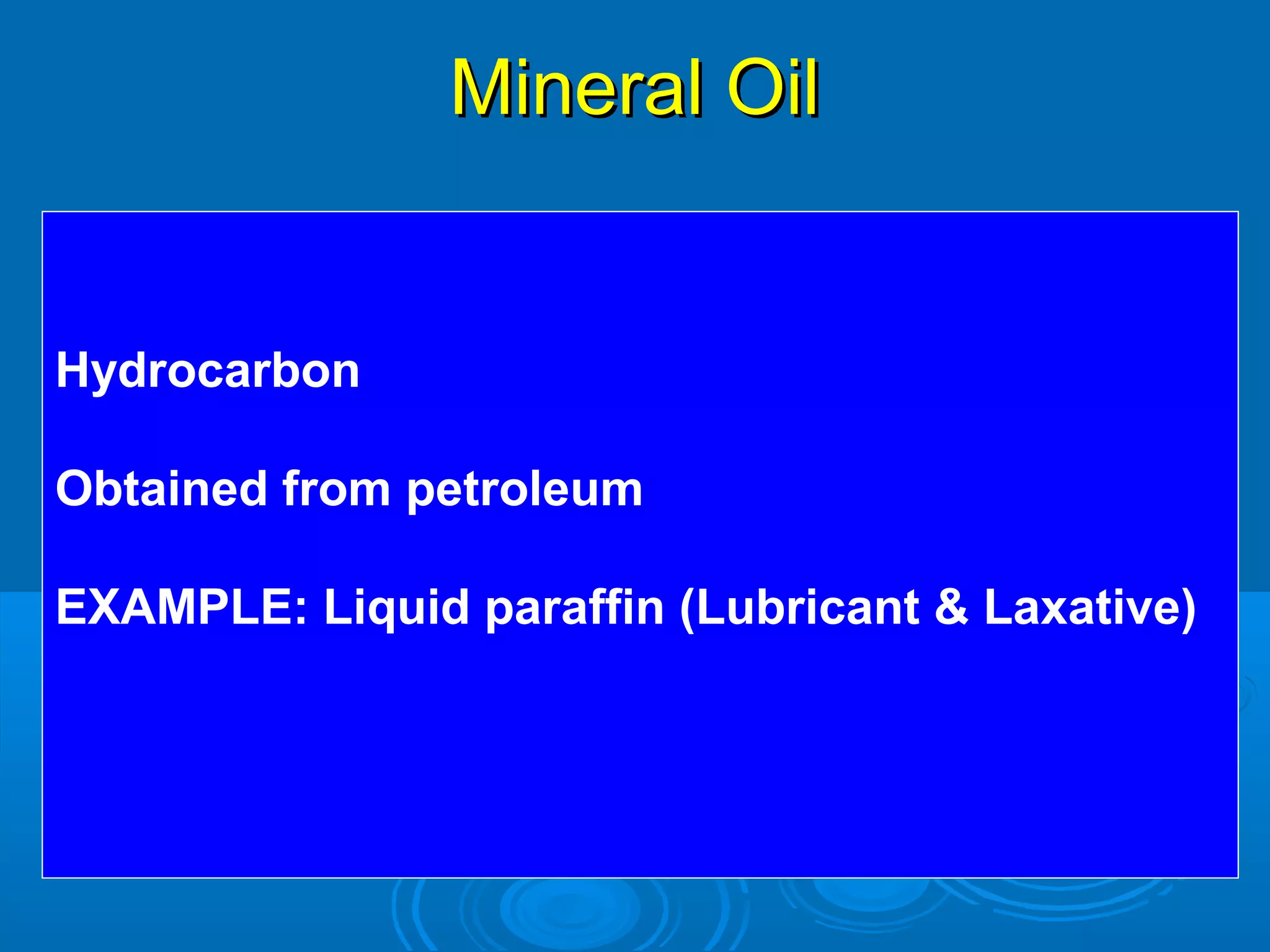
Mineral OilMineral Oil
Hydrocarbon
Obtained from petroleum
EXAMPLE: Liquid paraffin (Lubricant & Laxative)
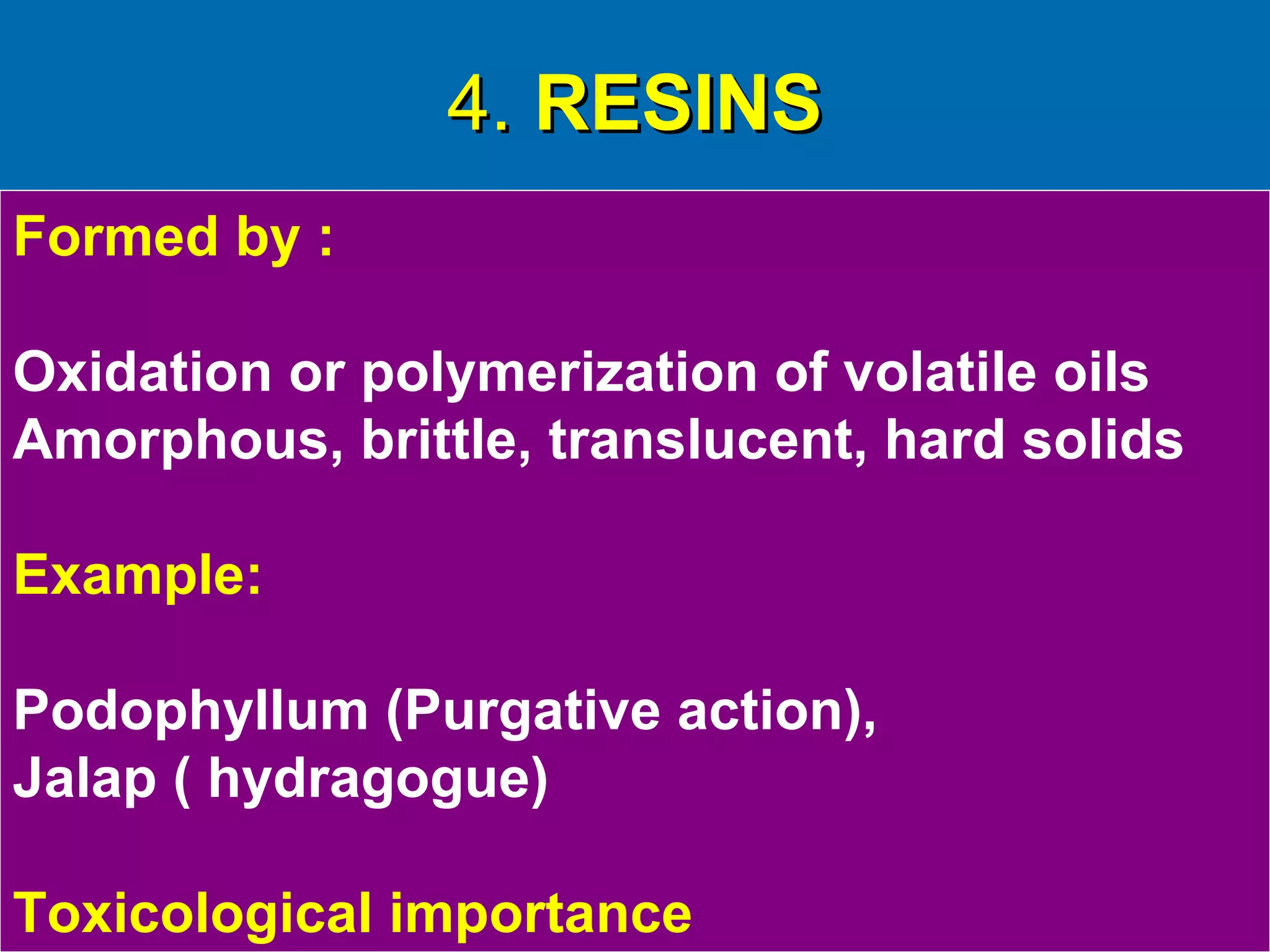
4.4. RESINSRESINS
Formed by :
Oxidation or polymerization of volatile oils
Amorphous, brittle, translucent, hard solids
Example:
Podophyllum (Purgative action),
Jalap ( hydragogue)
Toxicological importance
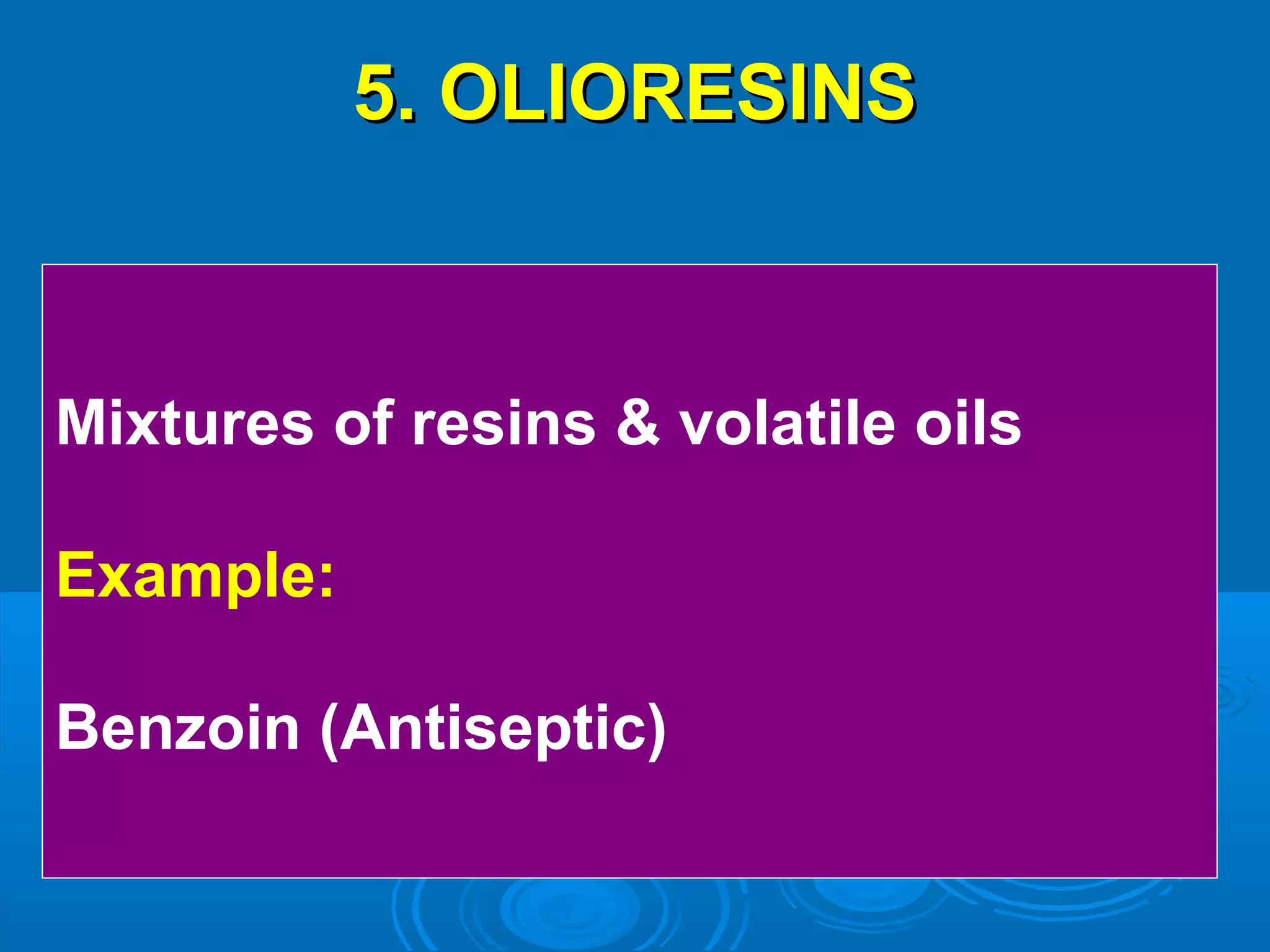
5. OLIORESINS5. OLIORESINS
Mixtures of resins & volatile oils
Example:
Benzoin (Antiseptic)
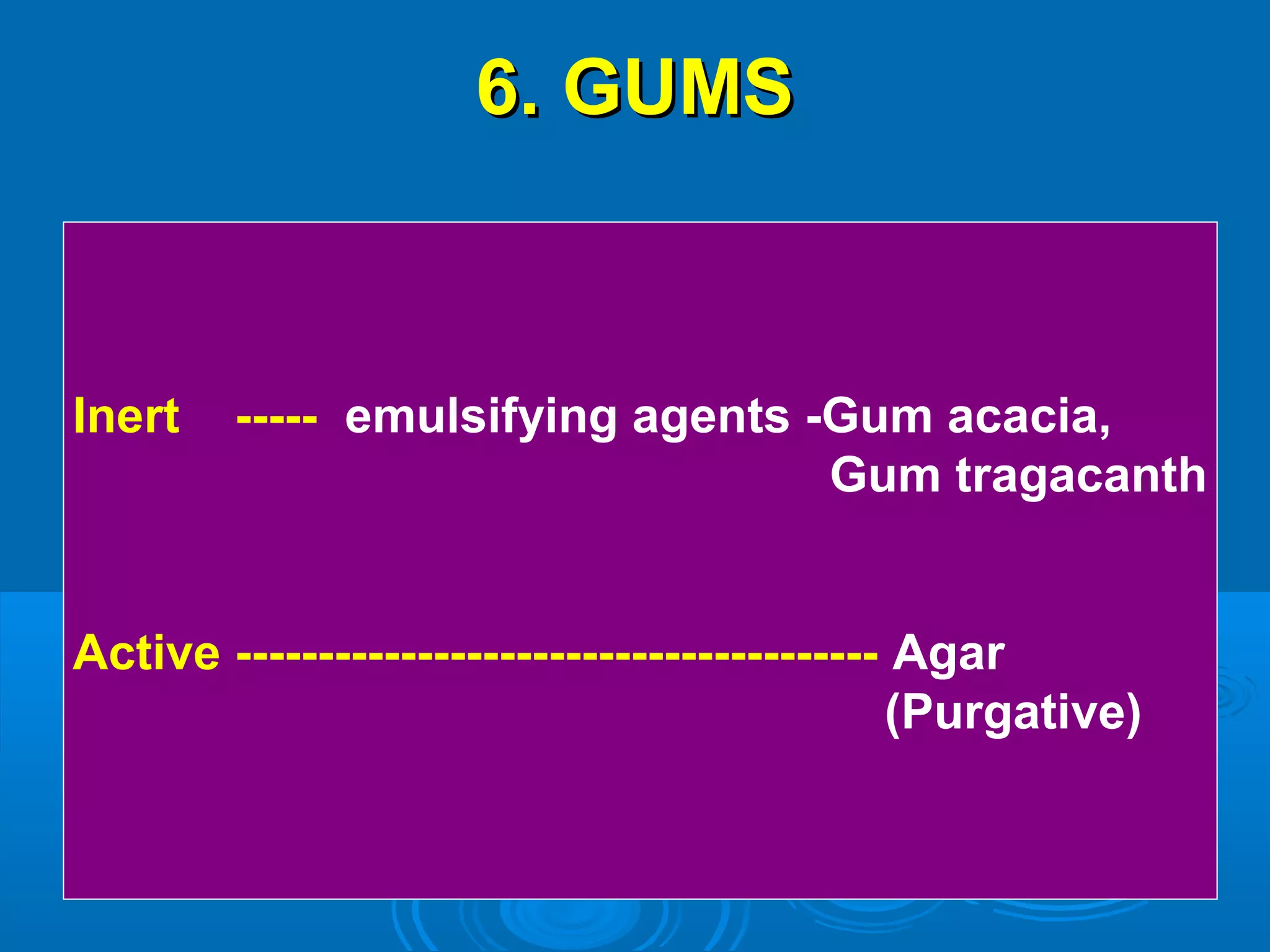
6. GUMS6. GUMS
Inert ----- emulsifying agents -Gum acacia,
Gum tragacanth
Active --------------------------------------- Agar
(Purgative)
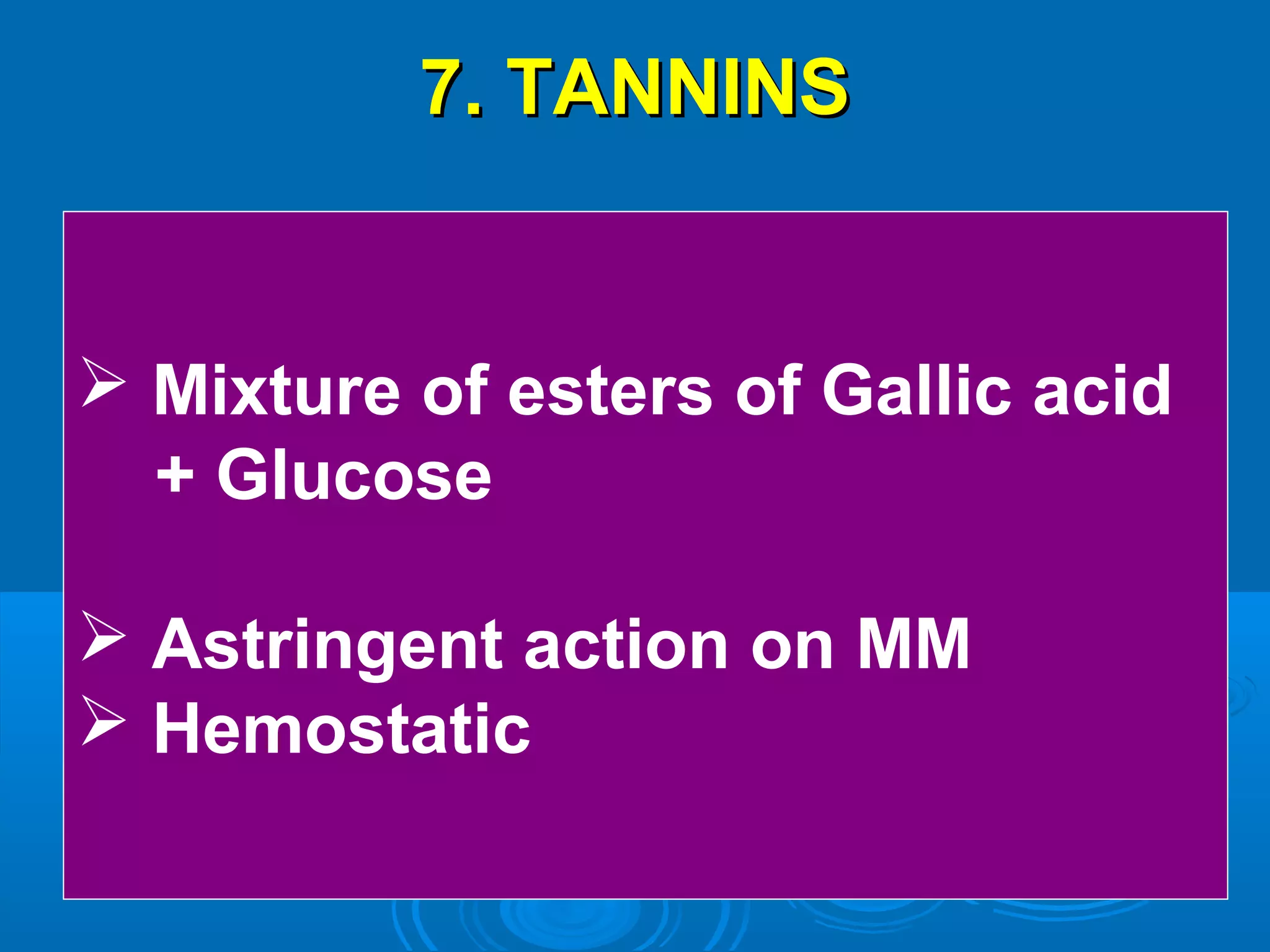
7. TANNINS7. TANNINS
 Mixture of esters of Gallic acid
+ Glucose
 Astringent action on MM
 Hemostatic
Animal SourcesAnimal Sources
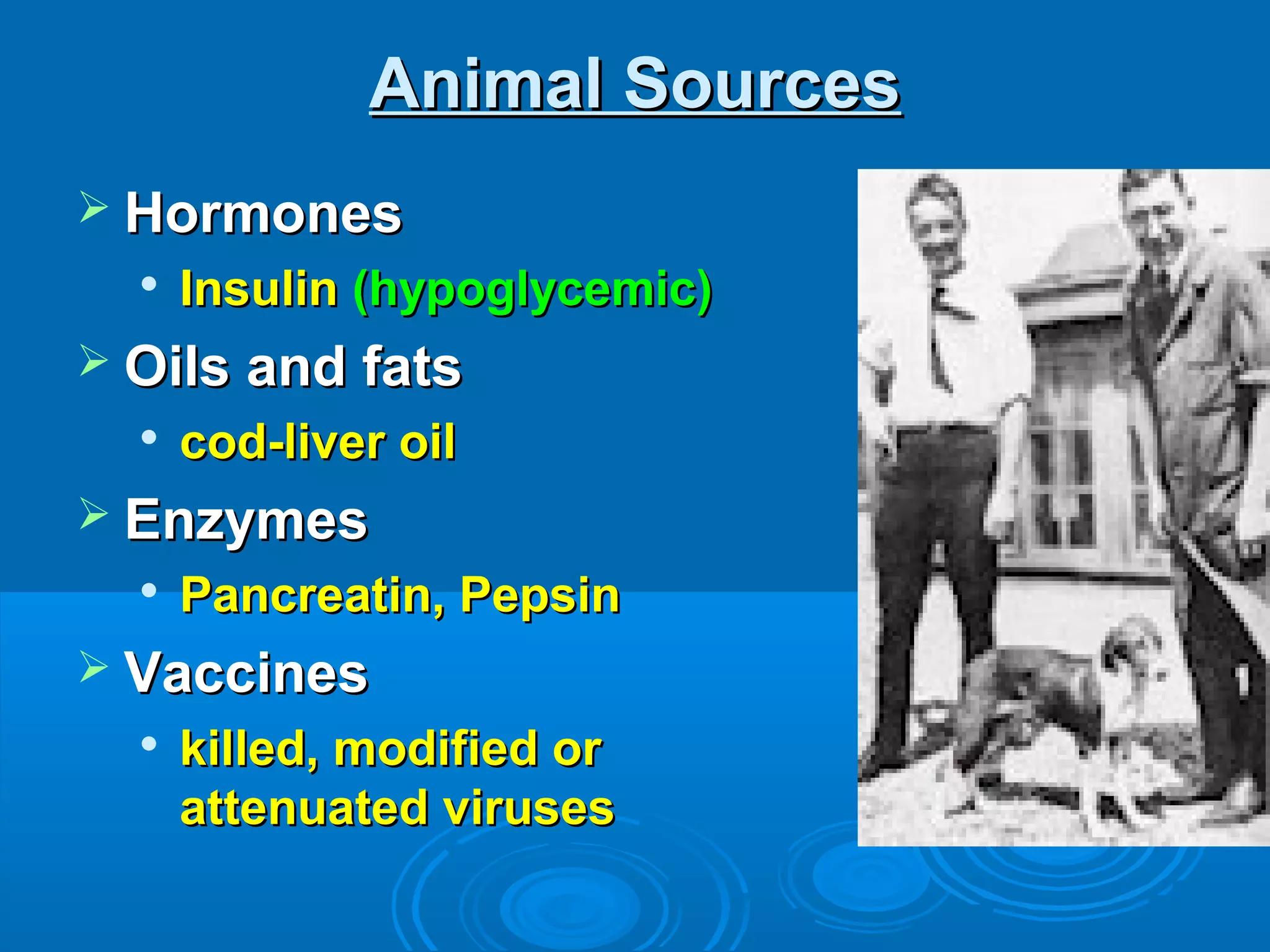
 HormonesHormones

InsulinInsulin (hypoglycemic)(hypoglycemic)
 Oils and fatsOils and fats

cod-liver oilcod-liver oil
 EnzymesEnzymes

Pancreatin, PepsinPancreatin, Pepsin
 VaccinesVaccines

killed, modified orkilled, modified or
attenuated virusesattenuated viruses
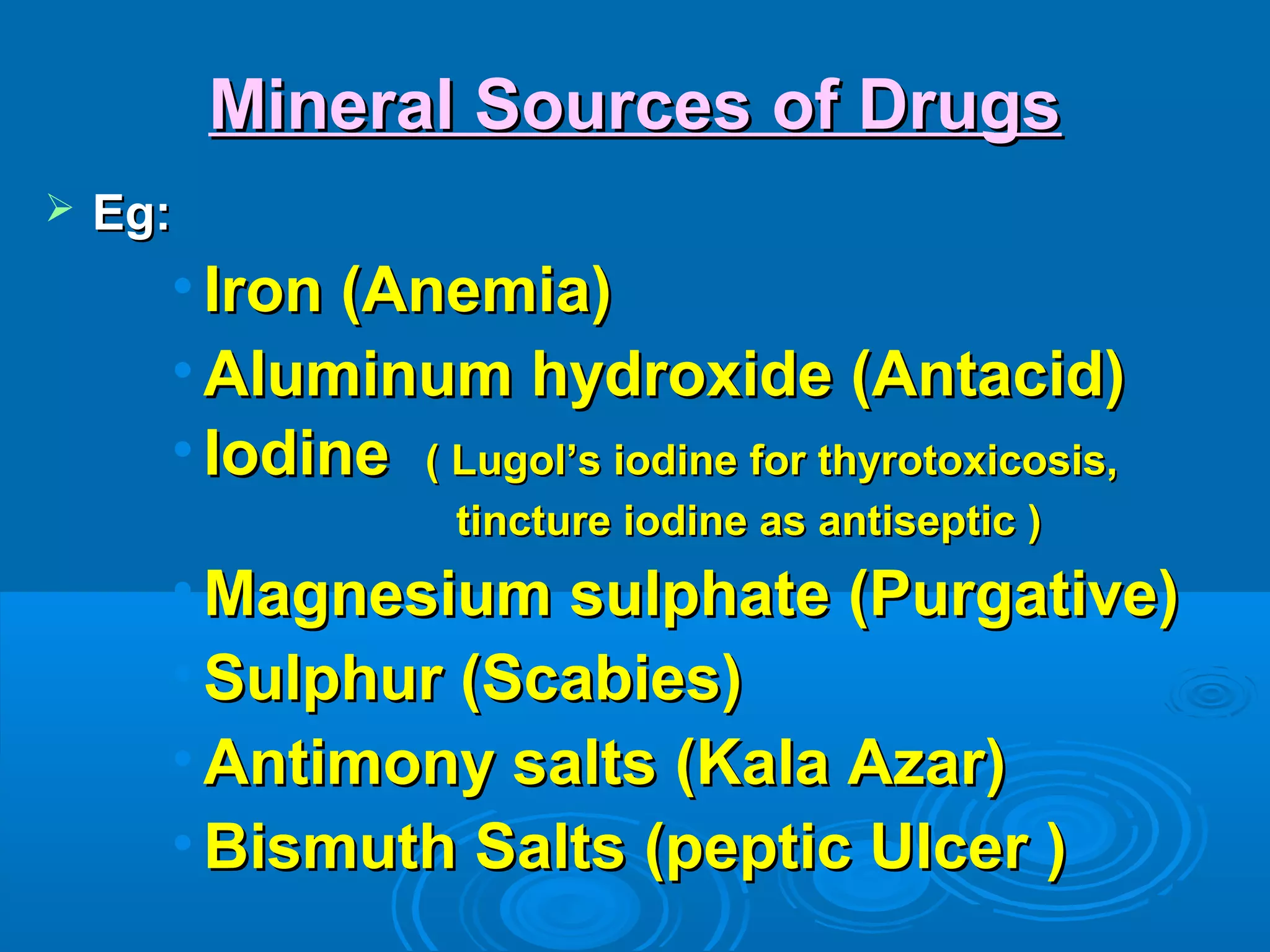
Mineral Sources of DrugsMineral Sources of Drugs
 Eg:Eg:
• Iron (Anemia)Iron (Anemia)
• Aluminum hydroxide (Antacid)Aluminum hydroxide (Antacid)
• IodineIodine ( Lugol’s iodine for thyrotoxicosis,( Lugol’s iodine for thyrotoxicosis,
tincture iodine as antiseptic )tincture iodine as antiseptic )
• Magnesium sulphate (Purgative)Magnesium sulphate (Purgative)
• Sulphur (Scabies)Sulphur (Scabies)
• Antimony salts (Kala Azar)Antimony salts (Kala Azar)
• Bismuth Salts (peptic Ulcer )Bismuth Salts (peptic Ulcer )
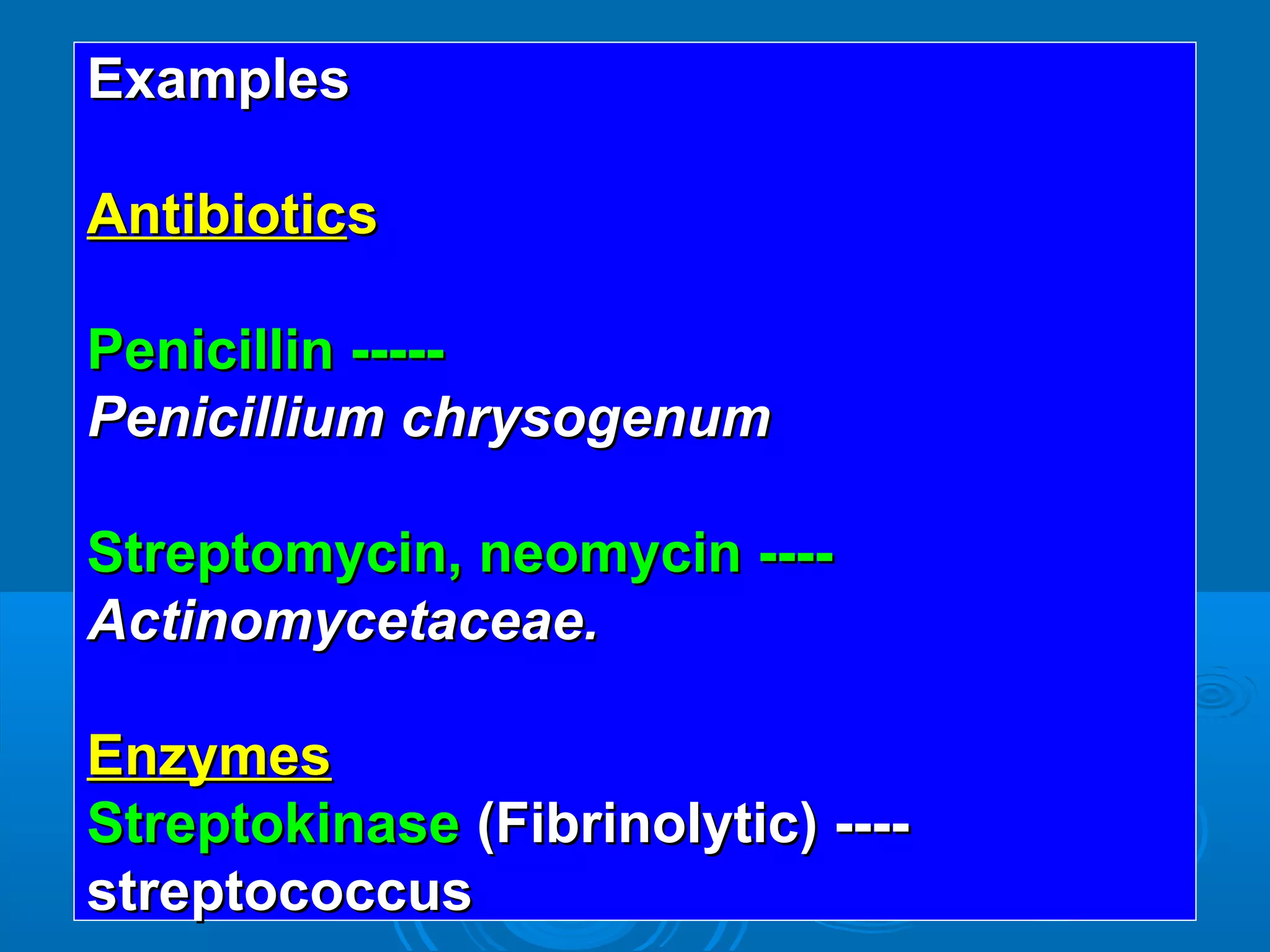
Microbial Sources
ExamplesExamples
AntibioticAntibioticss
Penicillin -----Penicillin -----
Penicillium chrysogenumPenicillium chrysogenum
Streptomycin, neomycin ----Streptomycin, neomycin ----
Actinomycetaceae.Actinomycetaceae.
EnzymesEnzymes
StreptokinaseStreptokinase (Fibrinolytic) ----(Fibrinolytic) ----
streptococcusstreptococcus
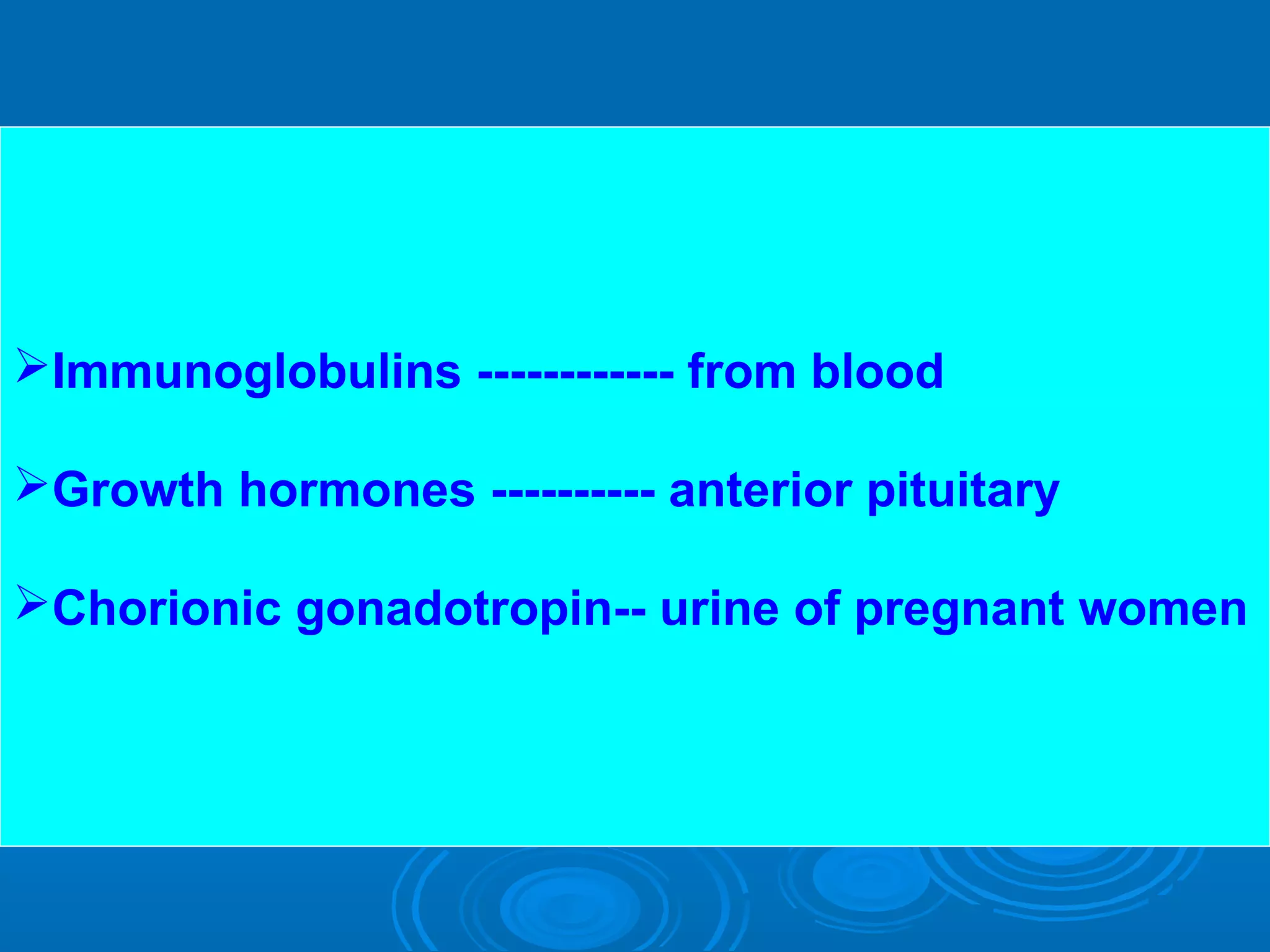
HUMAN SOURCES
Immunoglobulins ------------ from blood
Growth hormones ---------- anterior pituitary
Chorionic gonadotropin-- urine of pregnant women
SYNTHETIC SOURCES
Organic
e.g.: penicillin
Inorganic
 sulfonamide antibiotics
 oral contraceptives
GENETIC ENGINEERING
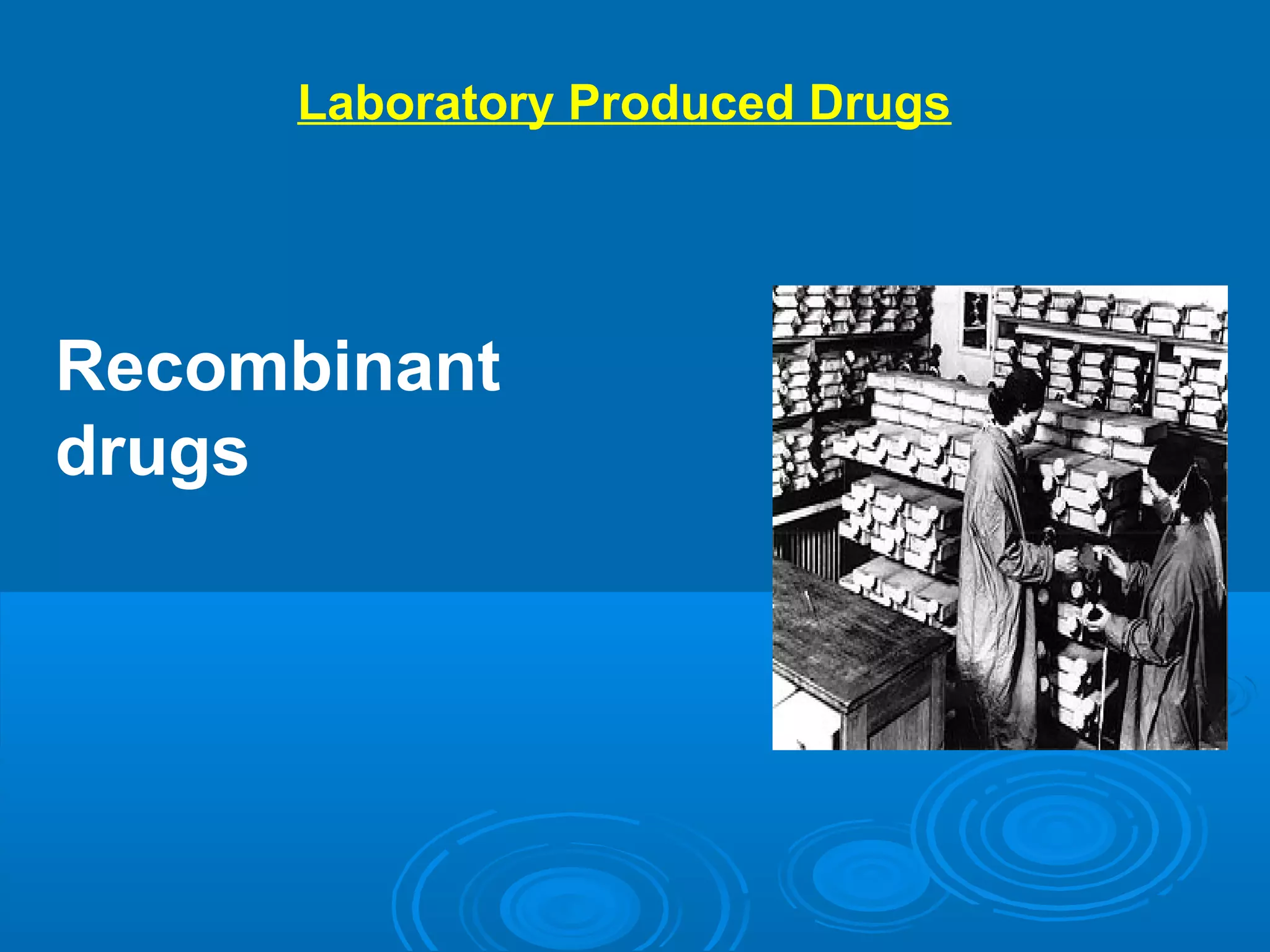
Laboratory Produced Drugs
Recombinant
drugs
And what,” you ask, “is aAnd what,” you ask, “is a
recombinantrecombinant drug?!”drug?!”
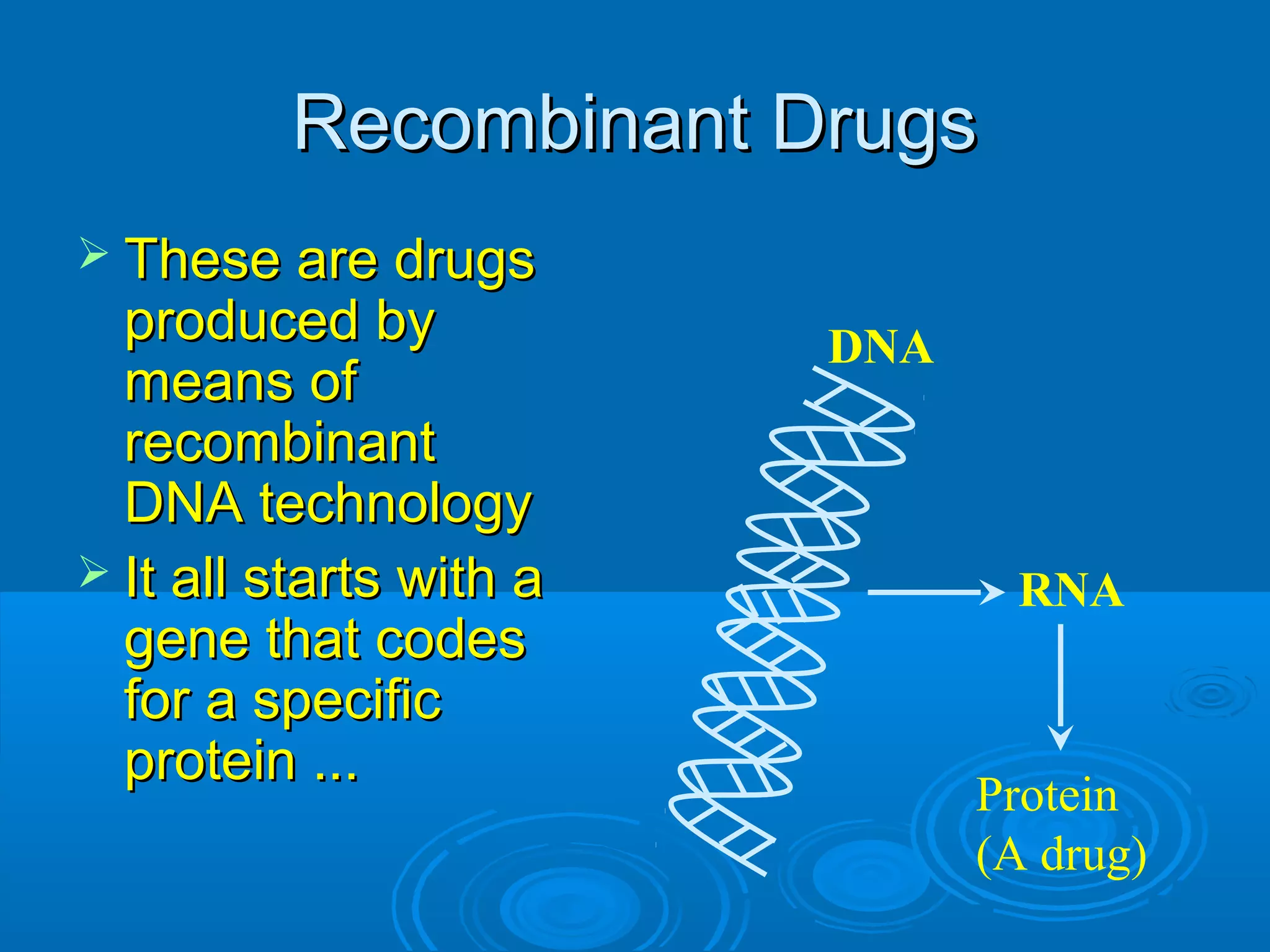
Recombinant DrugsRecombinant Drugs
 These are drugsThese are drugs
produced byproduced by
means ofmeans of
recombinantrecombinant
DNA technologyDNA technology
 It all starts with aIt all starts with a
gene that codesgene that codes
for a specificfor a specific
protein ...protein ...
DNA
RNA
Protein
(A drug)
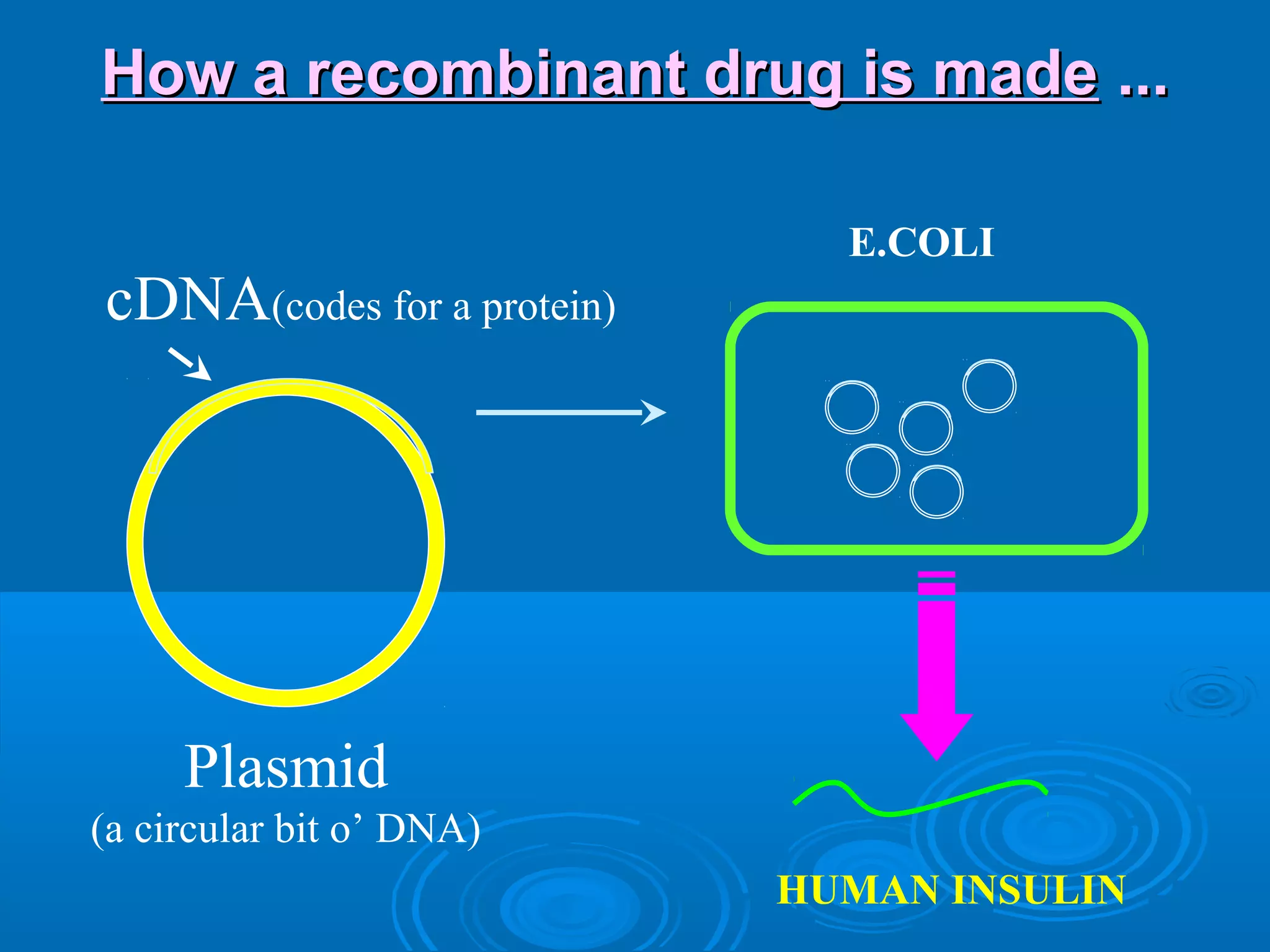
How a recombinant drug is madeHow a recombinant drug is made ......
Plasmid
(a circular bit o’ DNA)
cDNA(codes for a protein)
E.COLI
HUMAN INSULIN
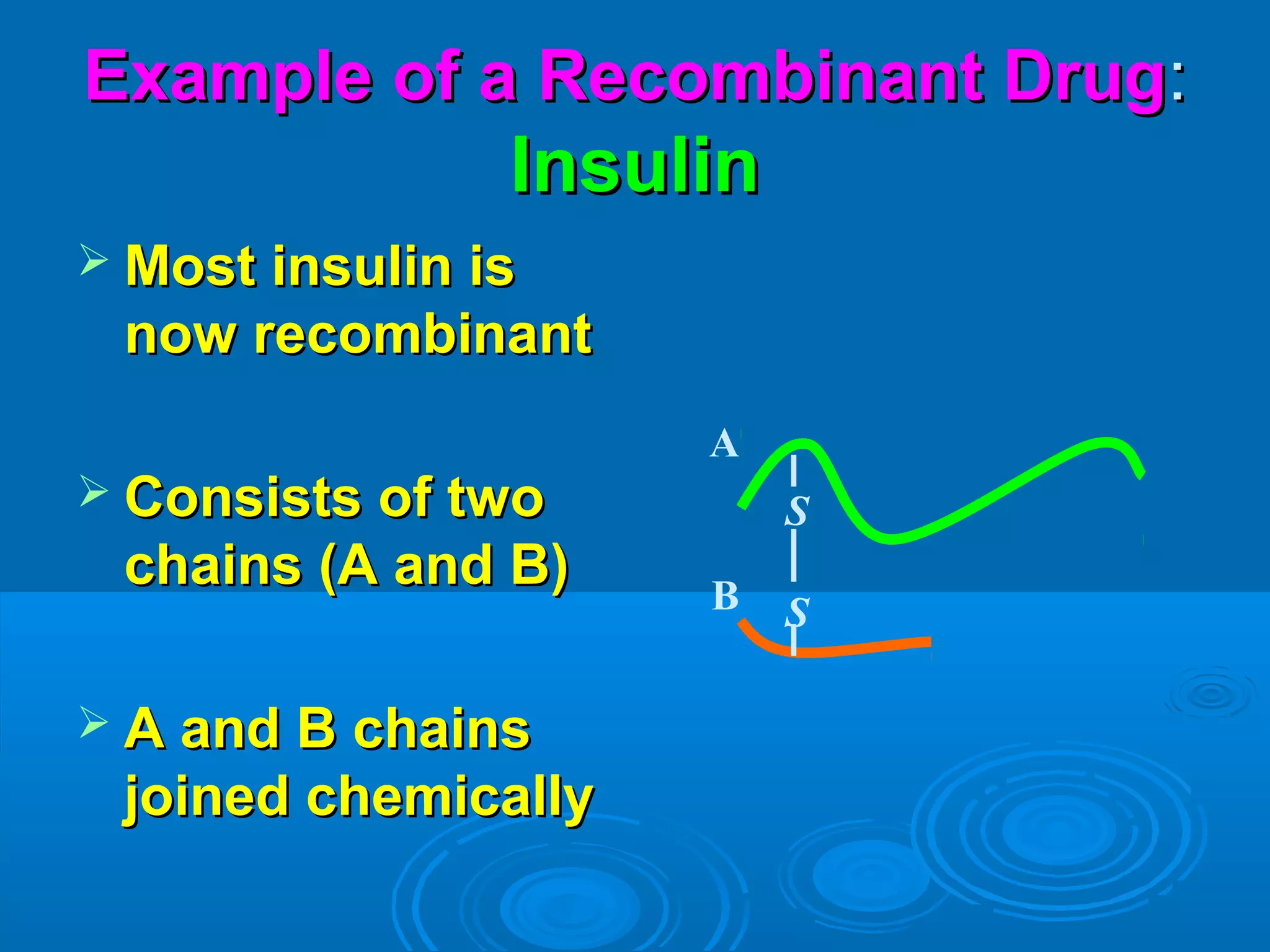
Example of a Recombinant DrugExample of a Recombinant Drug::
InsulinInsulin
 Most insulin isMost insulin is
now recombinantnow recombinant
 Consists of twoConsists of two
chains (A and B)chains (A and B)
 A and B chainsA and B chains
joined chemicallyjoined chemically
S
S
A
B
SOURCES OF DRUG INFORMATIONSOURCES OF DRUG INFORMATION
Sources of Drug InformationSources of Drug Information
 The United States Pharmacopoeia (USP) andThe United States Pharmacopoeia (USP) and
National Formulary (NF)National Formulary (NF)
 Physician's Desk Reference (PDR)Physician's Desk Reference (PDR)
 Drug Facts and ComparisonsDrug Facts and Comparisons
 TextbookTextbook
 JournalsJournals
 Continuing medical education programsContinuing medical education programs
 Drug company representativesDrug company representatives
 Advertisements ( medical/nonmedical journals)Advertisements ( medical/nonmedical journals)
 InternetInternet
Helpful Internet SitesHelpful Internet Sites
 MedscapeMedscape
(http:/www.medscape.com)(http:/www.medscape.com)
 Food and Drug AdministrationFood and Drug Administration
(http:/www.fda.gov)(http:/www.fda.gov)
 PharmInfoPharmInfo
(http:/www.pharminfo.com)(http:/www.pharminfo.com)
 RxMedRxMed
(http:/www.rxmed.com)(http:/www.rxmed.com)

[Pharma] 1.sources of drug & active principles

  • 1.
    Dr Bilal AhmadMalikDr Bilal Ahmad Malik Sources of DrugSources of Drug && Active principle of DrugActive principle of Drug
  • 2.
    ObjectivesObjectives After completing thediscussion, the student will be able toAfter completing the discussion, the student will be able to  Define drug and medicineDefine drug and medicine  Describe different sources of drugDescribe different sources of drug  Identify the active principles of a drugIdentify the active principles of a drug  Select authorative sources of drugSelect authorative sources of drug information.information.
  • 3.
    Do Drugs playany role in our lives ?
  • 4.
    MedicinesMedicines  Part ofour way of LifePart of our way of Life  Birth DeathBirth Death..
  • 5.
     Average familyexperiences illness onAverage family experiences illness on one day in four.one day in four. Between ages of 20-45 years a lowerBetween ages of 20-45 years a lower middle class man experiences approx.middle class man experiences approx.  one life endangering illnessone life endangering illness  20 disabling (temporarily) illnesses20 disabling (temporarily) illnesses  200 non disabling illnesses200 non disabling illnesses  1000 symptomatic episodes1000 symptomatic episodes  12 years of bad health in an average life12 years of bad health in an average life span.span.
  • 6.
    What is Drug?What is Drug ? What is Medicine ?
  • 7.
    Drugs/MedicinesDrugs/Medicines WHO scientific grouphas defined a drug asWHO scientific group has defined a drug as Any substance or product that is used or intended to be used to modify or explore physiological systems or pathological states for the benefit of the recipient. A substance that changes the biological system by interacting with it
  • 8.
    A medicine isa substance or aA medicine is a substance or a mixture of substances used inmixture of substances used in restoring or preserving health.restoring or preserving health.
  • 9.
     A drugis a single chemical substanceA drug is a single chemical substance that forms the active ingredient of athat forms the active ingredient of a medicine.medicine.  A medicine may contain many otherA medicine may contain many other substances to deliver the drug in asubstances to deliver the drug in a stable form, acceptable and convenientstable form, acceptable and convenient to the patient.to the patient. Drug vs Medicine?
  • 10.
    Why do weWhydo we need/ Useneed/ Use Drugs/Drugs/ Medicines?Medicines?
  • 11.
    Uses of drugs/MedicinesUsesof drugs/Medicines  To cure the disease To suppress the disease To prevent disease To diagnose the disease
  • 12.
  • 13.
    Study of pharmacologyinvolves the study ofStudy of pharmacology involves the study of  origin of drugsorigin of drugs  Chemical and physical properties of drugsChemical and physical properties of drugs  Physiologic effects and site of action in thePhysiologic effects and site of action in the bodybody  Absorption, distribution, metabolism, andAbsorption, distribution, metabolism, and excretion.excretion.  Safe/effective dosage regimen & route ofSafe/effective dosage regimen & route of administration.administration.  Adverse reactions, toxic effects & drug-drugAdverse reactions, toxic effects & drug-drug interactionsinteractions
  • 14.
    Sources of DrugsSourcesof Drugs  Naturally occurringNaturally occurring  Modified natural drugsModified natural drugs  Mineral sourcesMineral sources  Microbial sourcesMicrobial sources  Human sourcesHuman sources  Synthetic sourcesSynthetic sources  Genetic engineeringGenetic engineering
  • 15.
    Active principles ofdrugActive principles of drug A constituent of aA constituent of a drugdrug, upon the, upon the presence of which thepresence of which the characteristiccharacteristic therapeutictherapeutic actionaction of theof the substancesubstance largely depends.largely depends.
  • 16.
    ExamplesExamples  AlkaloidsAlkaloids  GlycodiesGlycodies TanninsTannins  Oleo-resinsOleo-resins  OilsOils  GumsGums
  • 17.
    Natural sources ofdrugsNatural sources of drugs Animals Plants
  • 18.
  • 19.
    Plant SourcesPlant Sources Earliest sourceEarliest source  GalenicalsGalenicals ------ Galen (GreekGalen (Greek physician)physician)
  • 20.
  • 21.
    1. Alkaloids1. Alkaloids organicorganic nitrogenousnitrogenous substancessubstances  bitterbitter  insoluble in waterinsoluble in water  react with acids to form saltsreact with acids to form salts  salts are soluble in body fluidssalts are soluble in body fluids Examples areExamples are atropineatropine,, caffeinecaffeine,,,, morphinemorphine,, nicotinenicotine,, quininequinine,, reserpine, emetine, codeine, tubocurarine.reserpine, emetine, codeine, tubocurarine.
  • 22.
    Morphine (opioid analgesic) Heroin codeine unripecapsules papaver somniferum (Opium Poppy).
  • 23.
  • 24.
    Caffeine (CNS Stimulant)Caffeine(CNS Stimulant) is the activeis the active principle in tea, coffee.principle in tea, coffee. CocaineCocaine is the active principle of theis the active principle of the coca leaf, which is chewed as acoca leaf, which is chewed as a stimulant-narcoticstimulant-narcotic
  • 25.
    Atropine (Anticholinergic) ---- fromleaves of atropa belladona. Ephedrine (bronchodilator) ---- from plant Ephedra Vulgaris Quinine (Antimalarial) ---- from bark of Cinchona. Reserpine (Antihypertensive) ---- from roots of Rauwalfia serpentia
  • 26.
    2.2. GlycosidesGlycosides AnyAny compoundcompoundthat contains athat contains a carbohydratecarbohydrate molecule (sugar)molecule (sugar) by hydrolytic cleavage, convertible intoby hydrolytic cleavage, convertible into sugar and a nonsugar component (aglycone)sugar and a nonsugar component (aglycone)  glucoside (glucose),glucoside (glucose),  pentosidepentoside (pentose),(pentose),  fructoside (fructose) etcfructoside (fructose) etc
  • 27.
    EXAMPLE:EXAMPLE: DigoxinDigoxin (cardiac stimulant)(cardiacstimulant)------ leavesleaves of digitalis purpurea or digitalisof digitalis purpurea or digitalis lanatalanata Anthraqinone glycosidesAnthraqinone glycosides ((laxativelaxative action)action) ---------- senna,cascara,aloesenna,cascara,aloe
  • 28.
    3.3. OilsOils  Fixedoils  Volatile oils  Mineral oils
  • 29.
    Fixed oilsFixed oils Esters of fatty acid and glycerol  Edible Examples  Coconut oil  Mustard oil  Olive oil  Castor oil (Purgative)  Cod liver oil (Vitamin A & D)  Used in the preparation of ointments, suppositories, Soaps
  • 30.
    Volatile OilsVolatile Oils Essentialor flavoring oils. EXAMPLES: LIQUID Clove oil (toothache) Eucalyptus oil Coriander oil Dill oil Ginger oil ( Carminative) Terpentine oil ( counter irrritant ) SOLIDS Camphor Menthol (peppermint oil)
  • 31.
    Mineral OilMineral Oil Hydrocarbon Obtainedfrom petroleum EXAMPLE: Liquid paraffin (Lubricant & Laxative)
  • 32.
    4.4. RESINSRESINS Formed by: Oxidation or polymerization of volatile oils Amorphous, brittle, translucent, hard solids Example: Podophyllum (Purgative action), Jalap ( hydragogue) Toxicological importance
  • 33.
    5. OLIORESINS5. OLIORESINS Mixturesof resins & volatile oils Example: Benzoin (Antiseptic)
  • 34.
    6. GUMS6. GUMS Inert----- emulsifying agents -Gum acacia, Gum tragacanth Active --------------------------------------- Agar (Purgative)
  • 35.
    7. TANNINS7. TANNINS Mixture of esters of Gallic acid + Glucose  Astringent action on MM  Hemostatic
  • 36.
  • 37.
    Animal SourcesAnimal Sources HormonesHormones  InsulinInsulin (hypoglycemic)(hypoglycemic)  Oils and fatsOils and fats  cod-liver oilcod-liver oil  EnzymesEnzymes  Pancreatin, PepsinPancreatin, Pepsin  VaccinesVaccines  killed, modified orkilled, modified or attenuated virusesattenuated viruses
  • 38.
    Mineral Sources ofDrugsMineral Sources of Drugs
  • 39.
    Mineral Sources ofDrugsMineral Sources of Drugs  Eg:Eg: • Iron (Anemia)Iron (Anemia) • Aluminum hydroxide (Antacid)Aluminum hydroxide (Antacid) • IodineIodine ( Lugol’s iodine for thyrotoxicosis,( Lugol’s iodine for thyrotoxicosis, tincture iodine as antiseptic )tincture iodine as antiseptic ) • Magnesium sulphate (Purgative)Magnesium sulphate (Purgative) • Sulphur (Scabies)Sulphur (Scabies) • Antimony salts (Kala Azar)Antimony salts (Kala Azar) • Bismuth Salts (peptic Ulcer )Bismuth Salts (peptic Ulcer )
  • 40.
  • 41.
    ExamplesExamples AntibioticAntibioticss Penicillin -----Penicillin ----- PenicilliumchrysogenumPenicillium chrysogenum Streptomycin, neomycin ----Streptomycin, neomycin ---- Actinomycetaceae.Actinomycetaceae. EnzymesEnzymes StreptokinaseStreptokinase (Fibrinolytic) ----(Fibrinolytic) ---- streptococcusstreptococcus
  • 42.
  • 43.
    Immunoglobulins ------------ fromblood Growth hormones ---------- anterior pituitary Chorionic gonadotropin-- urine of pregnant women
  • 44.
  • 45.
    Organic e.g.: penicillin Inorganic  sulfonamideantibiotics  oral contraceptives
  • 46.
  • 47.
  • 48.
    And what,” youask, “is aAnd what,” you ask, “is a recombinantrecombinant drug?!”drug?!”
  • 49.
    Recombinant DrugsRecombinant Drugs These are drugsThese are drugs produced byproduced by means ofmeans of recombinantrecombinant DNA technologyDNA technology  It all starts with aIt all starts with a gene that codesgene that codes for a specificfor a specific protein ...protein ... DNA RNA Protein (A drug)
  • 50.
    How a recombinantdrug is madeHow a recombinant drug is made ...... Plasmid (a circular bit o’ DNA) cDNA(codes for a protein) E.COLI HUMAN INSULIN
  • 51.
    Example of aRecombinant DrugExample of a Recombinant Drug:: InsulinInsulin  Most insulin isMost insulin is now recombinantnow recombinant  Consists of twoConsists of two chains (A and B)chains (A and B)  A and B chainsA and B chains joined chemicallyjoined chemically S S A B
  • 52.
    SOURCES OF DRUGINFORMATIONSOURCES OF DRUG INFORMATION
  • 53.
    Sources of DrugInformationSources of Drug Information  The United States Pharmacopoeia (USP) andThe United States Pharmacopoeia (USP) and National Formulary (NF)National Formulary (NF)  Physician's Desk Reference (PDR)Physician's Desk Reference (PDR)  Drug Facts and ComparisonsDrug Facts and Comparisons  TextbookTextbook  JournalsJournals  Continuing medical education programsContinuing medical education programs  Drug company representativesDrug company representatives  Advertisements ( medical/nonmedical journals)Advertisements ( medical/nonmedical journals)  InternetInternet
  • 54.
    Helpful Internet SitesHelpfulInternet Sites  MedscapeMedscape (http:/www.medscape.com)(http:/www.medscape.com)  Food and Drug AdministrationFood and Drug Administration (http:/www.fda.gov)(http:/www.fda.gov)  PharmInfoPharmInfo (http:/www.pharminfo.com)(http:/www.pharminfo.com)  RxMedRxMed (http:/www.rxmed.com)(http:/www.rxmed.com)