‘’ THE WHITE PLAGUE OF EUROPE’’
17 & 18 CENTURY
23/04/2013
Updated may 2015
HISTORY
NEOLITH AGES
EGYPTIAN MUMMIES
ROBERT KOCH ISOLATED IN 1882
SENITORIA
STREPTOMYCIN 1946
ISONIAZID 1952
Member of Mycobacterium tuberculosis Complex
1. M tuberculosis
2. M bovis
3. M BCG
4.M ulcerans
5. M africanum
MORPHOLOGY
BACILLUS :
rod shaped, non- spore bearing
 2-4um *0.2-0.5 um
Obligate Aerobe, growth enhanced by CO2
Slow growing
Carbon compds; oxidation & energy
High lipid content of wall hydrophobic
Resistant to oral fluids
MAJOR HEALTH PROBLEM
WHO 2008:
1/3 population effected
8.8 million new infected cases
1.6 million died in 2000
Every second a case infected
By end of 2014; 12.3 million smear positive cases &
150,000 MDR treated
WHO 2014 global reportt
9 million developed tb;
;6.1 million cases ; 5.7 new & 0.4 million already on TM
2014 report: 122 countries 56% SEA & pacific; ¼ Africa
India 24% & China 11%
1.5 million died
3,60000 had HIV too
ON DECLINE:
Diagnosis n therapy from 2000-2013
MDR 2013; 3.5 %
PAKISTAN: GFATM
Fifth highest burden country with TB
Fourth highest burden with MDR tb
WHO’s National Professional Officer for Tuberculosis
Control Dr Ghulam Nabi Kazi pointed out that
 2012 over 284,000 cases of Tb detected & put on tm
 this year the figure would touch around 300,000.
 around 420,000 new cases appeared every year.
12 tertiary care hospitals involved in Pakistan in
diagnosis & t/m
CELL STRUCTURE
• Slow growing: generation time 15-20hrs
• Intracellular parasite
• CELL WALL: 60% lipids
• 3 components:
1. MYCOLIC ACIDS: long chain FA C78- C90
Bound to proteins, polysaccharides
• Alpha branched structure
• 50% dry weight of cell envelope
• Form hydrophobic shell around MTB
LIPID BENEFITS
PERMEABILTY BARRIER FOR
1. Stains & dyes
2. resist antibiotics
3. resist killing by acids & alkalis
4. resist osmotic lysis by complement
5. resist oxygen and survive intracellular killing by
macrophages
VIRULENCE
NO ATTACK BY:
• CATIONIC PROTEINS
• LYSOZYME
• OXYGEN IN PHAGOCYTIC GRANULES
EXTRACELLULAR: Complement not deposited
2.CORD FACTOR: abundant in virulent strains
serpentine cords. parallel chains;
toxic to mammalian cells
inhibit PMN migraton
3 Wax D : Freund’s adjuvant
STAINING CHARACTER’S
BASIC STAINS
Gram’s stain: not taken/weakly taken
Ziehl Neelsen stain;
Carbol fuchsin: not readily taken, pushed by heat
ACID FAST:
once taken cannot be decolorized by alcohol.
95% alcohol + 3%HCL(ACID-ALCOHOL)
decolourize all but mycobacteria
HOT ACIDS & Sonication: destroy acid fastness
Lipid effects on tissue
Muramyl dipeptide + mycolic acid complex
Granuloma formation
Phospholipds: Caseous necrosis:
CORD FACTOR: trehalose 6,6’-dimycolate
1. Inhibit migration of leukocytes
2. Chronic granulomas
3. Immunologic adjuvant
Proteins: tuberculin reaction;
elicit Anti bodies
CULTURE MEDIA(non/selective)
Semisynthetic Agar medium.
Middlebrook 7H10 & 11
Contents: salts, cofactors + malachite green/AB
glycerol albumin
oleic acid catalase
Mjddlebrook 7H11; caesin hydrolysate as well
Large inocula needed in several weeks
Colonial morphology, sensitivity testing
INSPISSATED EGG MEDIA
LOWENSTEIN JENSEN MEDIA:
Complex organic substances;
fresh egg, yolks. potato flour
Salts
Glycerol
Malachite green; selective
Small innocula yield growth in 3-6 weeks
BROTH MEDIA
Middlebrook 7H9, 7H12
Tweens: water -soluble esters of fatty acids
wet the surface, dispersed growth in liquid
Rapid growth
PHYSICAL & CHEMICAL AGENTS;
Resistant bacterium;
hydrophobic nature, clumping
Pencillin, malachite green, acids, alkalis kill others
PATHOGENICITY
M tuberculosis
Susceptible ; Humans & guinae pigs
Resistant: fowl, cattle
M bovis
Susceptible; cattle, humans
M Kansasii
Lesion like MTB
PATHOGENESIS
Droplet infection; 1-5um nuclei
family, hospital personnel. < 25um
Speak, cough, sneeze settle in alveoli
Cytokines, lymphokines stimulate monocytes,
Primary infection of ALVEOLAR MACROPHAGES.
Unrestrained intracellular proliferation in non
immune alveolar macrophages
Lesions; 1-2 months in lungs
Hypersensitivity: polysaccharides
Disseminated infection via macrophages to LN& blood
In 3-8 weeks cell mediated immunity develops
Activated macrophages at infection sites
Granuloma formation
Ag-specific activation of CD4+ T cells, clonal expansion
IL2 secretion increased & IF -gamma
IL2 receptors expression increased
Activation of gamma interferon to kill M tuberculosis by
macrophages
Population exposure; Asia, Africa, latin America
 overcrowding,
 socioeconomic conditions
medical care provision
Genetic predisposition HLA Bw15Ag
Age ; extremes
Malnutrition, alcoholics, destitute
Coexisting disease : diabetes, silicosis, AIDS
PATHOLOGY
HOST FACTORS
MTB factors….no; multiplication
LESIONS
Exudative; like pneumonia
Oedema, polys, mononuclears surround Mtb
Fate; 1 resolution LN; enlarge/ Gohn’s complex
2 necrosis TT; positive
3 .productive
GOHN’S COMPLEX
L NODE;
 enlarged, Caseation, calcification
Children
Adults
REACTIVATION; surviving Mtb multiply; APEX
chronic tissue lesion; tubercle, caseation. Fibrosis
LN: Less effect
REACTIVATION
Latent infection reactivated
Partial immunity
Mycobacterial Ag increased in tissues
 intense inflammatory response by monocytes
Type 4 hypersensitivity response
Dense mononuclear infilterates cause tissue damage
due to release of O2 radicles and neutral proteases
Tissue damage: Caseous necrosis followed by
liquifactive necrosis in absence of treatment
PRODUCTIVE TYPE
Chronic Granuloma/tubercle; 3 zones
1 central area: large multinucleate giant cells
with Mtb; later caseous necrosis
2. Mid zone; Pale epithelliod cells; radially set
3 Peripheral zone; fibroblasts, lymphocytes,
monoytes cells; later fibrosis
Tubercle; empty in bronchus; form cavity
heal by fibrosis & calcification
SPREAD
Blood; LN.tubercle erosion in vein
Lymphatics; LN; miliary tb
Bronchi… aspirated to lungs
GIT; swallowed food, lung
INTRACELLULAR GROWTH. Resist chemothera
1.MONOCYTES
2.RES
3.GIANT CELL
SYMPTOMS
COUGH
SPUTUM… early tissue necrosis
Dysponea; late tissue necrosis ;
 parenchymal damage of lung
Fever; IL1 systemic effects
Weight loss; TNF alpha; cachectin
X-ray: Apical cavitary lesion of lung
PPD positive
HITOPATHOLOGY
GRANULOMAS
Epitheloid cells; activated macrophages
Giant cells; most successful host tissue response
Activated lympocytes
Tubercle/granulation tissue
TUBERCULIN TEST
MATERIAL;
OLDTUBERCULIN; 6 week growth in broth
Conc.filterate has tuberculoprotein
PPD; chemical fractionation of OT
PPD-S; Siebert’s Lot no 49608 standard
TU; Biological activity of sp.wt of PPD S
Dose; 1 TU, 5 TU, 250TU
standardize by comparative activity in humans
TUBERCULIN TEST
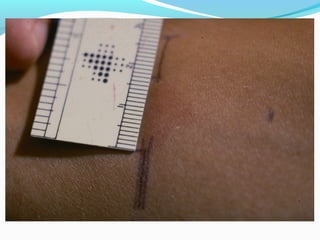
5 TU O.I ml injected intracutaneous
Read in 48-72 hrs
10 mm or >
Positive: 4-6 weeks of infection
Oedema. induration, erythema
Persist many days; weak disappear
Central necrosis may be seen
DIAGNOSIS
Clinical
Specimen
Smear
Culture
Molecular probe
Gene sequencing
Tuberculin test
Positive: infection (4-6 weeks)/ or past
 BCG vaccination
NEGATIVE:
No exposure
Anergy;,
 AIDS, Hodgkins
 measles, immunosuppression,
 sarcoidosis overwhelming TB,
LAB DIAGNOSIS
Sputum: 3-5 morning specimen
 CULTURE;
decontaminate/centrifuge
Egg based medium; LJ
Agar & Broth based media:Middlebrook
AFB; Z-N stain
Auramine-rhodamine
PCR; respiratory smear positive samples
NEW DIAGNOSTIC
TECHNOLOGIES
BACTEC RAPID RADIOMETRIC CULTURE
SYSTEM
Developed by Becton Dickinson
Liquid medium with C14 labelled palmetic acid
Automated early detection
 growing Mycobacteria use acid and release C14
Growth detected in 12 days
Expensive
Facility should handle radioactive material
HIGH PERFORMANCE LIQUID
CHROMATOGRAPHY
REF LAB: SPECIATION of mycobacteria
Mycolic acid profiles vary in species
DNA detection:PCR; 99% specific, 55-90% sensitive
STRAIN; clinical/epidemilogical typing
gene seq 6110 targeted:
DNA frag generated by restriction endonuclease
digestion,
separated by electrophoreses.
Probe against 6110 used
ID OF
M TUBERCULOSIS CULTURES
1.CONFIRM BY ZN STAIN; difficult to
emulsify; others easily emulsify
2.PIGMENT: leave in light for 2hrs
re-incubate at 370 C overnight
non- chromogen in light/dark
3. Incubation of s/c at 25 0 C; no growth
4.Growth on LJ Medium with p
Nitrobenzoic acid 500 ug/ml
No growth
PCR
DNA/RNA probes and amplification used
DNA & RNA sequences extracted from mycobacteria
in sputum
Epensive
Specialist training needed
MYCODOT ANTI-BODY
20 minute immuno-assay
Pureified lipoarabinomannan; highly immunogenic
Detects AB in active disease ie high levels; not screening
BACTERIOPHAGE TEST FOR
SPUTUM
FAST PLAQUE ASSAY:
Mix sputum with a reagent with bacteriophage
Mycophages infect mycobacteria
Use virucide to kill bacteria outside mycobacteria
Mycobacteriophages replicate inside mycobacteria,
cause their lysis and released out
Other rapid growing non pathogenic mycobacteria
are addded,infected by these phages.
Sample is incorporated in agar mixture, plated and
incubated overnight at 37 0 c
Phages lyse mycobacteria, leaving zones of clearing ie
holes
Thi proves pt sample had M TB
sensitivity like culture: can detect 100 tubercle
bacilli/ml
GLOBAL TB REPORT 2014
15 vaccines under trial
10anti tb drugs undergoing clinical trials
4 month versus 6 month therapy duration
2 approved
delamanid
Bedaquiline
TARGETS: 2035
95% reduction in deaths
90% reduction in incidence
GAMMA INTERFERON RELEASE ASSAY
MTB specific Ag: (not BCG/non myco tb)
 ESAT 6
 CFP 10
CD4 cells release gamma interferon in whole blood
ELISA ASSAY
Quantiferon Gold
T spot TB ; mononuclear cells used
conversion
To negative:
Isoniazid T/M
BCG VACCINE; + 3-7 yrs
 - elimination of viable Mtb
HEALTHY; after yrs negative
 retest: 2 weeks positive by boost inj
Molecular probes
1 day to detect/ 2hrs
Rapid, Sensitive, Specific
Mycobacterium 10,000 rRNA copies /cell; natural
amplification, easy detection
Hybridization of DNA with rRNA sequences single
strands separated from hybrids
DNA probes attached to chemicals that
chemiluminescence in hybrids & measure by lumino-
meter & equivalent to amount of hybrid
Probes for M tub complex & MAC
TREATMENT
FIRST LINE DRUGS
PRIMARY: daily 1—2 months; 9 biweekly
Isoniazid
Rifampin
OTHERS:
Pyrazinmide
Ethambutal
Streptomycin
6 months regime ; 4 drugs 2 months; iso/rif biweekly
SECOND LINE DRUGS
TOXIC; Used in T/M failure with first-line
KENAMYCIN
CAPREOMYCIN
ETHIONAMIDE
CYCLOSERINE
OFLOXACIN
CIPROFLOXACIN
DRUG RESISTANCE
One in 106
or 108
mutate spontaneously
Single drug
First line drugs
Combinations used: 4 drug regime
Isoniazid, rifampine, pyrazinamide, ethambutal
Second line; toxic, less effective, both
Reserved for special circumstances; t/m failure, MDR
riskfactors: HIV, Asian, Latin American migrants,
MDR area,
Mechanisms of drug resistance
Isoniazid resistance:
katG; deletion, mutation in catalase-peroxidase gene
no or less catalase function
InhA gene: enzyme encoding mycolic acid synthesis
Streptomycin resistance: mutation in genes coding
Ribosomal S12 protein, 16SrRNA, rpsl, rrs
MDR: isoniazid & rifampin resistance
problem in T/M & control
hospitals, prisons, HIV
t/m of contacts after sensitivity test , 3 or > drugs
XDR: extensive drug resistance
WHO defination R : INZ & PYR
flouroquinolone
3 second line injectables
CAUSES
1. Poor infection control
2. Ineffective T/M
3. Diagnostics poor
FATE:
Poor
Mortality; 64%
FUNDS
8 billion US dollars/ year needed for global full
response to TB epidemic
2/3 for detection & tm of drug susceptible tb
20% MDR T/M
10% rapid tests & diagnostics
5% HIV associated tb activity
PREVENTION & CONTROL
1.Public health control: t/m cases: prompt &
effective with follow up
Contacts: diagnose{ tt, x ray} & treat
2.Asymptomatic cases: tt +
Treat with drugs: children, immunosuppressed
3. Host resistance of person: reactivate or convert
asymptomatic to disease
Malnutrition, gastrectomy, infection, HIV, steroids
4. BCG 5. Cattle eradication 6. milk pasteurization
Atypical mycobacteria
ANONYMOUS MYCOBACTERIA
ENVIRONMENTAL MYCOBACTERIA
MYCOBACTERIA OTHER THAN TUBERCLE; MOTT
Found in soil, water
Cause opportunistic infection in
HIV/Immunosuppressed
DIAGNOSTIC FEATURES
CHROMOGENS
SCOTOCHROMOGENS; Pigment in dark
PHOTOCHROMOGENS; Pigment in light
NON-CHROMOGENS
TEMPERATURE:
Grow at 25 0 C
Grow in presence of P nitrobenzoic acid
GROWTH
Slow growers; 2 rapid growers
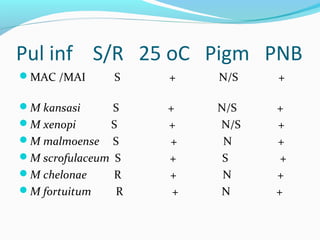
Pul inf S/R 25 oC Pigm PNB
MAC /MAI S + N/S +
M kansasi S + N/S +
M xenopi S + N/S +
M malmoense S + N +
M scrofulaceum S + S +
M chelonae R + N +
M fortuitum R + N +
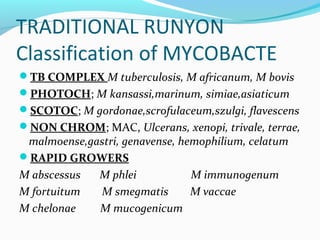
TRADITIONAL RUNYON
Classification of MYCOBACTE
TB COMPLEX M tuberculosis, M africanum, M bovis
PHOTOCH; M kansassi,marinum, simiae,asiaticum
SCOTOC; M gordonae,scrofulaceum,szulgi, flavescens
NON CHROM; MAC, Ulcerans, xenopi, trivale, terrae,
malmoense,gastri, genavense, hemophilium, celatum
RAPID GROWERS
M abscessus M phlei M immunogenum
M fortuitum M smegmatis M vaccae
M chelonae M mucogenicum
MAC MAI
Grow optimally at 41 C
Smooth, soft non pigmented colonies,
Ubiqutous; water, soil, food, animals, birds
Immuno-competent humans affected
AIDS: Opportunistic esp <100/ul
25-50% pts develop bacteremia, disseminated
infection. Decrease with HAART and azithromycin
Tissue infilteration…organ dysfunction eg lung,skin,
soft tissue, LN, bone, CNS
C/O fever,night sweat,abd pain, diarrhea, wt loss
M kansasii
Photochromogen, complex media at 37C
Pulmonary and systemic disease like TB esp ICompro
t/m; Rifampin, ethambutol,isoniazid
M scrofolacium; scotochromogen, water
Adults with chronic lung disease
 lymphadenitis in children
M marinum/ulcerans: water at 31 C, fish infected;
swimming pool granulomas
M chelonae-abscessus; rapid grower; skin, bone. soft
tissue infection,rep tract, cystic fibrosis

[Micro] mycobacterium tuberculosis

  • 1.
    ‘’ THE WHITEPLAGUE OF EUROPE’’ 17 & 18 CENTURY 23/04/2013 Updated may 2015
  • 2.
    HISTORY NEOLITH AGES EGYPTIAN MUMMIES ROBERTKOCH ISOLATED IN 1882 SENITORIA STREPTOMYCIN 1946 ISONIAZID 1952
  • 3.
    Member of Mycobacteriumtuberculosis Complex 1. M tuberculosis 2. M bovis 3. M BCG 4.M ulcerans 5. M africanum
  • 4.
    MORPHOLOGY BACILLUS : rod shaped,non- spore bearing  2-4um *0.2-0.5 um Obligate Aerobe, growth enhanced by CO2 Slow growing Carbon compds; oxidation & energy High lipid content of wall hydrophobic Resistant to oral fluids
  • 8.
    MAJOR HEALTH PROBLEM WHO2008: 1/3 population effected 8.8 million new infected cases 1.6 million died in 2000 Every second a case infected By end of 2014; 12.3 million smear positive cases & 150,000 MDR treated
  • 9.
    WHO 2014 globalreportt 9 million developed tb; ;6.1 million cases ; 5.7 new & 0.4 million already on TM 2014 report: 122 countries 56% SEA & pacific; ¼ Africa India 24% & China 11% 1.5 million died 3,60000 had HIV too ON DECLINE: Diagnosis n therapy from 2000-2013 MDR 2013; 3.5 %
  • 12.
    PAKISTAN: GFATM Fifth highestburden country with TB Fourth highest burden with MDR tb WHO’s National Professional Officer for Tuberculosis Control Dr Ghulam Nabi Kazi pointed out that  2012 over 284,000 cases of Tb detected & put on tm  this year the figure would touch around 300,000.  around 420,000 new cases appeared every year. 12 tertiary care hospitals involved in Pakistan in diagnosis & t/m
  • 13.
    CELL STRUCTURE • Slowgrowing: generation time 15-20hrs • Intracellular parasite • CELL WALL: 60% lipids • 3 components: 1. MYCOLIC ACIDS: long chain FA C78- C90 Bound to proteins, polysaccharides • Alpha branched structure • 50% dry weight of cell envelope • Form hydrophobic shell around MTB
  • 14.
    LIPID BENEFITS PERMEABILTY BARRIERFOR 1. Stains & dyes 2. resist antibiotics 3. resist killing by acids & alkalis 4. resist osmotic lysis by complement 5. resist oxygen and survive intracellular killing by macrophages
  • 15.
    VIRULENCE NO ATTACK BY: •CATIONIC PROTEINS • LYSOZYME • OXYGEN IN PHAGOCYTIC GRANULES EXTRACELLULAR: Complement not deposited 2.CORD FACTOR: abundant in virulent strains serpentine cords. parallel chains; toxic to mammalian cells inhibit PMN migraton 3 Wax D : Freund’s adjuvant
  • 16.
    STAINING CHARACTER’S BASIC STAINS Gram’sstain: not taken/weakly taken Ziehl Neelsen stain; Carbol fuchsin: not readily taken, pushed by heat ACID FAST: once taken cannot be decolorized by alcohol. 95% alcohol + 3%HCL(ACID-ALCOHOL) decolourize all but mycobacteria HOT ACIDS & Sonication: destroy acid fastness
  • 17.
    Lipid effects ontissue Muramyl dipeptide + mycolic acid complex Granuloma formation Phospholipds: Caseous necrosis: CORD FACTOR: trehalose 6,6’-dimycolate 1. Inhibit migration of leukocytes 2. Chronic granulomas 3. Immunologic adjuvant Proteins: tuberculin reaction; elicit Anti bodies
  • 19.
    CULTURE MEDIA(non/selective) Semisynthetic Agarmedium. Middlebrook 7H10 & 11 Contents: salts, cofactors + malachite green/AB glycerol albumin oleic acid catalase Mjddlebrook 7H11; caesin hydrolysate as well Large inocula needed in several weeks Colonial morphology, sensitivity testing
  • 20.
    INSPISSATED EGG MEDIA LOWENSTEINJENSEN MEDIA: Complex organic substances; fresh egg, yolks. potato flour Salts Glycerol Malachite green; selective Small innocula yield growth in 3-6 weeks
  • 21.
    BROTH MEDIA Middlebrook 7H9,7H12 Tweens: water -soluble esters of fatty acids wet the surface, dispersed growth in liquid Rapid growth PHYSICAL & CHEMICAL AGENTS; Resistant bacterium; hydrophobic nature, clumping Pencillin, malachite green, acids, alkalis kill others
  • 22.
    PATHOGENICITY M tuberculosis Susceptible ;Humans & guinae pigs Resistant: fowl, cattle M bovis Susceptible; cattle, humans M Kansasii Lesion like MTB
  • 25.
    PATHOGENESIS Droplet infection; 1-5umnuclei family, hospital personnel. < 25um Speak, cough, sneeze settle in alveoli Cytokines, lymphokines stimulate monocytes, Primary infection of ALVEOLAR MACROPHAGES. Unrestrained intracellular proliferation in non immune alveolar macrophages Lesions; 1-2 months in lungs Hypersensitivity: polysaccharides
  • 28.
    Disseminated infection viamacrophages to LN& blood In 3-8 weeks cell mediated immunity develops Activated macrophages at infection sites Granuloma formation Ag-specific activation of CD4+ T cells, clonal expansion IL2 secretion increased & IF -gamma IL2 receptors expression increased Activation of gamma interferon to kill M tuberculosis by macrophages
  • 29.
    Population exposure; Asia,Africa, latin America  overcrowding,  socioeconomic conditions medical care provision Genetic predisposition HLA Bw15Ag Age ; extremes Malnutrition, alcoholics, destitute Coexisting disease : diabetes, silicosis, AIDS
  • 30.
    PATHOLOGY HOST FACTORS MTB factors….no;multiplication LESIONS Exudative; like pneumonia Oedema, polys, mononuclears surround Mtb Fate; 1 resolution LN; enlarge/ Gohn’s complex 2 necrosis TT; positive 3 .productive
  • 31.
    GOHN’S COMPLEX L NODE; enlarged, Caseation, calcification Children Adults REACTIVATION; surviving Mtb multiply; APEX chronic tissue lesion; tubercle, caseation. Fibrosis LN: Less effect
  • 32.
    REACTIVATION Latent infection reactivated Partialimmunity Mycobacterial Ag increased in tissues  intense inflammatory response by monocytes Type 4 hypersensitivity response Dense mononuclear infilterates cause tissue damage due to release of O2 radicles and neutral proteases Tissue damage: Caseous necrosis followed by liquifactive necrosis in absence of treatment
  • 33.
    PRODUCTIVE TYPE Chronic Granuloma/tubercle;3 zones 1 central area: large multinucleate giant cells with Mtb; later caseous necrosis 2. Mid zone; Pale epithelliod cells; radially set 3 Peripheral zone; fibroblasts, lymphocytes, monoytes cells; later fibrosis Tubercle; empty in bronchus; form cavity heal by fibrosis & calcification
  • 35.
    SPREAD Blood; LN.tubercle erosionin vein Lymphatics; LN; miliary tb Bronchi… aspirated to lungs GIT; swallowed food, lung INTRACELLULAR GROWTH. Resist chemothera 1.MONOCYTES 2.RES 3.GIANT CELL
  • 36.
    SYMPTOMS COUGH SPUTUM… early tissuenecrosis Dysponea; late tissue necrosis ;  parenchymal damage of lung Fever; IL1 systemic effects Weight loss; TNF alpha; cachectin
  • 42.
    X-ray: Apical cavitarylesion of lung PPD positive HITOPATHOLOGY GRANULOMAS Epitheloid cells; activated macrophages Giant cells; most successful host tissue response Activated lympocytes Tubercle/granulation tissue
  • 43.
    TUBERCULIN TEST MATERIAL; OLDTUBERCULIN; 6week growth in broth Conc.filterate has tuberculoprotein PPD; chemical fractionation of OT PPD-S; Siebert’s Lot no 49608 standard TU; Biological activity of sp.wt of PPD S Dose; 1 TU, 5 TU, 250TU standardize by comparative activity in humans
  • 49.
    TUBERCULIN TEST 5 TUO.I ml injected intracutaneous Read in 48-72 hrs 10 mm or > Positive: 4-6 weeks of infection Oedema. induration, erythema Persist many days; weak disappear Central necrosis may be seen
  • 50.
  • 51.
    Tuberculin test Positive: infection(4-6 weeks)/ or past  BCG vaccination NEGATIVE: No exposure Anergy;,  AIDS, Hodgkins  measles, immunosuppression,  sarcoidosis overwhelming TB,
  • 52.
    LAB DIAGNOSIS Sputum: 3-5morning specimen  CULTURE; decontaminate/centrifuge Egg based medium; LJ Agar & Broth based media:Middlebrook AFB; Z-N stain Auramine-rhodamine PCR; respiratory smear positive samples
  • 55.
    NEW DIAGNOSTIC TECHNOLOGIES BACTEC RAPIDRADIOMETRIC CULTURE SYSTEM Developed by Becton Dickinson Liquid medium with C14 labelled palmetic acid Automated early detection  growing Mycobacteria use acid and release C14 Growth detected in 12 days Expensive Facility should handle radioactive material
  • 61.
    HIGH PERFORMANCE LIQUID CHROMATOGRAPHY REFLAB: SPECIATION of mycobacteria Mycolic acid profiles vary in species DNA detection:PCR; 99% specific, 55-90% sensitive STRAIN; clinical/epidemilogical typing gene seq 6110 targeted: DNA frag generated by restriction endonuclease digestion, separated by electrophoreses. Probe against 6110 used
  • 64.
    ID OF M TUBERCULOSISCULTURES 1.CONFIRM BY ZN STAIN; difficult to emulsify; others easily emulsify 2.PIGMENT: leave in light for 2hrs re-incubate at 370 C overnight non- chromogen in light/dark 3. Incubation of s/c at 25 0 C; no growth 4.Growth on LJ Medium with p Nitrobenzoic acid 500 ug/ml No growth
  • 65.
    PCR DNA/RNA probes andamplification used DNA & RNA sequences extracted from mycobacteria in sputum Epensive Specialist training needed MYCODOT ANTI-BODY 20 minute immuno-assay Pureified lipoarabinomannan; highly immunogenic Detects AB in active disease ie high levels; not screening
  • 66.
    BACTERIOPHAGE TEST FOR SPUTUM FASTPLAQUE ASSAY: Mix sputum with a reagent with bacteriophage Mycophages infect mycobacteria Use virucide to kill bacteria outside mycobacteria Mycobacteriophages replicate inside mycobacteria, cause their lysis and released out Other rapid growing non pathogenic mycobacteria are addded,infected by these phages. Sample is incorporated in agar mixture, plated and incubated overnight at 37 0 c
  • 67.
    Phages lyse mycobacteria,leaving zones of clearing ie holes Thi proves pt sample had M TB sensitivity like culture: can detect 100 tubercle bacilli/ml
  • 68.
    GLOBAL TB REPORT2014 15 vaccines under trial 10anti tb drugs undergoing clinical trials 4 month versus 6 month therapy duration 2 approved delamanid Bedaquiline TARGETS: 2035 95% reduction in deaths 90% reduction in incidence
  • 69.
    GAMMA INTERFERON RELEASEASSAY MTB specific Ag: (not BCG/non myco tb)  ESAT 6  CFP 10 CD4 cells release gamma interferon in whole blood ELISA ASSAY Quantiferon Gold T spot TB ; mononuclear cells used
  • 70.
    conversion To negative: Isoniazid T/M BCGVACCINE; + 3-7 yrs  - elimination of viable Mtb HEALTHY; after yrs negative  retest: 2 weeks positive by boost inj
  • 71.
    Molecular probes 1 dayto detect/ 2hrs Rapid, Sensitive, Specific Mycobacterium 10,000 rRNA copies /cell; natural amplification, easy detection Hybridization of DNA with rRNA sequences single strands separated from hybrids DNA probes attached to chemicals that chemiluminescence in hybrids & measure by lumino- meter & equivalent to amount of hybrid Probes for M tub complex & MAC
  • 72.
    TREATMENT FIRST LINE DRUGS PRIMARY:daily 1—2 months; 9 biweekly Isoniazid Rifampin OTHERS: Pyrazinmide Ethambutal Streptomycin 6 months regime ; 4 drugs 2 months; iso/rif biweekly
  • 73.
    SECOND LINE DRUGS TOXIC;Used in T/M failure with first-line KENAMYCIN CAPREOMYCIN ETHIONAMIDE CYCLOSERINE OFLOXACIN CIPROFLOXACIN
  • 74.
    DRUG RESISTANCE One in106 or 108 mutate spontaneously Single drug First line drugs Combinations used: 4 drug regime Isoniazid, rifampine, pyrazinamide, ethambutal Second line; toxic, less effective, both Reserved for special circumstances; t/m failure, MDR riskfactors: HIV, Asian, Latin American migrants, MDR area,
  • 75.
    Mechanisms of drugresistance Isoniazid resistance: katG; deletion, mutation in catalase-peroxidase gene no or less catalase function InhA gene: enzyme encoding mycolic acid synthesis Streptomycin resistance: mutation in genes coding Ribosomal S12 protein, 16SrRNA, rpsl, rrs
  • 76.
    MDR: isoniazid &rifampin resistance problem in T/M & control hospitals, prisons, HIV t/m of contacts after sensitivity test , 3 or > drugs XDR: extensive drug resistance WHO defination R : INZ & PYR flouroquinolone 3 second line injectables
  • 77.
    CAUSES 1. Poor infectioncontrol 2. Ineffective T/M 3. Diagnostics poor FATE: Poor Mortality; 64%
  • 78.
    FUNDS 8 billion USdollars/ year needed for global full response to TB epidemic 2/3 for detection & tm of drug susceptible tb 20% MDR T/M 10% rapid tests & diagnostics 5% HIV associated tb activity
  • 79.
    PREVENTION & CONTROL 1.Publichealth control: t/m cases: prompt & effective with follow up Contacts: diagnose{ tt, x ray} & treat 2.Asymptomatic cases: tt + Treat with drugs: children, immunosuppressed 3. Host resistance of person: reactivate or convert asymptomatic to disease Malnutrition, gastrectomy, infection, HIV, steroids 4. BCG 5. Cattle eradication 6. milk pasteurization
  • 80.
    Atypical mycobacteria ANONYMOUS MYCOBACTERIA ENVIRONMENTALMYCOBACTERIA MYCOBACTERIA OTHER THAN TUBERCLE; MOTT Found in soil, water Cause opportunistic infection in HIV/Immunosuppressed
  • 81.
    DIAGNOSTIC FEATURES CHROMOGENS SCOTOCHROMOGENS; Pigmentin dark PHOTOCHROMOGENS; Pigment in light NON-CHROMOGENS TEMPERATURE: Grow at 25 0 C Grow in presence of P nitrobenzoic acid GROWTH Slow growers; 2 rapid growers
  • 82.
    Pul inf S/R25 oC Pigm PNB MAC /MAI S + N/S + M kansasi S + N/S + M xenopi S + N/S + M malmoense S + N + M scrofulaceum S + S + M chelonae R + N + M fortuitum R + N +
  • 83.
    TRADITIONAL RUNYON Classification ofMYCOBACTE TB COMPLEX M tuberculosis, M africanum, M bovis PHOTOCH; M kansassi,marinum, simiae,asiaticum SCOTOC; M gordonae,scrofulaceum,szulgi, flavescens NON CHROM; MAC, Ulcerans, xenopi, trivale, terrae, malmoense,gastri, genavense, hemophilium, celatum RAPID GROWERS M abscessus M phlei M immunogenum M fortuitum M smegmatis M vaccae M chelonae M mucogenicum
  • 84.
    MAC MAI Grow optimallyat 41 C Smooth, soft non pigmented colonies, Ubiqutous; water, soil, food, animals, birds Immuno-competent humans affected AIDS: Opportunistic esp <100/ul 25-50% pts develop bacteremia, disseminated infection. Decrease with HAART and azithromycin Tissue infilteration…organ dysfunction eg lung,skin, soft tissue, LN, bone, CNS C/O fever,night sweat,abd pain, diarrhea, wt loss
  • 85.
    M kansasii Photochromogen, complexmedia at 37C Pulmonary and systemic disease like TB esp ICompro t/m; Rifampin, ethambutol,isoniazid M scrofolacium; scotochromogen, water Adults with chronic lung disease  lymphadenitis in children M marinum/ulcerans: water at 31 C, fish infected; swimming pool granulomas M chelonae-abscessus; rapid grower; skin, bone. soft tissue infection,rep tract, cystic fibrosis