Inducible Clindamycin Resistance
Test
Dr. Samira Fattah
PhD in Medical Bacteriology
College of Health Sciences-HMU
Inducible Clindamycin Resistance
(D Test)
• The CLSI recommends testing for inducible clindamycin resistance in
all staphylococci, Streptococcus pneumoniae, and beta-hemolytic
streptococci that are erythromycin-resistant and clindamycin
susceptible or intermediate prior to reporting clindamycin results.
• Inducible clindamycin resistance can be detected by:
- Disk diffusion method
- Broth microdilution method.
Mechanism of Action of Erythromycin and Clindamycin and
Development of Resistance
Erythromycin (a macrolide) and clindamycin (a lincosamide) represent
two distinct classes of antimicrobial agents that inhibit protein synthesis
by binding to the 50S ribosomal subunits of bacterial cells.
In staphylococci, resistance to both of these antimicrobial agents can
occur through methylation of their ribosomal target site. Such resistance is
typically mediated by erm (erythromycin ribosome methylation) genes.
Clinical Significance of D Test
• Clindamycin is an attractive agent for empirical therapy for suspected S. aureus
infections because of its excellent pharmacokinetic and pharmacodynamic
properties. Clinical failures of clindamycin therapy for the treatment of MRSA
infections have been documented for strains that were clindamycin sensitive but
erythromycin resistant. The failures were due to inducible resistance to
clindamycin.
• In such cases, In vivo, therapy with Clindamycin may select for constitutive erm
mutants, which may lead to clinical failure.
• Routine antibiotic susceptibility tests cannot identify these strains. The D
(inducible clindamycin resistance) test is employed to detect inducible
clindamycin resistance.
Procedure for D-zone Test
• Prepare 0.5 McFarland standard suspension of erythromycin-resistant Staphylococcus
aureus isolates using direct colony suspension.
• Make a lawn culture of bacteria in agar plates:
- Mueller-Hinton agar (MHA) for staphylococci
- MHA with 5% sheep blood for streptococci
• Put clindamycin (2-μg ) and erythromycin (15-μg ) disks approximately 15 mm apart.
For beta-hemolytic streptococci and S. pneumoniae, place disks 12 mm apart.
• Invert plates and incubate the plate:
- Incubate staphylococci for 16 to 18 h at 35°C in an ambient-air incubator.
- Incubate beta-hemolytic streptococci and S. pneumoniae for 20 to 24 h at 35°C
in 5% CO2 incubator.
Interpretation and Reporting
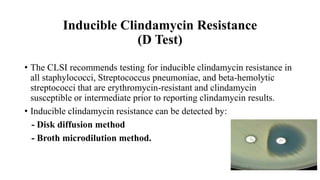
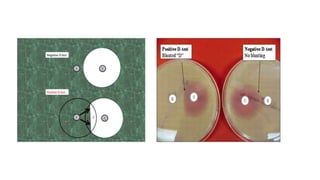
• Inducible clindamycin resistance = flattening of the zone of inhibition adjacent
to the erythromycin disk (D-zone)
• No inducible clindamycin resistance = completely round zone of inhibition
around clindamycin disk
Inducible clindamycin-resistant isolates should be reported as clindamycin-resistant
alongside a comment stating that inducible clindamycin resistance is in vitro results
and clindamycin may still be effective in some patients.
Limitations
• Despite positive results for inducible clindamycin resistance, clindamycin may
still be effective in some patients.
• The D-zone test is only standardized to detect inducible clindamycin resistance for
Staphylococcus spp., S.pneumoniae, and beta-hemolytic Streptococcus.
• Strict adherence to protocol is required to ensure reliable results as numerous
factors such as inoculum size, rate of growth, pH and formulation of media,
incubation condition and duration, disk content, etc can affect the result.

Inducible Clindamycin Resistance Test

  • 1.
    Inducible Clindamycin Resistance Test Dr.Samira Fattah PhD in Medical Bacteriology College of Health Sciences-HMU
  • 2.
    Inducible Clindamycin Resistance (DTest) • The CLSI recommends testing for inducible clindamycin resistance in all staphylococci, Streptococcus pneumoniae, and beta-hemolytic streptococci that are erythromycin-resistant and clindamycin susceptible or intermediate prior to reporting clindamycin results. • Inducible clindamycin resistance can be detected by: - Disk diffusion method - Broth microdilution method.
  • 3.
    Mechanism of Actionof Erythromycin and Clindamycin and Development of Resistance Erythromycin (a macrolide) and clindamycin (a lincosamide) represent two distinct classes of antimicrobial agents that inhibit protein synthesis by binding to the 50S ribosomal subunits of bacterial cells. In staphylococci, resistance to both of these antimicrobial agents can occur through methylation of their ribosomal target site. Such resistance is typically mediated by erm (erythromycin ribosome methylation) genes.
  • 4.
    Clinical Significance ofD Test • Clindamycin is an attractive agent for empirical therapy for suspected S. aureus infections because of its excellent pharmacokinetic and pharmacodynamic properties. Clinical failures of clindamycin therapy for the treatment of MRSA infections have been documented for strains that were clindamycin sensitive but erythromycin resistant. The failures were due to inducible resistance to clindamycin. • In such cases, In vivo, therapy with Clindamycin may select for constitutive erm mutants, which may lead to clinical failure. • Routine antibiotic susceptibility tests cannot identify these strains. The D (inducible clindamycin resistance) test is employed to detect inducible clindamycin resistance.
  • 5.
    Procedure for D-zoneTest • Prepare 0.5 McFarland standard suspension of erythromycin-resistant Staphylococcus aureus isolates using direct colony suspension. • Make a lawn culture of bacteria in agar plates: - Mueller-Hinton agar (MHA) for staphylococci - MHA with 5% sheep blood for streptococci • Put clindamycin (2-μg ) and erythromycin (15-μg ) disks approximately 15 mm apart. For beta-hemolytic streptococci and S. pneumoniae, place disks 12 mm apart. • Invert plates and incubate the plate: - Incubate staphylococci for 16 to 18 h at 35°C in an ambient-air incubator. - Incubate beta-hemolytic streptococci and S. pneumoniae for 20 to 24 h at 35°C in 5% CO2 incubator.
  • 6.
    Interpretation and Reporting •Inducible clindamycin resistance = flattening of the zone of inhibition adjacent to the erythromycin disk (D-zone) • No inducible clindamycin resistance = completely round zone of inhibition around clindamycin disk Inducible clindamycin-resistant isolates should be reported as clindamycin-resistant alongside a comment stating that inducible clindamycin resistance is in vitro results and clindamycin may still be effective in some patients.
  • 8.
    Limitations • Despite positiveresults for inducible clindamycin resistance, clindamycin may still be effective in some patients. • The D-zone test is only standardized to detect inducible clindamycin resistance for Staphylococcus spp., S.pneumoniae, and beta-hemolytic Streptococcus. • Strict adherence to protocol is required to ensure reliable results as numerous factors such as inoculum size, rate of growth, pH and formulation of media, incubation condition and duration, disk content, etc can affect the result.