Methods Of Recording /
Documentation Systems
BY:
Mr. M.Shivananda Reddy
• There are several documentation systems for
recording patient data.
• Regardless whether documentation is entered
electronically or on paper, each health care
agency selects a documentation system that
reflects its philosophy of nursing.
Methods (styles) of documentation:
• Narrative Charting
• Source-Oriented Charting
• Problem-Oriented Charting
• PIE Charting
• Focus Charting
• Charting by Exception (CBE)
• Computerized Documentation
• Case Management with Critical Paths
• Narrative Charting
– Describes the client’s status, interventions and
treatments; response to treatments is in story
format.
– Narrative charting is now being replaced by other
formats.
• Source-Oriented Charting
– Narrative recording by each member (source) of the
health care team on separate records.
– For example the admission department has an
admission sheet, nurses use the nurses’ notes,
physicians have a physician notes, etc….
• Problem-Oriented Charting
– Uses a structured, logical format called S.O.A.P.
• S: subjective data
• O: objective data
• A: assessment (conclusion stated in a form of
nursing diagnoses or client problems)
• P: plan
Recently S.O.A.P. format is modified as
S.O.A.P.I.E.R for better reflecting the nursing
process
• S: subjective data
• O: objective data
• A: assessment (conclusion stated in a form of nursing
diagnoses or client problems)
• P: plan
.I – intervention (specific interventions implemented)
.E – evaluation. Pt response to interventions.
.R – revision. Changes in treatment.
• PIE Charting
– P: Problem statement
– I: Intervention
– E: Evaluation
Example:
– P: Patient reports pain at surgical incision as 7/10 on 0 to 10 scale
– I : Given morphine 1mg IV at 23:35.
– E : Patient reports pain as 1/10 at 23:55.
• Focus Charting
– A method of identifying and organizing the narrative
documentation of all client concerns.
– Uses a columnar format within the progress notes to
distinguish the entry from other recordings in the narrative
notes (Date & Time, Focus, Progress note)
– The progress notes are organized into: Data (D), Action (A),
Response (R).
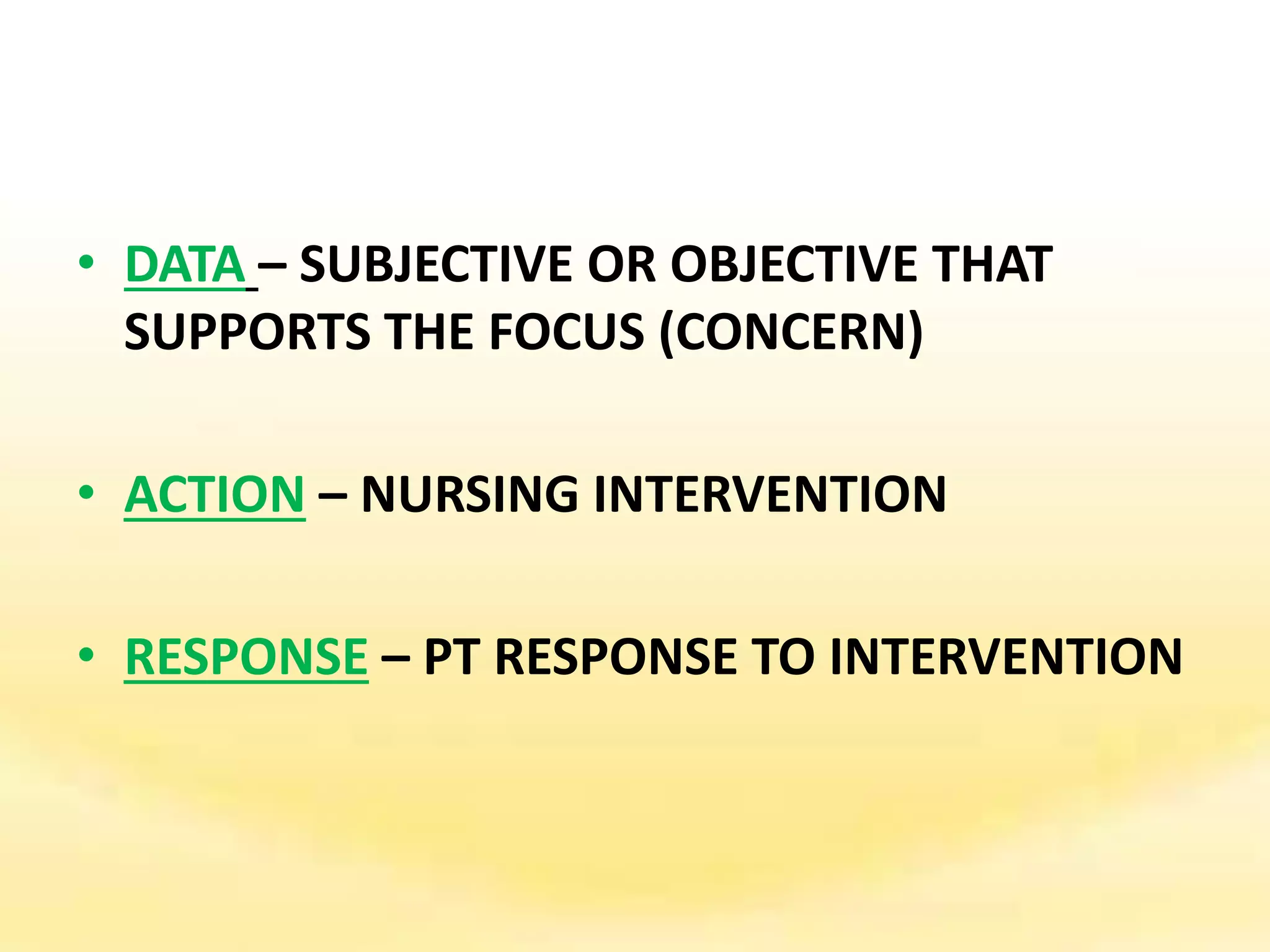
• DATA – SUBJECTIVE OR OBJECTIVE THAT
SUPPORTS THE FOCUS (CONCERN)
• ACTION – NURSING INTERVENTION
• RESPONSE – PT RESPONSE TO INTERVENTION
.
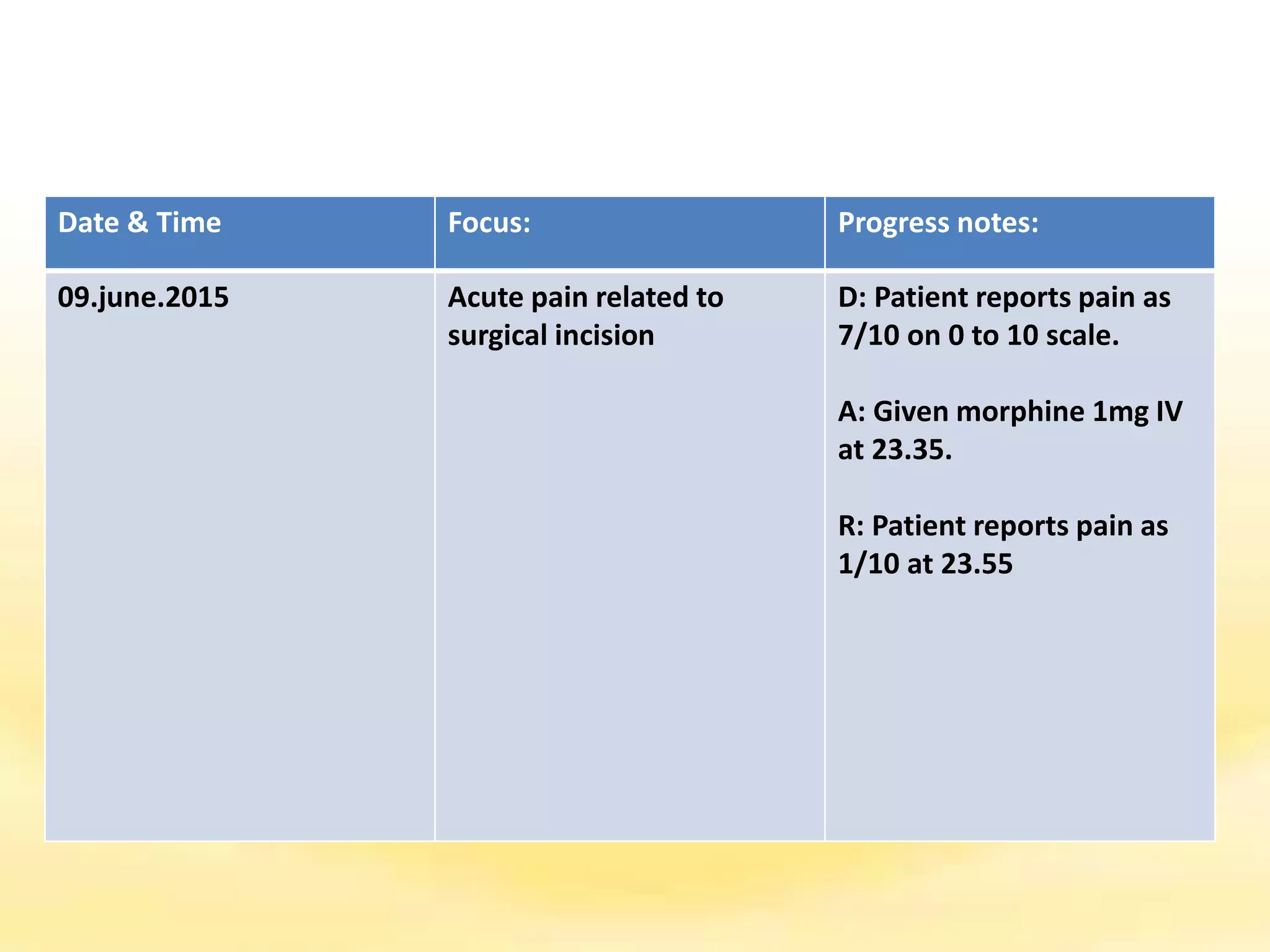
Date & Time Focus: Progress notes:
09.june.2015 Acute pain related to
surgical incision
D: Patient reports pain as
7/10 on 0 to 10 scale.
A: Given morphine 1mg IV
at 23.35.
R: Patient reports pain as
1/10 at 23.55
• Charting by Exception (CBE)
– The nurse documents only deviations from pre-
established norms (document only abnormal or
significant findings).
– Avoids lengthy, repetitive notes.
• Computerized Documentation
– Increases the quality of documentation and save
time.
– Increases legibility and accuracy.
– Facilitates statistical analysis of data.
• Case Management Process
– A methodology for organizing client care through an
illness, using a critical pathway/ standardized care
plan.
– A critical pathway is a multidisciplinary plan or tool
that specifies assessments, interventions, treatments
and outcomes of health related problems a cross a
time line.
Methods of recording

Methods of recording

  • 1.
    Methods Of Recording/ Documentation Systems BY: Mr. M.Shivananda Reddy
  • 2.
    • There areseveral documentation systems for recording patient data. • Regardless whether documentation is entered electronically or on paper, each health care agency selects a documentation system that reflects its philosophy of nursing.
  • 3.
    Methods (styles) ofdocumentation: • Narrative Charting • Source-Oriented Charting • Problem-Oriented Charting • PIE Charting • Focus Charting • Charting by Exception (CBE) • Computerized Documentation • Case Management with Critical Paths
  • 4.
    • Narrative Charting –Describes the client’s status, interventions and treatments; response to treatments is in story format. – Narrative charting is now being replaced by other formats.
  • 5.
    • Source-Oriented Charting –Narrative recording by each member (source) of the health care team on separate records. – For example the admission department has an admission sheet, nurses use the nurses’ notes, physicians have a physician notes, etc….
  • 6.
    • Problem-Oriented Charting –Uses a structured, logical format called S.O.A.P. • S: subjective data • O: objective data • A: assessment (conclusion stated in a form of nursing diagnoses or client problems) • P: plan
  • 7.
    Recently S.O.A.P. formatis modified as S.O.A.P.I.E.R for better reflecting the nursing process • S: subjective data • O: objective data • A: assessment (conclusion stated in a form of nursing diagnoses or client problems) • P: plan .I – intervention (specific interventions implemented) .E – evaluation. Pt response to interventions. .R – revision. Changes in treatment.
  • 8.
    • PIE Charting –P: Problem statement – I: Intervention – E: Evaluation Example: – P: Patient reports pain at surgical incision as 7/10 on 0 to 10 scale – I : Given morphine 1mg IV at 23:35. – E : Patient reports pain as 1/10 at 23:55.
  • 9.
    • Focus Charting –A method of identifying and organizing the narrative documentation of all client concerns. – Uses a columnar format within the progress notes to distinguish the entry from other recordings in the narrative notes (Date & Time, Focus, Progress note) – The progress notes are organized into: Data (D), Action (A), Response (R).
  • 10.
    • DATA –SUBJECTIVE OR OBJECTIVE THAT SUPPORTS THE FOCUS (CONCERN) • ACTION – NURSING INTERVENTION • RESPONSE – PT RESPONSE TO INTERVENTION
  • 11.
    . Date & TimeFocus: Progress notes: 09.june.2015 Acute pain related to surgical incision D: Patient reports pain as 7/10 on 0 to 10 scale. A: Given morphine 1mg IV at 23.35. R: Patient reports pain as 1/10 at 23.55
  • 12.
    • Charting byException (CBE) – The nurse documents only deviations from pre- established norms (document only abnormal or significant findings). – Avoids lengthy, repetitive notes.
  • 13.
    • Computerized Documentation –Increases the quality of documentation and save time. – Increases legibility and accuracy. – Facilitates statistical analysis of data.
  • 14.
    • Case ManagementProcess – A methodology for organizing client care through an illness, using a critical pathway/ standardized care plan. – A critical pathway is a multidisciplinary plan or tool that specifies assessments, interventions, treatments and outcomes of health related problems a cross a time line.