Presented by
Mr.Sachin Chhari
M.Sc (Nursing)
Community health nursing
DEFINITION OF ADMISSION
It is defined as allowing a patient to stay in
hospital for observation, investigation,
treatment and care.
PURPOSE
 To establish guidelines regarding admission of
patients
 To make the patient feel welcome,
comfortable and ease.
 To acquire vital information regarding the
patient.
 To assess the patient from which a nursing
care plan can be initiated and implemented.
PRINCIPLES
 Sudden change or strangeness on the
environment produces fear and anxiety.
 Entering the hospital is a threat to personal
identity.
 People have diversity of habits and mode of
behavior.
 Illness can be novel experience for the
patient and brings stress on his physical and
mental health.
GENERAL INSTRUCTIONS
 To receive the patient and help him to adjust
to the hospital environment.
 To welcome and establish a positive initial
relationship with the patient and relatives.
 To obtain the needed identifying data
concerning the patient.
 To provide immediate care, safety and
comfort.
 To observe, report signs and symptoms and
general conditions of the patient.
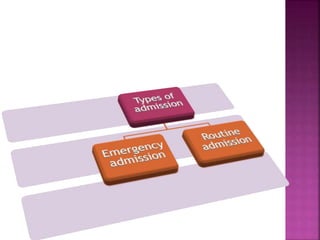
1.Emergency admission –
Immediate treatment
E.g. patient with accidents poisonings, burns
and heart attacks.
2.Routine admission-
The patients admitted for investigation and
medical or surgical treatment
E.g. patients with hypertensions, diabetes and
bronchitis.
EQUIPMENT
 Admission bed
 Thermometer tray, bp apparatus and
stethoscope
 Equipment used for physical examination
such as weighing machine, inch tape
 Admission slips.
 Patients case sheet, doctors, nurses and
progress notes.
 Investigation form-blood, x-ray, urine, stool
and sputum.
 Bath tray if needed.
 Completely record in a file
PROCEDURE
 Greet the patient and his relatives and
introduce yourself to them.
 Receive the patient cordially and self
comfortable.
 Introduce him to other persons in the ward.
 Complete the admission record.
 Collect history and carry out simple physical
examination.
 Carry out the prescribed treatment and keep
a record.
 Help the patient to maintain personal hygiene
and change into hospital cloths.
 Orient the patient to the ward-toilet bathroom,
drinking water supply, nurse’s station and
treatment room.
 Hand over the patients valuable to his relatives.
 Issue visitor pass.
 Encourage patient to take hospital diet
especially when therapeutic diet is ordered.
 Obtain local address or telephone number,
relatives lodge room and document in admission
record.
DEFINITION OF TRANSFER
Transfer is defined as preparing patient,
completing necessary records and shifting
patient to another department within the
hospital or to another hospital.
PURPOSE
 To obtain necessary diagnostic test and
procedure.
 To provide treatment and nursing care.
 To provide specialized care.
 To place most appropriate utilization or
available personal and services.
 To match intensity of nursing care, based on
patients level of needs and problems.
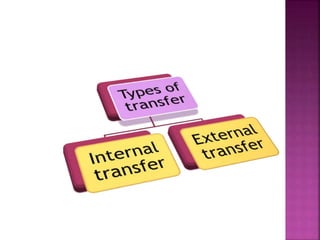
1.Internal transfer:
To transfer the patient in a unit to provide a
special care according the to the need of
patient.
2.External transfer:
To transfer the hospital from one hospital to
another hospital for the purpose of special
care.
PRELIMINARY ASSESSMENT
 Assess the method for transport, inform
receiving nurse.
 Maintain patient’s physical well being during
transport to new nursing unit.
 Provide verbal report about patient’s
conditions to the receiving unit nurse.
 Be sure all documentation including care
plan is completed.
 Assist patient’s arrival to the new unit.
 Announce patient’s arrival to the new unit.
 Transport to new room and assist in transfer
to bed.
 Hand over to receiving nurse.
 EQUIPMENT
 Wheel chair/stretcher
 Identification labels
 Patients belongings
 X-rays
 Investigation reports
 Patient records and file
PROCEDURE
 Transfer to another hospital/department
 Check the doctor’s order for transfer of
patient
 Inform the patient and relatives
 Inform the ward sister where the patient
needs to be transferred
 Check the chart for complete recording of
vital sings, nursing care and treatment given
 Collect patients x-ray medicine and other
belongings
 Cancel the hospital diet or transfer
 Make arrangement to settle the due bills if going to
another hospital
 Record time, mode of transfer and general condition
of the patient
 Assist in transferring silk patient to wheel
chair/stretcher and accompany patient to new area
 Hand over patient documents, belonging and report
verbally to charge nurse/and sister
 Collect the ward articles
 Inform the concern person/department regarding
transfer of the patient
 Clean unit thoroughly and keep ready for next
patient.
DEFINITION OF DISCHARGE
Patient is prepared for discharge when he is
admitted in the hospital. he should be
prepared physically mentally to leave the
hospital or ward.
PURPOSE
 To ensure continuity of care to patient after
discharge.
 To assist patient to complete hospital
formalities before returning home.
 To assist patient to return to a state of
optimal independent living.
 To assist the patient in discharge right in
deciding to leave hospital.
REASON FOR DISCHARGE
 Cured
 Transfer to other hospital
 Discharged at request(DOR)
 Discharged against medical advice(LAMA)
 Death
GENERAL INSTRUCTION
Prepare patient and family during
hospitalization with adequate information in
relation to probable date of discharge,
approximate in patient bill and relevant home
care.
PRELIMINARY ASSESSMENT
Check-
1.The doctor’s written order for discharge.
2.Inform the patient and relative about
discharge.
3.Document relevant discharge information.
DEPARTMENT TO BE INFORMED
 1.Drug return to pharmacy department
 2.Diet cancellation
 3.Oxygen/ventilator charges summary
 4.Accounts department
 5.Billing section.
PROCEDURE
 Check doctors written order for discharge
 Inform patient and relatives about discharge
 Document relevant discharge information
 Make sure all the fees are included such as
special investigation, special matters or
devices, doctors or surgeons fees and
narcotic drug used if any
 Obtain discharge prescription after retaining
the medicines to be continued for that day
and after discharge
 Send chart to billing section with relevant
information
 One bill is ready and chart is received back
in ward, ensure that bill is settled. check the
cashier’s signature in the discharge bill
 Help the patient to obtain discharge
summary, medical certificate and drugs
 Ensure that patient is instructed regarding
medication follow up, out patient visit, etc.
 Accompany the patient up to transport near
exit gate
AFTER DISCHARGE
 Record time and date and condition of the
patient at departure
 Sent chart to medical record department and
inform to the concern department
 After the patient has gone, the bed should
be washed, blankets kept in sunlight,
mackintosh washed and dried
 The room and utensils should be cleaned and
kept reedy for next
 Incase of infected cases, utensils should be
disinfected and then cleaned the linen
should be disinfected and then send to
laundry
 When discharging the medico legal cases, the
patient dead body should be handed over to
the police, before the concerning station
should be informed about the patient’s
discharge/death
 Patient or dead body is hand over to the
police and ask the police to sign with the
date and time
DISCHARGE TEACHING GOALS
 Understand his illness
 Complies with his drug therapy
 Carefully follows his diet
 Manages his activity level
 Understand his treatments
 Recognizes his need for rest
 Knows about possible complications
 Knows when to seek follow up care
Admission and discharge