
DOCUMENTATION &
REPORTING
PREPARED BY;
MR. VIVEK BHATT M.Sc.(N.)
Reporting and recording are the major
communication techniques used by health
care providers.
DOCUMENTATION serves as a permanent
record of client information and care.
REPORTING takes place when two or
more people share information about client
care, either face to face or by telephone
Documentation as Communication
Documentation is defined as written
evidence of:
• The interactions between and among
health professionals, clients, their families,
and health care organizations.
• The administration of tests, procedures,
treatments, and client education.
• The results or client’s response to these
diagnostic tests and interventions.
PURPOSES OF CLIENT’S RECORD CHART
1. Communication. Provides efficient and effective
method of sharing information..
2. Legal Documentation. It is admissible as
evidence in a court of law.
3. Research. Provides valuable health-related data
for research.
4. Statistics. Provides statistical information that can
be utilized for planning people’s future needs.
5. Education. Serves as an educational tool for
students in health discipline.
6. Audit & Quality Assurance. Monitors the
quality of care received by the client and the
competence of care received by the client and
the competence of health care givers.
7. Planning Client Care. Provides data which
the entire health team uses to plan care for the
client.
8. Reimbursement. Provides the basis for
decisions regarding care to be provided and
subsequent reimbursement to the agency, to
cover health- related expenses.
Types of Medical Records
Components of medical record:-
Patient identification & demographic data
Present complains
Informed consent for treatment & procedure
Admission nursing history
Family history
Physical examination finding
Medical history
Tentative history
Medical diagnosis
Therapeutic order
Treatment given
Medical progress notes
Supportive care given
Reports of diagnosis studies
Final diagnosis Patient education
Summary of operative procedures
Discharge plan and summary
Any specific instructions
Types of Nursing Records
Admission nursing assessment
Nursing care plan
Pertinent information about patient
Medication with date of order & time of administration
Daily treatment & procedures Flow chart
Graphic record (TPRBP) Fluid balance record
Medication Skin assessment record
Progress notes
Legal and Practice Standards
Informed consent means that the client understands the reasons
and risks of the proposed intervention.
Witnessing confirms that the person who signs the consent is
competent.
Elements of Effective Documentation
Use of Common Vocabulary
Legibility
Abbreviations and Symbols
Organization
Accuracy
Documenting a Medication Error
Confidentiality
Factual
Complete
Current
Organized
Use of Common Vocabulary • Improves communication and
lessens the chance of misunderstanding between members of
the health team.
Legibility • Print if necessary. • Do not erase or obliterate writing.
• State the reason for the error. • Sign and date the correction.
Concepts of Nursing-NUR 123 Elements of Effective Documentation
Correcting a documentation error
Abbreviations and Symbols • Always refer to the facility’s
approved listing. • Avoid abbreviations that can be misunderstood.
Organization • Start every entry with the date and time. • Chart in
chronological order. • Chart medications immediately after
administration. • Sign your name after each entry.
Accuracy • Use descriptive terms to chart exactly what was
observed or done. • Use correct spelling and grammar. • Write
complete sentences.
Documenting a Medication Error • Document in the nurses’ progress
notes: - Name and dosage of the medication - Name of the practitioner who
was notified of the error - Time of the notification - Nursing interventions or
medical treatment - Client’s response to treatment
Confidentiality • The nurse is responsible for protecting the privacy and
confidentiality of client interactions, assessments, and care.
Factual:- • A factual record contains descriptive, objective information
about what a nurse sees, hears, feels & smells. • An objective description is
the result of direct observation & measurement. Elements of Effective
Documentation
Complete:- • The information within a recorded entry or a record must be
complete, containing appropriate and essential information.
Current:- • Timely entries are essential in a patient’s ongoing care. Delays
in documentation leads to unsafe patient care. • Health organizations use
military time to avoid misinterpretation of AM & PM.
Current • Following activities should enter timely :-
Vital signs,
Pain assessment,
Administration of medication & treatment,
Preparation for diagnostic test or surgery,
Change in patient’s status & who notified,
Admission, transfer, discharge or death of the patient,
Patient’s response to treatment
Organized:- • Communicate information in a logical order.
• It is effective when notes are concise, clear, & to the point Elements
of Effective Documentation
TYPES OF RECORDING
• Types of records
• Patient clinical records
• Individual staff records
• Ward records
• Administrative records with educational
value
Common ward records
• Patient clinical records
• Staff attendance record
• Staff leave record
• Staff patient assignment record
• Student attendance and patient assignment record
• Ward indent record
• Ward inventory record
• Equipment maintenance record
• Ward incidence record
• Infection surveillance record
• Ward quality indicator record
• Ward diet supply record
• Emergency drug and crash card record
• Patient admission/discharge/shift record
Methods of Documentation
Narrative Charting
Source-Oriented Charting
Problem-Oriented Charting
PIE Charting
Focus Charting
Charting by Exception (CBE)
Computerized Documentation
Case Management with Critical Path
Narrative Charting (TRADITIONAL CLIENT RECORD)
• Describes the client’s status, interventions and
treatments; response to treatments is in story format.
• Narrative charting is now being replaced by other
formats.
• Five Basic components of a Traditional Client Record
Admission sheet
Physician’s order sheet
Medical history
Nurse’s notes
Special records and reports (referrals, X-ray, reports,
laboratory findings, report of surgery, anesthesia record,
flow sheets, vital signs, I&O
Source-Oriented Charting
• Each person or department makes notations in a
separate section/s of the client’s chart.
• Narrative recording by each member (source) of the
health care team on separate records.
• Most Traditional
• Different disciplines chart on separate forms
• Each reader must consult various parts of the record to
get a complete picture
• Records become bulky
• For example the admission department has an
admission sheet, nurses use the nurses’ notes, physicians
have a physician notes, etc…
PROBLEM-ORIENTED MEDICAL RECORD( POMR)
/NURSE’S OR NARRATIVE Notes (Soapie Format)
• Uses A Structured, Logical Format Called S.O.A.P.
S- Subjective. What Pt. Tells You.
0 – Objective. What You Observe, See.
A – Assessment. What You Think Is Going On Based On Your
Data.
P – Plan. What You Are Going To Do.
CAN ADD TO BETTER REFLECT NURSING PROCESS
I – Intervention (Specific Interventions Implemented)
E – Evaluation. Pt Response To Interventions.
R – Revision. Changes In Treatment.
Uses Flow Sheets To Record Routine Care.
Soap Entries Are Usually Made At Least Every 24 Hours On Any
Unresolved Problem.
PIE Charting
• P: Problem statement
• I: Intervention
• E: Evaluation
Example: • P: Patient reports pain at surgical
incision as 7/10 on 0 to 10 scale
• I : Given morphine 1mg IV at 23:35.
• E : Patient reports pain as 1/10 at 23:55.
Focus Charting (DAR)
• A method of identifying and organizing the narrative documentation
of all client concerns. • Uses a columnar format within the progress
notes to distinguish the entry from other recordings in the narrative
notes (Date & Time, Focus, Progress note)
Data – Subjective Or Objective That Supports The Focus (Concern)
Action – Nursing Intervention
Response – Pt. Response To Intervention
Ex: D – Complaining Of Pain At Incision Site , Ps: 7/10
A – Repositioned For Comfort. Demerol 50mg Im Given.
R – States A Decrease In Pain, “Feels Much Better.”
Example of focus charting Date & Time Focus:
Progress notes: 09.Sep.2013 Acute pain related to surgical
incision
D: Patient reports pain as 7/10 on 0 to 10 scale.
A: Given morphine 1mg IV at 23:35.
R: Patient reports pain as 1/10 at 23:55.
Charting by Exception (CBE)
• The nurse documents only deviations from pre-established norms
(document only abnormal or significant findings).
• Avoids lengthy, repetitive notes.
Computerized Documentation
• Increases the quality of documentation and save time. • Increases
legibility and accuracy. • Facilitates statistical analysis of data.
Case Management Process
• A methodology for organizing client care through an illness, using
a critical pathway. • A critical pathway is a multidisciplinary plan or
tool that specifies assessments, interventions, treatments and
outcomes of health related problems a cross a time line.
Forms for Recording Data
Kardex
Flow Sheets
Nurses’ Progress Notes
Discharge Summary
The Kardex Is Used As A Reference Throughout The Shift And
During Change-of-shift Reports.
• Client Data (E.G Name, Age, Admission Date, Allergy)
• Medical Diagnoses And Nursing Diagnoses
• Medical Orders, List Of Medications
• Activities, Diagnostic Tests, Or Specific Data On The Pt.
1. Provides A Concise Method Of Organizing And Recording Data About A Client,
Making Information Readily Accessible To All Members Of The Health Team.
2. It Is A Series Of Flip Cards Usually Kept In Portable File.
3. It Is A Way To Ensure Continuity Of Care From One Shift To Another And From
One Day To The Next.
4. It Is A Tool For Change – Of – Shift Report. But Endorsement Is Not Simply
Reciting Content Of Kardex. Health Care Needs Of The Client Is Still Primary
Basis For Endorsement.
Usually include the following data:
• Personal data
• Basic needs
• Allergies
• Diagnostic tests
•Daily nursing procedures
• Medications and intravenous (IV) therapy, blood transfusions
• Treatments like oxygen therapy, steam inhalation, suctioning,
change of dressings, mechanical ventilation.
Entries usually written in pencil. This implies the kardex is for
planning and communication purpose only.
Flow Sheets
The information on flow sheets can be formatted to meet the
specific needs of the client.
(e.g.: graphic sheets for vital signs, intake & output record, skin
assessment record).
Nurses’ Progress Notes
Used to document the client’s condition, problems and
complaints, interventions, responses, achievement of outcomes.
Discharge Summary
• Client’s status at admission and discharge.
• Brief summary of client’s care.
• Interventions and education outcomes.
• Resolved problems and continuing need.
• Referrals.
• Client instructions.
Reporting
• Verbal communication of data regarding
the client’s health status, needs, treatments,
outcomes, and responses
• Reporting is based on the nursing process.
Types of reporting
Summary / Hand-Off Reports
Walking Rounds Reports
Incident or Occurrence Reports
Telephone Reports and Orders
1. Summary / Hand-Off Reports Commonly occur at change of
shift (or when client care is transfers to another health care
provider).
2. Walking Rounds Reports Occur in the client’s room Include
Nursing, physician, interdisciplinary team.
3. Incident or Occurrence Reports Used to document any unusual
occurrence or accident in the delivery of client care.
3. Telephone Reports and Orders • Provide clear accurate and concise
information • The nurse documents telephone report by including the
following information:
- when the call was made
- who made the call/report
- - who was called
- - to whom information was given
- - what information was given - what information was received
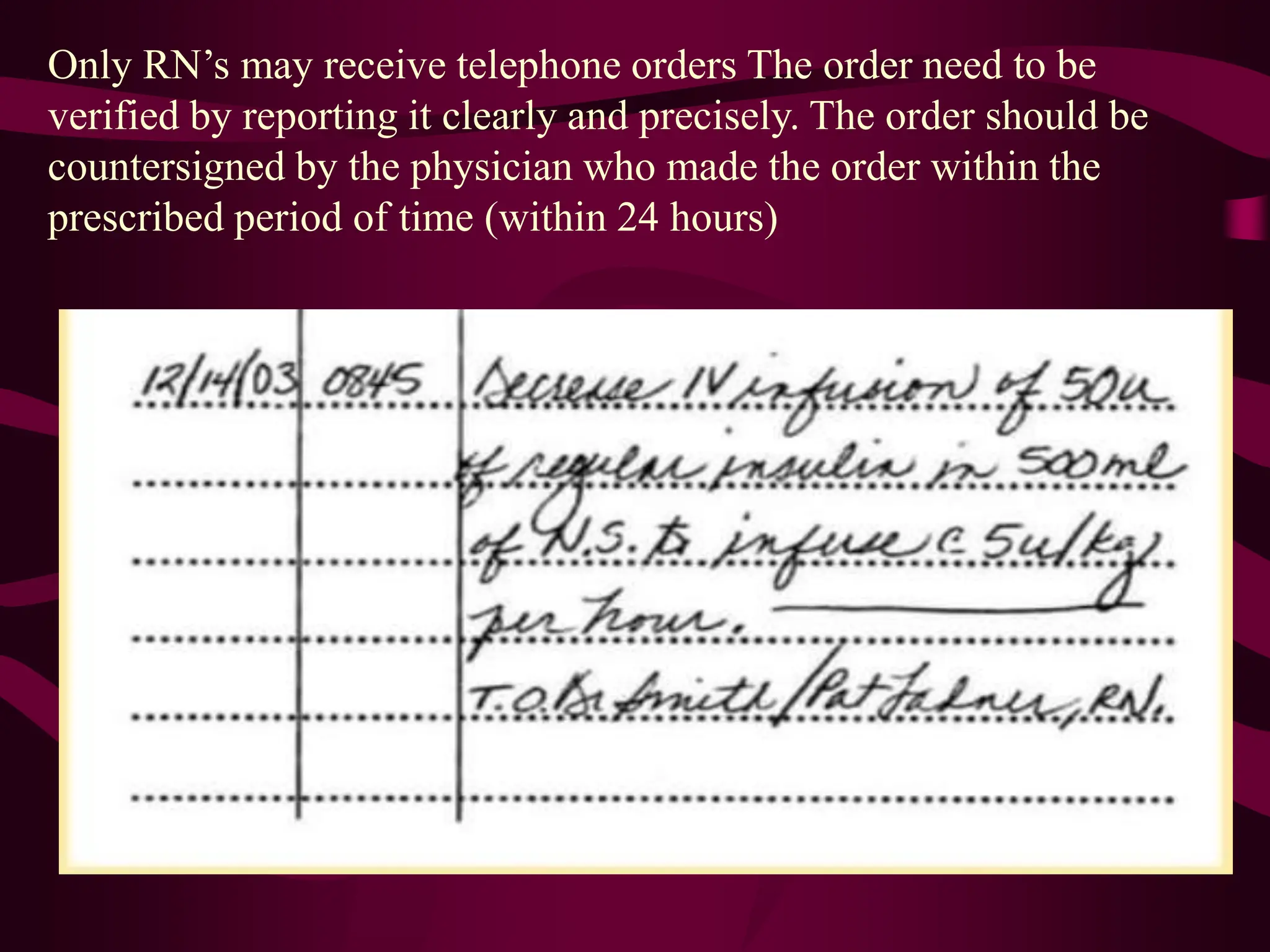
Only RN’s may receive telephone orders The order need to be
verified by reporting it clearly and precisely. The order should be
countersigned by the physician who made the order within the
prescribed period of time (within 24 hours)
GENERAL DOCUMENTATION GUIDELINES
• Ensure that you have the correct client record or chart.
• Document as soon as the client encounter is concluded to ensure
accurate recall of data.
• Date and time of each entry.
• Sign each entry with your full legal name and with your
professional credentials.
• Do not leave space in between entries.
• If an error is made while documenting, use a single line to cross
out the error, then date, time and sign the correction
• Never change another person’s entry even if it is incorrect
• Use quotation marks to indicate direct client responses.
• Document in chronological order
• Use permanent ink
• Document all telephone calls that you received that are related to
client’s case.
Minimizing legal liability through effective record keeping
Date & time
Timing
Legibility
Permanence
Correct spelling
Signature
Accuracy
Sequence
Appropriateness
Completeness
Conciseness
Accepted terminology
24 Hour Time formate
CORRECTING ERRORS
If You Spill Something On The Chart, Do Not Discard Notes.
Recopy, Put Original And Copied Sheets In Chart. Write “Copied” On
Copy.
Do Not Scribble Out Charting.
Avoid Using “Error” Or “Wrong Patient” When Making Correction.
Follow Your Facilities Policy.
Do Not Alter Charting, It Is A Legal Document.
*Correct Errors By Drawing A Single Horizontal Line
*Through The Error
*Write The Word Error Above The Line, Then Sign
*Your Signature
*No Ink Eradication, Erasures Or Use Of Occlusive Materials.
THANK
YOU!

documentation and reporting bsc nursing FUNDAMENTAL OF NURSING

  • 1.
  • 2.
    Reporting and recordingare the major communication techniques used by health care providers. DOCUMENTATION serves as a permanent record of client information and care. REPORTING takes place when two or more people share information about client care, either face to face or by telephone
  • 3.
    Documentation as Communication Documentationis defined as written evidence of: • The interactions between and among health professionals, clients, their families, and health care organizations. • The administration of tests, procedures, treatments, and client education. • The results or client’s response to these diagnostic tests and interventions.
  • 4.
    PURPOSES OF CLIENT’SRECORD CHART 1. Communication. Provides efficient and effective method of sharing information.. 2. Legal Documentation. It is admissible as evidence in a court of law. 3. Research. Provides valuable health-related data for research. 4. Statistics. Provides statistical information that can be utilized for planning people’s future needs. 5. Education. Serves as an educational tool for students in health discipline.
  • 5.
    6. Audit &Quality Assurance. Monitors the quality of care received by the client and the competence of care received by the client and the competence of health care givers. 7. Planning Client Care. Provides data which the entire health team uses to plan care for the client. 8. Reimbursement. Provides the basis for decisions regarding care to be provided and subsequent reimbursement to the agency, to cover health- related expenses.
  • 6.
    Types of MedicalRecords Components of medical record:- Patient identification & demographic data Present complains Informed consent for treatment & procedure Admission nursing history Family history Physical examination finding Medical history Tentative history Medical diagnosis Therapeutic order Treatment given Medical progress notes Supportive care given Reports of diagnosis studies Final diagnosis Patient education Summary of operative procedures Discharge plan and summary Any specific instructions
  • 7.
    Types of NursingRecords Admission nursing assessment Nursing care plan Pertinent information about patient Medication with date of order & time of administration Daily treatment & procedures Flow chart Graphic record (TPRBP) Fluid balance record Medication Skin assessment record Progress notes Legal and Practice Standards Informed consent means that the client understands the reasons and risks of the proposed intervention. Witnessing confirms that the person who signs the consent is competent.
  • 8.
    Elements of EffectiveDocumentation Use of Common Vocabulary Legibility Abbreviations and Symbols Organization Accuracy Documenting a Medication Error Confidentiality Factual Complete Current Organized
  • 9.
    Use of CommonVocabulary • Improves communication and lessens the chance of misunderstanding between members of the health team. Legibility • Print if necessary. • Do not erase or obliterate writing. • State the reason for the error. • Sign and date the correction. Concepts of Nursing-NUR 123 Elements of Effective Documentation Correcting a documentation error Abbreviations and Symbols • Always refer to the facility’s approved listing. • Avoid abbreviations that can be misunderstood. Organization • Start every entry with the date and time. • Chart in chronological order. • Chart medications immediately after administration. • Sign your name after each entry. Accuracy • Use descriptive terms to chart exactly what was observed or done. • Use correct spelling and grammar. • Write complete sentences.
  • 10.
    Documenting a MedicationError • Document in the nurses’ progress notes: - Name and dosage of the medication - Name of the practitioner who was notified of the error - Time of the notification - Nursing interventions or medical treatment - Client’s response to treatment Confidentiality • The nurse is responsible for protecting the privacy and confidentiality of client interactions, assessments, and care. Factual:- • A factual record contains descriptive, objective information about what a nurse sees, hears, feels & smells. • An objective description is the result of direct observation & measurement. Elements of Effective Documentation Complete:- • The information within a recorded entry or a record must be complete, containing appropriate and essential information. Current:- • Timely entries are essential in a patient’s ongoing care. Delays in documentation leads to unsafe patient care. • Health organizations use military time to avoid misinterpretation of AM & PM.
  • 11.
    Current • Followingactivities should enter timely :- Vital signs, Pain assessment, Administration of medication & treatment, Preparation for diagnostic test or surgery, Change in patient’s status & who notified, Admission, transfer, discharge or death of the patient, Patient’s response to treatment Organized:- • Communicate information in a logical order. • It is effective when notes are concise, clear, & to the point Elements of Effective Documentation
  • 12.
    TYPES OF RECORDING •Types of records • Patient clinical records • Individual staff records • Ward records • Administrative records with educational value
  • 13.
    Common ward records •Patient clinical records • Staff attendance record • Staff leave record • Staff patient assignment record • Student attendance and patient assignment record • Ward indent record • Ward inventory record • Equipment maintenance record • Ward incidence record • Infection surveillance record • Ward quality indicator record • Ward diet supply record • Emergency drug and crash card record • Patient admission/discharge/shift record
  • 14.
    Methods of Documentation NarrativeCharting Source-Oriented Charting Problem-Oriented Charting PIE Charting Focus Charting Charting by Exception (CBE) Computerized Documentation Case Management with Critical Path
  • 15.
    Narrative Charting (TRADITIONALCLIENT RECORD) • Describes the client’s status, interventions and treatments; response to treatments is in story format. • Narrative charting is now being replaced by other formats. • Five Basic components of a Traditional Client Record Admission sheet Physician’s order sheet Medical history Nurse’s notes Special records and reports (referrals, X-ray, reports, laboratory findings, report of surgery, anesthesia record, flow sheets, vital signs, I&O
  • 16.
    Source-Oriented Charting • Eachperson or department makes notations in a separate section/s of the client’s chart. • Narrative recording by each member (source) of the health care team on separate records. • Most Traditional • Different disciplines chart on separate forms • Each reader must consult various parts of the record to get a complete picture • Records become bulky • For example the admission department has an admission sheet, nurses use the nurses’ notes, physicians have a physician notes, etc…
  • 17.
    PROBLEM-ORIENTED MEDICAL RECORD(POMR) /NURSE’S OR NARRATIVE Notes (Soapie Format) • Uses A Structured, Logical Format Called S.O.A.P. S- Subjective. What Pt. Tells You. 0 – Objective. What You Observe, See. A – Assessment. What You Think Is Going On Based On Your Data. P – Plan. What You Are Going To Do. CAN ADD TO BETTER REFLECT NURSING PROCESS I – Intervention (Specific Interventions Implemented) E – Evaluation. Pt Response To Interventions. R – Revision. Changes In Treatment. Uses Flow Sheets To Record Routine Care. Soap Entries Are Usually Made At Least Every 24 Hours On Any Unresolved Problem.
  • 18.
    PIE Charting • P:Problem statement • I: Intervention • E: Evaluation Example: • P: Patient reports pain at surgical incision as 7/10 on 0 to 10 scale • I : Given morphine 1mg IV at 23:35. • E : Patient reports pain as 1/10 at 23:55.
  • 19.
    Focus Charting (DAR) •A method of identifying and organizing the narrative documentation of all client concerns. • Uses a columnar format within the progress notes to distinguish the entry from other recordings in the narrative notes (Date & Time, Focus, Progress note) Data – Subjective Or Objective That Supports The Focus (Concern) Action – Nursing Intervention Response – Pt. Response To Intervention Ex: D – Complaining Of Pain At Incision Site , Ps: 7/10 A – Repositioned For Comfort. Demerol 50mg Im Given. R – States A Decrease In Pain, “Feels Much Better.” Example of focus charting Date & Time Focus: Progress notes: 09.Sep.2013 Acute pain related to surgical incision D: Patient reports pain as 7/10 on 0 to 10 scale. A: Given morphine 1mg IV at 23:35. R: Patient reports pain as 1/10 at 23:55.
  • 20.
    Charting by Exception(CBE) • The nurse documents only deviations from pre-established norms (document only abnormal or significant findings). • Avoids lengthy, repetitive notes. Computerized Documentation • Increases the quality of documentation and save time. • Increases legibility and accuracy. • Facilitates statistical analysis of data. Case Management Process • A methodology for organizing client care through an illness, using a critical pathway. • A critical pathway is a multidisciplinary plan or tool that specifies assessments, interventions, treatments and outcomes of health related problems a cross a time line.
  • 21.
    Forms for RecordingData Kardex Flow Sheets Nurses’ Progress Notes Discharge Summary
  • 22.
    The Kardex IsUsed As A Reference Throughout The Shift And During Change-of-shift Reports. • Client Data (E.G Name, Age, Admission Date, Allergy) • Medical Diagnoses And Nursing Diagnoses • Medical Orders, List Of Medications • Activities, Diagnostic Tests, Or Specific Data On The Pt. 1. Provides A Concise Method Of Organizing And Recording Data About A Client, Making Information Readily Accessible To All Members Of The Health Team. 2. It Is A Series Of Flip Cards Usually Kept In Portable File. 3. It Is A Way To Ensure Continuity Of Care From One Shift To Another And From One Day To The Next. 4. It Is A Tool For Change – Of – Shift Report. But Endorsement Is Not Simply Reciting Content Of Kardex. Health Care Needs Of The Client Is Still Primary Basis For Endorsement.
  • 23.
    Usually include thefollowing data: • Personal data • Basic needs • Allergies • Diagnostic tests •Daily nursing procedures • Medications and intravenous (IV) therapy, blood transfusions • Treatments like oxygen therapy, steam inhalation, suctioning, change of dressings, mechanical ventilation. Entries usually written in pencil. This implies the kardex is for planning and communication purpose only.
  • 24.
    Flow Sheets The informationon flow sheets can be formatted to meet the specific needs of the client. (e.g.: graphic sheets for vital signs, intake & output record, skin assessment record). Nurses’ Progress Notes Used to document the client’s condition, problems and complaints, interventions, responses, achievement of outcomes. Discharge Summary • Client’s status at admission and discharge. • Brief summary of client’s care. • Interventions and education outcomes. • Resolved problems and continuing need. • Referrals. • Client instructions.
  • 25.
    Reporting • Verbal communicationof data regarding the client’s health status, needs, treatments, outcomes, and responses • Reporting is based on the nursing process.
  • 26.
    Types of reporting Summary/ Hand-Off Reports Walking Rounds Reports Incident or Occurrence Reports Telephone Reports and Orders
  • 27.
    1. Summary /Hand-Off Reports Commonly occur at change of shift (or when client care is transfers to another health care provider). 2. Walking Rounds Reports Occur in the client’s room Include Nursing, physician, interdisciplinary team. 3. Incident or Occurrence Reports Used to document any unusual occurrence or accident in the delivery of client care. 3. Telephone Reports and Orders • Provide clear accurate and concise information • The nurse documents telephone report by including the following information: - when the call was made - who made the call/report - - who was called - - to whom information was given - - what information was given - what information was received
  • 28.
    Only RN’s mayreceive telephone orders The order need to be verified by reporting it clearly and precisely. The order should be countersigned by the physician who made the order within the prescribed period of time (within 24 hours)
  • 29.
    GENERAL DOCUMENTATION GUIDELINES •Ensure that you have the correct client record or chart. • Document as soon as the client encounter is concluded to ensure accurate recall of data. • Date and time of each entry. • Sign each entry with your full legal name and with your professional credentials. • Do not leave space in between entries. • If an error is made while documenting, use a single line to cross out the error, then date, time and sign the correction • Never change another person’s entry even if it is incorrect • Use quotation marks to indicate direct client responses. • Document in chronological order • Use permanent ink • Document all telephone calls that you received that are related to client’s case.
  • 30.
    Minimizing legal liabilitythrough effective record keeping Date & time Timing Legibility Permanence Correct spelling Signature Accuracy Sequence Appropriateness Completeness Conciseness Accepted terminology 24 Hour Time formate
  • 31.
    CORRECTING ERRORS If YouSpill Something On The Chart, Do Not Discard Notes. Recopy, Put Original And Copied Sheets In Chart. Write “Copied” On Copy. Do Not Scribble Out Charting. Avoid Using “Error” Or “Wrong Patient” When Making Correction. Follow Your Facilities Policy. Do Not Alter Charting, It Is A Legal Document. *Correct Errors By Drawing A Single Horizontal Line *Through The Error *Write The Word Error Above The Line, Then Sign *Your Signature *No Ink Eradication, Erasures Or Use Of Occlusive Materials.
  • 32.