NON PROJECTED AV AIDS
BY
TAMOOR ZULFIQUAR
LIST OF TOPICS
 Audio Visual Aids
 Definitions
 Classification
 Projected AV Aids
 Non Projected
 Charts
 Diagrams
 Posters
 Flash Cards
 Graphs
 Maps
 Cartoons
 Newspapers
 Comic Strips
 Moulage
 Puppets
 Display Boards
 Models
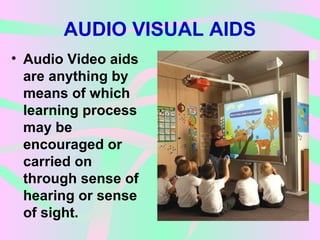
AUDIO VISUAL AIDS
• Audio Video aids
are anything by
means of which
learning process
may be
encouraged or
carried on
through sense of
hearing or sense
of sight.
AV AIDS - DEFENITIONS
• Audio-Visual Aids are those sensory
objects or images which initiate or
stimulate and reinforce learning.
(Burton)
AV AIDS - DEFENITIONS
• Audio-Visual Aids are any device
which can be used to make the
learning experience more concrete,
more realistic and more dynamic.
(Kinder s James)
• Audio-Visual Aids are those devices by the
use of which communications of ideas
between persons and groups in various
teaching and training situations is helped.
These are also termed as multi sensory
materials.
(Edgar Dale)
AV AIDS - DEFENITIONS
CLASSIFICATION OF AV AIDS
1. PROJECTED AIDS
2. NON-PROJECTED AIDS
SOME PROJECTED AV AIDS
 Over Head Projection
 Over Head Transparencies
 Opaque Projection
 Slide Projector
 Filmstrips
 Movies
SOME NON-PROJECTED AIDS
 Charts
 Diagrams
 Posters
 Flash Cards
 Graphs
 Maps
 Cartoons
 Newspapers
 Comic Strips
 Moulage
 Puppets
 Display Boards
 Models
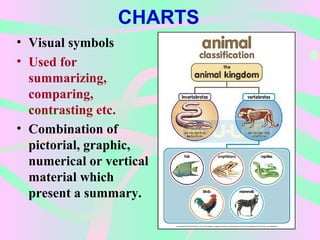
CHARTS
• Visual symbols
• Used for
summarizing,
comparing,
contrasting etc.
• Combination of
pictorial, graphic,
numerical or vertical
material which
present a summary.
TYPES OF CHARTS
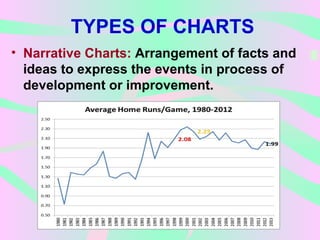
• Narrative Charts: Arrangement of facts and
ideas to express the events in process of
development or improvement.
TYPES OF CHARTS
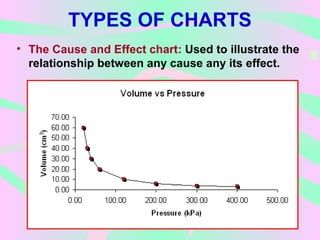
• The Cause and Effect chart: Used to illustrate the
relationship between any cause any its effect.
TYPES OF CHARTS
• The chain chart: Arrangement of facts
and ides to for expressing a cycle.
TYPES OF CHARTS
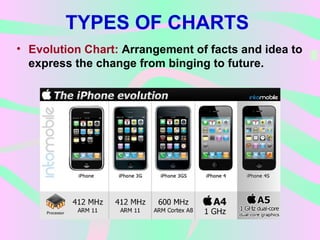
• Evolution Chart: Arrangement of facts and idea to
express the change from binging to future.
TYPES OF CHARTS
• Flow Chart: Used to show organizational
elements or functional relationship using
lines, boxes, circles etc.
TYPES OF CHARTS
• Flip charts: A
series of charts
on a topic
tagged together
on a sporting
stand. It convey
a message in a
sequence.
TYPES OF CHARTS
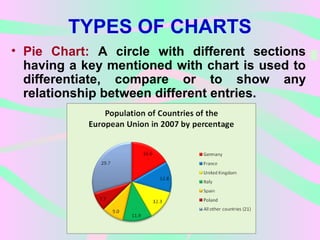
• Pie Chart: A circle with different sections
having a key mentioned with chart is used to
differentiate, compare or to show any
relationship between different entries.
DIAGRAMS
• Diagrams are used to label different
elements or parts of main topic.
POSTERS
• Posters are
Graphic aids
with short,
quick and
typical
message.
• Attention
capturing
paintings.
FLASFH CARDS
• Set of pictured cards of varying sizes.
• Flashed one by one in an order.
GRAPHS
• Represents statistical data
• Contrasting the trends or changes of
certain attributes
TYPES OF GRAPHS
• Bar Graph: the graphical representation extends
the scale along the length of bar. These graphs are
in two forms; horizontally and vertically.
TYPES OF GRAPHS
• Line Graph: Used to show the trends and
relationships through lines
TYPES OF GRAPHS
• Pictorial Graph: Pictures are used to illustrate any
idea, observation or measurement, graphically
TYPES OF GRAPHS
• Pie Graph: A circle diagram in which data
is presented through sections or portions.
MAPS
• Represents the proportionality as a
diagram, the surface of the earth, world or
parts there of.
• Conveys the message by lines, symbols,
words and colors.
TYPES OF MAP
• Political Maps
• Physical Maps
• Relief Maps
• Weather Maps
• Population Maps
• Tourist Maps
• Road Maps
• Railway Maps
• Air Maps
• Sea Root Maps
CARTOONS
• Humorous
caricature which
gives a subtle
message
• Preparatory
drawing for a
piece of art such
as painting
NEWS PAPERS
• Set of written messages and news in local
language which can reach to the public
easily
COMIC STRIPS
• Graphic representation in a series of
pictures or sketches
• Full of action.
PUPPETS
• Manipulates doll dressed as a character
and the performer is a person termed as a
puppeteer. Used in language teaching and
social sciences .
TYPES OF PUPPETS
• String Puppets
TYPES OF PUPPETS
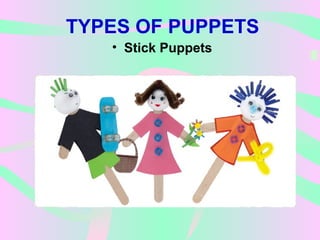
• Stick Puppets
TYPES OF PUPPETS
• Shadow Puppets
TYPES OF PUPPETS
• Finger of Hand Puppets
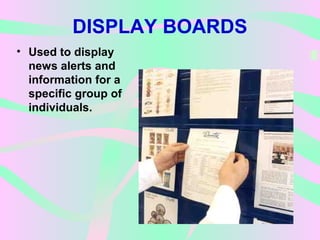
DISPLAY BOARDS
• Used to display
news alerts and
information for a
specific group of
individuals.
TYPES OF BOARDS:
• Chalk board
• White Board
• Flannel Board
• Bulletin Board
• Peg Board
• Magnetic Board
MODELS
• Recognizable representation of a real
thing three dimensionally
• Height, width, depth is felt as reality
TYPES OF MODELS
• Solid Models
• Cut-way and x-ray models
• Working models
• Sand models
REFERENCES
• B.T. Bavantappas “Nursing Education”, first
edition, 2003, Jaypee Brothers Publication, New
Delhi, India.
• http//:monroecc.edu/manila/webfiles/pbrunett/a
udiovisual.pdf
• http//:www.unesco.org/education/nfsunesco/pdf/LE
STAG_E.PDF
• http//:wp.lps.org/jholbei/files/2012/03/Visual-
Aids.pdf
Non Projected AV Aids

Non Projected AV Aids

  • 1.
    NON PROJECTED AVAIDS BY TAMOOR ZULFIQUAR
  • 2.
    LIST OF TOPICS Audio Visual Aids  Definitions  Classification  Projected AV Aids  Non Projected  Charts  Diagrams  Posters  Flash Cards  Graphs  Maps  Cartoons  Newspapers  Comic Strips  Moulage  Puppets  Display Boards  Models
  • 3.
    AUDIO VISUAL AIDS •Audio Video aids are anything by means of which learning process may be encouraged or carried on through sense of hearing or sense of sight.
  • 4.
    AV AIDS -DEFENITIONS • Audio-Visual Aids are those sensory objects or images which initiate or stimulate and reinforce learning. (Burton)
  • 5.
    AV AIDS -DEFENITIONS • Audio-Visual Aids are any device which can be used to make the learning experience more concrete, more realistic and more dynamic. (Kinder s James)
  • 6.
    • Audio-Visual Aidsare those devices by the use of which communications of ideas between persons and groups in various teaching and training situations is helped. These are also termed as multi sensory materials. (Edgar Dale) AV AIDS - DEFENITIONS
  • 7.
    CLASSIFICATION OF AVAIDS 1. PROJECTED AIDS 2. NON-PROJECTED AIDS
  • 8.
    SOME PROJECTED AVAIDS  Over Head Projection  Over Head Transparencies  Opaque Projection  Slide Projector  Filmstrips  Movies
  • 9.
    SOME NON-PROJECTED AIDS Charts  Diagrams  Posters  Flash Cards  Graphs  Maps  Cartoons  Newspapers  Comic Strips  Moulage  Puppets  Display Boards  Models
  • 10.
    CHARTS • Visual symbols •Used for summarizing, comparing, contrasting etc. • Combination of pictorial, graphic, numerical or vertical material which present a summary.
  • 11.
    TYPES OF CHARTS •Narrative Charts: Arrangement of facts and ideas to express the events in process of development or improvement.
  • 12.
    TYPES OF CHARTS •The Cause and Effect chart: Used to illustrate the relationship between any cause any its effect.
  • 13.
    TYPES OF CHARTS •The chain chart: Arrangement of facts and ides to for expressing a cycle.
  • 14.
    TYPES OF CHARTS •Evolution Chart: Arrangement of facts and idea to express the change from binging to future.
  • 15.
    TYPES OF CHARTS •Flow Chart: Used to show organizational elements or functional relationship using lines, boxes, circles etc.
  • 16.
    TYPES OF CHARTS •Flip charts: A series of charts on a topic tagged together on a sporting stand. It convey a message in a sequence.
  • 17.
    TYPES OF CHARTS •Pie Chart: A circle with different sections having a key mentioned with chart is used to differentiate, compare or to show any relationship between different entries.
  • 18.
    DIAGRAMS • Diagrams areused to label different elements or parts of main topic.
  • 19.
    POSTERS • Posters are Graphicaids with short, quick and typical message. • Attention capturing paintings.
  • 20.
    FLASFH CARDS • Setof pictured cards of varying sizes. • Flashed one by one in an order.
  • 21.
    GRAPHS • Represents statisticaldata • Contrasting the trends or changes of certain attributes
  • 22.
    TYPES OF GRAPHS •Bar Graph: the graphical representation extends the scale along the length of bar. These graphs are in two forms; horizontally and vertically.
  • 23.
    TYPES OF GRAPHS •Line Graph: Used to show the trends and relationships through lines
  • 24.
    TYPES OF GRAPHS •Pictorial Graph: Pictures are used to illustrate any idea, observation or measurement, graphically
  • 25.
    TYPES OF GRAPHS •Pie Graph: A circle diagram in which data is presented through sections or portions.
  • 26.
    MAPS • Represents theproportionality as a diagram, the surface of the earth, world or parts there of. • Conveys the message by lines, symbols, words and colors.
  • 27.
    TYPES OF MAP •Political Maps • Physical Maps • Relief Maps • Weather Maps • Population Maps • Tourist Maps • Road Maps • Railway Maps • Air Maps • Sea Root Maps
  • 28.
    CARTOONS • Humorous caricature which givesa subtle message • Preparatory drawing for a piece of art such as painting
  • 29.
    NEWS PAPERS • Setof written messages and news in local language which can reach to the public easily
  • 30.
    COMIC STRIPS • Graphicrepresentation in a series of pictures or sketches • Full of action.
  • 31.
    PUPPETS • Manipulates dolldressed as a character and the performer is a person termed as a puppeteer. Used in language teaching and social sciences .
  • 32.
    TYPES OF PUPPETS •String Puppets
  • 33.
    TYPES OF PUPPETS •Stick Puppets
  • 34.
    TYPES OF PUPPETS •Shadow Puppets
  • 35.
    TYPES OF PUPPETS •Finger of Hand Puppets
  • 36.
    DISPLAY BOARDS • Usedto display news alerts and information for a specific group of individuals.
  • 37.
    TYPES OF BOARDS: •Chalk board • White Board • Flannel Board • Bulletin Board • Peg Board • Magnetic Board
  • 38.
    MODELS • Recognizable representationof a real thing three dimensionally • Height, width, depth is felt as reality
  • 39.
    TYPES OF MODELS •Solid Models • Cut-way and x-ray models • Working models • Sand models
  • 40.
    REFERENCES • B.T. Bavantappas“Nursing Education”, first edition, 2003, Jaypee Brothers Publication, New Delhi, India. • http//:monroecc.edu/manila/webfiles/pbrunett/a udiovisual.pdf • http//:www.unesco.org/education/nfsunesco/pdf/LE STAG_E.PDF • http//:wp.lps.org/jholbei/files/2012/03/Visual- Aids.pdf