
RECORDING &
REPORTING
Anil Kumar BR
Lecturer
Medical surgical nursing
Introduction
■ Documentation within a client’s medical record is a vital aspect
of nursing care or practice.
■ The nursing documentation must be accurate,
comprehensive,and flexible.
■ Information in the client records provides a detailed account of
the level of quality of nursing care delivered to client’s. And
■ Accurate and effective documentation ensures continuity of
care, saves time and prevent duplication or error in the patient
care.
PurposesAnd importance of Records
A record is permanent written communication
that documents information relevant to a client’s
health care management.
Purposes or importance of records
■ Communication
■ Legal documentation
■ Nursing audit
■ Educational( records are useful in educational
purposes in various ways e.g a client diagnosis,s/s of
disease,sucessful and unsuccessful diagnostic
findings,and client behaviours.)
Purposes and importance of records
■ Financial billing
■ Nursing research
■ Improve quality of nursing care
■ Prevent errors and duplication and
■ Planning of care
Principles or guidelines for quality
documentation and recording
■ Nurses are need high-quality documentation and
recording are essential to enhance effective , accurate
and individualized patient care.
■ Quality documentation and recording have several
important characteristics.
Principles and guidelines for quality
documentation and recording.........
■ Factual
■ Accurate
■ Completness
■ Current
■ Organized
■ Timings
Factual.........
■ A factual record contains descriptive, objective
information about what a nurse sees,hears,fells,and
Smell’s.
■ E.g.A client BP is 80/50 mmHg, client
diaphoretic,restlesness, and HR is 102 and regular.*(the
use of inferences client appears to be in shock)
■ Without supporting factual data is not acceptable
because it can be misunderstood.
Accurate.......
■ The use if exact measurements establishes accuracy.
■ Use of an institution accepted abbreviations,symbols
and system of measures.
Completness......
■ The information will not be completed without full
information.
■ The information within a record entry or a report
needs to be complete, containing appropriate and
vital information otherwise it’s considered
incomplete.
Current.......
■ Timely documentation and recording is an vital
principles in documentation.
■ To increase accuracy , quality of care and decrease
unnecessary duplication and preventing errors it’s
essential to record timely.
■ For e.g a client BP is 140/90 when you’re admission
of some type of drugs the nude should records same.
Organized......
■ As a nurse you want communicate information in a
logical order.
■ For e.g an organized note describes the client’s
knowledge deficit, nurses assessment and interventions,
and the client’s response.
■ The nurse should applying theories, critical thinking,
EBP, and the nursing process gives logic and order to
nursing documentation.
Methods Of recording and
documentation
■ There are various documentation methods for
recording client’s data.
■ Each nursing services selected a documentation
system that reflects the philosophy if the instructions.
Methods of recording and
documentation
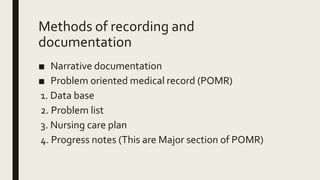
■ Narrative documentation
■ Problem oriented medical record (POMR)
1. Data base
2. Problem list
3. Nursing care plan
4. Progress notes (This are Major section of POMR)
Methods of recording and
documentation . Continue......
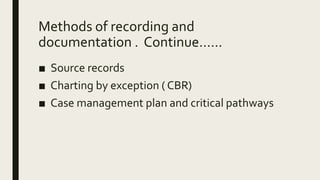
■ Source records
■ Charting by exception ( CBR)
■ Case management plan and critical pathways
Narrative documentation.....
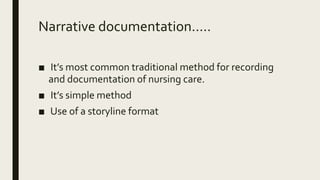
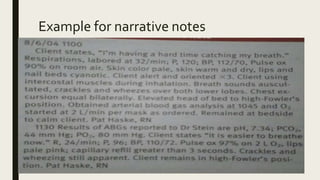
■ It’s most common traditional method for recording
and documentation of nursing care.
■ It’s simple method
■ Use of a storyline format
Example for narrative notes
Problem oriented medical record (
POMR)
■ The POMR is a method of documentation that
emphasize the client’s problems.
■ Data are organized by problem or diagnosis
■ Basically each member if the health care team
contributes to a single list of identified client
problems.
The POMR Sections
■ DATA BASE (e.g all available assessment information
pertaining to the client such as history &physical
assessment, nutrition assessment, nurse’s admission
history, ongoing assessment and laboratory reports
etc)
■ The data base is foundation for identifying client
problems and planning of care.
The POMR Sections
■ PROBLEM LIST......
A) After analyzing data, health care team members
identify problems and make a single problem list
B) The problem list includes the client’s both
physiological, psychological,sicual ,
cultural,spirtual,developmental,and environmental
needs.
Nursing care plans....
■ Develop a care plan for each problem
■ Nurses document the plan of care in variety of
formats
■ Generally these plans of care include nursing
diagnosis,outcomes,and interventions.
Progress notes....
■ Health care team members monitor and recorded the
progress of a client’s problems.
■ Progress notes come in different formats or
structured notes.
Progress notes ... Continue...
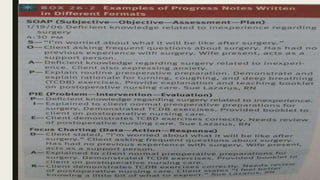
■ One method formerly known as “ SOAP” stands for
S – Subjective data
O – Objective data
A – Assessment
P - plan
Continue...
■ A second progress note method is the PIE format.
■ It’s similar to SOAP charting in its problem oriented
nature.
P – Problem
I – Interventions
E - Evaluation
Continue...
A third narrative format is focus is charting.
1) It involves use of DAR.......
D – Data ( subj &obj)
A- Action or Nursing interventions
R- Response of the client *effectiveness
Source of records
■ In a Source record the client has a separate for each
discipline e.g nursing, medicine,social work or respiratory
therapy to record data.
■ One advantage of a source record is that caregivers can
easily locate the proper section of the record in which to
make entries.
■ A disadvantage of this method is that details a specific
problem are distributed through out the record.
Example for disadvantage of source
records
■ A nurse describes the character of abdominal pain
and use if non pharmacologic therapy such as
relaxation therapy and analgesic medications in the
nurse’s notes.
■ The physician’s notes describe the progress of the
client’s bowel obstruction and the plan for surgery in
separate section of the record for same client.
Charting by exception.... CBE
■ CBE focuses on documenting deviations from
the established norm or abnormal findings.
■ This approach reduces documentation time
and highlights trends .
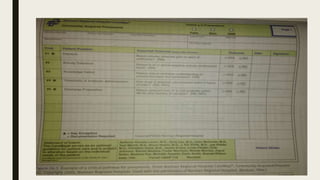
Case management plan and critical
pathways....
■ The case management model of delivering care in
corporates a multidisciplinary approach to
documenting client care.
Jai hind .....jai Karnataka

DOCUMENTATION IN NURSING

  • 1.
    RECORDING & REPORTING Anil KumarBR Lecturer Medical surgical nursing
  • 2.
    Introduction ■ Documentation withina client’s medical record is a vital aspect of nursing care or practice. ■ The nursing documentation must be accurate, comprehensive,and flexible. ■ Information in the client records provides a detailed account of the level of quality of nursing care delivered to client’s. And ■ Accurate and effective documentation ensures continuity of care, saves time and prevent duplication or error in the patient care.
  • 3.
    PurposesAnd importance ofRecords A record is permanent written communication that documents information relevant to a client’s health care management.
  • 4.
    Purposes or importanceof records ■ Communication ■ Legal documentation ■ Nursing audit ■ Educational( records are useful in educational purposes in various ways e.g a client diagnosis,s/s of disease,sucessful and unsuccessful diagnostic findings,and client behaviours.)
  • 5.
    Purposes and importanceof records ■ Financial billing ■ Nursing research ■ Improve quality of nursing care ■ Prevent errors and duplication and ■ Planning of care
  • 6.
    Principles or guidelinesfor quality documentation and recording ■ Nurses are need high-quality documentation and recording are essential to enhance effective , accurate and individualized patient care. ■ Quality documentation and recording have several important characteristics.
  • 7.
    Principles and guidelinesfor quality documentation and recording......... ■ Factual ■ Accurate ■ Completness ■ Current ■ Organized ■ Timings
  • 8.
    Factual......... ■ A factualrecord contains descriptive, objective information about what a nurse sees,hears,fells,and Smell’s. ■ E.g.A client BP is 80/50 mmHg, client diaphoretic,restlesness, and HR is 102 and regular.*(the use of inferences client appears to be in shock) ■ Without supporting factual data is not acceptable because it can be misunderstood.
  • 9.
    Accurate....... ■ The useif exact measurements establishes accuracy. ■ Use of an institution accepted abbreviations,symbols and system of measures.
  • 10.
    Completness...... ■ The informationwill not be completed without full information. ■ The information within a record entry or a report needs to be complete, containing appropriate and vital information otherwise it’s considered incomplete.
  • 11.
    Current....... ■ Timely documentationand recording is an vital principles in documentation. ■ To increase accuracy , quality of care and decrease unnecessary duplication and preventing errors it’s essential to record timely. ■ For e.g a client BP is 140/90 when you’re admission of some type of drugs the nude should records same.
  • 12.
    Organized...... ■ As anurse you want communicate information in a logical order. ■ For e.g an organized note describes the client’s knowledge deficit, nurses assessment and interventions, and the client’s response. ■ The nurse should applying theories, critical thinking, EBP, and the nursing process gives logic and order to nursing documentation.
  • 13.
    Methods Of recordingand documentation ■ There are various documentation methods for recording client’s data. ■ Each nursing services selected a documentation system that reflects the philosophy if the instructions.
  • 14.
    Methods of recordingand documentation ■ Narrative documentation ■ Problem oriented medical record (POMR) 1. Data base 2. Problem list 3. Nursing care plan 4. Progress notes (This are Major section of POMR)
  • 15.
    Methods of recordingand documentation . Continue...... ■ Source records ■ Charting by exception ( CBR) ■ Case management plan and critical pathways
  • 16.
    Narrative documentation..... ■ It’smost common traditional method for recording and documentation of nursing care. ■ It’s simple method ■ Use of a storyline format
  • 17.
  • 18.
    Problem oriented medicalrecord ( POMR) ■ The POMR is a method of documentation that emphasize the client’s problems. ■ Data are organized by problem or diagnosis ■ Basically each member if the health care team contributes to a single list of identified client problems.
  • 19.
    The POMR Sections ■DATA BASE (e.g all available assessment information pertaining to the client such as history &physical assessment, nutrition assessment, nurse’s admission history, ongoing assessment and laboratory reports etc) ■ The data base is foundation for identifying client problems and planning of care.
  • 20.
    The POMR Sections ■PROBLEM LIST...... A) After analyzing data, health care team members identify problems and make a single problem list B) The problem list includes the client’s both physiological, psychological,sicual , cultural,spirtual,developmental,and environmental needs.
  • 21.
    Nursing care plans.... ■Develop a care plan for each problem ■ Nurses document the plan of care in variety of formats ■ Generally these plans of care include nursing diagnosis,outcomes,and interventions.
  • 22.
    Progress notes.... ■ Healthcare team members monitor and recorded the progress of a client’s problems. ■ Progress notes come in different formats or structured notes.
  • 23.
    Progress notes ...Continue... ■ One method formerly known as “ SOAP” stands for S – Subjective data O – Objective data A – Assessment P - plan
  • 24.
    Continue... ■ A secondprogress note method is the PIE format. ■ It’s similar to SOAP charting in its problem oriented nature. P – Problem I – Interventions E - Evaluation
  • 25.
    Continue... A third narrativeformat is focus is charting. 1) It involves use of DAR....... D – Data ( subj &obj) A- Action or Nursing interventions R- Response of the client *effectiveness
  • 27.
    Source of records ■In a Source record the client has a separate for each discipline e.g nursing, medicine,social work or respiratory therapy to record data. ■ One advantage of a source record is that caregivers can easily locate the proper section of the record in which to make entries. ■ A disadvantage of this method is that details a specific problem are distributed through out the record.
  • 28.
    Example for disadvantageof source records ■ A nurse describes the character of abdominal pain and use if non pharmacologic therapy such as relaxation therapy and analgesic medications in the nurse’s notes. ■ The physician’s notes describe the progress of the client’s bowel obstruction and the plan for surgery in separate section of the record for same client.
  • 29.
    Charting by exception....CBE ■ CBE focuses on documenting deviations from the established norm or abnormal findings. ■ This approach reduces documentation time and highlights trends .
  • 30.
    Case management planand critical pathways.... ■ The case management model of delivering care in corporates a multidisciplinary approach to documenting client care.
  • 32.