1
Recording and Reporting
2
Medical Records
 Recording referred to (process of writing information)
 Other words (Reporting, Documenting, Charting, and Recording) .
 Medical (health) records are written collections of
information about a person’s health, the care provided
by health practitioners, and the client’s progress
 Also known as health records or client records
(files)
3
Uses of Medical Records
1. Permanent account
 The record is filled and maintained for future references.
2. Sharing information
 Continuing of care.
 Prevent duplication or omission
3. Quality assurance
 Continues quality improvement.
 To improve the quality of care.
4. Accreditation (Official Approval)
5. Reimbursement (To pay the coasts of documented care).
6. Education and research
7. Legal evidence
4
Components of Medical Records
1. Person’s health information
2. Care provided by health practitioners
3. The client’s progress
4. The plan for care
5. Medication cycle
5
Types of patient's records
1. Source-Oriented Records
 Organized according to source of documented
information
 Contain separate forms for physicians, nurses,
dietitians, physical therapists to make written entries
about their specific activities in relation to client’s care
 This record provides fragmented documentation
 Consider of traditional type of record
6
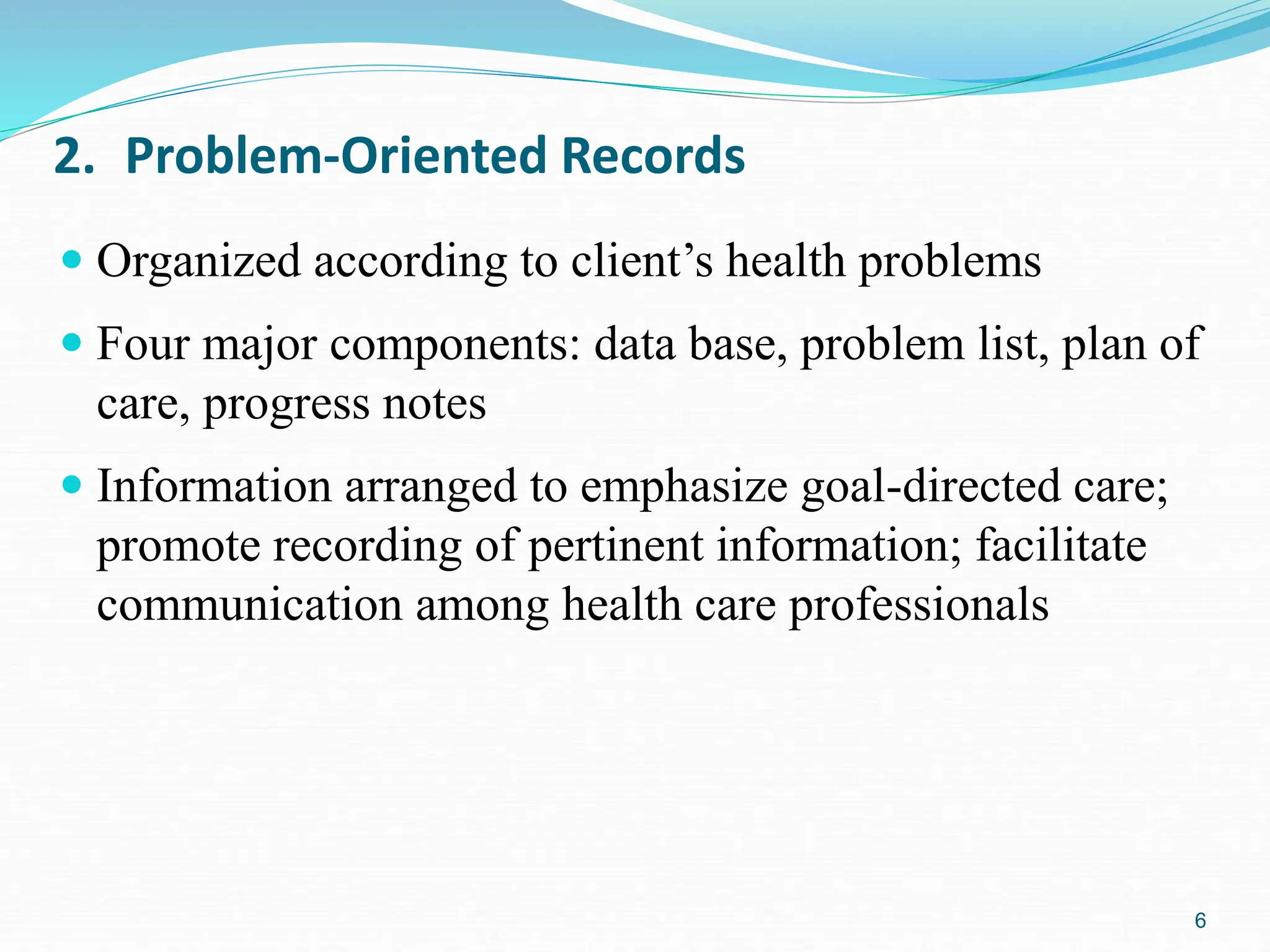
2. Problem-Oriented Records
 Organized according to client’s health problems
 Four major components: data base, problem list, plan of
care, progress notes
 Information arranged to emphasize goal-directed care;
promote recording of pertinent information; facilitate
communication among health care professionals
7
Components of
Problem-Oriented Records
8
Methods of Charting
1. Narrative charting
 Style of documentation generally used in Source-Oriented Records.
 Involve writing information about the patient and patient's care in a
chronologic order.
2. SOAP charting
 Style of documentation more likely to be used in a Problem-Oriented
Record.
 S = Subjective Data.
 O = Objective Data..
 A = Analysis of the Data..
 P = Plan for care.
 Some agencies have expanded the SOAP format to SOAPIE or SOAPIER
 I = Interventions
 E = Evaluation
 R = Revision to the plan of care
9
Methods of Charting (cont’d)
3. Focus charting (DAR model is used )
 D = Data A = Action R = Response
4. PIE charting
 P=Problem I=Intervention E=Evaluation
5. Charting by exception
 Method in which only abnormal assessment finding are written.
6. Computerized method
 Documenting patient information electronically
10
11
12
13
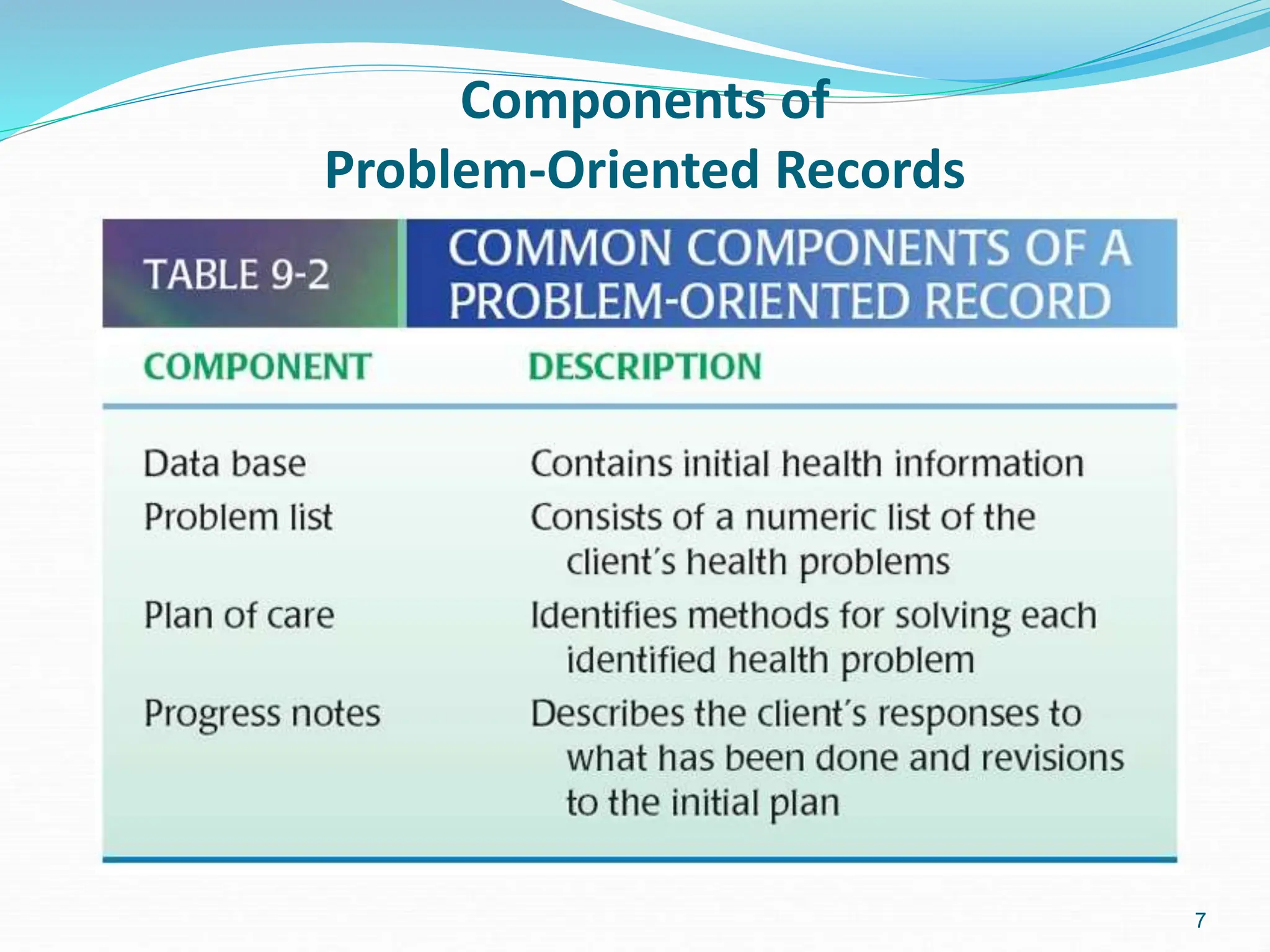
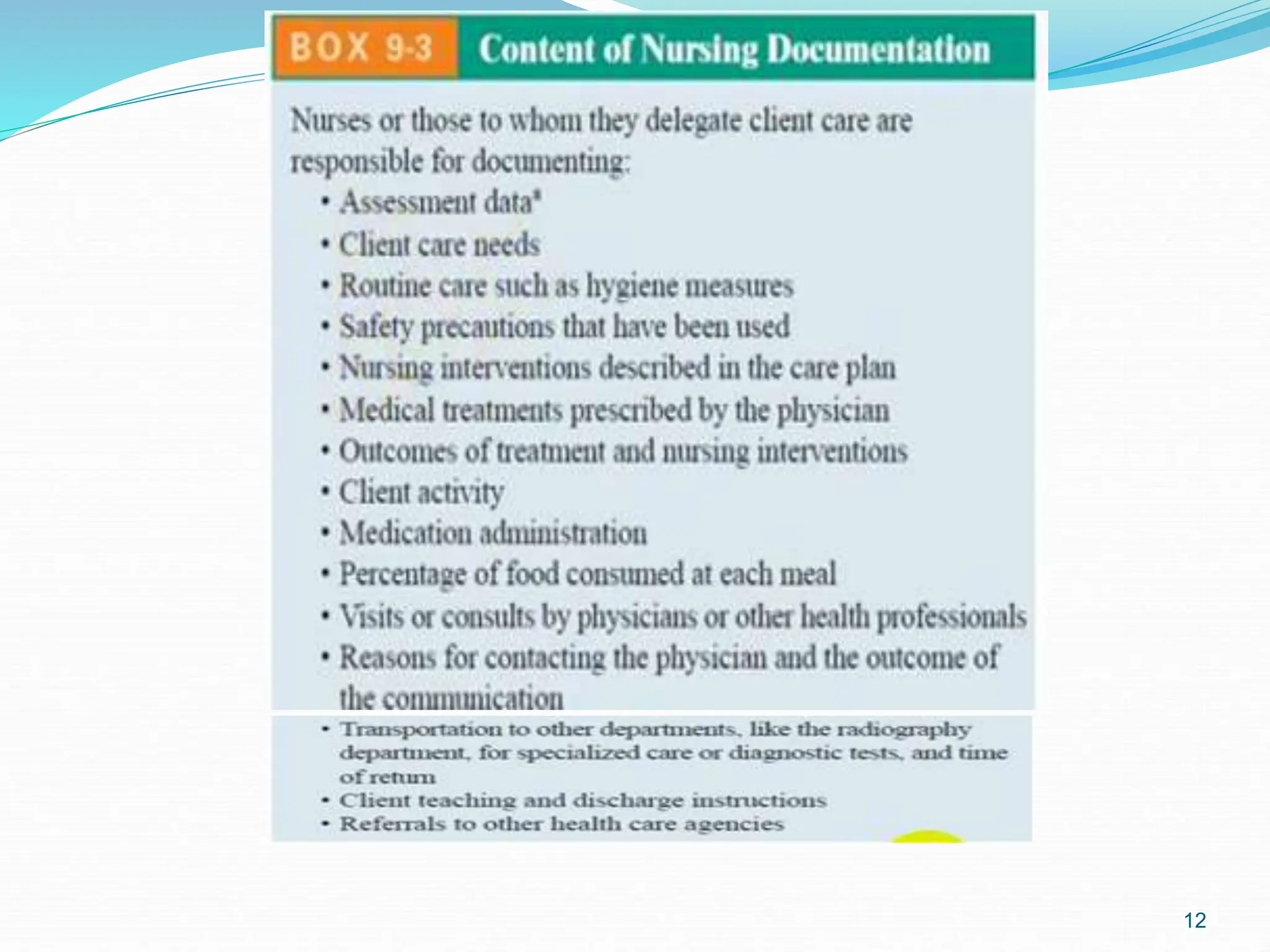
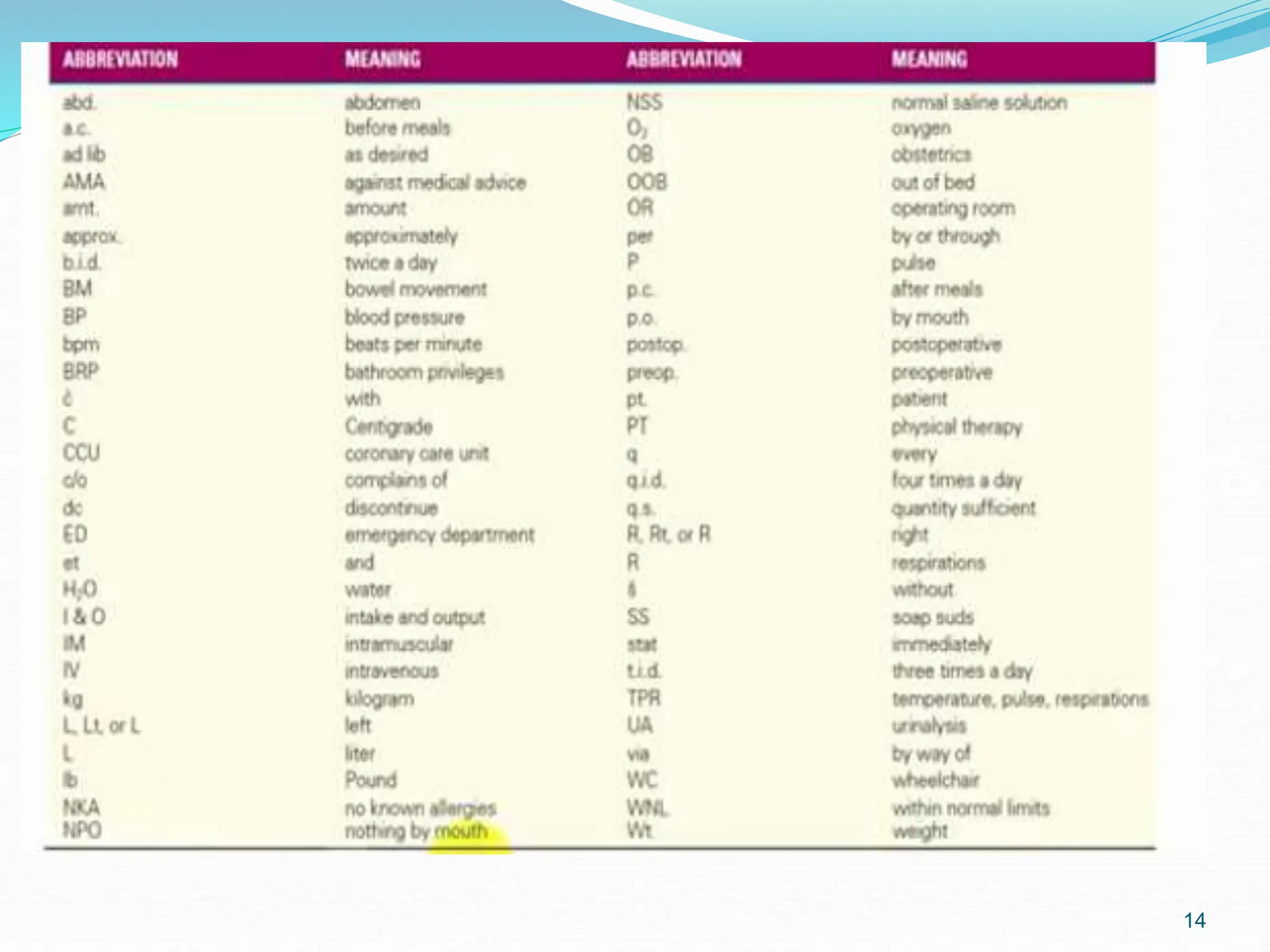
DOCUMENTING INFORMATION
 Abbreviations
 Abbreviations shorten length of documentation and
documentation time
 Agencies provide list of approved abbreviations and
their meanings
 Use only abbreviations on agency’s approved list
14
15
DOCUMENTING INFORMATION (cont’d)
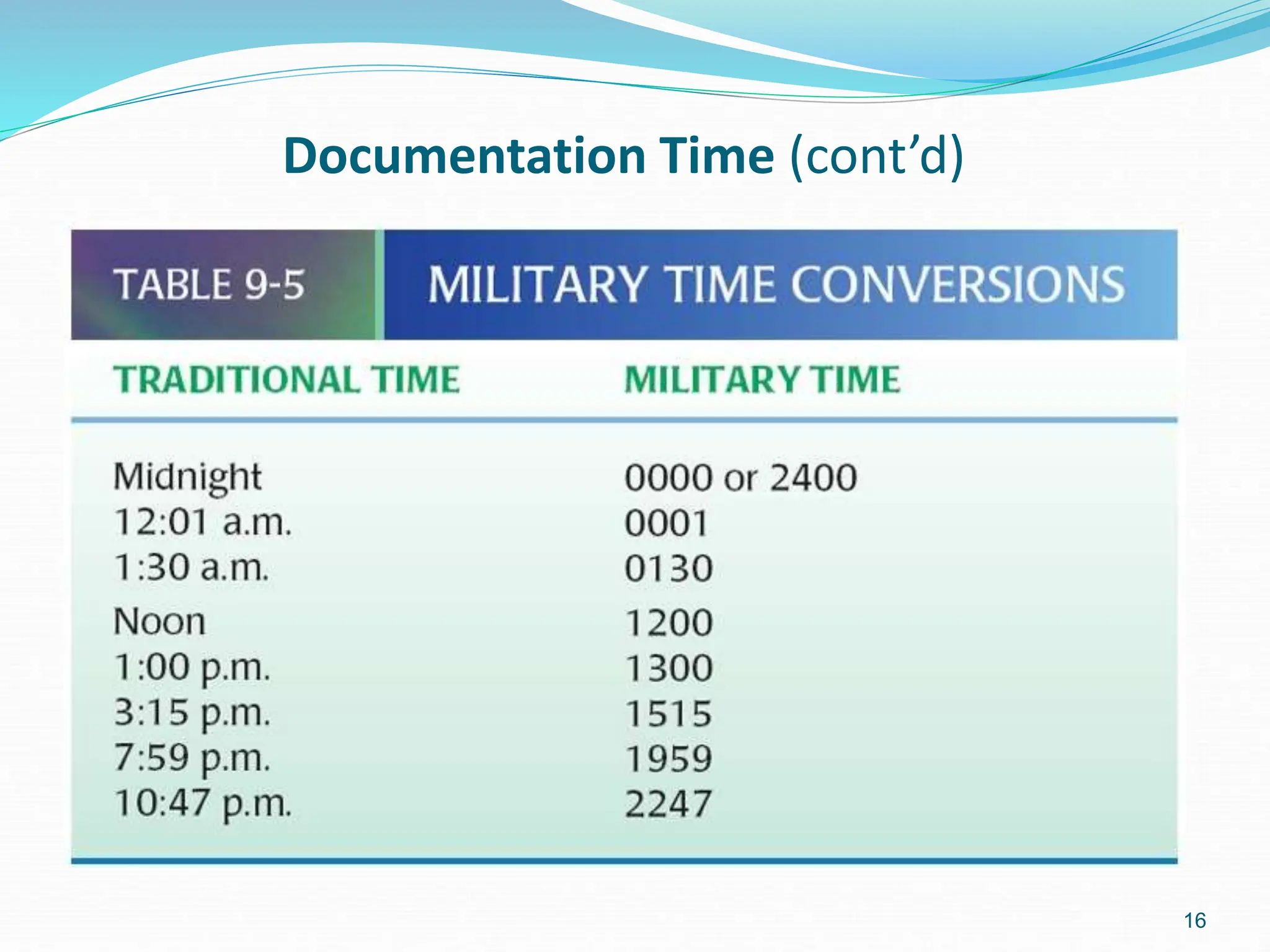
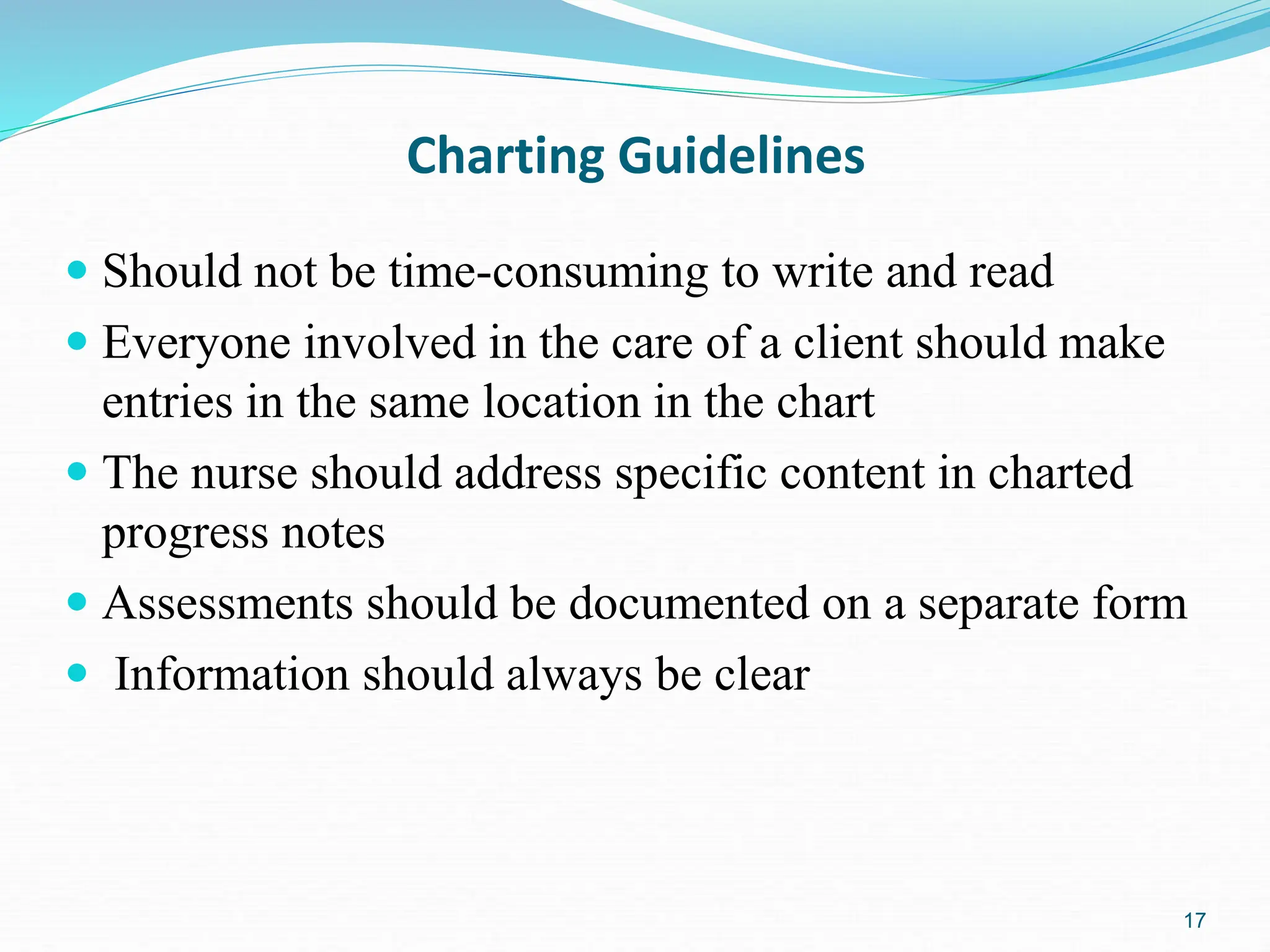
 Documentation Time
1. Traditional time
– Two 12-hour revolutions; identified with hour and
minute, followed by a.m. or p.m.
2. Military time
– Based on 24-hour clock; uses different four-digit
number for each hour and minute of the day
o First two digits indicate hour within 24-hour period
o Last two digits indicate minutes
16
Documentation Time (cont’d)
17
Charting Guidelines
 Should not be time-consuming to write and read
 Everyone involved in the care of a client should make
entries in the same location in the chart
 The nurse should address specific content in charted
progress notes
 Assessments should be documented on a separate form
 Information should always be clear
18
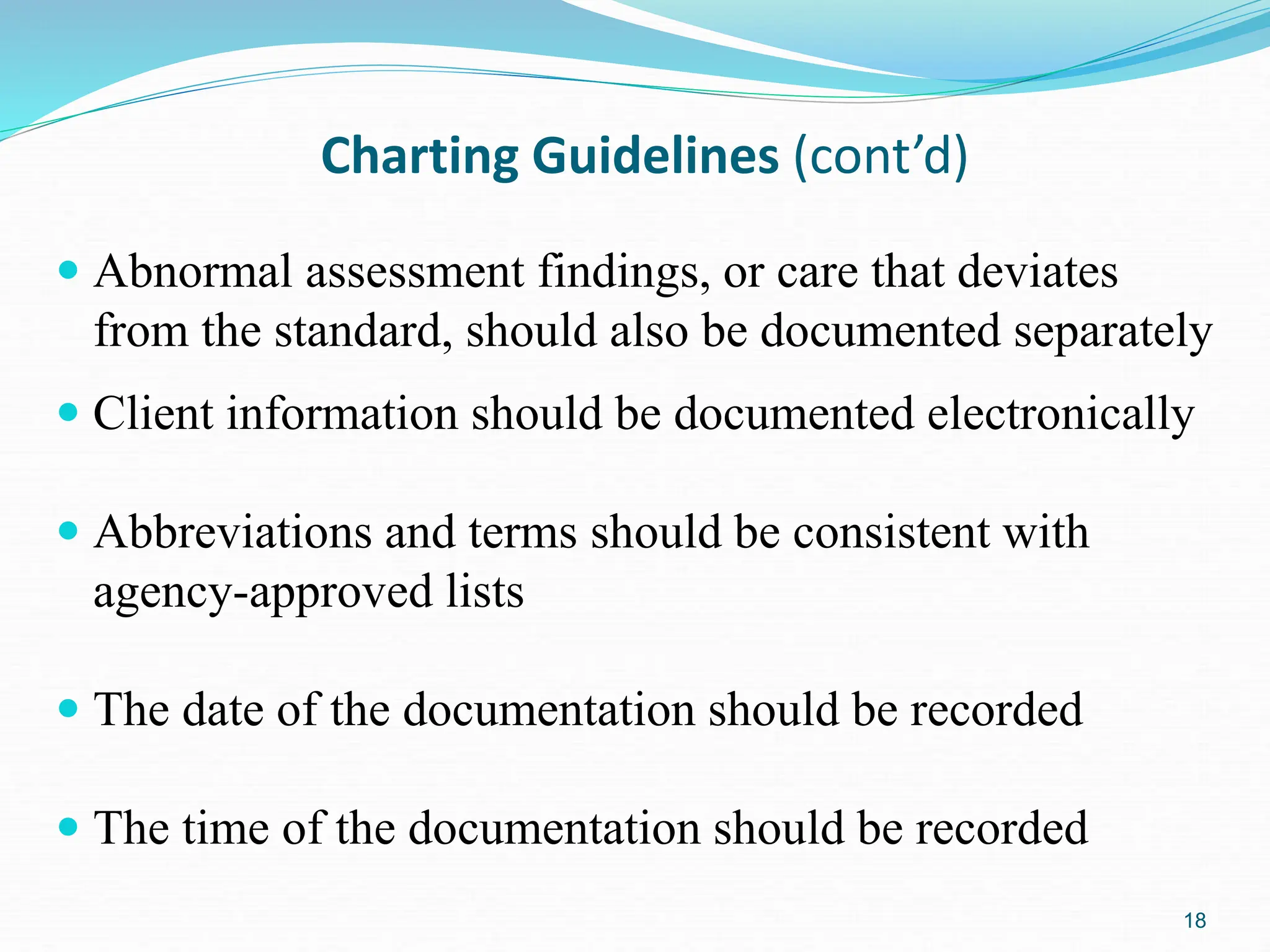
Charting Guidelines (cont’d)
 Abnormal assessment findings, or care that deviates
from the standard, should also be documented separately
 Client information should be documented electronically
 Abbreviations and terms should be consistent with
agency-approved lists
 The date of the documentation should be recorded
 The time of the documentation should be recorded
19
Written Forms of Communication
1) Nursing care plan: list of client’s problems, goals, and
nursing orders for client care
2) Nursing Kardex: quick reference for current
information about client and client care
3) Checklists: documentation with check mark or initials
4) Flow sheets: documentation with sections for
recording frequently repeated assessment data
20
Other Forms of Communication
1. Change of shift reports: Discussion between a nursing
spokes person from the shift that is ending and personnel
coming duty.
2. Client assignments: Are made at the beginning of each
shift.
3. Team conferences : Are commonly used for exchanging
information
4. Rounds : Visit to patients on an individual basis or as
group
5. Telephone calls
21
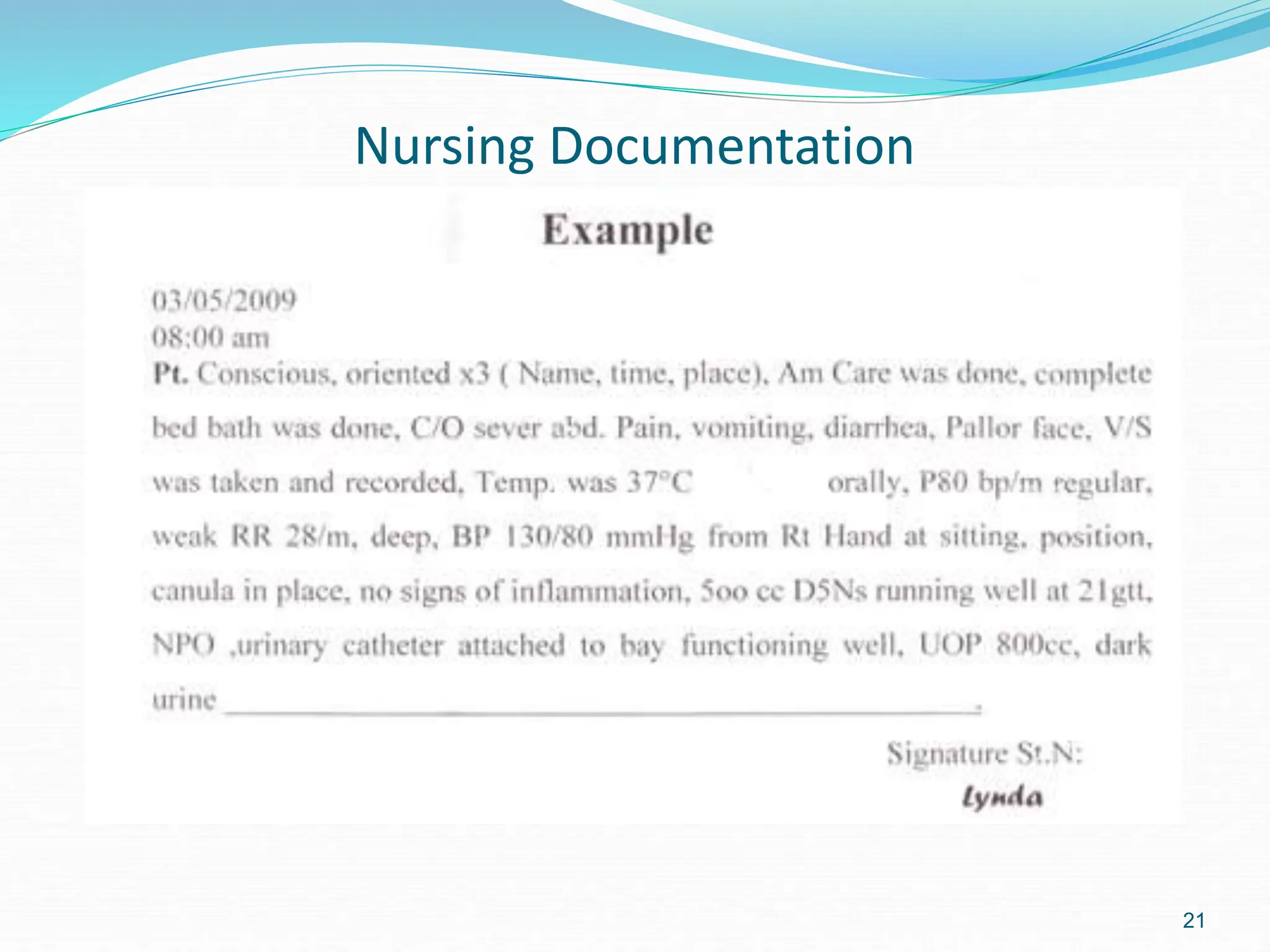
Nursing Documentation

chapter-9-Recording-and-reporting1 (1).ppt

  • 1.
  • 2.
    2 Medical Records  Recordingreferred to (process of writing information)  Other words (Reporting, Documenting, Charting, and Recording) .  Medical (health) records are written collections of information about a person’s health, the care provided by health practitioners, and the client’s progress  Also known as health records or client records (files)
  • 3.
    3 Uses of MedicalRecords 1. Permanent account  The record is filled and maintained for future references. 2. Sharing information  Continuing of care.  Prevent duplication or omission 3. Quality assurance  Continues quality improvement.  To improve the quality of care. 4. Accreditation (Official Approval) 5. Reimbursement (To pay the coasts of documented care). 6. Education and research 7. Legal evidence
  • 4.
    4 Components of MedicalRecords 1. Person’s health information 2. Care provided by health practitioners 3. The client’s progress 4. The plan for care 5. Medication cycle
  • 5.
    5 Types of patient'srecords 1. Source-Oriented Records  Organized according to source of documented information  Contain separate forms for physicians, nurses, dietitians, physical therapists to make written entries about their specific activities in relation to client’s care  This record provides fragmented documentation  Consider of traditional type of record
  • 6.
    6 2. Problem-Oriented Records Organized according to client’s health problems  Four major components: data base, problem list, plan of care, progress notes  Information arranged to emphasize goal-directed care; promote recording of pertinent information; facilitate communication among health care professionals
  • 7.
  • 8.
    8 Methods of Charting 1.Narrative charting  Style of documentation generally used in Source-Oriented Records.  Involve writing information about the patient and patient's care in a chronologic order. 2. SOAP charting  Style of documentation more likely to be used in a Problem-Oriented Record.  S = Subjective Data.  O = Objective Data..  A = Analysis of the Data..  P = Plan for care.  Some agencies have expanded the SOAP format to SOAPIE or SOAPIER  I = Interventions  E = Evaluation  R = Revision to the plan of care
  • 9.
    9 Methods of Charting(cont’d) 3. Focus charting (DAR model is used )  D = Data A = Action R = Response 4. PIE charting  P=Problem I=Intervention E=Evaluation 5. Charting by exception  Method in which only abnormal assessment finding are written. 6. Computerized method  Documenting patient information electronically
  • 10.
  • 11.
  • 12.
  • 13.
    13 DOCUMENTING INFORMATION  Abbreviations Abbreviations shorten length of documentation and documentation time  Agencies provide list of approved abbreviations and their meanings  Use only abbreviations on agency’s approved list
  • 14.
  • 15.
    15 DOCUMENTING INFORMATION (cont’d) Documentation Time 1. Traditional time – Two 12-hour revolutions; identified with hour and minute, followed by a.m. or p.m. 2. Military time – Based on 24-hour clock; uses different four-digit number for each hour and minute of the day o First two digits indicate hour within 24-hour period o Last two digits indicate minutes
  • 16.
  • 17.
    17 Charting Guidelines  Shouldnot be time-consuming to write and read  Everyone involved in the care of a client should make entries in the same location in the chart  The nurse should address specific content in charted progress notes  Assessments should be documented on a separate form  Information should always be clear
  • 18.
    18 Charting Guidelines (cont’d) Abnormal assessment findings, or care that deviates from the standard, should also be documented separately  Client information should be documented electronically  Abbreviations and terms should be consistent with agency-approved lists  The date of the documentation should be recorded  The time of the documentation should be recorded
  • 19.
    19 Written Forms ofCommunication 1) Nursing care plan: list of client’s problems, goals, and nursing orders for client care 2) Nursing Kardex: quick reference for current information about client and client care 3) Checklists: documentation with check mark or initials 4) Flow sheets: documentation with sections for recording frequently repeated assessment data
  • 20.
    20 Other Forms ofCommunication 1. Change of shift reports: Discussion between a nursing spokes person from the shift that is ending and personnel coming duty. 2. Client assignments: Are made at the beginning of each shift. 3. Team conferences : Are commonly used for exchanging information 4. Rounds : Visit to patients on an individual basis or as group 5. Telephone calls
  • 21.

Editor's Notes

  • #6 التسجيل حسب المصطر
  • #7 المعلومات الذي ب تجي حسب المشكلة
  • #8 هل المريض اتجاوب او لا بعد م اعطيناه الرعاي
  • #9 الكتابة السردية يعني ب اكتب كل شي يعتمد ع السورس يعني ان الطبيب بيكتب حاجات معينه عن المريض وكمان الممرض نغس الكلام لا يوجد استايل يأخذ وقت
  • #20 ملفات نستخدمها للتواصل بيننا وبين زملائنا التمريض