Prof.Nagamani.T
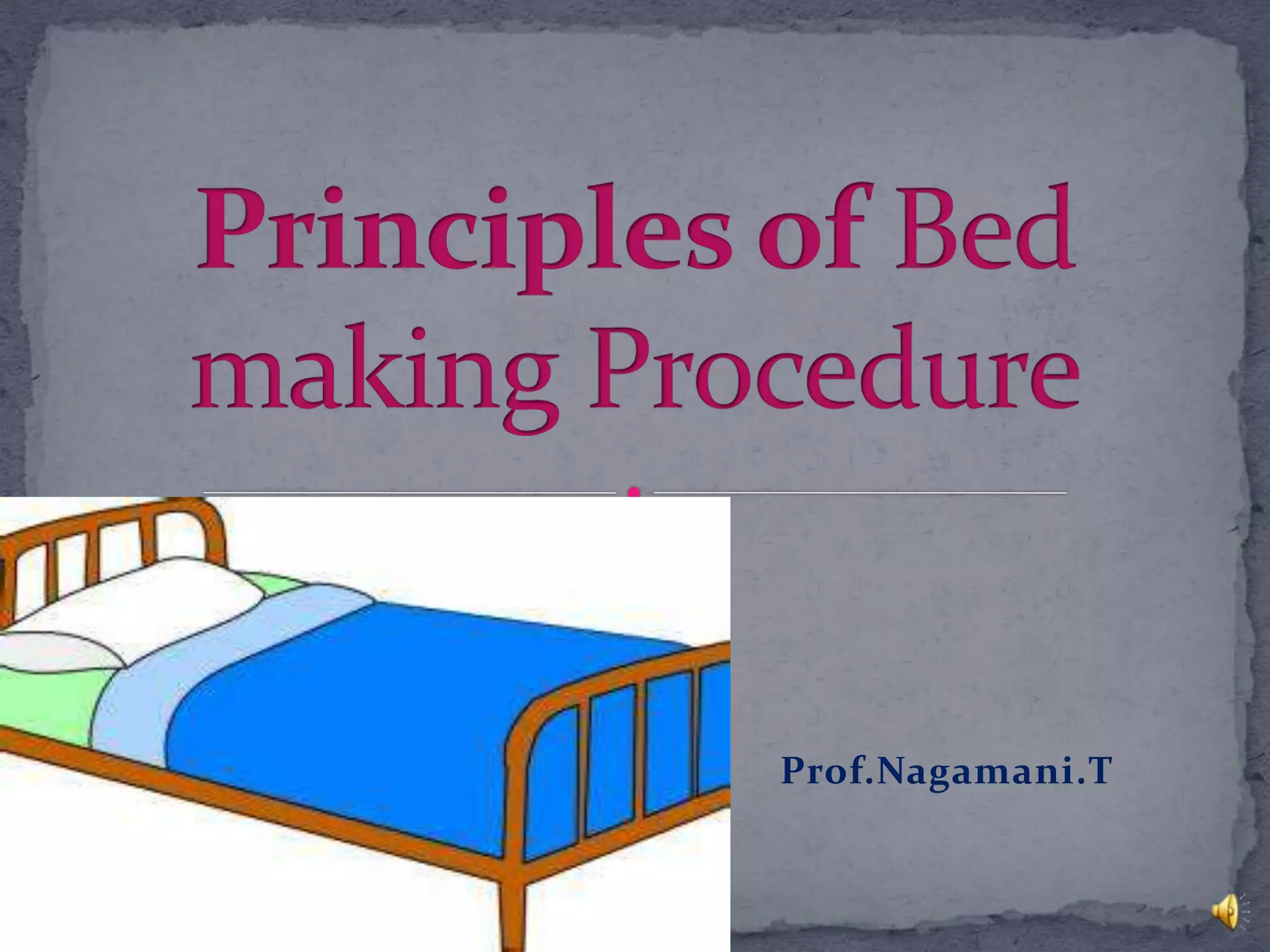
Bed making is a procedure or technique in
which different types of beds are
prepared to make the patient
comfortable according to the situations
and procedures.
 To provide the patient with a safe and comfortable
bed.
 To promote rest and sleep
 To provide the unit or ward a neat appearance
 To prevent micro organisms to come in contact with
patient, thus minimize the source of infection.
 To adapt to the needs of the client
 To economize time, material and effort
 To prevent bedsores
 To establish an effective nurse-patient relationship
 To provide active and passive exercises
 To observe the client ( eg, oral hygiene, ability of
self care, presence of bed sore etc.)
 To promote cleanliness
 To prevent injuries
 To dispose the soiled linen appropriately
 To develop skill in maintaining body mechanics for
the nurse
 To help relatives to learn the patient care at home.
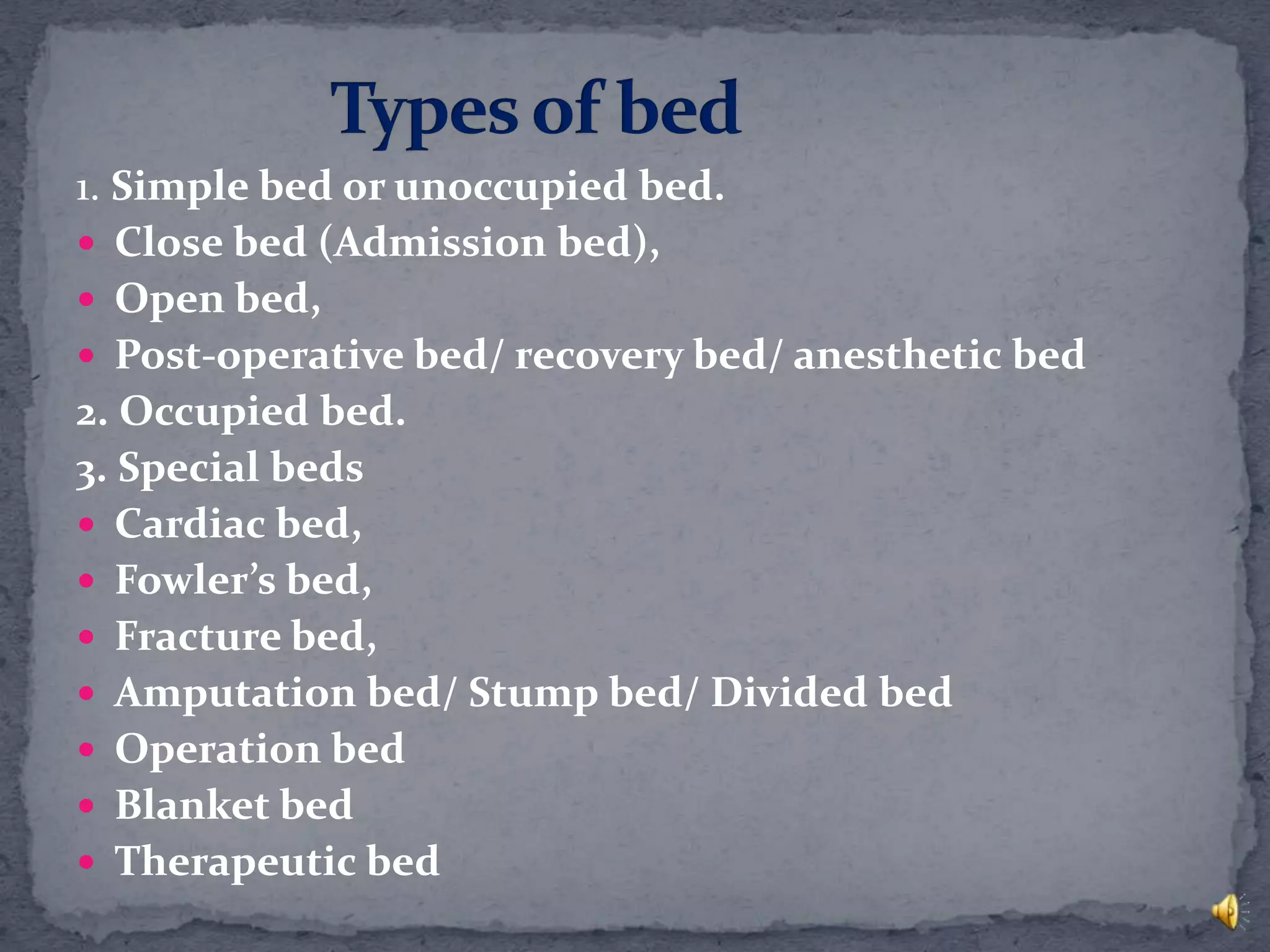
1. Simple bed or unoccupied bed.
 Close bed (Admission bed),
 Open bed,
 Post-operative bed/ recovery bed/ anesthetic bed
2. Occupied bed.
3. Special beds
 Cardiac bed,
 Fowler’s bed,
 Fracture bed,
 Amputation bed/ Stump bed/ Divided bed
 Operation bed
 Blanket bed
 Therapeutic bed
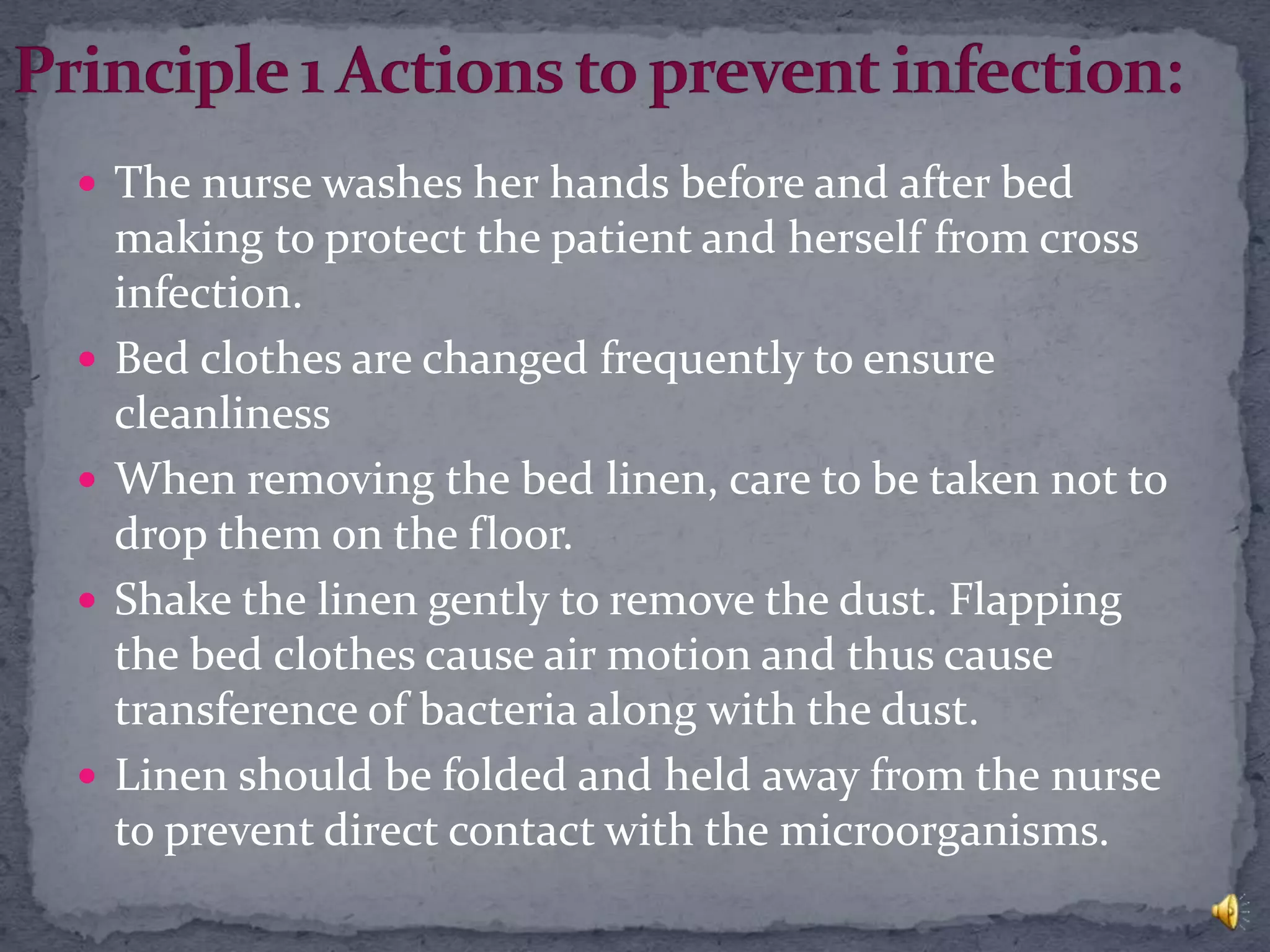
# Principle 1
Micro organisms are found every where on the skin, on
the articles used by the patient and in the
environment. The nurse takes care to prevent the
transfer of micro organisms from source to the new
host by direct or indirect contact or prevent the
multiplication of organisms.
 The nurse washes her hands before and after bed
making to protect the patient and herself from cross
infection.
 Bed clothes are changed frequently to ensure
cleanliness
 When removing the bed linen, care to be taken not to
drop them on the floor.
 Shake the linen gently to remove the dust. Flapping
the bed clothes cause air motion and thus cause
transference of bacteria along with the dust.
 Linen should be folded and held away from the nurse
to prevent direct contact with the microorganisms.
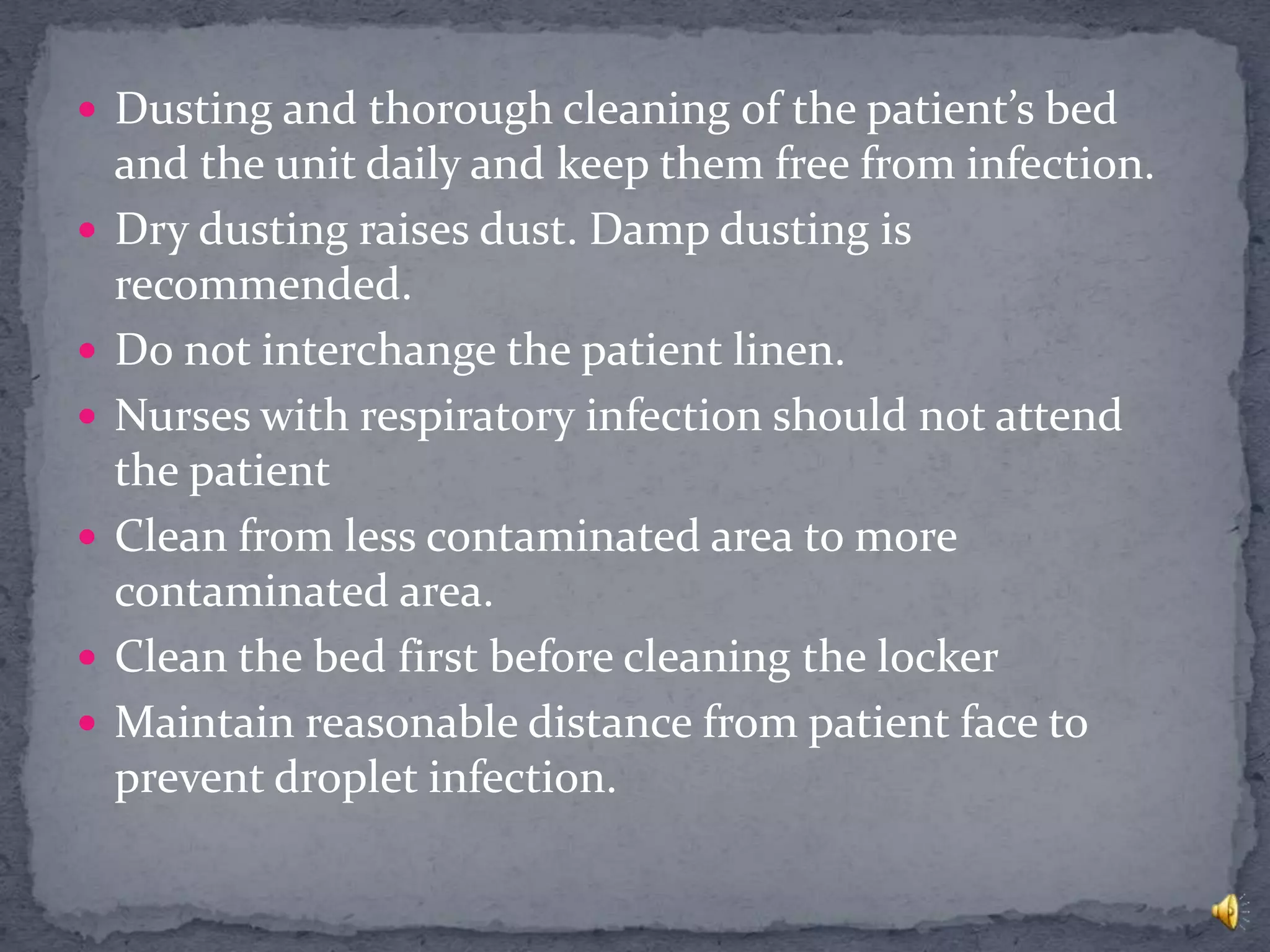
 Dusting and thorough cleaning of the patient’s bed
and the unit daily and keep them free from infection.
 Dry dusting raises dust. Damp dusting is
recommended.
 Do not interchange the patient linen.
 Nurses with respiratory infection should not attend
the patient
 Clean from less contaminated area to more
contaminated area.
 Clean the bed first before cleaning the locker
 Maintain reasonable distance from patient face to
prevent droplet infection.
 A safe and comfortable bed will ensure rest
& sleep and prevent several complications
among bed ridden patients. ( Eg., Bed sores,
foot drop etc.)
 The nurse should make sure that the bed is wrinkle
free and smooth to prevent bed sore due to friction
between the skin and the mattress or wrinkled sheets.
 Pull the bottom sheet tightly so that there are no
wrinkles
 The linen is tucked far enough under the mattress,
keep it fixed, tight and smooth.
 Make sure the mattress remains flat and even with the
corners firm and square.
 Remove unwanted waste like cotton to avoid
discomfort for the patient.
 Do not keep any wet linen on the bed.
 Daily dusting should be done to remove any food
waste or hospital waste like gauze, needles, cotton etc.)
 Expose the mattress and pillow to sunlight and
aeration to keep them fresh.
 A bed should have enough space for free moving of the
patient to prevent bed sore, stimulate circulation and
to maintain muscle tone.
 Use comfortable devices to provide additional comfort
to the patient.
 Good body mechanics maintain the body alignment
and prevents fatigue
# Principle 3 Action to take
 Maintain good body alignment when bed making
(avoid bending, twisting, stretching)
 Use large muscles rather than back muscles
 Work smoothly and rhythmically- 2 people can make
beds together to save time and effort.
 If possible raise the bed height to avoid bending and
back strain.
 Client safety and comfort
# Principle 4 Action
 Ensure that the locks of the bed are on.
 Ensure the height of the bed is adjusted to its proper
height after the bed making
 Make sure the bedside rails are on.
 Avoid areas of potential pressure on the bed.
 Promote comfort by having wrinkle free and bed free
from rough areas, creases,food crumbs and foreign
bodies.
 Systematic ways of functioning saves time, energy and
material.
# Principle 5 Action to take
 Assemble all articles and arrange them conveniently
before staring the procedure.
 Arrange the linen in reverse order
 When stripping the bed, remove the bed linen one by
one holding the open end towards the floor.
 The bed sheets are folded in such a way that it can be
replaced easily.
 Micro organisms are found every where on the skin, on the
articles used by the patient and in the environment. The
nurse takes care to prevent the transfer of micro organisms
from source to the new host by direct or indirect contact or
prevent the multiplication of organisms.
 A safe and comfortable bed will ensure rest & sleep and
prevent several complications I bed ridden patients.
( Eg., Bed sores, foot drop etc.)
 Good body mechanics maintain the body alignment and
prevents fatigue
 Client safety and comfort
 Systematic ways of functioning saves time, energy and
material.
 Wash hands before and after the procedure
 Do not expose the patient unnecessarily.
 Protect the patient from draught.
 Do not cover the patient’s face while placing the linen
 Do not mix clean linen with soiled linen
 Never place the woolen blanket directly on the patient
body except for blanket bed
 Always get extra help to make bed for helpless patients
and to prevent them from falling.
 Never allow the patient to lie down on mackintosh
directly.
 Do not let the linen touch your body or uniform
 Maintain good body mechanics
 Make the bed firm, smooth and wrinkle free
 Practice economy of time, energy and material
 Do not shake dirty linen to prevent germs spread
around the room
 Maintain privacy while making occupied bed making
 Inspect cot, mattress and pillows daily for presence of
vermins, and destroy them.
 Expose the mattress and pillow for sunlight when
needed.
 Make adaptations according to weather, climate
changes, individual needs, customs and habits.
 Ensure patient safety and comfort during the
procedure
 The nursing principles such as individuality, comfort,
safety and good relationship should be maintained.
Thank You