Documentation and RecordingCommunication with the Healthcare Team Subtitle
Document and ReportingEnsures quality of careRegulatory agencies require itMedicare reimbursement depends upon itShows nursing actionServes as a legal document
ReportingSummary of activities, observations, and actions performedObjective and non-judgmental
ReportsOral or writtenShift reportVerbal reports to physiciansMiscellaneousWritten lab reportsDietary reportsSocial workers notesPT, OT, Speech therapies
Types of ReportsChange of shiftOral, audiotape, roundsTelephoneTransferIncidentAny event not consistent with routine care of clientConcise, objectiveNot a part of the chartOral, audiotape, rounds
ConfidentialityLaw protects any information gained by exam, observation, conversation, or treatmentInformation not discussed or shared with anyone not directly involved in patient’s careNurses are legally and ethically obligated to keep patient information confidential
Medical RecordsPermanent written communicationsContinuing account of care statusDiscussion, discharge planning, conferences, consultationsAll caregivers can benefit from information and plan accordingly
Purpose of RecordsCommunicationFinancial billingEducationAssessmentResearchAuditing and monitoringLegal documentation
DocumentationAnything written or printed that is relied upon as a record of proof for authorized persons
Standards for DocumentationFederal regulations-Medicare and MedicaidState and Federal regulations – JCAHOProfessional standards – ANAFacility policies- charting techniques and responsibilities
LegibilityAll charting should be easy to readReduces errorsMay be used in court years after care given
FactualDescriptive, objective informationDecreases misinterpretationDo not use “seems”, “appears”, “apparently”, “good” “well”Subjective information is documented with client’s own words in quotationsNo opinions
Complete and ConciseThorough, exact, brief, and NO blah, blah, blah blahClear and succinctEliminate irrelevanceShort and to the point (long notes difficult to read)Too abbreviated gives impression of being hurried and incomplete
TimelinessDelay in reporting can result in serious omissions and delays in careLate entries may be interpreted as negligenceCertain things must be reported at time of occurrenceRoutine activities need not be charted immediately Military time usedNo leaving until important information recordedAvoids errors and duplication of care
AccurateReliable and preciseExact measurements when possibleUse only accepted abbreviationsSpell correctly
More accuracyNo charting for someone elseStudent’s notes are countersigned by person who assured care was givenDescriptive entries signed with full name and status (first initial, last name, and title)
Guidelines for Documentation and ReportingCertain abbreviations not acceptableAbbreviations used
OrganizationLogical format and orderChronological flow of events
Chart ComponentsData baseAssessment dataProblems listCare planProgress notesNarrativeFlow sheetsDischarge planning summaries
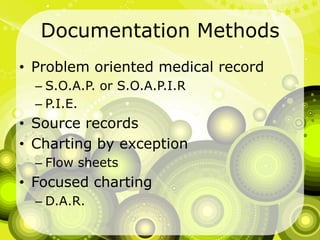
Documentation MethodsProblem oriented medical recordS.O.A.P. or S.O.A.P.I.RP.I.E.Source recordsCharting by exceptionFlow sheetsFocused chartingD.A.R.
Problem Oriented Medical RecordFocus on patient’s problemsFollows the nursing processOrganized by problems or diagnosesCoordinated care
Advantages of POMREasy to retrieve information and follow progressEasy to monitor for QA purposesSOAP notes establish structure that reflects what nurses do
PIE ChartingPIEDaily assessment data appears on flow sheetsContinuing problems documented dailyFocuses exclusively on single client problem
Source RecordsEach discipline has a separate section of the chart for recordingCan easily locate proper sectionExamples: admission sheet, physician's order sheet, history and physical, flow sheets, nurses notes, medication record
Charting by exceptionReduces repetitionClearly defined standards of practice and predetermined criteriaNurses documents only significant findings or exceptionsPreventive and wellness-focused functions not documented
Focus Charting - DAREasily understood and adaptable to most settingsReflects analysis and conclusionsDoes not indicate problem assessment
Standardized Care PlansPre-printed and established guidelines for clients with similar problemsImproved continuityLess time to documentInhibits unique or individualized therapies
Writing the Nursing Care PlanPrioritize problemsABC’sMaslowProblems perceived by patient
Formats5 columnsAssessment data or defining characteristicsDiagnosisGoals/outcomesInterventionsEvaluationConcept MapSame five components linked by rationalesBetter indicates process of critical thinking
Critical PathwaysDocumentation tool to integrate standards of care for multiple disciplinesList problems, key interventions, expected outcomes, expected timelinesAttempt to control and decrease length of stay
Discharge SummariesMultidisciplinary involvement is required by HCFAClient leaves hospital in timely manner with the necessary resourcesClient signs original for chart and takes copy home
KardexInformationMedicationIV’sTreatmentsDiagnostic proceduresAllergiesData Problem list
Computer DocumentationSaves time in storage and retrievalInformation is permanentVarious departments can coordinate informationCan be used at the bedside
Protocol ChartingNewest methodPrimary use in outpatient careWritten for use as a references or guide for careIndividualized, current, according to intended purpose

Documentation student outline

  • 1.
    Documentation and RecordingCommunicationwith the Healthcare Team Subtitle
  • 2.
    Document and ReportingEnsuresquality of careRegulatory agencies require itMedicare reimbursement depends upon itShows nursing actionServes as a legal document
  • 3.
    ReportingSummary of activities,observations, and actions performedObjective and non-judgmental
  • 4.
    ReportsOral or writtenShiftreportVerbal reports to physiciansMiscellaneousWritten lab reportsDietary reportsSocial workers notesPT, OT, Speech therapies
  • 5.
    Types of ReportsChangeof shiftOral, audiotape, roundsTelephoneTransferIncidentAny event not consistent with routine care of clientConcise, objectiveNot a part of the chartOral, audiotape, rounds
  • 6.
    ConfidentialityLaw protects anyinformation gained by exam, observation, conversation, or treatmentInformation not discussed or shared with anyone not directly involved in patient’s careNurses are legally and ethically obligated to keep patient information confidential
  • 7.
    Medical RecordsPermanent writtencommunicationsContinuing account of care statusDiscussion, discharge planning, conferences, consultationsAll caregivers can benefit from information and plan accordingly
  • 8.
    Purpose of RecordsCommunicationFinancialbillingEducationAssessmentResearchAuditing and monitoringLegal documentation
  • 9.
    DocumentationAnything written orprinted that is relied upon as a record of proof for authorized persons
  • 10.
    Standards for DocumentationFederalregulations-Medicare and MedicaidState and Federal regulations – JCAHOProfessional standards – ANAFacility policies- charting techniques and responsibilities
  • 11.
    LegibilityAll charting shouldbe easy to readReduces errorsMay be used in court years after care given
  • 12.
    FactualDescriptive, objective informationDecreasesmisinterpretationDo not use “seems”, “appears”, “apparently”, “good” “well”Subjective information is documented with client’s own words in quotationsNo opinions
  • 13.
    Complete and ConciseThorough,exact, brief, and NO blah, blah, blah blahClear and succinctEliminate irrelevanceShort and to the point (long notes difficult to read)Too abbreviated gives impression of being hurried and incomplete
  • 14.
    TimelinessDelay in reportingcan result in serious omissions and delays in careLate entries may be interpreted as negligenceCertain things must be reported at time of occurrenceRoutine activities need not be charted immediately Military time usedNo leaving until important information recordedAvoids errors and duplication of care
  • 15.
    AccurateReliable and preciseExactmeasurements when possibleUse only accepted abbreviationsSpell correctly
  • 16.
    More accuracyNo chartingfor someone elseStudent’s notes are countersigned by person who assured care was givenDescriptive entries signed with full name and status (first initial, last name, and title)
  • 17.
    Guidelines for Documentationand ReportingCertain abbreviations not acceptableAbbreviations used
  • 18.
    OrganizationLogical format andorderChronological flow of events
  • 19.
    Chart ComponentsData baseAssessmentdataProblems listCare planProgress notesNarrativeFlow sheetsDischarge planning summaries
  • 20.
    Documentation MethodsProblem orientedmedical recordS.O.A.P. or S.O.A.P.I.RP.I.E.Source recordsCharting by exceptionFlow sheetsFocused chartingD.A.R.
  • 21.
    Problem Oriented MedicalRecordFocus on patient’s problemsFollows the nursing processOrganized by problems or diagnosesCoordinated care
  • 22.
    Advantages of POMREasyto retrieve information and follow progressEasy to monitor for QA purposesSOAP notes establish structure that reflects what nurses do
  • 23.
    PIE ChartingPIEDaily assessmentdata appears on flow sheetsContinuing problems documented dailyFocuses exclusively on single client problem
  • 24.
    Source RecordsEach disciplinehas a separate section of the chart for recordingCan easily locate proper sectionExamples: admission sheet, physician's order sheet, history and physical, flow sheets, nurses notes, medication record
  • 25.
    Charting by exceptionReducesrepetitionClearly defined standards of practice and predetermined criteriaNurses documents only significant findings or exceptionsPreventive and wellness-focused functions not documented
  • 26.
    Focus Charting -DAREasily understood and adaptable to most settingsReflects analysis and conclusionsDoes not indicate problem assessment
  • 27.
    Standardized Care PlansPre-printedand established guidelines for clients with similar problemsImproved continuityLess time to documentInhibits unique or individualized therapies
  • 28.
    Writing the NursingCare PlanPrioritize problemsABC’sMaslowProblems perceived by patient
  • 29.
    Formats5 columnsAssessment dataor defining characteristicsDiagnosisGoals/outcomesInterventionsEvaluationConcept MapSame five components linked by rationalesBetter indicates process of critical thinking
  • 30.
    Critical PathwaysDocumentation toolto integrate standards of care for multiple disciplinesList problems, key interventions, expected outcomes, expected timelinesAttempt to control and decrease length of stay
  • 31.
    Discharge SummariesMultidisciplinary involvementis required by HCFAClient leaves hospital in timely manner with the necessary resourcesClient signs original for chart and takes copy home
  • 32.
  • 33.
    Computer DocumentationSaves timein storage and retrievalInformation is permanentVarious departments can coordinate informationCan be used at the bedside
  • 34.
    Protocol ChartingNewest methodPrimaryuse in outpatient careWritten for use as a references or guide for careIndividualized, current, according to intended purpose