Documentation and Reporting
10/2/2023 1
Objectives
1. Explain the purposes of documentation in health
care.
2. Discuss the principles of effective documentation.
3. Describe various methods of documentation.
4. Describe various types of documentation records.
16-2
Documentation as
Communication
 Reporting and recording are the major
communication techniques used by
health care providers.
16-3
Documentation as
Communication
 Documentation is defined as written
evidence of:
• The interactions between and among health
professionals, clients, their families, and
health care organizations.
• The administration of tests, procedures,
treatments, and client education.
• The results or client’s response to these
diagnostic tests and interventions.
16-4
Purposes of Health Care
Documentation
 Professional Responsibility and Accountability
 Communication
 Assessment
 Care Planning
 Education
 Quality Assurance
 Research
 Legal and Practice Standards
16-5
Legal and Practice Standards
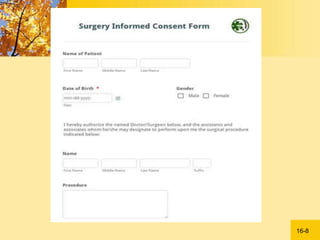
 Informed consent means that the client
understands the reasons and risks of the
proposed intervention.
 Witnessing confirms that the person who
signs the consent is competent.
16-6
16-7
16-8
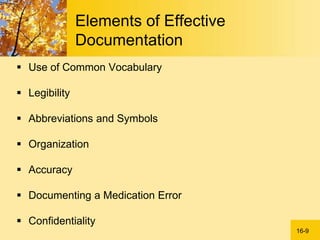
Elements of Effective
Documentation
 Use of Common Vocabulary
 Legibility
 Abbreviations and Symbols
 Organization
 Accuracy
 Documenting a Medication Error
 Confidentiality
16-9
Elements of Effective
Documentation
 Use of Common Vocabulary
• Improves communication and lessens the
chance of misunderstanding between
members of the health team.
16-10
Elements of Effective
Documentation
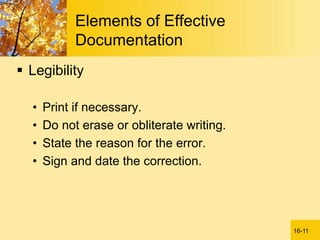
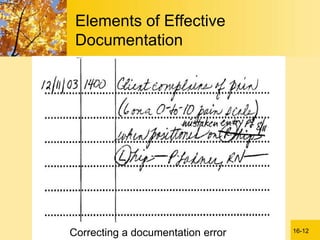
 Legibility
• Print if necessary.
• Do not erase or obliterate writing.
• State the reason for the error.
• Sign and date the correction.
16-11
Elements of Effective
Documentation
Correcting a documentation error 16-12
16-13
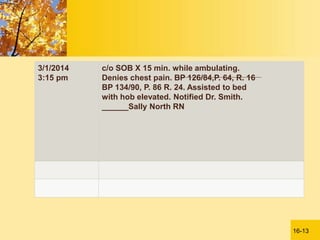
3/1/2014
3:15 pm
c/o SOB X 15 min. while ambulating.
Denies chest pain. BP 126/84,P. 64, R. 16
BP 134/90, P. 86 R. 24. Assisted to bed
with hob elevated. Notified Dr. Smith.
______Sally North RN
Elements of Effective
Documentation
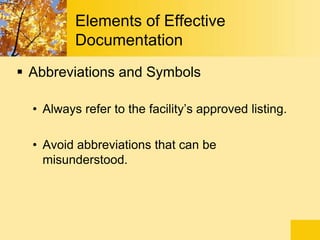
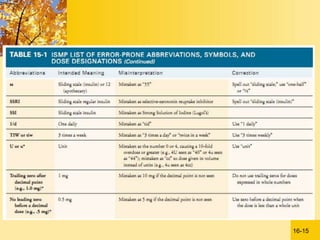
 Abbreviations and Symbols
• Always refer to the facility’s approved listing.
• Avoid abbreviations that can be
misunderstood.
16-15
Elements of Effective
Documentation
 Organization
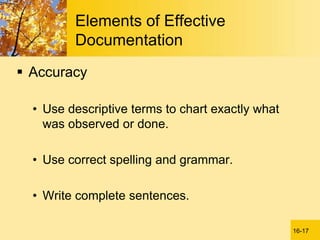
• Start every entry with the date and time.
• Chart in chronological order.
• Chart medications immediately after
administration.
• Sign your name after each entry.
16-16
Elements of Effective
Documentation
 Accuracy
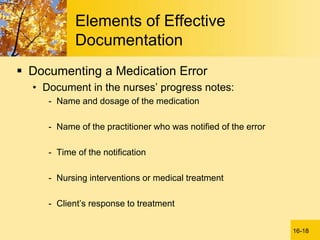
• Use descriptive terms to chart exactly what
was observed or done.
• Use correct spelling and grammar.
• Write complete sentences.
16-17
Elements of Effective
Documentation
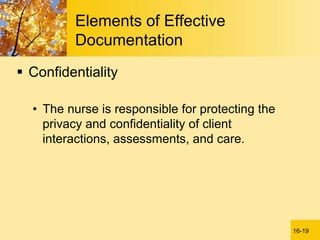
 Documenting a Medication Error
• Document in the nurses’ progress notes:
- Name and dosage of the medication
- Name of the practitioner who was notified of the error
- Time of the notification
- Nursing interventions or medical treatment
- Client’s response to treatment
16-18
Elements of Effective
Documentation
 Confidentiality
• The nurse is responsible for protecting the
privacy and confidentiality of client
interactions, assessments, and care.
16-19
Methods of Documentation
 Narrative Charting
 Source-Oriented Charting
 Problem-Oriented Charting
 PIE Charting
 Focus Charting
 Charting by Exception (CBE)
 Computerized Documentation
16-20
Methods of Documentation
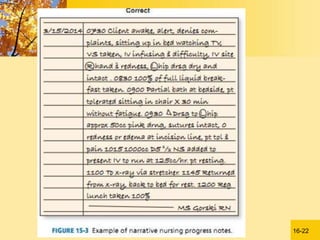
 Narrative Charting
• Describes the client’s status, interventions
and treatments; response to treatments is in
story format.
• Narrative charting is now being replaced by
other formats.
16-21
16-22
Methods of Documentation
 Source-Oriented Charting
• Narrative recording by each member (source)
of the health care team on separate records.
• For example the admission department has an
admission sheet, nurses use the nurses’
notes, physicians have a physician notes,
etc….
16-23
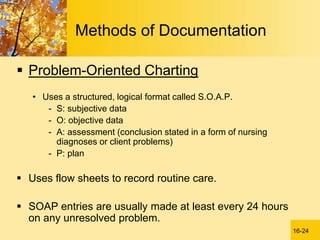
Methods of Documentation
 Problem-Oriented Charting
• Uses a structured, logical format called S.O.A.P.
- S: subjective data
- O: objective data
- A: assessment (conclusion stated in a form of nursing
diagnoses or client problems)
- P: plan
 Uses flow sheets to record routine care.
 SOAP entries are usually made at least every 24 hours
on any unresolved problem.
16-24
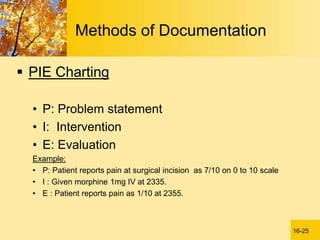
Methods of Documentation
 PIE Charting
• P: Problem statement
• I: Intervention
• E: Evaluation
Example:
• P: Patient reports pain at surgical incision as 7/10 on 0 to 10 scale
• I : Given morphine 1mg IV at 2335.
• E : Patient reports pain as 1/10 at 2355.
16-25
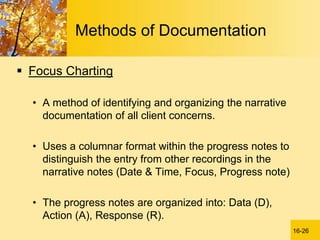
Methods of Documentation
 Focus Charting
• A method of identifying and organizing the narrative
documentation of all client concerns.
• Uses a columnar format within the progress notes to
distinguish the entry from other recordings in the
narrative notes (Date & Time, Focus, Progress note)
• The progress notes are organized into: Data (D),
Action (A), Response (R).
16-26
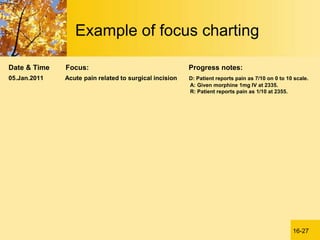
Example of focus charting
Date & Time Focus: Progress notes:
05.Jan.2011 Acute pain related to surgical incision D: Patient reports pain as 7/10 on 0 to 10 scale.
A: Given morphine 1mg IV at 2335.
R: Patient reports pain as 1/10 at 2355.
16-27
Methods of Documentation
 Charting by Exception (CBE)
• The nurse documents only deviations from
pre-established norms (document only
abnormal or significant findings).
• Avoids lengthy, repetitive notes.
16-28
Methods of Documentation
 Computerized Documentation
• Increases the quality of documentation and
save time.
• Increases legibility and accuracy.
• Facilitates statistical analysis of data.
16-29
Forms for Recording Data
 Kardex
 Flow Sheets
 Nurses’ Progress Notes
 Discharge Summary
16-30
Forms for Recording Data
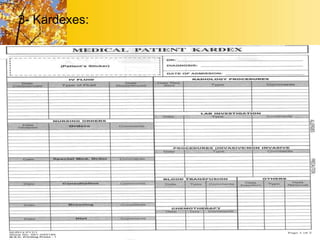
 The Kardex is used as a reference throughout the shift and during
change-of-shift reports.
 A medical-patient information system which uses forms preprinted on
durable card stock; loosely, any similar system for paper-based record-
keeping.
• Client data (e.g name, age, admission date, allergy)
• Medical diagnoses and nursing diagnoses
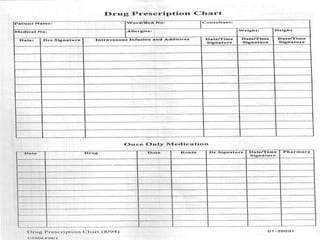
• Medical orders, list of medications
• Activities, diagnostic tests, or specific data on the pt.
16-31
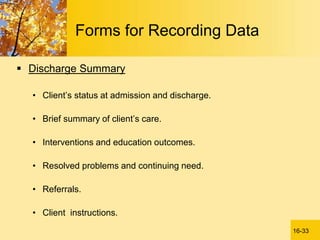
Forms for Recording Data
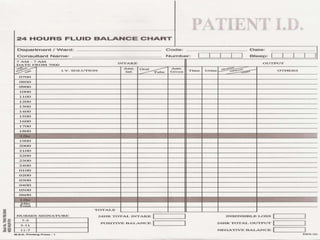
Flow Sheets
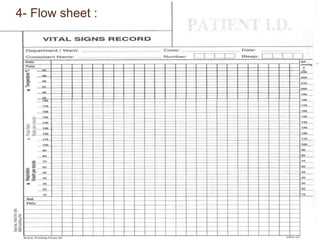
 A flow sheet is simply a one- or two-page form that gathers all the
important data regarding a patient's condition
 The information on flow sheets can be formatted to meet the specific
needs of the client.
(e.g.: graphic sheets for vital signs, intake & output record, skin
assessment record).
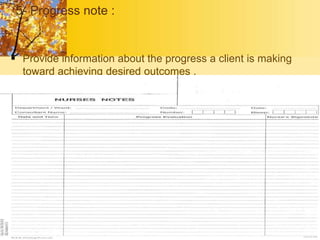
Nurses’ Progress Notes
 Used to document the client’s condition, problems and complaints,
interventions, responses, achievement of outcomes.
16-32
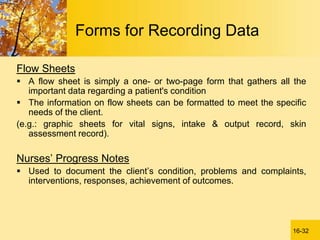
Forms for Recording Data
 Discharge Summary
• Client’s status at admission and discharge.
• Brief summary of client’s care.
• Interventions and education outcomes.
• Resolved problems and continuing need.
• Referrals.
• Client instructions.
16-33
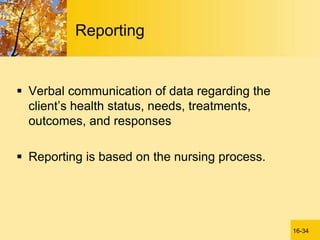
Reporting
 Verbal communication of data regarding the
client’s health status, needs, treatments,
outcomes, and responses
 Reporting is based on the nursing process.
16-34
Reporting
 Summary Reports
 Walking Rounds
 Incident Reports
 Telephone Reports and Orders
16-35
Reporting
Summary Reports
 Commonly occur at change of shift (or when client is
transferred).
Walking Rounds
 Occur in the client’s room
 Include Nursing, physician, interdisciplinary team.
Incident Reports
 Used to document any unusual occurrence or accident
in the delivery of client care.
16-36
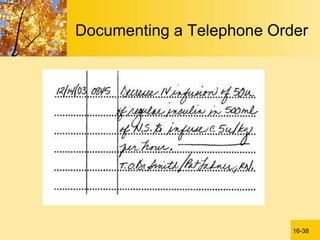
Reporting
Telephone Reports and Orders
 Report transfers, communicate referrals, obtain client
data, solve problems, inform a physician and/or client’s
family members regarding a change in the client’s
condition.
 Telephone orders are documented in the nurses’
progress notes and the physician order sheet.
16-37
16-38
Documenting a Telephone Order
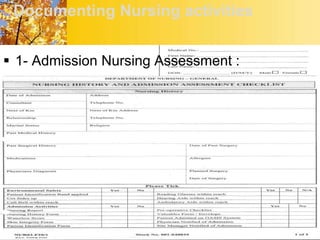
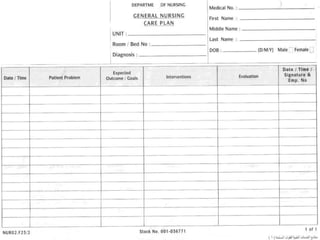
Documenting Nursing activities
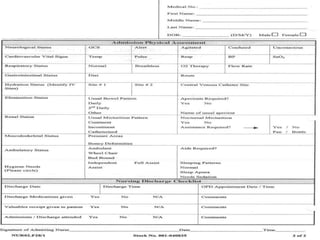
 1- Admission Nursing Assessment :
3- Kardexes:
4- Flow sheet :
5- Progress note :
 Provide information about the progress a client is making
toward achieving desired outcomes .
Thank you for your
listening

documentation_and_reporting.ppt

  • 1.
  • 2.
    Objectives 1. Explain thepurposes of documentation in health care. 2. Discuss the principles of effective documentation. 3. Describe various methods of documentation. 4. Describe various types of documentation records. 16-2
  • 3.
    Documentation as Communication  Reportingand recording are the major communication techniques used by health care providers. 16-3
  • 4.
    Documentation as Communication  Documentationis defined as written evidence of: • The interactions between and among health professionals, clients, their families, and health care organizations. • The administration of tests, procedures, treatments, and client education. • The results or client’s response to these diagnostic tests and interventions. 16-4
  • 5.
    Purposes of HealthCare Documentation  Professional Responsibility and Accountability  Communication  Assessment  Care Planning  Education  Quality Assurance  Research  Legal and Practice Standards 16-5
  • 6.
    Legal and PracticeStandards  Informed consent means that the client understands the reasons and risks of the proposed intervention.  Witnessing confirms that the person who signs the consent is competent. 16-6
  • 7.
  • 8.
  • 9.
    Elements of Effective Documentation Use of Common Vocabulary  Legibility  Abbreviations and Symbols  Organization  Accuracy  Documenting a Medication Error  Confidentiality 16-9
  • 10.
    Elements of Effective Documentation Use of Common Vocabulary • Improves communication and lessens the chance of misunderstanding between members of the health team. 16-10
  • 11.
    Elements of Effective Documentation Legibility • Print if necessary. • Do not erase or obliterate writing. • State the reason for the error. • Sign and date the correction. 16-11
  • 12.
  • 13.
    16-13 3/1/2014 3:15 pm c/o SOBX 15 min. while ambulating. Denies chest pain. BP 126/84,P. 64, R. 16 BP 134/90, P. 86 R. 24. Assisted to bed with hob elevated. Notified Dr. Smith. ______Sally North RN
  • 14.
    Elements of Effective Documentation Abbreviations and Symbols • Always refer to the facility’s approved listing. • Avoid abbreviations that can be misunderstood.
  • 15.
  • 16.
    Elements of Effective Documentation Organization • Start every entry with the date and time. • Chart in chronological order. • Chart medications immediately after administration. • Sign your name after each entry. 16-16
  • 17.
    Elements of Effective Documentation Accuracy • Use descriptive terms to chart exactly what was observed or done. • Use correct spelling and grammar. • Write complete sentences. 16-17
  • 18.
    Elements of Effective Documentation Documenting a Medication Error • Document in the nurses’ progress notes: - Name and dosage of the medication - Name of the practitioner who was notified of the error - Time of the notification - Nursing interventions or medical treatment - Client’s response to treatment 16-18
  • 19.
    Elements of Effective Documentation Confidentiality • The nurse is responsible for protecting the privacy and confidentiality of client interactions, assessments, and care. 16-19
  • 20.
    Methods of Documentation Narrative Charting  Source-Oriented Charting  Problem-Oriented Charting  PIE Charting  Focus Charting  Charting by Exception (CBE)  Computerized Documentation 16-20
  • 21.
    Methods of Documentation Narrative Charting • Describes the client’s status, interventions and treatments; response to treatments is in story format. • Narrative charting is now being replaced by other formats. 16-21
  • 22.
  • 23.
    Methods of Documentation Source-Oriented Charting • Narrative recording by each member (source) of the health care team on separate records. • For example the admission department has an admission sheet, nurses use the nurses’ notes, physicians have a physician notes, etc…. 16-23
  • 24.
    Methods of Documentation Problem-Oriented Charting • Uses a structured, logical format called S.O.A.P. - S: subjective data - O: objective data - A: assessment (conclusion stated in a form of nursing diagnoses or client problems) - P: plan  Uses flow sheets to record routine care.  SOAP entries are usually made at least every 24 hours on any unresolved problem. 16-24
  • 25.
    Methods of Documentation PIE Charting • P: Problem statement • I: Intervention • E: Evaluation Example: • P: Patient reports pain at surgical incision as 7/10 on 0 to 10 scale • I : Given morphine 1mg IV at 2335. • E : Patient reports pain as 1/10 at 2355. 16-25
  • 26.
    Methods of Documentation Focus Charting • A method of identifying and organizing the narrative documentation of all client concerns. • Uses a columnar format within the progress notes to distinguish the entry from other recordings in the narrative notes (Date & Time, Focus, Progress note) • The progress notes are organized into: Data (D), Action (A), Response (R). 16-26
  • 27.
    Example of focuscharting Date & Time Focus: Progress notes: 05.Jan.2011 Acute pain related to surgical incision D: Patient reports pain as 7/10 on 0 to 10 scale. A: Given morphine 1mg IV at 2335. R: Patient reports pain as 1/10 at 2355. 16-27
  • 28.
    Methods of Documentation Charting by Exception (CBE) • The nurse documents only deviations from pre-established norms (document only abnormal or significant findings). • Avoids lengthy, repetitive notes. 16-28
  • 29.
    Methods of Documentation Computerized Documentation • Increases the quality of documentation and save time. • Increases legibility and accuracy. • Facilitates statistical analysis of data. 16-29
  • 30.
    Forms for RecordingData  Kardex  Flow Sheets  Nurses’ Progress Notes  Discharge Summary 16-30
  • 31.
    Forms for RecordingData  The Kardex is used as a reference throughout the shift and during change-of-shift reports.  A medical-patient information system which uses forms preprinted on durable card stock; loosely, any similar system for paper-based record- keeping. • Client data (e.g name, age, admission date, allergy) • Medical diagnoses and nursing diagnoses • Medical orders, list of medications • Activities, diagnostic tests, or specific data on the pt. 16-31
  • 32.
    Forms for RecordingData Flow Sheets  A flow sheet is simply a one- or two-page form that gathers all the important data regarding a patient's condition  The information on flow sheets can be formatted to meet the specific needs of the client. (e.g.: graphic sheets for vital signs, intake & output record, skin assessment record). Nurses’ Progress Notes  Used to document the client’s condition, problems and complaints, interventions, responses, achievement of outcomes. 16-32
  • 33.
    Forms for RecordingData  Discharge Summary • Client’s status at admission and discharge. • Brief summary of client’s care. • Interventions and education outcomes. • Resolved problems and continuing need. • Referrals. • Client instructions. 16-33
  • 34.
    Reporting  Verbal communicationof data regarding the client’s health status, needs, treatments, outcomes, and responses  Reporting is based on the nursing process. 16-34
  • 35.
    Reporting  Summary Reports Walking Rounds  Incident Reports  Telephone Reports and Orders 16-35
  • 36.
    Reporting Summary Reports  Commonlyoccur at change of shift (or when client is transferred). Walking Rounds  Occur in the client’s room  Include Nursing, physician, interdisciplinary team. Incident Reports  Used to document any unusual occurrence or accident in the delivery of client care. 16-36
  • 37.
    Reporting Telephone Reports andOrders  Report transfers, communicate referrals, obtain client data, solve problems, inform a physician and/or client’s family members regarding a change in the client’s condition.  Telephone orders are documented in the nurses’ progress notes and the physician order sheet. 16-37
  • 38.
  • 39.
    Documenting Nursing activities 1- Admission Nursing Assessment :
  • 42.
  • 43.
  • 46.
    5- Progress note:  Provide information about the progress a client is making toward achieving desired outcomes .
  • 47.
    Thank you foryour listening