DOCUMENTATION
&
REPORTING
Mrs. Santhoshkumari. M,
MSc (N), PhD, MSc (Psy), PGDHM
Faculty in Nursing
College of Nursing,IGMC&RI
Puducherry
Documentation
Documentation is the process of
communicating in written form about
essential facts for the maintenance of
continuous history of events over a
period of time.
Recording & reporting are
the other ways of documentation.
Documentation as
Communication
• Documentation is defined as written
evidence of:
– The interactions between and among
health professionals, clients, their
families, and health care organizations.
– The administration of tests, procedures,
treatments, and client education.
– The results or client’s response to these
diagnostic tests and interventions.
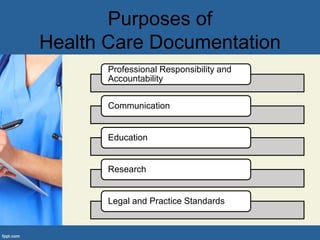
Purposes of
Health Care Documentation
Professional Responsibility and
Accountability
Communication
Education
Research
Legal and Practice Standards
• Informed consent means that the
client understands the reasons
and risks of the proposed
intervention.
• Witnessing confirms that the
person who signs the consent is
competent.
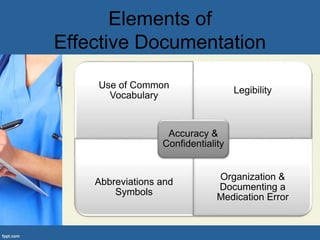
Elements of
Effective Documentation
Use of Common
Vocabulary
Legibility
Abbreviations and
Symbols
Organization &
Documenting a
Medication Error
Accuracy &
Confidentiality
• Use of Common Vocabulary
– Improves communication
– Lessens the chance of
misunderstanding between
members of the health team.
Elements of
Effective Documentation – Cont’d
• Legibility
– Print if necessary.
– Do not erase or obliterate writing.
– State the reason for the error.
– Sign and date the correction.
Elements of
Effective Documentation – Cont’d
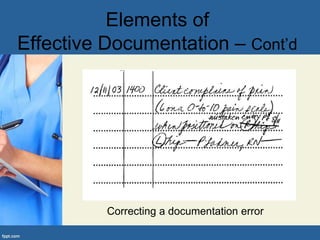
Correcting a documentation error
Elements of
Effective Documentation – Cont’d
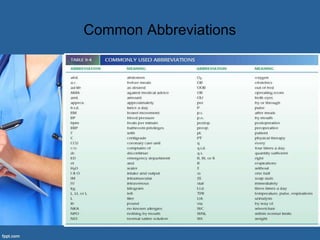
• Abbreviations and Symbols
– Always refer to the facility’s
approved listing.
– Avoid abbreviations that can be
misunderstood.
Elements of
Effective Documentation – Cont’d
Common Abbreviations
Elements of
Effective Documentation – Cont’d
• Organization
– Start every entry with the date and
time.
– Chart in chronological order.
– Chart medications immediately after
administration.
– Sign your name after each entry.
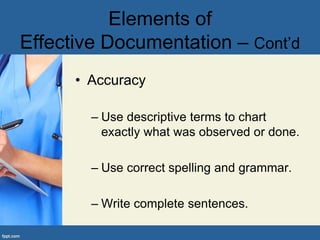
• Accuracy
– Use descriptive terms to chart
exactly what was observed or done.
– Use correct spelling and grammar.
– Write complete sentences.
Elements of
Effective Documentation – Cont’d
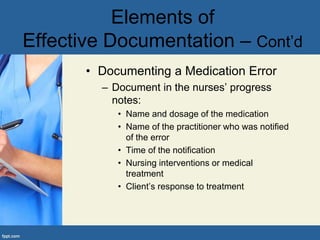
• Documenting a Medication Error
– Document in the nurses’ progress
notes:
• Name and dosage of the medication
• Name of the practitioner who was notified
of the error
• Time of the notification
• Nursing interventions or medical
treatment
• Client’s response to treatment
Elements of
Effective Documentation – Cont’d
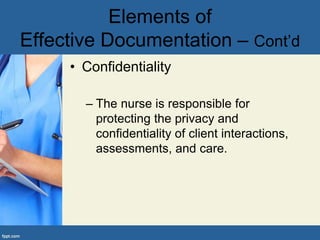
• Confidentiality
– The nurse is responsible for
protecting the privacy and
confidentiality of client interactions,
assessments, and care.
Elements of
Effective Documentation – Cont’d
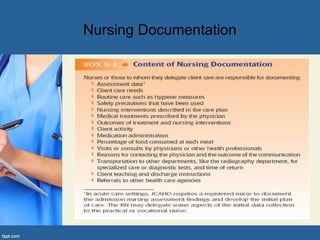
Nursing Documentation
Documentation Time
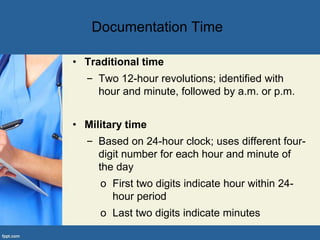
• Traditional time
– Two 12-hour revolutions; identified with
hour and minute, followed by a.m. or p.m.
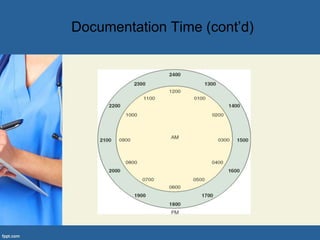
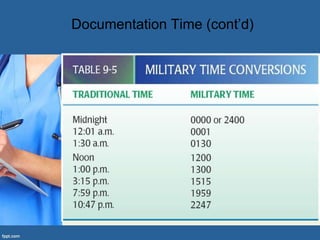
• Military time
– Based on 24-hour clock; uses different four-
digit number for each hour and minute of
the day
o First two digits indicate hour within 24-
hour period
o Last two digits indicate minutes
Documentation Time (cont’d)
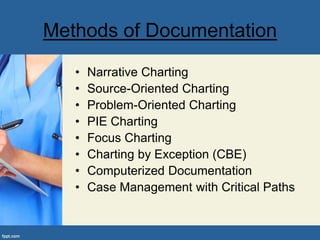
Methods of Documentation
• Narrative Charting
• Source-Oriented Charting
• Problem-Oriented Charting
• PIE Charting
• Focus Charting
• Charting by Exception (CBE)
• Computerized Documentation
• Case Management with Critical Paths
Methods of Documentation – Cont’d
• Narrative Charting
– Describes the client’s status,
interventions and treatments;
response to treatments is in story
format.
– Narrative charting is now being
replaced by other formats.
• Source-Oriented Charting
– Narrative recording by each member
(source) of the health care team on
separate records.
– For example the admission
department has an admission sheet,
nurses use the nurses’ notes,
physicians have a physician notes,
etc….
Methods of Documentation – Cont’d
• Problem-Oriented Charting
– Uses a structured, logical format called S.O.A.P.
• S: subjective data
• O: objective data
• A: assessment (conclusion stated in a form of
nursing diagnoses or client problems)
• P: plan
• Uses flow sheets to record routine care.
• SOAP entries are usually made at least every
24 hours on any unresolved problem.
Methods of Documentation – Cont’d
• PIE Charting
– P: Problem statement
– I: Intervention
– E: Evaluation
Example:
– P: Patient reports pain at surgical incision as 7/10
on 0 to 10 scale
– I : Given morphine 1mg IV at 23.35 hours.
– E : Patient reports pain as 1/10 at 23.55 hours.
Methods of Documentation – Cont’d
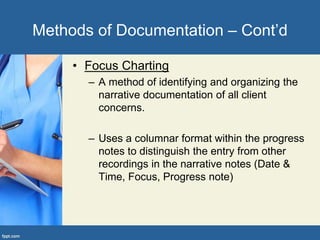
• Focus Charting
– A method of identifying and organizing the
narrative documentation of all client
concerns.
– Uses a columnar format within the progress
notes to distinguish the entry from other
recordings in the narrative notes (Date &
Time, Focus, Progress note)
Methods of Documentation – Cont’d
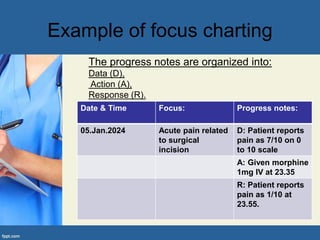
Example of focus charting
Date & Time Focus: Progress notes:
05.Jan.2024 Acute pain related
to surgical
incision
D: Patient reports
pain as 7/10 on 0
to 10 scale
A: Given morphine
1mg IV at 23.35
R: Patient reports
pain as 1/10 at
23.55.
The progress notes are organized into:
Data (D),
Action (A),
Response (R).
Methods of Documentation –Cont’d
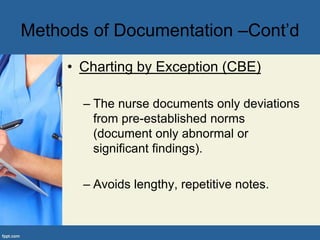
• Charting by Exception (CBE)
– The nurse documents only deviations
from pre-established norms
(document only abnormal or
significant findings).
– Avoids lengthy, repetitive notes.
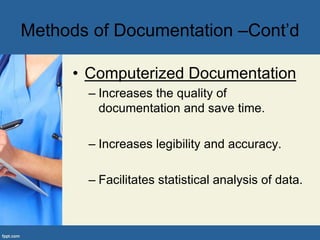
• Computerized Documentation
– Increases the quality of
documentation and save time.
– Increases legibility and accuracy.
– Facilitates statistical analysis of data.
Methods of Documentation –Cont’d
• Case Management Process
– A methodology for organizing client care
through an illness, using a critical pathway.
– A critical pathway is a multidisciplinary plan or
tool that specifies assessments, interventions,
treatments and outcomes of health related
problems across a time line.
Methods of Documentation –Cont’d
Medical or Nursing Records
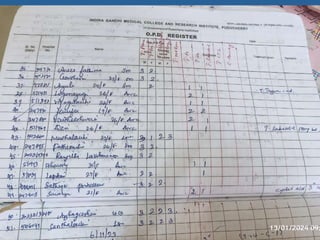
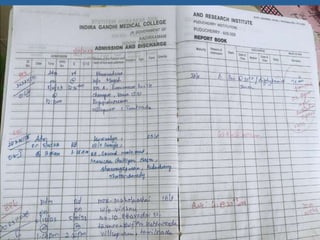
• Medical or Nursing records are written
collections of information about a
person’s health, the care provided by
health practitioners, and the client’s
progress
Health
Records Client
Records
• Permanent account
• Sharing information
• Quality assurance
• Accreditation
• Reimbursement
• Education and research
• Legal evidence
Uses of Health Records
• Person’s health information
• Care provided by health
practitioners
• The client’s progress
• The plan for care
• Medication administration record
• Laboratory and diagnostic reports
Components of Medical Records
TYPE OF RECORDS
• WARD RECORDS
• NURSE’S RECORDS
• STUDENTS RECORDS
• STAFF RECORDS
• ACADEMIC & ADMINISTRATIVE
RECORDS.
PATIENT RECORD
• Patient record in hospital is maintained as he /she comes
to the hospital for availing preventive & therapeutic
services.
OUT-PATIENT RECORD
• They provide information about out patient referral
numbers, patients biodata, medical history past &
present, family history if any, investigation records,
diagnosis & treatment & frequency of visit.
IN-PATIENT RECORD
• Admission record
• Observation record
• Investigation record
• Intake- output record
Patient Records – Cont’d
• Treatment record
• Diet record
• Progress record
• Nurse’s record
• Discharge record
All these records kept in one folder for each
individual patient in the ward under the charge of the
ward sister till the patient is discharged. Thereafter, it is
transferred to the medical record section as per rules.
OTHER PATIENT RECORDS
• Other patient records:
- treatment book
- diet book
- admission register
- discharge & death register,
- notification form,
- inventories & related record forms,
- duty roaster etc.
NURSING SERVICE RECORD
These records are maintained by nursing service
department.
The nursing service records include the
• nurses duty register,
• master plan of nursing personnel,
• leave register which contains annual, casual,
& medical leave,
• nurses attendance register
• confidential records,
• correspondence with other hospitals,
agencies.
Forms for Recording Data
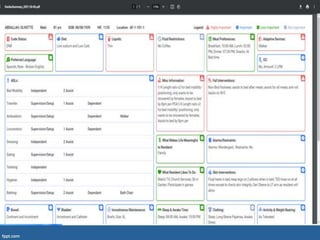
• Kardex
• Flow Sheets
• Nurses’ Progress Notes
• Discharge Summary
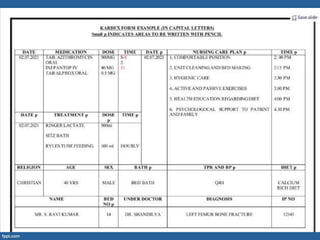
• The Kardex is used as a reference
throughout the shift and during change-of-
shift reports.
– Client data (e.g name, age, admission date,
allergy)
– Medical diagnoses and nursing diagnoses
– Medical orders, list of medications
– Activities, diagnostic tests, or specific data on
the pt.
Forms for Recording Data – Cont’d
Concepts of Nursing-NUR 123
Flow Sheets
• The information on flow sheets can be
formatted to meet the specific needs of the
client.
(e.g.: graphic sheets for vital signs, intake &
output record, skin assessment record).
Forms for Recording Data – Cont’d
Nurses’ Progress Notes
• Used to document the client’s
condition, problems and
complaints, interventions,
responses, achievement of
outcomes.
Forms for Recording Data – Cont’d
• Discharge Summary
– Client’s status at admission and discharge.
– Brief summary of client’s care.
– Interventions and education outcomes.
– Resolved problems and continuing need.
– Referrals.
– Client instructions.
Reporting
• Verbal communication of data regarding
the client’s health status, needs,
treatments, outcomes, and responses
• Reporting is based on the nursing
process.
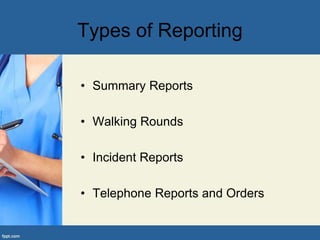
Types of Reporting
• Summary Reports
• Walking Rounds
• Incident Reports
• Telephone Reports and Orders
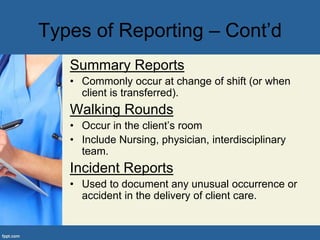
Types of Reporting – Cont’d
Summary Reports
• Commonly occur at change of shift (or when
client is transferred).
Walking Rounds
• Occur in the client’s room
• Include Nursing, physician, interdisciplinary
team.
Incident Reports
• Used to document any unusual occurrence or
accident in the delivery of client care.
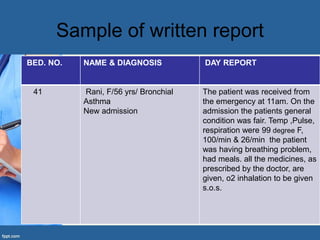
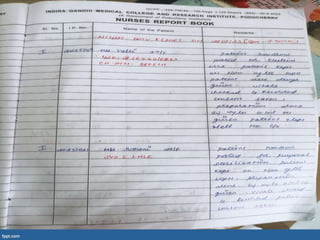
Sample of written report
BED. NO. NAME & DIAGNOSIS DAY REPORT
41 Rani, F/56 yrs/ Bronchial
Asthma
New admission
The patient was received from
the emergency at 11am. On the
admission the patients general
condition was fair. Temp ,Pulse,
respiration were 99 degree F,
100/min & 26/min the patient
was having breathing problem,
had meals. all the medicines, as
prescribed by the doctor, are
given, o2 inhalation to be given
s.o.s.
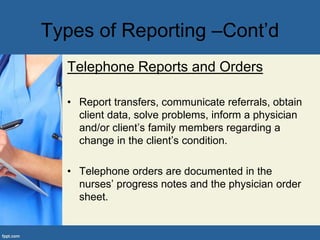
Types of Reporting –Cont’d
Telephone Reports and Orders
• Report transfers, communicate referrals, obtain
client data, solve problems, inform a physician
and/or client’s family members regarding a
change in the client’s condition.
• Telephone orders are documented in the
nurses’ progress notes and the physician order
sheet.
Documenting a Telephone
Order
16-50
DO'S AND DON'TS OF NURSING
DOCUMENTATION
• Nurses are well aware of the standard, which states
that if a certain matter affecting patient care is required
to be charted and it is not, the overwhelming
presumption is that it may not have been done.
• Good documentation will help you to defend yourself in
a malpractice lawsuit, it can also keep you out of court
in the first place.
DO’S
• Check that you have the correct chart before you begin
writing.
• Make sure your documentation reflects the nursing
process and your professional capabilities.
• Write legibly.
• Chart the time you gave a medication, the administration
route, and the patient's response.
• Chart precautions or preventive measures used, such as
bed rails.
• Record each phone call to a physician, including the
exact time, message, and response.
• Chart patient care at the time you provide it.
• If you remember an important point after you've
completed your documentation, chart the information with
a notation that it's a "late entry." Include the date and
time of the late entry.
DON’Ts
• Don't chart a symptom, such as "c/o pain,"
without also charting what you did about it.
• Don't alter a patient's record - this is a
criminal offense.
• Don't use shorthand or abbreviations that
aren't widely accepted.
• Don't write imprecise descriptions, such as
"bed soaked" or "a large amount."
Concepts of Nursing-NUR 123
Documentation_and_reporting_Santhoshkumari.ppt

Documentation_and_reporting_Santhoshkumari.ppt

  • 1.
    DOCUMENTATION & REPORTING Mrs. Santhoshkumari. M, MSc(N), PhD, MSc (Psy), PGDHM Faculty in Nursing College of Nursing,IGMC&RI Puducherry
  • 2.
    Documentation Documentation is theprocess of communicating in written form about essential facts for the maintenance of continuous history of events over a period of time. Recording & reporting are the other ways of documentation.
  • 3.
    Documentation as Communication • Documentationis defined as written evidence of: – The interactions between and among health professionals, clients, their families, and health care organizations. – The administration of tests, procedures, treatments, and client education. – The results or client’s response to these diagnostic tests and interventions.
  • 4.
    Purposes of Health CareDocumentation Professional Responsibility and Accountability Communication Education Research Legal and Practice Standards
  • 5.
    Legal and PracticeStandards • Informed consent means that the client understands the reasons and risks of the proposed intervention. • Witnessing confirms that the person who signs the consent is competent.
  • 6.
    Elements of Effective Documentation Useof Common Vocabulary Legibility Abbreviations and Symbols Organization & Documenting a Medication Error Accuracy & Confidentiality
  • 7.
    • Use ofCommon Vocabulary – Improves communication – Lessens the chance of misunderstanding between members of the health team. Elements of Effective Documentation – Cont’d
  • 8.
    • Legibility – Printif necessary. – Do not erase or obliterate writing. – State the reason for the error. – Sign and date the correction. Elements of Effective Documentation – Cont’d
  • 9.
    Correcting a documentationerror Elements of Effective Documentation – Cont’d
  • 10.
    • Abbreviations andSymbols – Always refer to the facility’s approved listing. – Avoid abbreviations that can be misunderstood. Elements of Effective Documentation – Cont’d
  • 11.
  • 12.
    Elements of Effective Documentation– Cont’d • Organization – Start every entry with the date and time. – Chart in chronological order. – Chart medications immediately after administration. – Sign your name after each entry.
  • 13.
    • Accuracy – Usedescriptive terms to chart exactly what was observed or done. – Use correct spelling and grammar. – Write complete sentences. Elements of Effective Documentation – Cont’d
  • 14.
    • Documenting aMedication Error – Document in the nurses’ progress notes: • Name and dosage of the medication • Name of the practitioner who was notified of the error • Time of the notification • Nursing interventions or medical treatment • Client’s response to treatment Elements of Effective Documentation – Cont’d
  • 15.
    • Confidentiality – Thenurse is responsible for protecting the privacy and confidentiality of client interactions, assessments, and care. Elements of Effective Documentation – Cont’d
  • 16.
  • 17.
    Documentation Time • Traditionaltime – Two 12-hour revolutions; identified with hour and minute, followed by a.m. or p.m. • Military time – Based on 24-hour clock; uses different four- digit number for each hour and minute of the day o First two digits indicate hour within 24- hour period o Last two digits indicate minutes
  • 18.
  • 19.
  • 20.
    Methods of Documentation •Narrative Charting • Source-Oriented Charting • Problem-Oriented Charting • PIE Charting • Focus Charting • Charting by Exception (CBE) • Computerized Documentation • Case Management with Critical Paths
  • 21.
    Methods of Documentation– Cont’d • Narrative Charting – Describes the client’s status, interventions and treatments; response to treatments is in story format. – Narrative charting is now being replaced by other formats.
  • 22.
    • Source-Oriented Charting –Narrative recording by each member (source) of the health care team on separate records. – For example the admission department has an admission sheet, nurses use the nurses’ notes, physicians have a physician notes, etc…. Methods of Documentation – Cont’d
  • 23.
    • Problem-Oriented Charting –Uses a structured, logical format called S.O.A.P. • S: subjective data • O: objective data • A: assessment (conclusion stated in a form of nursing diagnoses or client problems) • P: plan • Uses flow sheets to record routine care. • SOAP entries are usually made at least every 24 hours on any unresolved problem. Methods of Documentation – Cont’d
  • 24.
    • PIE Charting –P: Problem statement – I: Intervention – E: Evaluation Example: – P: Patient reports pain at surgical incision as 7/10 on 0 to 10 scale – I : Given morphine 1mg IV at 23.35 hours. – E : Patient reports pain as 1/10 at 23.55 hours. Methods of Documentation – Cont’d
  • 25.
    • Focus Charting –A method of identifying and organizing the narrative documentation of all client concerns. – Uses a columnar format within the progress notes to distinguish the entry from other recordings in the narrative notes (Date & Time, Focus, Progress note) Methods of Documentation – Cont’d
  • 26.
    Example of focuscharting Date & Time Focus: Progress notes: 05.Jan.2024 Acute pain related to surgical incision D: Patient reports pain as 7/10 on 0 to 10 scale A: Given morphine 1mg IV at 23.35 R: Patient reports pain as 1/10 at 23.55. The progress notes are organized into: Data (D), Action (A), Response (R).
  • 27.
    Methods of Documentation–Cont’d • Charting by Exception (CBE) – The nurse documents only deviations from pre-established norms (document only abnormal or significant findings). – Avoids lengthy, repetitive notes.
  • 28.
    • Computerized Documentation –Increases the quality of documentation and save time. – Increases legibility and accuracy. – Facilitates statistical analysis of data. Methods of Documentation –Cont’d
  • 29.
    • Case ManagementProcess – A methodology for organizing client care through an illness, using a critical pathway. – A critical pathway is a multidisciplinary plan or tool that specifies assessments, interventions, treatments and outcomes of health related problems across a time line. Methods of Documentation –Cont’d
  • 30.
    Medical or NursingRecords • Medical or Nursing records are written collections of information about a person’s health, the care provided by health practitioners, and the client’s progress Health Records Client Records
  • 31.
    • Permanent account •Sharing information • Quality assurance • Accreditation • Reimbursement • Education and research • Legal evidence Uses of Health Records
  • 32.
    • Person’s healthinformation • Care provided by health practitioners • The client’s progress • The plan for care • Medication administration record • Laboratory and diagnostic reports Components of Medical Records
  • 33.
    TYPE OF RECORDS •WARD RECORDS • NURSE’S RECORDS • STUDENTS RECORDS • STAFF RECORDS • ACADEMIC & ADMINISTRATIVE RECORDS.
  • 34.
    PATIENT RECORD • Patientrecord in hospital is maintained as he /she comes to the hospital for availing preventive & therapeutic services. OUT-PATIENT RECORD • They provide information about out patient referral numbers, patients biodata, medical history past & present, family history if any, investigation records, diagnosis & treatment & frequency of visit. IN-PATIENT RECORD • Admission record • Observation record • Investigation record • Intake- output record
  • 35.
    Patient Records –Cont’d • Treatment record • Diet record • Progress record • Nurse’s record • Discharge record All these records kept in one folder for each individual patient in the ward under the charge of the ward sister till the patient is discharged. Thereafter, it is transferred to the medical record section as per rules.
  • 36.
    OTHER PATIENT RECORDS •Other patient records: - treatment book - diet book - admission register - discharge & death register, - notification form, - inventories & related record forms, - duty roaster etc.
  • 37.
    NURSING SERVICE RECORD Theserecords are maintained by nursing service department. The nursing service records include the • nurses duty register, • master plan of nursing personnel, • leave register which contains annual, casual, & medical leave, • nurses attendance register • confidential records, • correspondence with other hospitals, agencies.
  • 38.
    Forms for RecordingData • Kardex • Flow Sheets • Nurses’ Progress Notes • Discharge Summary
  • 39.
    • The Kardexis used as a reference throughout the shift and during change-of- shift reports. – Client data (e.g name, age, admission date, allergy) – Medical diagnoses and nursing diagnoses – Medical orders, list of medications – Activities, diagnostic tests, or specific data on the pt. Forms for Recording Data – Cont’d
  • 40.
  • 42.
    Flow Sheets • Theinformation on flow sheets can be formatted to meet the specific needs of the client. (e.g.: graphic sheets for vital signs, intake & output record, skin assessment record). Forms for Recording Data – Cont’d
  • 43.
    Nurses’ Progress Notes •Used to document the client’s condition, problems and complaints, interventions, responses, achievement of outcomes. Forms for Recording Data – Cont’d
  • 44.
    Forms for RecordingData – Cont’d • Discharge Summary – Client’s status at admission and discharge. – Brief summary of client’s care. – Interventions and education outcomes. – Resolved problems and continuing need. – Referrals. – Client instructions.
  • 45.
    Reporting • Verbal communicationof data regarding the client’s health status, needs, treatments, outcomes, and responses • Reporting is based on the nursing process.
  • 46.
    Types of Reporting •Summary Reports • Walking Rounds • Incident Reports • Telephone Reports and Orders
  • 47.
    Types of Reporting– Cont’d Summary Reports • Commonly occur at change of shift (or when client is transferred). Walking Rounds • Occur in the client’s room • Include Nursing, physician, interdisciplinary team. Incident Reports • Used to document any unusual occurrence or accident in the delivery of client care.
  • 48.
    Sample of writtenreport BED. NO. NAME & DIAGNOSIS DAY REPORT 41 Rani, F/56 yrs/ Bronchial Asthma New admission The patient was received from the emergency at 11am. On the admission the patients general condition was fair. Temp ,Pulse, respiration were 99 degree F, 100/min & 26/min the patient was having breathing problem, had meals. all the medicines, as prescribed by the doctor, are given, o2 inhalation to be given s.o.s.
  • 49.
    Types of Reporting–Cont’d Telephone Reports and Orders • Report transfers, communicate referrals, obtain client data, solve problems, inform a physician and/or client’s family members regarding a change in the client’s condition. • Telephone orders are documented in the nurses’ progress notes and the physician order sheet.
  • 50.
  • 51.
    DO'S AND DON'TSOF NURSING DOCUMENTATION • Nurses are well aware of the standard, which states that if a certain matter affecting patient care is required to be charted and it is not, the overwhelming presumption is that it may not have been done. • Good documentation will help you to defend yourself in a malpractice lawsuit, it can also keep you out of court in the first place.
  • 52.
    DO’S • Check thatyou have the correct chart before you begin writing. • Make sure your documentation reflects the nursing process and your professional capabilities. • Write legibly. • Chart the time you gave a medication, the administration route, and the patient's response. • Chart precautions or preventive measures used, such as bed rails. • Record each phone call to a physician, including the exact time, message, and response. • Chart patient care at the time you provide it. • If you remember an important point after you've completed your documentation, chart the information with a notation that it's a "late entry." Include the date and time of the late entry.
  • 53.
    DON’Ts • Don't charta symptom, such as "c/o pain," without also charting what you did about it. • Don't alter a patient's record - this is a criminal offense. • Don't use shorthand or abbreviations that aren't widely accepted. • Don't write imprecise descriptions, such as "bed soaked" or "a large amount."
  • 54.
  • 55.
  • 56.