Kuldeep Vyas Associate Professor Dept. – Community Health Nursing | 1
NURSING FOUNDATION
UNIT – 13 PATIENT EDUCATIONS
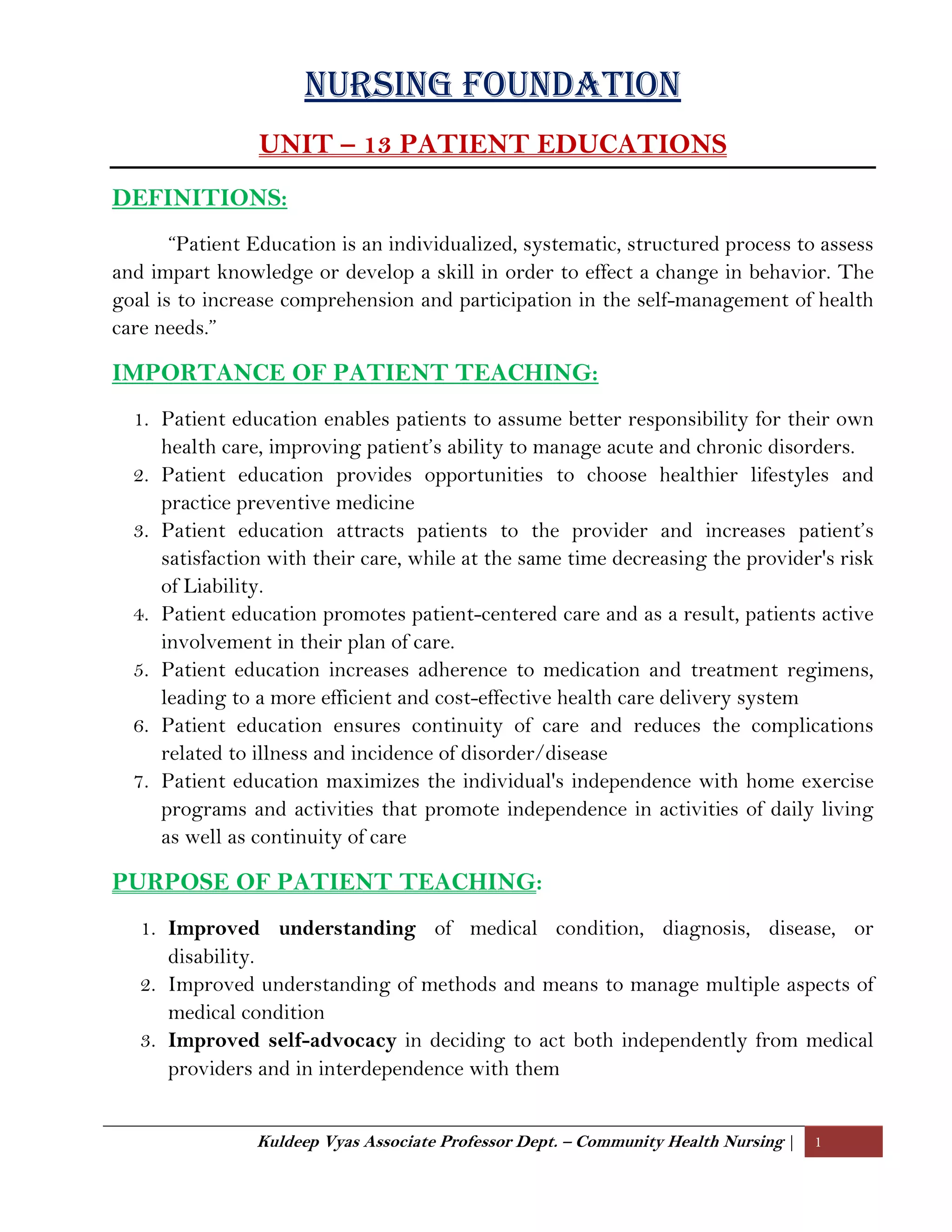
DEFINITIONS:
“Patient Education is an individualized, systematic, structured process to assess
and impart knowledge or develop a skill in order to effect a change in behavior. The
goal is to increase comprehension and participation in the self-management of health
care needs.”
IMPORTANCE OF PATIENT TEACHING:
1. Patient education enables patients to assume better responsibility for their own
health care, improving patient’s ability to manage acute and chronic disorders.
2. Patient education provides opportunities to choose healthier lifestyles and
practice preventive medicine
3. Patient education attracts patients to the provider and increases patient’s
satisfaction with their care, while at the same time decreasing the provider's risk
of Liability.
4. Patient education promotes patient-centered care and as a result, patients active
involvement in their plan of care.
5. Patient education increases adherence to medication and treatment regimens,
leading to a more efficient and cost-effective health care delivery system
6. Patient education ensures continuity of care and reduces the complications
related to illness and incidence of disorder/disease
7. Patient education maximizes the individual's independence with home exercise
programs and activities that promote independence in activities of daily living
as well as continuity of care
PURPOSE OF PATIENT TEACHING:
1. Improved understanding of medical condition, diagnosis, disease, or
disability.
2. Improved understanding of methods and means to manage multiple aspects of
medical condition
3. Improved self-advocacy in deciding to act both independently from medical
providers and in interdependence with them
Kuldeep Vyas Associate Professor Dept. – Community Health Nursing | 2
4. Increased compliance:- Effective communication and patient education
increases patient motivation to comply
5. Patient outcomes:- Patients more likely to respond well to their treatment
plan – fewer complications
6. Informed consent: - Patients feel you've provided the information they need
7. Utilization: - More effective use of medical services-fewer unnecessary phone
calls and visits.
8. Satisfaction and referrals: - Patients more likely to stay with your practice
and refer other patients
9. Risk management: - Lower risk of malpractice when patients have realistic
expectations
10.To prevent disease or injury: - Patient education creates health awareness
and prevents diseases. E.g. hand washing prevents few communicable diseases
11.To promote wellness: - e.g. education about healthy life style practices
promotes wellness.
12.To restore their health: - e.g. rehabilitation training and education to
orthopedic conditions makes the person more independent
13.To help patients cope: - Adequate patient education makes person to cope
with the existing problem soon. E.g. telling the patient that diabetes is not
curable but the progress can be controlled through life style modification and
medication
FACTORS INFLUENCING LEARNING/PATIENT TEACHING
 Age and developmental stage: - It influence the clients ability to understand
 Motivation: - A desire to learn influence speed of learning
 Readiness to learn: - A willingness to learn, and physiological and
psychological readiness to learn will influence speed of understanding
 Active involvement: - Learner's participation and self interest in learning will
influence speed and retention better
 Relevancy: - Information should be relevant to the person to show interest and
gain knowledge from previous knowledge
 Feedback: - Positive or negative feedback will increase practice regarding
psychomotor skills
 Non-judgmental support increases self-confident in their ability to learn.
 Simple to complex learning enhance comprehend new information and
assimilate with previous learning
 Repetition facilitate retentions
Kuldeep Vyas Associate Professor Dept. – Community Health Nursing | 3
 Timing
 Short timing between learning and practice (easy to remember)
 Long timing (possible to forget)
 Poor environmental condition as follows can affect level of
understanding.
 Inadequate lighting
 Temperature
 Ventilation distraction
 Noise
 Privacy
 Emotional factor as given below can affect learning process.
 Anger
 Fear
 Depression
 Physiological events as given below can influence the learning process
 Pain
 Critical illness
 Sensory
 Cultural aspects as given below can influence the learning process
 Different language
 Values
 Psychomotor ability as given below can influence the learning process
 Muscle strength
 Motor coordination
 Energy
 Sensory acuity
MALCOLM KNOWLES ASSUMPTION OF PATIENT LEARNING
 A person's personality progresses in an orderly fashion from a dependent to an
independent one.
 A person's readiness to learn is affected by sociocultural factors and their
developmental stage
 A person's previous learning experiences can be used as a stepping stone for
new knowledge and further learning
 Learning is reinforced through immediacy
Kuldeep Vyas Associate Professor Dept. – Community Health Nursing | 4
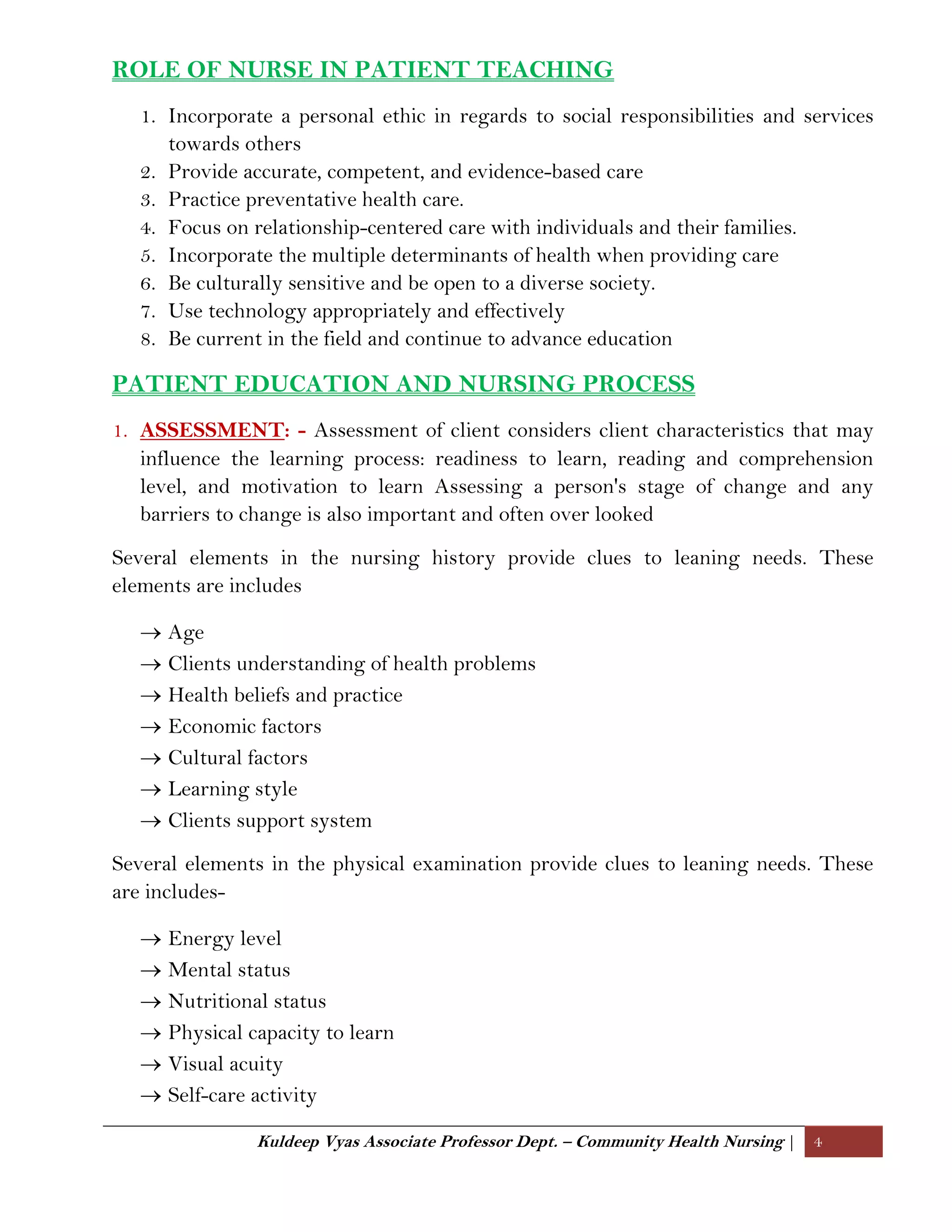
ROLE OF NURSE IN PATIENT TEACHING
1. Incorporate a personal ethic in regards to social responsibilities and services
towards others
2. Provide accurate, competent, and evidence-based care
3. Practice preventative health care.
4. Focus on relationship-centered care with individuals and their families.
5. Incorporate the multiple determinants of health when providing care
6. Be culturally sensitive and be open to a diverse society.
7. Use technology appropriately and effectively
8. Be current in the field and continue to advance education
PATIENT EDUCATION AND NURSING PROCESS
1. ASSESSMENT: - Assessment of client considers client characteristics that may
influence the learning process: readiness to learn, reading and comprehension
level, and motivation to learn Assessing a person's stage of change and any
barriers to change is also important and often over looked
Several elements in the nursing history provide clues to leaning needs. These
elements are includes
 Age
 Clients understanding of health problems
 Health beliefs and practice
 Economic factors
 Cultural factors
 Learning style
 Clients support system
Several elements in the physical examination provide clues to leaning needs. These
are includes-
 Energy level
 Mental status
 Nutritional status
 Physical capacity to learn
 Visual acuity
 Self-care activity
Kuldeep Vyas Associate Professor Dept. – Community Health Nursing | 5
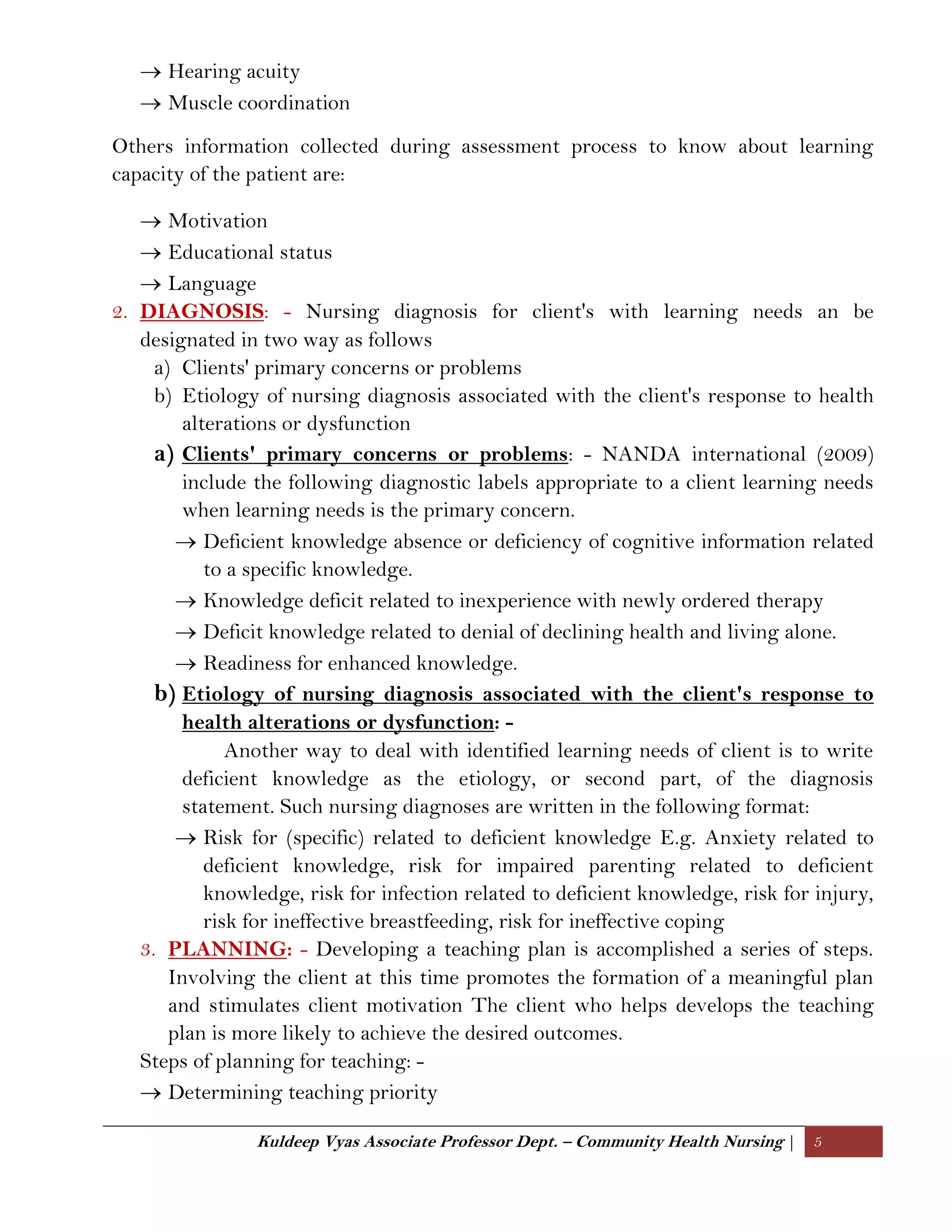
 Hearing acuity
 Muscle coordination
Others information collected during assessment process to know about learning
capacity of the patient are:
 Motivation
 Educational status
 Language
2. DIAGNOSIS: - Nursing diagnosis for client's with learning needs an be
designated in two way as follows
a) Clients' primary concerns or problems
b) Etiology of nursing diagnosis associated with the client's response to health
alterations or dysfunction
a) Clients' primary concerns or problems: - NANDA international (2009)
include the following diagnostic labels appropriate to a client learning needs
when learning needs is the primary concern.
 Deficient knowledge absence or deficiency of cognitive information related
to a specific knowledge.
 Knowledge deficit related to inexperience with newly ordered therapy
 Deficit knowledge related to denial of declining health and living alone.
 Readiness for enhanced knowledge.
b) Etiology of nursing diagnosis associated with the client's response to
health alterations or dysfunction: -
Another way to deal with identified learning needs of client is to write
deficient knowledge as the etiology, or second part, of the diagnosis
statement. Such nursing diagnoses are written in the following format:
 Risk for (specific) related to deficient knowledge E.g. Anxiety related to
deficient knowledge, risk for impaired parenting related to deficient
knowledge, risk for infection related to deficient knowledge, risk for injury,
risk for ineffective breastfeeding, risk for ineffective coping
3. PLANNING: - Developing a teaching plan is accomplished a series of steps.
Involving the client at this time promotes the formation of a meaningful plan
and stimulates client motivation The client who helps develops the teaching
plan is more likely to achieve the desired outcomes.
Steps of planning for teaching: -
 Determining teaching priority
Kuldeep Vyas Associate Professor Dept. – Community Health Nursing | 6
 Choosing content
 Organizing learning experiences
 Setting learning outcomes
 Selecting teaching strategies
4. Implementation: - The nurse needs to be flexible in implementing any
teaching plan because the plan may need revising. The client my become tired
sooner than anticipated or be faced too much information too quickly, the
client's needs may change or external factors may intervene
It is also important for nurses to use teaching techniques that enhance learning
and reduce oreliminate any barrier to learning such as pain or fatigue
Guidelines for teaching: -
 Maintain respectful relationship between the nurse and client
 Know the previous knowledge of the client about the topic.
 Depends of the clients need and capacity the time for teaching can be
flexible
 Teach clearly and concisely.
 The pace of the teaching session should not be too fast or too slow
 Use teaching aids.
 Teaching should involve the use of number of learner sense
 The teaching should be relevant to the client
 Repletion of content for retention by Summarizing and rephrasing and
material from another point of view.
Teaching strategies are including: -
 Client contracting
 Computer learning resources
 Group teaching
 Discovery/problem solving
 Behavior modification
Guidelines for transcultural teaching: -
The nurse and client of different cultural and ethnic backgrounds have additional
barrier to overcome in the teaching learning process. Use following guidelines for
transcultural teaching
Kuldeep Vyas Associate Professor Dept. – Community Health Nursing | 7
 Obtain teaching materials, pamphlets, and instructions in languages used by
clients.
 Use visual aids, such as picture chart, or diagram to communicate meaning
 Use concrete rather than abstract words.
 Allow time for questions.
 Avoid the use of medical terminology or health care language.
 If understanding another's pronunciation is a problem validate brief
information in writing
 Use humor very cautiously.
 Do not use slang words or colloquialisms
 Do not assume that a client who nods uses eye contact, or smiles are indicating
an understanding of what is being taught
 Invite and encourage questions during teaching
 When explaining procedure or functioning related to personal areas of the
body, it may be appropriate to have a nurse of the same sex do the teaching.
 Include the family in planning and teaching. This promotes trust and mutual
respect
 Consider the client time orientation
 Identify cultural health practice and beliefs
5. Evaluating: - Evaluation is both an ongoing and a final process in which the
client, the nurse and often the support people determine what has been learned
6. Evaluating learning: - learning is measured against the predetermined
learning outcomes selected in the planning phase of the teaching process. Thus
the outcome serves not only to direct teaching plan but also to provide
outcome criteria for evaluation. The best method of evaluation is depends on
the types of learning. In cognitive learning, the client demonstrates acquisition
of knowledge
Technique to evaluate learning is-
 Direct observation of behavior for change
 Oral questioning
 Self-report and self-monitoring.
7. Evaluating teaching: - It is important for nurses to evaluate their own
teaching and the content of the teaching program just as they evaluate the
effectiveness of nursing intervention for other nursing diagnosis Evaluation
Kuldeep Vyas Associate Professor Dept. – Community Health Nursing | 8
should include a consideration of all factors-a timing the teaching strategies,
the amount of information, whether the teaching was helpful and so on
8. Documentation: - documentation of the teaching process is essential as it is
a legal record that the teaching took place. It is important to document the
response of the client and support people to teaching activity
Document should include-
 Diagnosed leaning needs.
 Topics taught
 Learning outcomes
 Client outcome need for additional teaching
 . Resources provided.
The written teaching plan that the nurse uses as a resource to guide future
teaching sessions might also include these elements
 Actual information and skills taught
 Teaching strategies used.
 Time framework and content for each class
 Teaching outcomes and methods of evaluation
Thank You …

Unit - 13 Patient Education.pdf

  • 1.
    Kuldeep Vyas AssociateProfessor Dept. – Community Health Nursing | 1 NURSING FOUNDATION UNIT – 13 PATIENT EDUCATIONS DEFINITIONS: “Patient Education is an individualized, systematic, structured process to assess and impart knowledge or develop a skill in order to effect a change in behavior. The goal is to increase comprehension and participation in the self-management of health care needs.” IMPORTANCE OF PATIENT TEACHING: 1. Patient education enables patients to assume better responsibility for their own health care, improving patient’s ability to manage acute and chronic disorders. 2. Patient education provides opportunities to choose healthier lifestyles and practice preventive medicine 3. Patient education attracts patients to the provider and increases patient’s satisfaction with their care, while at the same time decreasing the provider's risk of Liability. 4. Patient education promotes patient-centered care and as a result, patients active involvement in their plan of care. 5. Patient education increases adherence to medication and treatment regimens, leading to a more efficient and cost-effective health care delivery system 6. Patient education ensures continuity of care and reduces the complications related to illness and incidence of disorder/disease 7. Patient education maximizes the individual's independence with home exercise programs and activities that promote independence in activities of daily living as well as continuity of care PURPOSE OF PATIENT TEACHING: 1. Improved understanding of medical condition, diagnosis, disease, or disability. 2. Improved understanding of methods and means to manage multiple aspects of medical condition 3. Improved self-advocacy in deciding to act both independently from medical providers and in interdependence with them
  • 2.
    Kuldeep Vyas AssociateProfessor Dept. – Community Health Nursing | 2 4. Increased compliance:- Effective communication and patient education increases patient motivation to comply 5. Patient outcomes:- Patients more likely to respond well to their treatment plan – fewer complications 6. Informed consent: - Patients feel you've provided the information they need 7. Utilization: - More effective use of medical services-fewer unnecessary phone calls and visits. 8. Satisfaction and referrals: - Patients more likely to stay with your practice and refer other patients 9. Risk management: - Lower risk of malpractice when patients have realistic expectations 10.To prevent disease or injury: - Patient education creates health awareness and prevents diseases. E.g. hand washing prevents few communicable diseases 11.To promote wellness: - e.g. education about healthy life style practices promotes wellness. 12.To restore their health: - e.g. rehabilitation training and education to orthopedic conditions makes the person more independent 13.To help patients cope: - Adequate patient education makes person to cope with the existing problem soon. E.g. telling the patient that diabetes is not curable but the progress can be controlled through life style modification and medication FACTORS INFLUENCING LEARNING/PATIENT TEACHING  Age and developmental stage: - It influence the clients ability to understand  Motivation: - A desire to learn influence speed of learning  Readiness to learn: - A willingness to learn, and physiological and psychological readiness to learn will influence speed of understanding  Active involvement: - Learner's participation and self interest in learning will influence speed and retention better  Relevancy: - Information should be relevant to the person to show interest and gain knowledge from previous knowledge  Feedback: - Positive or negative feedback will increase practice regarding psychomotor skills  Non-judgmental support increases self-confident in their ability to learn.  Simple to complex learning enhance comprehend new information and assimilate with previous learning  Repetition facilitate retentions
  • 3.
    Kuldeep Vyas AssociateProfessor Dept. – Community Health Nursing | 3  Timing  Short timing between learning and practice (easy to remember)  Long timing (possible to forget)  Poor environmental condition as follows can affect level of understanding.  Inadequate lighting  Temperature  Ventilation distraction  Noise  Privacy  Emotional factor as given below can affect learning process.  Anger  Fear  Depression  Physiological events as given below can influence the learning process  Pain  Critical illness  Sensory  Cultural aspects as given below can influence the learning process  Different language  Values  Psychomotor ability as given below can influence the learning process  Muscle strength  Motor coordination  Energy  Sensory acuity MALCOLM KNOWLES ASSUMPTION OF PATIENT LEARNING  A person's personality progresses in an orderly fashion from a dependent to an independent one.  A person's readiness to learn is affected by sociocultural factors and their developmental stage  A person's previous learning experiences can be used as a stepping stone for new knowledge and further learning  Learning is reinforced through immediacy
  • 4.
    Kuldeep Vyas AssociateProfessor Dept. – Community Health Nursing | 4 ROLE OF NURSE IN PATIENT TEACHING 1. Incorporate a personal ethic in regards to social responsibilities and services towards others 2. Provide accurate, competent, and evidence-based care 3. Practice preventative health care. 4. Focus on relationship-centered care with individuals and their families. 5. Incorporate the multiple determinants of health when providing care 6. Be culturally sensitive and be open to a diverse society. 7. Use technology appropriately and effectively 8. Be current in the field and continue to advance education PATIENT EDUCATION AND NURSING PROCESS 1. ASSESSMENT: - Assessment of client considers client characteristics that may influence the learning process: readiness to learn, reading and comprehension level, and motivation to learn Assessing a person's stage of change and any barriers to change is also important and often over looked Several elements in the nursing history provide clues to leaning needs. These elements are includes  Age  Clients understanding of health problems  Health beliefs and practice  Economic factors  Cultural factors  Learning style  Clients support system Several elements in the physical examination provide clues to leaning needs. These are includes-  Energy level  Mental status  Nutritional status  Physical capacity to learn  Visual acuity  Self-care activity
  • 5.
    Kuldeep Vyas AssociateProfessor Dept. – Community Health Nursing | 5  Hearing acuity  Muscle coordination Others information collected during assessment process to know about learning capacity of the patient are:  Motivation  Educational status  Language 2. DIAGNOSIS: - Nursing diagnosis for client's with learning needs an be designated in two way as follows a) Clients' primary concerns or problems b) Etiology of nursing diagnosis associated with the client's response to health alterations or dysfunction a) Clients' primary concerns or problems: - NANDA international (2009) include the following diagnostic labels appropriate to a client learning needs when learning needs is the primary concern.  Deficient knowledge absence or deficiency of cognitive information related to a specific knowledge.  Knowledge deficit related to inexperience with newly ordered therapy  Deficit knowledge related to denial of declining health and living alone.  Readiness for enhanced knowledge. b) Etiology of nursing diagnosis associated with the client's response to health alterations or dysfunction: - Another way to deal with identified learning needs of client is to write deficient knowledge as the etiology, or second part, of the diagnosis statement. Such nursing diagnoses are written in the following format:  Risk for (specific) related to deficient knowledge E.g. Anxiety related to deficient knowledge, risk for impaired parenting related to deficient knowledge, risk for infection related to deficient knowledge, risk for injury, risk for ineffective breastfeeding, risk for ineffective coping 3. PLANNING: - Developing a teaching plan is accomplished a series of steps. Involving the client at this time promotes the formation of a meaningful plan and stimulates client motivation The client who helps develops the teaching plan is more likely to achieve the desired outcomes. Steps of planning for teaching: -  Determining teaching priority
  • 6.
    Kuldeep Vyas AssociateProfessor Dept. – Community Health Nursing | 6  Choosing content  Organizing learning experiences  Setting learning outcomes  Selecting teaching strategies 4. Implementation: - The nurse needs to be flexible in implementing any teaching plan because the plan may need revising. The client my become tired sooner than anticipated or be faced too much information too quickly, the client's needs may change or external factors may intervene It is also important for nurses to use teaching techniques that enhance learning and reduce oreliminate any barrier to learning such as pain or fatigue Guidelines for teaching: -  Maintain respectful relationship between the nurse and client  Know the previous knowledge of the client about the topic.  Depends of the clients need and capacity the time for teaching can be flexible  Teach clearly and concisely.  The pace of the teaching session should not be too fast or too slow  Use teaching aids.  Teaching should involve the use of number of learner sense  The teaching should be relevant to the client  Repletion of content for retention by Summarizing and rephrasing and material from another point of view. Teaching strategies are including: -  Client contracting  Computer learning resources  Group teaching  Discovery/problem solving  Behavior modification Guidelines for transcultural teaching: - The nurse and client of different cultural and ethnic backgrounds have additional barrier to overcome in the teaching learning process. Use following guidelines for transcultural teaching
  • 7.
    Kuldeep Vyas AssociateProfessor Dept. – Community Health Nursing | 7  Obtain teaching materials, pamphlets, and instructions in languages used by clients.  Use visual aids, such as picture chart, or diagram to communicate meaning  Use concrete rather than abstract words.  Allow time for questions.  Avoid the use of medical terminology or health care language.  If understanding another's pronunciation is a problem validate brief information in writing  Use humor very cautiously.  Do not use slang words or colloquialisms  Do not assume that a client who nods uses eye contact, or smiles are indicating an understanding of what is being taught  Invite and encourage questions during teaching  When explaining procedure or functioning related to personal areas of the body, it may be appropriate to have a nurse of the same sex do the teaching.  Include the family in planning and teaching. This promotes trust and mutual respect  Consider the client time orientation  Identify cultural health practice and beliefs 5. Evaluating: - Evaluation is both an ongoing and a final process in which the client, the nurse and often the support people determine what has been learned 6. Evaluating learning: - learning is measured against the predetermined learning outcomes selected in the planning phase of the teaching process. Thus the outcome serves not only to direct teaching plan but also to provide outcome criteria for evaluation. The best method of evaluation is depends on the types of learning. In cognitive learning, the client demonstrates acquisition of knowledge Technique to evaluate learning is-  Direct observation of behavior for change  Oral questioning  Self-report and self-monitoring. 7. Evaluating teaching: - It is important for nurses to evaluate their own teaching and the content of the teaching program just as they evaluate the effectiveness of nursing intervention for other nursing diagnosis Evaluation
  • 8.
    Kuldeep Vyas AssociateProfessor Dept. – Community Health Nursing | 8 should include a consideration of all factors-a timing the teaching strategies, the amount of information, whether the teaching was helpful and so on 8. Documentation: - documentation of the teaching process is essential as it is a legal record that the teaching took place. It is important to document the response of the client and support people to teaching activity Document should include-  Diagnosed leaning needs.  Topics taught  Learning outcomes  Client outcome need for additional teaching  . Resources provided. The written teaching plan that the nurse uses as a resource to guide future teaching sessions might also include these elements  Actual information and skills taught  Teaching strategies used.  Time framework and content for each class  Teaching outcomes and methods of evaluation Thank You …