There are several purposes of nursing documentation including providing a written record of patient care, guiding reimbursement, and serving as legal evidence. Documentation follows the nursing process and is organized by problems, interventions, and evaluations. Common documentation methods include narrative charting, problem-oriented medical records, focus charting, and computer-assisted charting. Accuracy, brevity, legibility, and completeness are important principles of nursing documentation.
Purposes of DocumentationProvides a written record of the history, treatment, care, and response of the patient while under the care of a health care provider Is a guide for reimbursement of costs of care May serve as evidence of care in a court of law Shows the use of the nursing process Provides data for quality assurance studies
3.
Purposes of DocumentationIs a legal record that can be used as evidence of events that occurred or treatments given Contains observations by the nurses about the patient’s condition, care, and treatment delivered Shows progress toward expected outcomes
4.
Documentation and the Nursing Process Written nursing care plan or interdisciplinary care plan is framework for documentation Charting organized by nursing diagnosis or problem Implementation of each intervention documented on flow sheet or in nursing notes Evaluation statements placed in nurse’s notes and indicate progress toward the stated expected outcomes and goals
5.
The Medical RecordContains data about patient’s stay in a facility Only health care professionals directly caring for the patient, or those involved in research or teaching, should have access to the chart Patient information should not be discussed with anyone not directly involved in the patient’s care
6.
Methods of Documentation(Charting) Source-oriented (narrative) charting Problem-oriented medical record (POMR) charting Focus charting Charting by exception Computer-assisted charting Case management system charting
7.
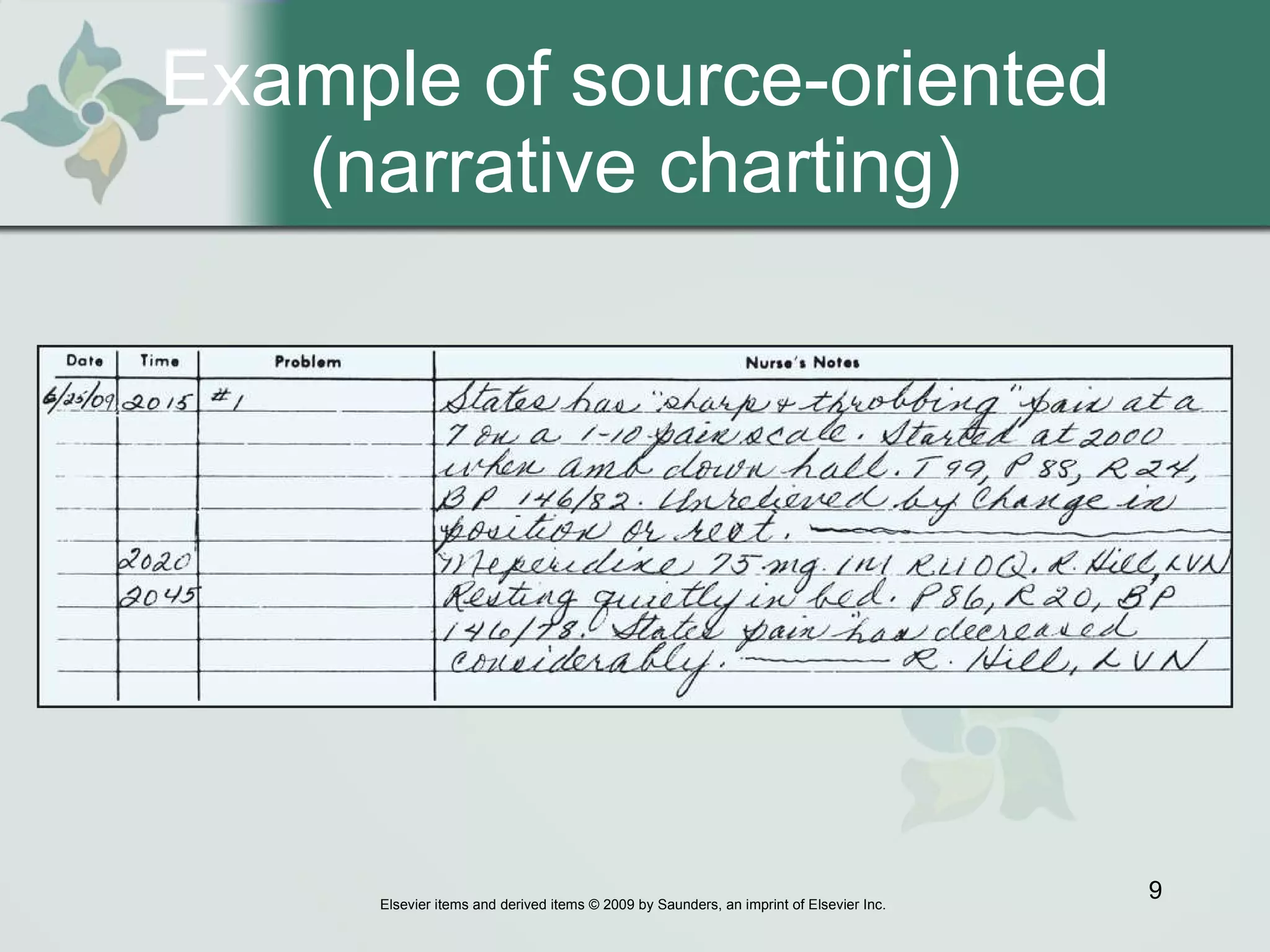
Source-Oriented or Narrative Charting Organized according to source of information Separate forms for nurses, physicians, dietitians, and other health care professionals to document assessment findings and plan the patient's care Narrative charting requires documentation of patient care in chronologic order
8.
Source-Oriented or Narrative Charting Advantages Information in chronologic order Documents patient’s baseline condition for each shift Indicates aspects of all steps of the nursing process Disadvantages Documents all findings: makes it difficult to separate pertinent from irrelevant information Requires extensive charting time by the staff Discourages physicians and other health team members from reading all parts of the chart
Problem-Oriented Medical RecordCharting (POMR) Focuses on patient status rather than on medical or nursing care Five basic parts: database, problem list, plan, progress notes, and discharge summary
11.
Problem-Oriented Medical RecordCharting (POMR) Advantages Documents care by focusing on patients’ problems Promotes problem-solving approach to care Improves continuity of care and communication by keeping relevant data all in one place Allows easy auditing of patient records in evaluating staff performance or quality of patient care Requires constant evaluation and revision of care plan Reinforces application of the nursing process
12.
Problem-Oriented Medical RecordCharting (POMR) Disadvantages Results in loss of chronologic charting More difficult to track trends in patient status Fragments data because more flow sheets required
13.
PIE Charting P—problemidentification I—interventions E—evaluation Follows the nursing process and uses nursing diagnoses while placing the plan of care within the nurses’ progress notes
14.
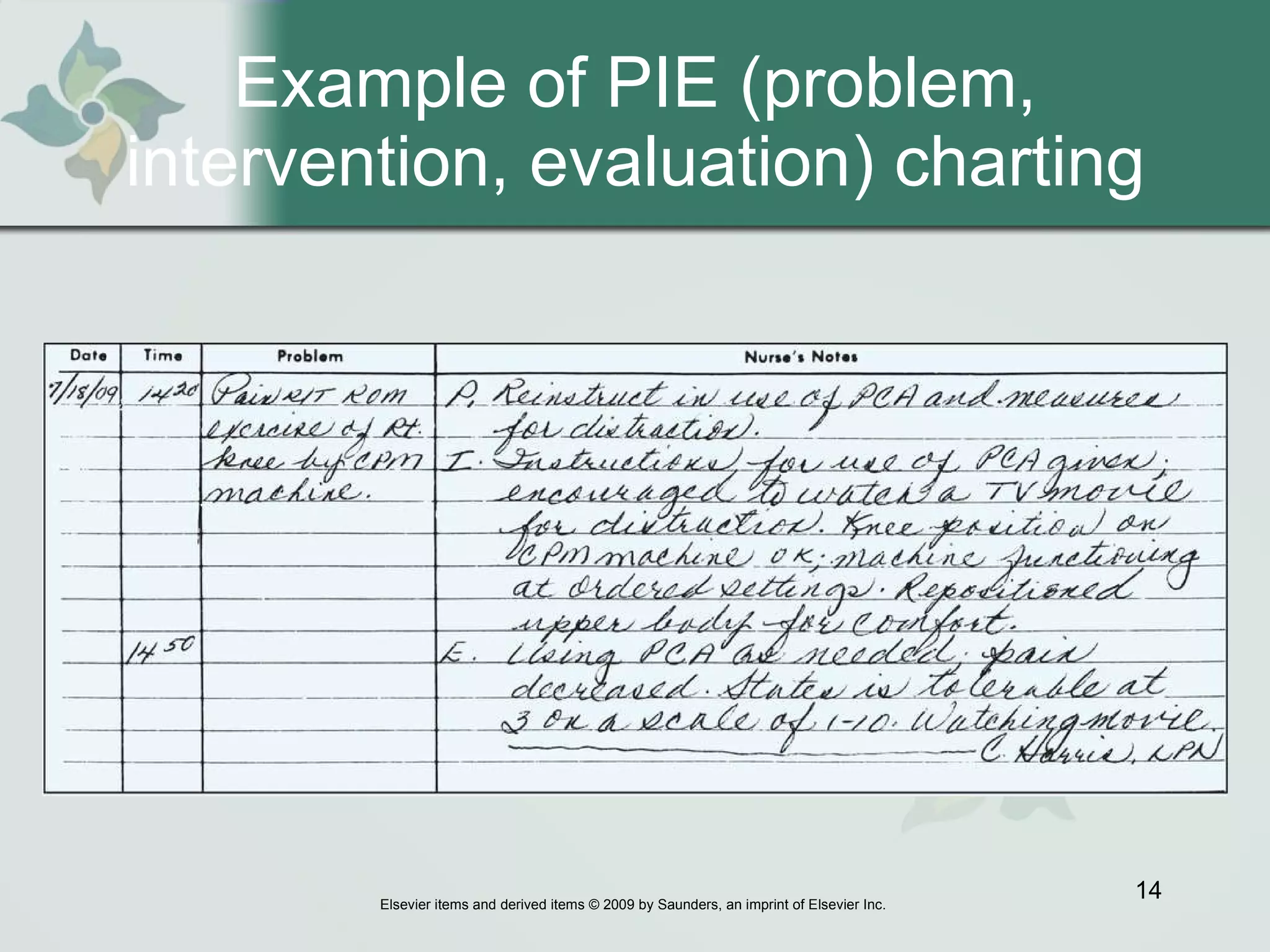
Example of PIE(problem, intervention, evaluation) charting
15.
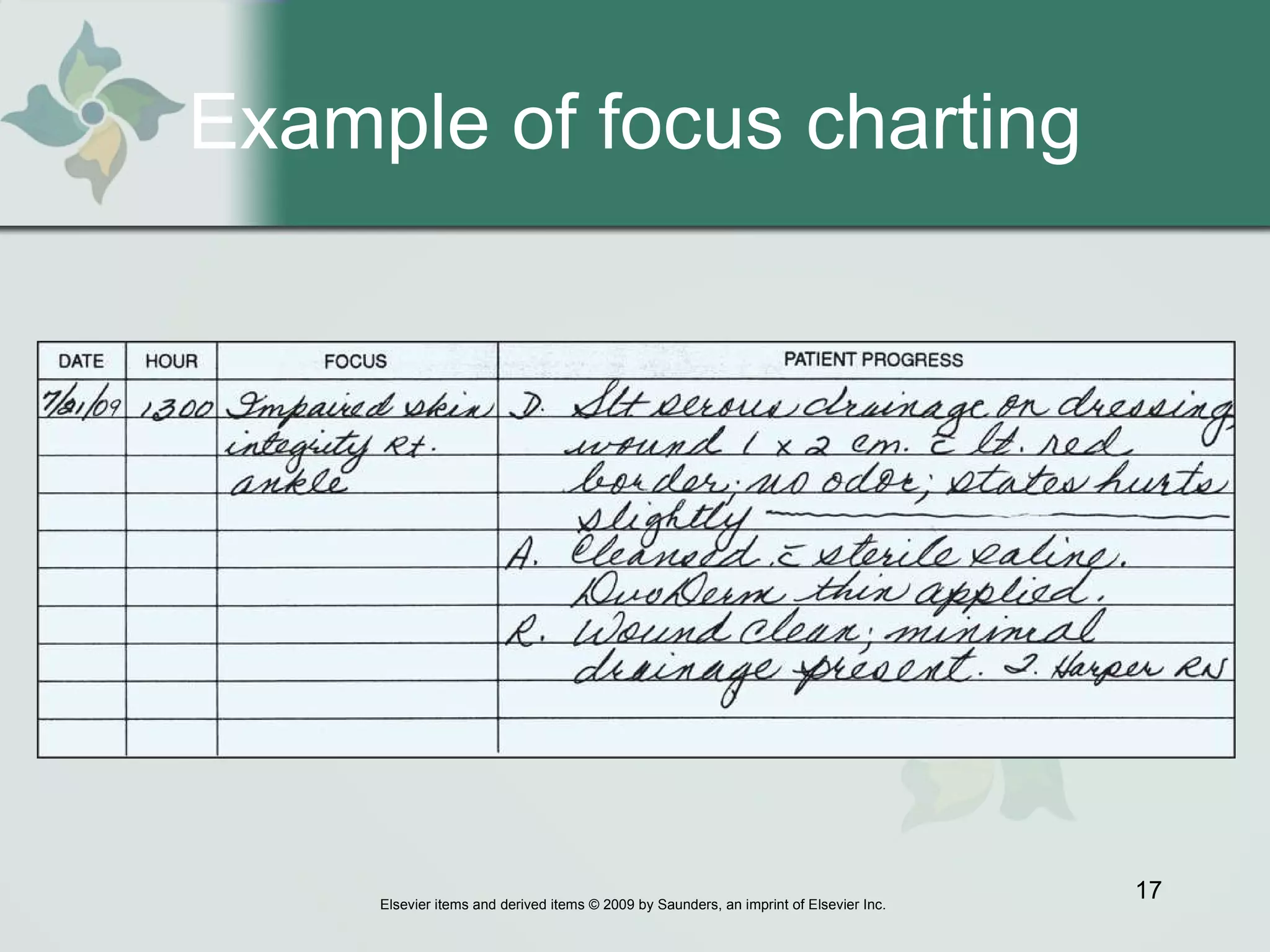
Focus Charting Directedat nursing diagnosis, patient problem, concern, sign, symptom, or event Three components: D: data, A: action, R: response (DAR) OR D: data, A: action, E: evaluation (DAE)
16.
Focus Charting AdvantagesCompatible with the use of the nursing process Shortens charting time: many flow sheets, checklists Not limited to patient problems or nursing diagnoses Disadvantages If database insufficient, patient problems missed Doesn’t adhere to charting with the focus on nursing diagnoses and expected outcomes
Charting by ExceptionBased on the assumption that all standards of practice are carried out and met with a normal or expected response unless otherwise documented A longhand note is written only when the standardized statement on the form is not met
19.
Charting by ExceptionAdvantages Highlights abnormal data and patient trends Decreases narrative charting time Eliminates duplication of charting Disadvantages Requires detailed protocols and standards Requires staff to use unfamiliar methods of record keeping and recording Nurses so used to not charting that important data sometimes omitted
20.
Computer-Assisted Charting Electronichealth record (EHR) Computerized record of patient's history and care across all facilities and admissions Computerized provider order entry (CPOE) Provides efficient work flow Automatically routs orders to appropriate clinical areas
21.
Computer-Assisted Charting Documentationdone as interventions are performed using bedside computers Variations depending on the system Some produce flow sheets with nursing interventions and expected outcomes Others use a POMR format to produce a prioritized problem list
22.
Computer-Assisted Charting Advantages Date and time of the notation automatically recorded Notes always legible and easy to read Quick communication among departments about patient needs Many providers have access to patient’s information at one time Can reduce documentation time Electronic records can be retrieved very quickly Reimbursement for services rendered is faster and complete Can provide a complete record of the patient's medical history Can reduce errors
23.
Computer-Assisted Charting Disadvantages Sophisticated security system needed to prevent unauthorized personnel from accessing records Initial costs are considerable Implementation can take a long time Significant cost and time to train staff to use the system Computer downtime can create problems of input, access, transfer of information
24.
Case Management System Charting A method of organizing patient care through an episode of illness so clinical outcomes are achieved within an expected time frame and at a predictable cost A clinical pathway or interdisciplinary care plan takes the place of the nursing care plan
25.
Accuracy in ChartingBe specific and definite in using words or phrases that convey the meaning you wish expressed Words that have ambiguous meanings and slang should not be used in charting
26.
Brevity in ChartingSentences not necessary Articles (a, an, the) may be omitted The word “patient” omitted when subject of sentence Abbreviations, acronyms, symbols acceptable to the agency used to save time and space Choose which behaviors and observations are noteworthy
27.
Legibility and Completeness in Charting If writing not legible, misperceptions can occur Completeness is more important than brevity (see Boxes 7-1 through 7-3 for charting guidelines) Record information about the patient’s needs and problems and specify nursing care given for those needs or problems
28.
The Kardex Nota part of the permanent medical record A quick reference for current information about the patient and ordered treatments Usually consists of a folded card for each patient in a holder that can be quickly flipped from one patient to another
29.
Information on theKardex Room number, patient name, age, sex, admitting diagnosis, physician’s name Date of surgery Type of diet ordered Scheduled tests or procedures Level of activity permitted Notations on tubes, machines, other equipment in use Nursing orders for assistive or comfort measures List of medications prescribed by name IV fluids ordered



![[1] documentation and reporting](https://cdn.slidesharecdn.com/ss_thumbnails/1documentationandreporting-150205213856-conversion-gate02-thumbnail.jpg?width=640&height=640&fit=bounds)


