Presented by:
Mr.Varun Babu .E,
Asst. Professor.
Definition:
 Documentation is anything written or printed on
which you rely as record or proof of patient
actions and activities
 Documentation serves as a permanent record of
client information and care
 The process of making an entry on a client record
is called recording, charting, or documenting
Record:
 A record or chart or client record, is a formal,
legal document that provides evidence of a client’s
care and can be written or computer based
Reporting:
 A report is oral, written, or computer -based
communication intended to convey information to
others.
 It takes place when two or more people share
information about client care, either face to face
or by telephone
 Each health care organization has policies about
recording and reporting client data, and each
nurse is accountable for practicing according to
these standards.
Purposes of Recording and reporting
 The patient record is a valuable source of data
for all members of the health care team
 Client records are kept for a number of purposes
including:
Communication
Planning client care
Auditing health agencies
Research
Education
Reimbursement
Legal documentation
Health care analysis
Cont..
Communication
 The record serves as the vehicle by which different
health professionals who interact with a client
communicate with each other.
 This prevents fragmentation, repetition, and delays in
client care
Planning Client Care
 Each health professional uses data from the client’s
record to plan care for that client.
 Nurses use baseline and ongoing data to evaluate the
effectiveness of the using care plan.
 The physician’s plans treatment after seeing the
laboratory reports of patient.
Cont…
Auditing Health Agencies
 An audit is a review of client records for quality
assurance purposes.
 Accrediting agencies such as The Joint
Commission may review client records to
determine if a particular health agency is meeting
its stated standards.
Research
 The information contained in a record can be a
valuable source of data for research.
 The treatment plans for a number of clients with
the same health problems can yield information
helpful in treating other clients.
Cont..
Education
 Students in health disciplines often use client
records as educational tools.
 A record can frequently provide a comprehensive
view of the client, the illness and effective
treatment strategies.
Reimbursement
 Documentation also helps a facility receive
reimbursement from the government.
 For a patient to obtain payment through
 Medicare or insurance agencies the client’s clinical
record must contain the correct diagnosis and
reveal that the appropriate care has been given
Cont…
Legal Documentation
 The client’s record is a legal document and is
usually admissible in court as evidence.
Health Care Analysis
 Information from records may assist health care
planners to identify agency needs, such as over
utilized and underutilized hospital services.
 Records can be used to establish the costs of
various services and to identify those services
that cost the agency money and those that
generate revenue.
Communication:
 It is a process in which people affect one another
through exchange of information, ideas, and
feelings.
 Communication is a basic component of human
relationships and nurse-client relationships.
 Communication is a, dynamic continuous and
multidimensional process for sharing information
as determined by standards or policies
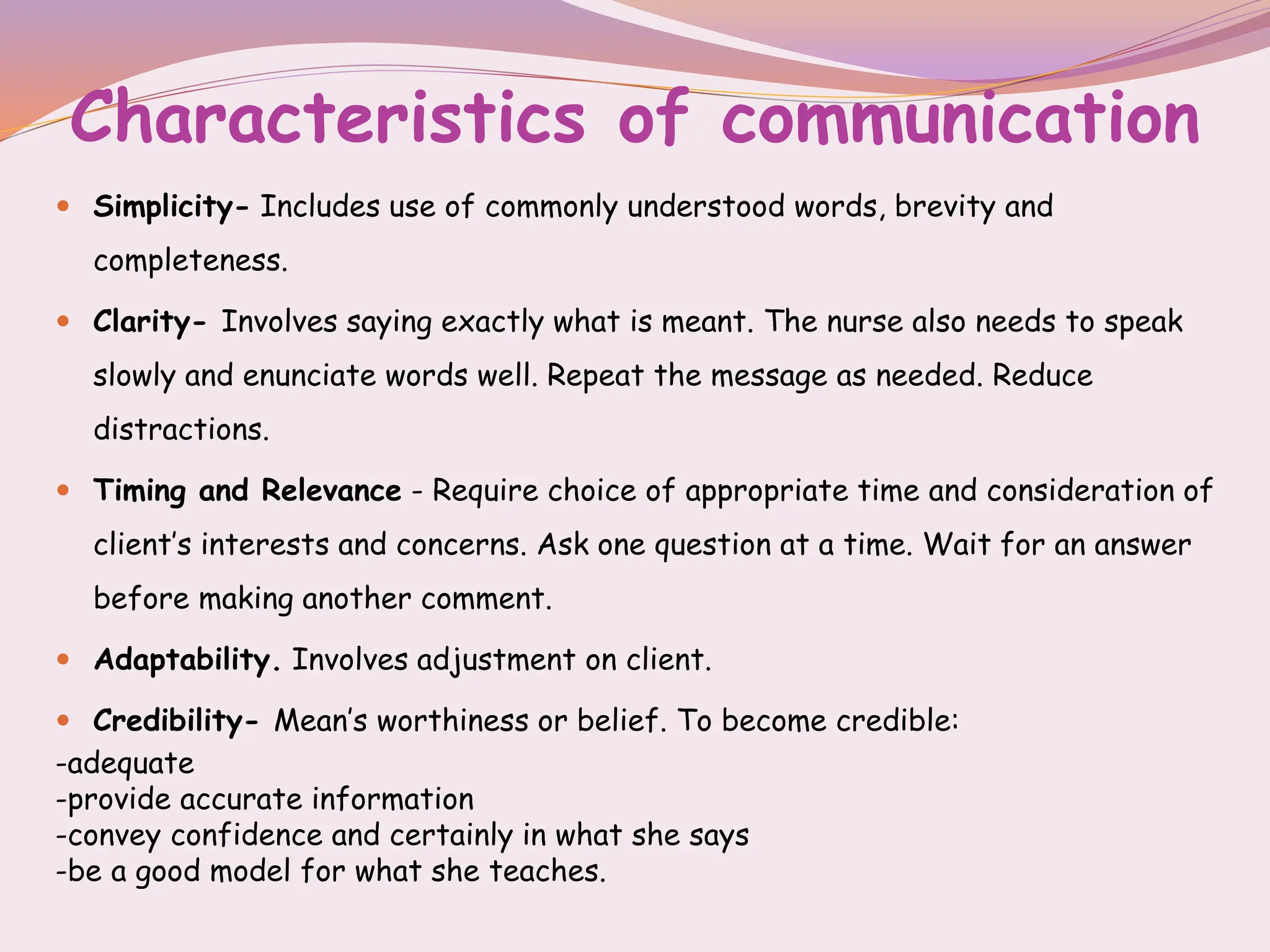
MODES OF COMMUNICATION
 Verbal communication- Uses spoken or written words.
 Nonverbal communication- Uses gestures, facial
expression, posture/gait, body movements, physical
appearance (also body language), eye contact, tone of voice.
Non-verbal communication is a more acute expression of a
person’s thoughts and feelings than verbal communication.
 When assessing non-verbal behaviours, consider cultural
influences
 Variety of feelings can be expressed by a single non-verbal
expression. E.g. head nodding does not always mean
agreement.
 Effective communication is reciprocal interaction (two-way
process)
Characteristics of communication
 Simplicity- Includes use of commonly understood words, brevity and
completeness.
 Clarity- Involves saying exactly what is meant. The nurse also needs to speak
slowly and enunciate words well. Repeat the message as needed. Reduce
distractions.
 Timing and Relevance - Require choice of appropriate time and consideration of
client’s interests and concerns. Ask one question at a time. Wait for an answer
before making another comment.
 Adaptability. Involves adjustment on client.
 Credibility- Mean’s worthiness or belief. To become credible:
-adequate
-provide accurate information
-convey confidence and certainly in what she says
-be a good model for what she teaches.
Characteristics of an effective – nurse client relationship
 An intellectual and emotional bond between the
nurse and the patient and is focused on the
patient.
 Respects the client as an individual-his ability to
participate in his care, ethnic and cultural
factors, family relationship and values.
 Respects client’s confidentially.
 Based on mutual trust and acceptance
COMMUNICATION WITH IN THE HEALTH CARE
TEAM
 In today’s health care system, delivery processes involve
numerous interfaces and patient handoffs among multiple health
care practitioners with varying levels of educational and
occupational training.
 During the course of a 4- day hospital stay, a patient may
interact with different professionals, including physicians,
nurses, technicians, and others
 Lack of communication creates situations where medical errors
can occur. These errors have the potential to cause severe injury
or unexpected patient death.
 Effective communication takes place along two
approaches.
Recording
Reporting
Records:
All records contain the following information:
 Patient identification and demographic data
 Informed consent for treatment and procedures
 Admission data
 Nursing diagnoses or problems and nursing or interdisciplinary care
plan
 Record of nursing care treatment and evaluation
 Medical history
 Medical diagnoses
 Therapeutic orders
 Medical and health discipline progress notes
 Physical assessment findings
 Diagnostic study results
 Patient education
 Summary of operative procedures
 Discharge plan and summary
Reports
Reports are oral, written, or audio taped exchanges of information among
caregivers.
 Common reports given by nurses include change-of-shift reports, telephone
reports, hand-off reports, and incident reports.
 A health care provider calls a nursing unit to receive a verbal report on a
patient’s condition.
 The laboratory submits a written report providing the results of diagnostic
tests and often notifies the nurse by telephone if results are critical.
 Team members communicate information through discussions or conferences.
 For example, a discharge planning conference involves members of all disciplines
(e.g., nursing, social work, dietary, medicine, and physical therapy) who meet to
discuss the patient’s progress toward established discharge goals
GUIDELINES / PRINCIPLES OF RECORDING
 Factual
 Timing
 Legibility
 Permanence
 Accepted terminology
 Correct signature
 Spelling
 Accuracy
 Sequence
 Appropriate
 Complete
 Concise
 Legal prudence
Factual
 A factual record contains descriptive, objective information about
what
 a nurse sees, hears, feels, and smells.
 Avoid vague terms such as appears, seems, or apparently because
these words suggest that you are stating an opinion, do not
accurately communicate facts.
 Objective documentation includes observations of a patient’s
behaviors.
 For example, instead of documenting “the patient seems anxious,”
provide objective signs of anxiety and document “the patient’s pulse
rate is elevated at 110 beats/min, respiratory rate is slightly
labored at 22 breaths/min, and the patient reports increased
restlessness.”
 The only subjective data included in the record are what the patient
says.
 When recording subjective data, document the patient’s exact
words within quotation marks whenever possible
Date and Time
 Document the date and time of each recording.
 This is essential not only for legal reasons but also
for client safety.
 Record the time in the conventional manner
(e.g., 9:00 AM or 3:15 PM) or according to the 24-
hour clock (military clock), which avoids confusion
about whether a time was AM or PM
Timing
 Follow the agency’s policy about the frequency of
documenting, and adjust the frequency as a client’s
condition indicates.
 for example, a client whose blood pressure is changing
requires more frequent documentation than a client whose
blood pressure is constant.
 As a rule, documenting should be done as soon as possible
after an assessment or intervention.
 No recording should be done before providing nursing care.
Legibility
 All entries must be legible and easy to read to prevent
interpretation errors.
 Hand printing or easily understood handwriting is usually
permissible.
Permanence
 All entries on the client’s record are made in dark ink so that the
record is permanent and changes can be identified.
 Dark ink reproduces well in duplication processes.
 Follow the agency’s policies about the type of pen and ink used
for recording.
Accepted Terminology
 People in the 21st century are often in a hurry and use
abbreviations when texting.
 Even though using abbreviations is convenient, medical
abbreviations have been responsible for serious errors and
deaths.
 Use only the standard and recognized abbreviations.
 Ambiguity occurs when an abbreviation can stand for more than
one term leading to misinterpretation.
 For example CP, stand for chest pain, cerebral palsy, cleft
palate, creatine, phosphate, and chickenpox
Correct Spelling
 Use correct spelling while documenting.
 Correct spelling is essential for accuracy in recording. Avoid spelling
mistakes
 If unsure how to spell a word, look it up in a dictionary or other resource.
 Two absolutely different medications may have similar spellings; for
example, Fosamax and Flomax
Signature
 Each recording on the nursing notes is signed by the nurse making it.
 The signature includes the name and title; for example, “M.S. REDDY, RN”
 With computerized charting, each nurse has his or her own password, which
allows the documentation to be identified.
Accuracy
 The client’s name and identifying information should be stamped
or written on each page of the clinical record.
 Before making any entry, check that it is the correct chart.
 Do not identify charts by room number only; check the client’s
name.
 •Special care is needed when caring for clients with the same
name
 When a recording mistake is made, draw a single line through it
to identify it as erroneous with your initials or name above or
near the line (depending on agency policy).
 Do not erase, blot out, or use correction fluid.
 The original entry must remain visible.
 When using computerized charting, the nurse needs to be aware
of the agency’s policy and process for correcting documentation
mistakes.
 Write on every line but never between lines. If a blank appears in
a notation, draw a line through the blank space so that no
additional information can be recorded at any other time or by
any other person, and sign the notation
Sequence
 Document events in the order in which they occur;
 for example, record assessments, then the nursing
interventions, and then the client’s responses.
Appropriateness
 Record only information that pertains to the client’s health
problems and care.
 Any other personal information that the client conveys is
inappropriate for the record.
 Recording irrelevant information may be considered an
invasion of the client’s privacy
Completeness
 Not all data that a nurse obtains about a client can be recorded.
 However, the information that is recorded needs to be complete and
helpful to the client and health care professionals.
 Nurses’ notes need to reflect the nursing process.
 Record all assessments, dependent and independent nursing
interventions, client problems, client comments and responses to
interventions and tests, progress toward goals, and communication with
other members of the health team
Conciseness
 Recordings need to be brief as well as complete to save time in
communication.
 Repeated usage of the client’s name and the word client are omitted
Legal Prudence
 Accurate, complete documentation should give legal
protection to the nurse, the client’s other caregivers, the
health care facility, and the client.
 Admissible in court as a legal document, the clinical record
provides proof of the quality of care given to a client.
 For the best legal protection, the nurse should not only
adhere to professional standards of nursing care but also
follow agency policy and procedures for intervention and
documentation in all situations—especially high-risk
situations
Types of documentation
Systems of recording and reporting data pertinent
to client care have evolved primarily in response
to demands that health care practitioners be held
to societal norms, professional standards of
practice, legal and regulatory standards, and
institutional policies and standards.
Types
 Narrative charting
 Source-oriented charting
 Problem- oriented charting
 PIE charting
 Focus charting
 Charting by exception
 Computerized documentation
 Critical pathways
1.Narrative charting:
Traditional method of nursing documentation is a chronologic account
written in paragraphs that describe client status, interventions and
treatments, and the client's response to treatments.
Basic components of traditional client record:
 admission sheet
 physician’s order sheet
 Medical history
 Nurse’s notes
 Special records and reports (referrals, X-ray, reports, laboratory
findings, report of surgery, anaesthesia record, flow sheets, vital
signs, I&O, Medications)
Cont..
Features:
a. Narrative documentation is the most flexible of all systems and
is usable in any clinical setting.
b. The relationship between nursing interventions and client's
responses is clearly shown.
Defects:
a. Client problems may be difficult to track because the same
information may not be consistently documented.
b. The client's progress may be difficult to identify.
c. Narrative charting often fails to reflect the nursing process.
2.Source-oriented charting:
Narrative recording by each member (source) of the health
care team on separate documents.
Features:
a. Each discipline uses a separate record.
Defects:
a. Often resulting in fragmented care.
b. Time-consuming communication between disciplines.
3.Problem-oriented medical record (POMR):
Problem-oriented medical record (POMR):
 Employs a structured, logical format and focuses
on the client's problem.
There are four critical components of POMR:
a. Database (assessment data)
b. Problem list (client's problems numbered
according to when identified)
c. Initial plan (outline of goals, expected outcomes,
and learning needs and further data, if needed)
d. Progress notes (charting based on the SOAP,
SOAPIE, or SOAPIER format)
Cont…
 The format in which progress notes are written
includes SOAP, SOAPIE, or SOAPIER:
 S: subjective data (what the client or family states)
 0: objective data (what is observed/inspected)
 A: assessment (conclusion reached on the basis of
data formulated as client problem or nursing
diagnosis)
 P: plan (expected outcomes and actions to be taken)
 SOAPIE and SOAPIER refer to formats that add the
following:
 I: implementation
 E: evaluation
 R: revision
Cont..
Features:
a. An entry need not be made for each component of SOAPIER) at
every documentation.
b. Each problem must have a complete note every 24 hours if
unresolved or whenever the client's condition changes.
c. Continuity of care is shown when the plan of care and
interventions performed are documented together.
d. Some physicians use this format when writing progress notes.
4.PIE charting
System was developed to streamline documentation.
The main parts of this system are an integrated plan of
care, assessment flow sheets, and nurse's progress notes.
 Similar to SOAP charting
 Both are problem-oriented
 PIE comes from the Nursing Process, SOAP comes from a
Medical Model.
P-Problem
I-Intervention
E-Evaluation
Ex:
P#1 Risk for trauma related to dizziness.
IP#1 Instructed to call for assistance when getting
OOB. Call light in reach.
EP#1 consistently calls for assistance before getting
OOB. Continues to experience dizziness
5.Focus charting:
 System using a column format to chart Data,
Action, and Response (DAR) .Usually the focus is a
nursing diagnosis, but it may also be:
a. A sign or symptoms (e.g., abnormal vaginal
bleeding)
b. An acute change in the client's condition (e.g.,
sudden increase in blood pressure)
c. A patient behavior (e.g., crying after talking on
the phone)
d. A treatment of procedure (e.g., dressing change
with wound drainage)
e. A special need (e.g., a discharge referral)
Cont..
Focus charting reflects the stages of the nursing
process:
a. Data are the subjective and objective information
describing the focus.
b. The data information corresponds to assessment in
the nursing process.
c. Action is the nursing interventions and mirrors the
planning and implementation stages of the nursing
process.
d. Response is the client's response to the interventions
reflecting the evaluation stage of the nursing process.
The column format of this system is used within
the progress notes but is easily distinguished from
other entries.
6.Charting by exception (CBE):
 System using standardized protocols stating what the
expected course of the illness is, and only significant
findings (exceptions) are documented in a narrative
form. It assumes that client care needs are routine
and predictable and that the client's responses and
outcomes are also routine and predictable.
7.Computerized documentation:
Health care facilities have been using computers for many
years to order diagnostic tests and medications and to receive
results of diagnostic tests.
Issues to be addressed when considering computerized client
records include:
a. Data standards—include length of fields, how dates and times
are shown, and ASCII or binary data
b. Vocabularies—the most commonly used are the combination of
the NANDA-International nursing diagnoses, Nursing
Interventions Classification (NIC) nursing interventions, and
Nursing Outcomes Classification (NOC) nursing outcomes
Cont..
c. Security—includes privacy, confidentiality, who has
access to which data, how errors are to be corrected,
and protection against data loss
d. Legal issues—electronic signatures
e. Costs—include planning, hardware, software, and
training for all users
Cont..
Features:
 Reducing documentation time
 Increasing accuracy,
 Computerized charting increases
legibility,
 Stores and retrieves information
quickly and easily,
 Helps link diverse sources of client
information,
 Uses standardized terminology,
 Planners for health care,
researchers, lawyers
Defects:
 Used incorrectly,
 Client information may be mixed up.
 Security measures are neglected,
 Client confidentiality may be
compromised.
 Users (e.g., nurses, physicians) should
never share computer ID numbers or
passwords with anyone.
8. A critical pathway
 (Care map) is a comprehensive pre-printed
interdisciplinary standard plan of care reflecting
the ideal course of treatment for the average
client with a given diagnosis or procedure,
especially those with relatively predictable
outcomes.
Forms for documentation
Forms for recording data include
 Kardex
 flow sheets
 nurse's progress notes
 discharge summaries.
They are designed to facilitate record keeping and allow
quick, easy access to information.
1. A Kardex:
A brief worksheet with basic client care information that traditionally is not part
of the medical record.
The Kardex is used as a reference throughout the shift and during change-of-
shift reports.
It comes in various sizes, shapes, and types, including computer-generated.
 Password. Never share. Change frequently.
 Legible
 Can be voice-activated, touch-activated.
 Date and time automatically recorded.
 Abbreviations and terms are selected by a Menu provided by the facility.
 Terminals are usually easily accessible, in Pt rooms, convenient hallway locations.
 Make sure terminal cannot be viewed by Unauthorized persons
The Kardex usually contains the following information
 Client name, age, marital status, religious preference, physician,
family contact with phone number
 Medical diagnoses: listed by priority
 Nursing diagnoses: listed by priority
 Allergies
 Medical orders: diet, medications, intravenous (IV) therapy,
treatments, diagnostic tests and procedures (including dates and
results), consultations, DNR (do-not-resuscitate) order (when
appropriate)
 Activities permitted: functional limitations, assistance needed in
activities of daily living, and safety precautions
2. Flow sheets:
 With vertical or horizontal columns for recording date, time, and
assessment data and intervention information, make it easy to
track the client's changes in condition.
 Special equipment used in client teaching and IV therapy are
other parts of the flow sheet.
 These forms usually contain legends identifying the approved
abbreviations for charting data because they have small spaces
for recording.
3. Nurse's progress notes:
Used to document the client's condition, problems, and complaints;
interventions; the client's response to interventions; and achievement of
outcomes.
Documents falling under the general heading of nurse's progress notes
include:
 a. Nurse's notes,
 b. Personal care flow sheets,
 c. Teaching records,
 d. Vital sign records,
 e. Intake and output forms,
 f. Specialty forms (e.g., diabetic flow sheet or neurologic assessment
form).
4. Discharge summary
The client's illness and course of care are
highlighted in the discharge summary. A narrative discharge
summary in the progress notes includes:
 Client status on admission and discharge
 A brief summary of the client's care
 Intervention and education outcomes
 Resolved problems and continuing care needs for unresolved
problems, including referrals
 Client instructions about medications, diet, food-drug
interactions, activity, treatments, follow-up, and other special
needs.
Reporting:
Takes place when two or more people share
information about client care , either face to face or by
telephone.
Types of reporting:
 walk in grounds
 change – of – shift reports or endorsement
–for continuity of care
–it is based on health care needs of the client
–it is not mere reciting the content of the kardex
Cont..
Telephone reports
 provide clear accurate and concise information
 the nurse documents telephone report by including the
following information:
 when the call was made
 who made the call/report
 who was called
 to whom information was given
 what information was given
 what information was received
Cont..
Telephone orders:
 Only RN’s may receive telephone orders
 The order need to be verified by reporting it clearly and
precisely.
 The order should be countersigned by the physician who made
the order within the prescribed period of time (within 24 hours)
Transfer reports:
 this is done when transferring a client from unit to another.
•Incident Reports or occurrence reports
 Used to document any unusual occurrence or accident in the
delivery of client care
Nursing Foundation Documentation Nursing Ist Sem Students

Nursing Foundation Documentation Nursing Ist Sem Students

  • 1.
    Presented by: Mr.Varun Babu.E, Asst. Professor.
  • 2.
    Definition:  Documentation isanything written or printed on which you rely as record or proof of patient actions and activities  Documentation serves as a permanent record of client information and care  The process of making an entry on a client record is called recording, charting, or documenting
  • 3.
    Record:  A recordor chart or client record, is a formal, legal document that provides evidence of a client’s care and can be written or computer based Reporting:  A report is oral, written, or computer -based communication intended to convey information to others.  It takes place when two or more people share information about client care, either face to face or by telephone  Each health care organization has policies about recording and reporting client data, and each nurse is accountable for practicing according to these standards.
  • 4.
    Purposes of Recordingand reporting  The patient record is a valuable source of data for all members of the health care team  Client records are kept for a number of purposes including: Communication Planning client care Auditing health agencies Research Education Reimbursement Legal documentation Health care analysis
  • 5.
    Cont.. Communication  The recordserves as the vehicle by which different health professionals who interact with a client communicate with each other.  This prevents fragmentation, repetition, and delays in client care Planning Client Care  Each health professional uses data from the client’s record to plan care for that client.  Nurses use baseline and ongoing data to evaluate the effectiveness of the using care plan.  The physician’s plans treatment after seeing the laboratory reports of patient.
  • 6.
    Cont… Auditing Health Agencies An audit is a review of client records for quality assurance purposes.  Accrediting agencies such as The Joint Commission may review client records to determine if a particular health agency is meeting its stated standards. Research  The information contained in a record can be a valuable source of data for research.  The treatment plans for a number of clients with the same health problems can yield information helpful in treating other clients.
  • 7.
    Cont.. Education  Students inhealth disciplines often use client records as educational tools.  A record can frequently provide a comprehensive view of the client, the illness and effective treatment strategies. Reimbursement  Documentation also helps a facility receive reimbursement from the government.  For a patient to obtain payment through  Medicare or insurance agencies the client’s clinical record must contain the correct diagnosis and reveal that the appropriate care has been given
  • 8.
    Cont… Legal Documentation  Theclient’s record is a legal document and is usually admissible in court as evidence. Health Care Analysis  Information from records may assist health care planners to identify agency needs, such as over utilized and underutilized hospital services.  Records can be used to establish the costs of various services and to identify those services that cost the agency money and those that generate revenue.
  • 10.
    Communication:  It isa process in which people affect one another through exchange of information, ideas, and feelings.  Communication is a basic component of human relationships and nurse-client relationships.  Communication is a, dynamic continuous and multidimensional process for sharing information as determined by standards or policies
  • 11.
    MODES OF COMMUNICATION Verbal communication- Uses spoken or written words.  Nonverbal communication- Uses gestures, facial expression, posture/gait, body movements, physical appearance (also body language), eye contact, tone of voice. Non-verbal communication is a more acute expression of a person’s thoughts and feelings than verbal communication.  When assessing non-verbal behaviours, consider cultural influences  Variety of feelings can be expressed by a single non-verbal expression. E.g. head nodding does not always mean agreement.  Effective communication is reciprocal interaction (two-way process)
  • 12.
    Characteristics of communication Simplicity- Includes use of commonly understood words, brevity and completeness.  Clarity- Involves saying exactly what is meant. The nurse also needs to speak slowly and enunciate words well. Repeat the message as needed. Reduce distractions.  Timing and Relevance - Require choice of appropriate time and consideration of client’s interests and concerns. Ask one question at a time. Wait for an answer before making another comment.  Adaptability. Involves adjustment on client.  Credibility- Mean’s worthiness or belief. To become credible: -adequate -provide accurate information -convey confidence and certainly in what she says -be a good model for what she teaches.
  • 13.
    Characteristics of aneffective – nurse client relationship  An intellectual and emotional bond between the nurse and the patient and is focused on the patient.  Respects the client as an individual-his ability to participate in his care, ethnic and cultural factors, family relationship and values.  Respects client’s confidentially.  Based on mutual trust and acceptance
  • 14.
    COMMUNICATION WITH INTHE HEALTH CARE TEAM  In today’s health care system, delivery processes involve numerous interfaces and patient handoffs among multiple health care practitioners with varying levels of educational and occupational training.  During the course of a 4- day hospital stay, a patient may interact with different professionals, including physicians, nurses, technicians, and others  Lack of communication creates situations where medical errors can occur. These errors have the potential to cause severe injury or unexpected patient death.  Effective communication takes place along two approaches. Recording Reporting
  • 16.
    Records: All records containthe following information:  Patient identification and demographic data  Informed consent for treatment and procedures  Admission data  Nursing diagnoses or problems and nursing or interdisciplinary care plan  Record of nursing care treatment and evaluation  Medical history  Medical diagnoses  Therapeutic orders  Medical and health discipline progress notes  Physical assessment findings  Diagnostic study results  Patient education  Summary of operative procedures  Discharge plan and summary
  • 17.
    Reports Reports are oral,written, or audio taped exchanges of information among caregivers.  Common reports given by nurses include change-of-shift reports, telephone reports, hand-off reports, and incident reports.  A health care provider calls a nursing unit to receive a verbal report on a patient’s condition.  The laboratory submits a written report providing the results of diagnostic tests and often notifies the nurse by telephone if results are critical.  Team members communicate information through discussions or conferences.  For example, a discharge planning conference involves members of all disciplines (e.g., nursing, social work, dietary, medicine, and physical therapy) who meet to discuss the patient’s progress toward established discharge goals
  • 18.
    GUIDELINES / PRINCIPLESOF RECORDING  Factual  Timing  Legibility  Permanence  Accepted terminology  Correct signature  Spelling  Accuracy  Sequence  Appropriate  Complete  Concise  Legal prudence
  • 19.
    Factual  A factualrecord contains descriptive, objective information about what  a nurse sees, hears, feels, and smells.  Avoid vague terms such as appears, seems, or apparently because these words suggest that you are stating an opinion, do not accurately communicate facts.  Objective documentation includes observations of a patient’s behaviors.  For example, instead of documenting “the patient seems anxious,” provide objective signs of anxiety and document “the patient’s pulse rate is elevated at 110 beats/min, respiratory rate is slightly labored at 22 breaths/min, and the patient reports increased restlessness.”  The only subjective data included in the record are what the patient says.  When recording subjective data, document the patient’s exact words within quotation marks whenever possible
  • 20.
    Date and Time Document the date and time of each recording.  This is essential not only for legal reasons but also for client safety.  Record the time in the conventional manner (e.g., 9:00 AM or 3:15 PM) or according to the 24- hour clock (military clock), which avoids confusion about whether a time was AM or PM
  • 21.
    Timing  Follow theagency’s policy about the frequency of documenting, and adjust the frequency as a client’s condition indicates.  for example, a client whose blood pressure is changing requires more frequent documentation than a client whose blood pressure is constant.  As a rule, documenting should be done as soon as possible after an assessment or intervention.  No recording should be done before providing nursing care.
  • 22.
    Legibility  All entriesmust be legible and easy to read to prevent interpretation errors.  Hand printing or easily understood handwriting is usually permissible. Permanence  All entries on the client’s record are made in dark ink so that the record is permanent and changes can be identified.  Dark ink reproduces well in duplication processes.  Follow the agency’s policies about the type of pen and ink used for recording.
  • 23.
    Accepted Terminology  Peoplein the 21st century are often in a hurry and use abbreviations when texting.  Even though using abbreviations is convenient, medical abbreviations have been responsible for serious errors and deaths.  Use only the standard and recognized abbreviations.  Ambiguity occurs when an abbreviation can stand for more than one term leading to misinterpretation.  For example CP, stand for chest pain, cerebral palsy, cleft palate, creatine, phosphate, and chickenpox
  • 24.
    Correct Spelling  Usecorrect spelling while documenting.  Correct spelling is essential for accuracy in recording. Avoid spelling mistakes  If unsure how to spell a word, look it up in a dictionary or other resource.  Two absolutely different medications may have similar spellings; for example, Fosamax and Flomax Signature  Each recording on the nursing notes is signed by the nurse making it.  The signature includes the name and title; for example, “M.S. REDDY, RN”  With computerized charting, each nurse has his or her own password, which allows the documentation to be identified.
  • 25.
    Accuracy  The client’sname and identifying information should be stamped or written on each page of the clinical record.  Before making any entry, check that it is the correct chart.  Do not identify charts by room number only; check the client’s name.  •Special care is needed when caring for clients with the same name  When a recording mistake is made, draw a single line through it to identify it as erroneous with your initials or name above or near the line (depending on agency policy).  Do not erase, blot out, or use correction fluid.  The original entry must remain visible.  When using computerized charting, the nurse needs to be aware of the agency’s policy and process for correcting documentation mistakes.  Write on every line but never between lines. If a blank appears in a notation, draw a line through the blank space so that no additional information can be recorded at any other time or by any other person, and sign the notation
  • 26.
    Sequence  Document eventsin the order in which they occur;  for example, record assessments, then the nursing interventions, and then the client’s responses. Appropriateness  Record only information that pertains to the client’s health problems and care.  Any other personal information that the client conveys is inappropriate for the record.  Recording irrelevant information may be considered an invasion of the client’s privacy
  • 27.
    Completeness  Not alldata that a nurse obtains about a client can be recorded.  However, the information that is recorded needs to be complete and helpful to the client and health care professionals.  Nurses’ notes need to reflect the nursing process.  Record all assessments, dependent and independent nursing interventions, client problems, client comments and responses to interventions and tests, progress toward goals, and communication with other members of the health team Conciseness  Recordings need to be brief as well as complete to save time in communication.  Repeated usage of the client’s name and the word client are omitted
  • 28.
    Legal Prudence  Accurate,complete documentation should give legal protection to the nurse, the client’s other caregivers, the health care facility, and the client.  Admissible in court as a legal document, the clinical record provides proof of the quality of care given to a client.  For the best legal protection, the nurse should not only adhere to professional standards of nursing care but also follow agency policy and procedures for intervention and documentation in all situations—especially high-risk situations
  • 29.
    Types of documentation Systemsof recording and reporting data pertinent to client care have evolved primarily in response to demands that health care practitioners be held to societal norms, professional standards of practice, legal and regulatory standards, and institutional policies and standards.
  • 30.
    Types  Narrative charting Source-oriented charting  Problem- oriented charting  PIE charting  Focus charting  Charting by exception  Computerized documentation  Critical pathways
  • 31.
    1.Narrative charting: Traditional methodof nursing documentation is a chronologic account written in paragraphs that describe client status, interventions and treatments, and the client's response to treatments. Basic components of traditional client record:  admission sheet  physician’s order sheet  Medical history  Nurse’s notes  Special records and reports (referrals, X-ray, reports, laboratory findings, report of surgery, anaesthesia record, flow sheets, vital signs, I&O, Medications)
  • 32.
    Cont.. Features: a. Narrative documentationis the most flexible of all systems and is usable in any clinical setting. b. The relationship between nursing interventions and client's responses is clearly shown. Defects: a. Client problems may be difficult to track because the same information may not be consistently documented. b. The client's progress may be difficult to identify. c. Narrative charting often fails to reflect the nursing process.
  • 33.
    2.Source-oriented charting: Narrative recordingby each member (source) of the health care team on separate documents. Features: a. Each discipline uses a separate record. Defects: a. Often resulting in fragmented care. b. Time-consuming communication between disciplines.
  • 34.
    3.Problem-oriented medical record(POMR): Problem-oriented medical record (POMR):  Employs a structured, logical format and focuses on the client's problem. There are four critical components of POMR: a. Database (assessment data) b. Problem list (client's problems numbered according to when identified) c. Initial plan (outline of goals, expected outcomes, and learning needs and further data, if needed) d. Progress notes (charting based on the SOAP, SOAPIE, or SOAPIER format)
  • 35.
    Cont…  The formatin which progress notes are written includes SOAP, SOAPIE, or SOAPIER:  S: subjective data (what the client or family states)  0: objective data (what is observed/inspected)  A: assessment (conclusion reached on the basis of data formulated as client problem or nursing diagnosis)  P: plan (expected outcomes and actions to be taken)  SOAPIE and SOAPIER refer to formats that add the following:  I: implementation  E: evaluation  R: revision
  • 36.
    Cont.. Features: a. An entryneed not be made for each component of SOAPIER) at every documentation. b. Each problem must have a complete note every 24 hours if unresolved or whenever the client's condition changes. c. Continuity of care is shown when the plan of care and interventions performed are documented together. d. Some physicians use this format when writing progress notes.
  • 37.
    4.PIE charting System wasdeveloped to streamline documentation. The main parts of this system are an integrated plan of care, assessment flow sheets, and nurse's progress notes.  Similar to SOAP charting  Both are problem-oriented  PIE comes from the Nursing Process, SOAP comes from a Medical Model. P-Problem I-Intervention E-Evaluation Ex: P#1 Risk for trauma related to dizziness. IP#1 Instructed to call for assistance when getting OOB. Call light in reach. EP#1 consistently calls for assistance before getting OOB. Continues to experience dizziness
  • 38.
    5.Focus charting:  Systemusing a column format to chart Data, Action, and Response (DAR) .Usually the focus is a nursing diagnosis, but it may also be: a. A sign or symptoms (e.g., abnormal vaginal bleeding) b. An acute change in the client's condition (e.g., sudden increase in blood pressure) c. A patient behavior (e.g., crying after talking on the phone) d. A treatment of procedure (e.g., dressing change with wound drainage) e. A special need (e.g., a discharge referral)
  • 39.
    Cont.. Focus charting reflectsthe stages of the nursing process: a. Data are the subjective and objective information describing the focus. b. The data information corresponds to assessment in the nursing process. c. Action is the nursing interventions and mirrors the planning and implementation stages of the nursing process. d. Response is the client's response to the interventions reflecting the evaluation stage of the nursing process. The column format of this system is used within the progress notes but is easily distinguished from other entries.
  • 40.
    6.Charting by exception(CBE):  System using standardized protocols stating what the expected course of the illness is, and only significant findings (exceptions) are documented in a narrative form. It assumes that client care needs are routine and predictable and that the client's responses and outcomes are also routine and predictable.
  • 41.
    7.Computerized documentation: Health carefacilities have been using computers for many years to order diagnostic tests and medications and to receive results of diagnostic tests. Issues to be addressed when considering computerized client records include: a. Data standards—include length of fields, how dates and times are shown, and ASCII or binary data b. Vocabularies—the most commonly used are the combination of the NANDA-International nursing diagnoses, Nursing Interventions Classification (NIC) nursing interventions, and Nursing Outcomes Classification (NOC) nursing outcomes
  • 42.
    Cont.. c. Security—includes privacy,confidentiality, who has access to which data, how errors are to be corrected, and protection against data loss d. Legal issues—electronic signatures e. Costs—include planning, hardware, software, and training for all users
  • 43.
    Cont.. Features:  Reducing documentationtime  Increasing accuracy,  Computerized charting increases legibility,  Stores and retrieves information quickly and easily,  Helps link diverse sources of client information,  Uses standardized terminology,  Planners for health care, researchers, lawyers Defects:  Used incorrectly,  Client information may be mixed up.  Security measures are neglected,  Client confidentiality may be compromised.  Users (e.g., nurses, physicians) should never share computer ID numbers or passwords with anyone.
  • 44.
    8. A criticalpathway  (Care map) is a comprehensive pre-printed interdisciplinary standard plan of care reflecting the ideal course of treatment for the average client with a given diagnosis or procedure, especially those with relatively predictable outcomes.
  • 46.
    Forms for documentation Formsfor recording data include  Kardex  flow sheets  nurse's progress notes  discharge summaries. They are designed to facilitate record keeping and allow quick, easy access to information.
  • 47.
    1. A Kardex: Abrief worksheet with basic client care information that traditionally is not part of the medical record. The Kardex is used as a reference throughout the shift and during change-of- shift reports. It comes in various sizes, shapes, and types, including computer-generated.  Password. Never share. Change frequently.  Legible  Can be voice-activated, touch-activated.  Date and time automatically recorded.  Abbreviations and terms are selected by a Menu provided by the facility.  Terminals are usually easily accessible, in Pt rooms, convenient hallway locations.  Make sure terminal cannot be viewed by Unauthorized persons
  • 48.
    The Kardex usuallycontains the following information  Client name, age, marital status, religious preference, physician, family contact with phone number  Medical diagnoses: listed by priority  Nursing diagnoses: listed by priority  Allergies  Medical orders: diet, medications, intravenous (IV) therapy, treatments, diagnostic tests and procedures (including dates and results), consultations, DNR (do-not-resuscitate) order (when appropriate)  Activities permitted: functional limitations, assistance needed in activities of daily living, and safety precautions
  • 49.
    2. Flow sheets: With vertical or horizontal columns for recording date, time, and assessment data and intervention information, make it easy to track the client's changes in condition.  Special equipment used in client teaching and IV therapy are other parts of the flow sheet.  These forms usually contain legends identifying the approved abbreviations for charting data because they have small spaces for recording.
  • 50.
    3. Nurse's progressnotes: Used to document the client's condition, problems, and complaints; interventions; the client's response to interventions; and achievement of outcomes. Documents falling under the general heading of nurse's progress notes include:  a. Nurse's notes,  b. Personal care flow sheets,  c. Teaching records,  d. Vital sign records,  e. Intake and output forms,  f. Specialty forms (e.g., diabetic flow sheet or neurologic assessment form).
  • 51.
    4. Discharge summary Theclient's illness and course of care are highlighted in the discharge summary. A narrative discharge summary in the progress notes includes:  Client status on admission and discharge  A brief summary of the client's care  Intervention and education outcomes  Resolved problems and continuing care needs for unresolved problems, including referrals  Client instructions about medications, diet, food-drug interactions, activity, treatments, follow-up, and other special needs.
  • 52.
    Reporting: Takes place whentwo or more people share information about client care , either face to face or by telephone. Types of reporting:  walk in grounds  change – of – shift reports or endorsement –for continuity of care –it is based on health care needs of the client –it is not mere reciting the content of the kardex
  • 53.
    Cont.. Telephone reports  provideclear accurate and concise information  the nurse documents telephone report by including the following information:  when the call was made  who made the call/report  who was called  to whom information was given  what information was given  what information was received
  • 54.
    Cont.. Telephone orders:  OnlyRN’s may receive telephone orders  The order need to be verified by reporting it clearly and precisely.  The order should be countersigned by the physician who made the order within the prescribed period of time (within 24 hours) Transfer reports:  this is done when transferring a client from unit to another. •Incident Reports or occurrence reports  Used to document any unusual occurrence or accident in the delivery of client care