Chapter 5 Cell Respiration and Metabolism
Objectives Explain the functional significance of the Kreb’s cycle in relation to the electron-transport system. Describe the electron-transport system and oxidative phosphorylation. Describe the role of oxygen in aerobic respiration. Compare the lactic acid pathway and aerobic respiration in terms of initial substrates, final products, cellular locations, and the total number of ATP molecules produced per glucose respired.
Metabolism All reactions that involve energy transformations. Divided into 2 categories: Catabolic:  Release energy. Breakdown larger organic molecules into smaller molecules. Serve as primary sources of energy for synthesis of ATP. Anabolic:  Require input of energy. Synthesis of large energy-storage molecules.
Glycolysis Metabolic pathway by which glucose is converted to 2 molecules of pyruvic acid (pyruvate). Glycolysis Pathway: Glucose + 2 NAD +  2 ADP + 2 P i  2 pyruvic acid +  2 NADH + 2 ATP Figure 5-1
Glycolysis  (continued) Glycolysis is exergonic. Glucose must be activated  first  before energy can be obtained. ATP consumed at the beginning of glycolysis. ATP  ADP + P i P i  is not released but added to intermediate molecules (phosphorylation). Phosphorylation of glucose, traps the glucose inside the cell. Net gain of 2 ATP, 2 NADH, + 2 H + .
Lactic Acid Pathway Metabolic pathway by which glucose is converted to lactic acid (anaerobic respiration): Oxygen is not used in the process. NADH + H +  + pyruvic acid  lactic acid and NAD. Produce 2 ATP/glucose molecule. Figure 5-3
Lactic Acid Pathway  (continued) Some tissues better adapt to anaerobic conditions: RBCs do not contain mitochondria and  only  use the lactic acid pathway. Occurs in skeletal muscles and heart when ratio of oxygen supply to oxygen need falls below critical level. Skeletal muscle:  Normal daily occurrence. Does not harm muscle tissue. Cardiac muscle normally respires aerobically: Myocardial ischemia occurs under anaerobic conditions.
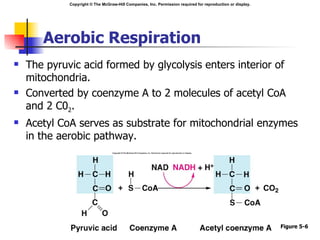
Aerobic Respiration The pyruvic acid formed by glycolysis enters interior of mitochondria. Converted by coenzyme A to 2 molecules of acetyl CoA  and 2 C0 2 . Acetyl CoA serves as substrate for mitochondrial enzymes in the aerobic pathway. Figure 5-6
Krebs Cycle (Citric Acid Cycle) Acetyl CoA subunit combines with oxaloacetic acid to form citric acid. Citric acid enters the Krebs Cycle. Through a series of reactions, citric acid is converted to oxaloacetic acid to complete the pathway. Produces: 1 GTP, 3 NADH, and 1 FADH 2 , C0 2 NADH and FADH 2   transport electrons to Electron Transport System (ETC).
Electron Transport  and Oxidative Phosphorylation Cristae of inner mitochondrial membrane contain molecules that serve as an electron transport system during aerobic respiration. Electron transport chain consists of FMN, coenzyme Q, and cytochromes. Each cytochrome transfers electron pairs from NADH and FADH 2  to next cytochrome.  Oxidized NAD and FAD are regenerated and shuttle electrons from the Krebs Cycle to the ETC. Cytochrome receives a pair of electrons.
Electron Transport Cytochrome a 3  transfers electrons to O 2  (final electron acceptor). Oxidative phosphorylation occurs: Energy derived is used to phosphorylate ADP to ATP. Figure 5-9
Coupling Electron Transport to to ATP Production Chemiosmotic theory: ETC (powered by transport of electrons) pumps H +  from mitochondria matrix into the space between inner and outer mitochondrial membranes. ETC grouped into 3 proton pumps: NADH-coenzyme Q reductase complex: Transports 4 H +  for every pair of electrons into the intermembrane space for every pair of electrons. Cytochrome C reductase complex: Transports 4 H +  into intermembrane space. Cytochrome C oxidase complex: Transports 2 H +  into intermembrane space.
Coupling Electron Transport to ATP Production  (continued) Oxygen functions as the last electron acceptor. Oxidizes cytochrome a 3 . Oxygen accepts 2 electrons. O 2  + 4 e -  + 4 H +  2 H 2 0  Figure 5-10

Metabolism

  • 1.
    Chapter 5 CellRespiration and Metabolism
  • 2.
    Objectives Explain thefunctional significance of the Kreb’s cycle in relation to the electron-transport system. Describe the electron-transport system and oxidative phosphorylation. Describe the role of oxygen in aerobic respiration. Compare the lactic acid pathway and aerobic respiration in terms of initial substrates, final products, cellular locations, and the total number of ATP molecules produced per glucose respired.
  • 3.
    Metabolism All reactionsthat involve energy transformations. Divided into 2 categories: Catabolic: Release energy. Breakdown larger organic molecules into smaller molecules. Serve as primary sources of energy for synthesis of ATP. Anabolic: Require input of energy. Synthesis of large energy-storage molecules.
  • 4.
    Glycolysis Metabolic pathwayby which glucose is converted to 2 molecules of pyruvic acid (pyruvate). Glycolysis Pathway: Glucose + 2 NAD + 2 ADP + 2 P i 2 pyruvic acid + 2 NADH + 2 ATP Figure 5-1
  • 5.
    Glycolysis (continued)Glycolysis is exergonic. Glucose must be activated first before energy can be obtained. ATP consumed at the beginning of glycolysis. ATP ADP + P i P i is not released but added to intermediate molecules (phosphorylation). Phosphorylation of glucose, traps the glucose inside the cell. Net gain of 2 ATP, 2 NADH, + 2 H + .
  • 6.
    Lactic Acid PathwayMetabolic pathway by which glucose is converted to lactic acid (anaerobic respiration): Oxygen is not used in the process. NADH + H + + pyruvic acid lactic acid and NAD. Produce 2 ATP/glucose molecule. Figure 5-3
  • 7.
    Lactic Acid Pathway (continued) Some tissues better adapt to anaerobic conditions: RBCs do not contain mitochondria and only use the lactic acid pathway. Occurs in skeletal muscles and heart when ratio of oxygen supply to oxygen need falls below critical level. Skeletal muscle: Normal daily occurrence. Does not harm muscle tissue. Cardiac muscle normally respires aerobically: Myocardial ischemia occurs under anaerobic conditions.
  • 8.
    Aerobic Respiration Thepyruvic acid formed by glycolysis enters interior of mitochondria. Converted by coenzyme A to 2 molecules of acetyl CoA and 2 C0 2 . Acetyl CoA serves as substrate for mitochondrial enzymes in the aerobic pathway. Figure 5-6
  • 9.
    Krebs Cycle (CitricAcid Cycle) Acetyl CoA subunit combines with oxaloacetic acid to form citric acid. Citric acid enters the Krebs Cycle. Through a series of reactions, citric acid is converted to oxaloacetic acid to complete the pathway. Produces: 1 GTP, 3 NADH, and 1 FADH 2 , C0 2 NADH and FADH 2 transport electrons to Electron Transport System (ETC).
  • 10.
    Electron Transport and Oxidative Phosphorylation Cristae of inner mitochondrial membrane contain molecules that serve as an electron transport system during aerobic respiration. Electron transport chain consists of FMN, coenzyme Q, and cytochromes. Each cytochrome transfers electron pairs from NADH and FADH 2 to next cytochrome. Oxidized NAD and FAD are regenerated and shuttle electrons from the Krebs Cycle to the ETC. Cytochrome receives a pair of electrons.
  • 11.
    Electron Transport Cytochromea 3 transfers electrons to O 2 (final electron acceptor). Oxidative phosphorylation occurs: Energy derived is used to phosphorylate ADP to ATP. Figure 5-9
  • 12.
    Coupling Electron Transportto to ATP Production Chemiosmotic theory: ETC (powered by transport of electrons) pumps H + from mitochondria matrix into the space between inner and outer mitochondrial membranes. ETC grouped into 3 proton pumps: NADH-coenzyme Q reductase complex: Transports 4 H + for every pair of electrons into the intermembrane space for every pair of electrons. Cytochrome C reductase complex: Transports 4 H + into intermembrane space. Cytochrome C oxidase complex: Transports 2 H + into intermembrane space.
  • 13.
    Coupling Electron Transportto ATP Production (continued) Oxygen functions as the last electron acceptor. Oxidizes cytochrome a 3 . Oxygen accepts 2 electrons. O 2 + 4 e - + 4 H + 2 H 2 0 Figure 5-10